WELCOME ALL
ULTRAVIOLET SPECTROSCOPY
BY
Dr.P.ANITHA
AP/CHEMISTRY
GOVERNMENT COLLEGE OF ENGINEERING,
SALEM
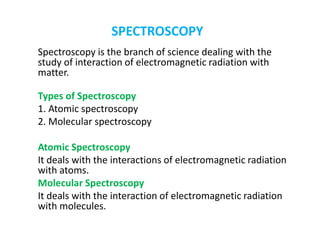
SPECTROSCOPY
Spectroscopy is the branch of science dealing with the
study of interaction of electromagnetic radiation with
matter.
Types of Spectroscopy
1. Atomic spectroscopy
2. Molecular spectroscopy
Atomic Spectroscopy
It deals with the interactions of electromagnetic radiation
with atoms.
Molecular Spectroscopy
It deals with the interaction of electromagnetic radiation
with molecules.
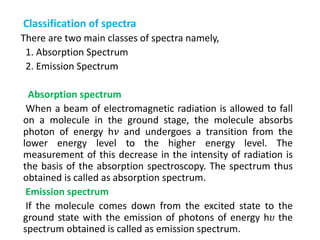
Classification of spectra
There are two main classes of spectra namely,
1. Absorption Spectrum
2. Emission Spectrum
Absorption spectrum
When a beam of electromagnetic radiation is allowed to fall
on a molecule in the ground stage, the molecule absorbs
photon of energy h𝜈 and undergoes a transition from the
lower energy level to the higher energy level. The
measurement of this decrease in the intensity of radiation is
the basis of the absorption spectroscopy. The spectrum thus
obtained is called as absorption spectrum.
Emission spectrum
If the molecule comes down from the excited state to the
ground state with the emission of photons of energy h𝜐 the
spectrum obtained is called as emission spectrum.
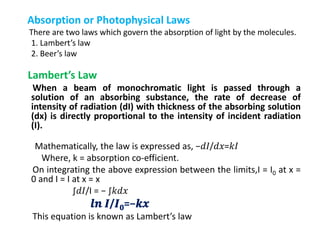
Absorption or Photophysical Laws
There are two laws which govern the absorption of light by the molecules.
1. Lambert’s law
2. Beer’s law
Lambert’s Law
When a beam of monochromatic light is passed through a
solution of an absorbing substance, the rate of decrease of
intensity of radiation (dI) with thickness of the absorbing solution
(dx) is directly proportional to the intensity of incident radiation
(I).
Mathematically, the law is expressed as, −𝑑𝐼/𝑑𝑥=𝑘𝐼
Where, k = absorption co-efficient.
On integrating the above expression between the limits,I = I0 at x =
0 and I = I at x = x
∫𝑑𝐼/I = − ∫𝑘𝑑𝑥
𝒍𝒏 𝑰/𝑰 𝟎=−𝒌𝒙
This equation is known as Lambert’s law
Beer’s Law (or) Beer-Lambert’s Law
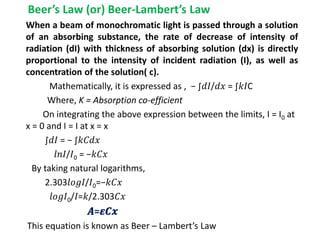
When a beam of monochromatic light is passed through a solution
of an absorbing substance, the rate of decrease of intensity of
radiation (dI) with thickness of absorbing solution (dx) is directly
proportional to the intensity of incident radiation (I), as well as
concentration of the solution( c).
Mathematically, it is expressed as , − ∫𝑑𝐼/𝑑𝑥 = ∫𝑘𝐼C
Where, K = Absorption co-efficient
On integrating the above expression between the limits, I = I0 at
x = 0 and I = I at x = x
∫𝑑𝐼 = − ∫𝑘𝐶𝑑𝑥
𝑙𝑛𝐼/𝐼0 = −𝑘𝐶𝑥
By taking natural logarithms,
2.303𝑙𝑜𝑔𝐼/𝐼0=−𝑘𝐶𝑥
𝑙𝑜𝑔𝐼0/𝐼=𝑘/2.303𝐶𝑥
𝑨=𝜺𝑪𝒙
This equation is known as Beer – Lambert’s Law
UV – Visible Spectroscopy
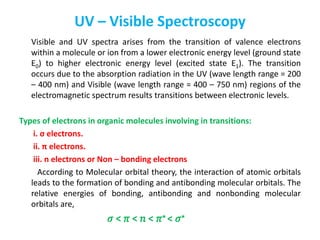
Visible and UV spectra arises from the transition of valence electrons
within a molecule or ion from a lower electronic energy level (ground state
E0) to higher electronic energy level (excited state E1). The transition
occurs due to the absorption radiation in the UV (wave length range = 200
– 400 nm) and Visible (wave length range = 400 – 750 nm) regions of the
electromagnetic spectrum results transitions between electronic levels.
Types of electrons in organic molecules involving in transitions:
i. σ electrons.
ii. π electrons.
iii. n electrons or Non – bonding electrons
According to Molecular orbital theory, the interaction of atomic orbitals
leads to the formation of bonding and antibonding molecular orbitals. The
relative energies of bonding, antibonding and nonbonding molecular
orbitals are,
𝜎 < 𝜋 < 𝑛 < 𝜋⋆ < 𝜎⋆
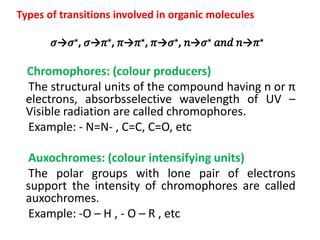
Types of transitions involved in organic molecules
𝜎→𝜎⋆, 𝜎→𝜋⋆, 𝜋→𝜋⋆, 𝜋→𝜎⋆, 𝑛→𝜎⋆ 𝑎𝑛𝑑 𝑛→𝜋⋆
Chromophores: (colour producers)
The structural units of the compound having n or π
electrons, absorbsselective wavelength of UV –
Visible radiation are called chromophores.
Example: - N=N- , C=C, C=O, etc
Auxochromes: (colour intensifying units)
The polar groups with lone pair of electrons
support the intensity of chromophores are called
auxochromes.
Example: -O – H , - O – R , etc
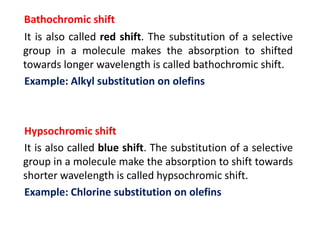
Bathochromic shift
It is also called red shift. The substitution of a selective
group in a molecule makes the absorption to shifted
towards longer wavelength is called bathochromic shift.
Example: Alkyl substitution on olefins
Hypsochromic shift
It is also called blue shift. The substitution of a selective
group in a molecule make the absorption to shift towards
shorter wavelength is called hypsochromic shift.
Example: Chlorine substitution on olefins
Hyperchromic effect
The substitution of a selective group in a molecule
causes increase in the intensity of absorption maximum
of the molecule, and then the effect is called
hyperchromic effect.
Example: Methyl substitution on benzene
Hypochromic effect
The substitution of a selective group in a molecule
causes decrease in the intensity of absorption maximum
of the molecule, and then the effect is called
hypochromic effect.
Example: Chlorine substitution on benzene
UV – Visible Spectrophotometer (Instrumentation)
Components
Radiation source
Hydrogen or deuterium lamps are used. It provides stable, continuous and
sufficient intensity.
Filter
It is also called monochromator. It permits the radiation of required
wavelength only. The essential elements are entrance slit, dispersing
element and exit slit. Prism or grating is used as dispersing element.
Cell
It is a transparent and uniformly constructed container which contains
either sample solution or reference solvent.
Detectors
It converts the absorbed radiation into current. There are three types of
detectors, viz., Barrier layer cell, photo multiplier tube and photo cell.
Recorder
It converts the signal reaches to itself into spectrum of a molecule.
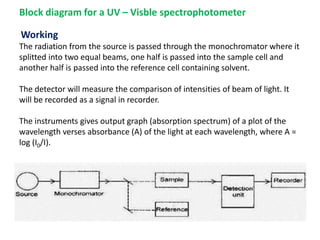
Block diagram for a UV – Visble spectrophotometer
Working
The radiation from the source is passed through the monochromator where it
splitted into two equal beams, one half is passed into the sample cell and
another half is passed into the reference cell containing solvent.
The detector will measure the comparison of intensities of beam of light. It
will be recorded as a signal in recorder.
The instruments gives output graph (absorption spectrum) of a plot of the
wavelength verses absorbance (A) of the light at each wavelength, where A =
log (I0/I).
Uv spectroscopy

Uv spectroscopy

  • 1.
  • 2.
    SPECTROSCOPY Spectroscopy is thebranch of science dealing with the study of interaction of electromagnetic radiation with matter. Types of Spectroscopy 1. Atomic spectroscopy 2. Molecular spectroscopy Atomic Spectroscopy It deals with the interactions of electromagnetic radiation with atoms. Molecular Spectroscopy It deals with the interaction of electromagnetic radiation with molecules.
  • 3.
    Classification of spectra Thereare two main classes of spectra namely, 1. Absorption Spectrum 2. Emission Spectrum Absorption spectrum When a beam of electromagnetic radiation is allowed to fall on a molecule in the ground stage, the molecule absorbs photon of energy h𝜈 and undergoes a transition from the lower energy level to the higher energy level. The measurement of this decrease in the intensity of radiation is the basis of the absorption spectroscopy. The spectrum thus obtained is called as absorption spectrum. Emission spectrum If the molecule comes down from the excited state to the ground state with the emission of photons of energy h𝜐 the spectrum obtained is called as emission spectrum.
  • 4.
    Absorption or PhotophysicalLaws There are two laws which govern the absorption of light by the molecules. 1. Lambert’s law 2. Beer’s law Lambert’s Law When a beam of monochromatic light is passed through a solution of an absorbing substance, the rate of decrease of intensity of radiation (dI) with thickness of the absorbing solution (dx) is directly proportional to the intensity of incident radiation (I). Mathematically, the law is expressed as, −𝑑𝐼/𝑑𝑥=𝑘𝐼 Where, k = absorption co-efficient. On integrating the above expression between the limits,I = I0 at x = 0 and I = I at x = x ∫𝑑𝐼/I = − ∫𝑘𝑑𝑥 𝒍𝒏 𝑰/𝑰 𝟎=−𝒌𝒙 This equation is known as Lambert’s law
  • 5.
    Beer’s Law (or)Beer-Lambert’s Law When a beam of monochromatic light is passed through a solution of an absorbing substance, the rate of decrease of intensity of radiation (dI) with thickness of absorbing solution (dx) is directly proportional to the intensity of incident radiation (I), as well as concentration of the solution( c). Mathematically, it is expressed as , − ∫𝑑𝐼/𝑑𝑥 = ∫𝑘𝐼C Where, K = Absorption co-efficient On integrating the above expression between the limits, I = I0 at x = 0 and I = I at x = x ∫𝑑𝐼 = − ∫𝑘𝐶𝑑𝑥 𝑙𝑛𝐼/𝐼0 = −𝑘𝐶𝑥 By taking natural logarithms, 2.303𝑙𝑜𝑔𝐼/𝐼0=−𝑘𝐶𝑥 𝑙𝑜𝑔𝐼0/𝐼=𝑘/2.303𝐶𝑥 𝑨=𝜺𝑪𝒙 This equation is known as Beer – Lambert’s Law
  • 6.
    UV – VisibleSpectroscopy Visible and UV spectra arises from the transition of valence electrons within a molecule or ion from a lower electronic energy level (ground state E0) to higher electronic energy level (excited state E1). The transition occurs due to the absorption radiation in the UV (wave length range = 200 – 400 nm) and Visible (wave length range = 400 – 750 nm) regions of the electromagnetic spectrum results transitions between electronic levels. Types of electrons in organic molecules involving in transitions: i. σ electrons. ii. π electrons. iii. n electrons or Non – bonding electrons According to Molecular orbital theory, the interaction of atomic orbitals leads to the formation of bonding and antibonding molecular orbitals. The relative energies of bonding, antibonding and nonbonding molecular orbitals are, 𝜎 < 𝜋 < 𝑛 < 𝜋⋆ < 𝜎⋆
  • 7.
    Types of transitionsinvolved in organic molecules 𝜎→𝜎⋆, 𝜎→𝜋⋆, 𝜋→𝜋⋆, 𝜋→𝜎⋆, 𝑛→𝜎⋆ 𝑎𝑛𝑑 𝑛→𝜋⋆ Chromophores: (colour producers) The structural units of the compound having n or π electrons, absorbsselective wavelength of UV – Visible radiation are called chromophores. Example: - N=N- , C=C, C=O, etc Auxochromes: (colour intensifying units) The polar groups with lone pair of electrons support the intensity of chromophores are called auxochromes. Example: -O – H , - O – R , etc
  • 8.
    Bathochromic shift It isalso called red shift. The substitution of a selective group in a molecule makes the absorption to shifted towards longer wavelength is called bathochromic shift. Example: Alkyl substitution on olefins Hypsochromic shift It is also called blue shift. The substitution of a selective group in a molecule make the absorption to shift towards shorter wavelength is called hypsochromic shift. Example: Chlorine substitution on olefins
  • 9.
    Hyperchromic effect The substitutionof a selective group in a molecule causes increase in the intensity of absorption maximum of the molecule, and then the effect is called hyperchromic effect. Example: Methyl substitution on benzene Hypochromic effect The substitution of a selective group in a molecule causes decrease in the intensity of absorption maximum of the molecule, and then the effect is called hypochromic effect. Example: Chlorine substitution on benzene
  • 10.
    UV – VisibleSpectrophotometer (Instrumentation) Components Radiation source Hydrogen or deuterium lamps are used. It provides stable, continuous and sufficient intensity. Filter It is also called monochromator. It permits the radiation of required wavelength only. The essential elements are entrance slit, dispersing element and exit slit. Prism or grating is used as dispersing element. Cell It is a transparent and uniformly constructed container which contains either sample solution or reference solvent. Detectors It converts the absorbed radiation into current. There are three types of detectors, viz., Barrier layer cell, photo multiplier tube and photo cell. Recorder It converts the signal reaches to itself into spectrum of a molecule.
  • 11.
    Block diagram fora UV – Visble spectrophotometer Working The radiation from the source is passed through the monochromator where it splitted into two equal beams, one half is passed into the sample cell and another half is passed into the reference cell containing solvent. The detector will measure the comparison of intensities of beam of light. It will be recorded as a signal in recorder. The instruments gives output graph (absorption spectrum) of a plot of the wavelength verses absorbance (A) of the light at each wavelength, where A = log (I0/I).