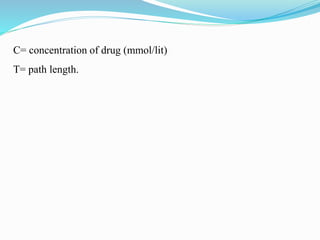
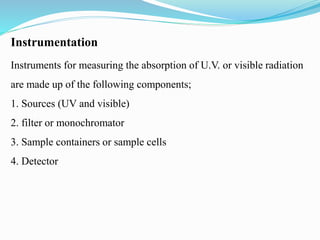
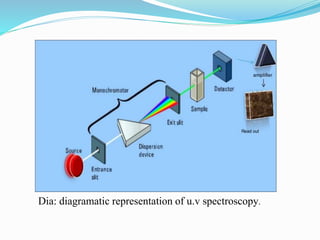
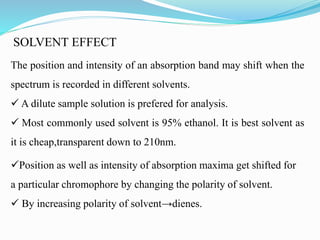
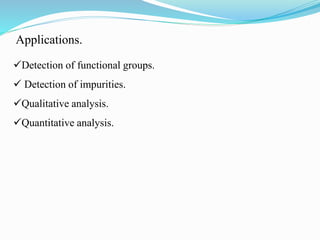
This document provides an overview of UV-visible spectroscopy. It discusses the basic principles including Beer's law and how UV spectroscopy can be used to analyze functional groups in molecules. The key components of a UV-visible spectrophotometer are described including radiation sources, monochromators, sample cells, and detectors. Common solvents used are also discussed along with how solvents can impact absorption spectra. In summary, UV-visible spectroscopy measures the absorption of UV and visible light by molecules and can be used to qualitatively and quantitatively analyze samples.

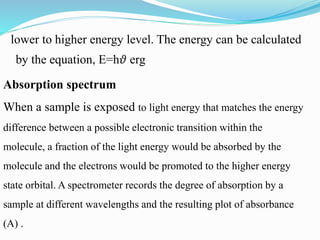
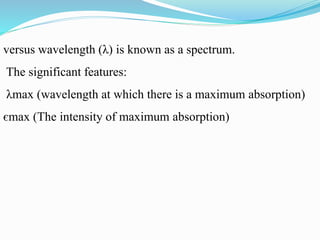
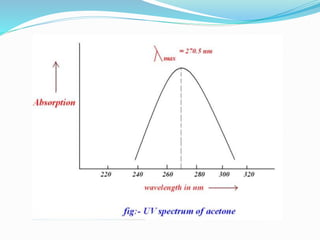
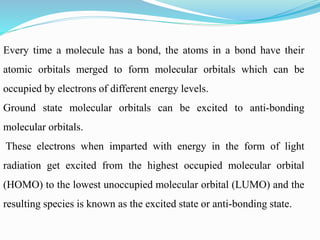
![Beer´s law
Beer´s law states that The intensity of a beam of
monochromatic light decreases exponentially with
increase in the concentration of absorbing species
arithmetically.
Accordingly.
- dI /dc α I
[The decrease in the intensity of incident light with conc. is proportional to
intensity of incident light]
- dI /dc = k I
... [Removing and introducing constant of proportionality k]](https://image.slidesharecdn.com/presentation3333anlshardcopy-181120120457/85/UV-visible-spectroscopy-12-320.jpg)
![-dI / I = k d c .... [rearranging terms]
-InI = kc + b ....... Eq 1
[When conc =0 there is no absorbance hence I = I0 sub.in Eq 1.]
-In I0 = k×0+b
-In I0= b ...substituting the value in Eq 1
-InI = kc – In I0
In I0 -InI= kc
In I0 /I=kc ....since (logA-log B = log A/B)](https://image.slidesharecdn.com/presentation3333anlshardcopy-181120120457/85/UV-visible-spectroscopy-13-320.jpg)
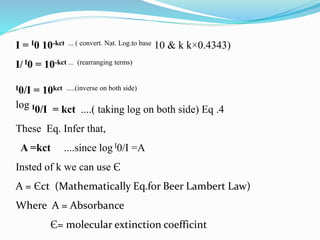
![I0 /I= ekc ... [ removing natural logarithm]
I/ I0 = e-kc ...[making inverse on both side]
I = I0 e-kc ...[ Eq 2 For Beer´s Law ]](https://image.slidesharecdn.com/presentation3333anlshardcopy-181120120457/85/UV-visible-spectroscopy-14-320.jpg)
![Lambert s law
The rate of decrease of intensity (monochromatic light) with the
thickness of the medium is directly proportional to the intensity of
light.
-dI /dt α I
[This eq. Can be simplified similar to eq. 2 to get the following eq.
By replacing c with t]
I = I0 e-kt .... Eq.3
Eq .2 & Eq.3 get combined
I = I0 e-kct](https://image.slidesharecdn.com/presentation3333anlshardcopy-181120120457/85/UV-visible-spectroscopy-15-320.jpg)