BASIC THEORY OF UV VISIBLE SPECTROSCOPY
presented by: Nittal Vekaria (M.PHARM SEM 1)
Modern pharmaceutical analytical technology
KBIPER
Introduction
The UV radiation region starts from 10 nm to 400 nm and the visible radiation region extends
from 400 nm to 800 nm
 near ultraviolet region : (200-400 nm)
 far or vacuum ultraviolet region: ( <200 nm)
Wavelengths in the ultraviolet region are usualy expresed in nanometers (1nm=10-7cm) or
angstroms (A°) (1A°=10-8cm)
UV is involved with electronic excitation.
ORIGIN AND THEORY OF ULTRAVIOLET SPECTRA
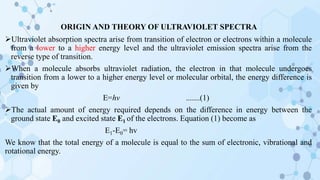
Ultraviolet absorption spectra arise from transition of electron or electrons within a molecule
from a lower to a higher energy level and the ultraviolet emission spectra arise from the
reverse type of transition.
When a molecule absorbs ultraviolet radiation, the electron in that molecule undergoes
transition from a lower to a higher energy level or molecular orbital, the energy difference is
given by
E=hv .......(1)
The actual amount of energy required depends on the difference in energy between the
ground state E0 and excited state E1 of the electrons. Equation (1) become as
E1-E0= hv
We know that the total energy of a molecule is equal to the sum of electronic, vibrational and
rotational energy.
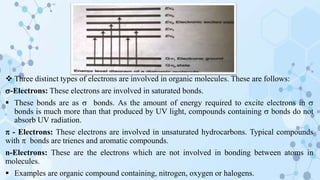
 Three distinct types of electrons are involved in organic molecules. These are follows:
-Electrons: These electrons are involved in saturated bonds.
 These bonds are as  bonds. As the amount of energy required to excite electrons in 
bonds is much more than that produced by UV light, compounds containing  bonds do not
absorb UV radiation.
 - Electrons: These electrons are involved in unsaturated hydrocarbons. Typical compounds
with  bonds are trienes and aromatic compounds.
n-Electrons: These are the electrons which are not involved in bonding between atoms in
molecules.
 Examples are organic compound containing, nitrogen, oxygen or halogens.
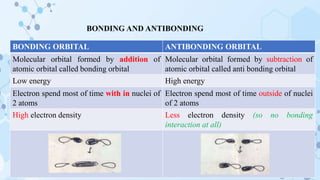
BONDING AND ANTIBONDING
BONDING ORBITAL ANTIBONDING ORBITAL
Molecular orbital formed by addition of
atomic orbital called bonding orbital
Molecular orbital formed by subtraction of
atomic orbital called anti bonding orbital
Low energy High energy
Electron spend most of time with in nuclei of
2 atoms
Electron spend most of time outside of nuclei
of 2 atoms
High electron density Less electron density (so no bonding
interaction at all)
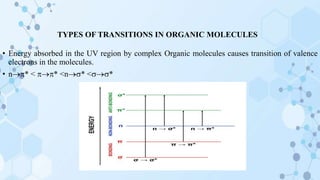
TYPES OF TRANSITIONS IN ORGANIC MOLECULES
• Energy absorbed in the UV region by complex Organic molecules causes transition of valence
electrons in the molecules.
• n* < * <n* <*
n* transition
An atom from non-bonding orbital is promoted to antibonding * orbital.
Compounds containing double bond involving hetro atoms (C = O, C  N, N = O) undergo
such transitions.
n  * transitions require minimum energy and show absorption at longer wavelength around
300nm.
* transition
These transitions can occur in such compounds in which all the electrons are involved in
single bonds and there are no lone pairs of electrons.
Examples involved such transitions are saturated hydrocarbons.
 electron from orbital is excited to corresponding anti - bonding orbital *
The energy required is large for this transition.
 e.g. methane (CH4) has C-H bond only and can undergo   * transition and shows
absorbance maxima at 125 nm
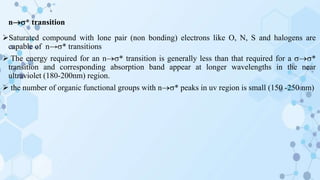
n* transition
Saturated compound with lone pair (non bonding) electrons like O, N, S and halogens are
capable of n→* transitions
 The energy required for an n* transition is generally less than that required for a *
transition and corresponding absorption band appear at longer wavelengths in the near
ultraviolet (180-200nm) region.
 the number of organic functional groups with n* peaks in uv region is small (150 -250 nm)
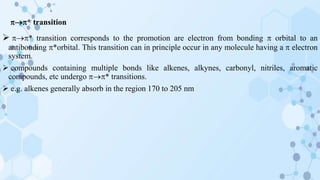
* transition
 * transition corresponds to the promotion are electron from bonding  orbital to an
antibonding *orbital. This transition can in principle occur in any molecule having a  electron
system.
 compounds containing multiple bonds like alkenes, alkynes, carbonyl, nitriles, aromatic
compounds, etc undergo * transitions.
 e.g. alkenes generally absorb in the region 170 to 205 nm
CHROMOPHORE
Chromophore is defined as any group which exhibits absorption of electromagnetic
radiations in the visible or ultraviolet region.
Important chromophore are ethylenic, carbonyls, ester acid, nitrile group etc
Two types of chromophore are known;
a) chromophore in which the group is having  electrons  undergo * transition. Example of
having such chromophore are ethylene, ester. [Also called Dependent chromophore When more
then one chromophore is required to produce color. Eg acetone having 1 kentone group is
colorless where as diacetyl having two kentone group is yellow ]
b) Chromophore, having both  electron and {non-bonding} electrons undergo two type of
transition, i.e   * and n *. Example carbonyls, nitrile, azo compound, nitro
compound.[Also called Independent chromophore: single chromophore is sufficient to import
color to the compound ]
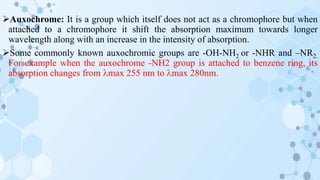
Auxochrome: It is a group which itself does not act as a chromophore but when
attached to a chromophore it shift the absorption maximum towards longer
wavelength along with an increase in the intensity of absorption.
Some commonly known auxochromic groups are -OH-NH2 or -NHR and –NR2.
For example when the auxochrome -NH2 group is attached to benzene ring, its
absorption changes from max 255 nm to max 280nm.
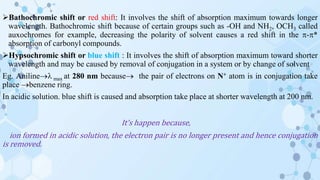
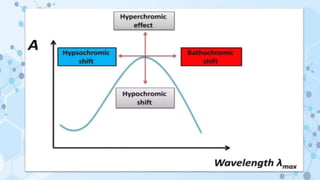
Bathochromic shift or red shift: It involves the shift of absorption maximum towards longer
wavelength. Bathochromic shift because of certain groups such as -OH and NH2, OCH3 called
auxochromes for example, decreasing the polarity of solvent causes a red shift in the -*
absorption of carbonyl compounds.
Hypsochromic shift or blue shift : It involves the shift of absorption maximum toward shorter
wavelength and may be caused by removal of conjugation in a system or by change of solvent
Eg. Aniline max at 280 nm because the pair of electrons on N+ atom is in conjugation take
place benzene ring.
In acidic solution. blue shift is caused and absorption take place at shorter wavelength at 200 nm.
It's happen because,
ion formed in acidic solution, the electron pair is no longer present and hence conjugation
is removed.
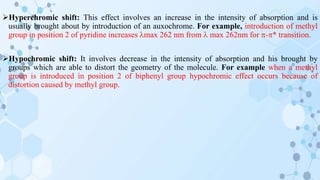
Hyperchromic shift: This effect involves an increase in the intensity of absorption and is
usually brought about by introduction of an auxochrome. For example, introduction of methyl
group in position 2 of pyridine increases max 262 nm from  max 262nm for -* transition.
Hypochromic shift: It involves decrease in the intensity of absorption and his brought by
groups which are able to distort the geometry of the molecule. For example when a methyl
group is introduced in position 2 of biphenyl group hypochromic effect occurs because of
distortion caused by methyl group.
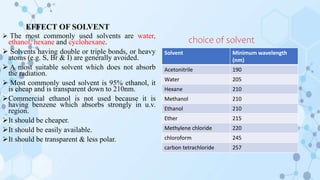
EFFECT OF SOLVENT
choice of solvent
 The most commonly used solvents are water,
ethanol, hexane and cyclohexane.
 Solvents having double or triple bonds, or heavy
atoms (e.g. S, Br & I) are generally avoided.
 A most suitable solvent which does not absorb
the radiation.
 Most commonly used solvent is 95% ethanol, it
is cheap and is transparent down to 210nm.
Commercial ethanol is not used because it is
having benzene which absorbs strongly in u.v.
region.
It should be cheaper.
It should be easily available.
It should be transparent & less polar.
Solvent Minimum wavelength
(nm)
Acetonitrile 190
Water 205
Hexane 210
Methanol 210
Ethanol 210
Ether 215
Methylene chloride 220
chloroform 245
carbon tetrachloride 257
Refrences:
• Introduction to Spectroscopy
-Donald A. Pavia
• Elementary Organic Spectroscopy
--Y. R. Sharma
• Physical Chemistry
-- Puri, Sharma & Pathaniya

BASIC THEORY OF UV VISIBLE SPECTROSCOPY.pptx

  • 1.
    BASIC THEORY OFUV VISIBLE SPECTROSCOPY presented by: Nittal Vekaria (M.PHARM SEM 1) Modern pharmaceutical analytical technology KBIPER
  • 2.
    Introduction The UV radiationregion starts from 10 nm to 400 nm and the visible radiation region extends from 400 nm to 800 nm  near ultraviolet region : (200-400 nm)  far or vacuum ultraviolet region: ( <200 nm) Wavelengths in the ultraviolet region are usualy expresed in nanometers (1nm=10-7cm) or angstroms (A°) (1A°=10-8cm) UV is involved with electronic excitation.
  • 3.
    ORIGIN AND THEORYOF ULTRAVIOLET SPECTRA Ultraviolet absorption spectra arise from transition of electron or electrons within a molecule from a lower to a higher energy level and the ultraviolet emission spectra arise from the reverse type of transition. When a molecule absorbs ultraviolet radiation, the electron in that molecule undergoes transition from a lower to a higher energy level or molecular orbital, the energy difference is given by E=hv .......(1) The actual amount of energy required depends on the difference in energy between the ground state E0 and excited state E1 of the electrons. Equation (1) become as E1-E0= hv We know that the total energy of a molecule is equal to the sum of electronic, vibrational and rotational energy.
  • 4.
     Three distincttypes of electrons are involved in organic molecules. These are follows: -Electrons: These electrons are involved in saturated bonds.  These bonds are as  bonds. As the amount of energy required to excite electrons in  bonds is much more than that produced by UV light, compounds containing  bonds do not absorb UV radiation.  - Electrons: These electrons are involved in unsaturated hydrocarbons. Typical compounds with  bonds are trienes and aromatic compounds. n-Electrons: These are the electrons which are not involved in bonding between atoms in molecules.  Examples are organic compound containing, nitrogen, oxygen or halogens.
  • 5.
    BONDING AND ANTIBONDING BONDINGORBITAL ANTIBONDING ORBITAL Molecular orbital formed by addition of atomic orbital called bonding orbital Molecular orbital formed by subtraction of atomic orbital called anti bonding orbital Low energy High energy Electron spend most of time with in nuclei of 2 atoms Electron spend most of time outside of nuclei of 2 atoms High electron density Less electron density (so no bonding interaction at all)
  • 6.
    TYPES OF TRANSITIONSIN ORGANIC MOLECULES • Energy absorbed in the UV region by complex Organic molecules causes transition of valence electrons in the molecules. • n* < * <n* <*
  • 7.
    n* transition An atomfrom non-bonding orbital is promoted to antibonding * orbital. Compounds containing double bond involving hetro atoms (C = O, C  N, N = O) undergo such transitions. n  * transitions require minimum energy and show absorption at longer wavelength around 300nm.
  • 8.
    * transition These transitionscan occur in such compounds in which all the electrons are involved in single bonds and there are no lone pairs of electrons. Examples involved such transitions are saturated hydrocarbons.  electron from orbital is excited to corresponding anti - bonding orbital * The energy required is large for this transition.  e.g. methane (CH4) has C-H bond only and can undergo   * transition and shows absorbance maxima at 125 nm
  • 9.
    n* transition Saturated compoundwith lone pair (non bonding) electrons like O, N, S and halogens are capable of n→* transitions  The energy required for an n* transition is generally less than that required for a * transition and corresponding absorption band appear at longer wavelengths in the near ultraviolet (180-200nm) region.  the number of organic functional groups with n* peaks in uv region is small (150 -250 nm)
  • 10.
    * transition  *transition corresponds to the promotion are electron from bonding  orbital to an antibonding *orbital. This transition can in principle occur in any molecule having a  electron system.  compounds containing multiple bonds like alkenes, alkynes, carbonyl, nitriles, aromatic compounds, etc undergo * transitions.  e.g. alkenes generally absorb in the region 170 to 205 nm
  • 11.
    CHROMOPHORE Chromophore is definedas any group which exhibits absorption of electromagnetic radiations in the visible or ultraviolet region. Important chromophore are ethylenic, carbonyls, ester acid, nitrile group etc Two types of chromophore are known; a) chromophore in which the group is having  electrons  undergo * transition. Example of having such chromophore are ethylene, ester. [Also called Dependent chromophore When more then one chromophore is required to produce color. Eg acetone having 1 kentone group is colorless where as diacetyl having two kentone group is yellow ] b) Chromophore, having both  electron and {non-bonding} electrons undergo two type of transition, i.e   * and n *. Example carbonyls, nitrile, azo compound, nitro compound.[Also called Independent chromophore: single chromophore is sufficient to import color to the compound ]
  • 12.
    Auxochrome: It isa group which itself does not act as a chromophore but when attached to a chromophore it shift the absorption maximum towards longer wavelength along with an increase in the intensity of absorption. Some commonly known auxochromic groups are -OH-NH2 or -NHR and –NR2. For example when the auxochrome -NH2 group is attached to benzene ring, its absorption changes from max 255 nm to max 280nm.
  • 13.
    Bathochromic shift orred shift: It involves the shift of absorption maximum towards longer wavelength. Bathochromic shift because of certain groups such as -OH and NH2, OCH3 called auxochromes for example, decreasing the polarity of solvent causes a red shift in the -* absorption of carbonyl compounds. Hypsochromic shift or blue shift : It involves the shift of absorption maximum toward shorter wavelength and may be caused by removal of conjugation in a system or by change of solvent Eg. Aniline max at 280 nm because the pair of electrons on N+ atom is in conjugation take place benzene ring. In acidic solution. blue shift is caused and absorption take place at shorter wavelength at 200 nm. It's happen because, ion formed in acidic solution, the electron pair is no longer present and hence conjugation is removed.
  • 14.
    Hyperchromic shift: Thiseffect involves an increase in the intensity of absorption and is usually brought about by introduction of an auxochrome. For example, introduction of methyl group in position 2 of pyridine increases max 262 nm from  max 262nm for -* transition. Hypochromic shift: It involves decrease in the intensity of absorption and his brought by groups which are able to distort the geometry of the molecule. For example when a methyl group is introduced in position 2 of biphenyl group hypochromic effect occurs because of distortion caused by methyl group.
  • 16.
    EFFECT OF SOLVENT choiceof solvent  The most commonly used solvents are water, ethanol, hexane and cyclohexane.  Solvents having double or triple bonds, or heavy atoms (e.g. S, Br & I) are generally avoided.  A most suitable solvent which does not absorb the radiation.  Most commonly used solvent is 95% ethanol, it is cheap and is transparent down to 210nm. Commercial ethanol is not used because it is having benzene which absorbs strongly in u.v. region. It should be cheaper. It should be easily available. It should be transparent & less polar. Solvent Minimum wavelength (nm) Acetonitrile 190 Water 205 Hexane 210 Methanol 210 Ethanol 210 Ether 215 Methylene chloride 220 chloroform 245 carbon tetrachloride 257
  • 17.
    Refrences: • Introduction toSpectroscopy -Donald A. Pavia • Elementary Organic Spectroscopy --Y. R. Sharma • Physical Chemistry -- Puri, Sharma & Pathaniya