UV VISIBLE SPECTROSCOPY
SPECTROSCOPY
 It is the branch of science that deals with the study of interaction
of matter with light or interaction of electromagnetic radiation with
matter.
 Electromagnetic radiation consist of discrete packages of energy
which are called as photons.
UV-VISIBLE SPECTROSCOPY
 UV spectroscopy Electronic Spectroscopy
It involves the promotion of electrons form ground state to excited
(higher energy) in an molecule.
 UV Spectroscopy deals with the measurement of energy absorbed
when electrons are promoted to higher energy levels.
UV spectrum is simply a plot of wavelength of light absorbed Vs the
absorption intensity( absorbance or transmittance)
 since UV radiation associated with larger amount of energy , they are
capable of electronic transitions and induce transitions in electronic ,
vibrational and rotational energy levels of a molecule.
RANGE : 200 800 nm
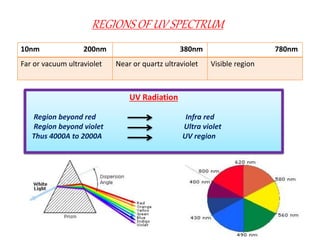
REGIONS OF UV SPECTRUM
10nm 200nm 380nm 780nm
Far or vacuum ultraviolet Near or quartz ultraviolet Visible region
UV Radiation
Region beyond red Infra red
Region beyond violet Ultra violet
Thus 4000A to 2000A UV region
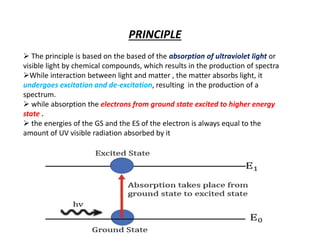
PRINCIPLE
 The principle is based on the based of the absorption of ultraviolet light or
visible light by chemical compounds, which results in the production of spectra
While interaction between light and matter , the matter absorbs light, it
undergoes excitation and de-excitation, resulting in the production of a
spectrum.
 while absorption the electrons from ground state excited to higher energy
state .
 the energies of the GS and the ES of the electron is always equal to the
amount of UV visible radiation absorbed by it
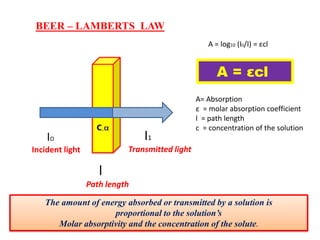
BEER – LAMBERTS LAW
IO
Incident light
I1
Transmitted light
l
Path length
A = log10 (I0/I) = εcl
A = εcl
A= Absorption
ε = molar absorption coefficient
l = path length
c = concentration of the solution
The amount of energy absorbed or transmitted by a solution is
proportional to the solution’s
Molar absorptivity and the concentration of the solute.
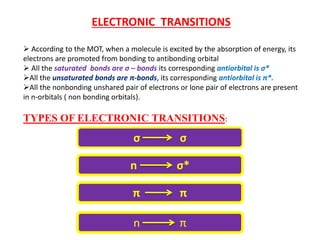
ELECTRONIC TRANSITIONS
 According to the MOT, when a molecule is excited by the absorption of energy, its
electrons are promoted from bonding to antibonding orbital
 All the saturated bonds are σ – bonds its corresponding antiorbital is σ*
All the unsaturated bonds are π-bonds, its corresponding antiorbital is π*.
All the nonbonding unshared pair of electrons or lone pair of electrons are present
in n-orbitals ( non bonding orbitals).
TYPES OF ELECTRONIC TRANSITIONS:
σ σ
n σ*
π π
n π
σ σ* Transition
 It is the transition of an electron from bonding σ-orbital to its antibonding
orbital .
It is a high energy process because σ-bonds are very strong (stable).
 Thus, these transitions do not occur in normal UV-regions (200-800nm)
 so, σ σ* transition is less informative in UV.
eg., saturated hydrocarbons like methane , propane etc ., absorption occurs
near 150mµ.
Thus, and evacuated spectrophotometer is used for studying such high
energy transitions.
 Below 200mµ, since oxygen begins to absorb strongly . Therefore, the
lower region is evacuated with nitrogen air.
 this region is called Vacuum region.
The spins of electrons is not change from GS to ES.
It occurs only singlet to singlet and triplet to triplet.
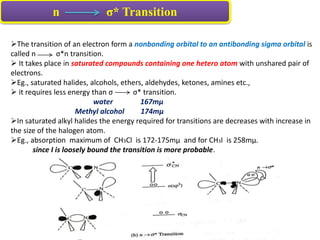
n σ* Transition
The transition of an electron form a nonbonding orbital to an antibonding sigma orbital is
called n σ*n transition.
 It takes place in saturated compounds containing one hetero atom with unshared pair of
electrons.
Eg., saturated halides, alcohols, ethers, aldehydes, ketones, amines etc.,
 it requires less energy than σ σ* transition.
water 167mµ
Methyl alcohol 174mµ
In saturated alkyl halides the energy required for transitions are decreases with increase in
the size of the halogen atom.
Eg., absorption maximum of CH3Cl is 172-175mµ and for CH3I is 258mµ.
since I is loosely bound the transition is more probable.
π π* Transition
 It is the transition of an electron from a π-bonding orbital to a π antibonding orbital.
 it occurs in unsaturated centers of the molecule.
i.e., compounds containing double bonds, triple bonds and also in aromatic compounds.
 These transitions require lower energy than in n σ* transitions . Therefore , it occurs at
longer wavelength.
 eg., alkenes, alkynes, carbonyl compounds, cyanides, azo compounds.
 In alkenes, absorption occurs at 170-190mµ
In carbonyl compounds occurs at around 180mµ and the value of extinction coefficient is
high
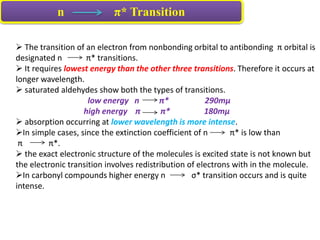
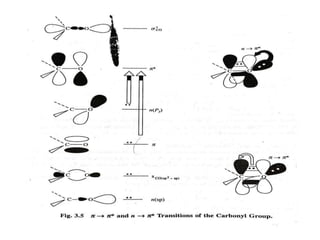
n π* Transition
 The transition of an electron from nonbonding orbital to antibonding π orbital is
designated n π* transitions.
 It requires lowest energy than the other three transitions. Therefore it occurs at
longer wavelength.
 saturated aldehydes show both the types of transitions.
low energy n π* 290mµ
high energy π π* 180mµ
 absorption occurring at lower wavelength is more intense.
In simple cases, since the extinction coefficient of n π* is low than
π π*.
 the exact electronic structure of the molecules is excited state is not known but
the electronic transition involves redistribution of electrons with in the molecule.
In carbonyl compounds higher energy n σ* transition occurs and is quite
intense.
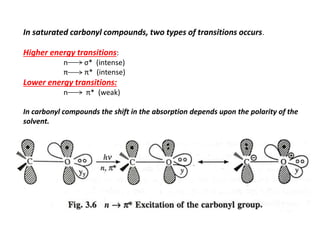
In saturated carbonyl compounds, two types of transitions occurs.
Higher energy transitions:
n σ* (intense)
π π* (intense)
Lower energy transitions:
n π* (weak)
In carbonyl compounds the shift in the absorption depends upon the polarity of the
solvent.
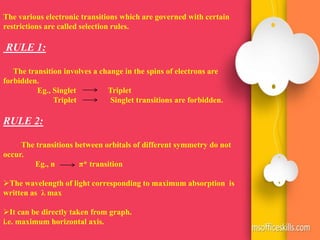
SELECTIONRULE
The various electronic transitions which are governed with certain
restrictions are called selection rules.
RULE 1:
The transition involves a change in the spins of electrons are
forbidden.
Eg., Singlet Triplet
Triplet Singlet transitions are forbidden.
RULE 2:
The transitions between orbitals of different symmetry do not
occur.
Eg., n π* transition
The wavelength of light corresponding to maximum absorption is
written as λ max
It can be directly taken from graph.
i.e. maximum horizontal axis.
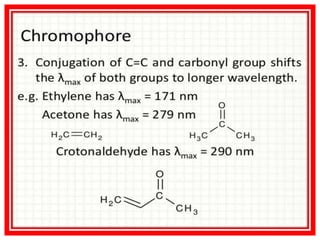
CHROMOPHORE
 All the compounds which absorbs light in the wavelength of 400 – 800 nm is
Visible to human eye.
 chromophore group can impart colour in the compound.
Eg. Ethylene, acetylene, NO2 ( yellow), acids, esters, azo group.
DEFINITION:
 Any isolated covalently bonded group that shows a characteristic absorption in
the ultraviolet or visible region
 Chromophore can undergo two types of transitions.
π π*
n π*
 chromophore in which the group contains pi electrons undergo π π*
transitions.
Eg., ethylenes, acetylenes.
Chromophore which contain both pi electrons and nonbonding electrons
undergo n π* & π π* transitions.
Eg., carbonyls, nitriles, azo compounds and nitro compounds.
AUXOCHROME
 Auxochrome is a colour enhancing group.
The functional groups attached to a chromophore which
modifies the ability of the chromophore to absorb light, altering
the wavelength or intensity of absorption .
OR
A covalently saturated group which, when attached to a
chromophore, changes both the wavelength and the intensity of
the absorption maximum is known as auxochrome.
Eg: NH2, OH, SH, halogens, NHR,NR2
 It do not show characteristic absorption above 200nm.
 Since the auxochrome contains lone pair above the hetero
atoms, they involve in the transition with π bonds of benzene ring
 The auxochrome nature can be affected by polarity of the
solvent.
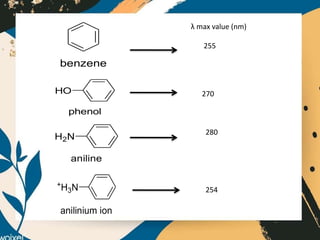
λ max value (nm)
255
270
280
254
benzene
HO
phenol
H2N
aniline
+
H3N
anilinium ion
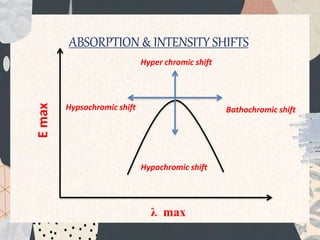
ABSORPTION & INTENSITY SHIFTS
λ max
Emax
Hyper chromic shift
Bathochromic shift
Hypochromic shift
Hypsochromic shift
BATHO CHROMIC SHIFT ( RED SHIFT)
 The shift of an absorption maximum to a longer wavelength side due
to the presence of auxochrome or solvent effect is called bathochromic shift
or red shift.
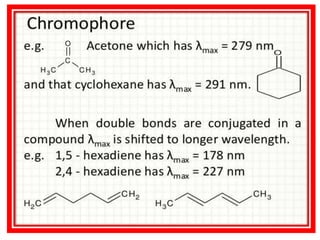
Eg., λ max for benzene 256nm
Aniline 280nm
 Thus there is a bathochromic shift of 34nm in the λmax of benzene due to
presence of the auxochrome NH2.
 the n π* transition for carbonyl compounds experiences bathochromic
shift when the polarity of the solvent decreased.
 λ max of acetone 264.5nm in water as compared to 279nm in hexane.
HYPSOCHROMIC SHIFT ( BLUE SHIFT)
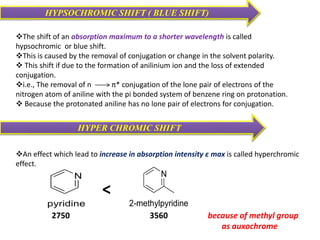
The shift of an absorption maximum to a shorter wavelength is called
hypsochromic or blue shift.
This is caused by the removal of conjugation or change in the solvent polarity.
 This shift if due to the formation of anilinium ion and the loss of extended
conjugation.
i.e., The removal of n π* conjugation of the lone pair of electrons of the
nitrogen atom of aniline with the pi bonded system of benzene ring on protonation.
 Because the protonated aniline has no lone pair of electrons for conjugation.
HYPER CHROMIC SHIFT
An effect which lead to increase in absorption intensity ε max is called hyperchromic
effect.
<
2750 3560 because of methyl group
as auxochrome
N
pyridine
N
2-methylpyridine
HYPOCHROMIC SHIFT
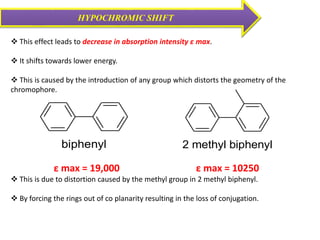
 This effect leads to decrease in absorption intensity ε max.
 It shifts towards lower energy.
 This is caused by the introduction of any group which distorts the geometry of the
chromophore.
ε max = 19,000 ε max = 10250
 This is due to distortion caused by the methyl group in 2 methyl biphenyl.
 By forcing the rings out of co planarity resulting in the loss of conjugation.
biphenyl 2 methyl biphenyl
TYPEs
OF
ABSORPTION BANDS
K- BAND
 K-bands originate due to π π* transition from a compound containing a
conjugated system.
 Such type of bands arise in compounds like dienes, polyenes, enones etc. and also
appear in aromatic compound which is substituted by a chromophore.
 The intensity of k-band, is usually more than 104 .
 The K-band absorption due to conjugated “ enes “ and “ enones “ are effected
differently by changing the polarity of the solvent.
Compound Transition (λ max )nm ε max
Butadiene 1,3 π π* 217 21,000
Acrolein π π* 210 11,500
styrene π π* 214 12,000
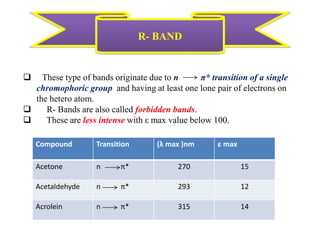
R- BAND
 These type of bands originate due to n π* transition of a single
chromophoric group and having at least one lone pair of electrons on
the hetero atom.
 R- Bands are also called forbidden bands.
 These are less intense with ε max value below 100.
Compound Transition (λ max )nm ε max
Acetone n π* 270 15
Acetaldehyde n π* 293 12
Acrolein n π* 315 14
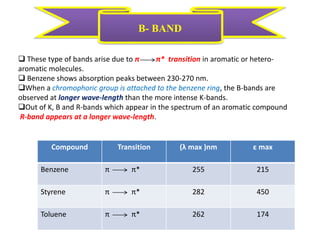
B- BAND
 These type of bands arise due to π π* transition in aromatic or hetero-
aromatic molecules.
 Benzene shows absorption peaks between 230-270 nm.
When a chromophoric group is attached to the benzene ring, the B-bands are
observed at longer wave-length than the more intense K-bands.
Out of K, B and R-bands which appear in the spectrum of an aromatic compound
R-band appears at a longer wave-length.
Compound Transition (λ max )nm ε max
Benzene π π* 255 215
Styrene π π* 282 450
Toluene π π* 262 174
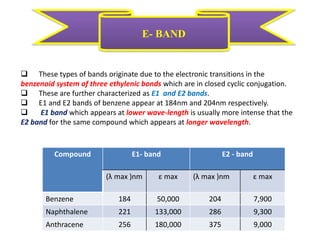
E- BAND
 These types of bands originate due to the electronic transitions in the
benzenoid system of three ethylenic bonds which are in closed cyclic conjugation.
 These are further characterized as E1 and E2 bands.
 E1 and E2 bands of benzene appear at 184nm and 204nm respectively.
 E1 band which appears at lower wave-length is usually more intense that the
E2 band for the same compound which appears at longer wavelength.
Compound E1- band E2 - band
(λ max )nm ε max (λ max )nm ε max
Benzene 184 50,000 204 7,900
Naphthalene 221 133,000 286 9,300
Anthracene 256 180,000 375 9,000
THANK YOU

UV visible spectroscopy ( electronic spectroscopy)

  • 1.
  • 2.
    SPECTROSCOPY  It isthe branch of science that deals with the study of interaction of matter with light or interaction of electromagnetic radiation with matter.  Electromagnetic radiation consist of discrete packages of energy which are called as photons.
  • 3.
    UV-VISIBLE SPECTROSCOPY  UVspectroscopy Electronic Spectroscopy It involves the promotion of electrons form ground state to excited (higher energy) in an molecule.  UV Spectroscopy deals with the measurement of energy absorbed when electrons are promoted to higher energy levels. UV spectrum is simply a plot of wavelength of light absorbed Vs the absorption intensity( absorbance or transmittance)  since UV radiation associated with larger amount of energy , they are capable of electronic transitions and induce transitions in electronic , vibrational and rotational energy levels of a molecule. RANGE : 200 800 nm
  • 4.
    REGIONS OF UVSPECTRUM 10nm 200nm 380nm 780nm Far or vacuum ultraviolet Near or quartz ultraviolet Visible region UV Radiation Region beyond red Infra red Region beyond violet Ultra violet Thus 4000A to 2000A UV region
  • 5.
    PRINCIPLE  The principleis based on the based of the absorption of ultraviolet light or visible light by chemical compounds, which results in the production of spectra While interaction between light and matter , the matter absorbs light, it undergoes excitation and de-excitation, resulting in the production of a spectrum.  while absorption the electrons from ground state excited to higher energy state .  the energies of the GS and the ES of the electron is always equal to the amount of UV visible radiation absorbed by it
  • 6.
    BEER – LAMBERTSLAW IO Incident light I1 Transmitted light l Path length A = log10 (I0/I) = εcl A = εcl A= Absorption ε = molar absorption coefficient l = path length c = concentration of the solution The amount of energy absorbed or transmitted by a solution is proportional to the solution’s Molar absorptivity and the concentration of the solute.
  • 7.
    ELECTRONIC TRANSITIONS  Accordingto the MOT, when a molecule is excited by the absorption of energy, its electrons are promoted from bonding to antibonding orbital  All the saturated bonds are σ – bonds its corresponding antiorbital is σ* All the unsaturated bonds are π-bonds, its corresponding antiorbital is π*. All the nonbonding unshared pair of electrons or lone pair of electrons are present in n-orbitals ( non bonding orbitals). TYPES OF ELECTRONIC TRANSITIONS: σ σ n σ* π π n π
  • 8.
    σ σ* Transition It is the transition of an electron from bonding σ-orbital to its antibonding orbital . It is a high energy process because σ-bonds are very strong (stable).  Thus, these transitions do not occur in normal UV-regions (200-800nm)  so, σ σ* transition is less informative in UV. eg., saturated hydrocarbons like methane , propane etc ., absorption occurs near 150mµ. Thus, and evacuated spectrophotometer is used for studying such high energy transitions.  Below 200mµ, since oxygen begins to absorb strongly . Therefore, the lower region is evacuated with nitrogen air.  this region is called Vacuum region. The spins of electrons is not change from GS to ES. It occurs only singlet to singlet and triplet to triplet.
  • 9.
    n σ* Transition Thetransition of an electron form a nonbonding orbital to an antibonding sigma orbital is called n σ*n transition.  It takes place in saturated compounds containing one hetero atom with unshared pair of electrons. Eg., saturated halides, alcohols, ethers, aldehydes, ketones, amines etc.,  it requires less energy than σ σ* transition. water 167mµ Methyl alcohol 174mµ In saturated alkyl halides the energy required for transitions are decreases with increase in the size of the halogen atom. Eg., absorption maximum of CH3Cl is 172-175mµ and for CH3I is 258mµ. since I is loosely bound the transition is more probable.
  • 10.
    π π* Transition It is the transition of an electron from a π-bonding orbital to a π antibonding orbital.  it occurs in unsaturated centers of the molecule. i.e., compounds containing double bonds, triple bonds and also in aromatic compounds.  These transitions require lower energy than in n σ* transitions . Therefore , it occurs at longer wavelength.  eg., alkenes, alkynes, carbonyl compounds, cyanides, azo compounds.  In alkenes, absorption occurs at 170-190mµ In carbonyl compounds occurs at around 180mµ and the value of extinction coefficient is high
  • 11.
    n π* Transition The transition of an electron from nonbonding orbital to antibonding π orbital is designated n π* transitions.  It requires lowest energy than the other three transitions. Therefore it occurs at longer wavelength.  saturated aldehydes show both the types of transitions. low energy n π* 290mµ high energy π π* 180mµ  absorption occurring at lower wavelength is more intense. In simple cases, since the extinction coefficient of n π* is low than π π*.  the exact electronic structure of the molecules is excited state is not known but the electronic transition involves redistribution of electrons with in the molecule. In carbonyl compounds higher energy n σ* transition occurs and is quite intense.
  • 12.
    In saturated carbonylcompounds, two types of transitions occurs. Higher energy transitions: n σ* (intense) π π* (intense) Lower energy transitions: n π* (weak) In carbonyl compounds the shift in the absorption depends upon the polarity of the solvent.
  • 14.
  • 15.
    The various electronictransitions which are governed with certain restrictions are called selection rules. RULE 1: The transition involves a change in the spins of electrons are forbidden. Eg., Singlet Triplet Triplet Singlet transitions are forbidden. RULE 2: The transitions between orbitals of different symmetry do not occur. Eg., n π* transition The wavelength of light corresponding to maximum absorption is written as λ max It can be directly taken from graph. i.e. maximum horizontal axis.
  • 16.
    CHROMOPHORE  All thecompounds which absorbs light in the wavelength of 400 – 800 nm is Visible to human eye.  chromophore group can impart colour in the compound. Eg. Ethylene, acetylene, NO2 ( yellow), acids, esters, azo group. DEFINITION:  Any isolated covalently bonded group that shows a characteristic absorption in the ultraviolet or visible region  Chromophore can undergo two types of transitions. π π* n π*  chromophore in which the group contains pi electrons undergo π π* transitions. Eg., ethylenes, acetylenes. Chromophore which contain both pi electrons and nonbonding electrons undergo n π* & π π* transitions. Eg., carbonyls, nitriles, azo compounds and nitro compounds.
  • 19.
    AUXOCHROME  Auxochrome isa colour enhancing group. The functional groups attached to a chromophore which modifies the ability of the chromophore to absorb light, altering the wavelength or intensity of absorption . OR A covalently saturated group which, when attached to a chromophore, changes both the wavelength and the intensity of the absorption maximum is known as auxochrome. Eg: NH2, OH, SH, halogens, NHR,NR2  It do not show characteristic absorption above 200nm.  Since the auxochrome contains lone pair above the hetero atoms, they involve in the transition with π bonds of benzene ring  The auxochrome nature can be affected by polarity of the solvent.
  • 20.
    λ max value(nm) 255 270 280 254 benzene HO phenol H2N aniline + H3N anilinium ion
  • 21.
    ABSORPTION & INTENSITYSHIFTS λ max Emax Hyper chromic shift Bathochromic shift Hypochromic shift Hypsochromic shift
  • 22.
    BATHO CHROMIC SHIFT( RED SHIFT)  The shift of an absorption maximum to a longer wavelength side due to the presence of auxochrome or solvent effect is called bathochromic shift or red shift. Eg., λ max for benzene 256nm Aniline 280nm  Thus there is a bathochromic shift of 34nm in the λmax of benzene due to presence of the auxochrome NH2.  the n π* transition for carbonyl compounds experiences bathochromic shift when the polarity of the solvent decreased.  λ max of acetone 264.5nm in water as compared to 279nm in hexane.
  • 23.
    HYPSOCHROMIC SHIFT (BLUE SHIFT) The shift of an absorption maximum to a shorter wavelength is called hypsochromic or blue shift. This is caused by the removal of conjugation or change in the solvent polarity.  This shift if due to the formation of anilinium ion and the loss of extended conjugation. i.e., The removal of n π* conjugation of the lone pair of electrons of the nitrogen atom of aniline with the pi bonded system of benzene ring on protonation.  Because the protonated aniline has no lone pair of electrons for conjugation. HYPER CHROMIC SHIFT An effect which lead to increase in absorption intensity ε max is called hyperchromic effect. < 2750 3560 because of methyl group as auxochrome N pyridine N 2-methylpyridine
  • 24.
    HYPOCHROMIC SHIFT  Thiseffect leads to decrease in absorption intensity ε max.  It shifts towards lower energy.  This is caused by the introduction of any group which distorts the geometry of the chromophore. ε max = 19,000 ε max = 10250  This is due to distortion caused by the methyl group in 2 methyl biphenyl.  By forcing the rings out of co planarity resulting in the loss of conjugation. biphenyl 2 methyl biphenyl
  • 25.
  • 26.
    K- BAND  K-bandsoriginate due to π π* transition from a compound containing a conjugated system.  Such type of bands arise in compounds like dienes, polyenes, enones etc. and also appear in aromatic compound which is substituted by a chromophore.  The intensity of k-band, is usually more than 104 .  The K-band absorption due to conjugated “ enes “ and “ enones “ are effected differently by changing the polarity of the solvent. Compound Transition (λ max )nm ε max Butadiene 1,3 π π* 217 21,000 Acrolein π π* 210 11,500 styrene π π* 214 12,000
  • 27.
    R- BAND  Thesetype of bands originate due to n π* transition of a single chromophoric group and having at least one lone pair of electrons on the hetero atom.  R- Bands are also called forbidden bands.  These are less intense with ε max value below 100. Compound Transition (λ max )nm ε max Acetone n π* 270 15 Acetaldehyde n π* 293 12 Acrolein n π* 315 14
  • 28.
    B- BAND  Thesetype of bands arise due to π π* transition in aromatic or hetero- aromatic molecules.  Benzene shows absorption peaks between 230-270 nm. When a chromophoric group is attached to the benzene ring, the B-bands are observed at longer wave-length than the more intense K-bands. Out of K, B and R-bands which appear in the spectrum of an aromatic compound R-band appears at a longer wave-length. Compound Transition (λ max )nm ε max Benzene π π* 255 215 Styrene π π* 282 450 Toluene π π* 262 174
  • 29.
    E- BAND  Thesetypes of bands originate due to the electronic transitions in the benzenoid system of three ethylenic bonds which are in closed cyclic conjugation.  These are further characterized as E1 and E2 bands.  E1 and E2 bands of benzene appear at 184nm and 204nm respectively.  E1 band which appears at lower wave-length is usually more intense that the E2 band for the same compound which appears at longer wavelength. Compound E1- band E2 - band (λ max )nm ε max (λ max )nm ε max Benzene 184 50,000 204 7,900 Naphthalene 221 133,000 286 9,300 Anthracene 256 180,000 375 9,000
  • 30.