UV-VISIBLE SPECTROSCOPY
*SPECTROSCOPY
PRESENTED BY : ANJALI RARICHAN ,
1st year MPHARM
*SPECTROSCOPY is the
measurement and interpretation
of Electro Magnetic Radiation
(EMR) absorbed or emitted when
the molecules or atoms or ions
of a sample move from one
energy state to another energy
state.
*Electromagnetic Radiation
*This radiation may be regarded as energy
propagated in a wave form. These radiations
travel in space at enormous velocity. It consist
of both electrical and magnetic vectors and
hence it is named as electromagnetic
radiation.
* Frequency (ν):
It is defined as the number of waves
passing through a point per second.
The unit for frequency is Hertz (Hz).
Wavelength (λ):
It is the distance between the two
successive peaks of waves, i.e. distance
between two nearest crest or troughs.
It is denoted by “lambda (λ).
*ELECTROMAGNETIC SPECTRUM
* The arrangement of all types of electromagnetic
radiations in order of their increasing wavelengths or
decreasing frequencies is known as complete
electromagnetic spectrum.
*PRINCIPLE OF UV- VISIBLE SPECTROSCOPY
*VISIBLE SPECTROSCOPY
Colorimetry is concerned with the study of
Absorption of visible radiation whose wavelength
ranges from 400nm-800nm. Any Coloured
substance will absorb radiation in this
wavelength region. Coloured substances, absorb
light of different wavelength in different manner
and hence we get an absorption curve in a
unique pattern for every coloured solution.
*UV SPECTROSCOPY
*Ultraviolet spectroscopy is concerned with the
study of absorption of UV radiation which
ranges from 200 to 400nm. Compounds which
are coloured, absorb radiation from 400-
800nm. But compounds which are colourless
absorb radiation in the UV region. In both UV as
well as visible spectroscopy, only the valence
electrons absorb the energy, thereby the
molecule undergo transition from Ground state
to excited state. Thus absorption is
characteristic and depends on the nature of
electrons present. The intensity of absorption
depends on the concentration and path length.
*ABSORPTION CURVE AND CALIBRATION CURVE
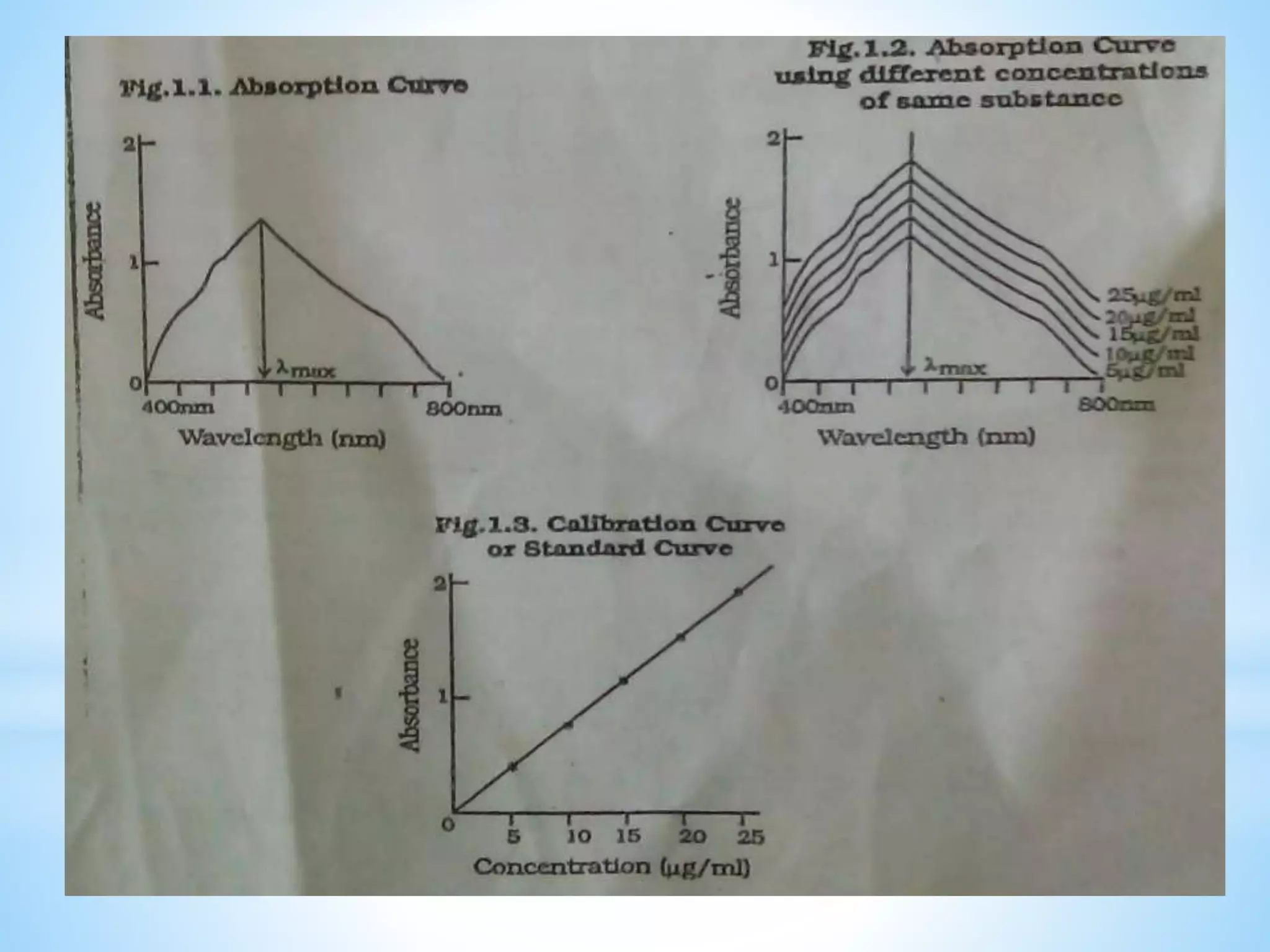
*Coloured substances , absorb light of different
wavelength in different manner and hence we
get an absorption curve(absorbance vs
wavelength) in a unique pattern for every
coloured solution. In this absorption curve,
the wavelength at which maximum absorption
of radiation takes place is called as λmax. It is
characteristic or unique for every coloured
substance and this is a qualitative aspect,
useful in identifying the substance.
* When we plot a graph of concentration
Vs absorbance , we get a Calibration
curve or Standard curve. This
calibration curve is useful in
determining the concentration or
amount of a drug substance in the given
sample solution or a formulation, by
extrapolation or intrapolation and
calculation.
Electronic
Transitions
*
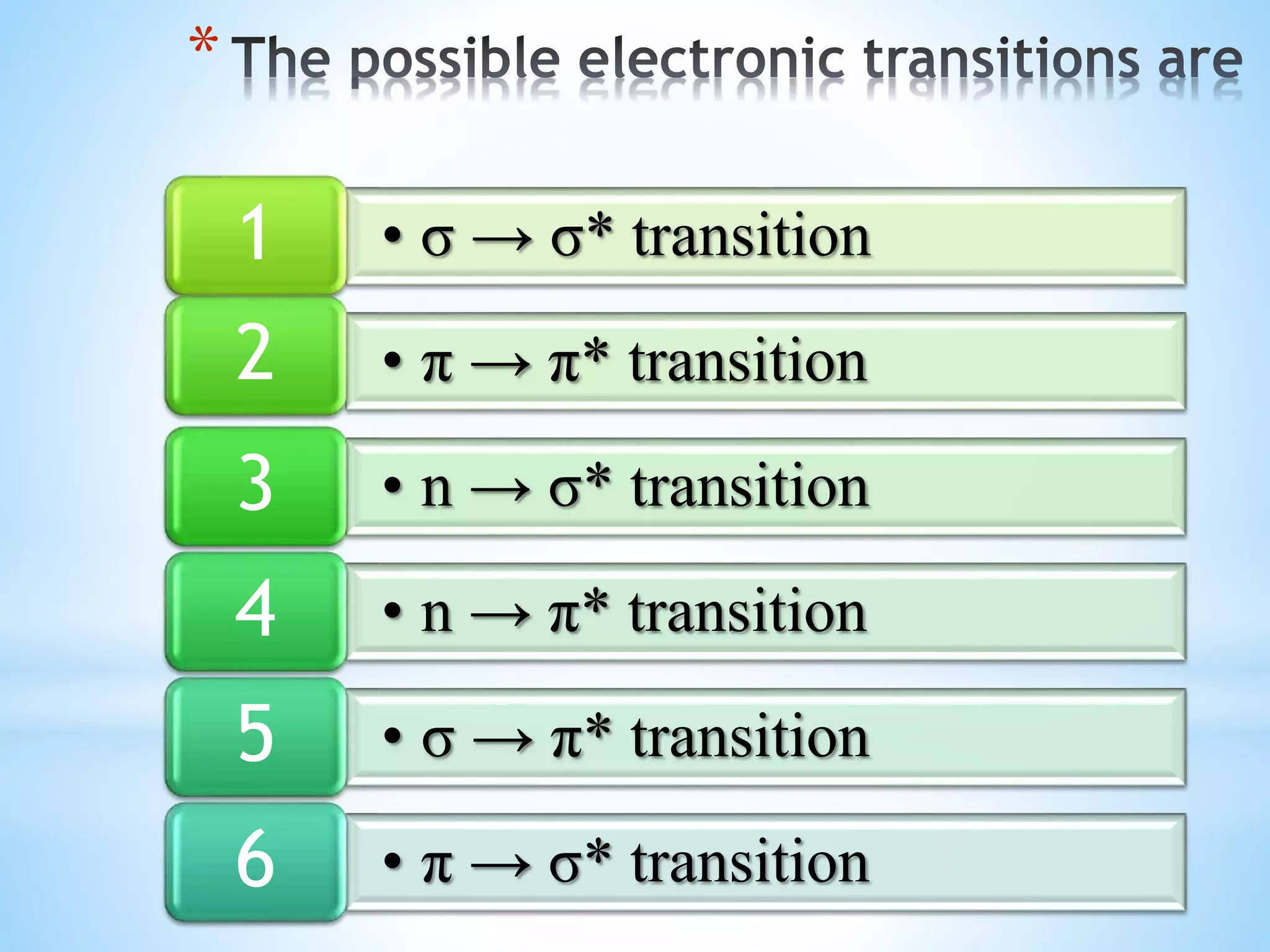
• σ → σ* transition1
• π → π* transition2
• n → σ* transition3
• n → π* transition4
• σ → π* transition5
• π → σ* transition6
*
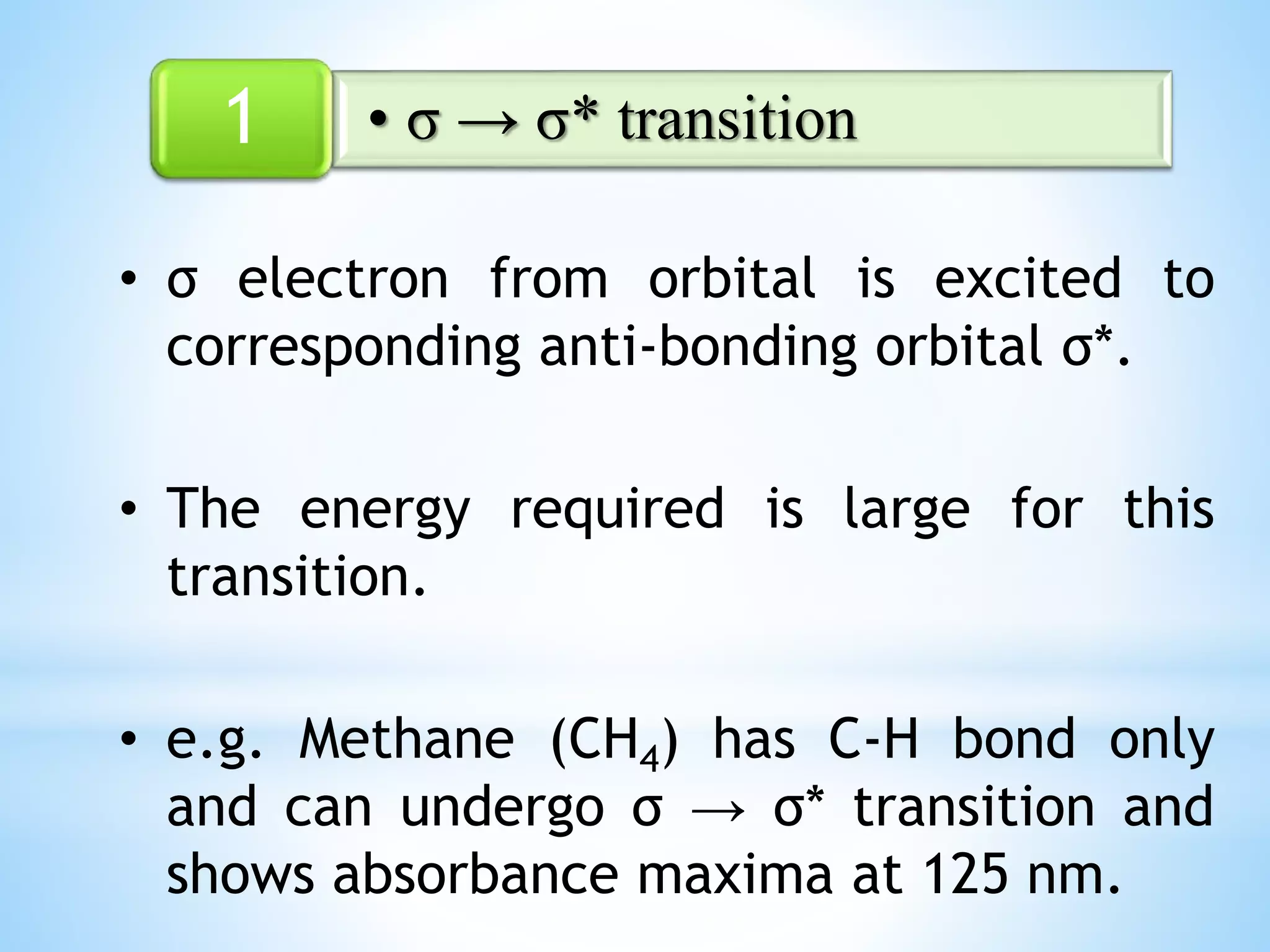
• σ electron from orbital is excited to
corresponding anti-bonding orbital σ*.
• The energy required is large for this
transition.
• e.g. Methane (CH4) has C-H bond only
and can undergo σ → σ* transition and
shows absorbance maxima at 125 nm.
• σ → σ* transition1
• π electron in a bonding orbital is excited
to corresponding anti-bonding orbital π*.
• Compounds containing multiple bonds
like alkenes, alkynes, carbonyl, nitriles,
aromatic compounds, etc undergo π →
π* transitions.
• e.g. Alkenes generally absorb in the
region 170 to 205 nm.
• π → π* transition2
• Saturated compounds containing atoms
with lone pair of electrons like O, N, S
and halogens are capable of n → σ*
transition.
• These transitions usually requires less
energy than σ → σ* transitions.
• The number of organic functional groups
with n → σ* peaks in UV region is small
(150 – 250 nm).
• n → σ* transition3
• An electron from non-bonding orbital is
promoted to anti-bonding π* orbital.
• Compounds containing double bond
involving hetero atoms (C=O, C≡N, N=O)
undergo such transitions.
• n → π* transitions require minimum
energy and show absorption at longer
wavelength around 300 nm.
• n → π* transition4
•These electronic transitions are forbidden
transitions & are only theoretically
possible.
•Thus, n → π* & π → π* electronic
transitions show absorption in region
above 200 nm which is accessible to UV-
visible spectrophotometer.
•The UV spectrum is of only a few broad of
absorption.
• σ → π* transition5
• π → σ* transition 6&
*LAWS GOVERNING
ABSORPTION OF
RADIATION
BEER’S LAW
Beer’s law states that “The intensity of
a beam of monochromatic light
decreases exponentially with increase
in the concentration of absorbing
species arithmetically”
-dI/dC α I
I=Intensity of incident light
C=concentration
The rate of decrease of intensity of
monochromatic light with the thickness of
medium is directly proportional to the
intensity of incident light.
i.e,
-di/dt α I
t=thickness or pathlength
I=intensity of incident light
LAMBERT’S LAW
On combining these two laws
A = Kct
A = Єct
A=absorbance or optical density or
extinction co-efficient
Є=molecular extinction co-efficient
c=concentration of drug
t=path length
These two laws are applicable under
following conditions.
I=Ia+It
• V
*COMMENT ON THERAPY

UV- VISIBLE SPECTROSCOPY BY Ann

  • 1.
    UV-VISIBLE SPECTROSCOPY *SPECTROSCOPY PRESENTED BY: ANJALI RARICHAN , 1st year MPHARM
  • 2.
    *SPECTROSCOPY is the measurementand interpretation of Electro Magnetic Radiation (EMR) absorbed or emitted when the molecules or atoms or ions of a sample move from one energy state to another energy state.
  • 3.
    *Electromagnetic Radiation *This radiationmay be regarded as energy propagated in a wave form. These radiations travel in space at enormous velocity. It consist of both electrical and magnetic vectors and hence it is named as electromagnetic radiation.
  • 4.
    * Frequency (ν): Itis defined as the number of waves passing through a point per second. The unit for frequency is Hertz (Hz). Wavelength (λ): It is the distance between the two successive peaks of waves, i.e. distance between two nearest crest or troughs. It is denoted by “lambda (λ).
  • 5.
    *ELECTROMAGNETIC SPECTRUM * Thearrangement of all types of electromagnetic radiations in order of their increasing wavelengths or decreasing frequencies is known as complete electromagnetic spectrum.
  • 6.
    *PRINCIPLE OF UV-VISIBLE SPECTROSCOPY *VISIBLE SPECTROSCOPY Colorimetry is concerned with the study of Absorption of visible radiation whose wavelength ranges from 400nm-800nm. Any Coloured substance will absorb radiation in this wavelength region. Coloured substances, absorb light of different wavelength in different manner and hence we get an absorption curve in a unique pattern for every coloured solution.
  • 7.
    *UV SPECTROSCOPY *Ultraviolet spectroscopyis concerned with the study of absorption of UV radiation which ranges from 200 to 400nm. Compounds which are coloured, absorb radiation from 400- 800nm. But compounds which are colourless absorb radiation in the UV region. In both UV as well as visible spectroscopy, only the valence electrons absorb the energy, thereby the molecule undergo transition from Ground state to excited state. Thus absorption is characteristic and depends on the nature of electrons present. The intensity of absorption depends on the concentration and path length.
  • 8.
    *ABSORPTION CURVE ANDCALIBRATION CURVE *Coloured substances , absorb light of different wavelength in different manner and hence we get an absorption curve(absorbance vs wavelength) in a unique pattern for every coloured solution. In this absorption curve, the wavelength at which maximum absorption of radiation takes place is called as λmax. It is characteristic or unique for every coloured substance and this is a qualitative aspect, useful in identifying the substance.
  • 9.
    * When weplot a graph of concentration Vs absorbance , we get a Calibration curve or Standard curve. This calibration curve is useful in determining the concentration or amount of a drug substance in the given sample solution or a formulation, by extrapolation or intrapolation and calculation.
  • 11.
  • 12.
  • 13.
    • σ →σ* transition1 • π → π* transition2 • n → σ* transition3 • n → π* transition4 • σ → π* transition5 • π → σ* transition6 *
  • 14.
    • σ electronfrom orbital is excited to corresponding anti-bonding orbital σ*. • The energy required is large for this transition. • e.g. Methane (CH4) has C-H bond only and can undergo σ → σ* transition and shows absorbance maxima at 125 nm. • σ → σ* transition1
  • 15.
    • π electronin a bonding orbital is excited to corresponding anti-bonding orbital π*. • Compounds containing multiple bonds like alkenes, alkynes, carbonyl, nitriles, aromatic compounds, etc undergo π → π* transitions. • e.g. Alkenes generally absorb in the region 170 to 205 nm. • π → π* transition2
  • 16.
    • Saturated compoundscontaining atoms with lone pair of electrons like O, N, S and halogens are capable of n → σ* transition. • These transitions usually requires less energy than σ → σ* transitions. • The number of organic functional groups with n → σ* peaks in UV region is small (150 – 250 nm). • n → σ* transition3
  • 17.
    • An electronfrom non-bonding orbital is promoted to anti-bonding π* orbital. • Compounds containing double bond involving hetero atoms (C=O, C≡N, N=O) undergo such transitions. • n → π* transitions require minimum energy and show absorption at longer wavelength around 300 nm. • n → π* transition4
  • 18.
    •These electronic transitionsare forbidden transitions & are only theoretically possible. •Thus, n → π* & π → π* electronic transitions show absorption in region above 200 nm which is accessible to UV- visible spectrophotometer. •The UV spectrum is of only a few broad of absorption. • σ → π* transition5 • π → σ* transition 6&
  • 19.
  • 20.
    BEER’S LAW Beer’s lawstates that “The intensity of a beam of monochromatic light decreases exponentially with increase in the concentration of absorbing species arithmetically” -dI/dC α I I=Intensity of incident light C=concentration
  • 21.
    The rate ofdecrease of intensity of monochromatic light with the thickness of medium is directly proportional to the intensity of incident light. i.e, -di/dt α I t=thickness or pathlength I=intensity of incident light LAMBERT’S LAW
  • 22.
    On combining thesetwo laws A = Kct A = Єct A=absorbance or optical density or extinction co-efficient Є=molecular extinction co-efficient c=concentration of drug t=path length These two laws are applicable under following conditions. I=Ia+It
  • 23.