Uveitis.
Part 1
Dr. Amr Mounir.MD
Lecturer of Ophthalmology
Sohag University
Background
Definition
Uveitis:
Inflammation of uveal tract (iris, ciliary
body & choroid)
Types:
1- Anterior uveitis
2-Intermediate uveitis
3- Posterior uveitis
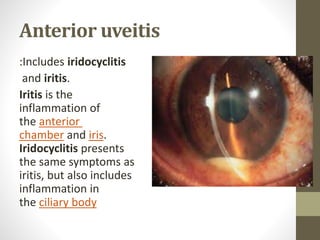
Anterior uveitis
:Includes iridocyclitis
and iritis.
Iritis is the
inflammation of
the anterior
chamber and iris.
Iridocyclitis presents
the same symptoms as
iritis, but also includes
inflammation in
the ciliary body
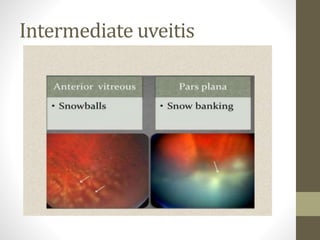
Intermediate uveitis
also known as pars planitis, consists of
vitritis—which is inflammation of cells in the
vitreous cavity, sometimes with snowbanking,
or deposition of inflammatory material on
the pars plana. There are also "snowballs,"
which are inflammatory cells in the vitreous.
Posterior uveitis
- Posterior uveitis:
Chorioretinitis
is the inflammation of
the retina and choroid.
- Pan-uveitis is the
inflammation of all
layers of the uvea
Clinical picture
o Respiratory symptoms ……..TB, Sarcoidosis.
o Skin problems accompanied by uveitis
erythema nodosum (arms +chin) >>>> Sarcoid & Bechet
oral & genital ulcers >> Bechet
o Joint disease
AS……….20% ant.uveitis
juvenile chronic arthritis
Reiter syndrome………..
Bowel problems
Signs
• Visual acuity may reduced
• ciliary injection
• Anterior uveitis:
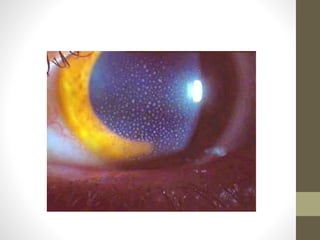
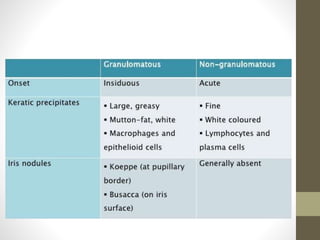
• Keratitic precipitates
• Inflam. Cells maybe visible as clumps on endothelial of
cornea (mostly Inferior)
• On slit lamp exam.
Flare & hypopyon in severe inflammation.
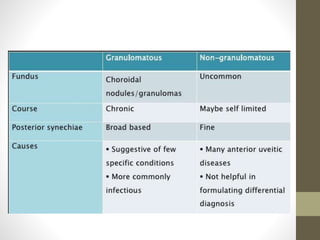
Posterior synechia
Signs
• Intermediate and posterior uveitis
• Cells in the vitreous
• Macular edema
• Grading of aqueous cells
• Slit-lamp grading of aqueous cells (1 mm ×
3–4 mm beam)
Trace……………… 1-5 cells
+1 …………………. 6-15
+2 …………………. 16-25
+3 ……………………. 26-50
+4 …………………….. >50
Etiology
• Idiopathic
• Infections
• Systemic immune-mediated disease (40%)
• Syndromes confined primarily to the eye
• Masquerade syndromes
• 30% of patients don’t fit an well-defined
disease category
Investigations
Main aim : determine systemic association
Investigation should be guided by medical
History & General Examination:
1. Pt with first episode of non granulomatous iritis with no past
medical History & no systemic signs…so investigations are
not indicated
2. Recurrent persistent iritis with unusual severity, not
responsive to medical therapy or bilateral……….so here
investigation is needed
Ancillary tests
1- Ultrasound biomicroscopy (UBM): Ciliary body involvement
can best be confirmed by ultrasound biomicroscopy (UBM).
2- Fundus fluorescein angiography (FA): is mandatory for retinal
and choroidal lesions.
The FA allows identification of active inflammation of the retinal
vessels as seen in vasculitis.
The pattern of staining and leakage provides diagnostic clues.
Vascular occlusions can also be detected
Complications of uveitis that are best studied on FA include
cystoid macular edema (CME), neovascularization of retina
3-Indocyanine green angiography (ICGA): is the technique of
choice for imaging the choroid.
4-Optical coherence tomography (OCT):
CME, neovascularization of retina, epiretinal membrane, or
Vitreomacular traction syndrome can be demonstrated well
Lab. Investigations
•CBC count
•Erythrocyte sedimentation rate (ESR)
•Antinuclear antibody (ANA)
•Rapid plasma reagin (RPR)
•Venereal disease research laboratory (VDRL)
•Purified protein derivative (PPD)
•Lyme titer
•HLA-B27
•Urinalysis
•HIV test
Imaging studies
1. Chest X ray to rule out sarcoidosis & TB
2. Chest CT done if we have –ve chest X
ray but sarcoidosis still highly
suspected
3. Sacroiliac radiograph , if AS is suspected
10 Clinical Pearls for Treating
Uveitis By American A.O
1-Anatomical location of the inflammation.
2- Patient’s current treatments and medications.
3-A targeted review of systems.
4-A careful examination for depth of inflammation.
5-The workup.
6-Corticosteroids are the mainstay of therapy.
7- Prolonged therapy with prednisone, especially at doses
greater than 10 mg daily, can have significant side effects.
8-Uveitis patients are frequently steroid responders.
9-New approaches in immunotherapy involve more cellular-
specific targeting, such as T-cells.
Lastly:
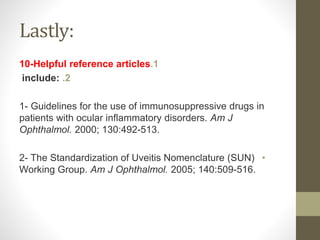
.110-Helpful reference articles
.2include:
1- Guidelines for the use of immunosuppressive drugs in
patients with ocular inflammatory disorders. Am J
Ophthalmol. 2000; 130:492-513.
•2- The Standardization of Uveitis Nomenclature (SUN)
Working Group. Am J Ophthalmol. 2005; 140:509-516.
 Aims:
1. relief pain & inflammation
2. prevent ocular structural damage
3. prevent visual loss & retinal or optic
damage
Include:
 Cycloplegia
Long acting cycloplegic agents (cyclopentolate ,
hematropine )used to relief pain& photophobia by
mydriasis
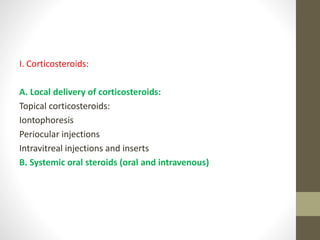
I. Corticosteroids:
A. Local delivery of corticosteroids:
Topical corticosteroids:
Iontophoresis
Periocular injections
Intravitreal injections and inserts
B. Systemic oral steroids (oral and intravenous)
II. Immunosuppressants
III. Biologics
IV. Adjuvant therapy:
Cycloplegic
Newer nonsteroidal anti-inflammatory agents
Anti-vascular endothelial growth factor (anti-VEGF) therapy
bevacizumab , ranibizumab
V. Current concepts in infectious uveitis management
Corticosteroids
1. Topical , is the mainstays of therapy used aggressively esp. in
initial phases of therapy ,
- “soft steroids” eg: fluorometholone, rimexolone, and
loteprednol etabonate
-difluprednate (0.05%) (difluoroprednisolone butyrate acetate)
-has greater glucocorticosteroid receptor binding
2. Subconjunctival injection , used if patient poorly complies
to topical type or iritis not respond to topical ttt alone
3. Oral corticosteroid maybe necessary in severe cases of iritis
and post uveitis
Topical steroids
Systemic steroids
Immunosuppressive agents
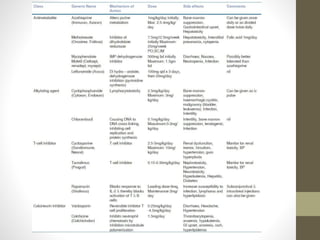
Immunosuppressive drugs can be classified as antimetabolites,
T cell inhibitors, and alkylating agents.
These drugs take many weeks to have an effect, so initial
therapy of ocular inflammation typically include high dose of
systemic steroids.
Immunosuppressive therapy can be started simultaneously with
corticosteroids in severe cases or during the tapering of oral
corticosteroids 4–8 weeks later in cases of chronic uveitis.
Biologics
Anti-tumor Necrosis Factor-alpha (Anti TNFα) Therapies:
etanercept, infliximab, and adalimumab
Interferons (IFN)
Intravenous Immunoglobulin
Anti-interleukin Therapies:
Daclizumab is a humanized monoclonal antibody against the
interleukin (IL)-2 receptor.
Biologic therapy provides new options for the treatment
of refractory uveitis, showing a favorable safety and
efficacy profile.
Adjuvant Therapy
To provide symptomatic relief for pain and discomfort and
break the posterior synechiae, the following cycloplegics can be
used:
Short acting cycloplegics:
Tropicamide (0.5 and 1%) has a duration of 6 hours
Cyclopentolate (0.5 and 1%) has a duration of 24 hours
Long acting cycloplegics:
Homatropine 2% has a duration of up to 2 days
Atropine 1% is the most powerful cycloplegic and mydriatic with
duration of up to 2 weeks.
NSAIDs
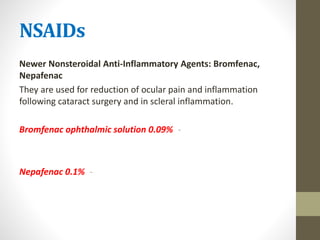
Newer Nonsteroidal Anti-Inflammatory Agents: Bromfenac,
Nepafenac
They are used for reduction of ocular pain and inflammation
following cataract surgery and in scleral inflammation.
-Bromfenac ophthalmic solution 0.09%
-Nepafenac 0.1%
Vitrectomy
Vitrectomy
1- Diagnostic vitrectomy combined with PCR in idiopathic
uveitis
2- Therapeutic vitrectomy:
Indications :
1) Uveitis persists despite maximum tolerable medical
treatment
2) In complications of long standing inflammations, a densely
opacified vitreous, scar tissue pulling on the ciliary body causing
hypotony, cystoid macular edema, an epiretinal membrane, a
dense posterior lens capsule opacification or a Tractional retinal
detachment
3) Vitrectomy removes the lodged lymphocytes in the vitreous,
inflammatory debris, immune complexes and autoantigens.
Thank you

Uveitis

  • 1.
    Uveitis. Part 1 Dr. AmrMounir.MD Lecturer of Ophthalmology Sohag University
  • 2.
  • 3.
    Definition Uveitis: Inflammation of uvealtract (iris, ciliary body & choroid) Types: 1- Anterior uveitis 2-Intermediate uveitis 3- Posterior uveitis
  • 4.
    Anterior uveitis :Includes iridocyclitis andiritis. Iritis is the inflammation of the anterior chamber and iris. Iridocyclitis presents the same symptoms as iritis, but also includes inflammation in the ciliary body
  • 5.
  • 6.
    Intermediate uveitis also knownas pars planitis, consists of vitritis—which is inflammation of cells in the vitreous cavity, sometimes with snowbanking, or deposition of inflammatory material on the pars plana. There are also "snowballs," which are inflammatory cells in the vitreous.
  • 7.
    Posterior uveitis - Posterioruveitis: Chorioretinitis is the inflammation of the retina and choroid. - Pan-uveitis is the inflammation of all layers of the uvea
  • 8.
    Clinical picture o Respiratorysymptoms ……..TB, Sarcoidosis. o Skin problems accompanied by uveitis erythema nodosum (arms +chin) >>>> Sarcoid & Bechet oral & genital ulcers >> Bechet o Joint disease AS……….20% ant.uveitis juvenile chronic arthritis Reiter syndrome……….. Bowel problems
  • 9.
    Signs • Visual acuitymay reduced • ciliary injection • Anterior uveitis: • Keratitic precipitates • Inflam. Cells maybe visible as clumps on endothelial of cornea (mostly Inferior) • On slit lamp exam. Flare & hypopyon in severe inflammation. Posterior synechia
  • 10.
  • 12.
    • Intermediate andposterior uveitis • Cells in the vitreous • Macular edema
  • 13.
    • Grading ofaqueous cells • Slit-lamp grading of aqueous cells (1 mm × 3–4 mm beam) Trace……………… 1-5 cells +1 …………………. 6-15 +2 …………………. 16-25 +3 ……………………. 26-50 +4 …………………….. >50
  • 16.
    Etiology • Idiopathic • Infections •Systemic immune-mediated disease (40%) • Syndromes confined primarily to the eye • Masquerade syndromes • 30% of patients don’t fit an well-defined disease category
  • 17.
    Investigations Main aim :determine systemic association Investigation should be guided by medical History & General Examination: 1. Pt with first episode of non granulomatous iritis with no past medical History & no systemic signs…so investigations are not indicated 2. Recurrent persistent iritis with unusual severity, not responsive to medical therapy or bilateral……….so here investigation is needed
  • 18.
    Ancillary tests 1- Ultrasoundbiomicroscopy (UBM): Ciliary body involvement can best be confirmed by ultrasound biomicroscopy (UBM). 2- Fundus fluorescein angiography (FA): is mandatory for retinal and choroidal lesions. The FA allows identification of active inflammation of the retinal vessels as seen in vasculitis. The pattern of staining and leakage provides diagnostic clues. Vascular occlusions can also be detected Complications of uveitis that are best studied on FA include cystoid macular edema (CME), neovascularization of retina 3-Indocyanine green angiography (ICGA): is the technique of choice for imaging the choroid.
  • 19.
    4-Optical coherence tomography(OCT): CME, neovascularization of retina, epiretinal membrane, or Vitreomacular traction syndrome can be demonstrated well
  • 20.
    Lab. Investigations •CBC count •Erythrocytesedimentation rate (ESR) •Antinuclear antibody (ANA) •Rapid plasma reagin (RPR) •Venereal disease research laboratory (VDRL) •Purified protein derivative (PPD) •Lyme titer •HLA-B27 •Urinalysis •HIV test
  • 21.
    Imaging studies 1. ChestX ray to rule out sarcoidosis & TB 2. Chest CT done if we have –ve chest X ray but sarcoidosis still highly suspected 3. Sacroiliac radiograph , if AS is suspected
  • 27.
    10 Clinical Pearlsfor Treating Uveitis By American A.O 1-Anatomical location of the inflammation. 2- Patient’s current treatments and medications. 3-A targeted review of systems. 4-A careful examination for depth of inflammation. 5-The workup. 6-Corticosteroids are the mainstay of therapy. 7- Prolonged therapy with prednisone, especially at doses greater than 10 mg daily, can have significant side effects. 8-Uveitis patients are frequently steroid responders. 9-New approaches in immunotherapy involve more cellular- specific targeting, such as T-cells.
  • 28.
    Lastly: .110-Helpful reference articles .2include: 1-Guidelines for the use of immunosuppressive drugs in patients with ocular inflammatory disorders. Am J Ophthalmol. 2000; 130:492-513. •2- The Standardization of Uveitis Nomenclature (SUN) Working Group. Am J Ophthalmol. 2005; 140:509-516.
  • 29.
     Aims: 1. reliefpain & inflammation 2. prevent ocular structural damage 3. prevent visual loss & retinal or optic damage Include:  Cycloplegia Long acting cycloplegic agents (cyclopentolate , hematropine )used to relief pain& photophobia by mydriasis
  • 30.
    I. Corticosteroids: A. Localdelivery of corticosteroids: Topical corticosteroids: Iontophoresis Periocular injections Intravitreal injections and inserts B. Systemic oral steroids (oral and intravenous)
  • 31.
    II. Immunosuppressants III. Biologics IV.Adjuvant therapy: Cycloplegic Newer nonsteroidal anti-inflammatory agents Anti-vascular endothelial growth factor (anti-VEGF) therapy bevacizumab , ranibizumab V. Current concepts in infectious uveitis management
  • 32.
    Corticosteroids 1. Topical ,is the mainstays of therapy used aggressively esp. in initial phases of therapy , - “soft steroids” eg: fluorometholone, rimexolone, and loteprednol etabonate -difluprednate (0.05%) (difluoroprednisolone butyrate acetate) -has greater glucocorticosteroid receptor binding 2. Subconjunctival injection , used if patient poorly complies to topical type or iritis not respond to topical ttt alone 3. Oral corticosteroid maybe necessary in severe cases of iritis and post uveitis
  • 33.
  • 34.
  • 35.
    Immunosuppressive agents Immunosuppressive drugscan be classified as antimetabolites, T cell inhibitors, and alkylating agents. These drugs take many weeks to have an effect, so initial therapy of ocular inflammation typically include high dose of systemic steroids. Immunosuppressive therapy can be started simultaneously with corticosteroids in severe cases or during the tapering of oral corticosteroids 4–8 weeks later in cases of chronic uveitis.
  • 37.
    Biologics Anti-tumor Necrosis Factor-alpha(Anti TNFα) Therapies: etanercept, infliximab, and adalimumab Interferons (IFN) Intravenous Immunoglobulin Anti-interleukin Therapies: Daclizumab is a humanized monoclonal antibody against the interleukin (IL)-2 receptor. Biologic therapy provides new options for the treatment of refractory uveitis, showing a favorable safety and efficacy profile.
  • 38.
    Adjuvant Therapy To providesymptomatic relief for pain and discomfort and break the posterior synechiae, the following cycloplegics can be used: Short acting cycloplegics: Tropicamide (0.5 and 1%) has a duration of 6 hours Cyclopentolate (0.5 and 1%) has a duration of 24 hours Long acting cycloplegics: Homatropine 2% has a duration of up to 2 days Atropine 1% is the most powerful cycloplegic and mydriatic with duration of up to 2 weeks.
  • 39.
    NSAIDs Newer Nonsteroidal Anti-InflammatoryAgents: Bromfenac, Nepafenac They are used for reduction of ocular pain and inflammation following cataract surgery and in scleral inflammation. -Bromfenac ophthalmic solution 0.09% -Nepafenac 0.1%
  • 40.
  • 41.
    Vitrectomy 1- Diagnostic vitrectomycombined with PCR in idiopathic uveitis 2- Therapeutic vitrectomy: Indications : 1) Uveitis persists despite maximum tolerable medical treatment 2) In complications of long standing inflammations, a densely opacified vitreous, scar tissue pulling on the ciliary body causing hypotony, cystoid macular edema, an epiretinal membrane, a dense posterior lens capsule opacification or a Tractional retinal detachment 3) Vitrectomy removes the lodged lymphocytes in the vitreous, inflammatory debris, immune complexes and autoantigens.
  • 42.