DEPT. OF OPTHALMOLOGY SHER-E-BANGLA MEDICAL COLLEGE HOSPITAL, BARISAL. 
OCULAR TRAUMA 
DR. MD. NURUL ISLAM 
DO STUDENT 
SESSION – JULY, 2013 
29-10-2013
Trauma 
Definitions from dictionary : 
• A deeply distressing or disturbing experience. 
• A serious injury or shock to the body, as from violence or an accident. 
• An event or situation that causes great distress and disruption.
Ocular Trauma 
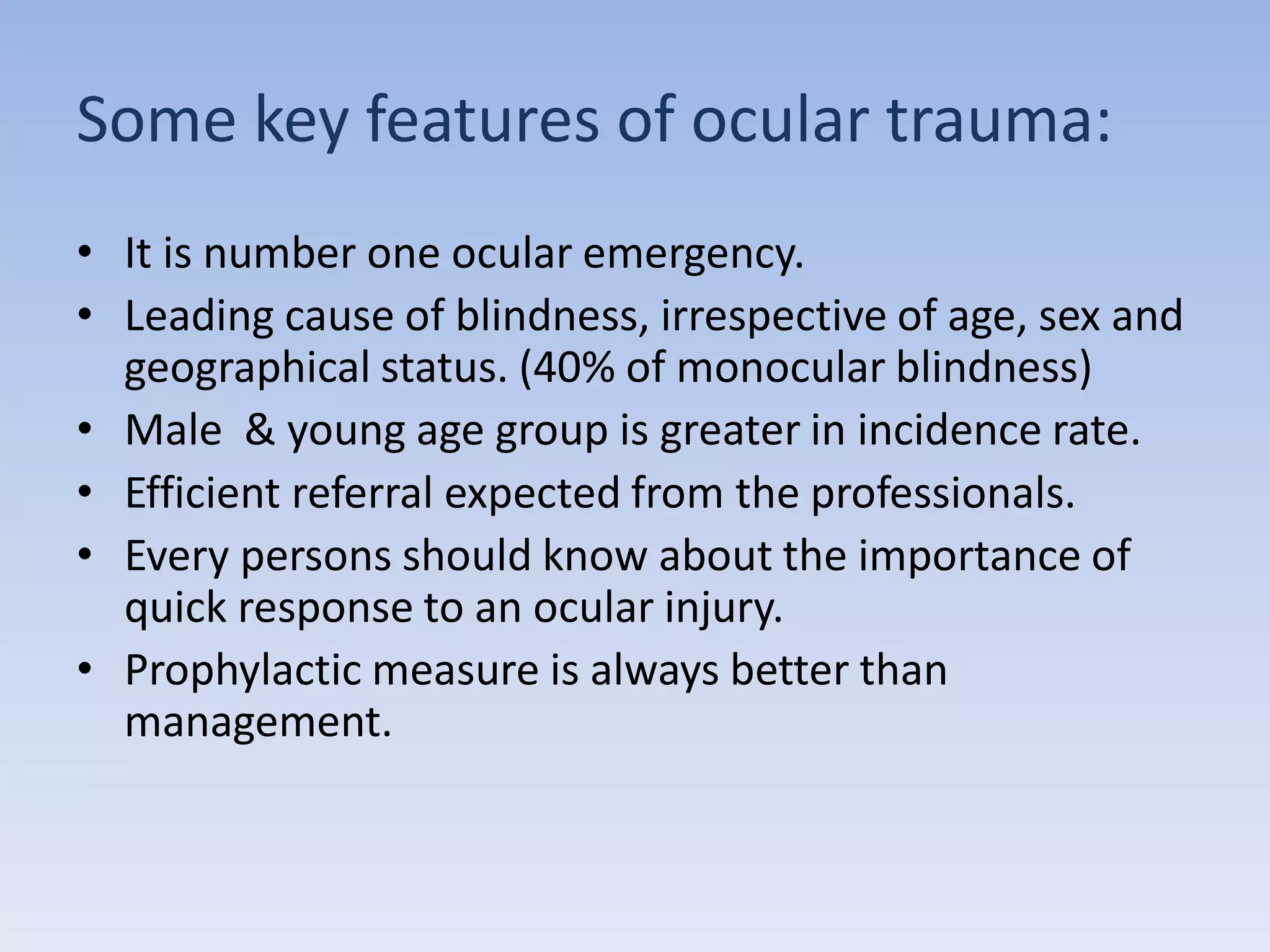
•The eye is protected from direct injury by lids, eyelashes and the projecting margins of the orbit. Nevertheless, it can be injured in a variety of ways; by chemicals, heat, radiation and mechanical trauma.
Some key features of ocular trauma: 
•It is number one ocular emergency. 
•Leading cause of blindness, irrespective of age, sex and geographical status. (40% of monocular blindness) 
•Male & young age group is greater in incidence rate. 
•Efficient referral expected from the professionals. 
•Every persons should know about the importance of quick response to an ocular injury. 
•Prophylactic measure is always better than management.
Classification of Trauma
•Etiological Classification - 
1. Accidental trauma. 
2. Self inflicted trauma. 
3. Occupational trauma.
•Classification according to nature- 
1. Physical trauma 
a. Perforating 
b. Nonperforating 
c. Blunt trauma 
2. Chemical trauma 
a. Acid 
b. Alkali 
c. Dye (Salt of acid or alkali)
3. Thermal trauma 
a. Heat 
b. Cold 
4. Radiation trauma 
a. Ionizing agents 
b. Ultra violet rays 
c. Laser burn 
5. Miscellaneous
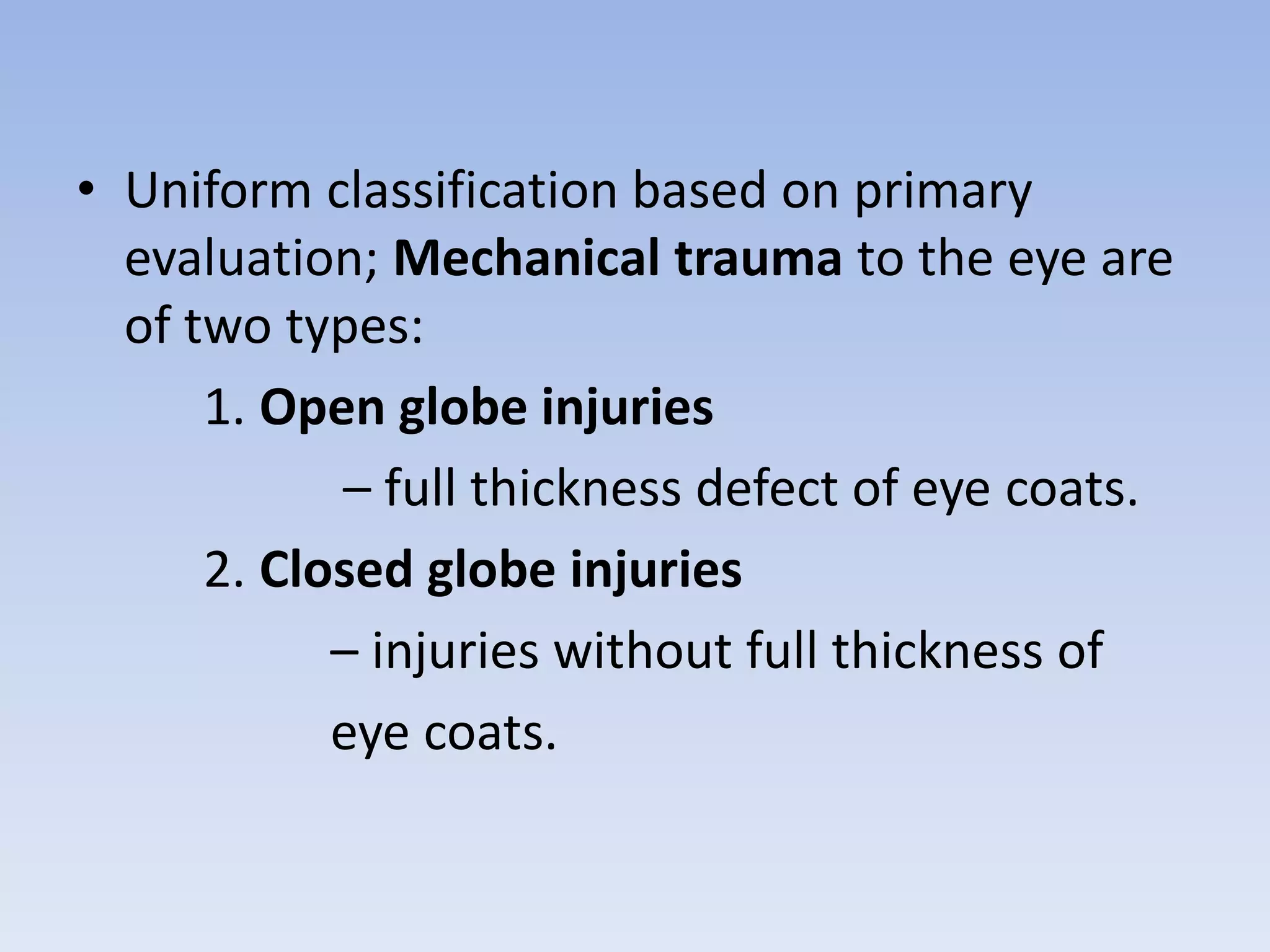
•Uniform classification based on primary evaluation; Mechanical trauma to the eye are of two types: 
1. Open globe injuries 
– full thickness defect of eye coats. 
2. Closed globe injuries 
– injuries without full thickness of 
eye coats.
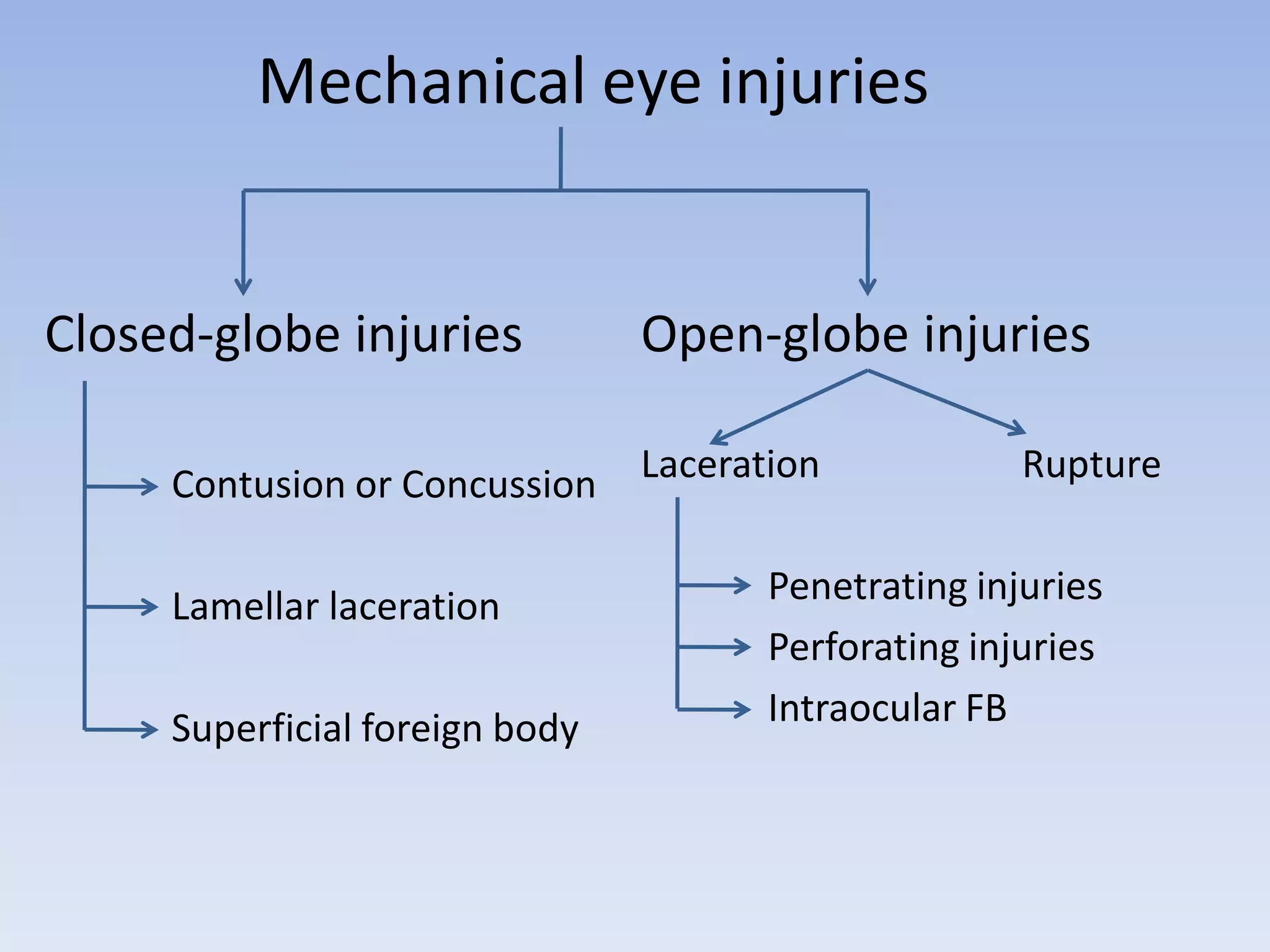
Mechanical eye injuries 
Closed-globe injuries 
Contusion or Concussion 
Lamellar laceration 
Superficial foreign body 
Open-globe injuries 
Laceration Rupture 
Penetrating injuries 
Perforating injuries 
Intraocular FB
Assessment: 
•History- 
- should be detailed as possible 
- time & nature of injury 
- missile,blunt,?FB remaining,chemical etc. 
- Past ocular history - VA, lid function 
- Immunization history 
•Rule out life threatening injuries 
•Rule out globe threatening injuries 
•Examine both eyes 
•Documentation +/- photograph 
•Plan for repair
Eyelid trauma
•Periocular Haematoma : 
- Generally innocuous but it is very important to exclude - 
1. Trauma to the globe or orbit 
2. Orbital roof fracture 
3. Basal skull fracture
Fig. (A) Periocular haematoma and oedema; (B) periocular haematoma and subconjunctival haemorrhage; (C) ‘panda eyes’
•Laceration : 
1. Superficial lacerations 
2. Lid margin lacerations 
3. Lacerations with mild tissue loss 
4. Lacerations with extensive tissue loss 
5. Canalicular lacerations
Fig. Lacerated eye injuries
Repair
•General principles of repair: 
1. Clean the wound 
2. Remove foreign body 
3. Careful handling of tissues 
4. Careful alignment of anatomy 
- lid margins,lash line,skin folds, etc. 
5. Close in layers 
6. Timing 
- Ideally within 12-24 hours of injury but can 
delay up to 1 week; pt’s factors, gross swelling 
7. Anaesthesia – GA / LA
Repairing procedure 
1.Superficial lacerations without gaping can be sutured with 5-0 / 6-0 black silk, removed after 5 days 
2.Lid margin laceration 
- Carefully align to prevent notching 
a. Align with 5-0 silk suture 
b. Close tarsal plate with fine 
absorbable suture (5-0 vicryl) 
c. Place additional marginal silk 
suture 
d. Close skin with multiple interrupted suture 
3.Lacerations with tissue loss 
- Primary closure and may also need a lateral cantholysis
Fig. Repairing lid margin lacerations
4.Canalicular lacerations repair: 
- Repair within 24 hours 
- Locate & approximate ends 
- Bridge the defect with silicone tubing 
- Leave the tube in situ for 3-6 months
•Complications - 
- Lid margin notching 
- Lagophthalmos 
- Hypertrophic scar 
- Infection 
- Tearing – canalicular damage, lid malposition, pump 
failure 
- Ptosis
Orbital fractures
Types : 
•Blow-out orbital floor fracture 
•Blow-out medial wall fracture 
•Roof fracture 
•Lateral wall fracture
•Blow-out orbital floor fracture 
Cause: 
Sudden increase in orbital pressure by an impacting object greater in diameter than the orbital aperture (>5 cm) 
e.g.- Fist, tennis ball etc.
Mechanism of an orbital floor blow-out fracture
Signs of orbital floor blow-out fracture 
•Periorbital ecchymosis, oedema and emphysema may also present 
•Infraorbital nerve anaesthesia 
•Ophthalmoplegia tipically in up and down-gaze (double diplopia) 
•Enophthalmos – if severe
Investigations 
• Right blow-out fracture with ‘tear-drop’ sign 
• Restriction of right upgaze and downgaze 
• Secondary overaction of left eye 
Coronal CT scan 
Hess test
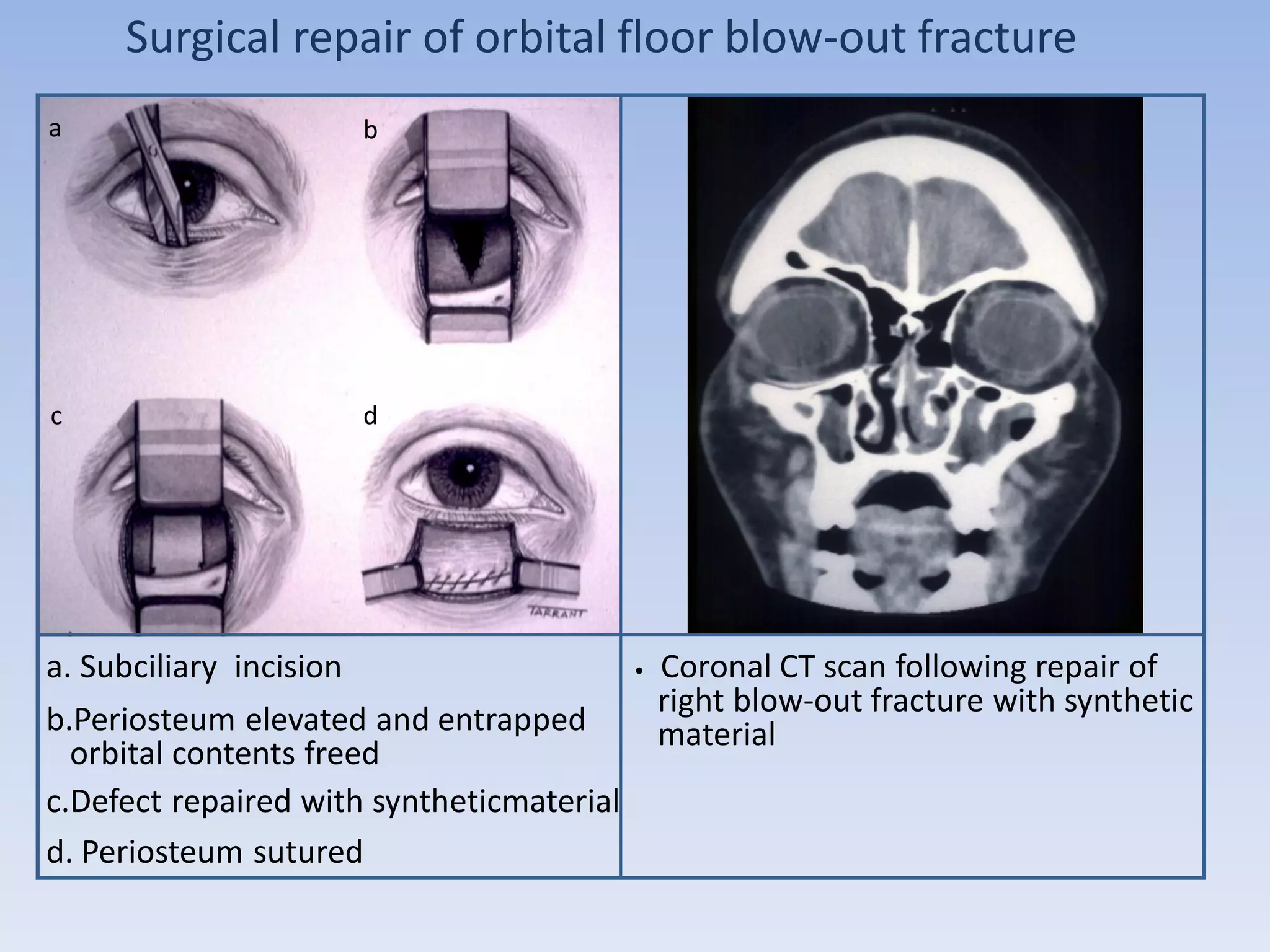
Surgical repair of orbital floor blow-out fracture 
a. Subciliary incision 
• Coronal CT scan following repair of right blow-out fracture with synthetic material 
b.Periosteum elevated and entrapped 
orbital contents freed 
c.Defect repaired with syntheticmaterial 
d. Periosteum sutured a 
b 
c 
d
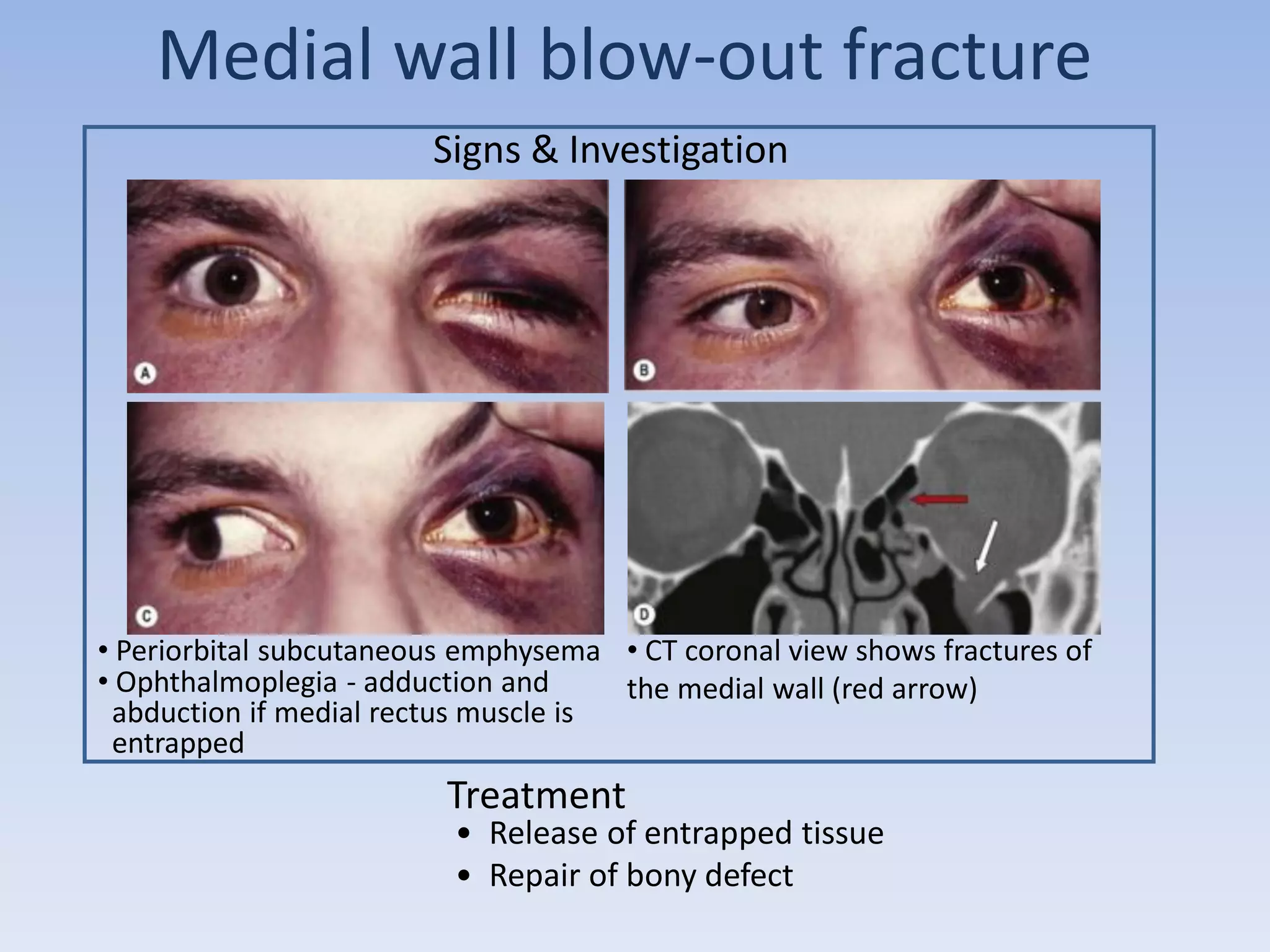
Medial wall blow-out fracture 
Signs & Investigation 
• Periorbital subcutaneous emphysema 
• Ophthalmoplegia - adduction and abduction if medial rectus muscle is entrapped 
• CT coronal view shows fractures of the medial wall (red arrow) 
Treatment 
• Release of entrapped tissue 
• Repair of bony defect
Trauma to the Globe
•Principles of Evaluation: 
1.Initial assessment 
a. Determination of nature, extent, life threatening problems 
b. History of the injury, including the circumstances, timing and likely object 
c. Thorough examination of eyes and the orbits 
2.Special investigations 
a. Plain X-ray 
b. CT scan 
c. MRI (Never if ferrous metalic FB) 
d. USG (B-scan)
Blunt Trauma
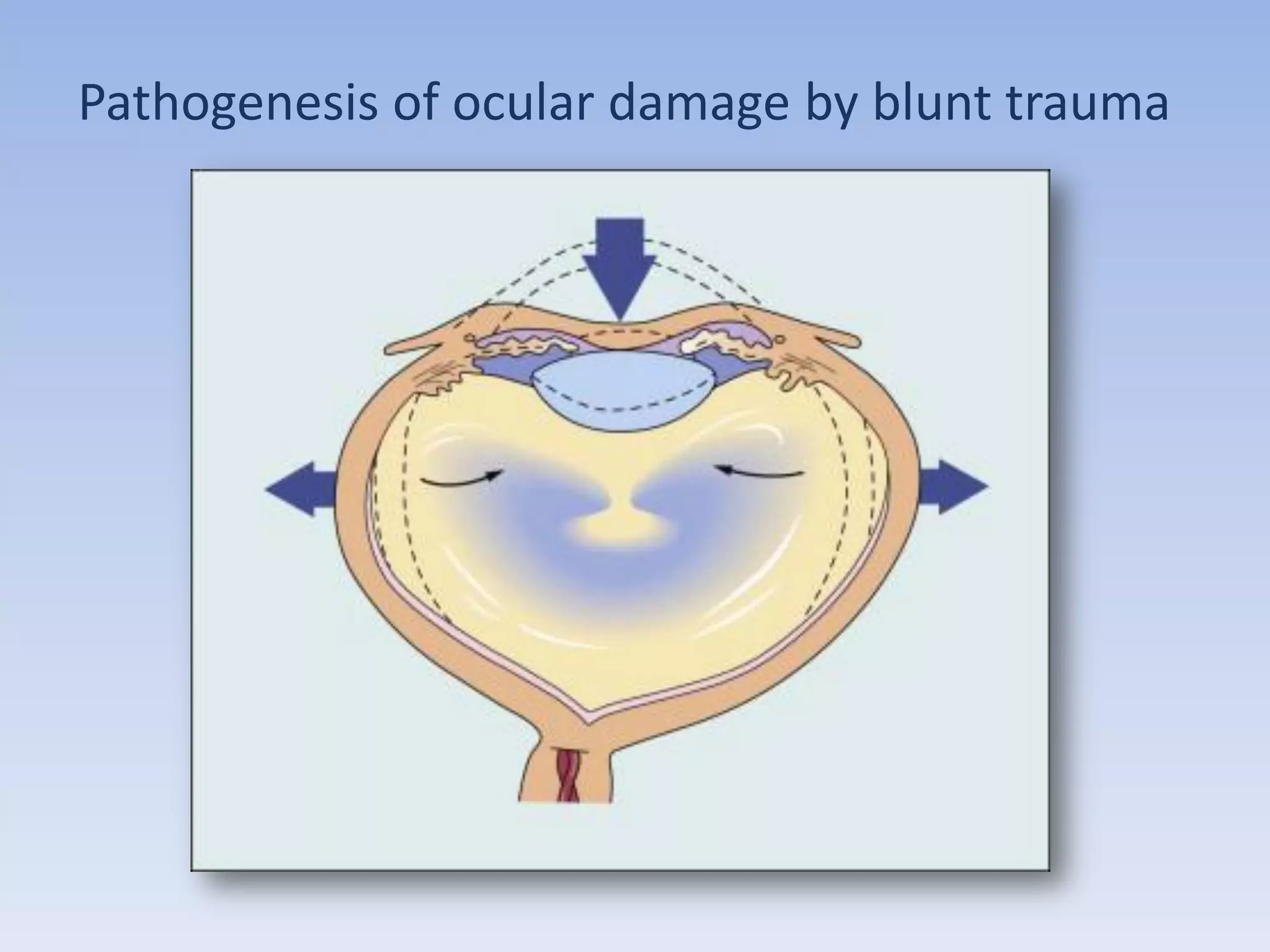
Pathogenesis of ocular damage by blunt trauma
Anterior segment complications of blunt trauma
•Corneal abrasion 
•Stromal oedema 
•Tears in Descemet membrane 
Corneal complications
• Traumatic hyphaema
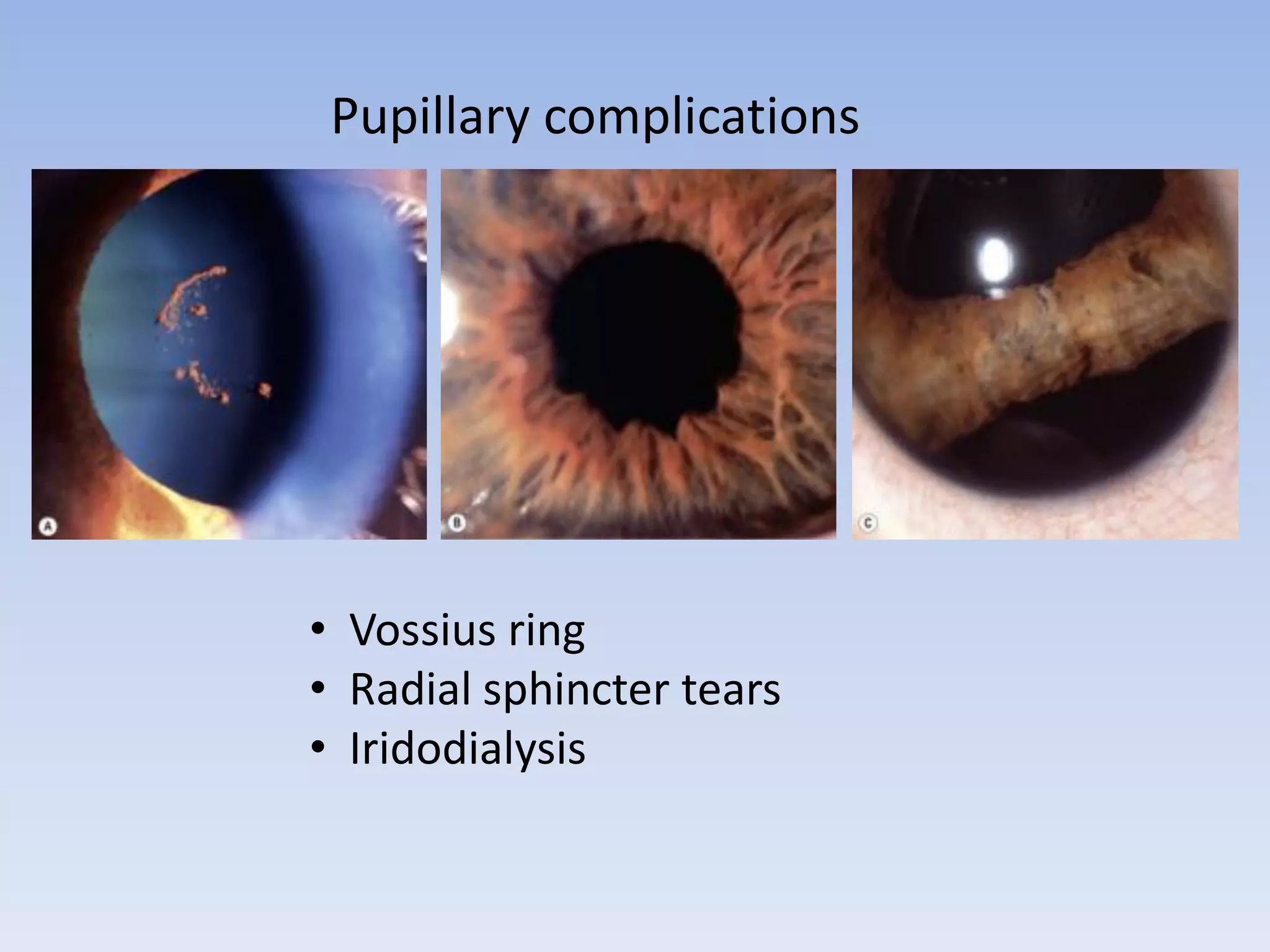
• Vossius ring 
• Radial sphincter tears 
• Iridodialysis 
Pupillary complications
• Cataract 
• Subluxation 
• Dislocation 
Lens complications of blunt trauma
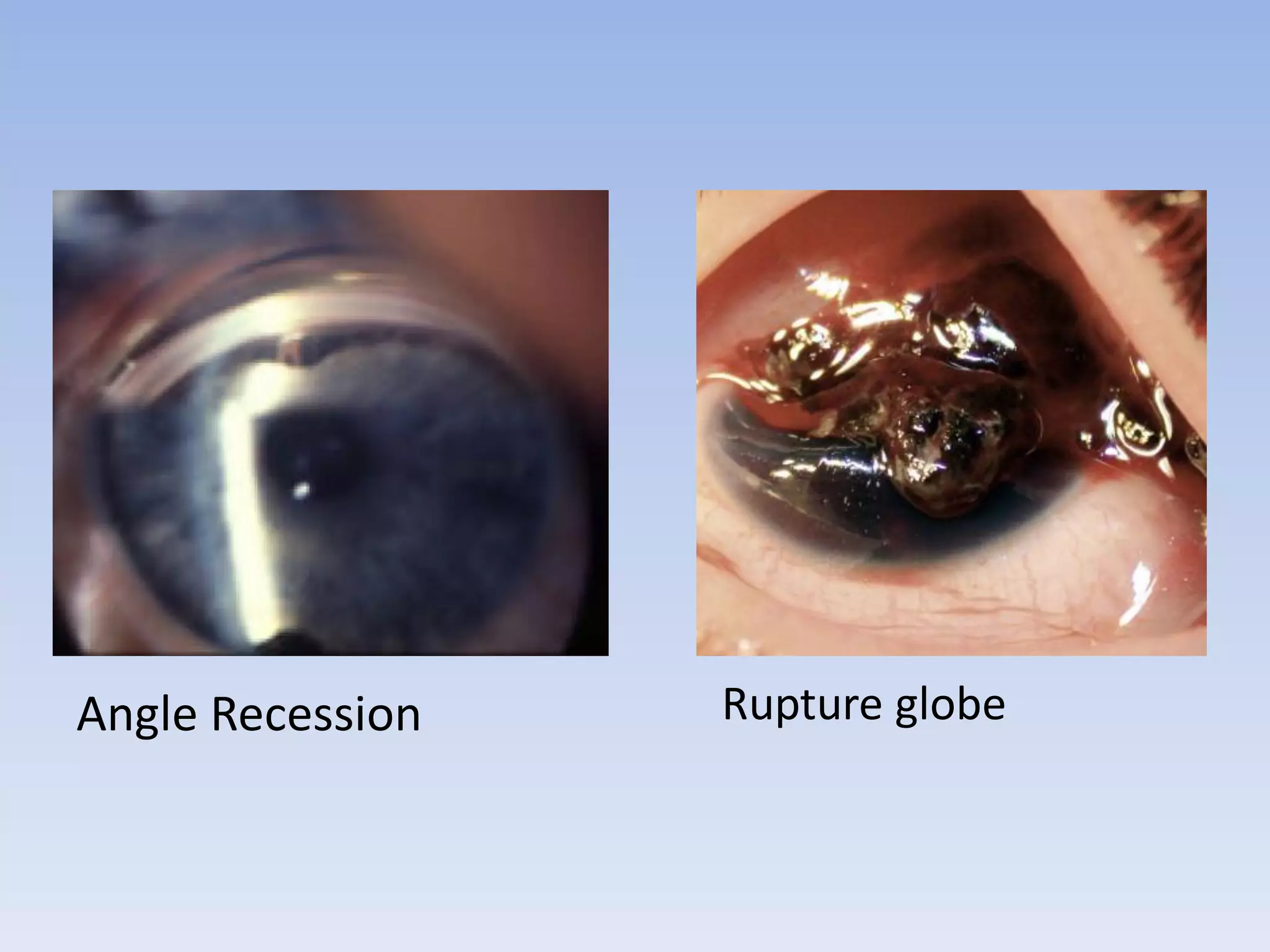
Angle Recession Rupture globe
Posterior segment complications of blunt trauma
Commotio retinae (A) Peripheral 
(B) central 
(C) macular hole following resolution
Choroidal rupture 
Acute with subretinal haemorrhage 
Old with secondary choroidal neovascularization
Retinal breaks and detachment 
Equatorial breaks Avulsion of the vitreous base with Dialysis 
Macular holes
Traumatic optic neuropathy (TON) 
Optic nerve avulsion
Penetrating trauma
Complications of penetrating trauma 
Penetrating corneal wounds 
Flat anterior chamber Small shelving with formed anterior chamber
Penetrating corneal wounds with lens damage 
with iris involvement
Anterior scleral laceration with ciliary and vitreous prolapse 
Scleral laceration with iridociliary prolapse
Vitreous haemorrhage 
Tractional retinal detachment
Foreign body
Superficial foreign body Subtarsal foreign body 
Corneal foreign body with surrounding cellular infiltration
•Management: 
a. Careful slit-lamp examination for exact position & depth 
b. Removal under slit-lamp with 26-gause needle 
c. Magnetic removal for a deeply embedded metallic foreign body 
c. Residual ‘rust ring’ may remove with sterile ‘burr’ 
d. Antibiotic oint. with cycloplegic and/or NSAIDs
Intraocular foreign body
Intraocular foreign body (A) In the lens 
(B) In the angle 
(C) in the anterior vitreous 
(D) on the retina
•Management: 
a. Accurate history- helpful for nature of FB 
b. Examination 
- Entry exit point 
- Gonioscopy & fundoscopy must 
- Documentation for damaged structure 
c. CT scan 
d. MRI contraindicated for metalic FB
Removal technique 
• Removal with magnet or by pars plana vitrectomy 
• with forceps either through the pars plana or limbus
Chemical Injury
Key features: 
•Majority of injuries are accidental 
•Few due to assault 
•2/3 rd of accidental burns occur at work place 
•Alkali burns are twice as common as acid 
•Alkali burns more severe than acid
Grading of severity of chemical injuries 
Grade I (excellent prognosis) 
•Clear cornea 
•Limbal ischaemia - nil 
Grade II (good prognosis) 
•Cornea hazy but visible iris details 
•Limbal ischaemia <1/3 
Grade III (guarded prognosis) 
•Hazy cornea with no iris details 
•Limbal ischaemia 1/3 to 1/2 
Grade IV (very poor prognosis) 
•Opaque cornea 
•Limbal ischaemia >1/2 
•G - II 
•G - III 
•G - IV
Medical Treatment of Chemical Injuries 
1.Copious irrigation (15-30 min) – to restore normal pH 
2.Topical steroids (first 7-10 days) – to reduce inflamation 
3.Topical and systemic ascorbic acid – to enhance collagen production 
4.Topical citric acid – to inhibit neutrophil activity 
5.Topical and systemic tetracycline – to inhibit collagenase and neutrophil activity 
6.Cycloplegia – to improve comfort
Surgical Management of Severe Chemical Injuries 
Treatment of severe corneal opacity by keratoplasty or keratoprosthesis 
Division of conjunctival bands 
Re-establish the fornices 
Correction of eyelid deformity
Thank You

Ocular trauma

  • 1.
    DEPT. OF OPTHALMOLOGYSHER-E-BANGLA MEDICAL COLLEGE HOSPITAL, BARISAL. OCULAR TRAUMA DR. MD. NURUL ISLAM DO STUDENT SESSION – JULY, 2013 29-10-2013
  • 2.
    Trauma Definitions fromdictionary : • A deeply distressing or disturbing experience. • A serious injury or shock to the body, as from violence or an accident. • An event or situation that causes great distress and disruption.
  • 3.
    Ocular Trauma •Theeye is protected from direct injury by lids, eyelashes and the projecting margins of the orbit. Nevertheless, it can be injured in a variety of ways; by chemicals, heat, radiation and mechanical trauma.
  • 4.
    Some key featuresof ocular trauma: •It is number one ocular emergency. •Leading cause of blindness, irrespective of age, sex and geographical status. (40% of monocular blindness) •Male & young age group is greater in incidence rate. •Efficient referral expected from the professionals. •Every persons should know about the importance of quick response to an ocular injury. •Prophylactic measure is always better than management.
  • 5.
  • 6.
    •Etiological Classification - 1. Accidental trauma. 2. Self inflicted trauma. 3. Occupational trauma.
  • 7.
    •Classification according tonature- 1. Physical trauma a. Perforating b. Nonperforating c. Blunt trauma 2. Chemical trauma a. Acid b. Alkali c. Dye (Salt of acid or alkali)
  • 8.
    3. Thermal trauma a. Heat b. Cold 4. Radiation trauma a. Ionizing agents b. Ultra violet rays c. Laser burn 5. Miscellaneous
  • 9.
    •Uniform classification basedon primary evaluation; Mechanical trauma to the eye are of two types: 1. Open globe injuries – full thickness defect of eye coats. 2. Closed globe injuries – injuries without full thickness of eye coats.
  • 10.
    Mechanical eye injuries Closed-globe injuries Contusion or Concussion Lamellar laceration Superficial foreign body Open-globe injuries Laceration Rupture Penetrating injuries Perforating injuries Intraocular FB
  • 11.
    Assessment: •History- -should be detailed as possible - time & nature of injury - missile,blunt,?FB remaining,chemical etc. - Past ocular history - VA, lid function - Immunization history •Rule out life threatening injuries •Rule out globe threatening injuries •Examine both eyes •Documentation +/- photograph •Plan for repair
  • 12.
  • 13.
    •Periocular Haematoma : - Generally innocuous but it is very important to exclude - 1. Trauma to the globe or orbit 2. Orbital roof fracture 3. Basal skull fracture
  • 14.
    Fig. (A) Periocularhaematoma and oedema; (B) periocular haematoma and subconjunctival haemorrhage; (C) ‘panda eyes’
  • 15.
    •Laceration : 1.Superficial lacerations 2. Lid margin lacerations 3. Lacerations with mild tissue loss 4. Lacerations with extensive tissue loss 5. Canalicular lacerations
  • 16.
  • 17.
  • 18.
    •General principles ofrepair: 1. Clean the wound 2. Remove foreign body 3. Careful handling of tissues 4. Careful alignment of anatomy - lid margins,lash line,skin folds, etc. 5. Close in layers 6. Timing - Ideally within 12-24 hours of injury but can delay up to 1 week; pt’s factors, gross swelling 7. Anaesthesia – GA / LA
  • 19.
    Repairing procedure 1.Superficiallacerations without gaping can be sutured with 5-0 / 6-0 black silk, removed after 5 days 2.Lid margin laceration - Carefully align to prevent notching a. Align with 5-0 silk suture b. Close tarsal plate with fine absorbable suture (5-0 vicryl) c. Place additional marginal silk suture d. Close skin with multiple interrupted suture 3.Lacerations with tissue loss - Primary closure and may also need a lateral cantholysis
  • 20.
    Fig. Repairing lidmargin lacerations
  • 21.
    4.Canalicular lacerations repair: - Repair within 24 hours - Locate & approximate ends - Bridge the defect with silicone tubing - Leave the tube in situ for 3-6 months
  • 22.
    •Complications - -Lid margin notching - Lagophthalmos - Hypertrophic scar - Infection - Tearing – canalicular damage, lid malposition, pump failure - Ptosis
  • 23.
  • 24.
    Types : •Blow-outorbital floor fracture •Blow-out medial wall fracture •Roof fracture •Lateral wall fracture
  • 25.
    •Blow-out orbital floorfracture Cause: Sudden increase in orbital pressure by an impacting object greater in diameter than the orbital aperture (>5 cm) e.g.- Fist, tennis ball etc.
  • 26.
    Mechanism of anorbital floor blow-out fracture
  • 27.
    Signs of orbitalfloor blow-out fracture •Periorbital ecchymosis, oedema and emphysema may also present •Infraorbital nerve anaesthesia •Ophthalmoplegia tipically in up and down-gaze (double diplopia) •Enophthalmos – if severe
  • 28.
    Investigations • Rightblow-out fracture with ‘tear-drop’ sign • Restriction of right upgaze and downgaze • Secondary overaction of left eye Coronal CT scan Hess test
  • 29.
    Surgical repair oforbital floor blow-out fracture a. Subciliary incision • Coronal CT scan following repair of right blow-out fracture with synthetic material b.Periosteum elevated and entrapped orbital contents freed c.Defect repaired with syntheticmaterial d. Periosteum sutured a b c d
  • 30.
    Medial wall blow-outfracture Signs & Investigation • Periorbital subcutaneous emphysema • Ophthalmoplegia - adduction and abduction if medial rectus muscle is entrapped • CT coronal view shows fractures of the medial wall (red arrow) Treatment • Release of entrapped tissue • Repair of bony defect
  • 31.
  • 32.
    •Principles of Evaluation: 1.Initial assessment a. Determination of nature, extent, life threatening problems b. History of the injury, including the circumstances, timing and likely object c. Thorough examination of eyes and the orbits 2.Special investigations a. Plain X-ray b. CT scan c. MRI (Never if ferrous metalic FB) d. USG (B-scan)
  • 33.
  • 34.
    Pathogenesis of oculardamage by blunt trauma
  • 35.
  • 36.
    •Corneal abrasion •Stromaloedema •Tears in Descemet membrane Corneal complications
  • 37.
  • 38.
    • Vossius ring • Radial sphincter tears • Iridodialysis Pupillary complications
  • 39.
    • Cataract •Subluxation • Dislocation Lens complications of blunt trauma
  • 40.
  • 41.
  • 42.
    Commotio retinae (A)Peripheral (B) central (C) macular hole following resolution
  • 43.
    Choroidal rupture Acutewith subretinal haemorrhage Old with secondary choroidal neovascularization
  • 44.
    Retinal breaks anddetachment Equatorial breaks Avulsion of the vitreous base with Dialysis Macular holes
  • 45.
    Traumatic optic neuropathy(TON) Optic nerve avulsion
  • 46.
  • 47.
    Complications of penetratingtrauma Penetrating corneal wounds Flat anterior chamber Small shelving with formed anterior chamber
  • 48.
    Penetrating corneal woundswith lens damage with iris involvement
  • 49.
    Anterior scleral lacerationwith ciliary and vitreous prolapse Scleral laceration with iridociliary prolapse
  • 50.
  • 51.
  • 52.
    Superficial foreign bodySubtarsal foreign body Corneal foreign body with surrounding cellular infiltration
  • 53.
    •Management: a. Carefulslit-lamp examination for exact position & depth b. Removal under slit-lamp with 26-gause needle c. Magnetic removal for a deeply embedded metallic foreign body c. Residual ‘rust ring’ may remove with sterile ‘burr’ d. Antibiotic oint. with cycloplegic and/or NSAIDs
  • 54.
  • 55.
    Intraocular foreign body(A) In the lens (B) In the angle (C) in the anterior vitreous (D) on the retina
  • 56.
    •Management: a. Accuratehistory- helpful for nature of FB b. Examination - Entry exit point - Gonioscopy & fundoscopy must - Documentation for damaged structure c. CT scan d. MRI contraindicated for metalic FB
  • 57.
    Removal technique •Removal with magnet or by pars plana vitrectomy • with forceps either through the pars plana or limbus
  • 58.
  • 59.
    Key features: •Majorityof injuries are accidental •Few due to assault •2/3 rd of accidental burns occur at work place •Alkali burns are twice as common as acid •Alkali burns more severe than acid
  • 60.
    Grading of severityof chemical injuries Grade I (excellent prognosis) •Clear cornea •Limbal ischaemia - nil Grade II (good prognosis) •Cornea hazy but visible iris details •Limbal ischaemia <1/3 Grade III (guarded prognosis) •Hazy cornea with no iris details •Limbal ischaemia 1/3 to 1/2 Grade IV (very poor prognosis) •Opaque cornea •Limbal ischaemia >1/2 •G - II •G - III •G - IV
  • 61.
    Medical Treatment ofChemical Injuries 1.Copious irrigation (15-30 min) – to restore normal pH 2.Topical steroids (first 7-10 days) – to reduce inflamation 3.Topical and systemic ascorbic acid – to enhance collagen production 4.Topical citric acid – to inhibit neutrophil activity 5.Topical and systemic tetracycline – to inhibit collagenase and neutrophil activity 6.Cycloplegia – to improve comfort
  • 62.
    Surgical Management ofSevere Chemical Injuries Treatment of severe corneal opacity by keratoplasty or keratoprosthesis Division of conjunctival bands Re-establish the fornices Correction of eyelid deformity
  • 63.