Secondary Ectasia..
How to interpret?
Subtitle
By
Dr. Amr Mounir, MD, PhD
Assistant Professor of Ophthalmology,
Sohag University .. Egypt
As we know…
- Laser corneal refractive surgery
became a very frequent
surgery..
So, It is important to differentiate
and diagnose varieties of normal and
abnormal Pentacam cases
Some Corneal Problems need further
investigations to be diagnosed..
Corneal ectasia
Definition:
Ectatic corneal disease (ECD) comprises a group of
disorders characterized by progressive thinning and
protrusion of the cornea, leading to visual impairment.
Types of corneal ectasia
- Primary:
Characterized by intrinsic structural abnormalities in the
cornea. e.g.; Keratoconus
- Secondary:
Corneal shape changes caused by external factors.
Causes of secondary ectasia
1- Post Lasik Ectasia
2- Post Penetrating Keratoplasty Ectasia
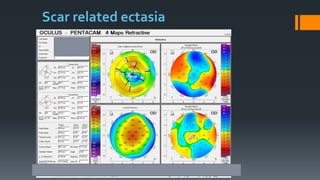
3- Scar related ectasia
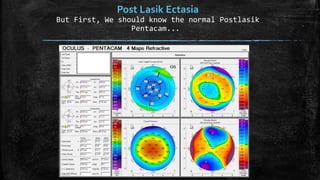
Post Lasik Ectasia
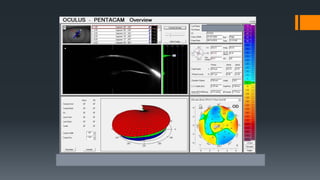
But First, We should know the normal Postlasik
Pentacam...
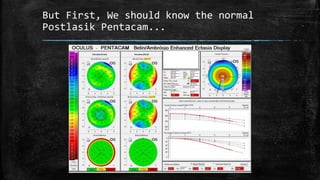
But First, We should know the normal
Postlasik Pentacam...
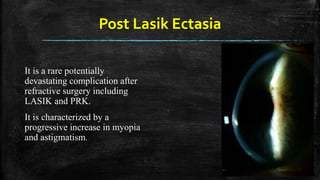
Post Lasik Ectasia
It is a rare potentially
devastating complication after
refractive surgery including
LASIK and PRK.
It is characterized by a
progressive increase in myopia
and astigmatism.
Risk factors:
- Young age
- High myopia (>8 diopters Ds)
- Low corneal thickness
- Low residual stromal bed thickness
- Preexisting suspicious corneal topography, forme fruste keratoconus, and
pellucid marginal degeneration
- Positive family history of ectasia
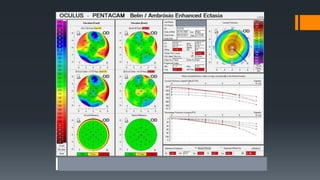
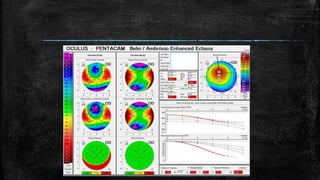
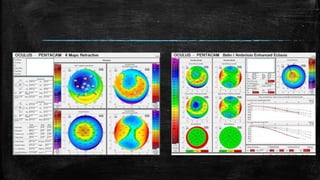
By Pentacam
Topographically;
Two stages:
1) Early post-Lasik ectasia.
2) Established post-Lasik ectasia.
3) Advanced post-Lasik ectasia.
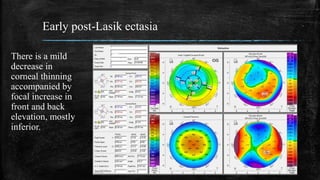
Early post-Lasik ectasia
There is a mild
decrease in
corneal thinning
accompanied by
focal increase in
front and back
elevation, mostly
inferior.
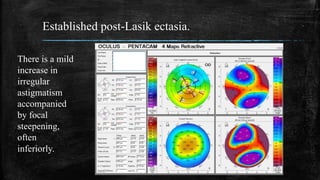
Established post-Lasik ectasia.
There is a mild
increase in
irregular
astigmatism
accompanied
by focal
steepening,
often
inferiorly.
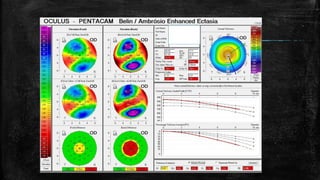
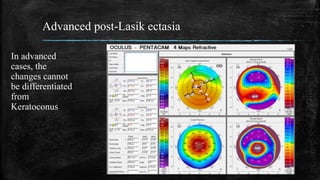
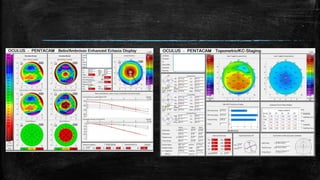
Advanced post-Lasik ectasia
In advanced
cases, the
changes cannot
be differentiated
from
Keratoconus
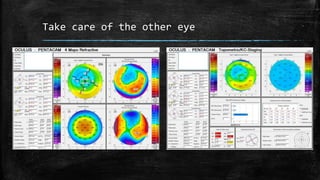
Take care of the other eye
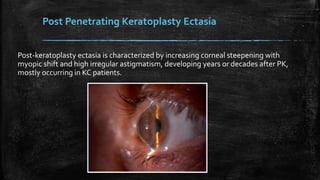
Post Penetrating Keratoplasty Ectasia
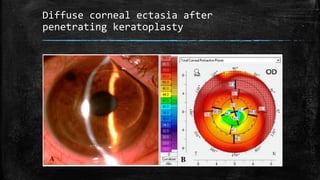
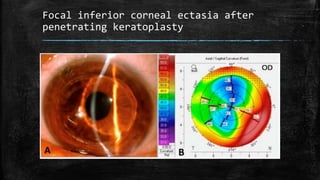
Post-keratoplasty ectasia is characterized by increasing corneal steepening with
myopic shift and high irregular astigmatism, developing years or decades after PK,
mostly occurring in KC patients.
Diffuse corneal ectasia after
penetrating keratoplasty
Focal inferior corneal ectasia after
penetrating keratoplasty
Scar related ectasia
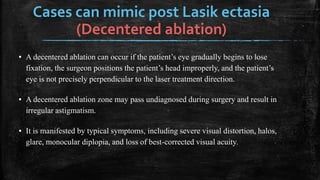
Cases can mimic post Lasik ectasia
(Decentered ablation)
▪ A decentered ablation can occur if the patient’s eye gradually begins to lose
fixation, the surgeon positions the patient’s head improperly, and the patient’s
eye is not precisely perpendicular to the laser treatment direction.
▪ A decentered ablation zone may pass undiagnosed during surgery and result in
irregular astigmatism.
▪ It is manifested by typical symptoms, including severe visual distortion, halos,
glare, monocular diplopia, and loss of best-corrected visual acuity.
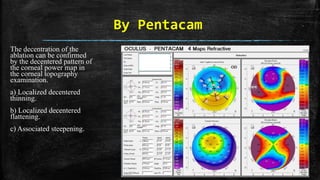
By Pentacam
The decentration of the
ablation can be confirmed
by the decentered pattern of
the corneal power map in
the corneal topography
examination.
a) Localized decentered
thinning.
b) Localized decentered
flattening.
c) Associated steepening.
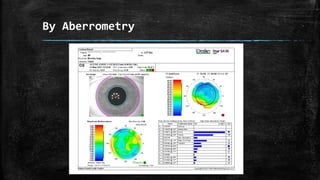
By Aberrometry
Thank You

Secondary Corneal Ectasia.pptx

  • 1.
    Secondary Ectasia.. How tointerpret? Subtitle By Dr. Amr Mounir, MD, PhD Assistant Professor of Ophthalmology, Sohag University .. Egypt
  • 2.
    As we know… -Laser corneal refractive surgery became a very frequent surgery.. So, It is important to differentiate and diagnose varieties of normal and abnormal Pentacam cases
  • 3.
    Some Corneal Problemsneed further investigations to be diagnosed..
  • 4.
    Corneal ectasia Definition: Ectatic cornealdisease (ECD) comprises a group of disorders characterized by progressive thinning and protrusion of the cornea, leading to visual impairment.
  • 5.
    Types of cornealectasia - Primary: Characterized by intrinsic structural abnormalities in the cornea. e.g.; Keratoconus - Secondary: Corneal shape changes caused by external factors.
  • 6.
    Causes of secondaryectasia 1- Post Lasik Ectasia 2- Post Penetrating Keratoplasty Ectasia 3- Scar related ectasia
  • 7.
    Post Lasik Ectasia ButFirst, We should know the normal Postlasik Pentacam...
  • 8.
    But First, Weshould know the normal Postlasik Pentacam...
  • 9.
    Post Lasik Ectasia Itis a rare potentially devastating complication after refractive surgery including LASIK and PRK. It is characterized by a progressive increase in myopia and astigmatism.
  • 10.
    Risk factors: - Youngage - High myopia (>8 diopters Ds) - Low corneal thickness - Low residual stromal bed thickness - Preexisting suspicious corneal topography, forme fruste keratoconus, and pellucid marginal degeneration - Positive family history of ectasia
  • 11.
    By Pentacam Topographically; Two stages: 1)Early post-Lasik ectasia. 2) Established post-Lasik ectasia. 3) Advanced post-Lasik ectasia.
  • 12.
    Early post-Lasik ectasia Thereis a mild decrease in corneal thinning accompanied by focal increase in front and back elevation, mostly inferior.
  • 13.
    Established post-Lasik ectasia. Thereis a mild increase in irregular astigmatism accompanied by focal steepening, often inferiorly.
  • 15.
    Advanced post-Lasik ectasia Inadvanced cases, the changes cannot be differentiated from Keratoconus
  • 17.
    Take care ofthe other eye
  • 18.
    Post Penetrating KeratoplastyEctasia Post-keratoplasty ectasia is characterized by increasing corneal steepening with myopic shift and high irregular astigmatism, developing years or decades after PK, mostly occurring in KC patients.
  • 19.
    Diffuse corneal ectasiaafter penetrating keratoplasty
  • 20.
    Focal inferior cornealectasia after penetrating keratoplasty
  • 21.
  • 24.
    Cases can mimicpost Lasik ectasia (Decentered ablation) ▪ A decentered ablation can occur if the patient’s eye gradually begins to lose fixation, the surgeon positions the patient’s head improperly, and the patient’s eye is not precisely perpendicular to the laser treatment direction. ▪ A decentered ablation zone may pass undiagnosed during surgery and result in irregular astigmatism. ▪ It is manifested by typical symptoms, including severe visual distortion, halos, glare, monocular diplopia, and loss of best-corrected visual acuity.
  • 25.
    By Pentacam The decentrationof the ablation can be confirmed by the decentered pattern of the corneal power map in the corneal topography examination. a) Localized decentered thinning. b) Localized decentered flattening. c) Associated steepening.
  • 28.
  • 29.