BIPIN KOIRALA MASTER’S OF OPTOMETRY, HIMALAYA EYE INSTITUTE
CORNEAL
ULCER
Contents
 Introduction
 Pathogenesis
 Sign/ symptoms
 Investigation
 Treatment
Infective keratitis
 Bacterial
 Viral
 Fungal
 Chlamydial
 Protozoal
 Spirochaetal
Definition
 Corneal ulcer may be defined as discontinuation in
normal epithelial surface of cornea associated with
necrosis of the surrounding corneal tissue
 Pathologically it is characterized by edema and
cellular infiltration.
 Infective corneal ulcer may develop when:
 Either the local ocular defence mechanism is
jeopardised
 There is some local ocular predisposing disease, or
host's immunity is compromised
 The causative organism is very virulent
Bacterial corneal ulcer
 There are two main factors in the production of
purulent corneal ulcer:
1. Damage to corneal epithelium
2. Infection of the eroded area
Common causative organisms
 Staphylococcus aureus
 Pseudomonas pyocyanea
 Streptococcus pneumoniae
 E. coli
 Proteus, Klebsiella
 N. gonorrhoea, N. meningitidis
 C. diphtheriae.
Pathogenesis (Stages)
 Stage of infiltration
 Stage of Active ulceration
 Stage of Regression
 Stage of Cicatrization
Perforated Ulcer
 Perforation of corneal ulcer occurs when the
ulcerative process deepens and reaches up to
Descemet's membrane.
 Exertion on the part of patient, such as coughing,
sneezing, straining for stool etc. will perforate the
corneal ulcer
 Adherent leucoma is the commonest end result
after such a catastrophe
Pseudo Cornea Formation
 When the infecting agent is highly virulent and/or
body resistance is very low
 Exudates block the pupil and cover the iris surface;
thus a false cornea is formed.
 Ultimately these exudates organize and form a thin
fibrous layer over which the conjunctival or corneal
epithelium rapidly grows and thus a pseudocornea
is formed.
Pseudocornea / Ant. Staphyloma
Bacterial Corneal Ulcers
Manifestation
 Broadly as:
1. Purulent corneal ulcer without hypopyon
2. Hypopyon corneal ulcer.
Symptoms
 1. Pain and foreign body sensation
 2. Watering (Hyperlacrimation)
 3. Photophobia
 4. Blurred vision
 5. Redness ( congestion of circumcorneal vessels)
Signs
 Lids are swollen
 Marked blepharospasm
 Conjunctiva is chemosed
 Conjunctival hyperaemia
 Ciliary congestion
 Greyish-white circumscribed infiltrate
 Stromal oedema
 Margins of the ulcer are swollen and over hanging
 Floor of the ulcer is covered by necrotic material.
Characteristic features produced by
some of the causative bacteria
 Staphylococal aureus and streptococcus (yellowish
white)
 Pseudomonas (greenish mucopurulent exudate
liquefactive necrosis)
 Enterobacteriae (E. coli, Proteusand Klebsiella sp.)
(Greyish white)
 Anterior chamber may or may not show pus
(hypopyon).
 Hypopyon corneal ulcer for the ulcer caused by
pneumococcus (ulcus serpens)
 Corneal ulcer with hypopyon for the ulcers
associated with hypopyon due to other causes
Complications
 Toxic iridocyclitis
 Secondary glaucoma
 Descemetocele
 Perforation of corneal ulcer
 Corneal scarring
 Thorough history taking
 General physical examination
 Ocular examination
1. Diffused light exam
2. Regurgitation test
3. Slit lamp
Laboratory investigations
 Routine laboratory investigations such as
haemoglobin, TLC, DLC, ESR, blood sugar, complete
urine and stool examination
 Microbiological investigations
1. Scraping
2. Swab
Treatment
 Treatment of corneal ulcer can be discussed under
three headings:
1. Specific treatment for the cause.
2. Non-specific supportive therapy.
3. Physical and general measures.
Specfic treatment
 Topical antibiotics (Fortified antibiotics)
 Ciprofloxacin (0.3%) eye drops,Ofloxacin (0.3%) eye
drops, Moxifloxacin (0.3%) eye drops.
 Systemic antibiotics
 Fortified cephazoline 5% ( 50mg/ml)
 Fortified tobramycine ( 1.3%)
 Fortified vancomycin 5% (50mg/ml)
Non-specific treatment
 Cycloplegic drugs
 Systemic analgesics and anti-inflammatory drugs
 Vitamins (A, B-complex and C)
 Goggles darker
MYCOTIC CORNEAL ULCER
 The incidence of suppurative corneal ulcers caused
by fungi has increased in the recent years:
1. Injudicious use of antibiotics
2. Steroids
Causative fungi
 The fungi which may cause corneal infections are :
 Filamentous fungi: Aspergillus, Fusarium,
Alternaria, Cephalosporium, Curvularia and
Penicillium.
 Yeasts: Candida and Cryptococcus
Mode of infection
 Injury by vegetative material
 Injury by Animal tail
 Secondary fungal ulcers
Signs and Symptoms
 Symptoms are similar to the central bacterial corneal
ulcer
 But in general they are less marked than the equal-
sized bacterial ulcer
 Overall course is slow and torpid.
Signs
 Corneal ulcer is dry-looking, Greyish white
 Feathery finger-like extensions are present into
the surrounding stroma under intact epithelium.
 A sterile immune ring
 Multiple, small satellite lesions around the ulcer
 Big hypopyon
 Perforation in mycotic ulcer is rare
 Corneal vascularization is rare
Laboratory investigations
 Wet KOH,
 Calcofluor white,
 Gram's and Giemsa- stained films for fungal
hyphae
 Culture on Sabouraud's agar medium
Treatment
 Topical antifungal eye drops should be used for a
long period (6 to 8 weeks).
 These include :
1. Natamycin (5%) eye drops
2. Fluconazol (0.2%) eye drops
3. Nystatin (3.5%) eye ointment.
 Systemic antifungal drugs may be required for
severe cases of fungal keratitis.
 Tablet fluconazole(200mg..bid) or ketoconazole
may be given for 2-3 weeks
 Non-specific treatment and general measures are
similar to that of bacterial corneal ulcer
Viral corneal ulcer :
 Typically affects both cornea and conjunctiva-
keratoconjunctivitis .
 Common viral infections-
1. Herpes simplex(DNA virus)
2. Herpes zoster
3. Adenovirus
Herpes simplex:
 Mode of Infection:
1. HSV-I : face, lips, eyes.(kissing)
2. HSV- II : genital herpes (infection from genital secretion)
 Primary Herpes:
1. Skin lesions
2. Conjunctiva - Acute follicular conjunctivitis
3. Corneal signs:
Fine epithelial punctate keratitis, coarse epithelial
punctate keratitis, dendritic ulcer.
Primary Ocular Herpes
 Basically seen during first attack b/w 6months to
teenagers.
 Clinical features
1. Skin lesions. (Vesicular lesions)
2. Acute follicular conjunctivitis
3. Keratitis ( Coarse punctate/ diffused branching
involving epithelium only)
Recurrent ocular herpes
 Fever such as malaria, flu, exposure to ultraviolet rays,
 General ill- health, emotional or physical exhaustion
 Mild trauma, menstrual stress
 Following administration of topical or systemic steroids
and immunosuppressive agents.
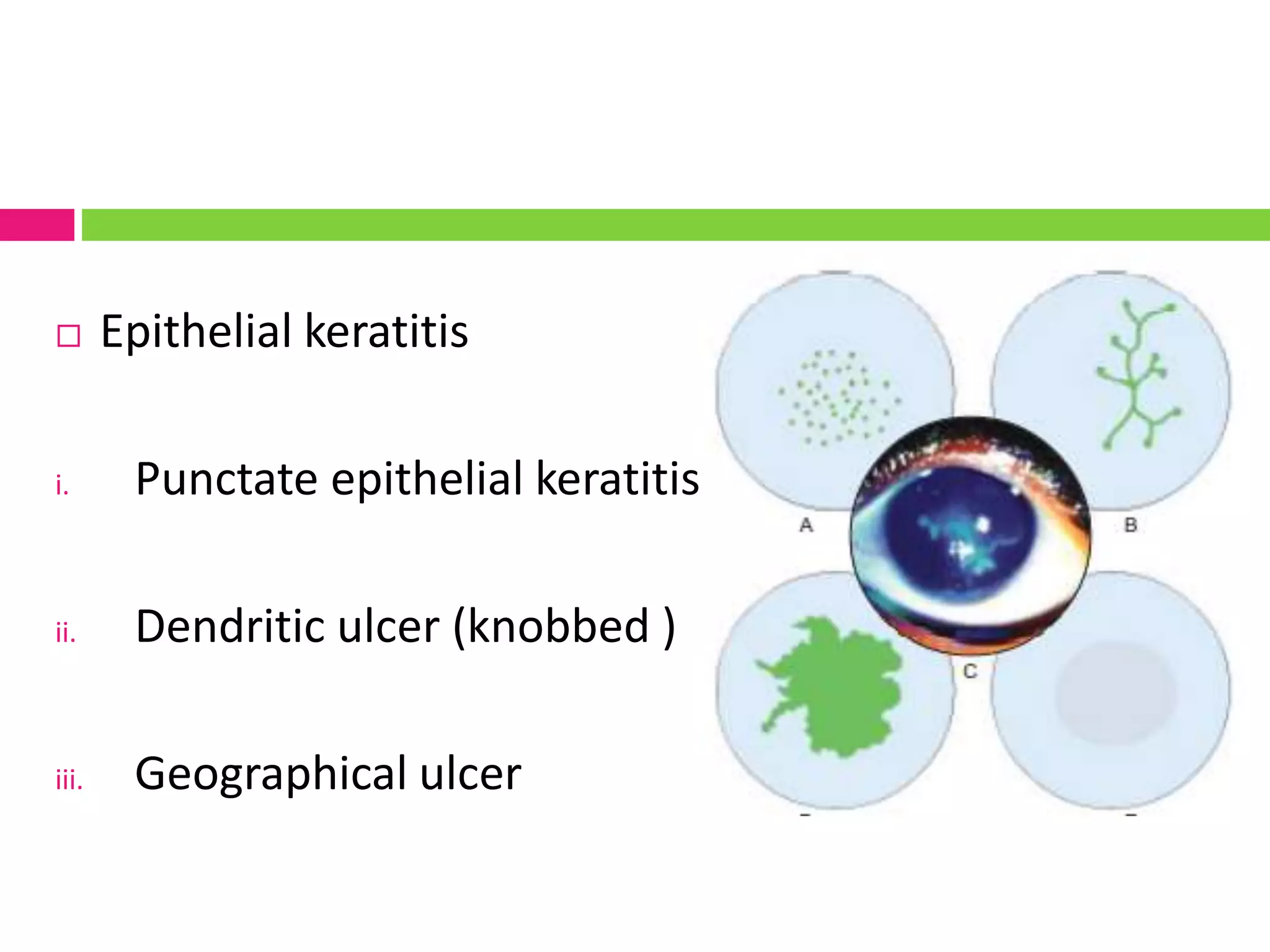
 Epithelial keratitis
i. Punctate epithelial keratitis
ii. Dendritic ulcer (knobbed )
iii. Geographical ulcer
 Stromal keratitis
1. Disciform keratitis
2. Necrotizing interstitial keratitis
 Meta herpetic keratitis
Treatment
 Specific treatment
1. Antiviral drugs are the first choice presently.
 Oint. Aciclovir 3 percent : 5 times a day until ulcer
heals and then taper to 3 times a day for 5 days.
OR
 Ganciclovir (0.15% gel)
 Triflurothymidine 1% dp (QID)
2. Mechanical debridement of involved area
 Systemic Antiviral
Tab .Acyclovir 400mg po tid/ bid for 10 to 21 days
In non responsive cases and recurrent cases.
 Stromal keratitis
(a) Disciform keratitis
(b) Diffuse stromal necrotic keratitis.
Treatment :
 Diluted steroid eye drops instilled 4-5 times a day
with an antiviral cover (aciclovir 3%) twice a day.
Herpes Zoster Ophthalmicus
 Herpes zoster ophthalmicus is an acute infection of
Gasserian ganglion of the fifth cranial nerve by the
varicella-zoster virus (VZV).
 It is neurotropic in nature
 The infection is manifests as chickenpox and the
child develops immunity. The virus then remains
dormant in the sensory ganglion of trigeminal
nerve
Clinical features
 Frontal nerve is more frequently affected than the
lacrimal and nasociliary nerves.
 50 percent cases of herpes zoster ophthalmicus get
ocular complications
 Hutchinson's rule
 General features.
 Cutaneous lesions
 Ocular lesions.
1. Conjunctivitis
2. Zoster keratitis
3. Episcleritis and scleritis
4. Iridocyclitis
5. Anterior segment necrosis and phthisis bulbi.
Treatment
 Systemic therapy for herpes zoster
 Oral antiviral drugs.
1. Acyclovir in a dose of 800 mg 5 times a day for 10
days, or
2. Valaciclovir in a dose of 500mg TDS
 Analgesics.
 Systemic steroids.
 Local therapy for ocular lesion
1. Topical steroid eye drops 4 times a day.
2. Cycloplegics such as cyclopentolate eyedrops BD
or atropine eye ointment OD.
3. Topical acyclovir 3 percent eye ointment should
be instilled 5 times a day for about 2
 Any queries???
 THANK YOU
corneal ulcer.pptx

corneal ulcer.pptx

  • 1.
    BIPIN KOIRALA MASTER’SOF OPTOMETRY, HIMALAYA EYE INSTITUTE CORNEAL ULCER
  • 2.
    Contents  Introduction  Pathogenesis Sign/ symptoms  Investigation  Treatment
  • 3.
    Infective keratitis  Bacterial Viral  Fungal  Chlamydial  Protozoal  Spirochaetal
  • 4.
    Definition  Corneal ulcermay be defined as discontinuation in normal epithelial surface of cornea associated with necrosis of the surrounding corneal tissue  Pathologically it is characterized by edema and cellular infiltration.
  • 5.
     Infective cornealulcer may develop when:  Either the local ocular defence mechanism is jeopardised  There is some local ocular predisposing disease, or host's immunity is compromised  The causative organism is very virulent
  • 6.
    Bacterial corneal ulcer There are two main factors in the production of purulent corneal ulcer: 1. Damage to corneal epithelium 2. Infection of the eroded area
  • 7.
    Common causative organisms Staphylococcus aureus  Pseudomonas pyocyanea  Streptococcus pneumoniae  E. coli  Proteus, Klebsiella  N. gonorrhoea, N. meningitidis  C. diphtheriae.
  • 8.
    Pathogenesis (Stages)  Stageof infiltration  Stage of Active ulceration  Stage of Regression  Stage of Cicatrization
  • 9.
    Perforated Ulcer  Perforationof corneal ulcer occurs when the ulcerative process deepens and reaches up to Descemet's membrane.  Exertion on the part of patient, such as coughing, sneezing, straining for stool etc. will perforate the corneal ulcer  Adherent leucoma is the commonest end result after such a catastrophe
  • 11.
    Pseudo Cornea Formation When the infecting agent is highly virulent and/or body resistance is very low  Exudates block the pupil and cover the iris surface; thus a false cornea is formed.  Ultimately these exudates organize and form a thin fibrous layer over which the conjunctival or corneal epithelium rapidly grows and thus a pseudocornea is formed.
  • 12.
  • 13.
    Bacterial Corneal Ulcers Manifestation Broadly as: 1. Purulent corneal ulcer without hypopyon 2. Hypopyon corneal ulcer.
  • 14.
    Symptoms  1. Painand foreign body sensation  2. Watering (Hyperlacrimation)  3. Photophobia  4. Blurred vision  5. Redness ( congestion of circumcorneal vessels)
  • 15.
    Signs  Lids areswollen  Marked blepharospasm  Conjunctiva is chemosed  Conjunctival hyperaemia  Ciliary congestion
  • 16.
     Greyish-white circumscribedinfiltrate  Stromal oedema  Margins of the ulcer are swollen and over hanging  Floor of the ulcer is covered by necrotic material.
  • 17.
    Characteristic features producedby some of the causative bacteria  Staphylococal aureus and streptococcus (yellowish white)  Pseudomonas (greenish mucopurulent exudate liquefactive necrosis)  Enterobacteriae (E. coli, Proteusand Klebsiella sp.) (Greyish white)
  • 18.
     Anterior chambermay or may not show pus (hypopyon).  Hypopyon corneal ulcer for the ulcer caused by pneumococcus (ulcus serpens)  Corneal ulcer with hypopyon for the ulcers associated with hypopyon due to other causes
  • 20.
    Complications  Toxic iridocyclitis Secondary glaucoma  Descemetocele  Perforation of corneal ulcer  Corneal scarring
  • 21.
     Thorough historytaking  General physical examination  Ocular examination 1. Diffused light exam 2. Regurgitation test 3. Slit lamp
  • 22.
    Laboratory investigations  Routinelaboratory investigations such as haemoglobin, TLC, DLC, ESR, blood sugar, complete urine and stool examination  Microbiological investigations 1. Scraping 2. Swab
  • 24.
    Treatment  Treatment ofcorneal ulcer can be discussed under three headings: 1. Specific treatment for the cause. 2. Non-specific supportive therapy. 3. Physical and general measures.
  • 25.
    Specfic treatment  Topicalantibiotics (Fortified antibiotics)  Ciprofloxacin (0.3%) eye drops,Ofloxacin (0.3%) eye drops, Moxifloxacin (0.3%) eye drops.  Systemic antibiotics
  • 26.
     Fortified cephazoline5% ( 50mg/ml)  Fortified tobramycine ( 1.3%)  Fortified vancomycin 5% (50mg/ml)
  • 27.
    Non-specific treatment  Cycloplegicdrugs  Systemic analgesics and anti-inflammatory drugs  Vitamins (A, B-complex and C)  Goggles darker
  • 28.
    MYCOTIC CORNEAL ULCER The incidence of suppurative corneal ulcers caused by fungi has increased in the recent years: 1. Injudicious use of antibiotics 2. Steroids
  • 29.
    Causative fungi  Thefungi which may cause corneal infections are :  Filamentous fungi: Aspergillus, Fusarium, Alternaria, Cephalosporium, Curvularia and Penicillium.  Yeasts: Candida and Cryptococcus
  • 30.
    Mode of infection Injury by vegetative material  Injury by Animal tail  Secondary fungal ulcers
  • 31.
    Signs and Symptoms Symptoms are similar to the central bacterial corneal ulcer  But in general they are less marked than the equal- sized bacterial ulcer  Overall course is slow and torpid.
  • 32.
    Signs  Corneal ulceris dry-looking, Greyish white  Feathery finger-like extensions are present into the surrounding stroma under intact epithelium.  A sterile immune ring  Multiple, small satellite lesions around the ulcer
  • 33.
     Big hypopyon Perforation in mycotic ulcer is rare  Corneal vascularization is rare
  • 35.
    Laboratory investigations  WetKOH,  Calcofluor white,  Gram's and Giemsa- stained films for fungal hyphae  Culture on Sabouraud's agar medium
  • 36.
    Treatment  Topical antifungaleye drops should be used for a long period (6 to 8 weeks).  These include : 1. Natamycin (5%) eye drops 2. Fluconazol (0.2%) eye drops 3. Nystatin (3.5%) eye ointment.
  • 37.
     Systemic antifungaldrugs may be required for severe cases of fungal keratitis.  Tablet fluconazole(200mg..bid) or ketoconazole may be given for 2-3 weeks  Non-specific treatment and general measures are similar to that of bacterial corneal ulcer
  • 38.
    Viral corneal ulcer:  Typically affects both cornea and conjunctiva- keratoconjunctivitis .  Common viral infections- 1. Herpes simplex(DNA virus) 2. Herpes zoster 3. Adenovirus
  • 40.
    Herpes simplex:  Modeof Infection: 1. HSV-I : face, lips, eyes.(kissing) 2. HSV- II : genital herpes (infection from genital secretion)  Primary Herpes: 1. Skin lesions 2. Conjunctiva - Acute follicular conjunctivitis 3. Corneal signs: Fine epithelial punctate keratitis, coarse epithelial punctate keratitis, dendritic ulcer.
  • 42.
    Primary Ocular Herpes Basically seen during first attack b/w 6months to teenagers.  Clinical features 1. Skin lesions. (Vesicular lesions) 2. Acute follicular conjunctivitis 3. Keratitis ( Coarse punctate/ diffused branching involving epithelium only)
  • 43.
    Recurrent ocular herpes Fever such as malaria, flu, exposure to ultraviolet rays,  General ill- health, emotional or physical exhaustion  Mild trauma, menstrual stress  Following administration of topical or systemic steroids and immunosuppressive agents.
  • 44.
     Epithelial keratitis i.Punctate epithelial keratitis ii. Dendritic ulcer (knobbed ) iii. Geographical ulcer
  • 45.
     Stromal keratitis 1.Disciform keratitis 2. Necrotizing interstitial keratitis  Meta herpetic keratitis
  • 47.
    Treatment  Specific treatment 1.Antiviral drugs are the first choice presently.  Oint. Aciclovir 3 percent : 5 times a day until ulcer heals and then taper to 3 times a day for 5 days. OR  Ganciclovir (0.15% gel)  Triflurothymidine 1% dp (QID) 2. Mechanical debridement of involved area
  • 48.
     Systemic Antiviral Tab.Acyclovir 400mg po tid/ bid for 10 to 21 days In non responsive cases and recurrent cases.
  • 49.
     Stromal keratitis (a)Disciform keratitis (b) Diffuse stromal necrotic keratitis. Treatment :  Diluted steroid eye drops instilled 4-5 times a day with an antiviral cover (aciclovir 3%) twice a day.
  • 50.
    Herpes Zoster Ophthalmicus Herpes zoster ophthalmicus is an acute infection of Gasserian ganglion of the fifth cranial nerve by the varicella-zoster virus (VZV).  It is neurotropic in nature  The infection is manifests as chickenpox and the child develops immunity. The virus then remains dormant in the sensory ganglion of trigeminal nerve
  • 51.
    Clinical features  Frontalnerve is more frequently affected than the lacrimal and nasociliary nerves.  50 percent cases of herpes zoster ophthalmicus get ocular complications  Hutchinson's rule
  • 52.
     General features. Cutaneous lesions  Ocular lesions. 1. Conjunctivitis 2. Zoster keratitis 3. Episcleritis and scleritis 4. Iridocyclitis 5. Anterior segment necrosis and phthisis bulbi.
  • 55.
    Treatment  Systemic therapyfor herpes zoster  Oral antiviral drugs. 1. Acyclovir in a dose of 800 mg 5 times a day for 10 days, or 2. Valaciclovir in a dose of 500mg TDS  Analgesics.  Systemic steroids.
  • 56.
     Local therapyfor ocular lesion 1. Topical steroid eye drops 4 times a day. 2. Cycloplegics such as cyclopentolate eyedrops BD or atropine eye ointment OD. 3. Topical acyclovir 3 percent eye ointment should be instilled 5 times a day for about 2
  • 57.

Editor's Notes

  • #12 , the whole cornea sloughs with the exception of a narrow rim at the margin and total prolapse of iris occurs
  • #14 Hypopyon is sseen in weak immune person like alcholic / old or high virulence organisms
  • #27 Fortification means to intensify or strengthen the medication to achieve adequate drug concentration.
  • #31 commonly responsible for mycotic corneal ulcers are Aspergillus (most common), Candida and Fusarium)
  • #42 DNA virus epitheliotropic/ neurotropic
  • #44 Self limiting and virus goes to tri ganglion and remains dormant
  • #49 Use single drug first and look effect. 4 days healing starts and complets in 10 days and after healing taper drug and remove