OPHTHALMOLOGY
SGD
PRESENTATION
Presented By
Bismita Patgiri (09)
Arko Probho Chattopadhyay (03)
Nitika Sharma (04)
Pratiksha Baruah (06)
EYE- ANATOMY
-It refers to the inflammation of the uveal tissue. The
inflammatory process may involve predominantly
anterior ,intermediate or posterior uvea although
there is always some associated inflammation of the
adjacent structure such as retina, vitreous, sclera and
cornea.
Intraocular Inflammation/ Uveitis
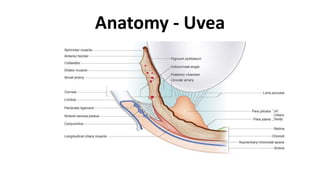
Anatomy - Uvea
ANTERIOR UVEITIS/IRIDOCYCLITIS
• CLINICAL FEATURES-
A. SYMPTOMS-
PAIN-
It is dominant symptom of acute anterior uveitis.
• Dull, aching and throbbing
• Usually referred along the distribution of CN V
REDNESS-
• Occurs due to circumcorneal congestion , which is a result of active hyperemia
of anterior ciliary vessels due to toxin , histamine and histamine like
substances.
PHOTOPHOBIA AND BLEPHAROSPASM-
• Occurs due to a reflex between sensory fibres of irritated CN V and motor
fibres of CN VII supplying the orbicularis oculi.
LACRIMATION
• Occurs as a result of lacrimatory reflex mediated by CN V( afferent) and CN VII
(efferent)
DEFECTIVE VISION
• Defect may vary from a slight blur in early phase to marked deterioration in
late phase
• Factors responsible:
a. Induced myopia due to ciliary spasm
b. Corneal haze due to edema and KPs
c. Aqueous turbidity
d. Pupillary block due to exudates
e. Complicated cataract
f. Vitreous haze
g. Cyclitic membrane
h. Associated macular edema
i. Paplillitis
j. Secondary glaucoma
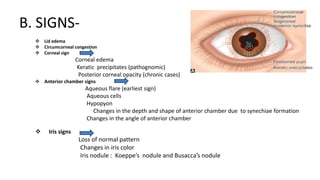
B. SIGNS-
 Lid edema
 Circumcorneal congestion
 Corneal sign
Corneal edema
Keratic precipitates (pathognomic)
Posterior corneal opacity (chronic cases)
 Anterior chamber signs
Aqueous flare (earliest sign)
Aqueous cells
Hypopyon
Changes in the depth and shape of anterior chamber due to synechiae formation
Changes in the angle of anterior chamber
 Iris signs
Loss of normal pattern
Changes in iris color
Iris nodule : Koeppe’s nodule and Busacca’s nodule
Posterior synechiae : These are adhesions between posterior surface of iris and anterior surface of lens.
Rubiosis iridis
 Pupillary signs :
Narrow pupil
Festooned pupil
Ectropion pupillae
Sluggish pupillary reaction
Occlusio pupillae
 Lens :
Pigment dispersal on anterior capsule
Exudate deposition
Complicated cataract
 Vitreous & Retina :
Presence of exudate and inflammatory cells.
Cystoid macular edema.
 IOP :
Normal
Increased
Decreased
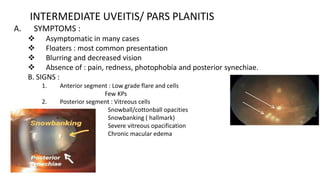
INTERMEDIATE UVEITIS/ PARS PLANITIS
A. SYMPTOMS :
 Asymptomatic in many cases
 Floaters : most common presentation
 Blurring and decreased vision
 Absence of : pain, redness, photophobia and posterior synechiae.
B. SIGNS :
1. Anterior segment : Low grade flare and cells
Few KPs
2. Posterior segment : Vitreous cells
Snowball/cottonball opacities
Snowbanking ( hallmark)
Severe vitreous opacification
Chronic macular edema
POSTERIOR UVEITIS
A. SYMPTOMS :
a. Defective vision :
due to - vitreous haze (mild)
central choroiditis (severe)
b. Photopsia :
due to irritation of rods and cones
c. Floaters :
d. Metamorphopsia :
due to alteration in the retinal contour caused by rays patch of choroiditis
e. Micropsia & Macropsia
f. Positive scotoma
B. SIGNS :
1. Anterior segment :
Usually no external signs but fine KPs may be found.
2. Vitreous opacities :
 Usually present in the medial or posterior part
 Fine/coarse/stringy/snowball
3. Patch of choroiditis :
 Active patch – Pale yellow / dirty white raised area
Ill defined edges
Due to exudation and cellular infiltration
Typically deeper to retinal vessels.
 Healed patch – Sharply defined
Delineated from the rest of normal area
The involved area shows white sclera below the
atrophic choroid and black pigmented clumps at the periphery
Clinical Signs
Of
Granulomatous and Non Granulomatous
Inflammation Of Uvea
Features Granulomatous Non Granulomatous
Onset Insidious Acute
Pain Minimal Marked
Photophobia Slight Marked
Ciliary Congestion Minimal Marked
Keratic Precipitates ( KPs ) Mutton Fat Small
Aqueous Flare Mild Marked
Iris nodules Usually Present Absent
Posterior Synaechiae Thick & Broad based Thin & tenous
Fundus Nodular Lesions Diffuse involvement
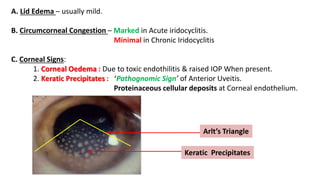
A. Lid Edema – usually mild.
B. Circumcorneal Congestion – Marked in Acute iridocyclitis.
Minimal in Chronic Iridocyclitis
C. Corneal Signs:
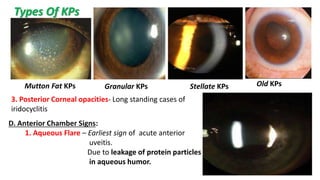
1. Corneal Oedema : Due to toxic endothilitis & raised IOP When present.
2. Keratic Precipitates : ‘Pathognomic Sign’ of Anterior Uveitis.
Proteinaceous cellular deposits at Corneal endothelium.
Arlt’s Triangle
Keratic Precipitates
Types Of KPs
Mutton Fat KPs Granular KPs Stellate KPs Old KPs
3. Posterior Corneal opacities- Long standing cases of
iridocyclitis
D. Anterior Chamber Signs:
1. Aqueous Flare – Earliest sign of acute anterior
uveitis.
Due to leakage of protein particles
in aqueous humor.
2. Hypopyon- Heavy & thick exudates settle down in lower part of the anterior
chamber.
Cold Hypopyon
Dense Immobile
Hypopyon
Haemorrhagic
Hypopyon
3. Changes in Depth & shape of anterior chamber may occur due to synechiae
formation.
4. Changes in angle of anterior chamber.
Marked in Non granulomatous Uveitis. Minimal in Granulomatous Uveitis.
E. Iris Signs
1. Loss of normal pattern:
Due to edema & waterlogging of Iris in active phase.
Due to Atropic changes in chronic phase.
2. Change in Iris Colour:
Muddy in active phase.
Hyperpigmented/Depigmented in healed stage.
3. Iris Nodules: typically in Granulomatous uveitis
Koeppe’s Nodules Busacca’s Nodules
F. Pupillary Signs-
1. Narrow Pupil- In Acute attack Of Iridocyclitis.
2. Irregular Pupil Shape- Festooned Pupils
3. Ectropion Pupillae- evertion of pupillary margin
4. Sluggish Pupillary reaction
5. Occulsio Pupillae
Segmental Posterior
Synechiae
Annular Posterior
Synechiae
Total Posterior
Synechiae
5.Neovascularisation Of Iris (Rubeosis Iridis)
4. Posterior Synechiae-
G. Changes in the Lens
1. Pigment Dispersal- universal occurrence in anterior uveitis.
2. Exudates - Acute Plastic iridocyclitis.
3. Complicated Cataract- Typical feature ,
Polychromatic Luster & Bread crumb Appearance of
early posterior subcapsular opacities.
H. Changes In Vitreous & Retina.
1. Exudates and inflammatory cells.
2. Cystoid Macular Edema.
I. IOP may be normal, Increased ( Secondary glaucoma) or Decreased.
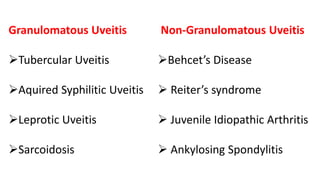
Granulomatous Uveitis
Tubercular Uveitis
Aquired Syphilitic Uveitis
Leprotic Uveitis
Sarcoidosis
Non-Granulomatous Uveitis
Behcet’s Disease
 Reiter’s syndrome
 Juvenile Idiopathic Arthritis
 Ankylosing Spondylitis
Classifications and Investigations of
Uveitis
Classifications of Uveitis
• Anatomical classification
• Clinical classification
• Pathological classification
• Etiological classification
Anatomical classification
• Anterior uveitis
– Iritis
– Iridocyclitis
– Anterior cyclitis
• Intermediate uveitis
• Posterior uveitis
– Choroiditis
– Chorioretinitis
– Retinochoroiditis
– Neuroretinitis
• Panuveitis
Clinical classification
• Acute uveitis
– Sudden symptomatic onset
– Duration- 6 weeks to 3 months
• Chronic uveitis
– Insidious and asymptomatic onset
– Duration- longer than 3 months to years
• Recurrent uveitis
– Repeated episodes separated by inactive periods of more than 3
months
Pathological classification
• Suppurative or Purulent uveitis
• Nonsuppurative uveitis
– Nongranulomatous uveitis
– Granulomatous uveitis
• Infectious uveitis
– Bacterial
– Viral
– Fungal
– Parasitic
– Rickettsial
• Masquerade syndromes
– Non-neoplastic
– Neoplastic
• Non-infectious uveitis
– Immune-related
• Microbial allergic
• Autoimmune
• HLA associated
• Anaphylactic
• Atopic
– Uveitis associated with non-
infectious systemic diseases
– Toxic
– Traumatic
– Idiopathic
Etiological classification
Investigations for Uveitis
• Ocular examination
Haematological Investigations
– TLC and DLC
– ESR
– Blood sugar levels
– Blood uric acid
– Serological tests
• Syphilis
• Toxoplasmosis
• Histoplasmosis
– Other Tests:
• Antinuclear antibodies
• Rh factor
• LE Cells
• C- Reactive proteins
HLA Typing for associated diseases like:
– HLA B-27 : Ankylosing spondylitis
– HLA B51 : Bechet disease
• Urine examination for WBCs, pus cells, RBCs and culture
• Stool examination for cysts and ova
• Radiological examination
– X rays of chest, PNS, sacroilliac joints and lumbar spine
– CT Scan high resolution, of thorax for suspected
Sarcoidosis
– MRI Scan of head for suspected Sarcoidosis, demyelination
and lymphomas
• Skin tests:
– Tuberculin test
– Kveim’s test for sarcoidosis
– Toxoplasmin test
– Lepromin test
– Pathergy test for Behcet’s disease
• Biopsy/ Intraocular fluid samples for examination:
– Aqueous samples for PCR
– Vitreous biopsy for culture and PCR
– Lungs and Lymph node biopsy for Sarcoidosis
DIFFERENTIAL DIAGNOSIS OF
RED EYE AND TREATMENT OF
ACUTE IRIDOCYCLITIS
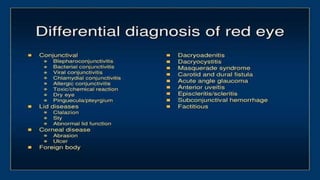
RED EYE
• It is the final common response to any
anterior segment disease
Distinguishing features between, acute conjunctivitis,
acute iridocyclitis and acute congestive glaucoma:
FIG: IRITIS FIG: ACUTE ANGLE CLOSURE GLAUCOMA
FIG: CONJUNCTIVITIS
TREATMENT OF ACUTE IRIDOCYLITIS
NON SPECIFIC
LOCAL THERAPY
SYSTEMIC
THERAPY
PHYSICAL MEASURE
SPECIFIC TREATMENT
OF THE CAUSE
TREATMENT OF
COMPLICATIONS
TREATMENT OF IRIDOCYCLITIS
Nonspecific treatment
A. Local therapy
(A)Cycloplegic drugs
Very useful and effective during acute phase of iridocyclitis
DRUGS –
i. 1% atropine sufate eye ointment or drops
Sig: 2-3 time/day-(2-3 weeks)
Atropin allergy
ii.2% homoatropin or 1% cyclopentolate eye drops
sig: 2-4 times /day(2-3 weeks)
iii. 0.25 mydricain (management of atropine,adrenalin procaine sub conjuctival injection)
Mode of action
a. comfort and rest to the eye by relieving spasm of
iris sphincter and ciliary muscle,
b. prevents the forma tion of synechiae and may break the already
formed synechiae,
c. reduces exudation by decreasing hyperaemia and vascular permeability
d. increases the blood supply to anterior uvea by relieving pressure on the
anterior ciliary arteries.
As a result, more antibodies reach the target tissues and more toxins are
absorbed
(B) Corticosteroids administered locally, are very
effective in cases of iridocyclitis.
Drugs; dexamethasone, betamethasone,hydrocortisone or
prednisolone
• Mode of action:
Reduce inflammation by theiranti-inflammatory effect;
anti-allergic (allergic type of uveitis)
antifibrotic activity, ( reduce fibrosis and thus prevent disorganisation
and destruction of the tissues)
Route of administration:
i) eye drops 4-6 times a day,
(ii) eye ointment at (bed time)
(iii) Anterior sub-Tenon injection ( severe cases)
B. Systemic therapy
i. Corticosteroids: In non-granulomatous. Iridocyclitis
Indication - indicated in intractable anterior uveitis resistant to topical
therapy.
DRUGS- i) high doses of prednisolone (60- 100 mg) or equivalent
quantities of other steroids (dexamethasone or betamethasone)
Regimes
 Daily therapy regime- 2 weeks ( marked inflammatory activity)
Alt day therapy Regime,(absence of acute inflammation)
Tapering of dose of steroids is done by a week interval and tapered
completely in 6-8 weeks in both the regime.
Complication of steroids
- ocular(steroid induced glaucoma and cataract)
- st (dyspepsia ,peptic ulcer, mental changes,worsening
of diabetes, osteoporosis,cushingoid,electrolyte
imbalance)
ii. NSAIDS  Aspirin, phenylbutazone, oxyphenbutazone (useful in uveitis associated
with RA)
M.O.A  Anti inflammatory action
Naproxen  Patients with ankylosing spondylitis
iii. Immuno-suppressive drugs Extremely serious cases of uveitisIndications  Severe
cases of Behcet's syndrome, VKH syndrome, Sympathetic ophthalmia, Pars planitis
Drugs  cyclophosphamide, chlorambucil, azathioprine, methotrexate- cyclosporin
powerful T anti-T cell immuno-suppressive drugs.
iv) Azithromycin or tetracyclin or erythromycin  To treat chlamydial infections in
patients.
c) Physical Measures
(1) Hot fomentation  either by dry heat it wet heat  very soothing, pain
decreases, circulation increases, venous stasis decreases
(2) Dark Goggles These give a feeling of comfort, especially when used in
sunlight, by reducing photophobia, lacrimation and blepharospasm.
Specific treatment of the cause
Non specific treatment described above is very effective and usually controls
the uveal inflammation, in most of the cases, but It does not cure the
disease, resulting in relapses.
(a) Anti-tubercular drugs  Koch's disease
(b) Treatment for syphilis, toxoplasmosis
When no cause is ascertained  broad spectrum antibiotic
Treatment of complications
(i) Inflammatory glaucoma
0.5% timolol eye drops (twice a day)
Acetazolamide (250 mg thrice a day)
(ii) Post - inflammatory glaucoma (due to Ring Synechiae )
Laser iridotomy
Surgical iridotomy under high doses of corticosteroids
(iii) Complicated Cataract
Requires lens extraction
(iv) Cystoid Macular Oedema
Intravitreal injection of triamclnolone acetate
(v) Retinal detachment
Exudative type  self limiting if uveitis is treated aggressively
Tractional vitrectomy
(vi) Phthisis Bulbi
Painful and requires removal by enucleation operation
Thank You

Uveitis

  • 1.
  • 2.
    Presented By Bismita Patgiri(09) Arko Probho Chattopadhyay (03) Nitika Sharma (04) Pratiksha Baruah (06)
  • 3.
  • 4.
    -It refers tothe inflammation of the uveal tissue. The inflammatory process may involve predominantly anterior ,intermediate or posterior uvea although there is always some associated inflammation of the adjacent structure such as retina, vitreous, sclera and cornea. Intraocular Inflammation/ Uveitis
  • 5.
  • 6.
    ANTERIOR UVEITIS/IRIDOCYCLITIS • CLINICALFEATURES- A. SYMPTOMS- PAIN- It is dominant symptom of acute anterior uveitis. • Dull, aching and throbbing • Usually referred along the distribution of CN V REDNESS- • Occurs due to circumcorneal congestion , which is a result of active hyperemia of anterior ciliary vessels due to toxin , histamine and histamine like substances. PHOTOPHOBIA AND BLEPHAROSPASM- • Occurs due to a reflex between sensory fibres of irritated CN V and motor fibres of CN VII supplying the orbicularis oculi.
  • 7.
    LACRIMATION • Occurs asa result of lacrimatory reflex mediated by CN V( afferent) and CN VII (efferent) DEFECTIVE VISION • Defect may vary from a slight blur in early phase to marked deterioration in late phase • Factors responsible: a. Induced myopia due to ciliary spasm b. Corneal haze due to edema and KPs c. Aqueous turbidity d. Pupillary block due to exudates e. Complicated cataract f. Vitreous haze g. Cyclitic membrane h. Associated macular edema i. Paplillitis j. Secondary glaucoma
  • 8.
    B. SIGNS-  Lidedema  Circumcorneal congestion  Corneal sign Corneal edema Keratic precipitates (pathognomic) Posterior corneal opacity (chronic cases)  Anterior chamber signs Aqueous flare (earliest sign) Aqueous cells Hypopyon Changes in the depth and shape of anterior chamber due to synechiae formation Changes in the angle of anterior chamber  Iris signs Loss of normal pattern Changes in iris color Iris nodule : Koeppe’s nodule and Busacca’s nodule
  • 9.
    Posterior synechiae :These are adhesions between posterior surface of iris and anterior surface of lens. Rubiosis iridis  Pupillary signs : Narrow pupil Festooned pupil Ectropion pupillae Sluggish pupillary reaction Occlusio pupillae  Lens : Pigment dispersal on anterior capsule Exudate deposition Complicated cataract  Vitreous & Retina : Presence of exudate and inflammatory cells. Cystoid macular edema.  IOP : Normal Increased Decreased
  • 10.
    INTERMEDIATE UVEITIS/ PARSPLANITIS A. SYMPTOMS :  Asymptomatic in many cases  Floaters : most common presentation  Blurring and decreased vision  Absence of : pain, redness, photophobia and posterior synechiae. B. SIGNS : 1. Anterior segment : Low grade flare and cells Few KPs 2. Posterior segment : Vitreous cells Snowball/cottonball opacities Snowbanking ( hallmark) Severe vitreous opacification Chronic macular edema
  • 11.
    POSTERIOR UVEITIS A. SYMPTOMS: a. Defective vision : due to - vitreous haze (mild) central choroiditis (severe) b. Photopsia : due to irritation of rods and cones c. Floaters : d. Metamorphopsia : due to alteration in the retinal contour caused by rays patch of choroiditis e. Micropsia & Macropsia f. Positive scotoma
  • 12.
    B. SIGNS : 1.Anterior segment : Usually no external signs but fine KPs may be found. 2. Vitreous opacities :  Usually present in the medial or posterior part  Fine/coarse/stringy/snowball 3. Patch of choroiditis :  Active patch – Pale yellow / dirty white raised area Ill defined edges Due to exudation and cellular infiltration Typically deeper to retinal vessels.
  • 13.
     Healed patch– Sharply defined Delineated from the rest of normal area The involved area shows white sclera below the atrophic choroid and black pigmented clumps at the periphery
  • 14.
    Clinical Signs Of Granulomatous andNon Granulomatous Inflammation Of Uvea
  • 15.
    Features Granulomatous NonGranulomatous Onset Insidious Acute Pain Minimal Marked Photophobia Slight Marked Ciliary Congestion Minimal Marked Keratic Precipitates ( KPs ) Mutton Fat Small Aqueous Flare Mild Marked Iris nodules Usually Present Absent Posterior Synaechiae Thick & Broad based Thin & tenous Fundus Nodular Lesions Diffuse involvement
  • 16.
    A. Lid Edema– usually mild. B. Circumcorneal Congestion – Marked in Acute iridocyclitis. Minimal in Chronic Iridocyclitis C. Corneal Signs: 1. Corneal Oedema : Due to toxic endothilitis & raised IOP When present. 2. Keratic Precipitates : ‘Pathognomic Sign’ of Anterior Uveitis. Proteinaceous cellular deposits at Corneal endothelium. Arlt’s Triangle Keratic Precipitates
  • 17.
    Types Of KPs MuttonFat KPs Granular KPs Stellate KPs Old KPs 3. Posterior Corneal opacities- Long standing cases of iridocyclitis D. Anterior Chamber Signs: 1. Aqueous Flare – Earliest sign of acute anterior uveitis. Due to leakage of protein particles in aqueous humor.
  • 18.
    2. Hypopyon- Heavy& thick exudates settle down in lower part of the anterior chamber. Cold Hypopyon Dense Immobile Hypopyon Haemorrhagic Hypopyon 3. Changes in Depth & shape of anterior chamber may occur due to synechiae formation. 4. Changes in angle of anterior chamber. Marked in Non granulomatous Uveitis. Minimal in Granulomatous Uveitis.
  • 19.
    E. Iris Signs 1.Loss of normal pattern: Due to edema & waterlogging of Iris in active phase. Due to Atropic changes in chronic phase. 2. Change in Iris Colour: Muddy in active phase. Hyperpigmented/Depigmented in healed stage. 3. Iris Nodules: typically in Granulomatous uveitis Koeppe’s Nodules Busacca’s Nodules
  • 20.
    F. Pupillary Signs- 1.Narrow Pupil- In Acute attack Of Iridocyclitis. 2. Irregular Pupil Shape- Festooned Pupils 3. Ectropion Pupillae- evertion of pupillary margin 4. Sluggish Pupillary reaction 5. Occulsio Pupillae Segmental Posterior Synechiae Annular Posterior Synechiae Total Posterior Synechiae 5.Neovascularisation Of Iris (Rubeosis Iridis) 4. Posterior Synechiae-
  • 21.
    G. Changes inthe Lens 1. Pigment Dispersal- universal occurrence in anterior uveitis. 2. Exudates - Acute Plastic iridocyclitis. 3. Complicated Cataract- Typical feature , Polychromatic Luster & Bread crumb Appearance of early posterior subcapsular opacities. H. Changes In Vitreous & Retina. 1. Exudates and inflammatory cells. 2. Cystoid Macular Edema. I. IOP may be normal, Increased ( Secondary glaucoma) or Decreased.
  • 22.
    Granulomatous Uveitis Tubercular Uveitis AquiredSyphilitic Uveitis Leprotic Uveitis Sarcoidosis Non-Granulomatous Uveitis Behcet’s Disease  Reiter’s syndrome  Juvenile Idiopathic Arthritis  Ankylosing Spondylitis
  • 23.
  • 24.
    Classifications of Uveitis •Anatomical classification • Clinical classification • Pathological classification • Etiological classification
  • 25.
    Anatomical classification • Anterioruveitis – Iritis – Iridocyclitis – Anterior cyclitis • Intermediate uveitis • Posterior uveitis – Choroiditis – Chorioretinitis – Retinochoroiditis – Neuroretinitis • Panuveitis
  • 26.
    Clinical classification • Acuteuveitis – Sudden symptomatic onset – Duration- 6 weeks to 3 months • Chronic uveitis – Insidious and asymptomatic onset – Duration- longer than 3 months to years • Recurrent uveitis – Repeated episodes separated by inactive periods of more than 3 months
  • 27.
    Pathological classification • Suppurativeor Purulent uveitis • Nonsuppurative uveitis – Nongranulomatous uveitis – Granulomatous uveitis
  • 28.
    • Infectious uveitis –Bacterial – Viral – Fungal – Parasitic – Rickettsial • Masquerade syndromes – Non-neoplastic – Neoplastic • Non-infectious uveitis – Immune-related • Microbial allergic • Autoimmune • HLA associated • Anaphylactic • Atopic – Uveitis associated with non- infectious systemic diseases – Toxic – Traumatic – Idiopathic Etiological classification
  • 29.
  • 30.
    Haematological Investigations – TLCand DLC – ESR – Blood sugar levels – Blood uric acid – Serological tests • Syphilis • Toxoplasmosis • Histoplasmosis – Other Tests: • Antinuclear antibodies • Rh factor • LE Cells • C- Reactive proteins HLA Typing for associated diseases like: – HLA B-27 : Ankylosing spondylitis – HLA B51 : Bechet disease
  • 31.
    • Urine examinationfor WBCs, pus cells, RBCs and culture • Stool examination for cysts and ova • Radiological examination – X rays of chest, PNS, sacroilliac joints and lumbar spine – CT Scan high resolution, of thorax for suspected Sarcoidosis – MRI Scan of head for suspected Sarcoidosis, demyelination and lymphomas
  • 32.
    • Skin tests: –Tuberculin test – Kveim’s test for sarcoidosis – Toxoplasmin test – Lepromin test – Pathergy test for Behcet’s disease • Biopsy/ Intraocular fluid samples for examination: – Aqueous samples for PCR – Vitreous biopsy for culture and PCR – Lungs and Lymph node biopsy for Sarcoidosis
  • 33.
    DIFFERENTIAL DIAGNOSIS OF REDEYE AND TREATMENT OF ACUTE IRIDOCYCLITIS
  • 34.
    RED EYE • Itis the final common response to any anterior segment disease
  • 37.
    Distinguishing features between,acute conjunctivitis, acute iridocyclitis and acute congestive glaucoma:
  • 38.
    FIG: IRITIS FIG:ACUTE ANGLE CLOSURE GLAUCOMA FIG: CONJUNCTIVITIS
  • 39.
    TREATMENT OF ACUTEIRIDOCYLITIS NON SPECIFIC LOCAL THERAPY SYSTEMIC THERAPY PHYSICAL MEASURE SPECIFIC TREATMENT OF THE CAUSE TREATMENT OF COMPLICATIONS
  • 40.
    TREATMENT OF IRIDOCYCLITIS Nonspecifictreatment A. Local therapy (A)Cycloplegic drugs Very useful and effective during acute phase of iridocyclitis DRUGS – i. 1% atropine sufate eye ointment or drops Sig: 2-3 time/day-(2-3 weeks) Atropin allergy ii.2% homoatropin or 1% cyclopentolate eye drops sig: 2-4 times /day(2-3 weeks) iii. 0.25 mydricain (management of atropine,adrenalin procaine sub conjuctival injection)
  • 41.
    Mode of action a.comfort and rest to the eye by relieving spasm of iris sphincter and ciliary muscle, b. prevents the forma tion of synechiae and may break the already formed synechiae, c. reduces exudation by decreasing hyperaemia and vascular permeability d. increases the blood supply to anterior uvea by relieving pressure on the anterior ciliary arteries. As a result, more antibodies reach the target tissues and more toxins are absorbed
  • 42.
    (B) Corticosteroids administeredlocally, are very effective in cases of iridocyclitis. Drugs; dexamethasone, betamethasone,hydrocortisone or prednisolone • Mode of action: Reduce inflammation by theiranti-inflammatory effect; anti-allergic (allergic type of uveitis) antifibrotic activity, ( reduce fibrosis and thus prevent disorganisation and destruction of the tissues)
  • 43.
    Route of administration: i)eye drops 4-6 times a day, (ii) eye ointment at (bed time) (iii) Anterior sub-Tenon injection ( severe cases)
  • 44.
    B. Systemic therapy i.Corticosteroids: In non-granulomatous. Iridocyclitis Indication - indicated in intractable anterior uveitis resistant to topical therapy. DRUGS- i) high doses of prednisolone (60- 100 mg) or equivalent quantities of other steroids (dexamethasone or betamethasone) Regimes  Daily therapy regime- 2 weeks ( marked inflammatory activity) Alt day therapy Regime,(absence of acute inflammation) Tapering of dose of steroids is done by a week interval and tapered completely in 6-8 weeks in both the regime.
  • 45.
    Complication of steroids -ocular(steroid induced glaucoma and cataract) - st (dyspepsia ,peptic ulcer, mental changes,worsening of diabetes, osteoporosis,cushingoid,electrolyte imbalance)
  • 46.
    ii. NSAIDS Aspirin, phenylbutazone, oxyphenbutazone (useful in uveitis associated with RA) M.O.A  Anti inflammatory action Naproxen  Patients with ankylosing spondylitis iii. Immuno-suppressive drugs Extremely serious cases of uveitisIndications  Severe cases of Behcet's syndrome, VKH syndrome, Sympathetic ophthalmia, Pars planitis Drugs  cyclophosphamide, chlorambucil, azathioprine, methotrexate- cyclosporin powerful T anti-T cell immuno-suppressive drugs. iv) Azithromycin or tetracyclin or erythromycin  To treat chlamydial infections in patients.
  • 47.
    c) Physical Measures (1)Hot fomentation  either by dry heat it wet heat  very soothing, pain decreases, circulation increases, venous stasis decreases (2) Dark Goggles These give a feeling of comfort, especially when used in sunlight, by reducing photophobia, lacrimation and blepharospasm. Specific treatment of the cause Non specific treatment described above is very effective and usually controls the uveal inflammation, in most of the cases, but It does not cure the disease, resulting in relapses. (a) Anti-tubercular drugs  Koch's disease (b) Treatment for syphilis, toxoplasmosis When no cause is ascertained  broad spectrum antibiotic
  • 48.
    Treatment of complications (i)Inflammatory glaucoma 0.5% timolol eye drops (twice a day) Acetazolamide (250 mg thrice a day) (ii) Post - inflammatory glaucoma (due to Ring Synechiae ) Laser iridotomy Surgical iridotomy under high doses of corticosteroids (iii) Complicated Cataract Requires lens extraction (iv) Cystoid Macular Oedema Intravitreal injection of triamclnolone acetate (v) Retinal detachment Exudative type  self limiting if uveitis is treated aggressively Tractional vitrectomy (vi) Phthisis Bulbi Painful and requires removal by enucleation operation
  • 49.