Discussion
section..
How to
write??
By
Dr. Amr Mounir
Assistant professor of Ophthalmology,
Sohag University
Background
An article is potentially
the most efficient means
for disseminating your
research and
establishing a
publication record.
Background
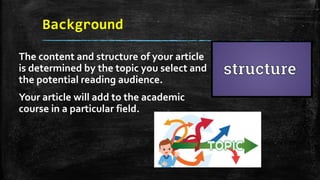
The content and structure of your article
is determined by the topic you select and
the potential reading audience.
Your article will add to the academic
course in a particular field.
Research article include
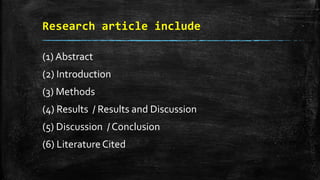
(1) Abstract
(2) Introduction
(3) Methods
(4) Results / Results and Discussion
(5) Discussion / Conclusion
(6) Literature Cited
Discussion
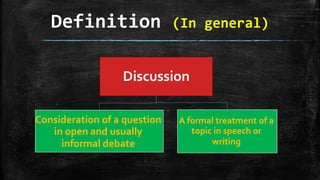
Definition (In general)
Discussion
Consideration of a question
in open and usually
informal debate
A formal treatment of a
topic in speech or
writing
It is difficult part to write of the
research article
Discussion in a scientific
article
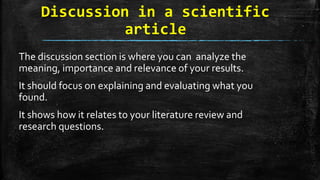
The discussion section is where you can analyze the
meaning, importance and relevance of your results.
It should focus on explaining and evaluating what you
found.
It shows how it relates to your literature review and
research questions.
Discussion should be
directed to one aim
Analysis of your
research results
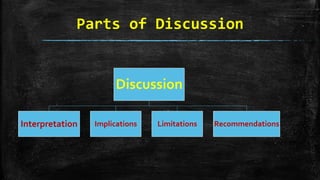
Parts of Discussion
Discussion
Interpretation Implications Limitations Recommendations
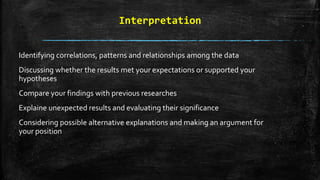
Interpretation
Identifying correlations, patterns and relationships among the data
Discussing whether the results met your expectations or supported your
hypotheses
Compare your findings with previous researches
Explaine unexpected results and evaluating their significance
Considering possible alternative explanations and making an argument for
your position
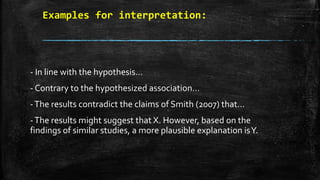
Examples for interpretation:
- In line with the hypothesis…
- Contrary to the hypothesized association…
-The results contradict the claims of Smith (2007) that…
-The results might suggest that X. However, based on the
findings of similar studies, a more plausible explanation isY.
Implications
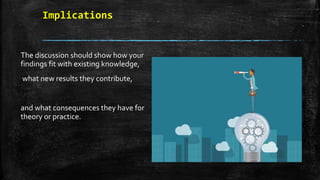
The discussion should show how your
findings fit with existing knowledge,
what new results they contribute,
and what consequences they have for
theory or practice.
Examples for implications:
These results build on existing evidence of…
The results do not fit with the theory that…
The experiment provides a new insight into the relationship
between…
These results should be taken into account when considering
how to…
The data contributes a clearer understanding of…-
Limitations
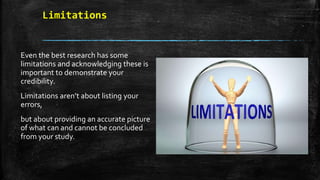
Even the best research has some
limitations and acknowledging these is
important to demonstrate your
credibility.
Limitations aren’t about listing your
errors,
but about providing an accurate picture
of what can and cannot be concluded
from your study.
Examples for limitations:
The usefulness of the results is limited by…
The reliability of this data is impacted by…
Due to the lack of data on X, the results cannot confirm…
The methodological choices were limited by…
It is beyond the scope of this study to…
State your recommendations
Based on the discussion of your results, you
can make recommendations for practical
implementation or further research.
Sometimes the recommendations are
saved for the conclusion.
Examples:
Further research is needed to establish…
Future studies should consider…
The intro of discussion..
Summarize your key findings
- Start this chapter by mentioning your research problem and concisely
summarizing your major findings.
- Don’t just repeat all the data you have already reported.
- Aim for a clear statement of the overall result that directly answers your
main research question.
Examples
The results indicate that…
The study demonstrates a correlation between…
This analysis supports the theory that…
The data suggests that…
Discussion
•What is new without exaggerating.
•Conclusion/summary, perspectives, implications.
•Research limitations and need for future research.
•Theoretical implications and possible practical
applications.
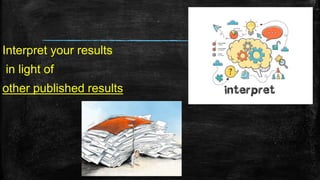
Interpret your results
in light of
other published results
How to Cite Sources in the Discussion
Section
It is important to cite sources in the discussion section of your
paper as evidence of the claims you are making.
There are ways of citing sources in the text so that the reader
can find the full reference in the literature cited section at the
end of the paper, yet the flow of the reading is not badly
interrupted.
Mistakes you should avoid..
Don’t introduce new results
– you should only discuss the data that you have
already reported in the results chapter.
Don’t make inflated claims
– avoid overinterpretation and speculation that isn’t
supported by your data.
Don’t undermine your research
– the discussion of limitations should aim to
strengthen your credibility, not emphasize
weaknesses or failures.
Home Messages
- The discussion section is where you can analyze the meaning,
importance and relevance of your results.
- It is difficult part to write of the research article.
- It includes interpretation, implications, limitations and
recommendations.
- Interpret your results in light of other published results.
- Don’t introduce new results, make inflated claims or
undermine your results.
Thank You
Hussein Bicar (1913-2002)

Discussion.pptx

  • 1.
    Discussion section.. How to write?? By Dr. AmrMounir Assistant professor of Ophthalmology, Sohag University
  • 2.
    Background An article ispotentially the most efficient means for disseminating your research and establishing a publication record.
  • 3.
    Background The content andstructure of your article is determined by the topic you select and the potential reading audience. Your article will add to the academic course in a particular field.
  • 4.
    Research article include (1)Abstract (2) Introduction (3) Methods (4) Results / Results and Discussion (5) Discussion / Conclusion (6) Literature Cited
  • 5.
  • 6.
    Definition (In general) Discussion Considerationof a question in open and usually informal debate A formal treatment of a topic in speech or writing
  • 7.
    It is difficultpart to write of the research article
  • 8.
    Discussion in ascientific article The discussion section is where you can analyze the meaning, importance and relevance of your results. It should focus on explaining and evaluating what you found. It shows how it relates to your literature review and research questions.
  • 9.
    Discussion should be directedto one aim Analysis of your research results
  • 10.
    Parts of Discussion Discussion InterpretationImplications Limitations Recommendations
  • 11.
    Interpretation Identifying correlations, patternsand relationships among the data Discussing whether the results met your expectations or supported your hypotheses Compare your findings with previous researches Explaine unexpected results and evaluating their significance Considering possible alternative explanations and making an argument for your position
  • 12.
    Examples for interpretation: -In line with the hypothesis… - Contrary to the hypothesized association… -The results contradict the claims of Smith (2007) that… -The results might suggest that X. However, based on the findings of similar studies, a more plausible explanation isY.
  • 13.
    Implications The discussion shouldshow how your findings fit with existing knowledge, what new results they contribute, and what consequences they have for theory or practice.
  • 14.
    Examples for implications: Theseresults build on existing evidence of… The results do not fit with the theory that… The experiment provides a new insight into the relationship between… These results should be taken into account when considering how to… The data contributes a clearer understanding of…-
  • 15.
    Limitations Even the bestresearch has some limitations and acknowledging these is important to demonstrate your credibility. Limitations aren’t about listing your errors, but about providing an accurate picture of what can and cannot be concluded from your study.
  • 16.
    Examples for limitations: Theusefulness of the results is limited by… The reliability of this data is impacted by… Due to the lack of data on X, the results cannot confirm… The methodological choices were limited by… It is beyond the scope of this study to…
  • 17.
    State your recommendations Basedon the discussion of your results, you can make recommendations for practical implementation or further research. Sometimes the recommendations are saved for the conclusion. Examples: Further research is needed to establish… Future studies should consider…
  • 18.
    The intro ofdiscussion..
  • 19.
    Summarize your keyfindings - Start this chapter by mentioning your research problem and concisely summarizing your major findings. - Don’t just repeat all the data you have already reported. - Aim for a clear statement of the overall result that directly answers your main research question. Examples The results indicate that… The study demonstrates a correlation between… This analysis supports the theory that… The data suggests that…
  • 20.
    Discussion •What is newwithout exaggerating. •Conclusion/summary, perspectives, implications. •Research limitations and need for future research. •Theoretical implications and possible practical applications.
  • 21.
    Interpret your results inlight of other published results
  • 22.
    How to CiteSources in the Discussion Section It is important to cite sources in the discussion section of your paper as evidence of the claims you are making. There are ways of citing sources in the text so that the reader can find the full reference in the literature cited section at the end of the paper, yet the flow of the reading is not badly interrupted.
  • 23.
    Mistakes you shouldavoid.. Don’t introduce new results – you should only discuss the data that you have already reported in the results chapter. Don’t make inflated claims – avoid overinterpretation and speculation that isn’t supported by your data. Don’t undermine your research – the discussion of limitations should aim to strengthen your credibility, not emphasize weaknesses or failures.
  • 24.
    Home Messages - Thediscussion section is where you can analyze the meaning, importance and relevance of your results. - It is difficult part to write of the research article. - It includes interpretation, implications, limitations and recommendations. - Interpret your results in light of other published results. - Don’t introduce new results, make inflated claims or undermine your results.
  • 25.