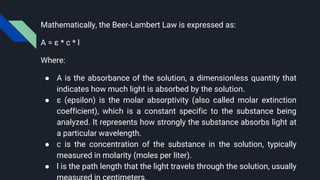
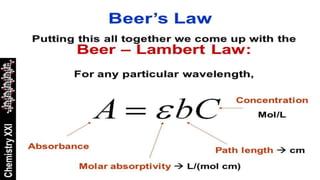
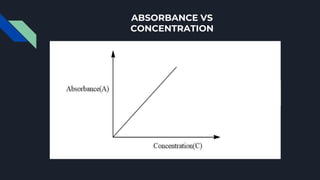
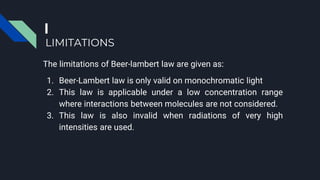
The Beer-Lambert law describes the relationship between the concentration of a substance in solution and the amount of light it absorbs. It states that absorbance is directly proportional to concentration and path length. Mathematically, it can be expressed as: A = ε * c * l, where A is absorbance, ε is the molar absorptivity, c is concentration, and l is path length. The Beer-Lambert law is important in quantitative analysis using UV-visible spectroscopy. It is only applicable to monochromatic light and at low concentrations where molecule interactions can be ignored.






![0LD-spectrophotometry-130121010534-phpapp02 [Autosaved] - Copy.ppt](https://cdn.slidesharecdn.com/ss_thumbnails/0ld-spectrophotometry-130121010534-phpapp02autosaved-copy-251007052503-e63bc71f-thumbnail.jpg?width=640&height=640&fit=bounds)


