MASS SPECTROMETRY
INTRODUCTION
• Mass Spectrometry (MS) is an analytical chemistry
technique that helps identify the amount and type of
chemicals present in a sample by measuring the mass-to-
charge ratio and abundance of gas-phase ions.
• In this instrumental technique, sample is converted to
rapidly moving positive ions by electron bombardment and
charged particles are separated according to their masses.
• Mass spectrum is a plot of relative abundance against the
ratio of mass/charge (m/e).
• These spectra are used to determine the elemental
or isotopic signature of a sample, the masses of particles
and of molecules, and to elucidate the chemical structures
of molecules and other chemical compounds.
PRINCIPLE
• In this technique, molecules are bombarded with
a beam of energetic electrons.
• The molecules are ionized and broken up into
many fragments, some of which are positive ions.
Each kind of ion has a particular ratio of mass to
charge, i.e. m/e ratio (value).
• For most ions, the charge is one and thus, m/e
ratio is simply the molecular mass of the ion.
• The ions pass through magnetic and electric fields
to reach detector where they are detected and
signals are recorded to give a mass spectra.
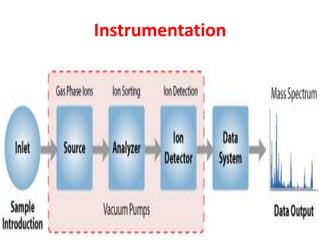
Instrumentation
INSTRUMENTATION
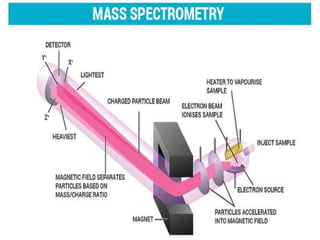
• A. Sample Inlet
• Sample stored in large reservoir from which molecules
reaches ionization chamber at low pressure in steady
stream by a pinhole called “Molecular leak”.
• B. Ionization
• Atoms are ionized by knocking one or more electrons off to
give positive ions by bombardment with a stream of
electrons. Most of the positive ions formed will carry
charge of +1.
• Ionization can be achieved by :
– Electron Ionization (EI-MS)
– Chemical Ionization (CI-MS)
– Desorption Technique (FAB)
• C . Acceleration
• Ions are accelerated so that they all have same kinetic
energy.
• Positive ions pass through 3 slits with voltage in decreasing
order.
• Middle slit carries intermediate and finals at zero volts.
• D. Deflection
• Ions are deflected by a magnetic field due to difference in
their masses.
• The lighter the mass, more they are deflected.
• It also depends upon the no. of +ve charge an ion is
carrying; the more +ve charge, more it will be deflected.
• E . Detection
• The beam of ions passing through the mass analyzer is
detected by detector on the basis of m/e ratio.
• When an ion hit the metal box, charge is neutralized by
an electron jumping from metal on to the ion.
• Types of analyzers:
– Magnetic sector mass analysers
– Double focussing analysers
– Quadrupole mass analysers
– Time of Flight analysers (TOF)
– Ion trap analyser
– Ion cyclotron analyser
APPLICATION
• Environmental monitoring and analysis (soil, water and air pollutants,
water quality, etc.)
• Geochemistry – age determination, soil and rock composition, oil and
gas surveying
• Chemical and Petrochemical industry – Quality control
• Identify structures of biomolecules, such as carbohydrates, nucleic
acids
• Sequence biopolymers such as proteins and oligosaccharides
• Determination of molecular mass of peptides, proteins, and
oligonucleotides.
• Monitoring gases in patients breath during surgery.
• Identification of drugs abuse and metabolites of drugs of abuse in
blood, urine, and saliva.

Mass spectrometry basic principle & Instrumentation

  • 1.
  • 2.
    INTRODUCTION • Mass Spectrometry(MS) is an analytical chemistry technique that helps identify the amount and type of chemicals present in a sample by measuring the mass-to- charge ratio and abundance of gas-phase ions. • In this instrumental technique, sample is converted to rapidly moving positive ions by electron bombardment and charged particles are separated according to their masses. • Mass spectrum is a plot of relative abundance against the ratio of mass/charge (m/e). • These spectra are used to determine the elemental or isotopic signature of a sample, the masses of particles and of molecules, and to elucidate the chemical structures of molecules and other chemical compounds.
  • 4.
    PRINCIPLE • In thistechnique, molecules are bombarded with a beam of energetic electrons. • The molecules are ionized and broken up into many fragments, some of which are positive ions. Each kind of ion has a particular ratio of mass to charge, i.e. m/e ratio (value). • For most ions, the charge is one and thus, m/e ratio is simply the molecular mass of the ion. • The ions pass through magnetic and electric fields to reach detector where they are detected and signals are recorded to give a mass spectra.
  • 5.
  • 6.
    INSTRUMENTATION • A. SampleInlet • Sample stored in large reservoir from which molecules reaches ionization chamber at low pressure in steady stream by a pinhole called “Molecular leak”. • B. Ionization • Atoms are ionized by knocking one or more electrons off to give positive ions by bombardment with a stream of electrons. Most of the positive ions formed will carry charge of +1. • Ionization can be achieved by : – Electron Ionization (EI-MS) – Chemical Ionization (CI-MS) – Desorption Technique (FAB)
  • 7.
    • C .Acceleration • Ions are accelerated so that they all have same kinetic energy. • Positive ions pass through 3 slits with voltage in decreasing order. • Middle slit carries intermediate and finals at zero volts. • D. Deflection • Ions are deflected by a magnetic field due to difference in their masses. • The lighter the mass, more they are deflected. • It also depends upon the no. of +ve charge an ion is carrying; the more +ve charge, more it will be deflected.
  • 8.
    • E .Detection • The beam of ions passing through the mass analyzer is detected by detector on the basis of m/e ratio. • When an ion hit the metal box, charge is neutralized by an electron jumping from metal on to the ion. • Types of analyzers: – Magnetic sector mass analysers – Double focussing analysers – Quadrupole mass analysers – Time of Flight analysers (TOF) – Ion trap analyser – Ion cyclotron analyser
  • 9.
    APPLICATION • Environmental monitoringand analysis (soil, water and air pollutants, water quality, etc.) • Geochemistry – age determination, soil and rock composition, oil and gas surveying • Chemical and Petrochemical industry – Quality control • Identify structures of biomolecules, such as carbohydrates, nucleic acids • Sequence biopolymers such as proteins and oligosaccharides • Determination of molecular mass of peptides, proteins, and oligonucleotides. • Monitoring gases in patients breath during surgery. • Identification of drugs abuse and metabolites of drugs of abuse in blood, urine, and saliva.