DEFINITION
PRIMARY
Develops in sterile urine
SECONDARY
Occurs in presence of
infection ,outflow obstruction
 impaired bladder emptying or a foreign body
Types
1. Mixed - most common
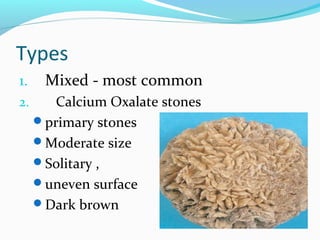
2. Calcium Oxalate stones
primary stones
Moderate size
Solitary ,
uneven surface
Dark brown
Types
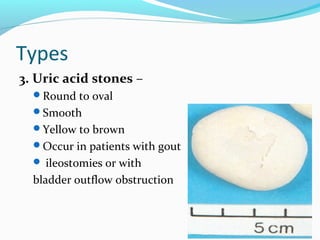
3. Uric acid stones –
Round to oval
Smooth
Yellow to brown
Occur in patients with gout
 ileostomies or with
bladder outflow obstruction
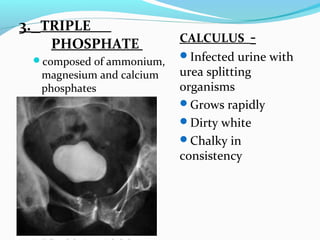
3. TRIPLE
PHOSPHATE
composed of ammonium,
magnesium and calcium
phosphates
CALCULUS -
Infected urine with
urea splitting
organisms
Grows rapidly
Dirty white
Chalky in
consistency
Types
4. Cysteine calculus
Presence of cystinuria
Radio-opaque
High sulphur content
A bladder stone is usually free to move in the
bladder
May cause erosions and haematuria
Gravitates to the lowest part of the bladder
Clinical features
Men >women. 8:1
Symptoms
1. Frequency : sensation of incomplete bladder
emptying.
2. Pain (strangury) occurs at the end of
micturition refered to tip of penis
1. Pain is worsened by movement
4. Haematuria drops of bright-red blood
at the end of micturition,
5.Interruption of the urinary stream
stone blocking the internal meatus.
6. UTI
Examination
1. Per abdomen : large calculus is palpable
in the female in suprapubic region
Investigations
1. urine reveals
1. microscopic haematuria,
2. pus or crystals that are typical of the
calculus,
2. Ultrasound abdomen
3. Radiogram
Treatment
Treat the cause
Bladder outflow obstruction
Incomplete bladder emptying in patients with
neurogenic bladder dysfunction.
Modalities
Lithotripsy
Per cutaneous suprapubic litholapaxy
Removal of retained foleys catheter
Different modalities
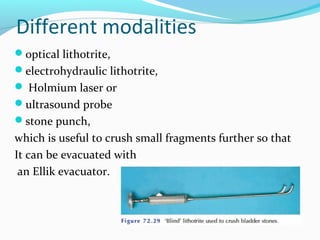
optical lithotrite,
electrohydraulic lithotrite,
 Holmium laser or
ultrasound probe
stone punch,
which is useful to crush small fragments further so that
It can be evacuated with
an Ellik evacuator.
Ultrasound lithotripsy is extremely safe but
appropriate only for small stones.
Percutaneous suprapubic litholapaxy
This is the best method to use if it is not possible
to carry
out litholapaxy per urethram because of a narrow
urethra.
Laser lithotripsy with the holmium laser can
deal with most large stones.
Once small fragments are produced, the optical
lithotrite can be used to finish the job. For
evacuation of the fragments, fluid (200 ml) is
introduced into the bladder. By evacuator the
returning solution carries with it fragments of
stone.
Contraindications
To perurethral litholapaxy are extremely rare:
Urethral stricture that cannot be dilated
sufficiently;
In patient is aged below 10 years;
Contracted bladder;
A very large stone.
Thank you
 REF BAILEY AND LOVE 25 ED

Bladder calculi

  • 2.
    DEFINITION PRIMARY Develops in sterileurine SECONDARY Occurs in presence of infection ,outflow obstruction  impaired bladder emptying or a foreign body
  • 3.
    Types 1. Mixed -most common 2. Calcium Oxalate stones primary stones Moderate size Solitary , uneven surface Dark brown
  • 4.
    Types 3. Uric acidstones – Round to oval Smooth Yellow to brown Occur in patients with gout  ileostomies or with bladder outflow obstruction
  • 5.
    3. TRIPLE PHOSPHATE composed ofammonium, magnesium and calcium phosphates CALCULUS - Infected urine with urea splitting organisms Grows rapidly Dirty white Chalky in consistency
  • 6.
    Types 4. Cysteine calculus Presenceof cystinuria Radio-opaque High sulphur content A bladder stone is usually free to move in the bladder May cause erosions and haematuria Gravitates to the lowest part of the bladder
  • 7.
    Clinical features Men >women.8:1 Symptoms 1. Frequency : sensation of incomplete bladder emptying. 2. Pain (strangury) occurs at the end of micturition refered to tip of penis 1. Pain is worsened by movement
  • 8.
    4. Haematuria dropsof bright-red blood at the end of micturition, 5.Interruption of the urinary stream stone blocking the internal meatus. 6. UTI
  • 9.
    Examination 1. Per abdomen: large calculus is palpable in the female in suprapubic region
  • 10.
    Investigations 1. urine reveals 1.microscopic haematuria, 2. pus or crystals that are typical of the calculus, 2. Ultrasound abdomen 3. Radiogram
  • 11.
    Treatment Treat the cause Bladderoutflow obstruction Incomplete bladder emptying in patients with neurogenic bladder dysfunction. Modalities Lithotripsy Per cutaneous suprapubic litholapaxy Removal of retained foleys catheter
  • 12.
    Different modalities optical lithotrite, electrohydrauliclithotrite,  Holmium laser or ultrasound probe stone punch, which is useful to crush small fragments further so that It can be evacuated with an Ellik evacuator.
  • 13.
    Ultrasound lithotripsy isextremely safe but appropriate only for small stones. Percutaneous suprapubic litholapaxy This is the best method to use if it is not possible to carry out litholapaxy per urethram because of a narrow urethra.
  • 14.
    Laser lithotripsy withthe holmium laser can deal with most large stones. Once small fragments are produced, the optical lithotrite can be used to finish the job. For evacuation of the fragments, fluid (200 ml) is introduced into the bladder. By evacuator the returning solution carries with it fragments of stone.
  • 15.
    Contraindications To perurethral litholapaxyare extremely rare: Urethral stricture that cannot be dilated sufficiently; In patient is aged below 10 years; Contracted bladder; A very large stone.
  • 16.
    Thank you  REFBAILEY AND LOVE 25 ED