UTERINE FIBROIDS
(LEIOMYOMATAS
DR. SUMAN KUMARI
What are they?
• Smooth Muscle Tumor of the Uterus
• The most common uterine tumor
– Occurring in about 30% of women above the age
of 30 years.
• Occurs up to 75% of hysterectomy specimens
• Symptomatic in 1/3 of cases
Patient Characteristics• Age:
– 30-40 years.
– Rare before 30 or after 40 years
• Parity:
– Common in nulliparas, patients with low parity.
– It is rare in multiparas.
• Race:
– 3-9 times more common in negroids.
• Family history:
– Usually positive.
• Hyper-estrenemia:
– Estrogen receptors (ER) more than the surrounding myometrium but
less than those in the endometrium
• Atrophies and shrinks after menopause.
• Common association with other hyper-estrenic conditions as
endometriosis, endometrial hyperplasia and endometrial
carcinoma
PATHOLOGY
• Frequently multiple
• May reach 15 cm in size or larger
• Firm
• Spherical or irregularly lobulated
• Have a false capsule
• Can be easily enucleated from surrounding myometrium
pathogenesis
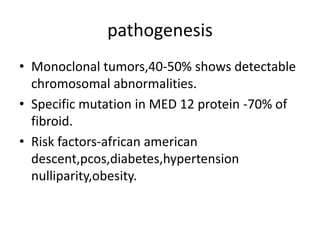
• Monoclonal tumors,40-50% shows detectable
chromosomal abnormalities.
• Specific mutation in MED 12 protein -70% of
fibroid.
• Risk factors-african american
descent,pcos,diabetes,hypertension
nulliparity,obesity.
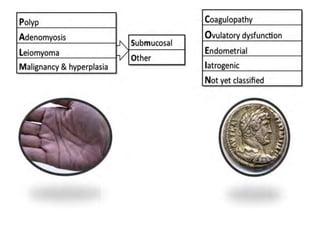
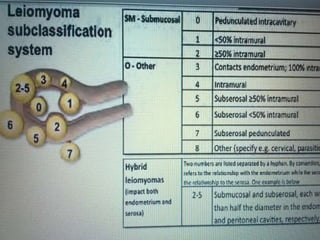
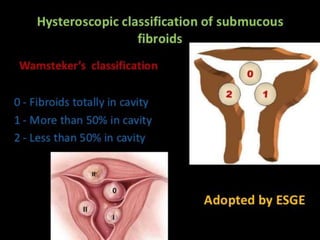
CLASSIFICATION
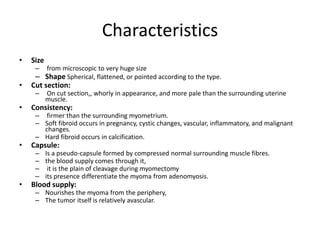
Characteristics
• Size
– from microscopic to very huge size
– Shape Spherical, flattened, or pointed according to the type.
• Cut section:
– On cut section,, whorly in appearance, and more pale than the surrounding uterine
muscle.
• Consistency:
– firmer than the surrounding myometrium.
– Soft fibroid occurs in pregnancy, cystic changes, vascular, inflammatory, and malignant
changes.
– Hard fibroid occurs in calcification.
• Capsule:
– Is a pseudo-capsule formed by compressed normal surrounding muscle fibres.
– the blood supply comes through it,
– it is the plain of cleavage during myomectomy
– its presence differentiate the myoma from adenomyosis.
• Blood supply:
– Nourishes the myoma from the periphery,
– The tumor itself is relatively avascular.
Presentations
• Asymptomatic:
– It is the commonest presentation.
– Vaginal bleeding: It is the commonest symptom,
– Menorrhagia or polymenorrhea: (commonest): This occurs due to:
• Associated hormonal imbalance and endometrial hyperplasia.
• Surface ulceration of submucous fibroid.
• Interstitial fibroid acts as F.B. preventing full contraction of myometrium to decrease
blood loss.
• Pelvic congestion.
• Increased uterine size, vascularity, and endometrial surface area.
– Metrorrhagia: due to:
• In submucous fibroid due to ulceration of the surface, necrosis of the tip, or secondary
infection.
• Associated endometrial polyp.
• Associated malignancy (cancer body or sarcomatous change).
– Contact bleeding: (rare)
– ulcerated or infected tip of submucous fibroid polyp.
– Post-menopausal bleeding:
• Either due to sarcomatous change or associated endometrial carcinoma.
• Picture of iron deficiency anemia.
• Discharge:
– Leucorrhea and mucoid discharge due to pelvic congestion.
– Muco-sanguinous discharge with ulcerated fibroid polyp.
– Muco-purulent discharge due to secondary infection.
• Swelling:
– Either abdominal swelling due to large fibroid or vaginal swelling due to a polyp.
• Infertility [in 5-10% of cases]:
– Most important is the underlying predisposing factor as anovulation and hormonal
disturbance.
– Broad ligamentary fibroid may stretch or distort the tubes.
– Corneal fibroids may obstruct the uterine end of the tube.
– S.M.F. acts as F.B. interfering with implantation.
– Cervical fibroid may obstruct the cervical canal.
– Associated endometriosis or endometrial hyperplasia.
• Pain: uncommon
– Intermittent colicky pain in submucous fibroid (acts as F.B. in the uterine cavity).
– Dull-aching pain and congestive dysmenorrhea due to pelvic congestion.
– Acute abdomen in red degeneration, torsion, ruptured vessel, and inflammation
• Pressure symptoms
– Cervical fibroid:
• Anteriorly on the urethra causing acute retention of urine, or the
bladder causing frequency of micturition.
• Laterally on the ureters causing colic and back pressure on the
kidneys.
• Posteriorly on the rectum causing dyskasia, constipation, and sense
of incomplete defecation.
– Huge fibroid:
• On the pelvic veins causing edema, pain, and varicose veins in the
lower limbs.
• On the GIT causing distension and dyspepsia.
• On the diaphragm causing dyspnea.
• Spontaneous abortion:
– Before myomectomy [ 40%]
– 20% after myomectomy
Signs of fibroid
• General examination:
– signs of chronic anemia.
• Abdominal examination:
– large pelvi-abdominal swelling in huge fibroids.
• Pelvic examination:
– symmetrically or asymmetrically enlarged uterus.
• Speculum examination
– fibroid polyp.
Management
• Conservative Management
– small asymptomatic fibroid,
– fibroid in pregnancy or puerperium.
• Just keep observation every 6 months.
• Beware of underlying and/or associated
pathology
Medical Treatment:
• Pre-operative till the time of surgery.
• Patient near the menopause, or newly married with
minimal symptoms.
• Red degeneration with pregnancy.
• Lines of treatment:
– Symptomatic:
• Correction of anemia,
• haemostatics,
• analgesics, and anti-spasmodics (anti-PG).
– Anti-estrogens:
• large dose of progesterone,
• Tamoxifen, Danazol,
• LH-RH analogues
– useful in decreasing the size and vascularity of the tumor by 50% which is
beneficial before myomectomy
Surgical Management
• Indications:
• Symptomatic cases or uterus larger than 12
weeks size.
• Suspected malignancy (rapidly enlarging or
post-menopausal growth).
• Multiple huge fibroids liable to
complications.
• Infertility.
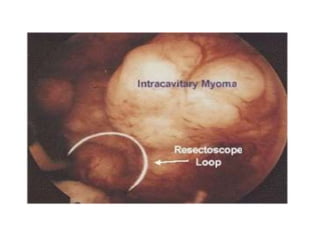
Myomectomy
• Abdominal Myomectomy
• Vaginal Myomectomy
• Endoscopic Myomectomy
– Hysteroscopic
– Laparoscopic
• Embolization techniques ( Interventional
Radiology)
Principle
•Myomectomy aims at
– removal of all the myomas,
– with conservation of a functioning uterus to
preserve the reproductive function.
•Generally the morbidity is higher than those
with hysterectomy.
– It is associated with much blood loss
– Liability of recurrence of fibroid.
•Myomectomy is better reserved only for those
keen to preserve the reproductive function.
• The patient must be prepared for the possible need for an
emergency hysterectomy.
• Precautions to minimize blood loss during myomectomy:
– The timing of operation is post-menstrual (minimal pelvic congestion).
– Pre-operative LH-RH analogues: may be given for 3 months before surgery
to reduce the size and vascularity of the myomas.
– Intraoperative hemostasis
• Vertical midline incision is the least vascular
• application of Bonney’s myomectomy clamp or a rubber tourniquet
• Use ring forceps to occlude the ovarian vessels
• Careful dissection to enucleate all the masses is needed to avoid
recurrence.
• Avoid anesthetic agents that induce uterine relaxation (e.g. halothane).
• Vasopressin (pitressin) 20 IU in 20 ml in normal saline are injected in the
uterine wall at the site of incision.
• Obliteration of the tumour cavities.
• Buried sutures to the tumor bed after shelling out of the masses.
• Use absorbable sutures.
• Blood needs to be prepared for possible transfusion
• Technique of abdominal myomectomy:
• Preliminary diagnostic curettage to exclude endometrial carcinoma.
• The uterine incision:
– Avoid incisions on the posterior uterine wall, for the risk of
adhesions to the bowel.
– The smallest incision is designed to enable removal of as many
lesions as possible.
– Tunneling in the uterine wall is utilized to minimize many
incisions and peritoneal trauma.
– Try to avoid opening the endometrial cavity.
• To keep the uterus anteverted
– ventrosuspension or plication of the round ligaments and
uterosacral ligaments.
• Dextran solution, Ringer lactate solution or
dexamethazone could be instilled in the peritoneal cavity
to minimize postoperative adhesions
Vaginal Procedures
• Vaginal myomectomy:
– Indicated when a fibroid polyp is not larger than 8 weeks
pregnancy size.
– The polyp is grasped and twisted until the pedicle tears.
– If the pedicle is too thick it is cut with scissors.
– A large polyp could be cut as piece-meal fashion
(morcellation).
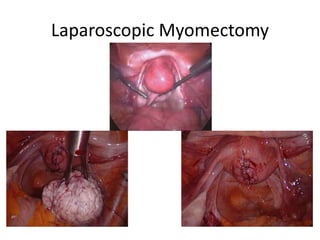
Laparoscopic Myomectomy
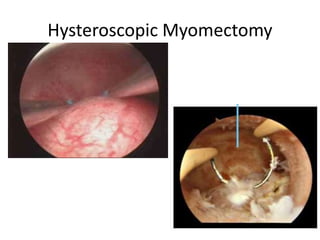
Hysteroscopic Myomectomy
Hysterectomy
• Patient around 40 years, and completed her
family.
• The number or site contraindicate myomectomy
• Severe bleeding during myomectomy.
• Major damage of the uterus by myomectomy
which affects its function for pregnancy.
• Recurrent fibroids.
• Suspicious of malignancy
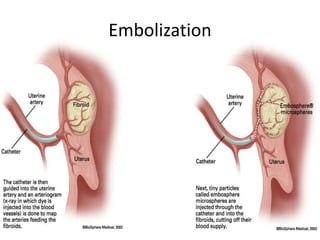
Embolization
• UAE-interventional radiologist uses a cather to
deliver small particles that block the blood supply
to uterine body.
• UFE-UAE for uterine fibroid.
• Req.LA,femoral artery-uterine artery.
• Pt. Can be discharged after 24 hr.
• s/e- < hystrectomy
• Adverse effect includes-death from
embolisation,or septicemia.
• Misembolisation of microspheres or poly vinyl
alcohol-damage to other organ.
• Ovarian damage resulting from embolic
material migrating to the ovaries.
• Loss of ovarian function, infertility, and loss of
orgasm.
• Failure of embolization surgery- continued
fibroid growth, regrowth within fourmonths.
• Menopause - iatrogenic, abnormal, cessation
of menstruation and folliclestimulating
hormones elevated to menopausal levels
Post embolisation syndrome(PES)
• acute /or chronic pain,fever nausea ,vometing
severe night sweats.
• Foul vaginal odour.
Radiofrequency Ablation (RFA)
• A minimally invasive procedure that involves
inserting a needle-like device intothe fibroid
through the abdomen and heating it with low
frequency electrical current.
• called as THE HALT’S METHOD
• Its currently in phase-three clinical trials—the
last phase & awaits approval foruterine
fibroids.
HALT’S METHOD
• The Halt procedure involves three small incisions.
•One is to insert the laparoscopic camera so the
surgeon can see inside theabdomen.
•Second is to insert an intra-abdominal ultrasound
probe, which can determine thesize and location of
fibroids.
•Third incision is for the Halt Device, a needle
electrode that penetrates the fibroidand burns the
cells, which are eventually reabsorbed by the body.
• requires general anesthesia
• take several hoursdepending on how many
fibroids are found.
• patients can go home the same day.
• Other S/E are similar to other minimally
invasive surgeries.
• In the current trial, investigators are ablating
fibroids larger than one centimeterand only
six at a time.
MRI guided Focused Ultrasound
• Approved for use by the FDA in October 2004.
• Highly precise medical procedure that applies
high-intensity focused sonicenergy to locally heat
& destroy the diseased/damaged tissue, via
ablation.
• Ultrasound can be focused,either via a Lens
(polystyrene lens),a Curved Transducer/
• An acoustic wave propagates through the tissue,
part of it is absorbed and convertedto heat
• Tissue damage occurs as a function of both :-
a) the temperature to which the tissue is
heated b) how long the tissue is exposed to
this heat level in a metric referred to as
"thermal dose". Dose.
ADVANTAGES
• No Scar.
• Can be done as a day procedure.
• Short hospital stay.
• Least chances of infection, other post-op
complications.
• Early resuming of daily activities.
• Interferes least with everyday life of the women.7
• Can be done in multiple sittings for a large sized
fibroid.8
• Repeating the procedure has lowest risks, as
compared to surgical options.
Selective Progesterone Receptor
Modulator (SPRM)
• emergency contraception within 120 hours (5
days) after an unprotected intercourse .
• evidence suggests that Ulipristal Acetate may
be useful in the managementof uterine
fibroids.
• available without a prescription in India.
• Ulipristal Acetate has partial agonistic as well
as antagonistic effectson the progesterone
receptor.
• It also binds to the glucocorticoid receptor,
but has no relevant affinity to theestrogen,
androgen and mineralocorticoid receptors
Degenerative Changes
• Hyaline degeneration:
– Commonest secondary change.
– Usually starts around the menopause, and in the
center of the fibroid.
– Macroscopically, fibroid looks homogenous, waxy,
soft, with loss of whorly appearance.
• Fatty changes:
– Likely to start around the age of menopause.
– Lipids reach the fibroid through the blood, so fatty
change starts at the periphery of the fibroid,
resulting in a yellow soft fibroid.
• Calcification:
– Step following fatty change when fatty acids undergo
saponification with Ca salts giving Ca stearate and palmitate,
forming layers of calcifications.
– Clinically, the fibroid become hard like bone (Womb stone).
– Radiologically, show a radio-opaque shadow with typical
onion skin appearance.
• Red degeneration (Necrobiosis):
– Usually occurs in the middle trimester of pregnancy, due to
increased vascularity and venous stasis, the tumor enlarges
with hemorrhage inside the tumor.
– It is called necrobiosis because it shows dead parts (central)
and living parts (peripheral).
Vascular Changes
• Torsion (Axial rotation):
–Occurs in moderate-sized, pedunculated, subserous fibroid with no adhesions.
–The precipitating factor is sudden twisting movement as trauma, intestinal
movement, or fetal kick, leading to axial rotation which is prevented from re-twisting
by the lashing effect of the pulsating pedicle.
–The clinical effects depend on the onset of torsion:
• Sudden torsion leads to acute abdomen and necrosis of the tumor.
• Gradual torsion leads to gradual decrease of the blood supply from the pedicle which ends
in the development of parasitic tumor.
• Telangeactasis:
–Likely to occur with pregnancy, malignant change, and cervical fibroid due to
increased vascularity.
–There are numerous dilated blood vessels on the surface of the fibroid which may
rupture leading to acute abdomen and internal hemorrhage.
• Lymphangeactasis:
–Likely to occur around the age of menopause as the fibroid is full of lymphatics.
–Dilated lymphatic vessels on the surface may rupture leading to lymphatic exudates
and strong adhesions.
• Congestion and edema: A result of impaction, incarceration, torsion, infection,
or pregnancy
Inflammatory changes
• Ways of infection:
– Trauma of submucous fibroid e.g. D & C or labor.
– Near by inflammation e.g. appendicitis.
– Blood-borne (very rare).
• Result of infection:
– The fibroid becomes congested, tender, and even
abscess formation; it becomes soft and heals by
adhesions to the surrounding
Malignant changes
• Rare (0.5%) into leiomyosarcoma (round, spindle,
mixed or giant cell histopathology types).
• Symptoms suggestive:
– The fibroid becomes more painful.
– Post-menopausal bleeding or growth of the tumor.
• Signs suggestive:
– The fibroid become softer, tender, or fixed.
– Rapid growth of the tumor.
Complications of fibroid
• Degenerative changes.
• Vascular changes.
• Inflammatory changes.
• Malignant changes.
• Pregnancy complications e.g. abortion, and preterm labor.
• Pressure complications on the urethra, bladder, ureters,
rectum, and pelvic veins.
• Rarely, chronic inversion of the uterus.
• Polycythemia and hypertension due to the release of
erythropoietic agent.
• Infertility.
• Secondary parasitic attachment of fibromyomas to other
abdominal structures gaining another blood supply

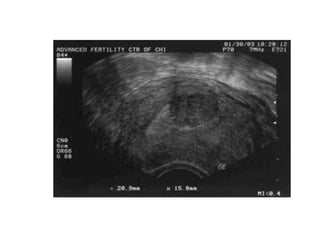
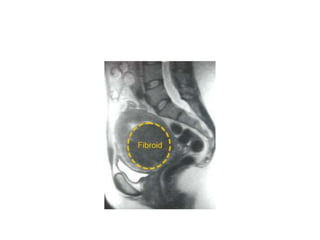
Fibroid uterus

  • 1.
  • 2.
    What are they? •Smooth Muscle Tumor of the Uterus • The most common uterine tumor – Occurring in about 30% of women above the age of 30 years. • Occurs up to 75% of hysterectomy specimens • Symptomatic in 1/3 of cases
  • 3.
    Patient Characteristics• Age: –30-40 years. – Rare before 30 or after 40 years • Parity: – Common in nulliparas, patients with low parity. – It is rare in multiparas. • Race: – 3-9 times more common in negroids. • Family history: – Usually positive. • Hyper-estrenemia: – Estrogen receptors (ER) more than the surrounding myometrium but less than those in the endometrium • Atrophies and shrinks after menopause. • Common association with other hyper-estrenic conditions as endometriosis, endometrial hyperplasia and endometrial carcinoma
  • 4.
    PATHOLOGY • Frequently multiple •May reach 15 cm in size or larger • Firm • Spherical or irregularly lobulated • Have a false capsule • Can be easily enucleated from surrounding myometrium
  • 5.
    pathogenesis • Monoclonal tumors,40-50%shows detectable chromosomal abnormalities. • Specific mutation in MED 12 protein -70% of fibroid. • Risk factors-african american descent,pcos,diabetes,hypertension nulliparity,obesity.
  • 8.
  • 16.
    Characteristics • Size – frommicroscopic to very huge size – Shape Spherical, flattened, or pointed according to the type. • Cut section: – On cut section,, whorly in appearance, and more pale than the surrounding uterine muscle. • Consistency: – firmer than the surrounding myometrium. – Soft fibroid occurs in pregnancy, cystic changes, vascular, inflammatory, and malignant changes. – Hard fibroid occurs in calcification. • Capsule: – Is a pseudo-capsule formed by compressed normal surrounding muscle fibres. – the blood supply comes through it, – it is the plain of cleavage during myomectomy – its presence differentiate the myoma from adenomyosis. • Blood supply: – Nourishes the myoma from the periphery, – The tumor itself is relatively avascular.
  • 17.
    Presentations • Asymptomatic: – Itis the commonest presentation. – Vaginal bleeding: It is the commonest symptom, – Menorrhagia or polymenorrhea: (commonest): This occurs due to: • Associated hormonal imbalance and endometrial hyperplasia. • Surface ulceration of submucous fibroid. • Interstitial fibroid acts as F.B. preventing full contraction of myometrium to decrease blood loss. • Pelvic congestion. • Increased uterine size, vascularity, and endometrial surface area. – Metrorrhagia: due to: • In submucous fibroid due to ulceration of the surface, necrosis of the tip, or secondary infection. • Associated endometrial polyp. • Associated malignancy (cancer body or sarcomatous change). – Contact bleeding: (rare) – ulcerated or infected tip of submucous fibroid polyp. – Post-menopausal bleeding: • Either due to sarcomatous change or associated endometrial carcinoma. • Picture of iron deficiency anemia.
  • 18.
    • Discharge: – Leucorrheaand mucoid discharge due to pelvic congestion. – Muco-sanguinous discharge with ulcerated fibroid polyp. – Muco-purulent discharge due to secondary infection. • Swelling: – Either abdominal swelling due to large fibroid or vaginal swelling due to a polyp. • Infertility [in 5-10% of cases]: – Most important is the underlying predisposing factor as anovulation and hormonal disturbance. – Broad ligamentary fibroid may stretch or distort the tubes. – Corneal fibroids may obstruct the uterine end of the tube. – S.M.F. acts as F.B. interfering with implantation. – Cervical fibroid may obstruct the cervical canal. – Associated endometriosis or endometrial hyperplasia. • Pain: uncommon – Intermittent colicky pain in submucous fibroid (acts as F.B. in the uterine cavity). – Dull-aching pain and congestive dysmenorrhea due to pelvic congestion. – Acute abdomen in red degeneration, torsion, ruptured vessel, and inflammation
  • 19.
    • Pressure symptoms –Cervical fibroid: • Anteriorly on the urethra causing acute retention of urine, or the bladder causing frequency of micturition. • Laterally on the ureters causing colic and back pressure on the kidneys. • Posteriorly on the rectum causing dyskasia, constipation, and sense of incomplete defecation. – Huge fibroid: • On the pelvic veins causing edema, pain, and varicose veins in the lower limbs. • On the GIT causing distension and dyspepsia. • On the diaphragm causing dyspnea. • Spontaneous abortion: – Before myomectomy [ 40%] – 20% after myomectomy
  • 20.
    Signs of fibroid •General examination: – signs of chronic anemia. • Abdominal examination: – large pelvi-abdominal swelling in huge fibroids. • Pelvic examination: – symmetrically or asymmetrically enlarged uterus. • Speculum examination – fibroid polyp.
  • 24.
    Management • Conservative Management –small asymptomatic fibroid, – fibroid in pregnancy or puerperium. • Just keep observation every 6 months. • Beware of underlying and/or associated pathology
  • 25.
    Medical Treatment: • Pre-operativetill the time of surgery. • Patient near the menopause, or newly married with minimal symptoms. • Red degeneration with pregnancy. • Lines of treatment: – Symptomatic: • Correction of anemia, • haemostatics, • analgesics, and anti-spasmodics (anti-PG). – Anti-estrogens: • large dose of progesterone, • Tamoxifen, Danazol, • LH-RH analogues – useful in decreasing the size and vascularity of the tumor by 50% which is beneficial before myomectomy
  • 26.
    Surgical Management • Indications: •Symptomatic cases or uterus larger than 12 weeks size. • Suspected malignancy (rapidly enlarging or post-menopausal growth). • Multiple huge fibroids liable to complications. • Infertility.
  • 27.
    Myomectomy • Abdominal Myomectomy •Vaginal Myomectomy • Endoscopic Myomectomy – Hysteroscopic – Laparoscopic • Embolization techniques ( Interventional Radiology)
  • 28.
    Principle •Myomectomy aims at –removal of all the myomas, – with conservation of a functioning uterus to preserve the reproductive function. •Generally the morbidity is higher than those with hysterectomy. – It is associated with much blood loss – Liability of recurrence of fibroid. •Myomectomy is better reserved only for those keen to preserve the reproductive function.
  • 29.
    • The patientmust be prepared for the possible need for an emergency hysterectomy. • Precautions to minimize blood loss during myomectomy: – The timing of operation is post-menstrual (minimal pelvic congestion). – Pre-operative LH-RH analogues: may be given for 3 months before surgery to reduce the size and vascularity of the myomas. – Intraoperative hemostasis • Vertical midline incision is the least vascular • application of Bonney’s myomectomy clamp or a rubber tourniquet • Use ring forceps to occlude the ovarian vessels • Careful dissection to enucleate all the masses is needed to avoid recurrence. • Avoid anesthetic agents that induce uterine relaxation (e.g. halothane). • Vasopressin (pitressin) 20 IU in 20 ml in normal saline are injected in the uterine wall at the site of incision. • Obliteration of the tumour cavities. • Buried sutures to the tumor bed after shelling out of the masses. • Use absorbable sutures. • Blood needs to be prepared for possible transfusion
  • 30.
    • Technique ofabdominal myomectomy: • Preliminary diagnostic curettage to exclude endometrial carcinoma. • The uterine incision: – Avoid incisions on the posterior uterine wall, for the risk of adhesions to the bowel. – The smallest incision is designed to enable removal of as many lesions as possible. – Tunneling in the uterine wall is utilized to minimize many incisions and peritoneal trauma. – Try to avoid opening the endometrial cavity. • To keep the uterus anteverted – ventrosuspension or plication of the round ligaments and uterosacral ligaments. • Dextran solution, Ringer lactate solution or dexamethazone could be instilled in the peritoneal cavity to minimize postoperative adhesions
  • 31.
    Vaginal Procedures • Vaginalmyomectomy: – Indicated when a fibroid polyp is not larger than 8 weeks pregnancy size. – The polyp is grasped and twisted until the pedicle tears. – If the pedicle is too thick it is cut with scissors. – A large polyp could be cut as piece-meal fashion (morcellation).
  • 32.
  • 33.
  • 34.
    Hysterectomy • Patient around40 years, and completed her family. • The number or site contraindicate myomectomy • Severe bleeding during myomectomy. • Major damage of the uterus by myomectomy which affects its function for pregnancy. • Recurrent fibroids. • Suspicious of malignancy
  • 35.
  • 36.
    • UAE-interventional radiologistuses a cather to deliver small particles that block the blood supply to uterine body. • UFE-UAE for uterine fibroid. • Req.LA,femoral artery-uterine artery. • Pt. Can be discharged after 24 hr. • s/e- < hystrectomy • Adverse effect includes-death from embolisation,or septicemia. • Misembolisation of microspheres or poly vinyl alcohol-damage to other organ.
  • 37.
    • Ovarian damageresulting from embolic material migrating to the ovaries. • Loss of ovarian function, infertility, and loss of orgasm. • Failure of embolization surgery- continued fibroid growth, regrowth within fourmonths. • Menopause - iatrogenic, abnormal, cessation of menstruation and folliclestimulating hormones elevated to menopausal levels
  • 38.
    Post embolisation syndrome(PES) •acute /or chronic pain,fever nausea ,vometing severe night sweats. • Foul vaginal odour.
  • 39.
    Radiofrequency Ablation (RFA) •A minimally invasive procedure that involves inserting a needle-like device intothe fibroid through the abdomen and heating it with low frequency electrical current. • called as THE HALT’S METHOD • Its currently in phase-three clinical trials—the last phase & awaits approval foruterine fibroids.
  • 40.
    HALT’S METHOD • TheHalt procedure involves three small incisions. •One is to insert the laparoscopic camera so the surgeon can see inside theabdomen. •Second is to insert an intra-abdominal ultrasound probe, which can determine thesize and location of fibroids. •Third incision is for the Halt Device, a needle electrode that penetrates the fibroidand burns the cells, which are eventually reabsorbed by the body.
  • 41.
    • requires generalanesthesia • take several hoursdepending on how many fibroids are found. • patients can go home the same day. • Other S/E are similar to other minimally invasive surgeries. • In the current trial, investigators are ablating fibroids larger than one centimeterand only six at a time.
  • 42.
    MRI guided FocusedUltrasound • Approved for use by the FDA in October 2004. • Highly precise medical procedure that applies high-intensity focused sonicenergy to locally heat & destroy the diseased/damaged tissue, via ablation. • Ultrasound can be focused,either via a Lens (polystyrene lens),a Curved Transducer/ • An acoustic wave propagates through the tissue, part of it is absorbed and convertedto heat
  • 43.
    • Tissue damageoccurs as a function of both :- a) the temperature to which the tissue is heated b) how long the tissue is exposed to this heat level in a metric referred to as "thermal dose". Dose.
  • 44.
    ADVANTAGES • No Scar. •Can be done as a day procedure. • Short hospital stay. • Least chances of infection, other post-op complications. • Early resuming of daily activities. • Interferes least with everyday life of the women.7 • Can be done in multiple sittings for a large sized fibroid.8 • Repeating the procedure has lowest risks, as compared to surgical options.
  • 45.
    Selective Progesterone Receptor Modulator(SPRM) • emergency contraception within 120 hours (5 days) after an unprotected intercourse . • evidence suggests that Ulipristal Acetate may be useful in the managementof uterine fibroids. • available without a prescription in India. • Ulipristal Acetate has partial agonistic as well as antagonistic effectson the progesterone receptor.
  • 46.
    • It alsobinds to the glucocorticoid receptor, but has no relevant affinity to theestrogen, androgen and mineralocorticoid receptors
  • 47.
    Degenerative Changes • Hyalinedegeneration: – Commonest secondary change. – Usually starts around the menopause, and in the center of the fibroid. – Macroscopically, fibroid looks homogenous, waxy, soft, with loss of whorly appearance. • Fatty changes: – Likely to start around the age of menopause. – Lipids reach the fibroid through the blood, so fatty change starts at the periphery of the fibroid, resulting in a yellow soft fibroid.
  • 48.
    • Calcification: – Stepfollowing fatty change when fatty acids undergo saponification with Ca salts giving Ca stearate and palmitate, forming layers of calcifications. – Clinically, the fibroid become hard like bone (Womb stone). – Radiologically, show a radio-opaque shadow with typical onion skin appearance. • Red degeneration (Necrobiosis): – Usually occurs in the middle trimester of pregnancy, due to increased vascularity and venous stasis, the tumor enlarges with hemorrhage inside the tumor. – It is called necrobiosis because it shows dead parts (central) and living parts (peripheral).
  • 49.
    Vascular Changes • Torsion(Axial rotation): –Occurs in moderate-sized, pedunculated, subserous fibroid with no adhesions. –The precipitating factor is sudden twisting movement as trauma, intestinal movement, or fetal kick, leading to axial rotation which is prevented from re-twisting by the lashing effect of the pulsating pedicle. –The clinical effects depend on the onset of torsion: • Sudden torsion leads to acute abdomen and necrosis of the tumor. • Gradual torsion leads to gradual decrease of the blood supply from the pedicle which ends in the development of parasitic tumor. • Telangeactasis: –Likely to occur with pregnancy, malignant change, and cervical fibroid due to increased vascularity. –There are numerous dilated blood vessels on the surface of the fibroid which may rupture leading to acute abdomen and internal hemorrhage. • Lymphangeactasis: –Likely to occur around the age of menopause as the fibroid is full of lymphatics. –Dilated lymphatic vessels on the surface may rupture leading to lymphatic exudates and strong adhesions. • Congestion and edema: A result of impaction, incarceration, torsion, infection, or pregnancy
  • 50.
    Inflammatory changes • Waysof infection: – Trauma of submucous fibroid e.g. D & C or labor. – Near by inflammation e.g. appendicitis. – Blood-borne (very rare). • Result of infection: – The fibroid becomes congested, tender, and even abscess formation; it becomes soft and heals by adhesions to the surrounding
  • 51.
    Malignant changes • Rare(0.5%) into leiomyosarcoma (round, spindle, mixed or giant cell histopathology types). • Symptoms suggestive: – The fibroid becomes more painful. – Post-menopausal bleeding or growth of the tumor. • Signs suggestive: – The fibroid become softer, tender, or fixed. – Rapid growth of the tumor.
  • 52.
    Complications of fibroid •Degenerative changes. • Vascular changes. • Inflammatory changes. • Malignant changes. • Pregnancy complications e.g. abortion, and preterm labor. • Pressure complications on the urethra, bladder, ureters, rectum, and pelvic veins. • Rarely, chronic inversion of the uterus. • Polycythemia and hypertension due to the release of erythropoietic agent. • Infertility. • Secondary parasitic attachment of fibromyomas to other abdominal structures gaining another blood supply