

Click to edit Master title style
• Edit Master text styles
• Second level
• Third level
• Fourth level
• Fifth level
Prostatitis
Dr. Doha Rasheedy
Assisstant professor of Geriatrics and Gerontology
Faculty of Medicine
Ain Shams University
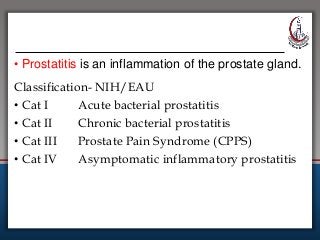
• Prostatitis is an inflammation of the prostate gland.
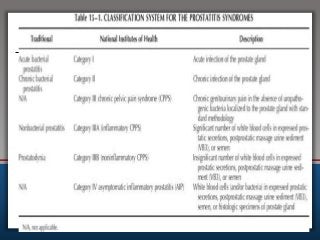
Classification- NIH/EAU
• Cat I Acute bacterial prostatitis
• Cat II Chronic bacterial prostatitis
• Cat III Prostate Pain Syndrome (CPPS)
• Cat IV Asymptomatic inflammatory prostatitis
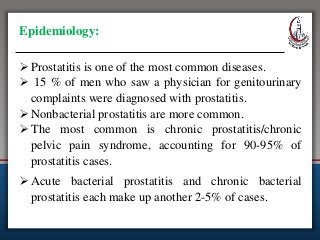
Epidemiology:
 Prostatitis is one of the most common diseases.
 15 % of men who saw a physician for genitourinary
complaints were diagnosed with prostatitis.
 Nonbacterial prostatitis are more common.
 The most common is chronic prostatitis/chronic
pelvic pain syndrome, accounting for 90-95% of
prostatitis cases.
 Acute bacterial prostatitis and chronic bacterial
prostatitis each make up another 2-5% of cases.
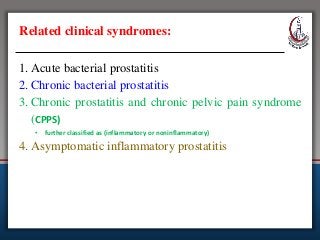
Related clinical syndromes:
1. Acute bacterial prostatitis
2. Chronic bacterial prostatitis
3. Chronic prostatitis and chronic pelvic pain syndrome
(CPPS)
• further classified as (inflammatory or noninflammatory)
4. Asymptomatic inflammatory prostatitis
Acute bacterial prostatitis- 1
• Sources:
1. Ascending infection (The first is reflux of infected urine into the glandular prostatic tissue via
the ejaculatory and prostatic ducts. The second is ascending urethral infection from the meatus,
particularly during sexual intercourse)
2. Direct extension or lymphatic spread from the rectum.
3. Heamatogenous
• Organisms:
1. 80% of the pathogens are gram-negative organisms (eg, Escherichia coli, Enterobacter, Serratia,
Pseudomonas, Enterococcus, and Proteus species).
2. Mixed bacterial infections are uncommon
3. Consider Neisseria gonorrhoeae and Chlamydia trachomatis infection in any male younger than 35
years presenting with urinary tract symptoms
4. Consider a diagnosis of sexually transmitted prostatitis in sexually active adolescents.
5. Anti-Chlamydial antibodies in 30% of chronic prostatitis, but < 1% culture organism.
Acute bacterial prostatitis- 2
Risk factors:
1. indwelling urethral catheters
2. Sclerotherapy for rectal prolapse
Patients with acute bacterial prostatitis may present with the following:
1. Fever, Chills, Malaise, Arthralgias , Myalgias
2. Perineal/prostatic pain
3. Lower urinary tract symptoms, including frequency, urgency, dysuria, nocturia, hesitancy, weak
stream, and incomplete voiding
4. Urine retention
5. Low back pain, Low abdominal pain
6. Spontaneous urethral discharge
7. History of sclerotherapy for rectal prolapse
On examination:
1. Tender, nodular, hot, boggy, or normal-feeling gland on digital rectal examination
2. Suprapubic abdominal tenderness
3. Enlarged tender bladder due to urinary retention
4. Avoid prostatic massage in patients with acute bacterial prostatitis it increases risk of
bacteremia.
Chronic bacterial prostatitis- 1
Risk factors:
• A primary voiding dysfunction problem, either structural or
functional
Causative agents:
1. E coli is responsible for 75-80% of chronic bacterial prostatitis cases.
2. Enterococci and gram-negative aerobes such as Pseudomonas are
usually isolated in the remainder of cases.
3. C trachomatis, Ureaplasma species, Trichomonas vaginalis
4. Uncommon organisms, such as M tuberculosis and Coccidioides,
Histoplasma, and Candida species , must also be considered.
Tuberculous prostatitis may be found in patients with renal
tuberculosis
Chronic bacterial prostatitis- 2
Patients with chronic bacterial prostatitis typically have no systemic
symptoms. Instead, these patients may present with the following:
1. Intermittent dysuria
2. Intermittent lower urinary tract symptoms
3. Recurrent urinary tract infections
• On examination:
1. Normal examination findings between acute episodes
2. Tender, nodular, or normal gland on digital rectal examination
3. Suprapubic tenderness during acute episodes
•
Chronic prostatitis and chronic pelvic pain
syndrome CPPS
• (inflammatory or non inflammatory) based on the presence or absence of
white blood cells in prostatic secretions
• Chronic pelvic pain syndrome is diagnosed based on pain in the
setting of negative cultures of urine and prostatic secretions.
• Neuromuscular dysfunction or congenital reflux of urine into the
ejaculatory and prostatic ducts may be a precipitating factor.
• The etiology of CPPS is poorly understood but may involve an
infectious or inflammatory initiator that results in neurologic injury
and eventually in pelvic floor dysfunction in the form of increased
pelvic tone.
• About 5-8% of men with this syndrome eventually have a bacterial
pathogen isolated from urine or prostatic fluid.
Multiple factors within and between patients
(Hypotheses):
1. Presence of antibiotic resistant non-culturable micro-
organisms
2. Chemical irritation
3. Intra-ductal reflux and obstruction
4. Dysfunctional high pressure voiding
5. Neuropathic pain
6. Pudendal nerve entrapment
7. Autoimmune
• Causes:
1. Functional or structural bladder pathology, such as
primary vesical neck obstruction, pseudodyssynergia
(failure of the external sphincter to relax during
voiding), impaired detrusor contractility, or
acontractile detrusor muscle
2. Ejaculatory duct obstruction
3. Increased pelvic side wall tension
4. Nonspecific prostatic inflammation
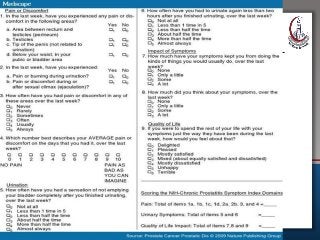
Patients with chronic prostatitis and chronic pelvic pain syndrome
may present with the following:
1. Pelvic pain or discomfort, including perineal, suprapubic, coccygeal, rectal,
urethral, and testicular/scrotal pain for more than 3 of the previous 6 months
without documented urinary tract infections from uropathogens.
2. Lower urinary tract symptoms, including frequency, dysuria, and incomplete
voiding
3. Ejaculatory pain
4. Erectile dysfunction
• Physical examination in patients with chronic prostatitis and chronic
pelvic pain syndrome may reveal the following:
1. Mildly tender or normal prostate on digital rectal examination
2. Tight anal sphincter on digital rectal examination
• Assess symptoms using:
• Chronic Prostatitis Symptom Index
Asymptomatic inflammatory prostatitis
• Asymptomatic inflammatory prostatitis by definition
produces no symptoms.
Complications of prostatitis
1. Bladder outlet obstruction/urinary retention
2. Abscess - Typically in immunocompromised patients
3. Infertility due to scarring of the urethra or ejaculatory ducts
4. Recurrent cystitis
5. Pyelonephritis
6. Renal damage
7. Prostatitis may lead to urosepsis with significant associated
mortality in patients with diabetes mellitus, patients on dialysis for
chronic renal failure, patients who are immunocompromised, and
postsurgical patients who have had urethral instrumentation.
8. Chronic prostatitis and asymptomatic inflammatory prostatitis have
not been definitively linked to the development of prostate cancer.
Investigations:
1. Urinalysis and urine culture can confirm the presence of infection and identify
pathogens.
2. complete blood count (CBC) with differential
3. blood cultures
4. serum prostate-specific antigen
5. (TRUS ): transrectal ultrasonography, capsular thickening and prostatic calculi.
6. CT to rule out prostatic abscess or suspected neoplasm.
7. Fractional urine studies (urethral and bladder urine) and cytology of expressed
prostatic secretions can help differentiate prostatitis from urethritis and cystitis.
8. Cystoscopy is useful in refractory cases with significant voiding dysfunction
symptoms to rule out neoplasm of the bladder or interstitial cystitis.
9. Voiding cystourethrography (VCUG) or retrograde urethrography (RUG) may be
appropriate for evaluation of the bladder neck anatomy and penile and anterior
urethra in cases of suspected bladder neck dyssynergia or urethral stricture.
Fractional urine examination
1. The use of fractional urine specimens may be useful in the diagnosis of
prostatitis. Although not practical in most emergency departments, this
technique is used by urologists if the diagnosis of prostatitis remains
unclear.
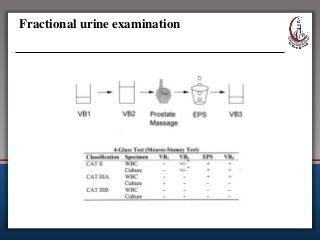
2. The initial 10 mL of voided urine represents urine from the urethra and is
termed voided urine 1 (V1). Elevated bacterial counts in V1 suggest
urethritis. The next 200 mL of voided urine is discarded, and a midstream
urine sample (V2) is collected, which represents bladder urine. Bacterial
counts elevated in the midstream sample suggest cystitis without
prostatitis.
3. Next, the physician performs a prostatic massage and the expressed
prostatic secretions (EPS) are collected from the urethral meatus Finally,
the 10 mL of voided urine following prostatic massage (V3) are collected.
The bacterial findings of the EPS and V3 samples represent the
microbiologic characteristics of the prostate gland.
Fractional urine examination
Treatment
Acute bacterial prostatitis:
Patients without a toxic appearance:
• can be treated on an outpatient basis with a 14- to 28-day course of oral antibiotics,
usually a fluoroquinolone or trimethoprim-sulfamethoxazole
 Provide supportive measures such as antipyretics, analgesics, hydration, and stool
softeners as needed. Urinary analgesics such as phenazopyridine and flavoxate
(genurin- urispas) are also commonly used.
For retention:
 Suprapubic catheters are considered safer than urethral catheterization in severe
obstruction due to prostatic swelling from bacterial infection and may be placed in
consultation with a urologist
In cases of prostatic abscess:
the fluctuant site may be drained under local anesthesia either transrectally or
transperineally. When performed transperineally, a pigtail catheter can be inserted as a
drain. Cystoscopic, transurethral unroofing of an abscess is also possible with the patient
under anesthesia.
Others:
1. Because the rate of occult infection is high, a therapeutic trial of antibiotics is
often in order even when patients do not appear to have bacterial prostatitis.
2. 4- to 6-week trial of antibiotic therapy is indicated in chronic bacterial
prostatitis and chronic pelvic pain syndrome with inflammation, but no
consensus exists regarding its use in chronic pelvic pain syndrome without
inflammation and asymptomatic prostatitis.
3. Prostate-penetrating antibiotics, such as fluoroquinolone or trimethoprim-
sulfamethoxazole.
4. Chronic prostatitis, chronic pelvic pain syndrome, and asymptomatic
inflammatory prostatitis may be treated with alpha-blocking agents with sitz
baths.
5. Chronic nonbacterial prostatitis, treatment includes nonsteroidal anti-
inflammatory drugs, alpha-blocking agents, anticholinergic agents, trial of
pregabalin or amitryptaline for neuropathic etiology
6. Prostate Massage but no good evidence to support use
7. Finasteride v Placebo slight improvement but not properly powered.
 Herbal therapy:
o Bee Pollen Extract (a bioflavonoid) showed slight improvements
o Saw Palmetto – no effect
 Balloon dilatation and needle ablation
 TURP if obstructive or BPH, or as a last resort
 Heat therapy: How to convey heat to the prostate:
 Transrectal (microwave)
 Transurethral (microwave)
 Interstitial (laser, Nanoparticles)
 Tempro or Tuna (radiofrequency)
 Hifu (ultrasound)
•
Click to edit Master title style
• Edit Master text styles
• Second level
• Third level
• Fourth level
• Fifth level

Prostatitis

  • 1.
    Click to editMaster title style • Edit Master text styles • Second level • Third level • Fourth level • Fifth level Prostatitis Dr. Doha Rasheedy Assisstant professor of Geriatrics and Gerontology Faculty of Medicine Ain Shams University
  • 2.
    • Prostatitis isan inflammation of the prostate gland. Classification- NIH/EAU • Cat I Acute bacterial prostatitis • Cat II Chronic bacterial prostatitis • Cat III Prostate Pain Syndrome (CPPS) • Cat IV Asymptomatic inflammatory prostatitis
  • 3.
    Epidemiology:  Prostatitis isone of the most common diseases.  15 % of men who saw a physician for genitourinary complaints were diagnosed with prostatitis.  Nonbacterial prostatitis are more common.  The most common is chronic prostatitis/chronic pelvic pain syndrome, accounting for 90-95% of prostatitis cases.  Acute bacterial prostatitis and chronic bacterial prostatitis each make up another 2-5% of cases.
  • 4.
    Related clinical syndromes: 1.Acute bacterial prostatitis 2. Chronic bacterial prostatitis 3. Chronic prostatitis and chronic pelvic pain syndrome (CPPS) • further classified as (inflammatory or noninflammatory) 4. Asymptomatic inflammatory prostatitis
  • 6.
    Acute bacterial prostatitis-1 • Sources: 1. Ascending infection (The first is reflux of infected urine into the glandular prostatic tissue via the ejaculatory and prostatic ducts. The second is ascending urethral infection from the meatus, particularly during sexual intercourse) 2. Direct extension or lymphatic spread from the rectum. 3. Heamatogenous • Organisms: 1. 80% of the pathogens are gram-negative organisms (eg, Escherichia coli, Enterobacter, Serratia, Pseudomonas, Enterococcus, and Proteus species). 2. Mixed bacterial infections are uncommon 3. Consider Neisseria gonorrhoeae and Chlamydia trachomatis infection in any male younger than 35 years presenting with urinary tract symptoms 4. Consider a diagnosis of sexually transmitted prostatitis in sexually active adolescents. 5. Anti-Chlamydial antibodies in 30% of chronic prostatitis, but < 1% culture organism.
  • 7.
    Acute bacterial prostatitis-2 Risk factors: 1. indwelling urethral catheters 2. Sclerotherapy for rectal prolapse Patients with acute bacterial prostatitis may present with the following: 1. Fever, Chills, Malaise, Arthralgias , Myalgias 2. Perineal/prostatic pain 3. Lower urinary tract symptoms, including frequency, urgency, dysuria, nocturia, hesitancy, weak stream, and incomplete voiding 4. Urine retention 5. Low back pain, Low abdominal pain 6. Spontaneous urethral discharge 7. History of sclerotherapy for rectal prolapse On examination: 1. Tender, nodular, hot, boggy, or normal-feeling gland on digital rectal examination 2. Suprapubic abdominal tenderness 3. Enlarged tender bladder due to urinary retention 4. Avoid prostatic massage in patients with acute bacterial prostatitis it increases risk of bacteremia.
  • 8.
    Chronic bacterial prostatitis-1 Risk factors: • A primary voiding dysfunction problem, either structural or functional Causative agents: 1. E coli is responsible for 75-80% of chronic bacterial prostatitis cases. 2. Enterococci and gram-negative aerobes such as Pseudomonas are usually isolated in the remainder of cases. 3. C trachomatis, Ureaplasma species, Trichomonas vaginalis 4. Uncommon organisms, such as M tuberculosis and Coccidioides, Histoplasma, and Candida species , must also be considered. Tuberculous prostatitis may be found in patients with renal tuberculosis
  • 9.
    Chronic bacterial prostatitis-2 Patients with chronic bacterial prostatitis typically have no systemic symptoms. Instead, these patients may present with the following: 1. Intermittent dysuria 2. Intermittent lower urinary tract symptoms 3. Recurrent urinary tract infections • On examination: 1. Normal examination findings between acute episodes 2. Tender, nodular, or normal gland on digital rectal examination 3. Suprapubic tenderness during acute episodes •
  • 10.
    Chronic prostatitis andchronic pelvic pain syndrome CPPS • (inflammatory or non inflammatory) based on the presence or absence of white blood cells in prostatic secretions • Chronic pelvic pain syndrome is diagnosed based on pain in the setting of negative cultures of urine and prostatic secretions. • Neuromuscular dysfunction or congenital reflux of urine into the ejaculatory and prostatic ducts may be a precipitating factor. • The etiology of CPPS is poorly understood but may involve an infectious or inflammatory initiator that results in neurologic injury and eventually in pelvic floor dysfunction in the form of increased pelvic tone. • About 5-8% of men with this syndrome eventually have a bacterial pathogen isolated from urine or prostatic fluid.
  • 11.
    Multiple factors withinand between patients (Hypotheses): 1. Presence of antibiotic resistant non-culturable micro- organisms 2. Chemical irritation 3. Intra-ductal reflux and obstruction 4. Dysfunctional high pressure voiding 5. Neuropathic pain 6. Pudendal nerve entrapment 7. Autoimmune
  • 12.
    • Causes: 1. Functionalor structural bladder pathology, such as primary vesical neck obstruction, pseudodyssynergia (failure of the external sphincter to relax during voiding), impaired detrusor contractility, or acontractile detrusor muscle 2. Ejaculatory duct obstruction 3. Increased pelvic side wall tension 4. Nonspecific prostatic inflammation
  • 13.
    Patients with chronicprostatitis and chronic pelvic pain syndrome may present with the following: 1. Pelvic pain or discomfort, including perineal, suprapubic, coccygeal, rectal, urethral, and testicular/scrotal pain for more than 3 of the previous 6 months without documented urinary tract infections from uropathogens. 2. Lower urinary tract symptoms, including frequency, dysuria, and incomplete voiding 3. Ejaculatory pain 4. Erectile dysfunction • Physical examination in patients with chronic prostatitis and chronic pelvic pain syndrome may reveal the following: 1. Mildly tender or normal prostate on digital rectal examination 2. Tight anal sphincter on digital rectal examination • Assess symptoms using: • Chronic Prostatitis Symptom Index
  • 15.
    Asymptomatic inflammatory prostatitis •Asymptomatic inflammatory prostatitis by definition produces no symptoms.
  • 16.
    Complications of prostatitis 1.Bladder outlet obstruction/urinary retention 2. Abscess - Typically in immunocompromised patients 3. Infertility due to scarring of the urethra or ejaculatory ducts 4. Recurrent cystitis 5. Pyelonephritis 6. Renal damage 7. Prostatitis may lead to urosepsis with significant associated mortality in patients with diabetes mellitus, patients on dialysis for chronic renal failure, patients who are immunocompromised, and postsurgical patients who have had urethral instrumentation. 8. Chronic prostatitis and asymptomatic inflammatory prostatitis have not been definitively linked to the development of prostate cancer.
  • 17.
    Investigations: 1. Urinalysis andurine culture can confirm the presence of infection and identify pathogens. 2. complete blood count (CBC) with differential 3. blood cultures 4. serum prostate-specific antigen 5. (TRUS ): transrectal ultrasonography, capsular thickening and prostatic calculi. 6. CT to rule out prostatic abscess or suspected neoplasm. 7. Fractional urine studies (urethral and bladder urine) and cytology of expressed prostatic secretions can help differentiate prostatitis from urethritis and cystitis. 8. Cystoscopy is useful in refractory cases with significant voiding dysfunction symptoms to rule out neoplasm of the bladder or interstitial cystitis. 9. Voiding cystourethrography (VCUG) or retrograde urethrography (RUG) may be appropriate for evaluation of the bladder neck anatomy and penile and anterior urethra in cases of suspected bladder neck dyssynergia or urethral stricture.
  • 18.
    Fractional urine examination 1.The use of fractional urine specimens may be useful in the diagnosis of prostatitis. Although not practical in most emergency departments, this technique is used by urologists if the diagnosis of prostatitis remains unclear. 2. The initial 10 mL of voided urine represents urine from the urethra and is termed voided urine 1 (V1). Elevated bacterial counts in V1 suggest urethritis. The next 200 mL of voided urine is discarded, and a midstream urine sample (V2) is collected, which represents bladder urine. Bacterial counts elevated in the midstream sample suggest cystitis without prostatitis. 3. Next, the physician performs a prostatic massage and the expressed prostatic secretions (EPS) are collected from the urethral meatus Finally, the 10 mL of voided urine following prostatic massage (V3) are collected. The bacterial findings of the EPS and V3 samples represent the microbiologic characteristics of the prostate gland.
  • 19.
  • 20.
    Treatment Acute bacterial prostatitis: Patientswithout a toxic appearance: • can be treated on an outpatient basis with a 14- to 28-day course of oral antibiotics, usually a fluoroquinolone or trimethoprim-sulfamethoxazole  Provide supportive measures such as antipyretics, analgesics, hydration, and stool softeners as needed. Urinary analgesics such as phenazopyridine and flavoxate (genurin- urispas) are also commonly used. For retention:  Suprapubic catheters are considered safer than urethral catheterization in severe obstruction due to prostatic swelling from bacterial infection and may be placed in consultation with a urologist In cases of prostatic abscess: the fluctuant site may be drained under local anesthesia either transrectally or transperineally. When performed transperineally, a pigtail catheter can be inserted as a drain. Cystoscopic, transurethral unroofing of an abscess is also possible with the patient under anesthesia.
  • 21.
    Others: 1. Because therate of occult infection is high, a therapeutic trial of antibiotics is often in order even when patients do not appear to have bacterial prostatitis. 2. 4- to 6-week trial of antibiotic therapy is indicated in chronic bacterial prostatitis and chronic pelvic pain syndrome with inflammation, but no consensus exists regarding its use in chronic pelvic pain syndrome without inflammation and asymptomatic prostatitis. 3. Prostate-penetrating antibiotics, such as fluoroquinolone or trimethoprim- sulfamethoxazole. 4. Chronic prostatitis, chronic pelvic pain syndrome, and asymptomatic inflammatory prostatitis may be treated with alpha-blocking agents with sitz baths. 5. Chronic nonbacterial prostatitis, treatment includes nonsteroidal anti- inflammatory drugs, alpha-blocking agents, anticholinergic agents, trial of pregabalin or amitryptaline for neuropathic etiology 6. Prostate Massage but no good evidence to support use 7. Finasteride v Placebo slight improvement but not properly powered.
  • 22.
     Herbal therapy: oBee Pollen Extract (a bioflavonoid) showed slight improvements o Saw Palmetto – no effect  Balloon dilatation and needle ablation  TURP if obstructive or BPH, or as a last resort  Heat therapy: How to convey heat to the prostate:  Transrectal (microwave)  Transurethral (microwave)  Interstitial (laser, Nanoparticles)  Tempro or Tuna (radiofrequency)  Hifu (ultrasound) •
  • 23.
    Click to editMaster title style • Edit Master text styles • Second level • Third level • Fourth level • Fifth level