Urolithiasis
Prepared by
1.Yter chamrane
2.Teang chaanmakara
3.Korng pharat
4.Tea titiya
Lectured by Yok
Ratana MD
contents
• Urolithiasis
• Background
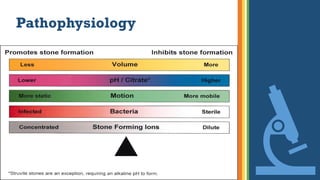
• Epidemiology
• Chemical type of stone
• Pathophysiology of stone formation
• Risk factors
• Clinical feature
• Location and characteristic of pain
• Phase of an attack
• Physical examination
• Diagnosis
• Emergency
• Management
Urolithiasis
• Urolithiasis (from Greek oûron-urine and lithos-stone) is
the condition where urinary stones are formed or located
anywhere in the urinary system.
Background
 Urolithiasis is a common disease that is estimated to
produce medical costs of $2.1 billion per year in the United
States alone.
Background
 Renal colic affects approximately 1.2 million people
each year in USA and accounts for approximately 1% of
all hospital admissions.
 Most active emergency departments (EDs) manage
patients with acute renal colic every day.
Epidemiology
• The lower the economic status, the lower the likelihood
of renal stones
• Most at 20-49 years
• Peak incidence at 35-45 years
• Male-to-female ratio of 3:1
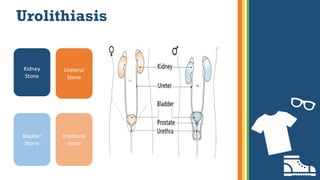
Urolithiasis
Kidney
Stone
Bladder
Stone
Ureteral
Stone
Uretheral
stone
Chemical types of stone
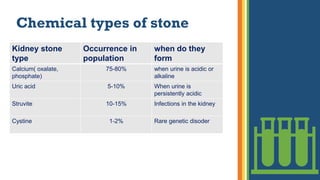
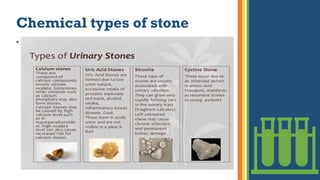
Four main chemical types :
1st Calcium stone
2nd Struvite stone
3rd Uric Acid stone
4th Cystine stone
Chemical types of stone
Kidney stone
type
Occurrence in
population
when do they
form
Calcium( oxalate,
phosphate)
75-80% when urine is acidic or
alkaline
Uric acid 5-10% When urine is
persistently acidic
Struvite 10-15% Infections in the kidney
Cystine 1-2% Rare genetic disoder
Chemical types of stone
• (Use this space to discuss procedures to follow in the
event of a lab accident.)
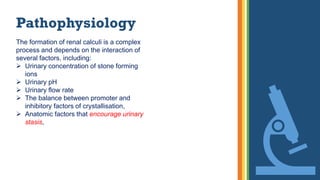
Pathophysiology
The formation of renal calculi is a complex
process and depends on the interaction of
several factors, including:
 Urinary concentration of stone forming
ions
 Urinary pH
 Urinary flow rate
 The balance between promoter and
inhibitory factors of crystallisation,
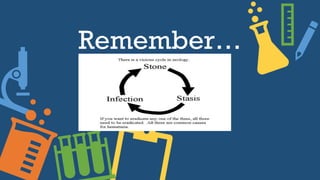
 Anatomic factors that encourage urinary
stasis,
Remember…
Pathophysiology
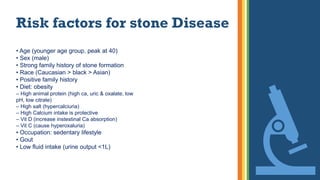
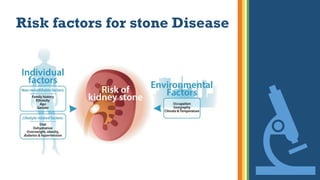
Risk factors for stone Disease
• Age (younger age group, peak at 40)
• Sex (male)
• Strong family history of stone formation
• Race (Caucasian > black > Asian)
• Positive family history
• Diet: obesity
– High animal protein (high ca, uric & oxalate, low
pH, low citrate)
– High salt (hypercalciuria)
– High Calcium intake is protective
– Vit D (increase instestinal Ca absorption)
– Vit C (cause hyperoxaluria)
• Occupation: sedentary lifestyle
• Gout
• Low fluid intake (urine output <1L)
Risk factors for stone Disease
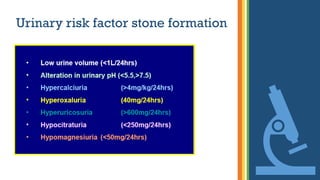
Urinary risk factor stone formation
Clinical manifestation
The presentation is variable.
Patients with urinary calculi may report:
 Pain
infection
Hematuria
Asymptomatic
Clinical manifestation
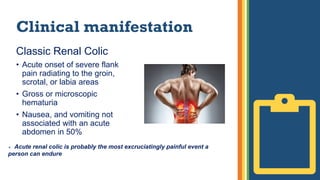
Classic Renal Colic
• Acute onset of severe flank
pain radiating to the groin,
scrotal, or labia areas
• Gross or microscopic
hematuria
• Nausea, and vomiting not
associated with an acute
abdomen in 50%
 Acute renal colic is probably the most excruciatingly painful event a
person can endure
Clinical manifestation
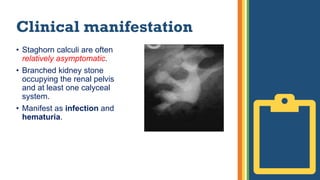
• Staghorn calculi are often
relatively asymptomatic.
• Branched kidney stone
occupying the renal pelvis
and at least one calyceal
system.
• Manifest as infection and
hematuria.
Clinical manifestation
• Acute obstruction of ureter-
• severe colic
• Flank pain referred to
genitalia
• Nausea, vomiting
• Microhematuria
• can be little or no pain
• Chronic stone distends to
be associated with large or
multiple stones
• may have impaired renal
function,anemia, weight
loss etc.
• concomitant infection more
likely
Location and Characteristics
of pain
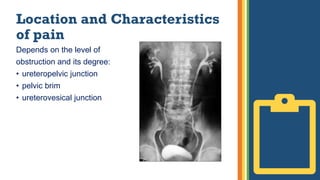
Depends on the level of
obstruction and its degree:
• ureteropelvic junction
• pelvic brim
• ureterovesical junction
Location and Characteristics
of pain
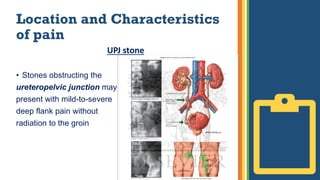
UPJ stone
• Stones obstructing the
ureteropelvic junction may
present with mild-to-severe
deep flank pain without
radiation to the groin
Location and Characteristics
of pain
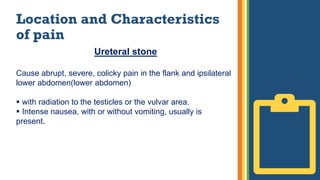
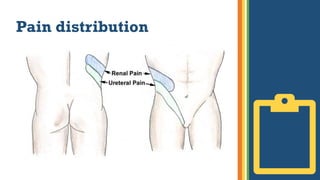
Ureteral stone
Cause abrupt, severe, colicky pain in the flank and ipsilateral
lower abdomen(lower abdomen)
 with radiation to the testicles or the vulvar area.
 Intense nausea, with or without vomiting, usually is
present.
Location and Characteristics
of pain
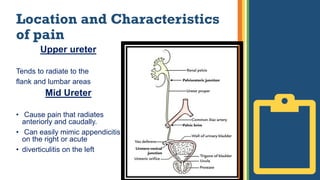
Upper ureter
Tends to radiate to the
flank and lumbar areas
Mid Ureter
• Cause pain that radiates
anteriorly and caudally.
• Can easily mimic appendicitis
on the right or acute
• diverticulitis on the left
Location and Characteristics
of pain
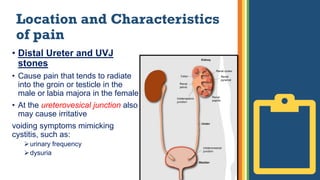
• Distal Ureter and UVJ
stones
• Cause pain that tends to radiate
into the groin or testicle in the
male or labia majora in the female
• At the ureterovesical junction also
may cause irritative
voiding symptoms mimicking
cystitis, such as:
urinary frequency
dysuria
Pain distribution
Location and Characteristics
of pain
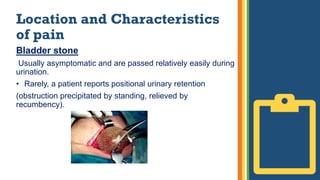
Bladder stone
Usually asymptomatic and are passed relatively easily during
urination.
• Rarely, a patient reports positional urinary retention
(obstruction precipitated by standing, relieved by
recumbency).
Phases of an attack
• The entire process typical lasts 3-18 hours
• Acute phase: peak in most patients within 2 hours
of onset (30 min to 6
• hours)
• Constant Phase 1- 4 hours maximum 12 hours
• Relief phase 1.5-3 hours
Physical examination
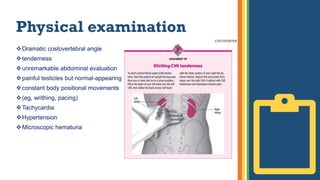
Dramatic costovertebral angle
tenderness
unremarkable abdominal evaluation
painful testicles but normal-appearing
constant body positional movements
(eg, writhing, pacing)
Tachycardia
Hypertension
Microscopic hematuria
Diagnosis
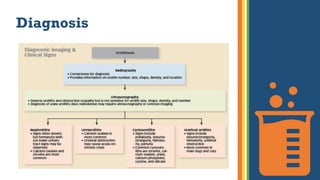
Hx, PE, Clinic
Imaging
Lab Test
Diagnosis
Diagnosis Clinic:
• symptoms or incidentally
Presenting symptoms include pain or
haematuria (microscopic or occasionally macroscopic).
*Struvite staghorn calculi classically present
with recurrent UTIs. Malaise, weakness, and
loss of appetite can also occur.
Diagnosis
Diagnosis Imagining:
 Ultrasound (US) :its sensitivity about 95%,
can identify stones located in the calices, pelvis, and
pyeloureteric and vesico-ureteric junctions, upper
urinary tract dilatation.
 KUB radiography
 Intravenous radiography
 Intravenous pyelogram(IVP)
 CT scan
Diagnosis
Laboratory test
The recommended based on EUA recommendations:
 Urinary sediment/dipstick test: To demonstrate blood cells
 Serum creatinine level: To measure renal function
Additional lab test
May be helpful:
 CBC in febrile patients
 Serum electrolyte assessment in vomiting patients
 24-Hour urine profile on outpatient basis
Emergency renal colic
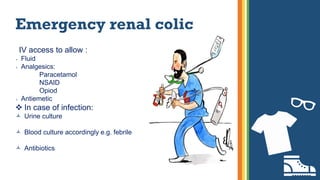
IV access to allow :
 Fluid
 Analgesics:
Paracetamol
NSAID
Opiod
 Antiemetic
 In case of infection:
 Urine culture
 Blood culture accordingly e.g. febrile
 Antibiotics
Medical option
Renal colic:
Pain relief should be initiated immediately.
• NSAIDs are effective in patients with acute stone colic
• Opioids, particularly pethidine, are associated with a high
rate of vomiting compared to NSAIDs
Prevention of recurrent renal colic
• First choice: NSAIDs. (diclofenac*, indomethacin or
ibuprofen**).
• Second choice: hydromorphine, pentazocine or tramadol.
• Alpha-blockers as medical expulsive therapy for ureteral
stone.
Surgical option
Obstruction relief:
 Ureteral stent insertion
 Percutaneous nephrostomy
Definitive surgical treatment:
 ESWL
 Ureteroscopy
 PCNL
 Open, laparoscopic and robotic
pyelo-lithotomy, ureterolithotomy,
cystolithotomy
References
• Medscape article nephrolithiasis by J Stuart
Wolf Jr, MD, FACS updated
feb 11, 2013
• Campbell-Walsh Urology 10th edition
• Smith and Tanagho's General Urology,
Eighteenth Edition
Thank you for
your attention

Urolithiasis

  • 1.
    Urolithiasis Prepared by 1.Yter chamrane 2.Teangchaanmakara 3.Korng pharat 4.Tea titiya Lectured by Yok Ratana MD
  • 2.
    contents • Urolithiasis • Background •Epidemiology • Chemical type of stone • Pathophysiology of stone formation • Risk factors • Clinical feature • Location and characteristic of pain • Phase of an attack • Physical examination • Diagnosis • Emergency • Management
  • 3.
    Urolithiasis • Urolithiasis (fromGreek oûron-urine and lithos-stone) is the condition where urinary stones are formed or located anywhere in the urinary system.
  • 4.
    Background  Urolithiasis isa common disease that is estimated to produce medical costs of $2.1 billion per year in the United States alone.
  • 5.
    Background  Renal colicaffects approximately 1.2 million people each year in USA and accounts for approximately 1% of all hospital admissions.  Most active emergency departments (EDs) manage patients with acute renal colic every day.
  • 6.
    Epidemiology • The lowerthe economic status, the lower the likelihood of renal stones • Most at 20-49 years • Peak incidence at 35-45 years • Male-to-female ratio of 3:1
  • 7.
  • 8.
    Chemical types ofstone Four main chemical types : 1st Calcium stone 2nd Struvite stone 3rd Uric Acid stone 4th Cystine stone
  • 9.
    Chemical types ofstone Kidney stone type Occurrence in population when do they form Calcium( oxalate, phosphate) 75-80% when urine is acidic or alkaline Uric acid 5-10% When urine is persistently acidic Struvite 10-15% Infections in the kidney Cystine 1-2% Rare genetic disoder
  • 10.
    Chemical types ofstone • (Use this space to discuss procedures to follow in the event of a lab accident.)
  • 11.
    Pathophysiology The formation ofrenal calculi is a complex process and depends on the interaction of several factors, including:  Urinary concentration of stone forming ions  Urinary pH  Urinary flow rate  The balance between promoter and inhibitory factors of crystallisation,  Anatomic factors that encourage urinary stasis,
  • 12.
  • 13.
  • 14.
    Risk factors forstone Disease • Age (younger age group, peak at 40) • Sex (male) • Strong family history of stone formation • Race (Caucasian > black > Asian) • Positive family history • Diet: obesity – High animal protein (high ca, uric & oxalate, low pH, low citrate) – High salt (hypercalciuria) – High Calcium intake is protective – Vit D (increase instestinal Ca absorption) – Vit C (cause hyperoxaluria) • Occupation: sedentary lifestyle • Gout • Low fluid intake (urine output <1L)
  • 15.
    Risk factors forstone Disease
  • 16.
    Urinary risk factorstone formation
  • 17.
    Clinical manifestation The presentationis variable. Patients with urinary calculi may report:  Pain infection Hematuria Asymptomatic
  • 18.
    Clinical manifestation Classic RenalColic • Acute onset of severe flank pain radiating to the groin, scrotal, or labia areas • Gross or microscopic hematuria • Nausea, and vomiting not associated with an acute abdomen in 50%  Acute renal colic is probably the most excruciatingly painful event a person can endure
  • 19.
    Clinical manifestation • Staghorncalculi are often relatively asymptomatic. • Branched kidney stone occupying the renal pelvis and at least one calyceal system. • Manifest as infection and hematuria.
  • 20.
    Clinical manifestation • Acuteobstruction of ureter- • severe colic • Flank pain referred to genitalia • Nausea, vomiting • Microhematuria • can be little or no pain • Chronic stone distends to be associated with large or multiple stones • may have impaired renal function,anemia, weight loss etc. • concomitant infection more likely
  • 21.
    Location and Characteristics ofpain Depends on the level of obstruction and its degree: • ureteropelvic junction • pelvic brim • ureterovesical junction
  • 22.
    Location and Characteristics ofpain UPJ stone • Stones obstructing the ureteropelvic junction may present with mild-to-severe deep flank pain without radiation to the groin
  • 23.
    Location and Characteristics ofpain Ureteral stone Cause abrupt, severe, colicky pain in the flank and ipsilateral lower abdomen(lower abdomen)  with radiation to the testicles or the vulvar area.  Intense nausea, with or without vomiting, usually is present.
  • 24.
    Location and Characteristics ofpain Upper ureter Tends to radiate to the flank and lumbar areas Mid Ureter • Cause pain that radiates anteriorly and caudally. • Can easily mimic appendicitis on the right or acute • diverticulitis on the left
  • 25.
    Location and Characteristics ofpain • Distal Ureter and UVJ stones • Cause pain that tends to radiate into the groin or testicle in the male or labia majora in the female • At the ureterovesical junction also may cause irritative voiding symptoms mimicking cystitis, such as: urinary frequency dysuria
  • 26.
  • 27.
    Location and Characteristics ofpain Bladder stone Usually asymptomatic and are passed relatively easily during urination. • Rarely, a patient reports positional urinary retention (obstruction precipitated by standing, relieved by recumbency).
  • 28.
    Phases of anattack • The entire process typical lasts 3-18 hours • Acute phase: peak in most patients within 2 hours of onset (30 min to 6 • hours) • Constant Phase 1- 4 hours maximum 12 hours • Relief phase 1.5-3 hours
  • 29.
    Physical examination Dramatic costovertebralangle tenderness unremarkable abdominal evaluation painful testicles but normal-appearing constant body positional movements (eg, writhing, pacing) Tachycardia Hypertension Microscopic hematuria
  • 30.
  • 31.
    Diagnosis Diagnosis Clinic: • symptomsor incidentally Presenting symptoms include pain or haematuria (microscopic or occasionally macroscopic). *Struvite staghorn calculi classically present with recurrent UTIs. Malaise, weakness, and loss of appetite can also occur.
  • 32.
    Diagnosis Diagnosis Imagining:  Ultrasound(US) :its sensitivity about 95%, can identify stones located in the calices, pelvis, and pyeloureteric and vesico-ureteric junctions, upper urinary tract dilatation.  KUB radiography  Intravenous radiography  Intravenous pyelogram(IVP)  CT scan
  • 33.
  • 34.
    Laboratory test The recommendedbased on EUA recommendations:  Urinary sediment/dipstick test: To demonstrate blood cells  Serum creatinine level: To measure renal function Additional lab test May be helpful:  CBC in febrile patients  Serum electrolyte assessment in vomiting patients  24-Hour urine profile on outpatient basis
  • 35.
    Emergency renal colic IVaccess to allow :  Fluid  Analgesics: Paracetamol NSAID Opiod  Antiemetic  In case of infection:  Urine culture  Blood culture accordingly e.g. febrile  Antibiotics
  • 36.
    Medical option Renal colic: Painrelief should be initiated immediately. • NSAIDs are effective in patients with acute stone colic • Opioids, particularly pethidine, are associated with a high rate of vomiting compared to NSAIDs Prevention of recurrent renal colic • First choice: NSAIDs. (diclofenac*, indomethacin or ibuprofen**). • Second choice: hydromorphine, pentazocine or tramadol. • Alpha-blockers as medical expulsive therapy for ureteral stone.
  • 37.
    Surgical option Obstruction relief: Ureteral stent insertion  Percutaneous nephrostomy Definitive surgical treatment:  ESWL  Ureteroscopy  PCNL  Open, laparoscopic and robotic pyelo-lithotomy, ureterolithotomy, cystolithotomy
  • 38.
    References • Medscape articlenephrolithiasis by J Stuart Wolf Jr, MD, FACS updated feb 11, 2013 • Campbell-Walsh Urology 10th edition • Smith and Tanagho's General Urology, Eighteenth Edition
  • 39.