Essentials of Human Anatomy & Physiology
Elaine N. Marieb
The Urinary System
Functions of the Urinary SystemFunctions of the Urinary System
• Elimination of waste products
•Nitrogenous wastes
•Toxins
•Drugs
Functions of the Urinary SystemFunctions of the Urinary System
• Regulate aspects of homeostasis
•Water balance
•Electrolytes
•Acid-base balance in the blood
•Blood pressure
•Red blood cell production
•Activation of vitamin D
Organs of the Urinary systemOrgans of the Urinary system
• Kidneys
• Ureters
• Urinary bladder
• Urethra
Location of the KidneysLocation of the Kidneys
• Against the dorsal body wall
• At the level of T12 to L3
• The right kidney is slightly lower than
the left
• Attached to ureters, renal blood vessels,
and nerves at renal hilus
• Atop each kidney is an adrenal gland
Regions of the KidneyRegions of the Kidney
• Renal cortex –
outer region
• Renal medulla –
inside the cortex
• Renal pelvis –
inner collecting
tube
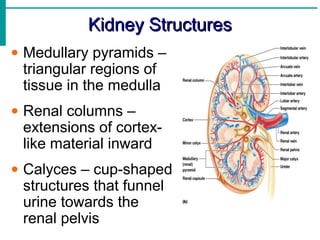
Kidney StructuresKidney Structures
• Medullary pyramids –
triangular regions of
tissue in the medulla
• Renal columns –
extensions of cortex-
like material inward
• Calyces – cup-shaped
structures that funnel
urine towards the
renal pelvis
Blood Flow in the KidneysBlood Flow in the Kidneys
NephronsNephrons
• The structural and functional units of the
kidneys
• Responsible for forming urine
• Main structures of the nephrons
•Glomerulus
•Renal tubule
GlomerulusGlomerulus
• A specialized
capillary bed
• Attached to
arterioles on both sides
(maintains
high pressure)
• Large afferent
arteriole
• Narrow efferent
arteriole
The glomerulus sits within a
glomerular capsule (the first
part of the renal tubule)
Renal TubuleRenal Tubule
• Glomerular
(Bowman’s)
capsule
• Proximal
convoluted
tubule
• Loop of Henle
• Distal
convoluted
tubule
Figure 15.3b
ReabsorptionReabsorption
• The peritubular capillaries reabsorb several
materials
• Some water
• Glucose
• Amino acids
• Ions
• Some reabsorption is passive, most is active
• Most reabsorption occurs in the proximal
convoluted tubule
Materials Not ReabsorbedMaterials Not Reabsorbed
• Nitrogenous waste products
•Urea
•Uric acid
•Creatinine
• Excess water
Characteristics of Urine Used forCharacteristics of Urine Used for
Medical DiagnosisMedical Diagnosis
• Colored somewhat yellow due to the
pigment urochrome (from the
destruction of hemoglobin) and solutes
• Sterile
• Slightly aromatic
• Normal pH of around 6 (varies 4.5-8)
• Specific gravity of 1.001 to 1.035
UretersUreters• Slender tubes
attaching the kidney
to the bladder
•Continuous with the
renal pelvis
•Enter the posterior
aspect of the bladder
• Runs behind the
peritoneum
• Peristalsis aids
gravity in urine
transport
Urinary BladderUrinary Bladder
• Smooth, collapsible, muscular sac
• Temporarily stores urine
Urinary BladderUrinary Bladder
• Trigone – three openings
•Two from the ureters
•One to the urethrea
Urinary Bladder WallUrinary Bladder Wall
Slide 15.22Copyright © 2003 Pearson Education, Inc. publishing as Benjamin Cummings
• Three layers of smooth muscle
(detrusor muscle)
• Mucosa made of transitional epithelium
• Walls are thick and folded in an empty
bladder
• Bladder can expand significantly without
increasing internal pressure
UrethraUrethra
Slide 15.23Copyright © 2003 Pearson Education, Inc. publishing as Benjamin Cummings
• Thin-walled tube that carries urine from
the bladder to the outside of the body by
peristalsis
• Release of urine is controlled by two
sphincters
•Internal urethral sphincter (involuntary)
•External urethral sphincter (voluntary)
Urethra Gender DifferencesUrethra Gender Differences
Slide 15.24a
Copyright © 2003 Pearson Education, Inc. publishing as Benjamin Cummings
• Length
•Females – 3–4 cm (1 inch)
•Males – 20 cm (8 inches)
• Location
•Females – along wall of the vagina
•Males – through the prostate and penis
Urethra Gender DifferencesUrethra Gender Differences
Slide 15.24b
Copyright © 2003 Pearson Education, Inc. publishing as Benjamin Cummings
• Function
•Females – only carries urine
•Males – carries urine and is a passageway
for sperm cells
Micturition (Voiding)Micturition (Voiding)
• Both sphincter muscles must open to
allow voiding
•The internal urethral sphincter is relaxed
after stretching of the bladder
•Activation is from an impulse sent to the
spinal cord and then back via the pelvic
splanchnic nerves
•The external urethral sphincter must be
voluntarily relaxed
Maintaining Water BalanceMaintaining Water Balance
• Normal amount of water in the human
body
•Young adult females – 50%
•Young adult males – 60%
•Babies – 75%
•Old age – 45%
• Water is necessary for many body
functions and levels must be maintained
Developmental Aspects of theDevelopmental Aspects of the
Urinary SystemUrinary System
• Functional kidneys are developed by the
third month
• Urinary system of a newborn
•Bladder is small
•Urine cannot be concentrated
Developmental Aspects of theDevelopmental Aspects of the
Urinary SystemUrinary System
• Control of the voluntary urethral
sphincter does not start until age 18
months
• Urinary infections are the only common
problems before old age
Aging and the Urinary SystemAging and the Urinary System
• There is a progressive decline in urinary
function
• The bladder shrinks with aging
• Urinary retention is common in males
Good luck
Go to
http://www.slideshare.net/muradalshehry
To download today’s lecture

Urinary dent

  • 1.
    Essentials of HumanAnatomy & Physiology Elaine N. Marieb The Urinary System
  • 2.
    Functions of theUrinary SystemFunctions of the Urinary System • Elimination of waste products •Nitrogenous wastes •Toxins •Drugs
  • 3.
    Functions of theUrinary SystemFunctions of the Urinary System • Regulate aspects of homeostasis •Water balance •Electrolytes •Acid-base balance in the blood •Blood pressure •Red blood cell production •Activation of vitamin D
  • 4.
    Organs of theUrinary systemOrgans of the Urinary system • Kidneys • Ureters • Urinary bladder • Urethra
  • 5.
    Location of theKidneysLocation of the Kidneys • Against the dorsal body wall • At the level of T12 to L3 • The right kidney is slightly lower than the left • Attached to ureters, renal blood vessels, and nerves at renal hilus • Atop each kidney is an adrenal gland
  • 6.
    Regions of theKidneyRegions of the Kidney • Renal cortex – outer region • Renal medulla – inside the cortex • Renal pelvis – inner collecting tube
  • 7.
    Kidney StructuresKidney Structures •Medullary pyramids – triangular regions of tissue in the medulla • Renal columns – extensions of cortex- like material inward • Calyces – cup-shaped structures that funnel urine towards the renal pelvis
  • 8.
    Blood Flow inthe KidneysBlood Flow in the Kidneys
  • 9.
    NephronsNephrons • The structuraland functional units of the kidneys • Responsible for forming urine • Main structures of the nephrons •Glomerulus •Renal tubule
  • 10.
    GlomerulusGlomerulus • A specialized capillarybed • Attached to arterioles on both sides (maintains high pressure) • Large afferent arteriole • Narrow efferent arteriole The glomerulus sits within a glomerular capsule (the first part of the renal tubule)
  • 11.
    Renal TubuleRenal Tubule •Glomerular (Bowman’s) capsule • Proximal convoluted tubule • Loop of Henle • Distal convoluted tubule Figure 15.3b
  • 12.
    ReabsorptionReabsorption • The peritubularcapillaries reabsorb several materials • Some water • Glucose • Amino acids • Ions • Some reabsorption is passive, most is active • Most reabsorption occurs in the proximal convoluted tubule
  • 13.
    Materials Not ReabsorbedMaterialsNot Reabsorbed • Nitrogenous waste products •Urea •Uric acid •Creatinine • Excess water
  • 14.
    Characteristics of UrineUsed forCharacteristics of Urine Used for Medical DiagnosisMedical Diagnosis • Colored somewhat yellow due to the pigment urochrome (from the destruction of hemoglobin) and solutes • Sterile • Slightly aromatic • Normal pH of around 6 (varies 4.5-8) • Specific gravity of 1.001 to 1.035
  • 15.
    UretersUreters• Slender tubes attachingthe kidney to the bladder •Continuous with the renal pelvis •Enter the posterior aspect of the bladder • Runs behind the peritoneum • Peristalsis aids gravity in urine transport
  • 16.
    Urinary BladderUrinary Bladder •Smooth, collapsible, muscular sac • Temporarily stores urine
  • 17.
    Urinary BladderUrinary Bladder •Trigone – three openings •Two from the ureters •One to the urethrea
  • 18.
    Urinary Bladder WallUrinaryBladder Wall Slide 15.22Copyright © 2003 Pearson Education, Inc. publishing as Benjamin Cummings • Three layers of smooth muscle (detrusor muscle) • Mucosa made of transitional epithelium • Walls are thick and folded in an empty bladder • Bladder can expand significantly without increasing internal pressure
  • 19.
    UrethraUrethra Slide 15.23Copyright ©2003 Pearson Education, Inc. publishing as Benjamin Cummings • Thin-walled tube that carries urine from the bladder to the outside of the body by peristalsis • Release of urine is controlled by two sphincters •Internal urethral sphincter (involuntary) •External urethral sphincter (voluntary)
  • 20.
    Urethra Gender DifferencesUrethraGender Differences Slide 15.24a Copyright © 2003 Pearson Education, Inc. publishing as Benjamin Cummings • Length •Females – 3–4 cm (1 inch) •Males – 20 cm (8 inches) • Location •Females – along wall of the vagina •Males – through the prostate and penis
  • 21.
    Urethra Gender DifferencesUrethraGender Differences Slide 15.24b Copyright © 2003 Pearson Education, Inc. publishing as Benjamin Cummings • Function •Females – only carries urine •Males – carries urine and is a passageway for sperm cells
  • 22.
    Micturition (Voiding)Micturition (Voiding) •Both sphincter muscles must open to allow voiding •The internal urethral sphincter is relaxed after stretching of the bladder •Activation is from an impulse sent to the spinal cord and then back via the pelvic splanchnic nerves •The external urethral sphincter must be voluntarily relaxed
  • 23.
    Maintaining Water BalanceMaintainingWater Balance • Normal amount of water in the human body •Young adult females – 50% •Young adult males – 60% •Babies – 75% •Old age – 45% • Water is necessary for many body functions and levels must be maintained
  • 24.
    Developmental Aspects oftheDevelopmental Aspects of the Urinary SystemUrinary System • Functional kidneys are developed by the third month • Urinary system of a newborn •Bladder is small •Urine cannot be concentrated
  • 25.
    Developmental Aspects oftheDevelopmental Aspects of the Urinary SystemUrinary System • Control of the voluntary urethral sphincter does not start until age 18 months • Urinary infections are the only common problems before old age
  • 26.
    Aging and theUrinary SystemAging and the Urinary System • There is a progressive decline in urinary function • The bladder shrinks with aging • Urinary retention is common in males
  • 27.