Chapter 15
The Urinary System
Slides 15.1 – 15.20
Lecture Slides in PowerPoint by Jerry L. Cook
Copyright © 2003 Pearson Education, Inc. publishing as Benjamin Cummings
Essentials of Human Anatomy & Physiology
Seventh Edition
Elaine N. Marieb
Elimination of waste products
Nitrogenous wastes
Toxins
Drugs
Slide 15.1a
Copyright © 2003 Pearson Education, Inc. publishing as Benjamin Cummings
Functions of the Urinary System
Regulate aspects of homeostasis
Water balance
Electrolytes
Acid-base balance in the blood
Blood pressure
Red blood cell production
Activation of vitamin D
Slide 15.1b
Copyright © 2003 Pearson Education, Inc. publishing as Benjamin Cummings
Functions of the Urinary System
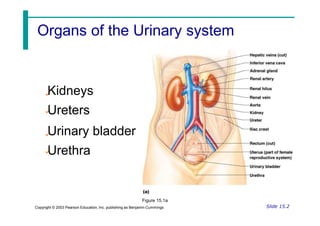
Kidneys
Ureters
Urinary
Urethra
bladder
Figure 15.1a
Copyright © 2003 Pearson Education, Inc. publishing as Benjamin Cummings Slide 15.2
Organs of the Urinary system
Against the dorsal body wall
At the level of T12 to L3
The right kidney is slightly lower
the left
than
Attached to ureters, renal blood vessels,
and nerves at renal hilus
Atop each kidney is an adrenal gland
Slide 15.3
Copyright © 2003 Pearson Education, Inc. publishing as Benjamin Cummings
Location of the Kidneys
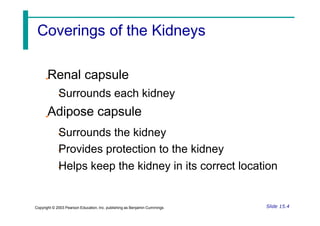
Renal capsule
Surrounds each kidney
Adipose capsule
Surrounds the kidney
Provides protection to the kidney
Helps keep the kidney in its correct location
Slide 15.4
Copyright © 2003 Pearson Education, Inc. publishing as Benjamin Cummings
Coverings of the Kidneys
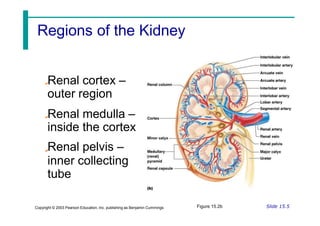
Renal cortex –
outer region
Renal medulla –
inside
Renal
the cortex
pelvis –
inner collecting
tube
Figure 15.2b Slide 15.5
Copyright © 2003 Pearson Education, Inc. publishing as Benjamin Cummings
Regions of the Kidney
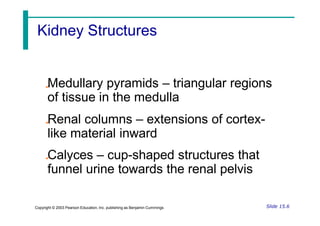
Medullary pyramids – triangular regions
of tissue in the medulla
Renal columns – extensions of cortex-
like material inward
Calyces – cup-shaped structures that
funnel urine towards the renal pelvis
Slide 15.6
Copyright © 2003 Pearson Education, Inc. publishing as Benjamin Cummings
Kidney Structures
Figure 15.2c
Slide 15.7
Copyright © 2003 Pearson Education, Inc. publishing as Benjamin Cummings
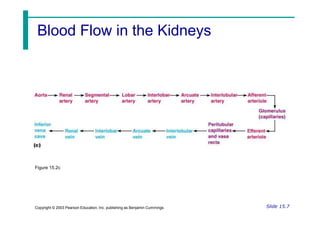
Blood Flow in the Kidneys
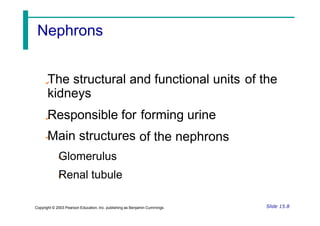
The structural and functional units
kidneys
of the
Responsible for
Main structures
Glomerulus
Renal tubule
forming urine
of the nephrons
Slide 15.8
Copyright © 2003 Pearson Education, Inc. publishing as Benjamin Cummings
Nephrons
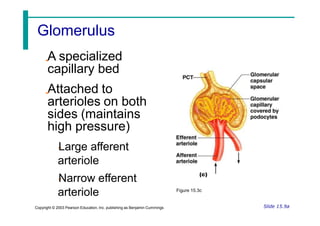
A specialized
capillary bed
Attached to
arterioles on both
sides (maintains
high pressure)
Large afferent
arteriole
Narrow efferent
arteriole Figure 15.3c
Slide 15.9a
Copyright © 2003 Pearson Education, Inc. publishing as Benjamin Cummings
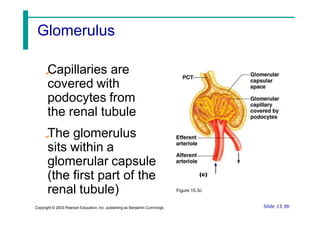
Glomerulus
Capillaries are
covered with
podocytes from
the renal tubule
The glomerulus
sits within a
glomerular capsule
(the first part of the
renal tubule) Figure 15.3c
Slide 15.9b
Copyright © 2003 Pearson Education, Inc. publishing as Benjamin Cummings
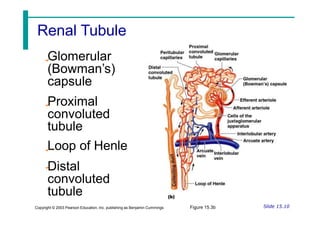
Glomerulus
Glomerular
(Bowman’s)
capsule
Proximal
convoluted
tubule
Loop of Henle
Distal
convoluted
tubule
Slide 15.10
Figure 15.3b
Copyright © 2003 Pearson Education, Inc. publishing as Benjamin Cummings
Renal Tubule
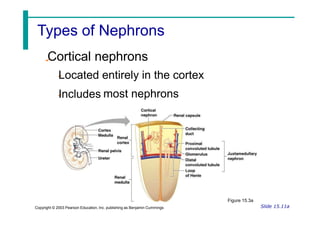
Cortical nephrons
Located entirely in the cortex
Includes most nephrons
Figure 15.3a
Slide 15.11a
Copyright © 2003 Pearson Education, Inc. publishing as Benjamin Cummings
Types of Nephrons
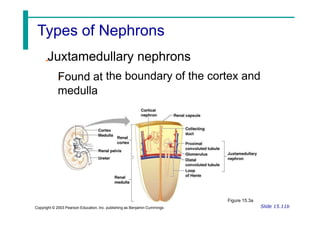
Juxtamedullary nephrons
Found at
medulla
the boundary of the cortex and
Figure 15.3a
Slide 15.11b
Copyright © 2003 Pearson Education, Inc. publishing as Benjamin Cummings
Types of Nephrons
Arise from efferent arteriole of the
glomerulus
Normal, low pressure capillaries
Attached to a venule
Cling close to the renal tubule
Reabsorb (reclaim) some substances
from collecting tubes
Slide 15.12
Copyright © 2003 Pearson Education, Inc. publishing as Benjamin Cummings
Peritubular Capillaries
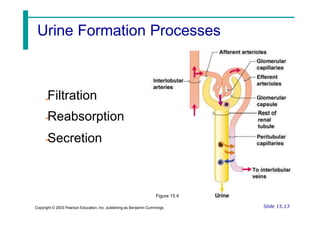
Filtration
Reabsorption
Secretion
Figure 15.4
Slide 15.13
Copyright © 2003 Pearson Education, Inc. publishing as Benjamin Cummings
Urine Formation Processes
Nonselective passive process
Water and solutes smaller than proteins
are forced through capillary walls
Blood cells cannot pass out to the
capillaries
Filtrate is collected in the glomerular
capsule and leaves via the renal tubule
Slide 15.14
Copyright © 2003 Pearson Education, Inc. publishing as Benjamin Cummings
Filtration
The peritubular
materials
Some water
Glucose
Amino acids
Ions
capillaries reabsorb several
Some reabsorption is passive, most is active
Most reabsorption occurs in the proximal
convoluted tubule
Slide 15.15
Copyright © 2003 Pearson Education, Inc. publishing as Benjamin Cummings
Reabsorption
Nitrogenous waste
Urea
Uric acid
Creatinine
Excess water
products
Slide 15.16
Copyright © 2003 Pearson Education, Inc. publishing as Benjamin Cummings
Materials Not Reabsorbed
Reverse
Some materials move from the
peritubular capillaries into the renal
tubules
Hydrogen and potassium ions
Creatinine
Materials left in the renal tubule
toward the ureter
move
Slide 15.17
Copyright © 2003 Pearson Education, Inc. publishing as Benjamin Cummings
Secretion – Reabsorption in
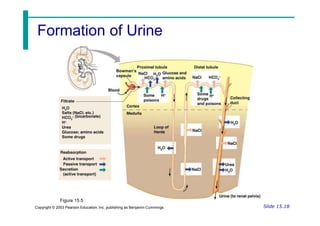
Figure 15.5
Copyright © 2003 Pearson Education, Inc. publishing as Benjamin Cummings Slide 15.18
Formation of Urine
Medical Diagnosis
Colored somewhat yellow due to the
pigment urochrome (from the
destruction of hemoglobin)
Sterile
Slightly aromatic
Normal pH of around 6
Specific gravity of 1.001 to
and solutes
1.035
Slide 15.19
Copyright © 2003 Pearson Education, Inc. publishing as Benjamin Cummings
Characteristics of Urine Used for
Slender tubes attaching the kidney to
the bladder
Continuous with the renal pelvis
Enter the posterior aspect of the
Runs behind the peritoneum
Peristalsis aids gravity in urine
bladder
transport
Slide 15.20
Copyright © 2003 Pearson Education, Inc. publishing as Benjamin Cummings
Ureters
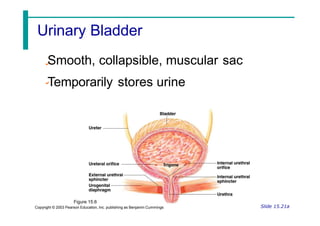
Smooth, collapsible, muscular sac
Temporarily stores urine
Figure 15.6
Copyright © 2003 Pearson Education, Inc. publishing as Benjamin Cummings Slide 15.21a
Urinary Bladder
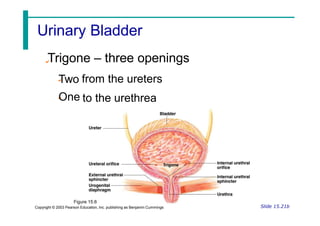
Trigone – three openings
Two
One
from the ureters
to the urethrea
Figure 15.6
Copyright © 2003 Pearson Education, Inc. publishing as Benjamin Cummings Slide 15.21b
Urinary Bladder
Three layers of smooth muscle
(detrusor muscle)
Mucosa made of transitional epithelium
Walls are thick and folded in
bladder
an empty
Bladder can expand significantly without
increasing internal pressure
Slide 15.22
Copyright © 2003 Pearson Education, Inc. publishing as Benjamin Cummings
Urinary Bladder Wall
Thin-walled tube that carries urine from
the bladder to the outside of the body
peristalsis
Release of urine is controlled by two
sphincters
Internal urethral sphincter (involuntary)
External urethral sphincter (voluntary)
by
Slide 15.23
Copyright © 2003 Pearson Education, Inc. publishing as Benjamin Cummings
Urethra
Length
Females – 3–4 cm (1 inch)
Males – 20 cm (8 inches)
Location
Females – along wall of the vagina
Males – through the prostate and penis
Slide 15.24a
Copyright © 2003 Pearson Education, Inc. publishing as Benjamin Cummings
Urethra Gender Differences
Function
Females – only carries urine
Males – carries
for sperm cells
urine and is a passageway
Slide 15.24b
Copyright © 2003 Pearson Education, Inc. publishing as Benjamin Cummings
Urethra Gender Differences
Both sphincter muscles must open to
allow voiding
The internal urethral sphincter is relaxed
after stretching of the bladder
Activation is from an impulse sent to the
spinal cord and then back via the pelvic
splanchnic nerves
The external urethral sphincter must be
voluntarily relaxed
Slide 15.25
Copyright © 2003 Pearson Education, Inc. publishing as Benjamin Cummings
Micturition (Voiding)
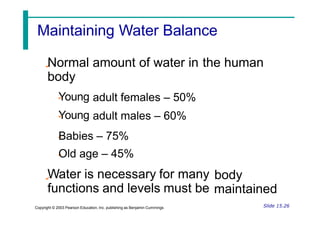
Normal
body
Young
Young
amount of water in the human
adult females
adult males –
– 50%
60%
Babies – 75%
Old age – 45%
Water is necessary for many
functions and levels must be
body
maintained
Slide 15.26
Copyright © 2003 Pearson Education, Inc. publishing as Benjamin Cummings
Maintaining Water Balance
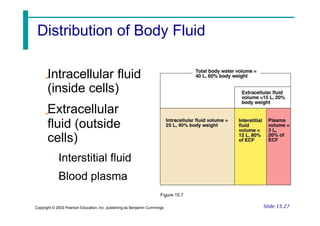
Intracellular fluid
(inside cells)
Extracellular
fluid (outside
cells)
Interstitial fluid
Blood plasma
Figure 15.7
Slide 15.27
Copyright © 2003 Pearson Education, Inc. publishing as Benjamin Cummings
Distribution of Body Fluid
Changes in electrolyte balance causes
water to move from one compartment to
another
Alters blood volume and blood
Can impair the activity of cells
pressure
Slide 15.28
Copyright © 2003 Pearson Education, Inc. publishing as Benjamin Cummings
The Link Between Water and Salt
Water intake must equal water output
Sources for water intake
Ingested foods and fluids
Water produced from metabolic processes
Sources for water output
Vaporization out of the lungs
Lost in perspiration
Leaves the body in the feces
Urine production
Slide 15.29
Copyright © 2003 Pearson Education, Inc. publishing as Benjamin Cummings
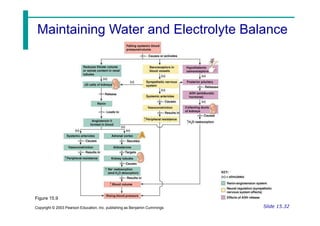
Maintaining Water Balance
Dilute urine is produced if water intake
is excessive
Less urine (concentrated) is produced
large amounts of water are lost
Proper concentrations of various
electrolytes must be present
if
Slide 15.30
Copyright © 2003 Pearson Education, Inc. publishing as Benjamin Cummings
Maintaining Water Balance
Reabsorption
Regulation is primarily by hormones
Antidiuretic hormone (ADH) prevents
excessive water loss in urine
Aldosterone regulates sodium ion content
extracellular fluid
Triggered by the rennin-angiotensin
mechanism
Cells in the kidneys and hypothalamus
are active monitors
of
Slide 15.31
Copyright © 2003 Pearson Education, Inc. publishing as Benjamin Cummings
Regulation of Water and Electrolyte
Figure 15.9
Slide 15.32
Copyright © 2003 Pearson Education, Inc. publishing as Benjamin Cummings
Maintaining Water and Electrolyte Balance
Blood
Blood pH must remain between 7.35
and 7.45 to maintain homeostasis
Alkalosis – pH above 7.45
Acidosis – pH below 7.35
Most ions originate as byproducts
cellular metabolism
of
Slide 15.33a
Copyright © 2003 Pearson Education, Inc. publishing as Benjamin Cummings
Maintaining Acid-Base Balance in
Blood
Most acid-base balance is maintained
by the kidneys
Other acid-base
Blood buffers
Respiration
controlling systems
Slide 15.33b
Copyright © 2003 Pearson Education, Inc. publishing as Benjamin Cummings
Maintaining Acid-Base Balance in
Molecules react to prevent dramatic
changes in hydrogen ion (H+)
concentrations
H+
Bind to when pH drops
H+
Release when pH rises
Three major chemical buffer
Bicarbonate buffer system
Phosphate buffer system
Protein buffer system
systems
Slide 15.34
Copyright © 2003 Pearson Education, Inc. publishing as Benjamin Cummings
Blood Buffers
Mixture of carbonic acid (H2CO3) and
sodium bicarbonate (NaHCO3)
Bicarbonate ions (HCO3 ) react with
–
strong acids to change them to weak
acids
Carbonic acid dissociates in the presence
of a strong base to form a weak base and
water
Slide 15.35
Copyright © 2003 Pearson Education, Inc. publishing as Benjamin Cummings
The Bicarbonate Buffer System
Acid-Base Balance
Carbon dioxide in the blood is converted to
bicarbonate ion and transported in the
plasma
Increases in hydrogen ion concentration
produces more carbonic acid
Excess hydrogen ion can be blown off with
the release of carbon dioxide from the lungs
Respiratory rate can rise and fall depending
on changing blood pH
Slide 15.36
Copyright © 2003 Pearson Education, Inc. publishing as Benjamin Cummings
Respiratory System Controls of
Balance
Excrete bicarbonate ions if needed
Conserve or generate new bicarbonate
ions if needed
Urine pH varies from 4.5 to 8.0
Slide 15.37
Copyright © 2003 Pearson Education, Inc. publishing as Benjamin Cummings
Renal Mechanisms of Acid-Base
Urinary System
Functional kidneys
the third month
are developed by
Urinary system of a newborn
Bladder is small
Urine cannot be concentrated
Slide 15.38a
Copyright © 2003 Pearson Education, Inc. publishing as Benjamin Cummings
Developmental Aspects of the
Urinary System
Control of the voluntary
sphincter does not start
urethral
until age 18
months
Urinary infections are the only common
problems before old age
Slide 15.38b
Copyright © 2003 Pearson Education, Inc. publishing as Benjamin Cummings
Developmental Aspects of the
There is a progressive decline in urinary
function
The bladder shrinks with aging
Urinary retention is common in males
Slide 15.39
Copyright © 2003 Pearson Education, Inc. publishing as Benjamin Cummings
Aging and the Urinary System

Chapter 15 jk.pptx

  • 1.
    Chapter 15 The UrinarySystem Slides 15.1 – 15.20 Lecture Slides in PowerPoint by Jerry L. Cook Copyright © 2003 Pearson Education, Inc. publishing as Benjamin Cummings Essentials of Human Anatomy & Physiology Seventh Edition Elaine N. Marieb
  • 2.
    Elimination of wasteproducts Nitrogenous wastes Toxins Drugs Slide 15.1a Copyright © 2003 Pearson Education, Inc. publishing as Benjamin Cummings Functions of the Urinary System
  • 3.
    Regulate aspects ofhomeostasis Water balance Electrolytes Acid-base balance in the blood Blood pressure Red blood cell production Activation of vitamin D Slide 15.1b Copyright © 2003 Pearson Education, Inc. publishing as Benjamin Cummings Functions of the Urinary System
  • 4.
    Kidneys Ureters Urinary Urethra bladder Figure 15.1a Copyright ©2003 Pearson Education, Inc. publishing as Benjamin Cummings Slide 15.2 Organs of the Urinary system
  • 5.
    Against the dorsalbody wall At the level of T12 to L3 The right kidney is slightly lower the left than Attached to ureters, renal blood vessels, and nerves at renal hilus Atop each kidney is an adrenal gland Slide 15.3 Copyright © 2003 Pearson Education, Inc. publishing as Benjamin Cummings Location of the Kidneys
  • 6.
    Renal capsule Surrounds eachkidney Adipose capsule Surrounds the kidney Provides protection to the kidney Helps keep the kidney in its correct location Slide 15.4 Copyright © 2003 Pearson Education, Inc. publishing as Benjamin Cummings Coverings of the Kidneys
  • 7.
    Renal cortex – outerregion Renal medulla – inside Renal the cortex pelvis – inner collecting tube Figure 15.2b Slide 15.5 Copyright © 2003 Pearson Education, Inc. publishing as Benjamin Cummings Regions of the Kidney
  • 8.
    Medullary pyramids –triangular regions of tissue in the medulla Renal columns – extensions of cortex- like material inward Calyces – cup-shaped structures that funnel urine towards the renal pelvis Slide 15.6 Copyright © 2003 Pearson Education, Inc. publishing as Benjamin Cummings Kidney Structures
  • 9.
    Figure 15.2c Slide 15.7 Copyright© 2003 Pearson Education, Inc. publishing as Benjamin Cummings Blood Flow in the Kidneys
  • 10.
    The structural andfunctional units kidneys of the Responsible for Main structures Glomerulus Renal tubule forming urine of the nephrons Slide 15.8 Copyright © 2003 Pearson Education, Inc. publishing as Benjamin Cummings Nephrons
  • 11.
    A specialized capillary bed Attachedto arterioles on both sides (maintains high pressure) Large afferent arteriole Narrow efferent arteriole Figure 15.3c Slide 15.9a Copyright © 2003 Pearson Education, Inc. publishing as Benjamin Cummings Glomerulus
  • 12.
    Capillaries are covered with podocytesfrom the renal tubule The glomerulus sits within a glomerular capsule (the first part of the renal tubule) Figure 15.3c Slide 15.9b Copyright © 2003 Pearson Education, Inc. publishing as Benjamin Cummings Glomerulus
  • 13.
    Glomerular (Bowman’s) capsule Proximal convoluted tubule Loop of Henle Distal convoluted tubule Slide15.10 Figure 15.3b Copyright © 2003 Pearson Education, Inc. publishing as Benjamin Cummings Renal Tubule
  • 14.
    Cortical nephrons Located entirelyin the cortex Includes most nephrons Figure 15.3a Slide 15.11a Copyright © 2003 Pearson Education, Inc. publishing as Benjamin Cummings Types of Nephrons
  • 15.
    Juxtamedullary nephrons Found at medulla theboundary of the cortex and Figure 15.3a Slide 15.11b Copyright © 2003 Pearson Education, Inc. publishing as Benjamin Cummings Types of Nephrons
  • 16.
    Arise from efferentarteriole of the glomerulus Normal, low pressure capillaries Attached to a venule Cling close to the renal tubule Reabsorb (reclaim) some substances from collecting tubes Slide 15.12 Copyright © 2003 Pearson Education, Inc. publishing as Benjamin Cummings Peritubular Capillaries
  • 17.
    Filtration Reabsorption Secretion Figure 15.4 Slide 15.13 Copyright© 2003 Pearson Education, Inc. publishing as Benjamin Cummings Urine Formation Processes
  • 18.
    Nonselective passive process Waterand solutes smaller than proteins are forced through capillary walls Blood cells cannot pass out to the capillaries Filtrate is collected in the glomerular capsule and leaves via the renal tubule Slide 15.14 Copyright © 2003 Pearson Education, Inc. publishing as Benjamin Cummings Filtration
  • 19.
    The peritubular materials Some water Glucose Aminoacids Ions capillaries reabsorb several Some reabsorption is passive, most is active Most reabsorption occurs in the proximal convoluted tubule Slide 15.15 Copyright © 2003 Pearson Education, Inc. publishing as Benjamin Cummings Reabsorption
  • 20.
    Nitrogenous waste Urea Uric acid Creatinine Excesswater products Slide 15.16 Copyright © 2003 Pearson Education, Inc. publishing as Benjamin Cummings Materials Not Reabsorbed
  • 21.
    Reverse Some materials movefrom the peritubular capillaries into the renal tubules Hydrogen and potassium ions Creatinine Materials left in the renal tubule toward the ureter move Slide 15.17 Copyright © 2003 Pearson Education, Inc. publishing as Benjamin Cummings Secretion – Reabsorption in
  • 22.
    Figure 15.5 Copyright ©2003 Pearson Education, Inc. publishing as Benjamin Cummings Slide 15.18 Formation of Urine
  • 23.
    Medical Diagnosis Colored somewhatyellow due to the pigment urochrome (from the destruction of hemoglobin) Sterile Slightly aromatic Normal pH of around 6 Specific gravity of 1.001 to and solutes 1.035 Slide 15.19 Copyright © 2003 Pearson Education, Inc. publishing as Benjamin Cummings Characteristics of Urine Used for
  • 24.
    Slender tubes attachingthe kidney to the bladder Continuous with the renal pelvis Enter the posterior aspect of the Runs behind the peritoneum Peristalsis aids gravity in urine bladder transport Slide 15.20 Copyright © 2003 Pearson Education, Inc. publishing as Benjamin Cummings Ureters
  • 25.
    Smooth, collapsible, muscularsac Temporarily stores urine Figure 15.6 Copyright © 2003 Pearson Education, Inc. publishing as Benjamin Cummings Slide 15.21a Urinary Bladder
  • 26.
    Trigone – threeopenings Two One from the ureters to the urethrea Figure 15.6 Copyright © 2003 Pearson Education, Inc. publishing as Benjamin Cummings Slide 15.21b Urinary Bladder
  • 27.
    Three layers ofsmooth muscle (detrusor muscle) Mucosa made of transitional epithelium Walls are thick and folded in bladder an empty Bladder can expand significantly without increasing internal pressure Slide 15.22 Copyright © 2003 Pearson Education, Inc. publishing as Benjamin Cummings Urinary Bladder Wall
  • 28.
    Thin-walled tube thatcarries urine from the bladder to the outside of the body peristalsis Release of urine is controlled by two sphincters Internal urethral sphincter (involuntary) External urethral sphincter (voluntary) by Slide 15.23 Copyright © 2003 Pearson Education, Inc. publishing as Benjamin Cummings Urethra
  • 29.
    Length Females – 3–4cm (1 inch) Males – 20 cm (8 inches) Location Females – along wall of the vagina Males – through the prostate and penis Slide 15.24a Copyright © 2003 Pearson Education, Inc. publishing as Benjamin Cummings Urethra Gender Differences
  • 30.
    Function Females – onlycarries urine Males – carries for sperm cells urine and is a passageway Slide 15.24b Copyright © 2003 Pearson Education, Inc. publishing as Benjamin Cummings Urethra Gender Differences
  • 31.
    Both sphincter musclesmust open to allow voiding The internal urethral sphincter is relaxed after stretching of the bladder Activation is from an impulse sent to the spinal cord and then back via the pelvic splanchnic nerves The external urethral sphincter must be voluntarily relaxed Slide 15.25 Copyright © 2003 Pearson Education, Inc. publishing as Benjamin Cummings Micturition (Voiding)
  • 32.
    Normal body Young Young amount of waterin the human adult females adult males – – 50% 60% Babies – 75% Old age – 45% Water is necessary for many functions and levels must be body maintained Slide 15.26 Copyright © 2003 Pearson Education, Inc. publishing as Benjamin Cummings Maintaining Water Balance
  • 33.
    Intracellular fluid (inside cells) Extracellular fluid(outside cells) Interstitial fluid Blood plasma Figure 15.7 Slide 15.27 Copyright © 2003 Pearson Education, Inc. publishing as Benjamin Cummings Distribution of Body Fluid
  • 34.
    Changes in electrolytebalance causes water to move from one compartment to another Alters blood volume and blood Can impair the activity of cells pressure Slide 15.28 Copyright © 2003 Pearson Education, Inc. publishing as Benjamin Cummings The Link Between Water and Salt
  • 35.
    Water intake mustequal water output Sources for water intake Ingested foods and fluids Water produced from metabolic processes Sources for water output Vaporization out of the lungs Lost in perspiration Leaves the body in the feces Urine production Slide 15.29 Copyright © 2003 Pearson Education, Inc. publishing as Benjamin Cummings Maintaining Water Balance
  • 36.
    Dilute urine isproduced if water intake is excessive Less urine (concentrated) is produced large amounts of water are lost Proper concentrations of various electrolytes must be present if Slide 15.30 Copyright © 2003 Pearson Education, Inc. publishing as Benjamin Cummings Maintaining Water Balance
  • 37.
    Reabsorption Regulation is primarilyby hormones Antidiuretic hormone (ADH) prevents excessive water loss in urine Aldosterone regulates sodium ion content extracellular fluid Triggered by the rennin-angiotensin mechanism Cells in the kidneys and hypothalamus are active monitors of Slide 15.31 Copyright © 2003 Pearson Education, Inc. publishing as Benjamin Cummings Regulation of Water and Electrolyte
  • 38.
    Figure 15.9 Slide 15.32 Copyright© 2003 Pearson Education, Inc. publishing as Benjamin Cummings Maintaining Water and Electrolyte Balance
  • 39.
    Blood Blood pH mustremain between 7.35 and 7.45 to maintain homeostasis Alkalosis – pH above 7.45 Acidosis – pH below 7.35 Most ions originate as byproducts cellular metabolism of Slide 15.33a Copyright © 2003 Pearson Education, Inc. publishing as Benjamin Cummings Maintaining Acid-Base Balance in
  • 40.
    Blood Most acid-base balanceis maintained by the kidneys Other acid-base Blood buffers Respiration controlling systems Slide 15.33b Copyright © 2003 Pearson Education, Inc. publishing as Benjamin Cummings Maintaining Acid-Base Balance in
  • 41.
    Molecules react toprevent dramatic changes in hydrogen ion (H+) concentrations H+ Bind to when pH drops H+ Release when pH rises Three major chemical buffer Bicarbonate buffer system Phosphate buffer system Protein buffer system systems Slide 15.34 Copyright © 2003 Pearson Education, Inc. publishing as Benjamin Cummings Blood Buffers
  • 42.
    Mixture of carbonicacid (H2CO3) and sodium bicarbonate (NaHCO3) Bicarbonate ions (HCO3 ) react with – strong acids to change them to weak acids Carbonic acid dissociates in the presence of a strong base to form a weak base and water Slide 15.35 Copyright © 2003 Pearson Education, Inc. publishing as Benjamin Cummings The Bicarbonate Buffer System
  • 43.
    Acid-Base Balance Carbon dioxidein the blood is converted to bicarbonate ion and transported in the plasma Increases in hydrogen ion concentration produces more carbonic acid Excess hydrogen ion can be blown off with the release of carbon dioxide from the lungs Respiratory rate can rise and fall depending on changing blood pH Slide 15.36 Copyright © 2003 Pearson Education, Inc. publishing as Benjamin Cummings Respiratory System Controls of
  • 44.
    Balance Excrete bicarbonate ionsif needed Conserve or generate new bicarbonate ions if needed Urine pH varies from 4.5 to 8.0 Slide 15.37 Copyright © 2003 Pearson Education, Inc. publishing as Benjamin Cummings Renal Mechanisms of Acid-Base
  • 45.
    Urinary System Functional kidneys thethird month are developed by Urinary system of a newborn Bladder is small Urine cannot be concentrated Slide 15.38a Copyright © 2003 Pearson Education, Inc. publishing as Benjamin Cummings Developmental Aspects of the
  • 46.
    Urinary System Control ofthe voluntary sphincter does not start urethral until age 18 months Urinary infections are the only common problems before old age Slide 15.38b Copyright © 2003 Pearson Education, Inc. publishing as Benjamin Cummings Developmental Aspects of the
  • 47.
    There is aprogressive decline in urinary function The bladder shrinks with aging Urinary retention is common in males Slide 15.39 Copyright © 2003 Pearson Education, Inc. publishing as Benjamin Cummings Aging and the Urinary System