URINE
FORMATION.
Dr. Nilesh N. Kate.
M.D.
ASSOCIATE PROFESSOR
DEPARTMENT OF
PHYSIOLOGY.
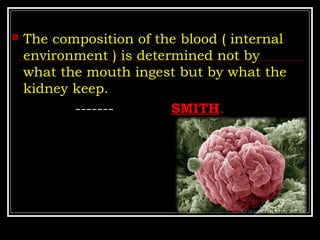
 The composition of the blood ( internal
environment ) is determined not by
what the mouth ingest but by what the
kidney keep.
------- SMITH.
OBJECTIVES
 Filtration
 Characteristics of filtration membrane
 Composition of Glomerular filtrate
 Dynamics Of Glomerular Filtration
 Glomerular filtration rate
 Filtration fraction
 Factors affecting Glomerular filtration
 Regulation of Glomerular filtration
 Measurement of Glomerular filtration.
IDENTIFY THE PARTS
2
3
4
5
1
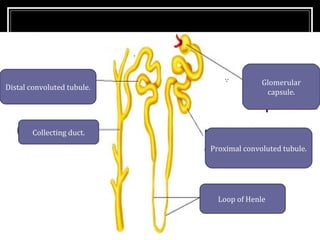
IDENTIFY THE PARTS
11
Proximal convoluted tubule.
Loop of Henle
Distal convoluted tubule.
Collecting duct.
Glomerular
capsule.
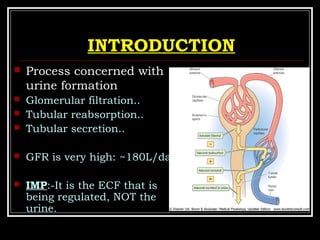
INTRODUCTION
 Process concerned with
urine formation
 Glomerular filtration..
 Tubular reabsorption..
 Tubular secretion..
 GFR is very high: ~180L/day.
 IMP:-It is the ECF that is
being regulated, NOT the
urine.
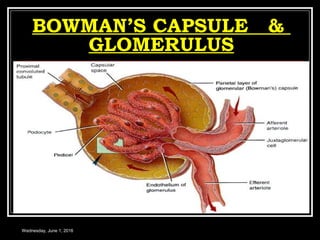
BOWMAN’S CAPSULE &
GLOMERULUS
Wednesday, June 1, 2016
CHARACTERISTICS OF FILTRATION
MEMBRANE
SITE OF FILTRATION
 Glomerulus
 The site of filtration
 Mechanism is sieve-like
 Layers:-
 1 foot processes of podocytes.
 2 Lamina rara externa or
outer cement layer.
 3 Lamina densa.
 4 Lamina rara interna or
inner cement layer.
 5 Endothelial cell layer.
Wednesday, June 1, 2016
GLOMERULAR
FILTRATION MEMBRANE
ELECTRON MICROGRAPH OFELECTRON MICROGRAPH OF
PODOCYTE COVERINGPODOCYTE COVERING GLOMERULAR
CAPILLARY LOOP.CAPILLARY LOOP.
ELECTRON MICROGRAPH OFELECTRON MICROGRAPH OF
GLOMERULAR MEMBRANE.GLOMERULAR MEMBRANE.
CHARACTERISTICS OF FILTRATION
MEMBRANE (Cont..)
 Endothelial capillary pores -- Large fenestrae.
 High permeability:- 100-400 times more permeable to plasma,
H20, and dissolved solutes than capillaries of skeletal muscles.
 Permeability selectivity :-
Pore size
Electrical charge
 Pores are small enough to prevent RBCs, platelets, and WBCs
from passing through the pores.
CHARACTERISTICS OF FILTRATION
MEMBRANE (Cont..)
Pore size.
Glomerular capillary – 8 nm.
podocyte filtration slits – 25 nm.
< 4 nm -- freely filtered.
4-8 nm -- inversely proportional to
diameter
> 8 nm – not filtered.
Electrical charge.
Negatively charged – Glycoproteins rich in sialic acid.
so cationic & neutral particals – more
permeability
APPLIED PHYSIOLOGY.
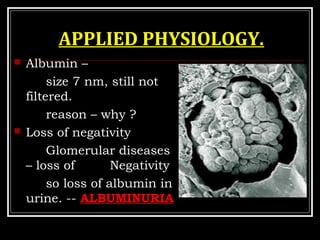
 Albumin –
size 7 nm, still not
filtered.
reason – why ?
 Loss of negativity
Glomerular diseases
– loss of Negativity
so loss of albumin in
urine. -- ALBUMINURIA
COMPOSITION OF GLOMERULAR FILTRATE
(GLOMERULAR ULTRA FILTRATE)
 Ultra filtration.– Filtration under pressure.
 Composition – same like that of plasma except for
proteins & cells.
 Glomerular filtration:
 Mechanism of producing ultra filtrate under
hydrostatic pressure of the blood.
 Process similar to the formation of tissue
fluid by other capillary beds.
DYNAMICS OF GLOMERULAR
FILTRATION
GFR = KF [(pGc † ΠBS)-(ΠGc † pBS)]
EFFECTIVE FILTRATION
PRESSURE ( EFP)
EFP=
[(pGc † ΠBS)-(ΠGc † pBS)]
GFR= KF × EFP
= 12.5 [(60 + 0) – (32+18)]
= 12.5 × 10
= 125 ml/min
FILTRATION
 Analysis of Glomerular Capillary Dynamics
GFR = KF [(pGc – pBS)-(ΠGc- ΠBS)]
KF -- filtration coeffiecient = 12.5
 pGc - Hydrostatic Pressure Of Glomerular
Capillary = 60.0 mm Hg
 pBS – Hydrostatic pressure of bowmans space =
18 mm Hg
 ΠGc -oncotic pressure of glomerular cappilary =
32 mm Hg
 ΠBS - Oncotic pressure of Bowmans space = 0 mm Hg
NORMAL GLOMERULAR
FILTRATION RATE
 Glomerular filtration rate (GFR):
 Volume of filtrate produced by both kidneys each
minute.
 Averages 115 ml/min. in women;
 125 ml/min. in men.
 7.5 L/hr.
 180 L/ day i.e.
 In one day
 4 times total body water,
 15 times ECF, &
 60 times plasma volume.
FILTRATION FRACTION
 DEF:- Ratio of GFR to the renal plasma flow
FF = GFR / RPF
= 125 / 650
= 0.2 % ( 20 % RPF filtered / min)
 Glomerular versus systemic filtration
1 Total filtration.
180 L / 20 L. per day.
2 Filtration coefficient (Kf).
100 times in glomerulus.
3 Hydrostatic pressure. 2 / 1
FILTRATION FRACTION
4 Total capillary exchange area.
1.6 m2
(2-3 %) / 1000 m2
(25 %)
500 to 810 cm2
/ 250 m2
5 Balance of starling forces..
FACTORS AFFECTING GLOMERULAR
FILTRATION RATE
 Age –
 Filtration Coefficient (Kf).
 Kf = permeability × filtration area
Permeability -- hypoxia & toxic agents
thickening of capillary
membrane
 Filtration area Relaxation of Mesangial cells
Vasodilators – Dopamine , cAMP, ANP, NO, PG.
 Contraction of Mesangial cells
Vasoconstrictors – Angiotensin II,
NE,
Endothelins,
TXA2, Leukotrienes & histamine.
FACTORS AFFECTING GLOMERULAR
FILTRATION RATE
 Hydrostatic pressure in bowman’s space fluid (PBS). --
acute obstruction – stone.
 Glomerular capillary hydrostatic pressure.
Arterial pressure – except 80 to 200
Renal blood flow
Afferent & Efferent arteriolar resistance.
 Glomerular capillary oncotic pressure.
Hyperproteinaemia
Hypoproteinaemia
REGULATION OF GFR
 Auto regulation
 Hormonal regulation
 Nervous regulation
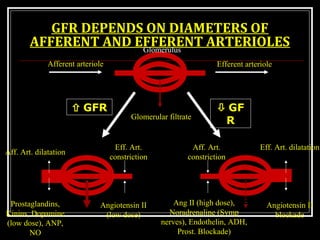
GFR DEPENDS ON DIAMETERS OF
AFFERENT AND EFFERENT ARTERIOLES
GFR GF
R
Glomerulus
Afferent arteriole Efferent arteriole
Glomerular filtrate
Aff. Art. dilatation
Eff. Art. dilatationEff. Art.
constriction
Aff. Art.
constriction
Prostaglandins,
Kinins, Dopamine
(low dose), ANP,
NO
Angiotensin II
(low dose)
Angiotensin II
blockade
Ang II (high dose),
Noradrenaline (Symp
nerves), Endothelin, ADH,
Prost. Blockade)
AUTO REGULATION
 Mechanism of Auto-regulation
1 Myogenic mechanism ( Respond to
change in arterial pressure).
2 Tubuloglomerular feedback
mechanism ( Respond to change in NaCl
concentration of tubular fluid.
TUBULOGLOMERULAR FEEDBACK
MECHANISM
 Renal arterial pressure
GFR
NaCl conc. in tubular fluid
Stimulate macula densa cells
Renin release
Afferent arteriole constriction /
dilation
Renal arterial pressure
HORMONAL REGULATION
 HORMONES
Vasoconstrictors
1 NE
2 Angiotensin II
3 Endothelin
VASODIALATORS
1 PG
2 NO
3 ANP
4 Bradykinin
 STIMULUS GFR
ECV
ECV
ECV
ECV, stretch NC
stretch, Ach, histamine
ECV
PG, ACE
NERVOUS REGULATION
 Afferent & efferent – sympathetic from T4-L2
through splanchnic nerves.
 Normally sympathetic tone minimum.
 Mild to moderate stimulation – mild effect.
 Strong acute stimulation – Fall in RBF due to
constriction of both afferent & efferent arterioles.
MEASUREMENT OF GFR
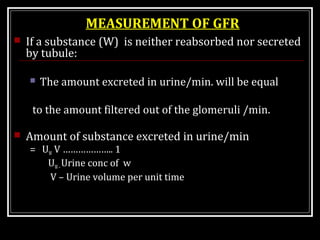
 If a substance (W) is neither reabsorbed nor secreted
by tubule:
 The amount excreted in urine/min. will be equal
to the amount filtered out of the glomeruli /min.
 Amount of substance excreted in urine/min
= UW V ……………….. 1
UW–Urine conc of w
V – Urine volume per unit time
MEASUREMENT OF GFR
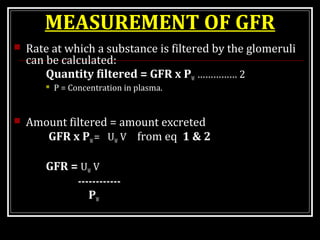
 Rate at which a substance is filtered by the glomeruli
can be calculated:
Quantity filtered = GFR x PW …………… 2
 P = Concentration in plasma.
 Amount filtered = amount excreted
GFR x PW= UW V from eq 1 & 2
GFR = UW V
------------
PW
CRITERION FOR W
 Freely filterable at renal corpuscle
 Not reabsorbed
 Not secreted.
 Not synthesized by renal tubules.
 Not metabolized by renal tubules.
only one substance --- INULIN
CLEARANCE
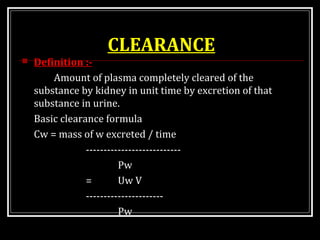
 Definition :-
Amount of plasma completely cleared of the
substance by kidney in unit time by excretion of that
substance in urine.
Basic clearance formula
Cw = mass of w excreted / time
---------------------------
Pw
= Uw V
----------------------
Pw
INULIN CLEARANCE
 Inulin –
dye, fructopolysaccharide,
does not exist naturally,
measure of GFR – not reabsorbed, nor secreted, nor-
metabolized, non-toxic,
Method – single bolus dose
i/v infusion,
urine/ plasma conc,
urine flow rate,
Cin = Uin V / Pin
CLINICAL APPLICATION
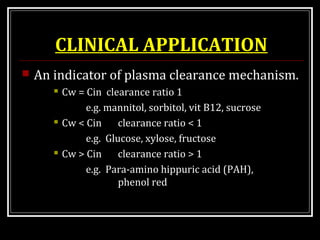
 An indicator of plasma clearance mechanism.
 Cw = Cin clearance ratio 1
e.g. mannitol, sorbitol, vit B12, sucrose
 Cw < Cin clearance ratio < 1
e.g. Glucose, xylose, fructose
 Cw > Cin clearance ratio > 1
e.g. Para-amino hippuric acid (PAH),
phenol red
CREATININE CLEARANCE
 Adv.– More preferred
No intravenous dose needed.
Endogenous substance from metabolism of muscle
creatine
Filtered & marginally secreted
Method:-
24 hr urine collection, urine conc,
mid-point plasma conc sample,
Normal Value – 130 ml/min
UREA CLEARANCE
 Urea- End product of protein metabolism.
 Filtered & partly reabsorbed
 Clearance less than GFR
 Influenced by protein content of diet.
METHOD :-
Empty bladder,
urine collected at the end of 1 hour,
blood sample collected at mid point
estimate blood & urine urea.
UREA CLEARANCE
 Urea clearance drastically changes – urine output <
2ml /min
 So 2 urea clearance values
1 Maximal :- urine output > 2 ml.
CU = UV/ P
Normal value = 75 ml / min
2 Standard :- urine output < 2 ml.
CU = U √ V/ P
Normal value = 54 ml / min
MEASUREENT OF RENAL PLASMA
FLOW
 FICK’S Principle to kidney
“ Amount of substance excreted by
the kidney per unit time (UV) is equal
to the product of renal plasma flow
(RPF) and arteriovenous difference in
its plasma concentration.”
UV = RPF (Pa- Pv)
RPF = UV / (Pa-Pv)……………(1)
PAH CLEARANCE – TO
MEASURE RPF
 PAH clearance is used to measure
RPF
b’coz–
1 Completely extracted.
2 Neither metabolized nor
reabsorbed.
3 Does not affect RBF.
4 Actively secreted.
5 Conc. easily measured.
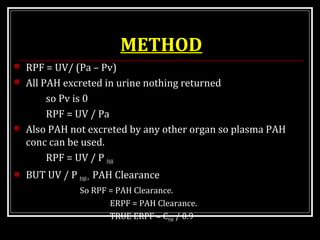
METHOD
 RPF = UV/ (Pa – Pv)
 All PAH excreted in urine nothing returned
so Pv is 0
RPF = UV / Pa
 Also PAH not excreted by any other organ so plasma PAH
conc can be used.
RPF = UV / P PAH
 BUT UV / P PAH= PAH Clearance
So RPF = PAH Clearance.
ERPF = PAH Clearance.
TRUE ERPF = CPAH / 0.9
Wednesday, June 1, 2016
THANK YOUTHANK YOU

URINE FORMATION

  • 1.
    URINE FORMATION. Dr. Nilesh N.Kate. M.D. ASSOCIATE PROFESSOR DEPARTMENT OF PHYSIOLOGY.
  • 2.
     The compositionof the blood ( internal environment ) is determined not by what the mouth ingest but by what the kidney keep. ------- SMITH.
  • 3.
    OBJECTIVES  Filtration  Characteristicsof filtration membrane  Composition of Glomerular filtrate  Dynamics Of Glomerular Filtration  Glomerular filtration rate  Filtration fraction  Factors affecting Glomerular filtration  Regulation of Glomerular filtration  Measurement of Glomerular filtration.
  • 4.
  • 5.
    IDENTIFY THE PARTS 11 Proximalconvoluted tubule. Loop of Henle Distal convoluted tubule. Collecting duct. Glomerular capsule.
  • 6.
    INTRODUCTION  Process concernedwith urine formation  Glomerular filtration..  Tubular reabsorption..  Tubular secretion..  GFR is very high: ~180L/day.  IMP:-It is the ECF that is being regulated, NOT the urine.
  • 7.
  • 8.
    CHARACTERISTICS OF FILTRATION MEMBRANE SITEOF FILTRATION  Glomerulus  The site of filtration  Mechanism is sieve-like  Layers:-  1 foot processes of podocytes.  2 Lamina rara externa or outer cement layer.  3 Lamina densa.  4 Lamina rara interna or inner cement layer.  5 Endothelial cell layer.
  • 9.
  • 10.
  • 11.
    ELECTRON MICROGRAPH OFELECTRONMICROGRAPH OF PODOCYTE COVERINGPODOCYTE COVERING GLOMERULAR CAPILLARY LOOP.CAPILLARY LOOP.
  • 12.
    ELECTRON MICROGRAPH OFELECTRONMICROGRAPH OF GLOMERULAR MEMBRANE.GLOMERULAR MEMBRANE.
  • 13.
    CHARACTERISTICS OF FILTRATION MEMBRANE(Cont..)  Endothelial capillary pores -- Large fenestrae.  High permeability:- 100-400 times more permeable to plasma, H20, and dissolved solutes than capillaries of skeletal muscles.  Permeability selectivity :- Pore size Electrical charge  Pores are small enough to prevent RBCs, platelets, and WBCs from passing through the pores.
  • 14.
    CHARACTERISTICS OF FILTRATION MEMBRANE(Cont..) Pore size. Glomerular capillary – 8 nm. podocyte filtration slits – 25 nm. < 4 nm -- freely filtered. 4-8 nm -- inversely proportional to diameter > 8 nm – not filtered. Electrical charge. Negatively charged – Glycoproteins rich in sialic acid. so cationic & neutral particals – more permeability
  • 15.
    APPLIED PHYSIOLOGY.  Albumin– size 7 nm, still not filtered. reason – why ?  Loss of negativity Glomerular diseases – loss of Negativity so loss of albumin in urine. -- ALBUMINURIA
  • 16.
    COMPOSITION OF GLOMERULARFILTRATE (GLOMERULAR ULTRA FILTRATE)  Ultra filtration.– Filtration under pressure.  Composition – same like that of plasma except for proteins & cells.  Glomerular filtration:  Mechanism of producing ultra filtrate under hydrostatic pressure of the blood.  Process similar to the formation of tissue fluid by other capillary beds.
  • 17.
    DYNAMICS OF GLOMERULAR FILTRATION GFR= KF [(pGc † ΠBS)-(ΠGc † pBS)]
  • 18.
    EFFECTIVE FILTRATION PRESSURE (EFP) EFP= [(pGc † ΠBS)-(ΠGc † pBS)] GFR= KF × EFP = 12.5 [(60 + 0) – (32+18)] = 12.5 × 10 = 125 ml/min
  • 19.
    FILTRATION  Analysis ofGlomerular Capillary Dynamics GFR = KF [(pGc – pBS)-(ΠGc- ΠBS)] KF -- filtration coeffiecient = 12.5  pGc - Hydrostatic Pressure Of Glomerular Capillary = 60.0 mm Hg  pBS – Hydrostatic pressure of bowmans space = 18 mm Hg  ΠGc -oncotic pressure of glomerular cappilary = 32 mm Hg  ΠBS - Oncotic pressure of Bowmans space = 0 mm Hg
  • 20.
    NORMAL GLOMERULAR FILTRATION RATE Glomerular filtration rate (GFR):  Volume of filtrate produced by both kidneys each minute.  Averages 115 ml/min. in women;  125 ml/min. in men.  7.5 L/hr.  180 L/ day i.e.  In one day  4 times total body water,  15 times ECF, &  60 times plasma volume.
  • 21.
    FILTRATION FRACTION  DEF:-Ratio of GFR to the renal plasma flow FF = GFR / RPF = 125 / 650 = 0.2 % ( 20 % RPF filtered / min)  Glomerular versus systemic filtration 1 Total filtration. 180 L / 20 L. per day. 2 Filtration coefficient (Kf). 100 times in glomerulus. 3 Hydrostatic pressure. 2 / 1
  • 22.
    FILTRATION FRACTION 4 Totalcapillary exchange area. 1.6 m2 (2-3 %) / 1000 m2 (25 %) 500 to 810 cm2 / 250 m2 5 Balance of starling forces..
  • 23.
    FACTORS AFFECTING GLOMERULAR FILTRATIONRATE  Age –  Filtration Coefficient (Kf).  Kf = permeability × filtration area Permeability -- hypoxia & toxic agents thickening of capillary membrane  Filtration area Relaxation of Mesangial cells Vasodilators – Dopamine , cAMP, ANP, NO, PG.  Contraction of Mesangial cells Vasoconstrictors – Angiotensin II, NE, Endothelins, TXA2, Leukotrienes & histamine.
  • 24.
    FACTORS AFFECTING GLOMERULAR FILTRATIONRATE  Hydrostatic pressure in bowman’s space fluid (PBS). -- acute obstruction – stone.  Glomerular capillary hydrostatic pressure. Arterial pressure – except 80 to 200 Renal blood flow Afferent & Efferent arteriolar resistance.  Glomerular capillary oncotic pressure. Hyperproteinaemia Hypoproteinaemia
  • 25.
    REGULATION OF GFR Auto regulation  Hormonal regulation  Nervous regulation
  • 26.
    GFR DEPENDS ONDIAMETERS OF AFFERENT AND EFFERENT ARTERIOLES GFR GF R Glomerulus Afferent arteriole Efferent arteriole Glomerular filtrate Aff. Art. dilatation Eff. Art. dilatationEff. Art. constriction Aff. Art. constriction Prostaglandins, Kinins, Dopamine (low dose), ANP, NO Angiotensin II (low dose) Angiotensin II blockade Ang II (high dose), Noradrenaline (Symp nerves), Endothelin, ADH, Prost. Blockade)
  • 27.
    AUTO REGULATION  Mechanismof Auto-regulation 1 Myogenic mechanism ( Respond to change in arterial pressure). 2 Tubuloglomerular feedback mechanism ( Respond to change in NaCl concentration of tubular fluid.
  • 28.
    TUBULOGLOMERULAR FEEDBACK MECHANISM  Renalarterial pressure GFR NaCl conc. in tubular fluid Stimulate macula densa cells Renin release Afferent arteriole constriction / dilation Renal arterial pressure
  • 29.
    HORMONAL REGULATION  HORMONES Vasoconstrictors 1NE 2 Angiotensin II 3 Endothelin VASODIALATORS 1 PG 2 NO 3 ANP 4 Bradykinin  STIMULUS GFR ECV ECV ECV ECV, stretch NC stretch, Ach, histamine ECV PG, ACE
  • 30.
    NERVOUS REGULATION  Afferent& efferent – sympathetic from T4-L2 through splanchnic nerves.  Normally sympathetic tone minimum.  Mild to moderate stimulation – mild effect.  Strong acute stimulation – Fall in RBF due to constriction of both afferent & efferent arterioles.
  • 31.
    MEASUREMENT OF GFR If a substance (W) is neither reabsorbed nor secreted by tubule:  The amount excreted in urine/min. will be equal to the amount filtered out of the glomeruli /min.  Amount of substance excreted in urine/min = UW V ……………….. 1 UW–Urine conc of w V – Urine volume per unit time
  • 32.
    MEASUREMENT OF GFR Rate at which a substance is filtered by the glomeruli can be calculated: Quantity filtered = GFR x PW …………… 2  P = Concentration in plasma.  Amount filtered = amount excreted GFR x PW= UW V from eq 1 & 2 GFR = UW V ------------ PW
  • 33.
    CRITERION FOR W Freely filterable at renal corpuscle  Not reabsorbed  Not secreted.  Not synthesized by renal tubules.  Not metabolized by renal tubules. only one substance --- INULIN
  • 34.
    CLEARANCE  Definition :- Amountof plasma completely cleared of the substance by kidney in unit time by excretion of that substance in urine. Basic clearance formula Cw = mass of w excreted / time --------------------------- Pw = Uw V ---------------------- Pw
  • 35.
    INULIN CLEARANCE  Inulin– dye, fructopolysaccharide, does not exist naturally, measure of GFR – not reabsorbed, nor secreted, nor- metabolized, non-toxic, Method – single bolus dose i/v infusion, urine/ plasma conc, urine flow rate, Cin = Uin V / Pin
  • 36.
    CLINICAL APPLICATION  Anindicator of plasma clearance mechanism.  Cw = Cin clearance ratio 1 e.g. mannitol, sorbitol, vit B12, sucrose  Cw < Cin clearance ratio < 1 e.g. Glucose, xylose, fructose  Cw > Cin clearance ratio > 1 e.g. Para-amino hippuric acid (PAH), phenol red
  • 37.
    CREATININE CLEARANCE  Adv.–More preferred No intravenous dose needed. Endogenous substance from metabolism of muscle creatine Filtered & marginally secreted Method:- 24 hr urine collection, urine conc, mid-point plasma conc sample, Normal Value – 130 ml/min
  • 38.
    UREA CLEARANCE  Urea-End product of protein metabolism.  Filtered & partly reabsorbed  Clearance less than GFR  Influenced by protein content of diet. METHOD :- Empty bladder, urine collected at the end of 1 hour, blood sample collected at mid point estimate blood & urine urea.
  • 39.
    UREA CLEARANCE  Ureaclearance drastically changes – urine output < 2ml /min  So 2 urea clearance values 1 Maximal :- urine output > 2 ml. CU = UV/ P Normal value = 75 ml / min 2 Standard :- urine output < 2 ml. CU = U √ V/ P Normal value = 54 ml / min
  • 40.
    MEASUREENT OF RENALPLASMA FLOW  FICK’S Principle to kidney “ Amount of substance excreted by the kidney per unit time (UV) is equal to the product of renal plasma flow (RPF) and arteriovenous difference in its plasma concentration.” UV = RPF (Pa- Pv) RPF = UV / (Pa-Pv)……………(1)
  • 41.
    PAH CLEARANCE –TO MEASURE RPF  PAH clearance is used to measure RPF b’coz– 1 Completely extracted. 2 Neither metabolized nor reabsorbed. 3 Does not affect RBF. 4 Actively secreted. 5 Conc. easily measured.
  • 42.
    METHOD  RPF =UV/ (Pa – Pv)  All PAH excreted in urine nothing returned so Pv is 0 RPF = UV / Pa  Also PAH not excreted by any other organ so plasma PAH conc can be used. RPF = UV / P PAH  BUT UV / P PAH= PAH Clearance So RPF = PAH Clearance. ERPF = PAH Clearance. TRUE ERPF = CPAH / 0.9
  • 43.
  • 44.