The URInary
System
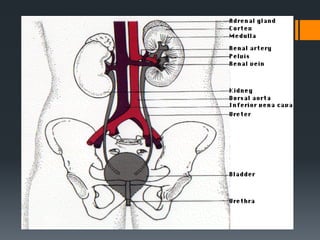
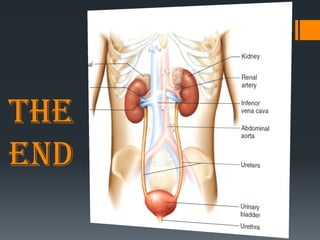
Organs of the Urinary System
Kidneys
Ureter
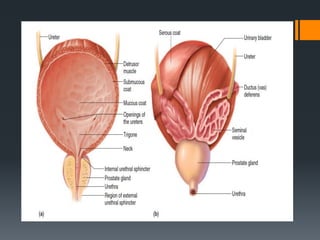
Urinary Bladder
Urethra
Kidneys
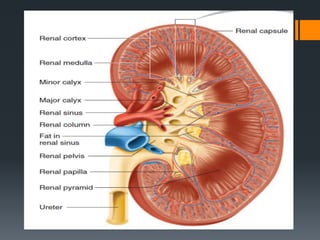
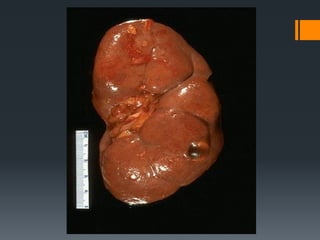
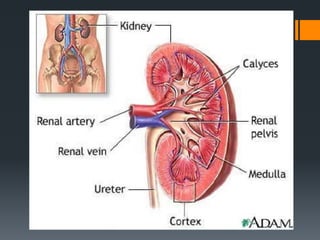
Bean-shaped organ located between the 12th thoracic
and 3rd lumbar vertebrae in the flank area
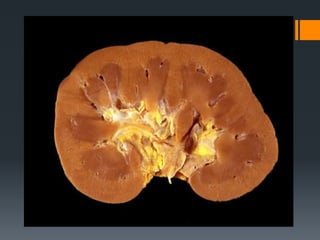
Divided into the cortex (outer layer) and medulla
(middle portion)
Concave border has a notch called the hilum where the
renal artery, vein, nerves and lymphatic vessels enter.
The ureter starts at the hilum
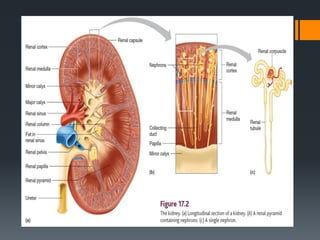
Contains the nephrons (functional units of the kidney)
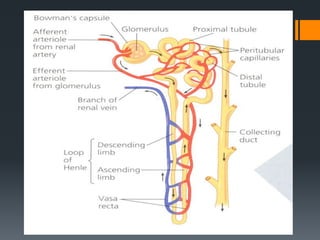
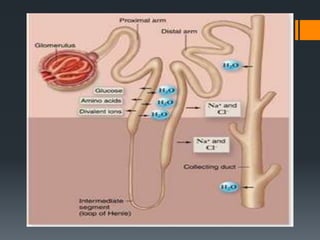
Nephron
Microscopic
1 million in each kidney
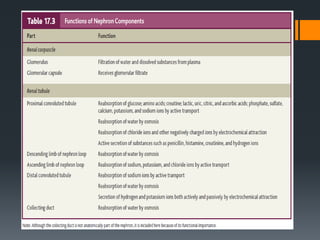
Divided into the renal corpuscle (glomerulus &
Bowman’s capsule) and tubule (proximal
convoluted tubule, descending loop of Henle,
ascending loop of Henle, distal convoluted
tubule, collecting duct)
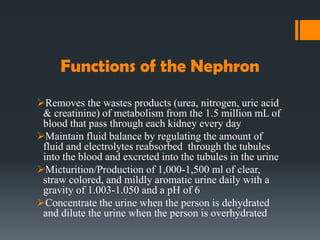
Functions of the Nephron
Removes the wastes products (urea, nitrogen, uric acid
& creatinine) of metabolism from the 1.5 million mL of
blood that pass through each kidney every day
Maintain fluid balance by regulating the amount of
fluid and electrolytes reabsorbed through the tubules
into the blood and excreted into the tubules in the urine
Micturition/Production of 1,000-1,500 ml of clear,
straw colored, and mildly aromatic urine daily with a
gravity of 1.003-1.050 and a pH of 6
Concentrate the urine when the person is dehydrated
and dilute the urine when the person is overhydrated
Ureters
Two muscular tubes that carry the urine from
each kidney to the bladder
Urinary Bladder
Muscular sac in the pelvic cavity that stores the
urine
Can hold up to 500 mL of urine when its wall
stretches
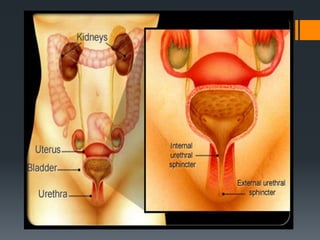
Urethra
Musculomembranous tube transporting the
urine from the bladder to the urinary meatus
Has an internal sphincter and an external
sphincter
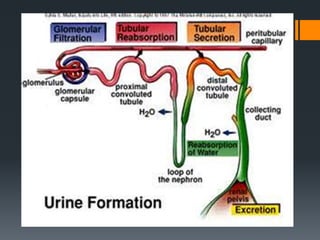
Urine Formation
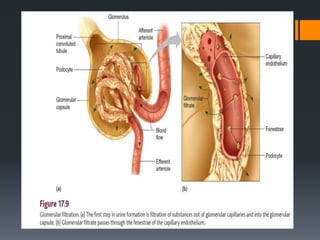
Glomerular Filtration : All the small molecules
(glucose, amino acids & uric acid) except the blood
cells and plasma protein in the blood pass through the
pores of the capillaries (glomerulus) into the
Bowman’s capsule to form the glomerular filtrate
Tubular Reabsorption : 99% of the water that passed
through the pores are reabsorbed through the tubules
into the capillaries surrounding the tubules. Useful
substances like glucose and salt (NaCl) are also
reabsorbed in the proximal convoluted tubule
Tubular Secretion : Medications and other
substances
Common Disorders Associated
with the Urinary System
Renal Failure : When the kidney ceases
functioning
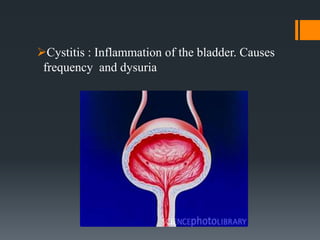
Cystitis : Inflammation of the bladder. Causes
frequency and dysuria
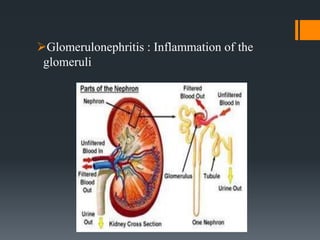
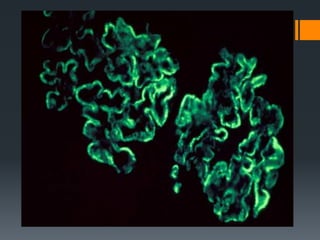
Glomerulonephritis : Inflammation of the
glomeruli
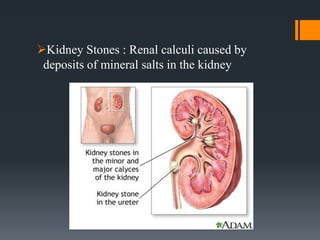
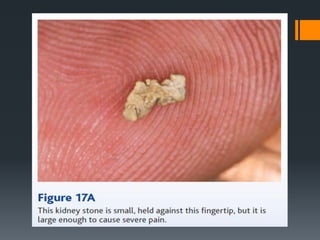
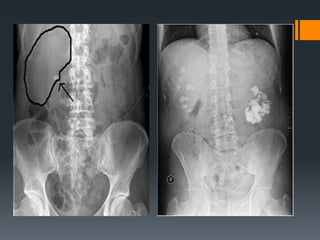
Kidney Stones : Renal calculi caused by
deposits of mineral salts in the kidney
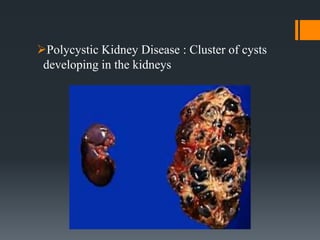
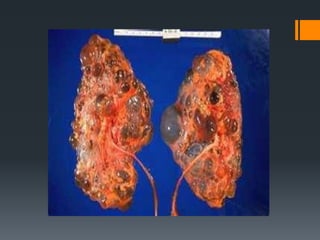
Polycystic Kidney Disease : Cluster of cysts
developing in the kidneys
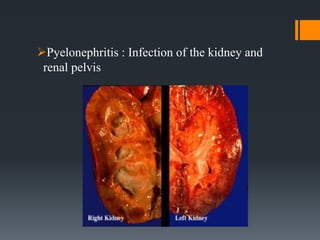
Pyelonephritis : Infection of the kidney and
renal pelvis
Urinary Incontinence : Involuntary and
unpredictable flow of urine
The
End

The urinary system

  • 1.
  • 2.
    Organs of theUrinary System Kidneys Ureter Urinary Bladder Urethra
  • 3.
    Kidneys Bean-shaped organ locatedbetween the 12th thoracic and 3rd lumbar vertebrae in the flank area Divided into the cortex (outer layer) and medulla (middle portion) Concave border has a notch called the hilum where the renal artery, vein, nerves and lymphatic vessels enter. The ureter starts at the hilum Contains the nephrons (functional units of the kidney)
  • 9.
    Nephron Microscopic 1 million ineach kidney Divided into the renal corpuscle (glomerulus & Bowman’s capsule) and tubule (proximal convoluted tubule, descending loop of Henle, ascending loop of Henle, distal convoluted tubule, collecting duct)
  • 11.
    Functions of theNephron Removes the wastes products (urea, nitrogen, uric acid & creatinine) of metabolism from the 1.5 million mL of blood that pass through each kidney every day Maintain fluid balance by regulating the amount of fluid and electrolytes reabsorbed through the tubules into the blood and excreted into the tubules in the urine Micturition/Production of 1,000-1,500 ml of clear, straw colored, and mildly aromatic urine daily with a gravity of 1.003-1.050 and a pH of 6 Concentrate the urine when the person is dehydrated and dilute the urine when the person is overhydrated
  • 15.
    Ureters Two muscular tubesthat carry the urine from each kidney to the bladder
  • 17.
    Urinary Bladder Muscular sacin the pelvic cavity that stores the urine Can hold up to 500 mL of urine when its wall stretches
  • 19.
    Urethra Musculomembranous tube transportingthe urine from the bladder to the urinary meatus Has an internal sphincter and an external sphincter
  • 21.
    Urine Formation Glomerular Filtration: All the small molecules (glucose, amino acids & uric acid) except the blood cells and plasma protein in the blood pass through the pores of the capillaries (glomerulus) into the Bowman’s capsule to form the glomerular filtrate Tubular Reabsorption : 99% of the water that passed through the pores are reabsorbed through the tubules into the capillaries surrounding the tubules. Useful substances like glucose and salt (NaCl) are also reabsorbed in the proximal convoluted tubule Tubular Secretion : Medications and other substances
  • 24.
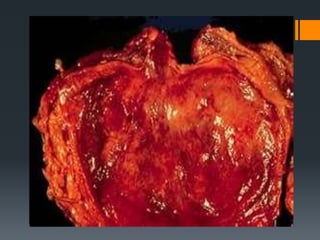
    Common Disorders Associated withthe Urinary System Renal Failure : When the kidney ceases functioning
  • 25.
    Cystitis : Inflammationof the bladder. Causes frequency and dysuria
  • 27.
  • 30.
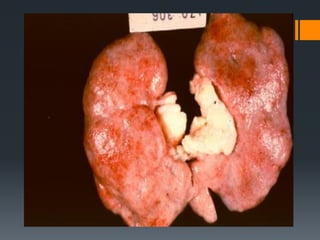
    Kidney Stones :Renal calculi caused by deposits of mineral salts in the kidney
  • 33.
    Polycystic Kidney Disease: Cluster of cysts developing in the kidneys
  • 35.
    Pyelonephritis : Infectionof the kidney and renal pelvis
  • 37.
    Urinary Incontinence :Involuntary and unpredictable flow of urine
  • 38.