Muslima P. Liwalug
BS Biology
The process of sperm
production in male
Begins during puberty
Involves meiosis
The 2 cell successive cell
divisions in gamete formation
producing nuclei with half the
full number of chromosome
Occurs in seminiferous
tubules
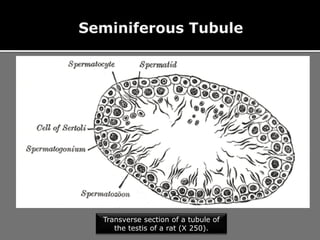
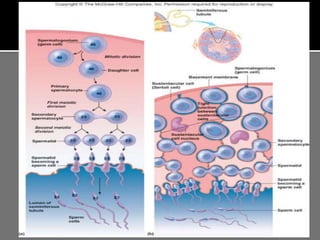
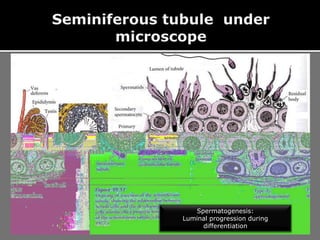
Transverse section of a tubule of
the testis of a rat (X 250).
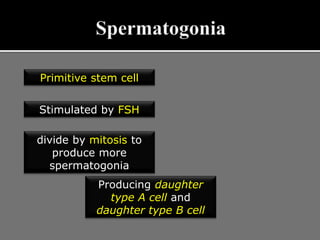
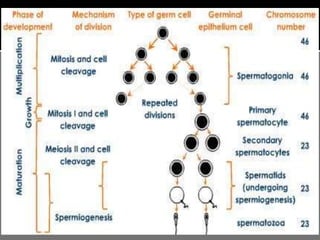
Primitive stem cell
divide by mitosis to
produce more
spermatogonia
Stimulated by FSH
Producing daughter
type A cell and
daughter type B cell
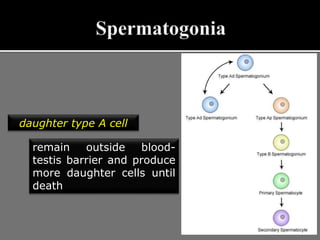
daughter type A cell
remain outside blood-
testis barrier and produce
more daughter cells until
death
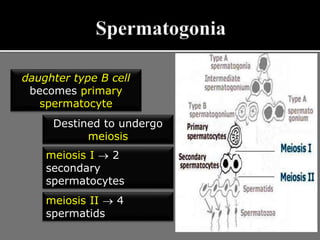
daughter type B cell
becomes primary
spermatocyte
Destined to undergo
meiosis
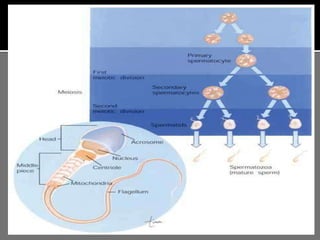
meiosis I  2
secondary
spermatocytes
meiosis II  4
spermatids
In prophase1 pairing and crossing over of
chromosomal segments takes place and genetic
recombination occurs
In metaphase1 homologous pairs arrange on
equator
In anaphase 1 homologous pairs separate to go to
opposite poles
After telophase 1 meiosis I ends and 2 secondary
spermatocytes form each with 23 double
structured chromosomes with X or Y sex
chromosome complement
Did
You
know?
It takes about 22
days to complete
meiosis I
Meiosis II follows immediately without DNA
replication. Only 23 double structured
chromosomes are involved
2 secondary spermatocytes quickly undergo
meiosis II(Centromeres split in metaphase 2)
end with the formation of 4 spermatids
each with 23 single structured
chromosomes and 1N DNA
2 spermatids bear X chromosome complement
and other two bear Y chromosome complement
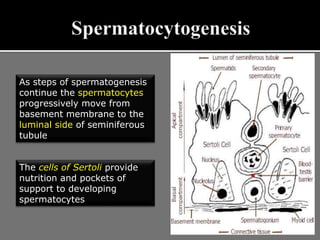
As steps of spermatogenesis
continue the spermatocytes
progressively move from
basement membrane to the
luminal side of seminiferous
tubule
The cells of Sertoli provide
nutrition and pockets of
support to developing
spermatocytes
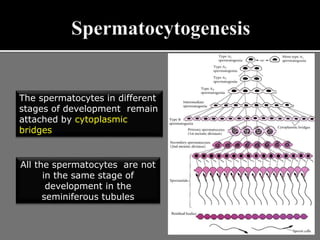
The spermatocytes in different
stages of development remain
attached by cytoplasmic
bridges
All the spermatocytes are not
in the same stage of
development in the
seminiferous tubules
Spermatogenesis:
Luminal progression during
differentiation
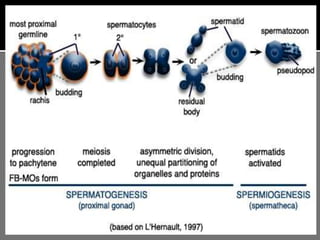
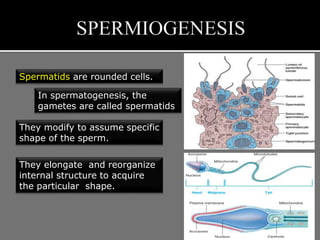
Spermatids are rounded cells.
They modify to assume specific
shape of the sperm.
They elongate and reorganize
internal structure to acquire
the particular shape.
In spermatogenesis, the
gametes are called spermatids
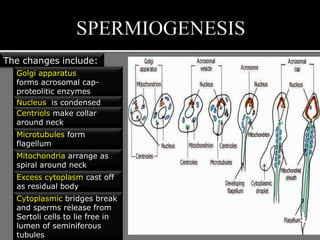
The changes include:
Golgi apparatus
forms acrosomal cap-
proteolitic enzymes
Nucleus is condensed
Centriols make collar
around neck
Microtubules form
flagellum
Mitochondria arrange as
spiral around neck
Excess cytoplasm cast off
as residual body
Cytoplasmic bridges break
and sperms release from
Sertoli cells to lie free in
lumen of seminiferous
tubules
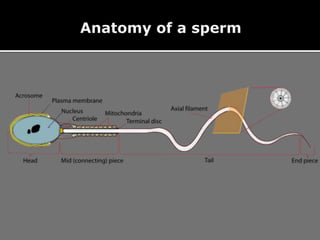
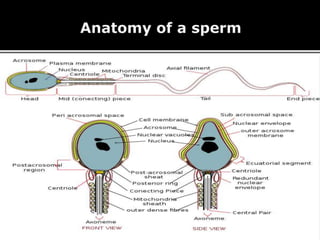
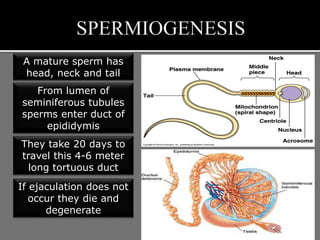
A mature sperm has
head, neck and tail
From lumen of
seminiferous tubules
sperms enter duct of
epididymis
They take 20 days to
travel this 4-6 meter
long tortuous duct
If ejaculation does not
occur they die and
degenerate
Did
You
know?
About 64-72
days are
required to go
from a
spermatogonium
to be a sperm
SPERMATOGENESIS
Pathway of
Sperms
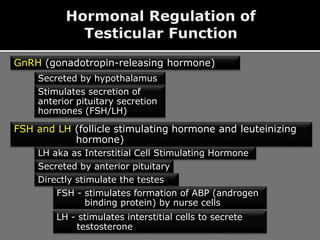
GnRH (gonadotropin-releasing hormone)
Secreted by hypothalamus
Stimulates secretion of
anterior pituitary secretion
hormones (FSH/LH)
FSH and LH (follicle stimulating hormone and leuteinizing
hormone)
LH aka as Interstitial Cell Stimulating Hormone
Secreted by anterior pituitary
Directly stimulate the testes
FSH - stimulates formation of ABP (androgen
binding protein) by nurse cells
LH - stimulates interstitial cells to secrete
testosterone
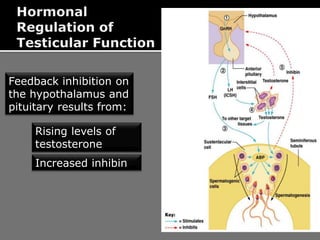
Feedback inhibition on
the hypothalamus and
pituitary results from:
Rising levels of
testosterone
Increased inhibin
Spermatogenesis

Spermatogenesis

  • 1.
  • 2.
    The process ofsperm production in male Begins during puberty Involves meiosis The 2 cell successive cell divisions in gamete formation producing nuclei with half the full number of chromosome Occurs in seminiferous tubules
  • 4.
    Transverse section ofa tubule of the testis of a rat (X 250).
  • 6.
    Primitive stem cell divideby mitosis to produce more spermatogonia Stimulated by FSH Producing daughter type A cell and daughter type B cell
  • 7.
    daughter type Acell remain outside blood- testis barrier and produce more daughter cells until death
  • 8.
    daughter type Bcell becomes primary spermatocyte Destined to undergo meiosis meiosis I  2 secondary spermatocytes meiosis II  4 spermatids
  • 13.
    In prophase1 pairingand crossing over of chromosomal segments takes place and genetic recombination occurs In metaphase1 homologous pairs arrange on equator In anaphase 1 homologous pairs separate to go to opposite poles After telophase 1 meiosis I ends and 2 secondary spermatocytes form each with 23 double structured chromosomes with X or Y sex chromosome complement
  • 14.
    Did You know? It takes about22 days to complete meiosis I
  • 15.
    Meiosis II followsimmediately without DNA replication. Only 23 double structured chromosomes are involved 2 secondary spermatocytes quickly undergo meiosis II(Centromeres split in metaphase 2) end with the formation of 4 spermatids each with 23 single structured chromosomes and 1N DNA 2 spermatids bear X chromosome complement and other two bear Y chromosome complement
  • 16.
    As steps ofspermatogenesis continue the spermatocytes progressively move from basement membrane to the luminal side of seminiferous tubule The cells of Sertoli provide nutrition and pockets of support to developing spermatocytes
  • 17.
    The spermatocytes indifferent stages of development remain attached by cytoplasmic bridges All the spermatocytes are not in the same stage of development in the seminiferous tubules
  • 18.
  • 19.
    Spermatids are roundedcells. They modify to assume specific shape of the sperm. They elongate and reorganize internal structure to acquire the particular shape. In spermatogenesis, the gametes are called spermatids
  • 20.
    The changes include: Golgiapparatus forms acrosomal cap- proteolitic enzymes Nucleus is condensed Centriols make collar around neck Microtubules form flagellum Mitochondria arrange as spiral around neck Excess cytoplasm cast off as residual body Cytoplasmic bridges break and sperms release from Sertoli cells to lie free in lumen of seminiferous tubules
  • 22.
    A mature spermhas head, neck and tail From lumen of seminiferous tubules sperms enter duct of epididymis They take 20 days to travel this 4-6 meter long tortuous duct If ejaculation does not occur they die and degenerate
  • 23.
    Did You know? About 64-72 days are requiredto go from a spermatogonium to be a sperm
  • 24.
  • 25.
    GnRH (gonadotropin-releasing hormone) Secretedby hypothalamus Stimulates secretion of anterior pituitary secretion hormones (FSH/LH) FSH and LH (follicle stimulating hormone and leuteinizing hormone) LH aka as Interstitial Cell Stimulating Hormone Secreted by anterior pituitary Directly stimulate the testes FSH - stimulates formation of ABP (androgen binding protein) by nurse cells LH - stimulates interstitial cells to secrete testosterone
  • 26.
    Feedback inhibition on thehypothalamus and pituitary results from: Rising levels of testosterone Increased inhibin