CELL CYCLE AND CELL
DIVISION
-BY PROF T.V.RATHOD
INTRODUCTION
• Cell cycle can be defined as the entire sequence of events happening
from the end of one nuclear division to the beginning of the next.
• A cell cycle consists of two phases, viz.,
1) interphase and
2) the cell division proper.
• The time required for the completion of cell cycle differs from species
to species.
• Interphase is generally known as DNA systhesis phase.
• Consists of G1, S and G2 sub phases.
Interphase
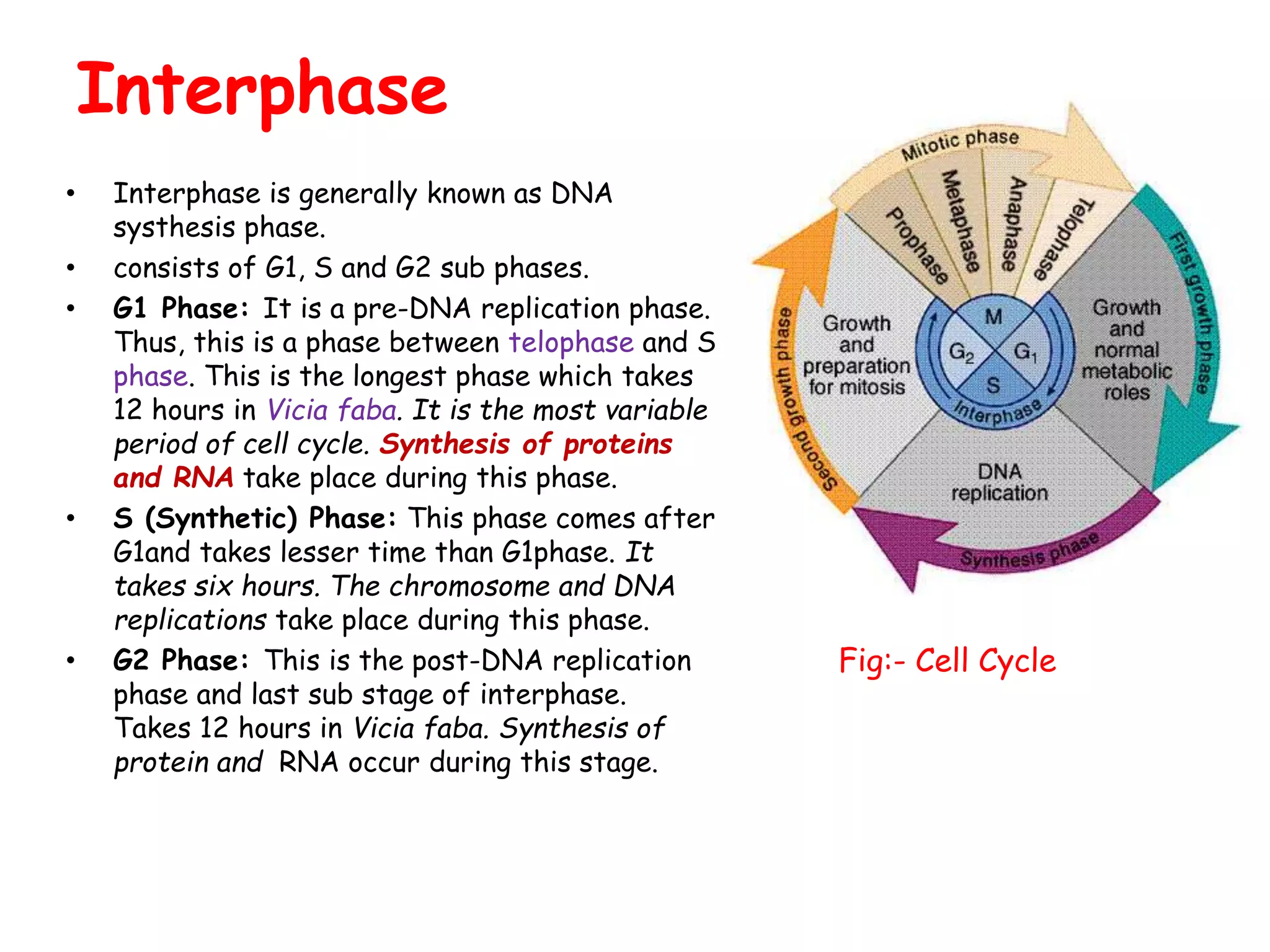
• Interphase is generally known as DNA
systhesis phase.
• consists of G1, S and G2 sub phases.
• G1 Phase: It is a pre-DNA replication phase.
Thus, this is a phase between telophase and S
phase. This is the longest phase which takes
12 hours in Vicia faba. It is the most variable
period of cell cycle. Synthesis of proteins
and RNA take place during this phase.
• S (Synthetic) Phase: This phase comes after
G1and takes lesser time than G1phase. It
takes six hours. The chromosome and DNA
replications take place during this phase.
• G2 Phase: This is the post-DNA replication
phase and last sub stage of interphase.
Takes 12 hours in Vicia faba. Synthesis of
protein and RNA occur during this stage.
Fig:- Cell Cycle
CELL DIVISION
• All the cells are produced by division of pre-existing cells.
• Continuity of life depends on cell division.
• In the cell division, the division of nucleus is called karyokinesis
and division of cytoplasm is called cytokinesis.
• The cell division is of two types.
1) Mitosis and
2) Meiosis
MITOSIS
• The term mitosis was coined by
Flemming in 1882.
• Mitosis occurs in somatic organs
like root tip, stem tip and leaf
base etc. Hence it is also known
as somatic cell division.
• The daughter cells are similar to
the mother cell in shape, size
and chromosome complement.
• Since the chromosome number is
same in the daughter cells as
compared to that of mother cell,
this is also known as homotypic
or equational division.
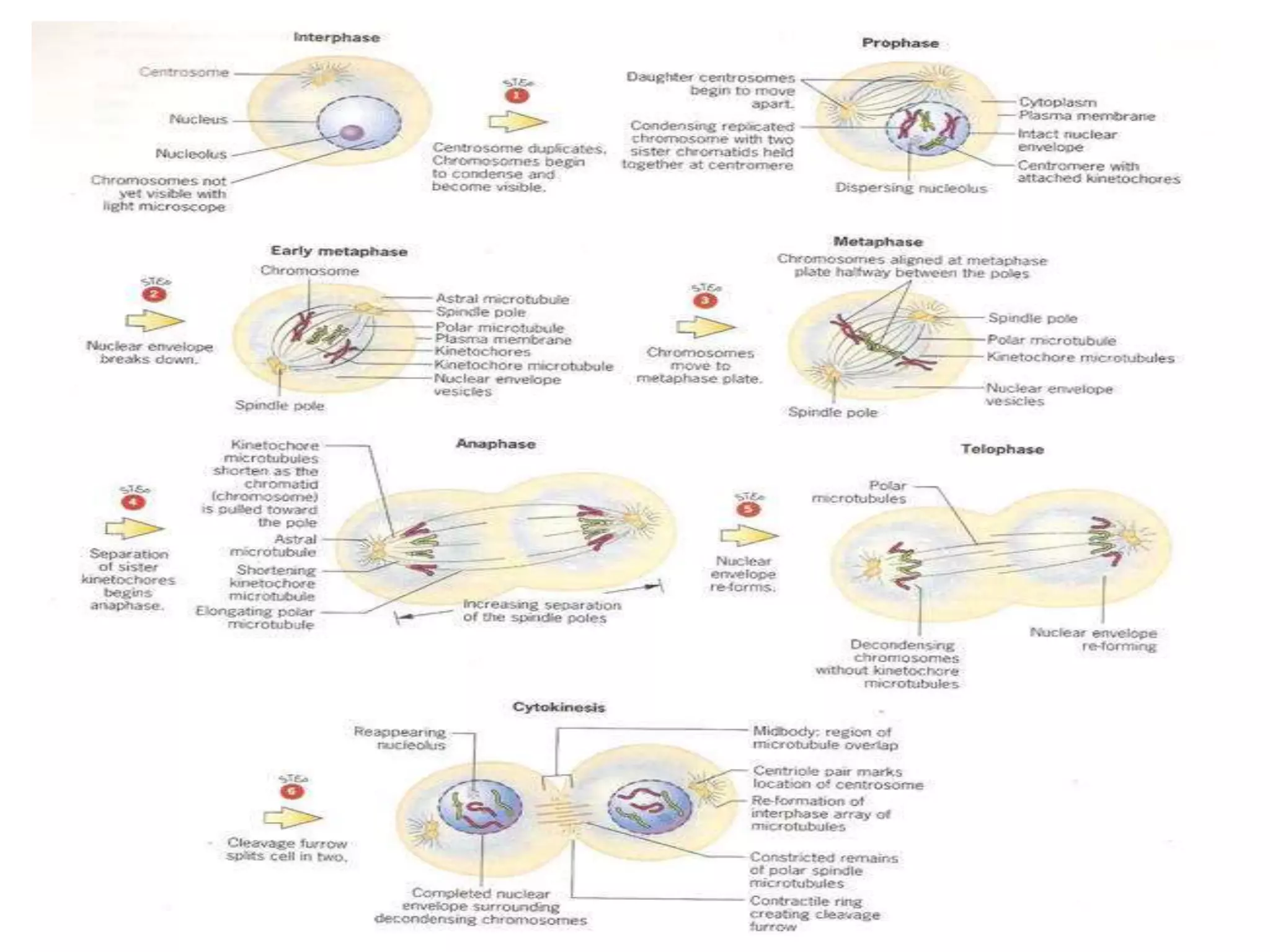
• Mitosis consist of four stage,
viz.,
(a) Prophase,
(b) Metaphase,
(c) Anaphase and
(d) Telophase
Prophase
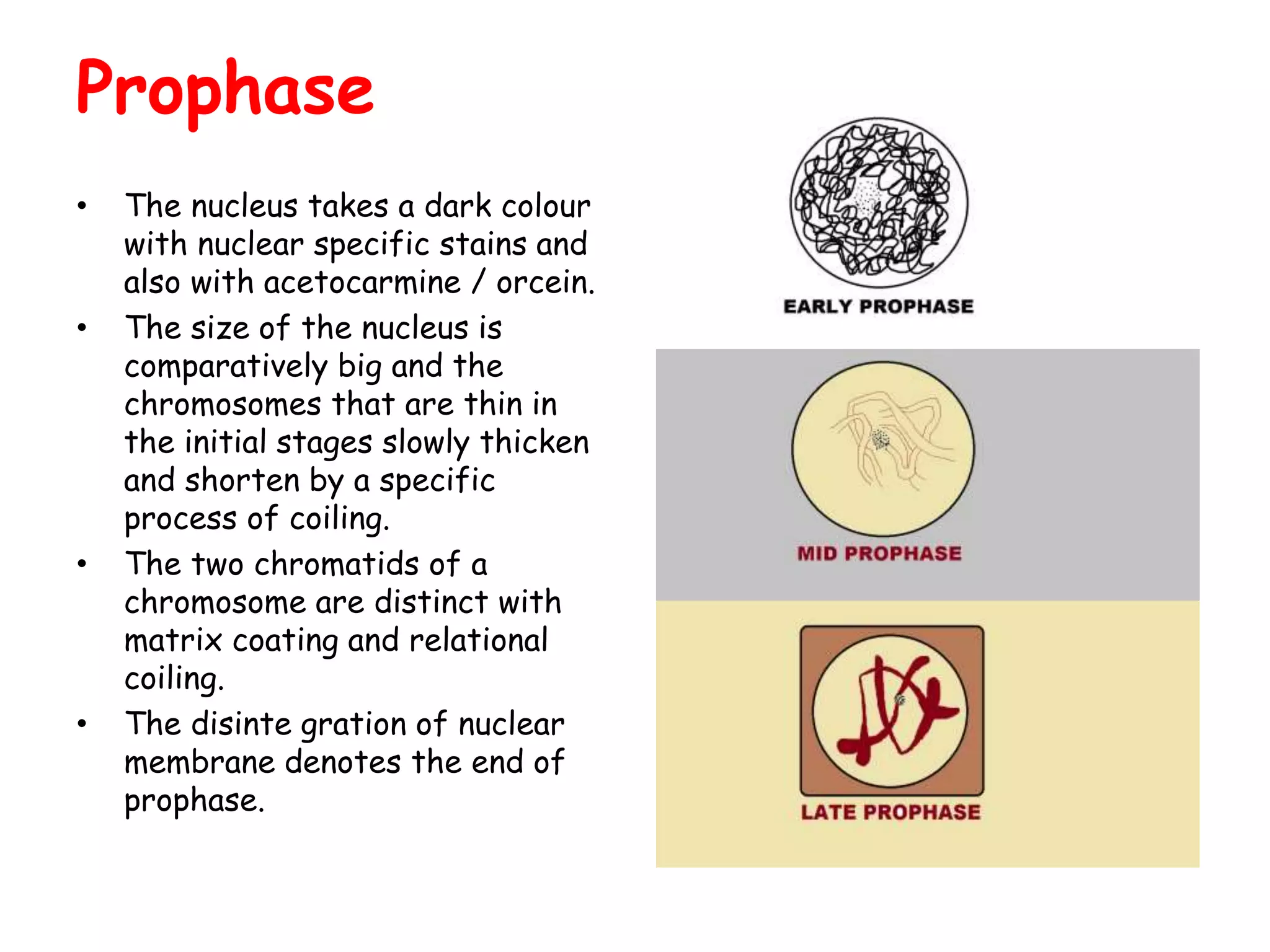
• The nucleus takes a dark colour
with nuclear specific stains and
also with acetocarmine / orcein.
• The size of the nucleus is
comparatively big and the
chromosomes that are thin in
the initial stages slowly thicken
and shorten by a specific
process of coiling.
• The two chromatids of a
chromosome are distinct with
matrix coating and relational
coiling.
• The disinte gration of nuclear
membrane denotes the end of
prophase.
Metaphase
• The size of the chromosomes is
further reduced and thickened.
• The distinct centromere of each
chromosome is connected to the
poles through spindle fibres.
• The chromosomes move towards
equator and the centromere of each
chromosome is arranged on the
equatorial plate.
• This type of orientation of
centromeres on the equator is known
as autoorientation.
• The chromosomes at this stage are
shortest and thickest.
• The chromatids of a chromosome
are held together at the point of
centromeres.
Anaphase
• The centromere of each
chromosome separates first and
moves to towards the poles.
• The chromosomes show ` V `,
` L ` and ` I ` shapes
respectively as the anaphase
progresses.
• The sister chromatids move to
the poles.
• The chromosome number is
constant but the quantity of
each chromosome is reduced to
half.
Telophase
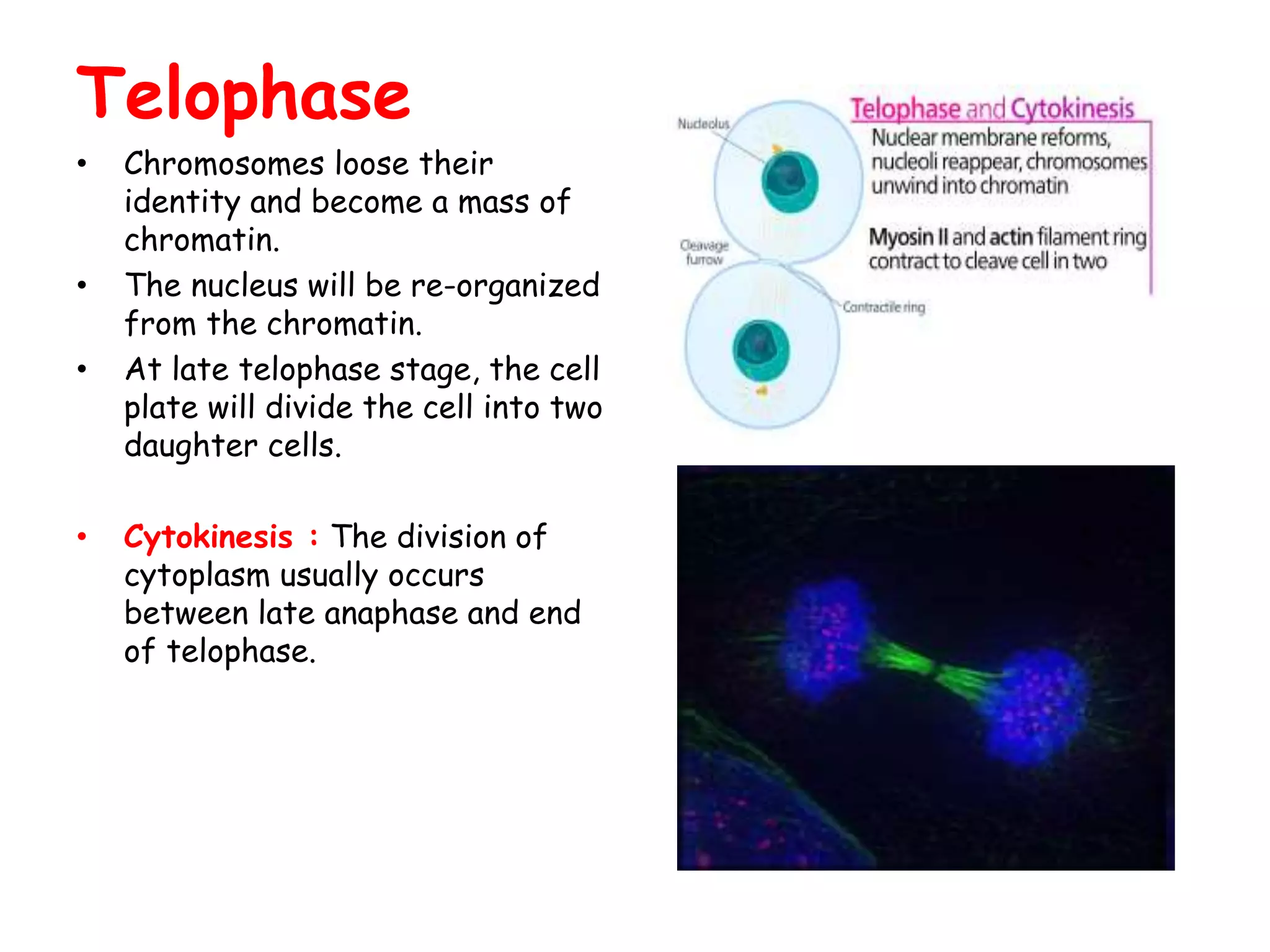
• Chromosomes loose their
identity and become a mass of
chromatin.
• The nucleus will be re-organized
from the chromatin.
• At late telophase stage, the cell
plate will divide the cell into two
daughter cells.
• Cytokinesis : The division of
cytoplasm usually occurs
between late anaphase and end
of telophase.
Significance of Mitosis
 Development of a zygote into adult organism.
 Essential for normal growth and development of living organisms.
 It gives a definite shape to a specific organism.
 It leads to formation of new organs like roots, leaves, stems and
branches.
 It also helps in repairing of damaged parts.
 Replacement of the old, decayed and dead cells and thus it helps to
overcome ageing of the cells.
 It helps in asexual propagation of vegetatively propagated crops like
sugarcane, banana, sweet potato, potato, etc. mitosis leads to
production of identical progeny in such crops.
 Useful in maintaining the purity of types because it leads to production
of identical daughter cells.
 Does not allow segregation and recombination to occur.
MEIOSIS
• The term meiosis was coined by J.B. Farmer in 1905.
• This type of division is found in organisms in which there is sexual
reproduction.
• Three important processes that occur during meiosis are:
1. Pairing of homologous chromosomes (synapsis)
2. Formation of chiasmata and crossing over
3. Segregation of homologous chromosomes
• The first division of meiosis results in reduction of chromosome number
to half and is called reductional division.
• The first meiotic division is also called heterotypic division.
• Two haploid cells are produced at the end of first meiotic division and
• In the second meiotic division, the haploid cells divide mitotically and
results in the production of four daughter cells (tetrad), each with
haploid number of chromosomes.
• Both the meiotic divisions occur continuously and each includes the usual
stages viz., prophase, metaphase, anaphase and telophase.
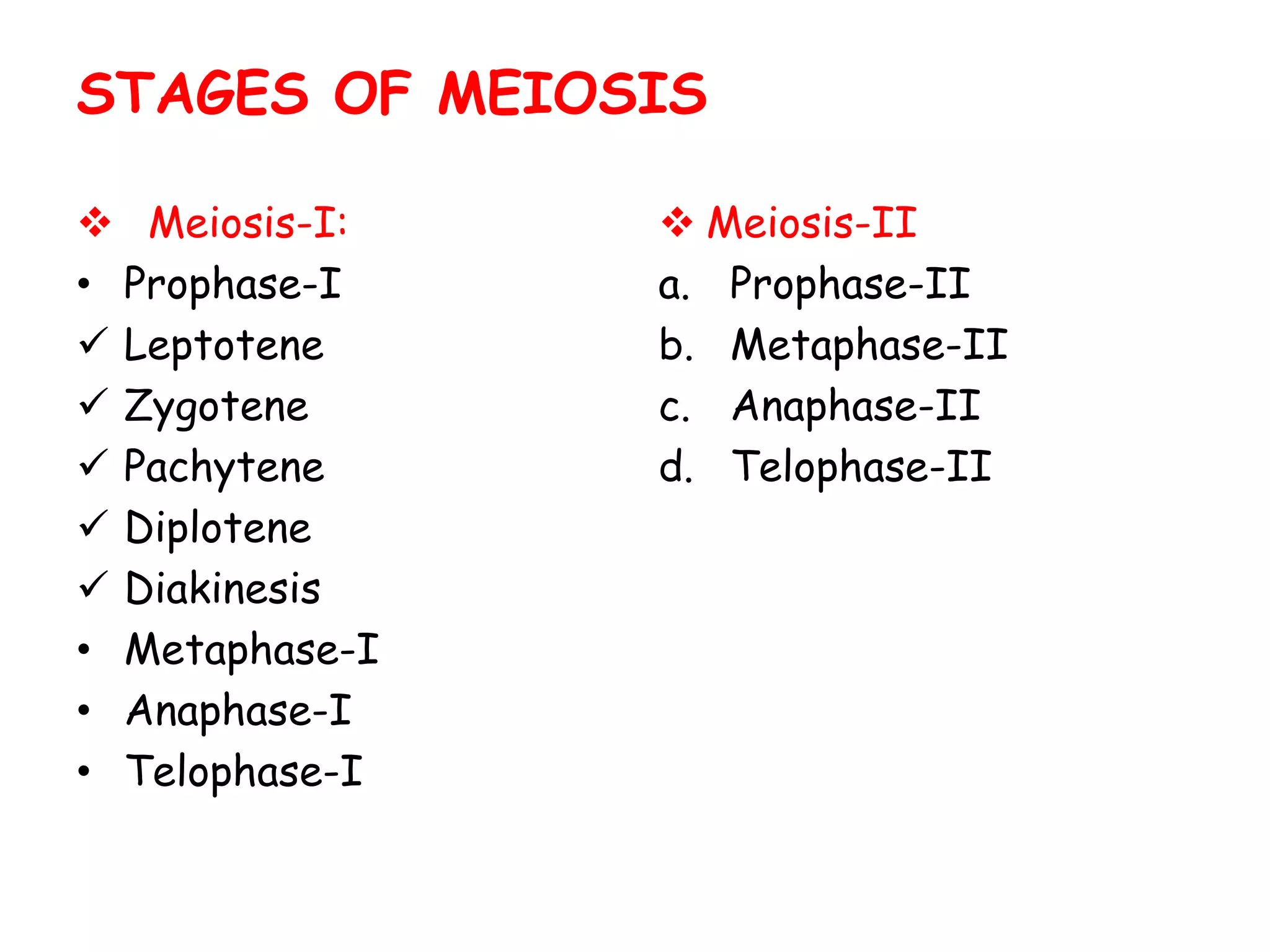
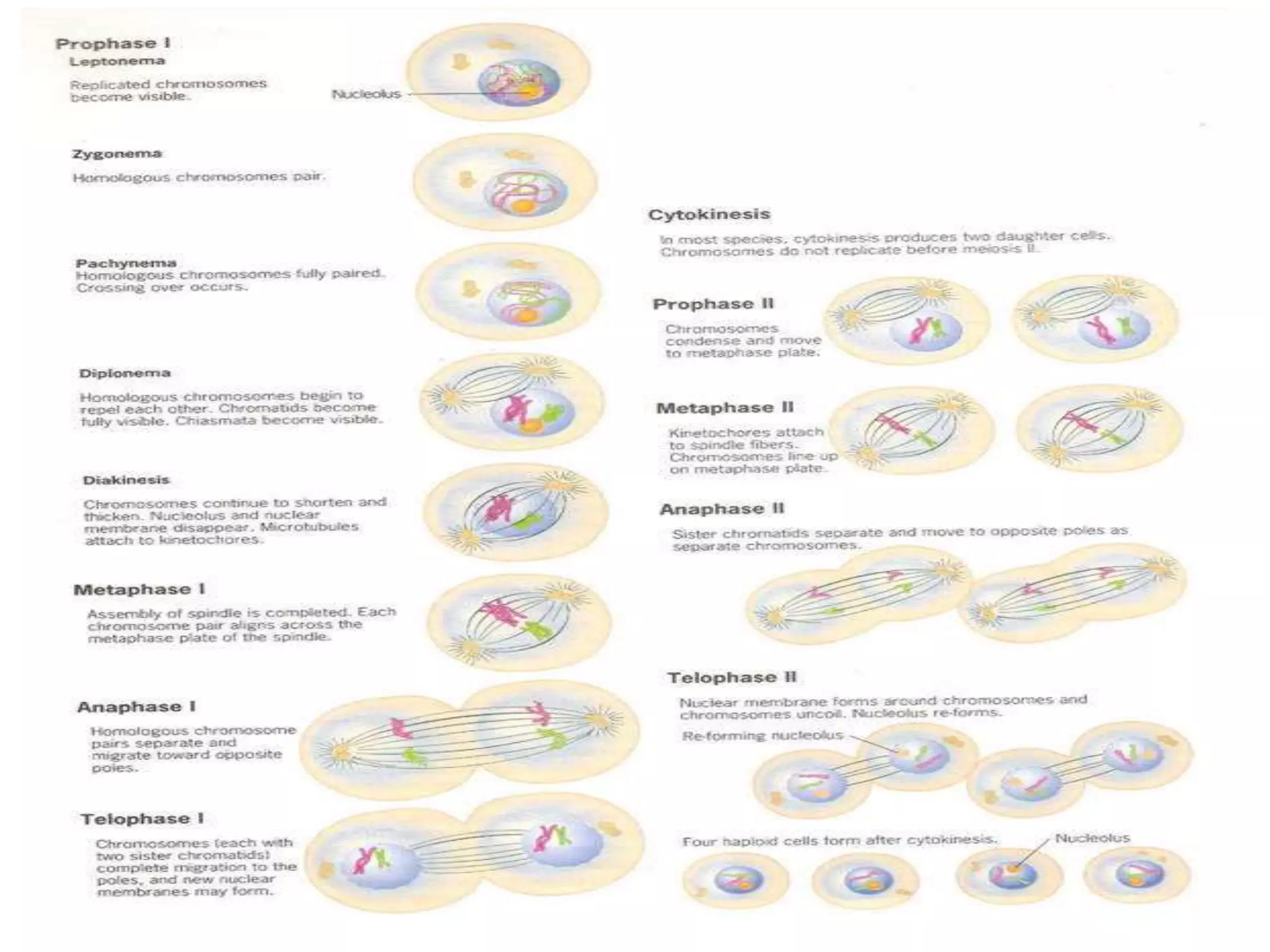
 Meiosis-I:
• Prophase-I
 Leptotene
 Zygotene
 Pachytene
 Diplotene
 Diakinesis
• Metaphase-I
• Anaphase-I
• Telophase-I
 Meiosis-II
a. Prophase-II
b. Metaphase-II
c. Anaphase-II
d. Telophase-II
STAGES OF MEIOSIS
Prophase-I
a) Leptotene: Chromosomes at this stage appear as long thread like structures that
are loosely interwoven. In some species, on these chromosomes, bead-like
structures called chromomeres are found all along the length of the
chromosomes.
b) Zygotene: It is characterized by pairing of homologous chromosomes (synapsis ),
which form bivalents. The paired homologous chromosomes are joined by a protein
containing frame work known as synaptonemal complex. The bivalents have four
strands
c) Pachytene: The chromosomes appear as thickened thread-like structures. At this
stage, exchange of segments between non-sister chromatids of homologous
chromosomes known as crossing over occurs. During crossing over, only one
chromatid from each of the two homologous chromosomes takes part. The
nucleolus still persists.
d) Diplotene: At this stage further thickening and shortening of chromosomes takes
place. Homologous chromosomes start separating from one another. Separation
starts at the centromere and travels towards the ends (terminalization).
Homologous chromosomes are held together only at certain points along the
length. Such points of contact are known as chiasmata and represent the places
of crossing over. The process of terminalization is completed at this stage.
e) Diakinesis: Chromosomes continue to undergo further contraction. The bivalents
appear as round darkly stained bodies and they are evenly distributed throughout
the cell. The nuclear membrane and nucleolus disappear.
Metaphase-I
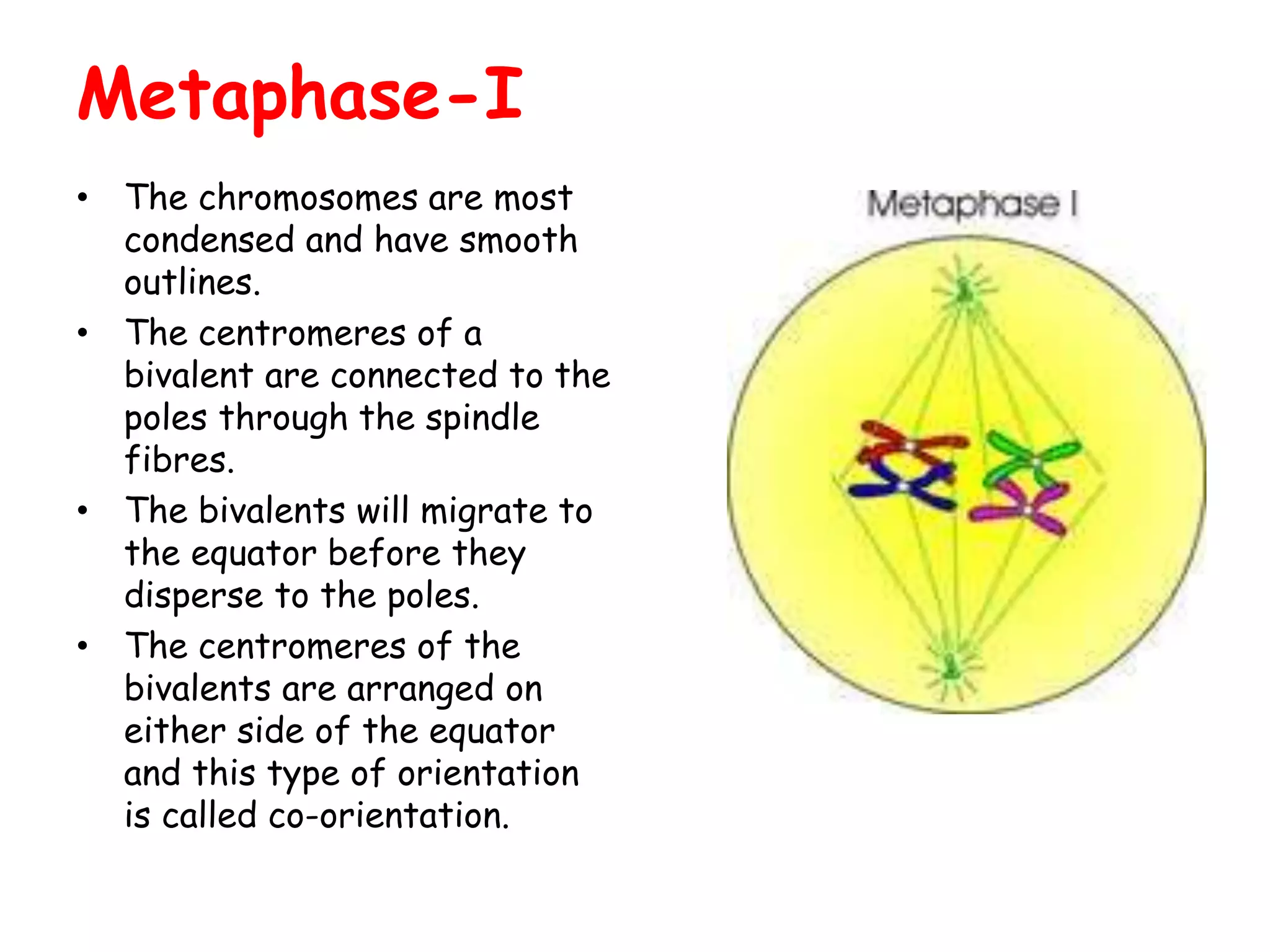
• The chromosomes are most
condensed and have smooth
outlines.
• The centromeres of a
bivalent are connected to the
poles through the spindle
fibres.
• The bivalents will migrate to
the equator before they
disperse to the poles.
• The centromeres of the
bivalents are arranged on
either side of the equator
and this type of orientation
is called co-orientation.
Anaphase-I
• The chromosomes in a
bivalent move to
opposite poles
(disjunction).
• Each chromosome
possess two chromatids.
• The centromere is the
first to move to the
pole.
• Each pole has a haploid
number of chromosomes
Telophase-I
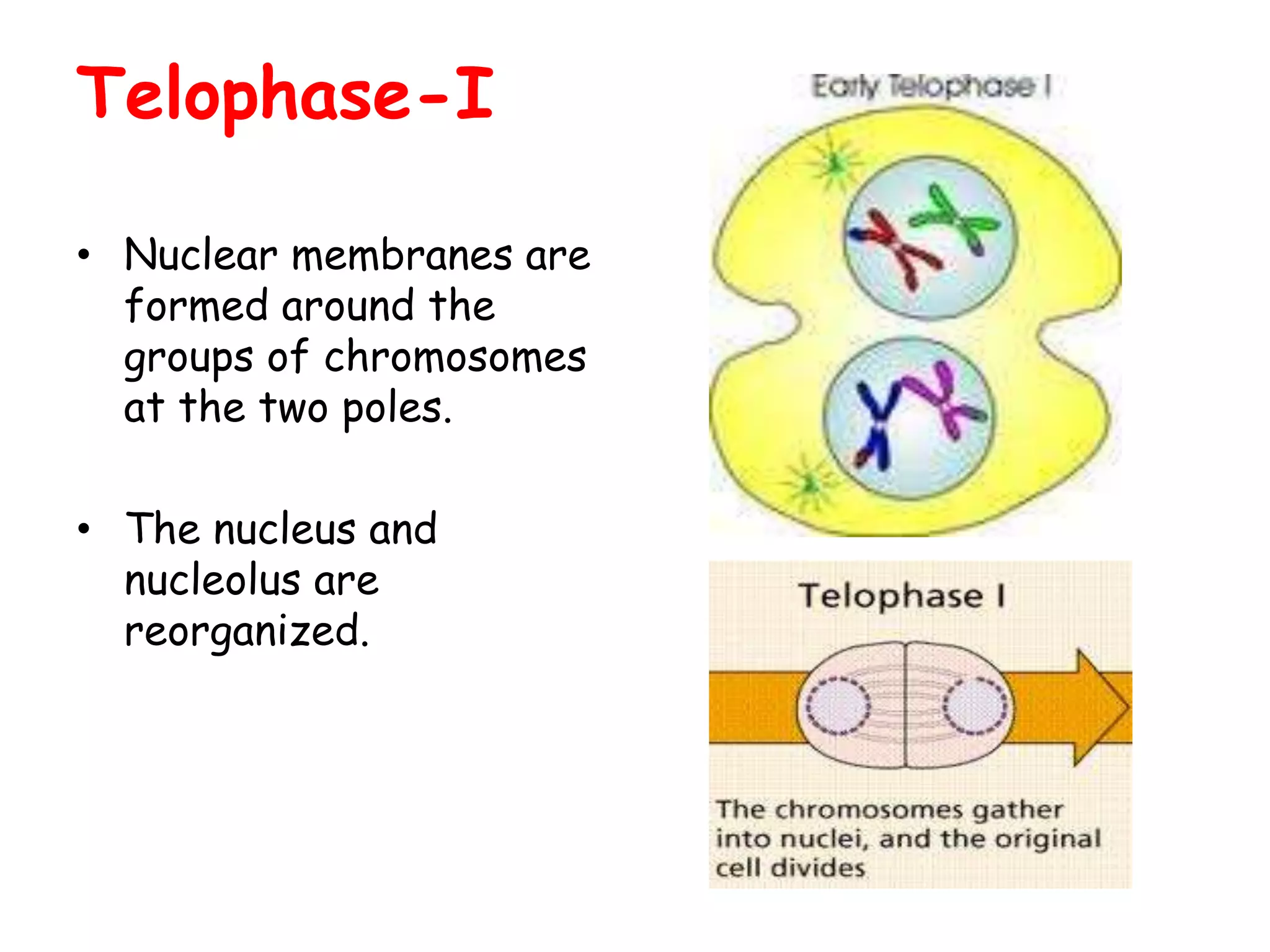
• Nuclear membranes are
formed around the
groups of chromosomes
at the two poles.
• The nucleus and
nucleolus are
reorganized.
Prophase-II
• The chromosomes
condense again.
• The nucleolus and
nuclear membrane
disappear.
• The chromosomes with
two chromatids each
become short and thick
Metaphase-II
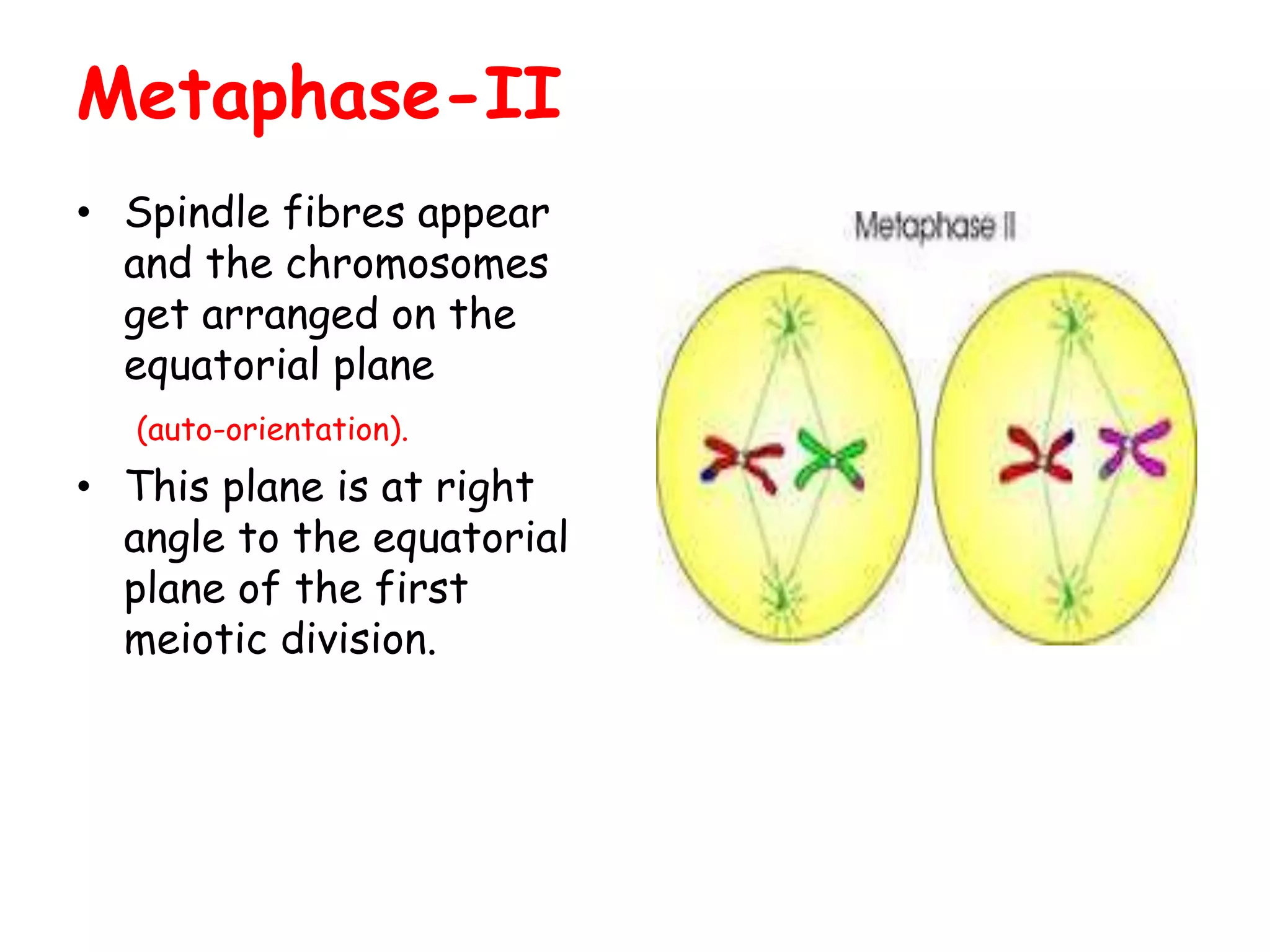
• Spindle fibres appear
and the chromosomes
get arranged on the
equatorial plane
(auto-orientation).
• This plane is at right
angle to the equatorial
plane of the first
meiotic division.
Anaphase-II
• Each centromere divides
and separates the two
chromtids,
• which move towards the
opposite poles.
Telophase-II
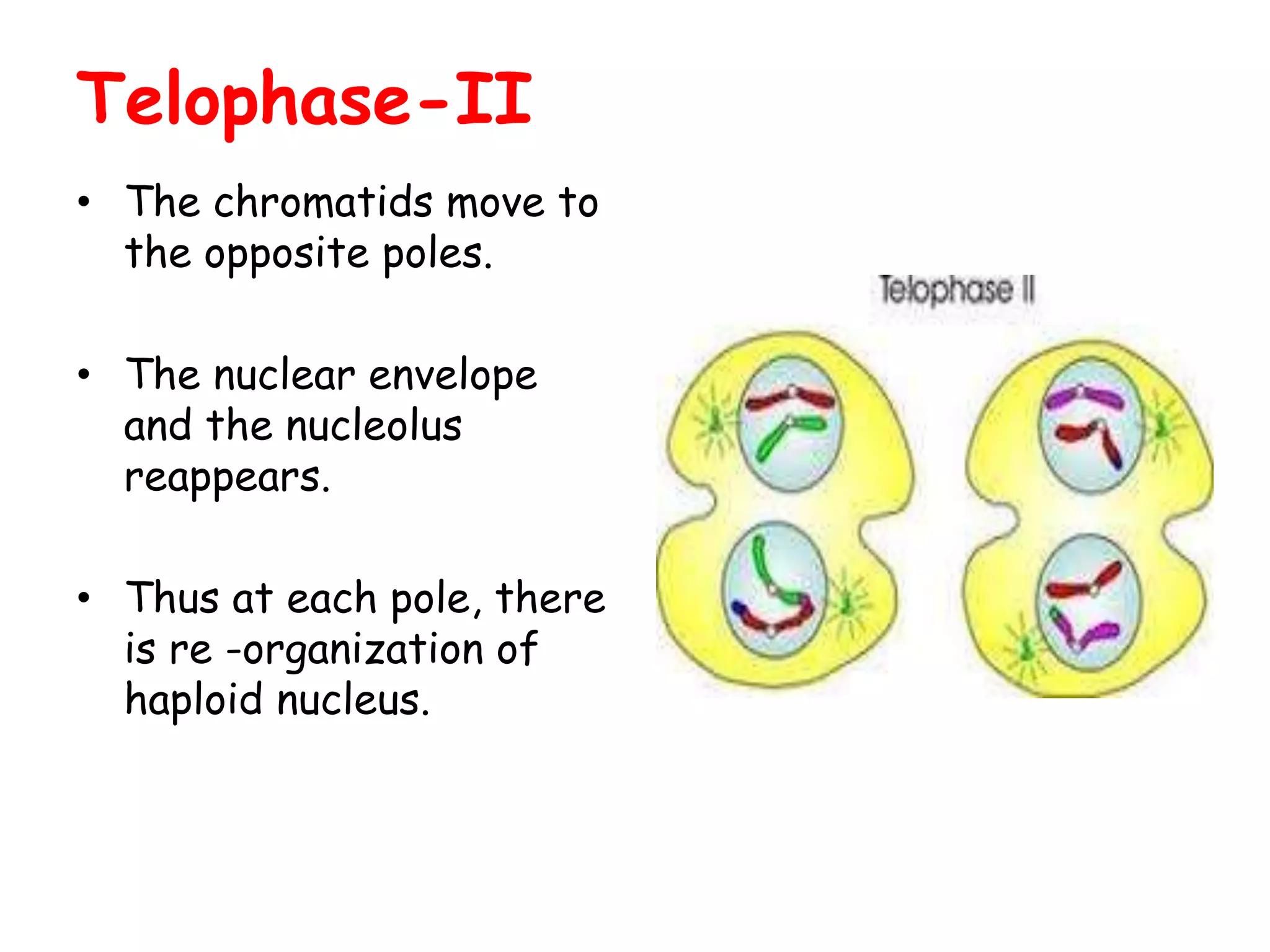
• The chromatids move to
the opposite poles.
• The nuclear envelope
and the nucleolus
reappears.
• Thus at each pole, there
is re -organization of
haploid nucleus.
Significance of Meiosis
1. It helps in maintaining a definite and constant number of chromosomes in a
species.
2. Meiosis results in production of gametes with haploid (half) chromosome number.
3. Meiosis facilitates segregation and independent assortment of chromosomes and
genes.
4. It provides an opportunity for the exchange of genes through the process of
crossing over.
5.Recombination of genes results in generation of variability which is important from
evolution points of view.
6. In sexually reproducing species, meiosis is essential for the continuity of
generation.
cell division and cell cycle

cell division and cell cycle

  • 1.
    CELL CYCLE ANDCELL DIVISION -BY PROF T.V.RATHOD
  • 2.
    INTRODUCTION • Cell cyclecan be defined as the entire sequence of events happening from the end of one nuclear division to the beginning of the next. • A cell cycle consists of two phases, viz., 1) interphase and 2) the cell division proper. • The time required for the completion of cell cycle differs from species to species. • Interphase is generally known as DNA systhesis phase. • Consists of G1, S and G2 sub phases.
  • 3.
    Interphase • Interphase isgenerally known as DNA systhesis phase. • consists of G1, S and G2 sub phases. • G1 Phase: It is a pre-DNA replication phase. Thus, this is a phase between telophase and S phase. This is the longest phase which takes 12 hours in Vicia faba. It is the most variable period of cell cycle. Synthesis of proteins and RNA take place during this phase. • S (Synthetic) Phase: This phase comes after G1and takes lesser time than G1phase. It takes six hours. The chromosome and DNA replications take place during this phase. • G2 Phase: This is the post-DNA replication phase and last sub stage of interphase. Takes 12 hours in Vicia faba. Synthesis of protein and RNA occur during this stage. Fig:- Cell Cycle
  • 4.
    CELL DIVISION • Allthe cells are produced by division of pre-existing cells. • Continuity of life depends on cell division. • In the cell division, the division of nucleus is called karyokinesis and division of cytoplasm is called cytokinesis. • The cell division is of two types. 1) Mitosis and 2) Meiosis
  • 5.
    MITOSIS • The termmitosis was coined by Flemming in 1882. • Mitosis occurs in somatic organs like root tip, stem tip and leaf base etc. Hence it is also known as somatic cell division. • The daughter cells are similar to the mother cell in shape, size and chromosome complement. • Since the chromosome number is same in the daughter cells as compared to that of mother cell, this is also known as homotypic or equational division. • Mitosis consist of four stage, viz., (a) Prophase, (b) Metaphase, (c) Anaphase and (d) Telophase
  • 6.
    Prophase • The nucleustakes a dark colour with nuclear specific stains and also with acetocarmine / orcein. • The size of the nucleus is comparatively big and the chromosomes that are thin in the initial stages slowly thicken and shorten by a specific process of coiling. • The two chromatids of a chromosome are distinct with matrix coating and relational coiling. • The disinte gration of nuclear membrane denotes the end of prophase.
  • 7.
    Metaphase • The sizeof the chromosomes is further reduced and thickened. • The distinct centromere of each chromosome is connected to the poles through spindle fibres. • The chromosomes move towards equator and the centromere of each chromosome is arranged on the equatorial plate. • This type of orientation of centromeres on the equator is known as autoorientation. • The chromosomes at this stage are shortest and thickest. • The chromatids of a chromosome are held together at the point of centromeres.
  • 8.
    Anaphase • The centromereof each chromosome separates first and moves to towards the poles. • The chromosomes show ` V `, ` L ` and ` I ` shapes respectively as the anaphase progresses. • The sister chromatids move to the poles. • The chromosome number is constant but the quantity of each chromosome is reduced to half.
  • 9.
    Telophase • Chromosomes loosetheir identity and become a mass of chromatin. • The nucleus will be re-organized from the chromatin. • At late telophase stage, the cell plate will divide the cell into two daughter cells. • Cytokinesis : The division of cytoplasm usually occurs between late anaphase and end of telophase.
  • 10.
    Significance of Mitosis Development of a zygote into adult organism.  Essential for normal growth and development of living organisms.  It gives a definite shape to a specific organism.  It leads to formation of new organs like roots, leaves, stems and branches.  It also helps in repairing of damaged parts.  Replacement of the old, decayed and dead cells and thus it helps to overcome ageing of the cells.  It helps in asexual propagation of vegetatively propagated crops like sugarcane, banana, sweet potato, potato, etc. mitosis leads to production of identical progeny in such crops.  Useful in maintaining the purity of types because it leads to production of identical daughter cells.  Does not allow segregation and recombination to occur.
  • 12.
    MEIOSIS • The termmeiosis was coined by J.B. Farmer in 1905. • This type of division is found in organisms in which there is sexual reproduction. • Three important processes that occur during meiosis are: 1. Pairing of homologous chromosomes (synapsis) 2. Formation of chiasmata and crossing over 3. Segregation of homologous chromosomes • The first division of meiosis results in reduction of chromosome number to half and is called reductional division. • The first meiotic division is also called heterotypic division. • Two haploid cells are produced at the end of first meiotic division and • In the second meiotic division, the haploid cells divide mitotically and results in the production of four daughter cells (tetrad), each with haploid number of chromosomes. • Both the meiotic divisions occur continuously and each includes the usual stages viz., prophase, metaphase, anaphase and telophase.
  • 13.
     Meiosis-I: • Prophase-I Leptotene  Zygotene  Pachytene  Diplotene  Diakinesis • Metaphase-I • Anaphase-I • Telophase-I  Meiosis-II a. Prophase-II b. Metaphase-II c. Anaphase-II d. Telophase-II STAGES OF MEIOSIS
  • 14.
    Prophase-I a) Leptotene: Chromosomesat this stage appear as long thread like structures that are loosely interwoven. In some species, on these chromosomes, bead-like structures called chromomeres are found all along the length of the chromosomes. b) Zygotene: It is characterized by pairing of homologous chromosomes (synapsis ), which form bivalents. The paired homologous chromosomes are joined by a protein containing frame work known as synaptonemal complex. The bivalents have four strands c) Pachytene: The chromosomes appear as thickened thread-like structures. At this stage, exchange of segments between non-sister chromatids of homologous chromosomes known as crossing over occurs. During crossing over, only one chromatid from each of the two homologous chromosomes takes part. The nucleolus still persists. d) Diplotene: At this stage further thickening and shortening of chromosomes takes place. Homologous chromosomes start separating from one another. Separation starts at the centromere and travels towards the ends (terminalization). Homologous chromosomes are held together only at certain points along the length. Such points of contact are known as chiasmata and represent the places of crossing over. The process of terminalization is completed at this stage. e) Diakinesis: Chromosomes continue to undergo further contraction. The bivalents appear as round darkly stained bodies and they are evenly distributed throughout the cell. The nuclear membrane and nucleolus disappear.
  • 16.
    Metaphase-I • The chromosomesare most condensed and have smooth outlines. • The centromeres of a bivalent are connected to the poles through the spindle fibres. • The bivalents will migrate to the equator before they disperse to the poles. • The centromeres of the bivalents are arranged on either side of the equator and this type of orientation is called co-orientation.
  • 17.
    Anaphase-I • The chromosomesin a bivalent move to opposite poles (disjunction). • Each chromosome possess two chromatids. • The centromere is the first to move to the pole. • Each pole has a haploid number of chromosomes
  • 18.
    Telophase-I • Nuclear membranesare formed around the groups of chromosomes at the two poles. • The nucleus and nucleolus are reorganized.
  • 19.
    Prophase-II • The chromosomes condenseagain. • The nucleolus and nuclear membrane disappear. • The chromosomes with two chromatids each become short and thick
  • 20.
    Metaphase-II • Spindle fibresappear and the chromosomes get arranged on the equatorial plane (auto-orientation). • This plane is at right angle to the equatorial plane of the first meiotic division.
  • 21.
    Anaphase-II • Each centromeredivides and separates the two chromtids, • which move towards the opposite poles.
  • 22.
    Telophase-II • The chromatidsmove to the opposite poles. • The nuclear envelope and the nucleolus reappears. • Thus at each pole, there is re -organization of haploid nucleus.
  • 23.
    Significance of Meiosis 1.It helps in maintaining a definite and constant number of chromosomes in a species. 2. Meiosis results in production of gametes with haploid (half) chromosome number. 3. Meiosis facilitates segregation and independent assortment of chromosomes and genes. 4. It provides an opportunity for the exchange of genes through the process of crossing over. 5.Recombination of genes results in generation of variability which is important from evolution points of view. 6. In sexually reproducing species, meiosis is essential for the continuity of generation.