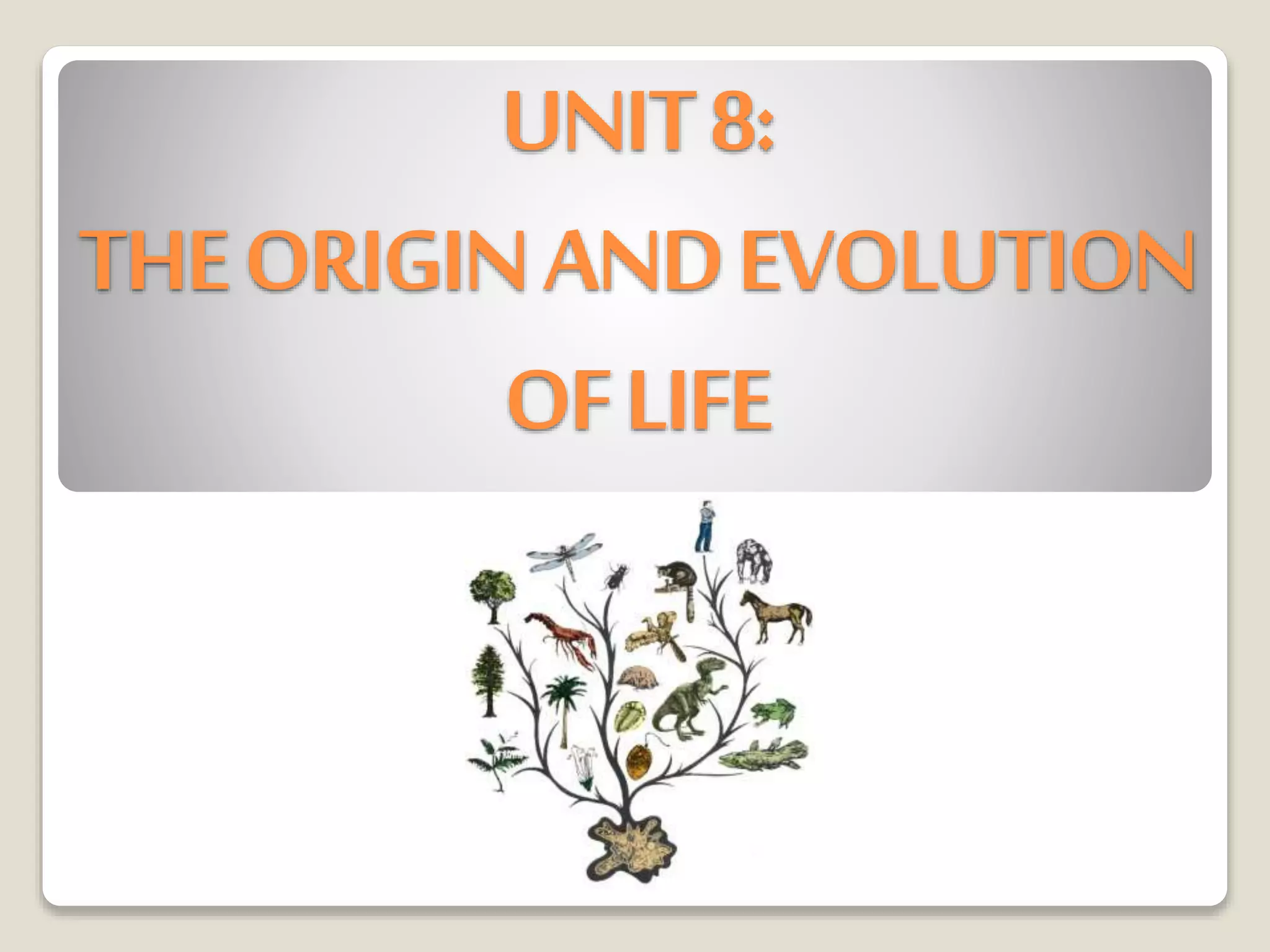
UNIT8:
THEORIGINANDEVOLUTION
OFLIFE
INDEX
1. The beginning of life
2. Evolutionary theoriesbefore the20th century
3. Evidence of evolution
4. Present-day theories of evolution
5. The beginning of new species
6. The appearance of human beings
Stanley Miller
1. The beginning of life
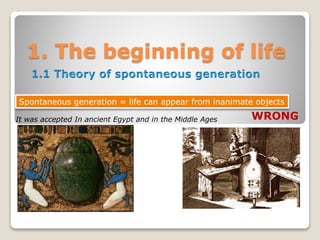
Spontaneous generation = life can appear from inanimate objects
WRONGIt was accepted In ancient Egypt and in the Middle Ages
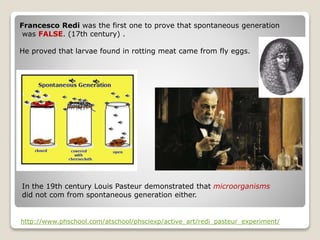
Francesco Redi was the first one to prove that spontaneous generation
was FALSE. (17th century) .
He proved that larvae found in rotting meat came from fly eggs.
http://www.phschool.com/atschool/phsciexp/active_art/redi_pasteur_experiment/
In the 19th century Louis Pasteur demonstrated that microorganisms
did not com from spontaneous generation either.
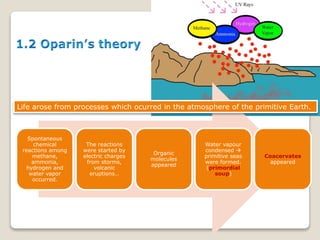
Spontaneous
chemical
reactions among
methane,
ammonia,
hydrogen and
water vapor
occurred.
The reactions
were started by
electric charges
from storms,
volcanic
eruptions…
Organic
molecules
appeared
Water vapour
condensed 
primitive seas
were formed.
(primordial
soup)
Coacervates
appeared
Life arose from processes which ocurred in the atmosphere of the primitive Earth.
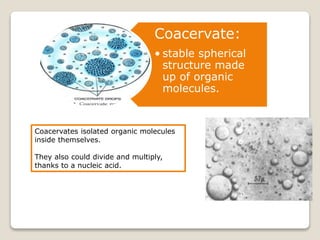
Coacervate:
• stable spherical
structure made
up of organic
molecules.
Coacervates isolated organic molecules
inside themselves.
They also could divide and multiply,
thanks to a nucleic acid.
http://www.wiley.com/college/trefil/0470118547/vdl/lab_miller_experi
ment/
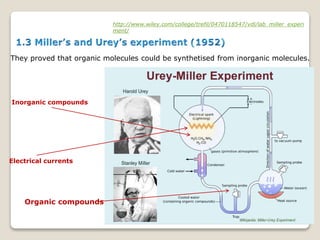
They proved that organic molecules could be synthetised from inorganic molecules.
Inorganic compounds
Organic compounds
Electrical currents
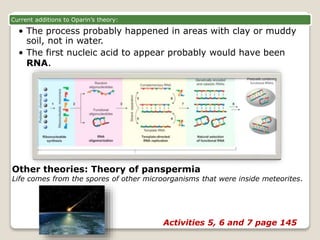
Current additions to Oparin’s theory:
• The process probably happened in areas with clay or muddy
soil, not in water.
• The first nucleic acid to appear probably would have been
RNA.
Other theories: Theory of panspermia
Life comes from the spores of other microorganisms that were inside meteorites.
Activities 5, 6 and 7 page 145
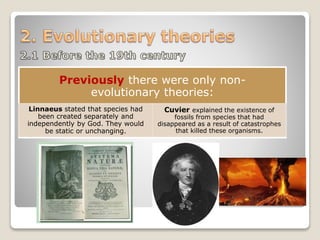
Previously there were only non-
evolutionary theories:
Linnaeus stated that species had
been created separately and
independently by God. They would
be static or unchanging.
Cuvier explained the existence of
fossils from species that had
disappeared as a result of catastrophes
that killed these organisms.
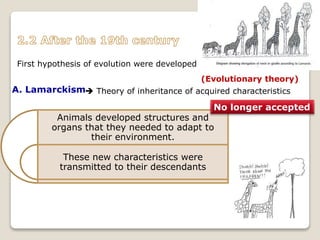
Animals developed structures and
organs that they needed to adapt to
their environment.
These new characteristics were
transmitted to their descendants
First hypothesis of evolution were developed:
A. Lamarckism
(Evolutionary theory)
 Theory of inheritance of acquired characteristics
No longer accepted
B. Darwinism
• Individuals in a population have differences among them.
• Struggle for existence: There is competition between
new-born individuals for space and food.
• Survival of the fittest: individuals whose variations help
their survival in a certain environment are favoured.
• The surviving individuals produce the next generation, so
that the more favourable variations are transmitted to the
offspring.
Basic principles of Darwinism
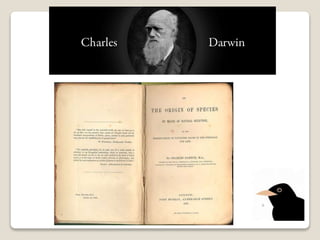
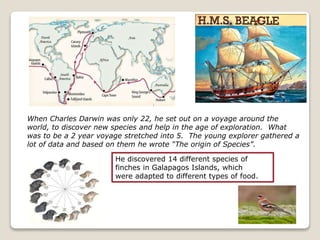
When Charles Darwin was only 22, he set out on a voyage around the
world, to discover new species and help in the age of exploration. What
was to be a 2 year voyage stretched into 5. The young explorer gathered a
lot of data and based on them he wrote “The origin of Species”.
He discovered 14 different species of
finches in Galapagos Islands, which
were adapted to different types of food.
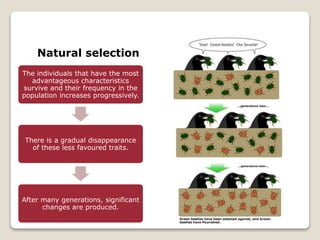
Natural selection
The individuals that have the most
advantageous characteristics
survive and their frequency in the
population increases progressively.
There is a gradual disappearance
of these less favoured traits.
After many generations, significant
changes are produced.
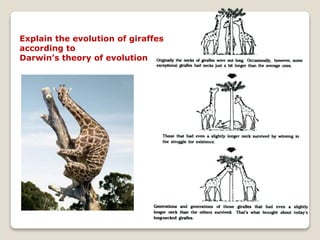
Explain the evolution of giraffes
according to
Darwin’s theory of evolution
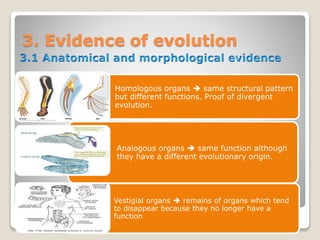
3. Evidence of evolution
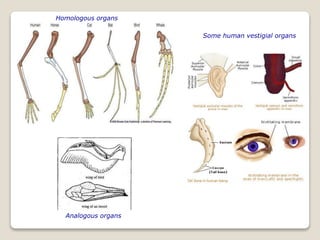
Homologous organs  same structural pattern
but different functions. Proof of divergent
evolution.
Analogous organs  same function although
they have a different evolutionary origin.
Vestigial organs  remains of organs which tend
to disappear because they no longer have a
function
Some human vestigial organs
Homologous organs
Analogous organs
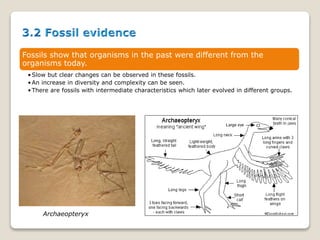
Fossils show that organisms in the past were different from the
organisms today.
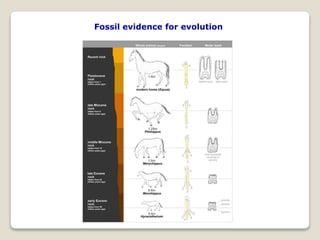
•Slow but clear changes can be observed in these fossils.
•An increase in diversity and complexity can be seen.
•There are fossils with intermediate characteristics which later evolved in different groups.
Archaeopteryx
Fossil evidence for evolution
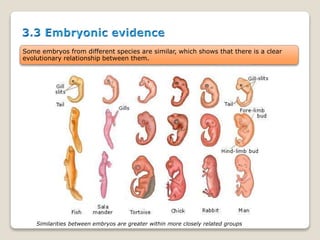
Some embryos from different species are similar, which shows that there is a clear
evolutionary relationship between them.
Similarities between embryos are greater within more closely related groups
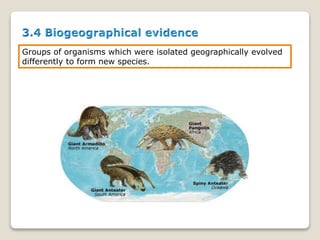
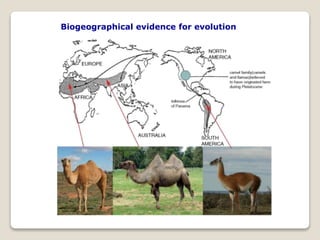
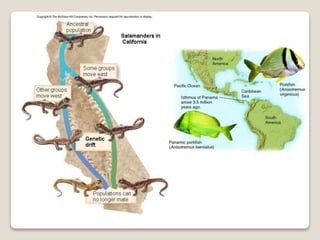
Groups of organisms which were isolated geographically evolved
differently to form new species.
Biogeographical evidence for evolution
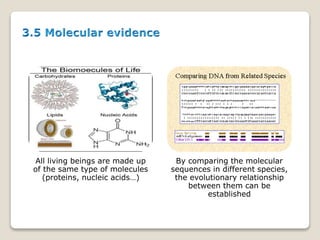
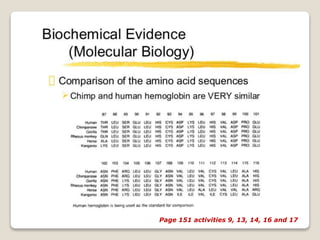
All living beings are made up
of the same type of molecules
(proteins, nucleic acids…)
By comparing the molecular
sequences in different species,
the evolutionary relationship
between them can be
established
Page 151 activities 9, 13, 14, 16 and 17
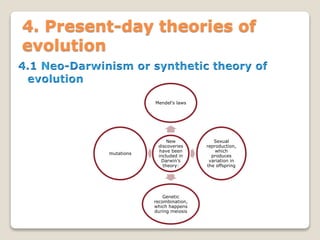
4. Present-day theories of
evolution
New
discoveries
have been
included in
Darwin’s
theory:
Mendel’s laws
Sexual
reproduction,
which
produces
variation in
the offspring
Genetic
recombination,
which happens
during meiosis
mutations
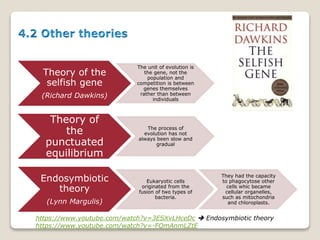
Theory of the
selfish gene
(Richard Dawkins)
The unit of evolution is
the gene, not the
population and
competition is between
genes themselves
rather than between
individuals
Theory of
the
punctuated
equilibrium
The process of
evolution has not
always been slow and
gradual
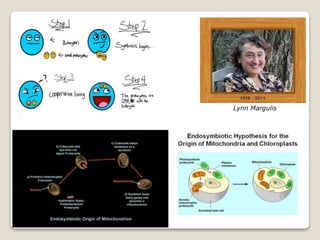
Endosymbiotic
theory
(Lynn Margulis)
Eukaryotic cells
originated from the
fusion of two types of
bacteria.
They had the capacity
to phagocytose other
cells whic became
cellular organelles,
such as mitochondria
and chloroplasts.
https://www.youtube.com/watch?v=3ESXvLHceDc  Endosymbiotic theory
https://www.youtube.com/watch?v=-FQmAnmLZtE
Lynn Margulis
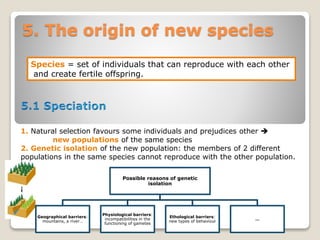
5. The origin of new species
Species = set of individuals that can reproduce with each other
and create fertile offspring.
1. Natural selection favours some individuals and prejudices other 
new populations of the same species
2. Genetic isolation of the new population: the members of 2 different
populations in the same species cannot reproduce with the other population.
Possible reasons of genetic
isolation
Geographical barriers:
mountains, a river…
Physiological barriers:
incompatibilities in the
functioning of gametes
Ethological barriers:
new types of behaviour
…
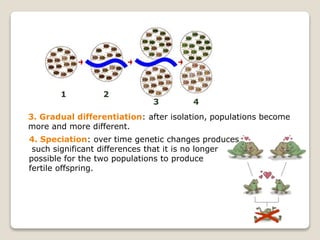
3. Gradual differentiation: after isolation, populations become
more and more different.
2
3 4
1
4. Speciation: over time genetic changes produces
such significant differences that it is no longer
possible for the two populations to produce
fertile offspring.
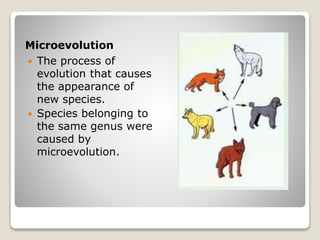
Microevolution
 The process of
evolution that causes
the appearance of
new species.
 Species belonging to
the same genus were
caused by
microevolution.
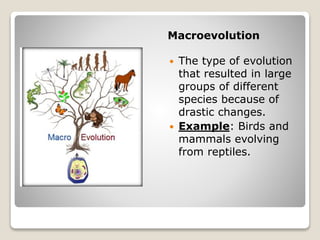
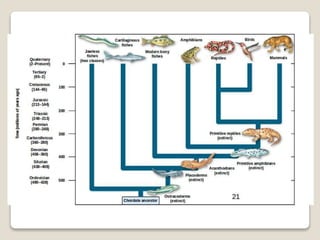
Macroevolution
 The type of evolution
that resulted in large
groups of different
species because of
drastic changes.
 Example: Birds and
mammals evolving
from reptiles.
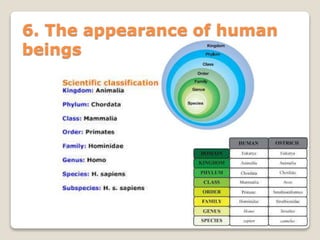
6. The appearance of human
beings
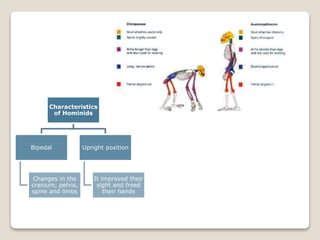
Characteristics
of Hominids
Bipedal
Changes in the
cranium, pelvis,
spine and limbs
Upright position
It improved their
sight and freed
their hands
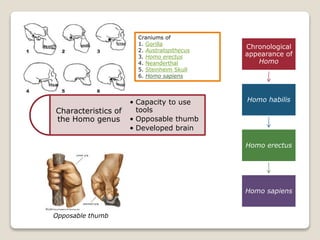
Craniums of
1. Gorilla
2. Australopithecus
3. Homo erectus
4. Neanderthal
5. Steinheim Skull
6. Homo sapiens
Characteristics of
the Homo genus
• Capacity to use
tools
• Opposable thumb
• Developed brain
Opposable thumb
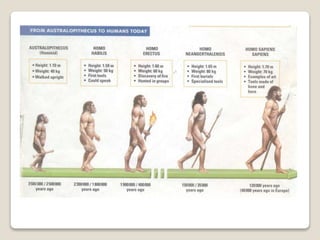
Chronological
appearance of
Homo
Homo habilis
Homo erectus
Homo sapiens
 Glossary
 Spontaneous generation
 Coacervate
 Natural selection
 Phlylogenetics
 Speciation

Unit8: Origin and Evolution of Life

  • 1.
  • 2.
    INDEX 1. The beginningof life 2. Evolutionary theoriesbefore the20th century 3. Evidence of evolution 4. Present-day theories of evolution 5. The beginning of new species 6. The appearance of human beings Stanley Miller
  • 3.
    1. The beginningof life Spontaneous generation = life can appear from inanimate objects WRONGIt was accepted In ancient Egypt and in the Middle Ages
  • 4.
    Francesco Redi wasthe first one to prove that spontaneous generation was FALSE. (17th century) . He proved that larvae found in rotting meat came from fly eggs. http://www.phschool.com/atschool/phsciexp/active_art/redi_pasteur_experiment/ In the 19th century Louis Pasteur demonstrated that microorganisms did not com from spontaneous generation either.
  • 5.
    Spontaneous chemical reactions among methane, ammonia, hydrogen and watervapor occurred. The reactions were started by electric charges from storms, volcanic eruptions… Organic molecules appeared Water vapour condensed  primitive seas were formed. (primordial soup) Coacervates appeared Life arose from processes which ocurred in the atmosphere of the primitive Earth.
  • 6.
    Coacervate: • stable spherical structuremade up of organic molecules. Coacervates isolated organic molecules inside themselves. They also could divide and multiply, thanks to a nucleic acid.
  • 7.
    http://www.wiley.com/college/trefil/0470118547/vdl/lab_miller_experi ment/ They proved thatorganic molecules could be synthetised from inorganic molecules. Inorganic compounds Organic compounds Electrical currents
  • 8.
    Current additions toOparin’s theory: • The process probably happened in areas with clay or muddy soil, not in water. • The first nucleic acid to appear probably would have been RNA. Other theories: Theory of panspermia Life comes from the spores of other microorganisms that were inside meteorites. Activities 5, 6 and 7 page 145
  • 9.
    Previously there wereonly non- evolutionary theories: Linnaeus stated that species had been created separately and independently by God. They would be static or unchanging. Cuvier explained the existence of fossils from species that had disappeared as a result of catastrophes that killed these organisms.
  • 10.
    Animals developed structuresand organs that they needed to adapt to their environment. These new characteristics were transmitted to their descendants First hypothesis of evolution were developed: A. Lamarckism (Evolutionary theory)  Theory of inheritance of acquired characteristics No longer accepted
  • 11.
    B. Darwinism • Individualsin a population have differences among them. • Struggle for existence: There is competition between new-born individuals for space and food. • Survival of the fittest: individuals whose variations help their survival in a certain environment are favoured. • The surviving individuals produce the next generation, so that the more favourable variations are transmitted to the offspring. Basic principles of Darwinism
  • 13.
    When Charles Darwinwas only 22, he set out on a voyage around the world, to discover new species and help in the age of exploration. What was to be a 2 year voyage stretched into 5. The young explorer gathered a lot of data and based on them he wrote “The origin of Species”. He discovered 14 different species of finches in Galapagos Islands, which were adapted to different types of food.
  • 14.
    Natural selection The individualsthat have the most advantageous characteristics survive and their frequency in the population increases progressively. There is a gradual disappearance of these less favoured traits. After many generations, significant changes are produced.
  • 15.
    Explain the evolutionof giraffes according to Darwin’s theory of evolution
  • 16.
    3. Evidence ofevolution Homologous organs  same structural pattern but different functions. Proof of divergent evolution. Analogous organs  same function although they have a different evolutionary origin. Vestigial organs  remains of organs which tend to disappear because they no longer have a function
  • 17.
    Some human vestigialorgans Homologous organs Analogous organs
  • 18.
    Fossils show thatorganisms in the past were different from the organisms today. •Slow but clear changes can be observed in these fossils. •An increase in diversity and complexity can be seen. •There are fossils with intermediate characteristics which later evolved in different groups. Archaeopteryx
  • 19.
  • 20.
    Some embryos fromdifferent species are similar, which shows that there is a clear evolutionary relationship between them. Similarities between embryos are greater within more closely related groups
  • 21.
    Groups of organismswhich were isolated geographically evolved differently to form new species.
  • 22.
  • 23.
    All living beingsare made up of the same type of molecules (proteins, nucleic acids…) By comparing the molecular sequences in different species, the evolutionary relationship between them can be established
  • 24.
    Page 151 activities9, 13, 14, 16 and 17
  • 25.
    4. Present-day theoriesof evolution New discoveries have been included in Darwin’s theory: Mendel’s laws Sexual reproduction, which produces variation in the offspring Genetic recombination, which happens during meiosis mutations
  • 26.
    Theory of the selfishgene (Richard Dawkins) The unit of evolution is the gene, not the population and competition is between genes themselves rather than between individuals Theory of the punctuated equilibrium The process of evolution has not always been slow and gradual Endosymbiotic theory (Lynn Margulis) Eukaryotic cells originated from the fusion of two types of bacteria. They had the capacity to phagocytose other cells whic became cellular organelles, such as mitochondria and chloroplasts. https://www.youtube.com/watch?v=3ESXvLHceDc  Endosymbiotic theory https://www.youtube.com/watch?v=-FQmAnmLZtE
  • 27.
  • 28.
    5. The originof new species Species = set of individuals that can reproduce with each other and create fertile offspring. 1. Natural selection favours some individuals and prejudices other  new populations of the same species 2. Genetic isolation of the new population: the members of 2 different populations in the same species cannot reproduce with the other population. Possible reasons of genetic isolation Geographical barriers: mountains, a river… Physiological barriers: incompatibilities in the functioning of gametes Ethological barriers: new types of behaviour …
  • 29.
    3. Gradual differentiation:after isolation, populations become more and more different. 2 3 4 1 4. Speciation: over time genetic changes produces such significant differences that it is no longer possible for the two populations to produce fertile offspring.
  • 31.
    Microevolution  The processof evolution that causes the appearance of new species.  Species belonging to the same genus were caused by microevolution.
  • 32.
    Macroevolution  The typeof evolution that resulted in large groups of different species because of drastic changes.  Example: Birds and mammals evolving from reptiles.
  • 34.
    6. The appearanceof human beings
  • 35.
    Characteristics of Hominids Bipedal Changes inthe cranium, pelvis, spine and limbs Upright position It improved their sight and freed their hands
  • 36.
    Craniums of 1. Gorilla 2.Australopithecus 3. Homo erectus 4. Neanderthal 5. Steinheim Skull 6. Homo sapiens Characteristics of the Homo genus • Capacity to use tools • Opposable thumb • Developed brain Opposable thumb Chronological appearance of Homo Homo habilis Homo erectus Homo sapiens
  • 38.
     Glossary  Spontaneousgeneration  Coacervate  Natural selection  Phlylogenetics  Speciation