2017-18
CELL DIVISION
 Introduction
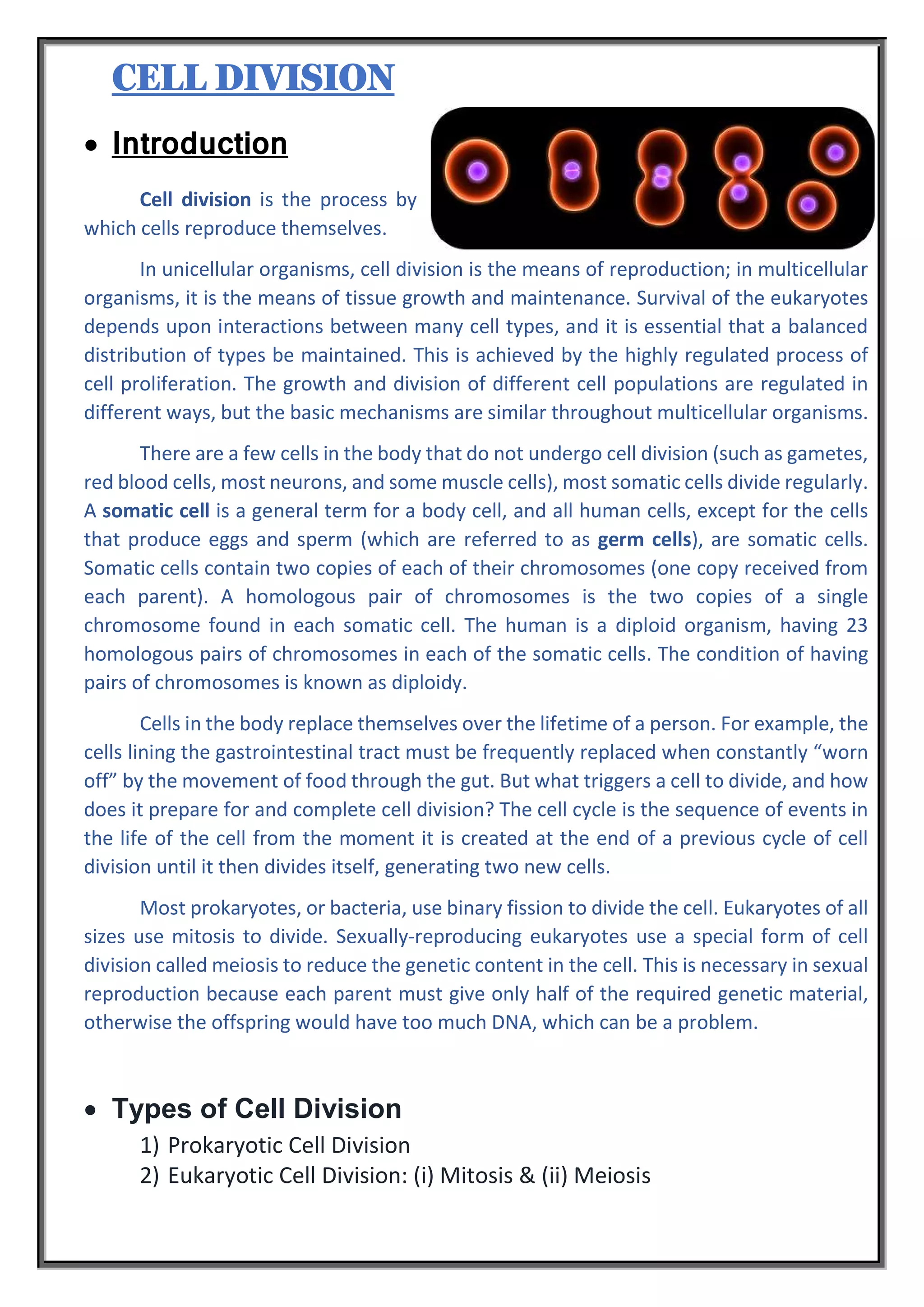
Cell division is the process by
which cells reproduce themselves.
In unicellular organisms, cell division is the means of reproduction; in multicellular
organisms, it is the means of tissue growth and maintenance. Survival of the eukaryotes
depends upon interactions between many cell types, and it is essential that a balanced
distribution of types be maintained. This is achieved by the highly regulated process of
cell proliferation. The growth and division of different cell populations are regulated in
different ways, but the basic mechanisms are similar throughout multicellular organisms.
There are a few cells in the body that do not undergo cell division (such as gametes,
red blood cells, most neurons, and some muscle cells), most somatic cells divide regularly.
A somatic cell is a general term for a body cell, and all human cells, except for the cells
that produce eggs and sperm (which are referred to as germ cells), are somatic cells.
Somatic cells contain two copies of each of their chromosomes (one copy received from
each parent). A homologous pair of chromosomes is the two copies of a single
chromosome found in each somatic cell. The human is a diploid organism, having 23
homologous pairs of chromosomes in each of the somatic cells. The condition of having
pairs of chromosomes is known as diploidy.
Cells in the body replace themselves over the lifetime of a person. For example, the
cells lining the gastrointestinal tract must be frequently replaced when constantly “worn
off” by the movement of food through the gut. But what triggers a cell to divide, and how
does it prepare for and complete cell division? The cell cycle is the sequence of events in
the life of the cell from the moment it is created at the end of a previous cycle of cell
division until it then divides itself, generating two new cells.
Most prokaryotes, or bacteria, use binary fission to divide the cell. Eukaryotes of all
sizes use mitosis to divide. Sexually-reproducing eukaryotes use a special form of cell
division called meiosis to reduce the genetic content in the cell. This is necessary in sexual
reproduction because each parent must give only half of the required genetic material,
otherwise the offspring would have too much DNA, which can be a problem.
 Types of Cell Division
1) Prokaryotic Cell Division
2) Eukaryotic Cell Division: (i) Mitosis & (ii) Meiosis
1. Prokaryotic Cell Division
Prokaryotes replicate through a type of cell division known as binary fission.
Prokaryotes are simple organism, with only one membrane and no division internally.
Thus, when a prokaryote divides, it simply replicates the DNA and splits in half. The
process is a little more complicated than this, as DNA must first be unwound by special
proteins. Although the DNA in prokaryotes usually exists in a ring, it can get quite tangled
when it is being used by the cell. To copy the DNA efficiently, it must be stretched out.
This also allows the two new rings of DNA created to be separated after they are
produced. The two strands of DNA separate into two different sides of the prokaryote cell.
The cell then gets longer, and divides in the middle. The process can be seen in the image
below.
The DNA is the tangled line. The other components are labelled. Plasmids are small rings
of DNA that also get copied during binary fission and can be picked up in the environment,
from dead cells that break apart. These plasmids can then be further replicated. If a
plasmid is beneficial, it will increase in a population. This is in part how antibiotic
resistance in bacteria happens. The ribosomes are small protein structures that help
produce proteins. They are also replicated so each cell can have enough to function.
2. Eukaryotic Cell Division:
i. Mitosis (Somatic Cell Division)
Eukaryotic organisms have membrane bound organelles and DNA that exists on
chromosomes, which makes cell division harder. Eukaryotes must replicate their DNA,
organelles, and cell mechanisms before dividing. Many of the organelles divide using a
process that is essentially binary fission, leading scientist to believe that eukaryotes were
formed by prokaryotes living inside of other prokaryotes.
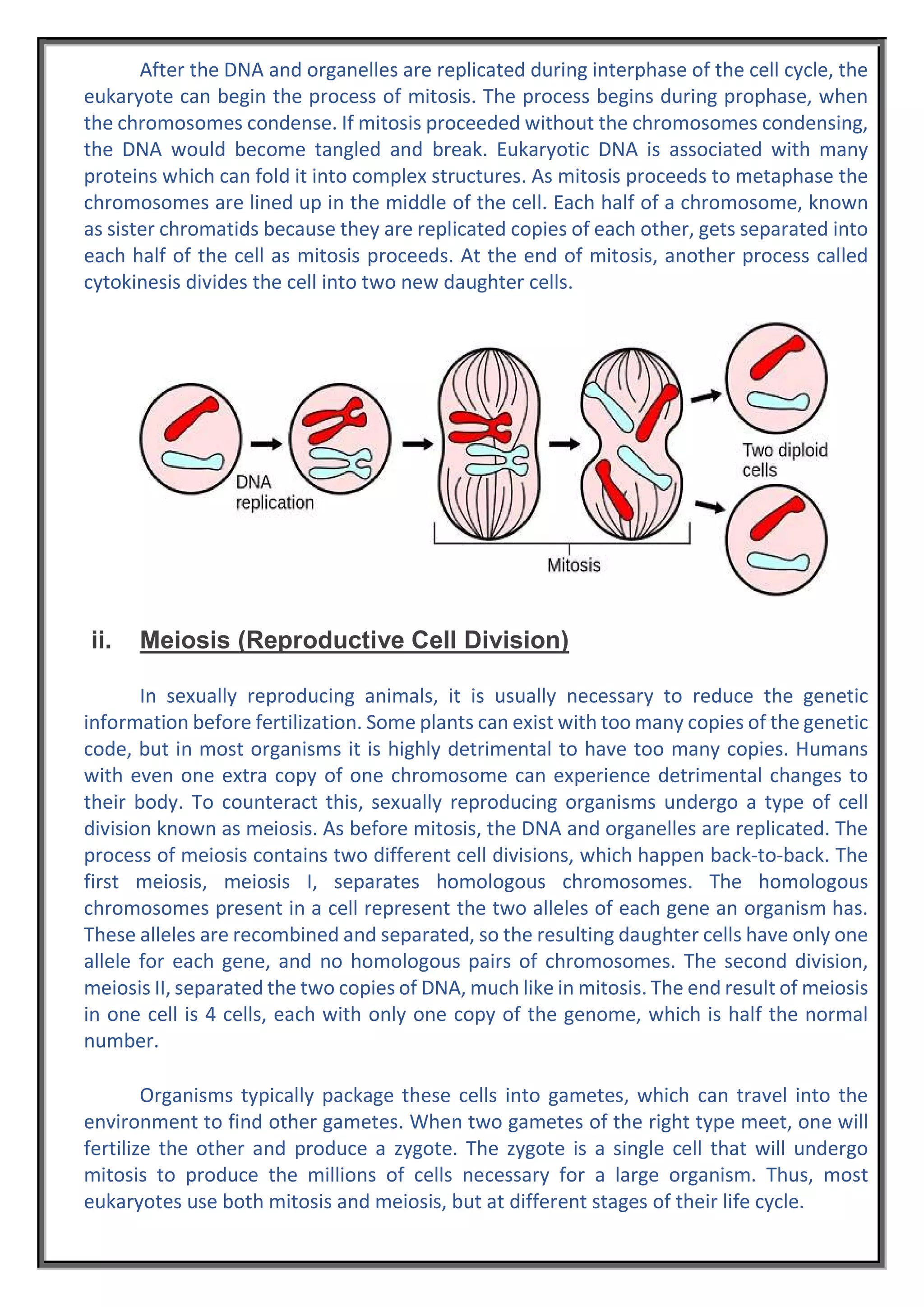
After the DNA and organelles are replicated during interphase of the cell cycle, the
eukaryote can begin the process of mitosis. The process begins during prophase, when
the chromosomes condense. If mitosis proceeded without the chromosomes condensing,
the DNA would become tangled and break. Eukaryotic DNA is associated with many
proteins which can fold it into complex structures. As mitosis proceeds to metaphase the
chromosomes are lined up in the middle of the cell. Each half of a chromosome, known
as sister chromatids because they are replicated copies of each other, gets separated into
each half of the cell as mitosis proceeds. At the end of mitosis, another process called
cytokinesis divides the cell into two new daughter cells.
ii. Meiosis (Reproductive Cell Division)
In sexually reproducing animals, it is usually necessary to reduce the genetic
information before fertilization. Some plants can exist with too many copies of the genetic
code, but in most organisms it is highly detrimental to have too many copies. Humans
with even one extra copy of one chromosome can experience detrimental changes to
their body. To counteract this, sexually reproducing organisms undergo a type of cell
division known as meiosis. As before mitosis, the DNA and organelles are replicated. The
process of meiosis contains two different cell divisions, which happen back-to-back. The
first meiosis, meiosis I, separates homologous chromosomes. The homologous
chromosomes present in a cell represent the two alleles of each gene an organism has.
These alleles are recombined and separated, so the resulting daughter cells have only one
allele for each gene, and no homologous pairs of chromosomes. The second division,
meiosis II, separated the two copies of DNA, much like in mitosis. The end result of meiosis
in one cell is 4 cells, each with only one copy of the genome, which is half the normal
number.
Organisms typically package these cells into gametes, which can travel into the
environment to find other gametes. When two gametes of the right type meet, one will
fertilize the other and produce a zygote. The zygote is a single cell that will undergo
mitosis to produce the millions of cells necessary for a large organism. Thus, most
eukaryotes use both mitosis and meiosis, but at different stages of their life cycle.
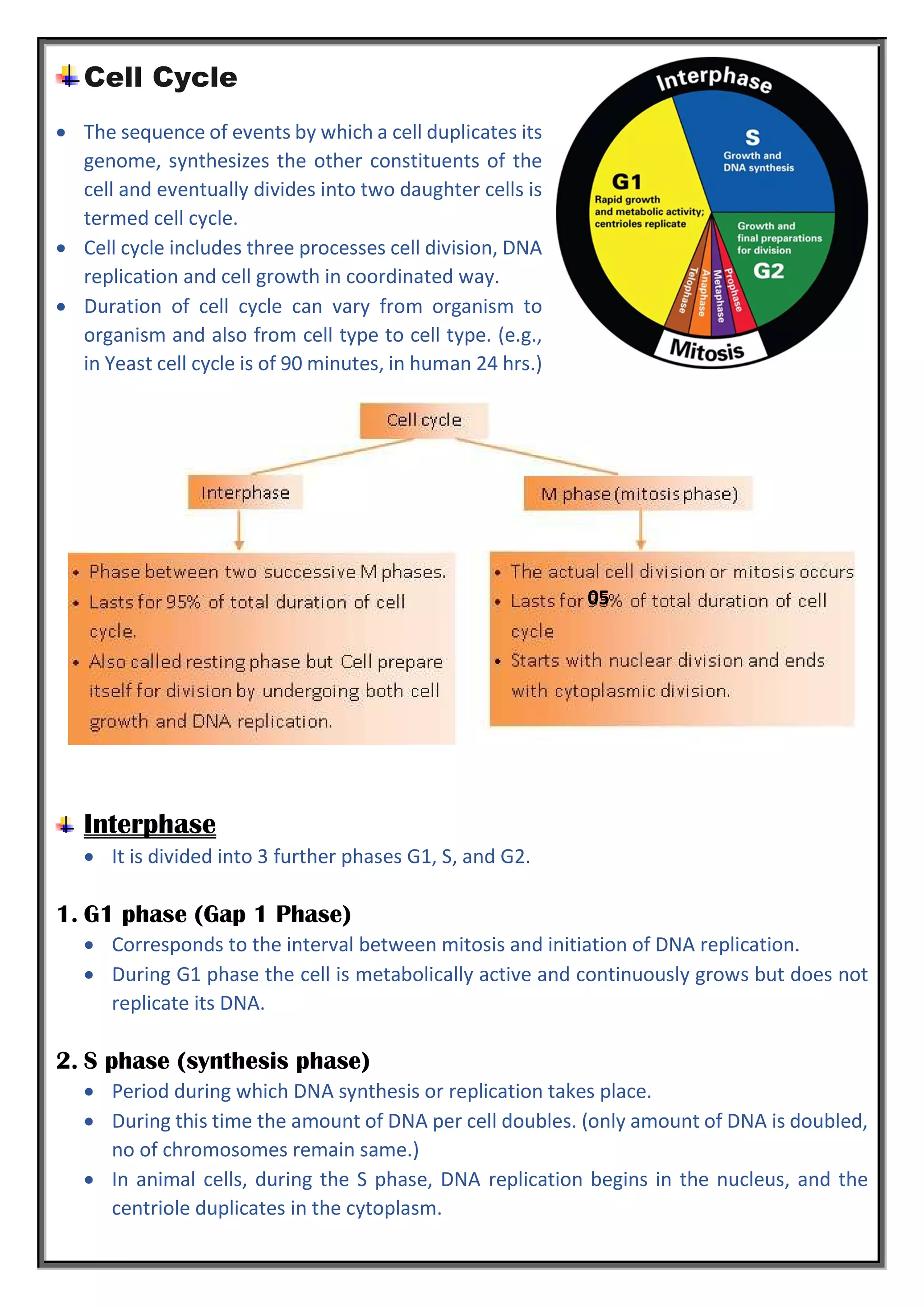
Cell Cycle
 The sequence of events by which a cell duplicates its
genome, synthesizes the other constituents of the
cell and eventually divides into two daughter cells is
termed cell cycle.
 Cell cycle includes three processes cell division, DNA
replication and cell growth in coordinated way.
 Duration of cell cycle can vary from organism to
organism and also from cell type to cell type. (e.g.,
in Yeast cell cycle is of 90 minutes, in human 24 hrs.)
Interphase
 It is divided into 3 further phases G1, S, and G2.
1. G1 phase (Gap 1 Phase)
 Corresponds to the interval between mitosis and initiation of DNA replication.
 During G1 phase the cell is metabolically active and continuously grows but does not
replicate its DNA.
2. S phase (synthesis phase)
 Period during which DNA synthesis or replication takes place.
 During this time the amount of DNA per cell doubles. (only amount of DNA is doubled,
no of chromosomes remain same.)
 In animal cells, during the S phase, DNA replication begins in the nucleus, and the
centriole duplicates in the cytoplasm.
05
3. G2 phase (Gap 2 Phase)
 Proteins are synthesised in preparation for mitosis while cell growth continues.
 Some cells do not exhibit division like heart cells, nerve cells etc. these cells enter in an
inactive phase called G0 or quiescent phase from G1 phase.
 Cells in this phase are metabolically active but they do not divide unless they are called
on to do so.
Mitosis or M phase
 In animals, mitotic cell division is only seen in the diploid somatic cells while in the
plants mitotic divisions can be seen in both haploid and diploid cells.
 It is also called as equational division as the number of chromosomes in the parent and
progeny cells are the same.
 Mitosis is divided into the following four stages:
i. Prophase
ii. Metaphase
iii. Anaphase
iv. Telophase
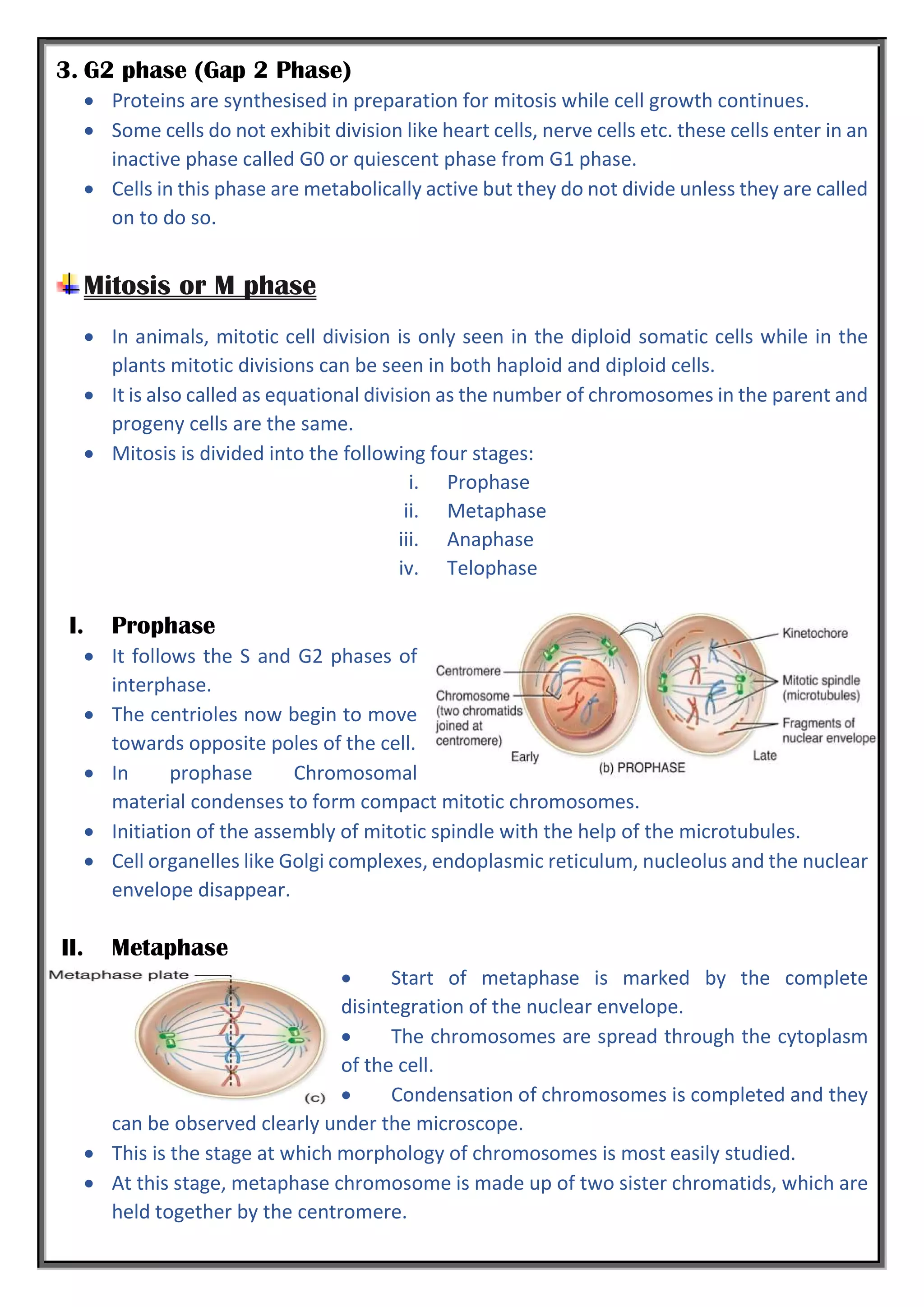
I. Prophase
 It follows the S and G2 phases of
interphase.
 The centrioles now begin to move
towards opposite poles of the cell.
 In prophase Chromosomal
material condenses to form compact mitotic chromosomes.
 Initiation of the assembly of mitotic spindle with the help of the microtubules.
 Cell organelles like Golgi complexes, endoplasmic reticulum, nucleolus and the nuclear
envelope disappear.
II. Metaphase
 Start of metaphase is marked by the complete
disintegration of the nuclear envelope.
 The chromosomes are spread through the cytoplasm
of the cell.
 Condensation of chromosomes is completed and they
can be observed clearly under the microscope.
 This is the stage at which morphology of chromosomes is most easily studied.
 At this stage, metaphase chromosome is made up of two sister chromatids, which are
held together by the centromere.
 Centromere serve as the sites of attachment of spindle fibres to the chromosomes.
 Chromosomes are moved into position at the centre of the cell.
 The metaphase is characterised by all the chromosomes coming to lie at the equator
with one chromatid of each chromosome connected by its kinetochore to spindle
fibres from one pole and its sister chromatid connected by its kinetochore to spindle
fibres from the opposite pole.
 The plane of alignment of the chromosomes at metaphase is referred to as the
metaphase plate or equatorial plate.
III. Anaphase
 At the onset of anaphase, each
chromosome arranged at the
metaphase plate is split
simultaneously and the two
daughter chromatids begin to move towards the two opposite poles.
 As each chromosome moves away from the equatorial plate, the centromere of each
chromosome is towards the pole and hence at the leading edge, with the arms of the
chromosome trailing behind
IV. Telophase
 At the beginning of telophase, the chromosomes at
their respective poles decondense and form chromatin
network.
 Nuclear envelope assembles around the chromatin
network.
 Nucleolus, Golgi complex and ER etc. cell organelles
reform.
Cytokinesis
 After karyokinesis the cell itself is divided into two daughter cells by a separate process
called cytokinesis.
 In an animal cell, this is achieved by the appearance of a furrow in the plasma
membrane.
 The furrow gradually deepens and ultimately joins in the centre dividing the cell
cytoplasm into two.
 Plant cells undergo cytokinesis by cell plate method. In cell plate method wall
formation starts in the centre of the cell and grows outward to meet the existing lateral
walls.
 The formation of the new cell wall begins with the formation of a simple precursor,
called the cell-plate that represents the middle lamella between the walls of two
adjacent cells.
 At the time of cytoplasmic division, organelles like mitochondria and plastids get
distributed between the two daughter cells.
 In some organisms karyokinesis is not followed by cytokinesis as a result of which
multinucleate condition arises leading to the formation of syncytium (e.g., liquid
endosperm in coconut). (should be coenocytic)
Significance of mitosis
 Mitosis results in the production of diploid daughter cells with identical genetic
complement usually.
 The growth of multicellular organisms is due to mitosis.
 Cell growth results in disturbing the ratio between the nucleus and the cytoplasm.
Therefore, cell divide to restore the nucleo-cytoplasmic ratio.
 Mitosis is important in cell repair. The cells of the upper layer of the epidermis, cells of
the lining of the gut, and blood cells are being constantly replaced.
 Mitotic divisions in the meristematic tissues – the apical and the lateral cambium,
result in a continuous growth of plants throughout their life.
MEIOSIS
 The specialised kind of cell division that reduces the chromosome number by half
results in the production of haploid daughter cells called
 It is responsible for formation of haploid gametes, which during sexual reproduction
form diploid zygote by fusion.
 Meiosis involves two sequential cycles of nuclear and cell division called meiosis I and
meiosis II but only a single cycle of DNA replication.
 Interphase of meiosis is similar to interphase of mitosis.
Meiosis I
I. Prophase I
 Prophase of the meiosis I division is typically longer and more complex than prophase
of mitosis.
 It has been further subdivided into the following five phases based on chromosomal
behaviour.
II. Metaphase I
 The bivalent chromosomes align on the equatorial plate.
 The microtubules from the opposite poles of the spindle attach to the pair of
homologous chromosomes.
III. Anaphase I
 The homologous chromosomes separate, while sister chromatids remain associated at
their centromeres.
IV. Telophase I
 The nuclear membrane and nucleolus reappear.
 cytokinesis follows telophase I.
 Although in many cases the chromosomes do undergo some dispersion, they do not
reach the extremely extended state of the interphase nucleus. The stage between the
two meiotic divisions is called interkinesis and is generally short lived.
 Interkinesis is followed by prophase II, a much simpler prophase than prophase I.
Meiosis II
Meiosis II resembles a normal mitosis.
I. Prophase II:
 Meiosis II is initiated immediately after cytokinesis.
 The nuclear membrane disappears by the end of prophase II.
 The chromosomes again become compact.
II. Metaphase II:
 At this stage the chromosomes align at the equator and the microtubules from
opposite poles of the spindle get attached to the kinetochores of sister chromatids.
III. Anaphase II:
 Splitting of the centromere of each chromosome.
 Chromosomes move toward opposite poles of the cell.
IV. Telophase II:
 The two groups of chromosomes once again get enclosed by a nuclear envelope.
 Cytokinesis follows resulting in the formation of four haploid daughter cells).
SIGNIFICANCE OF MEIOSIS
 By meiosis conservation of specific chromosome number of each species is achieved
across generations in sexually reproducing organisms.
 It also increases the genetic variability in the population of organisms from one
generation to the next. Variations are very important for the process of evolution.
 Production of haploid (n) gametes so that fertilization restores the normal somatic
(2n) chromosomes complement,
 Segregation of the two alleles of genes located in separate chromosomes,
 Recombination between linked genes due to crossing over during pachytene stage,
 Generation of tremendous amounts of genetic variation through the above points
REGULATION OF CELL CYCLE
A very elaborate and precise system of regulation controls direct the way cells
proceed from one phase to the next in the cell cycle and begin mitosis. The control system
involves molecules within the cell as well as external triggers. These internal and external
control triggers provide “stop” and “advance” signals for the cell. Precise regulation of the
cell cycle is critical for maintaining the health of an organism, and loss of cell cycle control
can lead to cancer.
What is cell cycle checkpoint?
Every cell in our body pass through a series of different stages in a cyclic
manner called cell cycle. Cell cycle is a sequential step that taking place in a cell leading to
the accurate duplication of genetic materials (DNA), precise separation of replicated genetic
materials and passing them in to two daughter cells. The process of cell cycle is very critical
in each cell; thus it operate strictly under strong surveillance to prevent any mistakes. This
strong surveillance system in the cell to monitor the cell cycle progression itself is called cell
cycle checkpoints.
Checkpoints are surveillance mechanisms that halt the progress of cell cycle if
(1) any of the chromosomal DNA is damaged, or
(2) critical cellular processes, such as DNA replication during S phase or chromosome
alignment during M phase, have not been properly completed.
Progression of cell cycle in eukaryotes is highly regulated in certain points. These critical
regulatory points of cell cycle are called cell cycle checkpoints.
Cell cycle checkpoints ensure that:
 The nuclear genome is intact (without any mutation).
 The conditions are appropriate for a cell to divide (enough nutrients are there for the
daughter cells).
 Genetic material is replicated only once in a cell cycle.
 Genetic material is completely replicated.
 No mutations occurred in the replicated chromosomes.
 If mutations are occurred, these mutations will be rectified by DNA repair system.
 Chromosomes are correctly oriented in the metaphase plate Ø All chromosomes are
correctly attached to the spindle fibres.
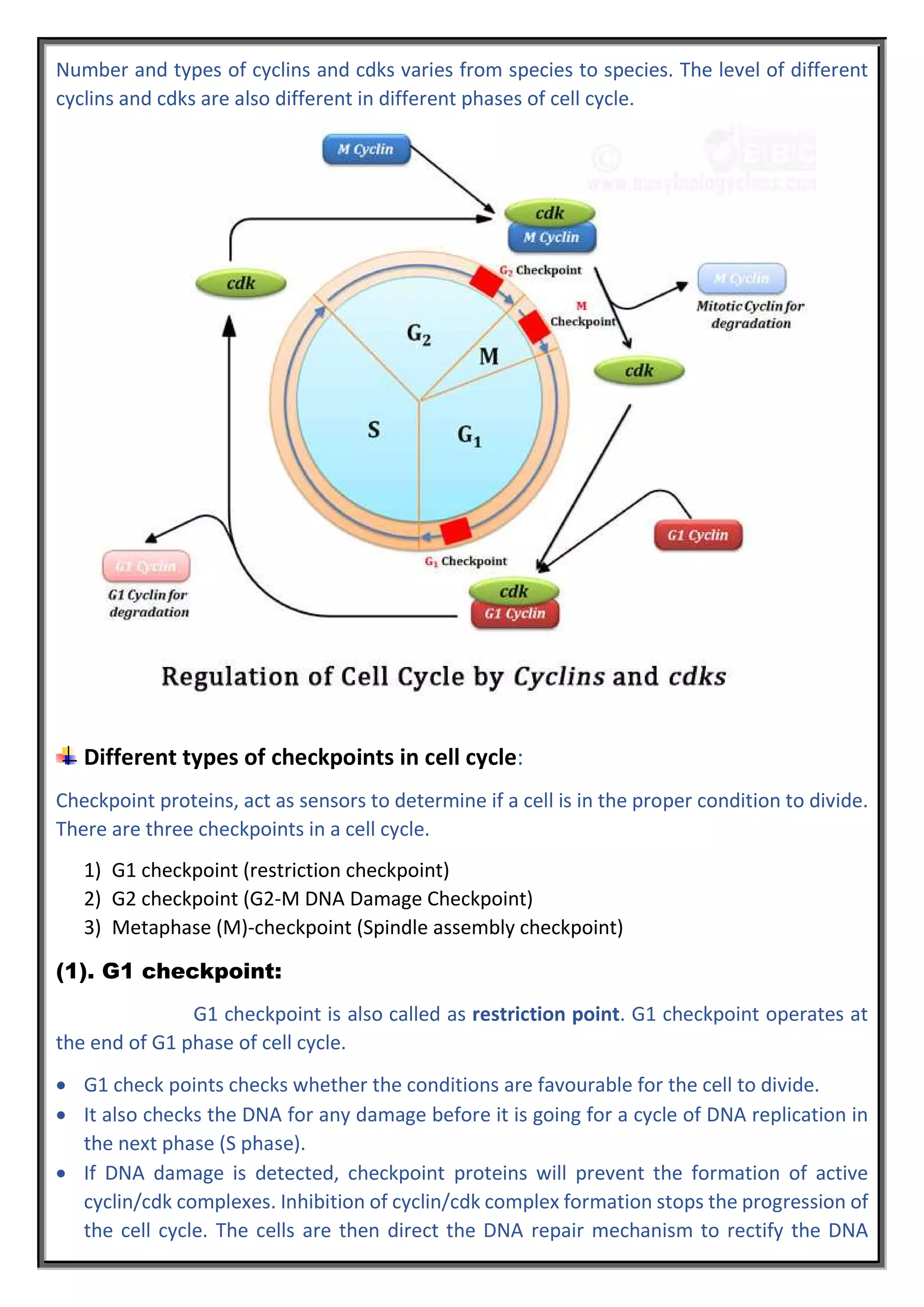
What are cyclins and cyclin dependent kinases (cdks)?
Two categories of related proteins called cyclins and cyclin-dependent
kinases (cdks) orchestrate the cell cycle checkpoint in eukaryotic cells.
The cyclins are so named because their amount varies throughout the cell cycle. To be active,
the cyclin dependent kinases (cdks) controlling the cell cycle must bind to a specific cyclin.
Number and types of cyclins and cdks varies from species to species. The level of different
cyclins and cdks are also different in different phases of cell cycle.
Different types of checkpoints in cell cycle:
Checkpoint proteins, act as sensors to determine if a cell is in the proper condition to divide.
There are three checkpoints in a cell cycle.
1) G1 checkpoint (restriction checkpoint)
2) G2 checkpoint (G2-M DNA Damage Checkpoint)
3) Metaphase (M)-checkpoint (Spindle assembly checkpoint)
(1). G1 checkpoint:
G1 checkpoint is also called as restriction point. G1 checkpoint operates at
the end of G1 phase of cell cycle.
 G1 check points checks whether the conditions are favourable for the cell to divide.
 It also checks the DNA for any damage before it is going for a cycle of DNA replication in
the next phase (S phase).
 If DNA damage is detected, checkpoint proteins will prevent the formation of active
cyclin/cdk complexes. Inhibition of cyclin/cdk complex formation stops the progression of
the cell cycle. The cells are then direct the DNA repair mechanism to rectify the DNA
damage. If the environmental conditions are not good, the cell may enter into G0 phase.
In yeast cells, G1 checkpoint is also called as start point.
(2). G2 checkpoint:
G2 is the second checkpoint which operates at the end of G2 phase. It is also
called as G2-M DNA damage checkpoint.
 G2 checkpoint checks the DNA for any damage that might be occurred during the DNA
replication in the previous cell cycle phase (S phase).
 G2 checkpoint also ensures that the entire DNA has been replicated completely.
 Apart from this, G2 checkpoint monitors the levels of proteins and growth factors that are
needed in the next phase (M phase) of cell cycle.
If any of the above factors are not satisfactory, the G2 check point hold the cells at G2 phase
and initiate machineries to rectify the problems.
(3). Metaphase (M) checkpoint (spindle assembly checkpoint)
Metaphase checkpoint is also called as spindle assembly checkpoint. It is the
third and last cell cycle checkpoint in a cell cycle operates at the end of M phase.
 Metaphase checkpoint senses the integrity of the spindle apparatus in the cell. Spindle
apparatus is involved in sorting of chromosomes during cell division.
 Correct orientation of chromosomes in the metaphase plate of cell is very essential for
the proper segregation of chromosomes. If chromosomes are not correctly attached to
the spindle apparatus, the metaphase checkpoint will stop the cell cycle.
 Thus, M checkpoint prevents cells from incorrectly sorting their chromosomes during
division.
What are the importance of cell cycle checkpoints?
 Checkpoint proteins delay the cell cycle progression until problems are fixed.
 Checkpoint can prevent cell division when problems cannot be fixed.
 They can induce apoptosis (programmed cell death) if the problems are so severe and
cannot be repaired.
 Cell cycle checkpoints accurately maintain the genome of the organism.
 Cell cycle checkpoint ensure only one round replication of DNA per cell cycle.
 If functions of checkpoint genes are lost due to mutation, leads to additional mutations
and cancerous growth initiate in the organ.
 Almost all cancers are due to the improper functioning of either one or many proteins
involved in cell cycle regulation. (E.g. P53 – guardian of genome, a tumour suppressor
gene)
References
o Internet search
o NCERT
o Cell Division – Definition, Stages and Types | Biology Dictionary
https://biologydictionary.net/cell-division/
o jfby1101-lecture3-2013.ppt | CAMPBELL BIOLOGY | Lecture 3 Cell division: mitosis and meiosis
https://www.tcd.ie/Biology_Teaching_Centre/assets/pdf/by1101/jfby1101/jfby1101-lecture3-
2013-bw.pdf
o EARTHSLAB PHYSIOLOGY ▶ MITOTIC CELL DIVISION AND MITOTIC PHASES
https://www.earthslab.com/physiology/mitotic-cell-division-mitotic-phases/
o Easy Biology class. Cell Cycle Checkpoints in Regulation of Cell Division and Cancer
http://www.easybiologyclass.com/cell-cycle-checkpoints-regulation-cancer/
o Cell Division | Boundless Anatomy and Physiology. LUMEN
https://courses.lumenlearning.com/boundless-ap/chapter/cell-division/
o Cell Growth and Division | Anatomy & Physiology
http://library.open.oregonstate.edu/aandp/chapter/3-5-cell-growth-and-division/
o Marilyn Soriano, Oct 2, 2017 CELL PHYSIOLOGY PART 3 Cell Division
https://www.slideshare.net/MarilynSoriano1/cell-physiology-part-3-cell-division-80362435

cell division & physiology of cell division

  • 1.
  • 2.
    CELL DIVISION  Introduction Celldivision is the process by which cells reproduce themselves. In unicellular organisms, cell division is the means of reproduction; in multicellular organisms, it is the means of tissue growth and maintenance. Survival of the eukaryotes depends upon interactions between many cell types, and it is essential that a balanced distribution of types be maintained. This is achieved by the highly regulated process of cell proliferation. The growth and division of different cell populations are regulated in different ways, but the basic mechanisms are similar throughout multicellular organisms. There are a few cells in the body that do not undergo cell division (such as gametes, red blood cells, most neurons, and some muscle cells), most somatic cells divide regularly. A somatic cell is a general term for a body cell, and all human cells, except for the cells that produce eggs and sperm (which are referred to as germ cells), are somatic cells. Somatic cells contain two copies of each of their chromosomes (one copy received from each parent). A homologous pair of chromosomes is the two copies of a single chromosome found in each somatic cell. The human is a diploid organism, having 23 homologous pairs of chromosomes in each of the somatic cells. The condition of having pairs of chromosomes is known as diploidy. Cells in the body replace themselves over the lifetime of a person. For example, the cells lining the gastrointestinal tract must be frequently replaced when constantly “worn off” by the movement of food through the gut. But what triggers a cell to divide, and how does it prepare for and complete cell division? The cell cycle is the sequence of events in the life of the cell from the moment it is created at the end of a previous cycle of cell division until it then divides itself, generating two new cells. Most prokaryotes, or bacteria, use binary fission to divide the cell. Eukaryotes of all sizes use mitosis to divide. Sexually-reproducing eukaryotes use a special form of cell division called meiosis to reduce the genetic content in the cell. This is necessary in sexual reproduction because each parent must give only half of the required genetic material, otherwise the offspring would have too much DNA, which can be a problem.  Types of Cell Division 1) Prokaryotic Cell Division 2) Eukaryotic Cell Division: (i) Mitosis & (ii) Meiosis
  • 3.
    1. Prokaryotic CellDivision Prokaryotes replicate through a type of cell division known as binary fission. Prokaryotes are simple organism, with only one membrane and no division internally. Thus, when a prokaryote divides, it simply replicates the DNA and splits in half. The process is a little more complicated than this, as DNA must first be unwound by special proteins. Although the DNA in prokaryotes usually exists in a ring, it can get quite tangled when it is being used by the cell. To copy the DNA efficiently, it must be stretched out. This also allows the two new rings of DNA created to be separated after they are produced. The two strands of DNA separate into two different sides of the prokaryote cell. The cell then gets longer, and divides in the middle. The process can be seen in the image below. The DNA is the tangled line. The other components are labelled. Plasmids are small rings of DNA that also get copied during binary fission and can be picked up in the environment, from dead cells that break apart. These plasmids can then be further replicated. If a plasmid is beneficial, it will increase in a population. This is in part how antibiotic resistance in bacteria happens. The ribosomes are small protein structures that help produce proteins. They are also replicated so each cell can have enough to function. 2. Eukaryotic Cell Division: i. Mitosis (Somatic Cell Division) Eukaryotic organisms have membrane bound organelles and DNA that exists on chromosomes, which makes cell division harder. Eukaryotes must replicate their DNA, organelles, and cell mechanisms before dividing. Many of the organelles divide using a process that is essentially binary fission, leading scientist to believe that eukaryotes were formed by prokaryotes living inside of other prokaryotes.
  • 4.
    After the DNAand organelles are replicated during interphase of the cell cycle, the eukaryote can begin the process of mitosis. The process begins during prophase, when the chromosomes condense. If mitosis proceeded without the chromosomes condensing, the DNA would become tangled and break. Eukaryotic DNA is associated with many proteins which can fold it into complex structures. As mitosis proceeds to metaphase the chromosomes are lined up in the middle of the cell. Each half of a chromosome, known as sister chromatids because they are replicated copies of each other, gets separated into each half of the cell as mitosis proceeds. At the end of mitosis, another process called cytokinesis divides the cell into two new daughter cells. ii. Meiosis (Reproductive Cell Division) In sexually reproducing animals, it is usually necessary to reduce the genetic information before fertilization. Some plants can exist with too many copies of the genetic code, but in most organisms it is highly detrimental to have too many copies. Humans with even one extra copy of one chromosome can experience detrimental changes to their body. To counteract this, sexually reproducing organisms undergo a type of cell division known as meiosis. As before mitosis, the DNA and organelles are replicated. The process of meiosis contains two different cell divisions, which happen back-to-back. The first meiosis, meiosis I, separates homologous chromosomes. The homologous chromosomes present in a cell represent the two alleles of each gene an organism has. These alleles are recombined and separated, so the resulting daughter cells have only one allele for each gene, and no homologous pairs of chromosomes. The second division, meiosis II, separated the two copies of DNA, much like in mitosis. The end result of meiosis in one cell is 4 cells, each with only one copy of the genome, which is half the normal number. Organisms typically package these cells into gametes, which can travel into the environment to find other gametes. When two gametes of the right type meet, one will fertilize the other and produce a zygote. The zygote is a single cell that will undergo mitosis to produce the millions of cells necessary for a large organism. Thus, most eukaryotes use both mitosis and meiosis, but at different stages of their life cycle.
  • 5.
    Cell Cycle  Thesequence of events by which a cell duplicates its genome, synthesizes the other constituents of the cell and eventually divides into two daughter cells is termed cell cycle.  Cell cycle includes three processes cell division, DNA replication and cell growth in coordinated way.  Duration of cell cycle can vary from organism to organism and also from cell type to cell type. (e.g., in Yeast cell cycle is of 90 minutes, in human 24 hrs.) Interphase  It is divided into 3 further phases G1, S, and G2. 1. G1 phase (Gap 1 Phase)  Corresponds to the interval between mitosis and initiation of DNA replication.  During G1 phase the cell is metabolically active and continuously grows but does not replicate its DNA. 2. S phase (synthesis phase)  Period during which DNA synthesis or replication takes place.  During this time the amount of DNA per cell doubles. (only amount of DNA is doubled, no of chromosomes remain same.)  In animal cells, during the S phase, DNA replication begins in the nucleus, and the centriole duplicates in the cytoplasm. 05
  • 6.
    3. G2 phase(Gap 2 Phase)  Proteins are synthesised in preparation for mitosis while cell growth continues.  Some cells do not exhibit division like heart cells, nerve cells etc. these cells enter in an inactive phase called G0 or quiescent phase from G1 phase.  Cells in this phase are metabolically active but they do not divide unless they are called on to do so. Mitosis or M phase  In animals, mitotic cell division is only seen in the diploid somatic cells while in the plants mitotic divisions can be seen in both haploid and diploid cells.  It is also called as equational division as the number of chromosomes in the parent and progeny cells are the same.  Mitosis is divided into the following four stages: i. Prophase ii. Metaphase iii. Anaphase iv. Telophase I. Prophase  It follows the S and G2 phases of interphase.  The centrioles now begin to move towards opposite poles of the cell.  In prophase Chromosomal material condenses to form compact mitotic chromosomes.  Initiation of the assembly of mitotic spindle with the help of the microtubules.  Cell organelles like Golgi complexes, endoplasmic reticulum, nucleolus and the nuclear envelope disappear. II. Metaphase  Start of metaphase is marked by the complete disintegration of the nuclear envelope.  The chromosomes are spread through the cytoplasm of the cell.  Condensation of chromosomes is completed and they can be observed clearly under the microscope.  This is the stage at which morphology of chromosomes is most easily studied.  At this stage, metaphase chromosome is made up of two sister chromatids, which are held together by the centromere.
  • 7.
     Centromere serveas the sites of attachment of spindle fibres to the chromosomes.  Chromosomes are moved into position at the centre of the cell.  The metaphase is characterised by all the chromosomes coming to lie at the equator with one chromatid of each chromosome connected by its kinetochore to spindle fibres from one pole and its sister chromatid connected by its kinetochore to spindle fibres from the opposite pole.  The plane of alignment of the chromosomes at metaphase is referred to as the metaphase plate or equatorial plate. III. Anaphase  At the onset of anaphase, each chromosome arranged at the metaphase plate is split simultaneously and the two daughter chromatids begin to move towards the two opposite poles.  As each chromosome moves away from the equatorial plate, the centromere of each chromosome is towards the pole and hence at the leading edge, with the arms of the chromosome trailing behind IV. Telophase  At the beginning of telophase, the chromosomes at their respective poles decondense and form chromatin network.  Nuclear envelope assembles around the chromatin network.  Nucleolus, Golgi complex and ER etc. cell organelles reform. Cytokinesis  After karyokinesis the cell itself is divided into two daughter cells by a separate process called cytokinesis.  In an animal cell, this is achieved by the appearance of a furrow in the plasma membrane.  The furrow gradually deepens and ultimately joins in the centre dividing the cell cytoplasm into two.  Plant cells undergo cytokinesis by cell plate method. In cell plate method wall formation starts in the centre of the cell and grows outward to meet the existing lateral walls.
  • 8.
     The formationof the new cell wall begins with the formation of a simple precursor, called the cell-plate that represents the middle lamella between the walls of two adjacent cells.  At the time of cytoplasmic division, organelles like mitochondria and plastids get distributed between the two daughter cells.  In some organisms karyokinesis is not followed by cytokinesis as a result of which multinucleate condition arises leading to the formation of syncytium (e.g., liquid endosperm in coconut). (should be coenocytic) Significance of mitosis  Mitosis results in the production of diploid daughter cells with identical genetic complement usually.  The growth of multicellular organisms is due to mitosis.  Cell growth results in disturbing the ratio between the nucleus and the cytoplasm. Therefore, cell divide to restore the nucleo-cytoplasmic ratio.  Mitosis is important in cell repair. The cells of the upper layer of the epidermis, cells of the lining of the gut, and blood cells are being constantly replaced.  Mitotic divisions in the meristematic tissues – the apical and the lateral cambium, result in a continuous growth of plants throughout their life. MEIOSIS  The specialised kind of cell division that reduces the chromosome number by half results in the production of haploid daughter cells called  It is responsible for formation of haploid gametes, which during sexual reproduction form diploid zygote by fusion.  Meiosis involves two sequential cycles of nuclear and cell division called meiosis I and meiosis II but only a single cycle of DNA replication.  Interphase of meiosis is similar to interphase of mitosis. Meiosis I I. Prophase I  Prophase of the meiosis I division is typically longer and more complex than prophase of mitosis.  It has been further subdivided into the following five phases based on chromosomal behaviour.
  • 9.
    II. Metaphase I The bivalent chromosomes align on the equatorial plate.  The microtubules from the opposite poles of the spindle attach to the pair of homologous chromosomes. III. Anaphase I  The homologous chromosomes separate, while sister chromatids remain associated at their centromeres. IV. Telophase I  The nuclear membrane and nucleolus reappear.  cytokinesis follows telophase I.  Although in many cases the chromosomes do undergo some dispersion, they do not reach the extremely extended state of the interphase nucleus. The stage between the two meiotic divisions is called interkinesis and is generally short lived.  Interkinesis is followed by prophase II, a much simpler prophase than prophase I.
  • 10.
    Meiosis II Meiosis IIresembles a normal mitosis. I. Prophase II:  Meiosis II is initiated immediately after cytokinesis.  The nuclear membrane disappears by the end of prophase II.  The chromosomes again become compact. II. Metaphase II:  At this stage the chromosomes align at the equator and the microtubules from opposite poles of the spindle get attached to the kinetochores of sister chromatids. III. Anaphase II:  Splitting of the centromere of each chromosome.  Chromosomes move toward opposite poles of the cell. IV. Telophase II:  The two groups of chromosomes once again get enclosed by a nuclear envelope.  Cytokinesis follows resulting in the formation of four haploid daughter cells). SIGNIFICANCE OF MEIOSIS  By meiosis conservation of specific chromosome number of each species is achieved across generations in sexually reproducing organisms.  It also increases the genetic variability in the population of organisms from one generation to the next. Variations are very important for the process of evolution.  Production of haploid (n) gametes so that fertilization restores the normal somatic (2n) chromosomes complement,  Segregation of the two alleles of genes located in separate chromosomes,  Recombination between linked genes due to crossing over during pachytene stage,  Generation of tremendous amounts of genetic variation through the above points
  • 11.
    REGULATION OF CELLCYCLE A very elaborate and precise system of regulation controls direct the way cells proceed from one phase to the next in the cell cycle and begin mitosis. The control system involves molecules within the cell as well as external triggers. These internal and external control triggers provide “stop” and “advance” signals for the cell. Precise regulation of the cell cycle is critical for maintaining the health of an organism, and loss of cell cycle control can lead to cancer. What is cell cycle checkpoint? Every cell in our body pass through a series of different stages in a cyclic manner called cell cycle. Cell cycle is a sequential step that taking place in a cell leading to the accurate duplication of genetic materials (DNA), precise separation of replicated genetic materials and passing them in to two daughter cells. The process of cell cycle is very critical in each cell; thus it operate strictly under strong surveillance to prevent any mistakes. This strong surveillance system in the cell to monitor the cell cycle progression itself is called cell cycle checkpoints. Checkpoints are surveillance mechanisms that halt the progress of cell cycle if (1) any of the chromosomal DNA is damaged, or (2) critical cellular processes, such as DNA replication during S phase or chromosome alignment during M phase, have not been properly completed. Progression of cell cycle in eukaryotes is highly regulated in certain points. These critical regulatory points of cell cycle are called cell cycle checkpoints. Cell cycle checkpoints ensure that:  The nuclear genome is intact (without any mutation).  The conditions are appropriate for a cell to divide (enough nutrients are there for the daughter cells).  Genetic material is replicated only once in a cell cycle.  Genetic material is completely replicated.  No mutations occurred in the replicated chromosomes.  If mutations are occurred, these mutations will be rectified by DNA repair system.  Chromosomes are correctly oriented in the metaphase plate Ø All chromosomes are correctly attached to the spindle fibres. What are cyclins and cyclin dependent kinases (cdks)? Two categories of related proteins called cyclins and cyclin-dependent kinases (cdks) orchestrate the cell cycle checkpoint in eukaryotic cells. The cyclins are so named because their amount varies throughout the cell cycle. To be active, the cyclin dependent kinases (cdks) controlling the cell cycle must bind to a specific cyclin.
  • 12.
    Number and typesof cyclins and cdks varies from species to species. The level of different cyclins and cdks are also different in different phases of cell cycle. Different types of checkpoints in cell cycle: Checkpoint proteins, act as sensors to determine if a cell is in the proper condition to divide. There are three checkpoints in a cell cycle. 1) G1 checkpoint (restriction checkpoint) 2) G2 checkpoint (G2-M DNA Damage Checkpoint) 3) Metaphase (M)-checkpoint (Spindle assembly checkpoint) (1). G1 checkpoint: G1 checkpoint is also called as restriction point. G1 checkpoint operates at the end of G1 phase of cell cycle.  G1 check points checks whether the conditions are favourable for the cell to divide.  It also checks the DNA for any damage before it is going for a cycle of DNA replication in the next phase (S phase).  If DNA damage is detected, checkpoint proteins will prevent the formation of active cyclin/cdk complexes. Inhibition of cyclin/cdk complex formation stops the progression of the cell cycle. The cells are then direct the DNA repair mechanism to rectify the DNA
  • 13.
    damage. If theenvironmental conditions are not good, the cell may enter into G0 phase. In yeast cells, G1 checkpoint is also called as start point. (2). G2 checkpoint: G2 is the second checkpoint which operates at the end of G2 phase. It is also called as G2-M DNA damage checkpoint.  G2 checkpoint checks the DNA for any damage that might be occurred during the DNA replication in the previous cell cycle phase (S phase).  G2 checkpoint also ensures that the entire DNA has been replicated completely.  Apart from this, G2 checkpoint monitors the levels of proteins and growth factors that are needed in the next phase (M phase) of cell cycle. If any of the above factors are not satisfactory, the G2 check point hold the cells at G2 phase and initiate machineries to rectify the problems. (3). Metaphase (M) checkpoint (spindle assembly checkpoint) Metaphase checkpoint is also called as spindle assembly checkpoint. It is the third and last cell cycle checkpoint in a cell cycle operates at the end of M phase.  Metaphase checkpoint senses the integrity of the spindle apparatus in the cell. Spindle apparatus is involved in sorting of chromosomes during cell division.  Correct orientation of chromosomes in the metaphase plate of cell is very essential for the proper segregation of chromosomes. If chromosomes are not correctly attached to the spindle apparatus, the metaphase checkpoint will stop the cell cycle.  Thus, M checkpoint prevents cells from incorrectly sorting their chromosomes during division. What are the importance of cell cycle checkpoints?  Checkpoint proteins delay the cell cycle progression until problems are fixed.  Checkpoint can prevent cell division when problems cannot be fixed.  They can induce apoptosis (programmed cell death) if the problems are so severe and cannot be repaired.  Cell cycle checkpoints accurately maintain the genome of the organism.  Cell cycle checkpoint ensure only one round replication of DNA per cell cycle.  If functions of checkpoint genes are lost due to mutation, leads to additional mutations and cancerous growth initiate in the organ.  Almost all cancers are due to the improper functioning of either one or many proteins involved in cell cycle regulation. (E.g. P53 – guardian of genome, a tumour suppressor gene)
  • 14.
    References o Internet search oNCERT o Cell Division – Definition, Stages and Types | Biology Dictionary https://biologydictionary.net/cell-division/ o jfby1101-lecture3-2013.ppt | CAMPBELL BIOLOGY | Lecture 3 Cell division: mitosis and meiosis https://www.tcd.ie/Biology_Teaching_Centre/assets/pdf/by1101/jfby1101/jfby1101-lecture3- 2013-bw.pdf o EARTHSLAB PHYSIOLOGY ▶ MITOTIC CELL DIVISION AND MITOTIC PHASES https://www.earthslab.com/physiology/mitotic-cell-division-mitotic-phases/ o Easy Biology class. Cell Cycle Checkpoints in Regulation of Cell Division and Cancer http://www.easybiologyclass.com/cell-cycle-checkpoints-regulation-cancer/ o Cell Division | Boundless Anatomy and Physiology. LUMEN https://courses.lumenlearning.com/boundless-ap/chapter/cell-division/ o Cell Growth and Division | Anatomy & Physiology http://library.open.oregonstate.edu/aandp/chapter/3-5-cell-growth-and-division/ o Marilyn Soriano, Oct 2, 2017 CELL PHYSIOLOGY PART 3 Cell Division https://www.slideshare.net/MarilynSoriano1/cell-physiology-part-3-cell-division-80362435