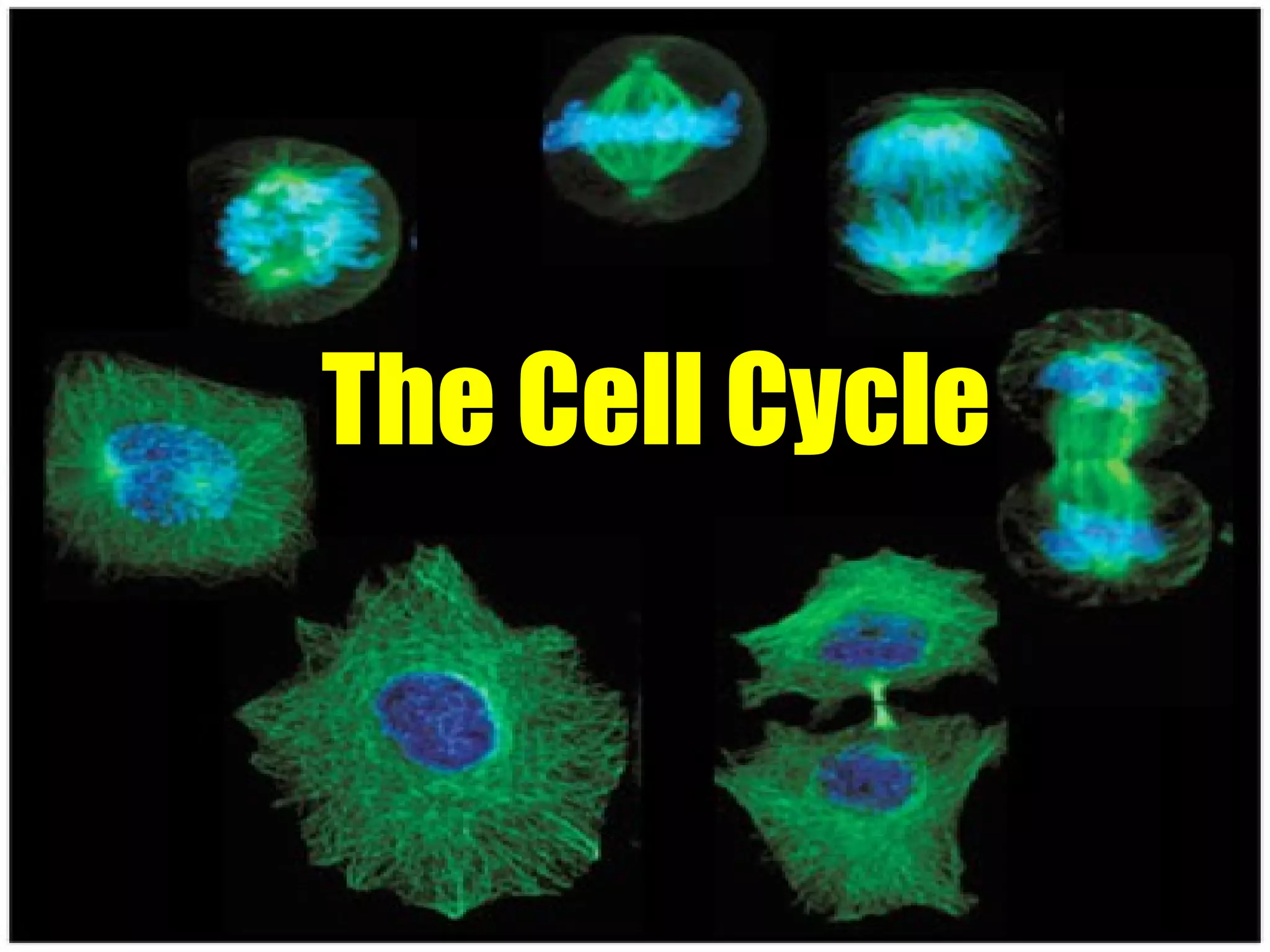
The Cell Cycle
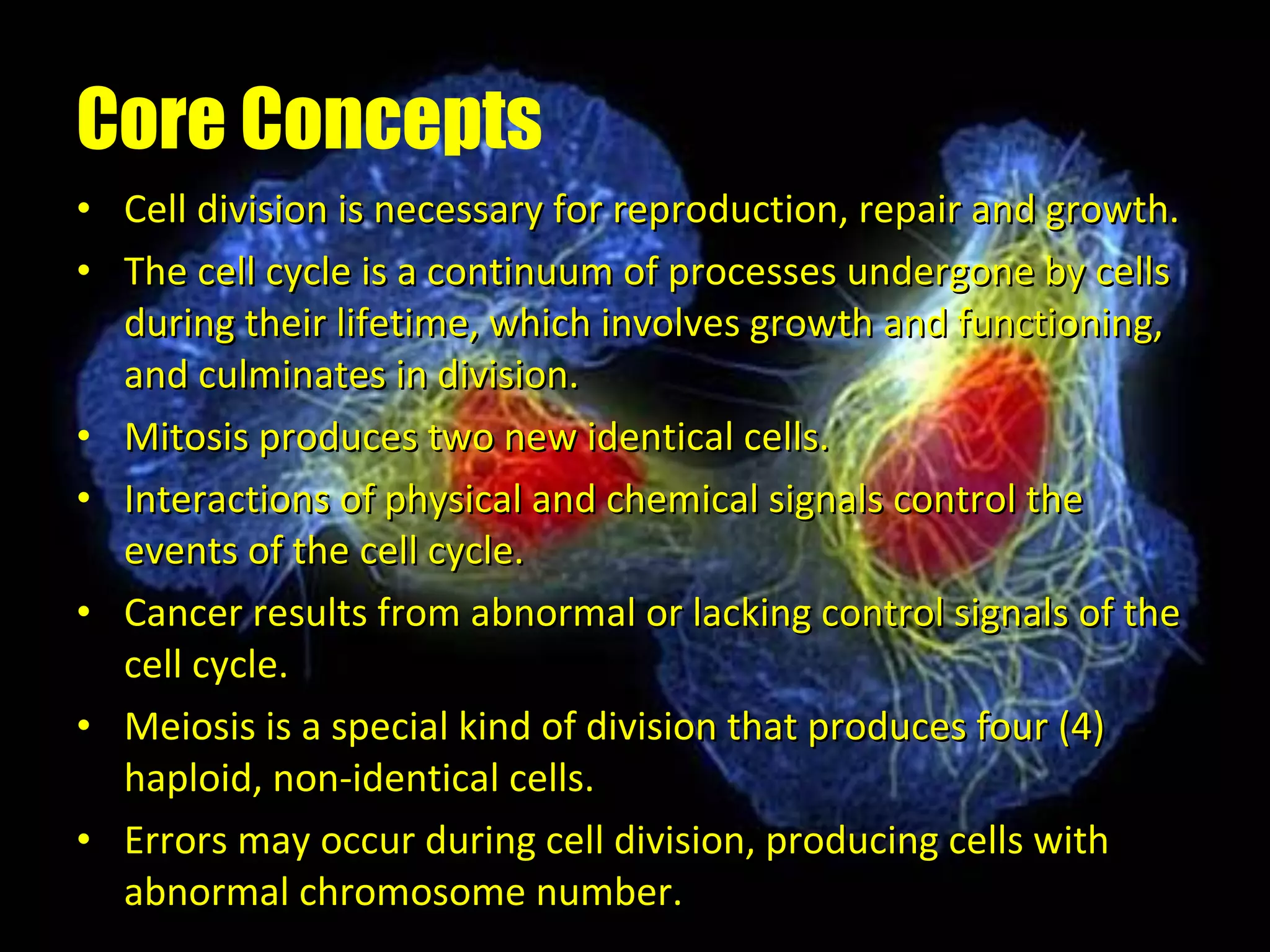
Core Concepts Cell division is necessary for reproduction, repair and growth. The cell cycle is a continuum of processes undergone by cells during their lifetime, which involves growth and functioning, and culminates in division. Mitosis produces two new identical cells. Interactions of physical and chemical signals control the events of the cell cycle. Cancer results from abnormal or lacking control signals of the cell cycle. Meiosis is a special kind of division that produces four (4) haploid, non-identical cells. Errors may occur during cell division, producing cells with abnormal chromosome number.
Keywords anaphase centromere chromatin chromosome crossing-over cytokinesis diploid G1 G2 genome haploid homologue interphase kinetochore meiosis metaphase mitosis non-disjunction prophase sister chromatid spindle synthesis telophase tetrad
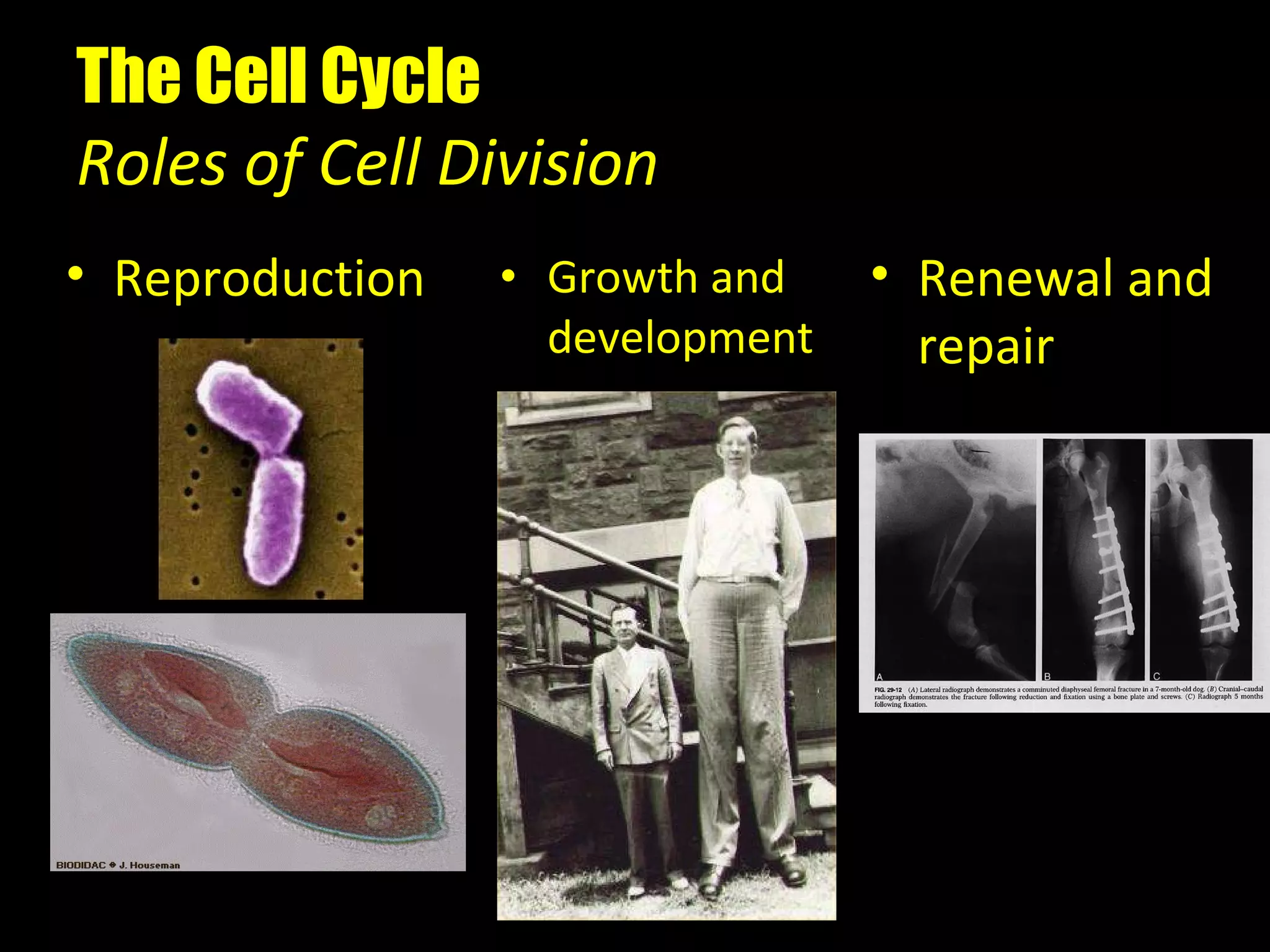
The Cell Cycle Roles of Cell Division Growth and development Reproduction Renewal and repair
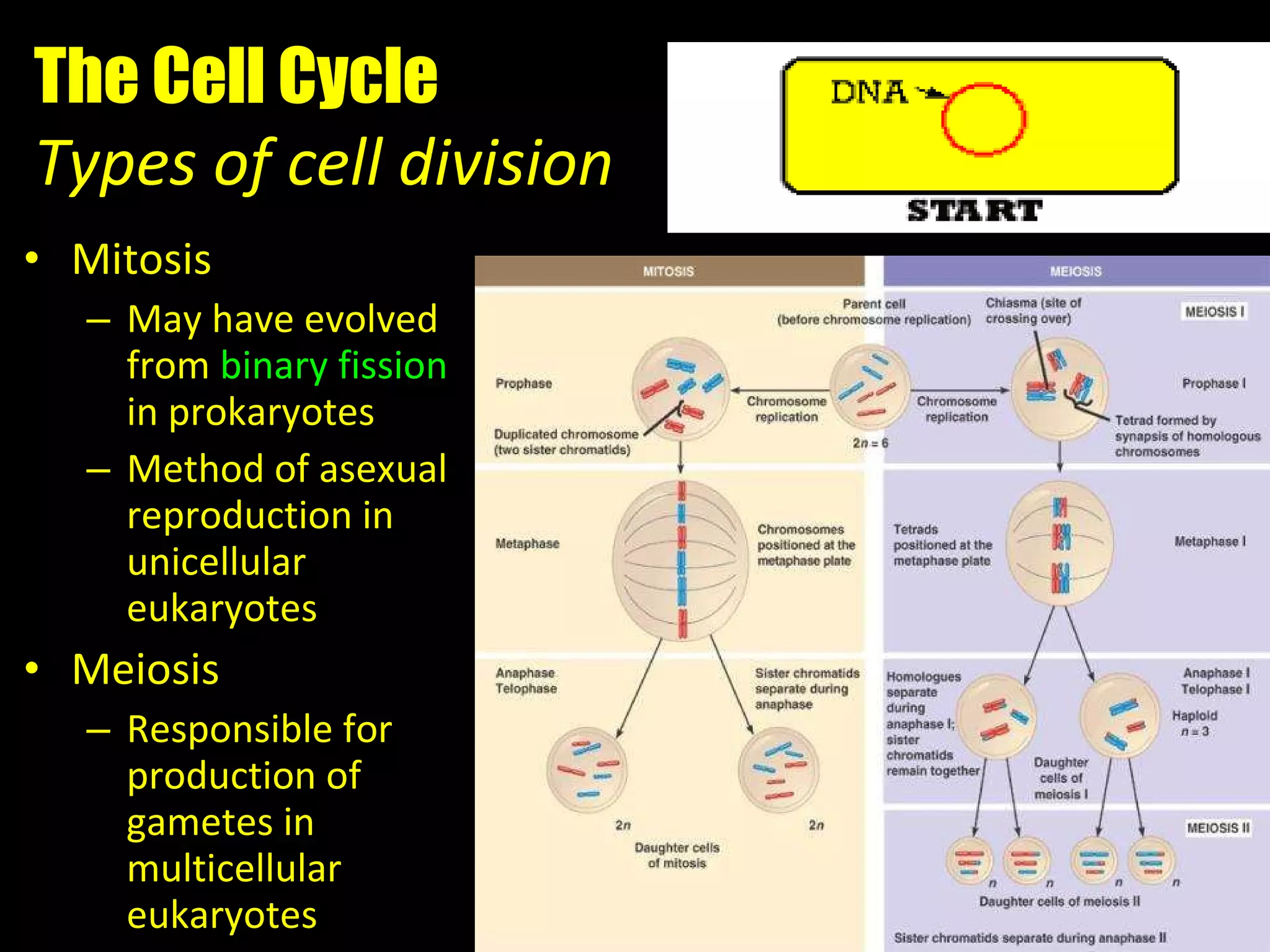
The Cell Cycle Types of cell division Mitosis May have evolved from  binary fission  in prokaryotes Method of asexual reproduction in unicellular eukaryotes Meiosis Responsible for production of gametes in multicellular eukaryotes
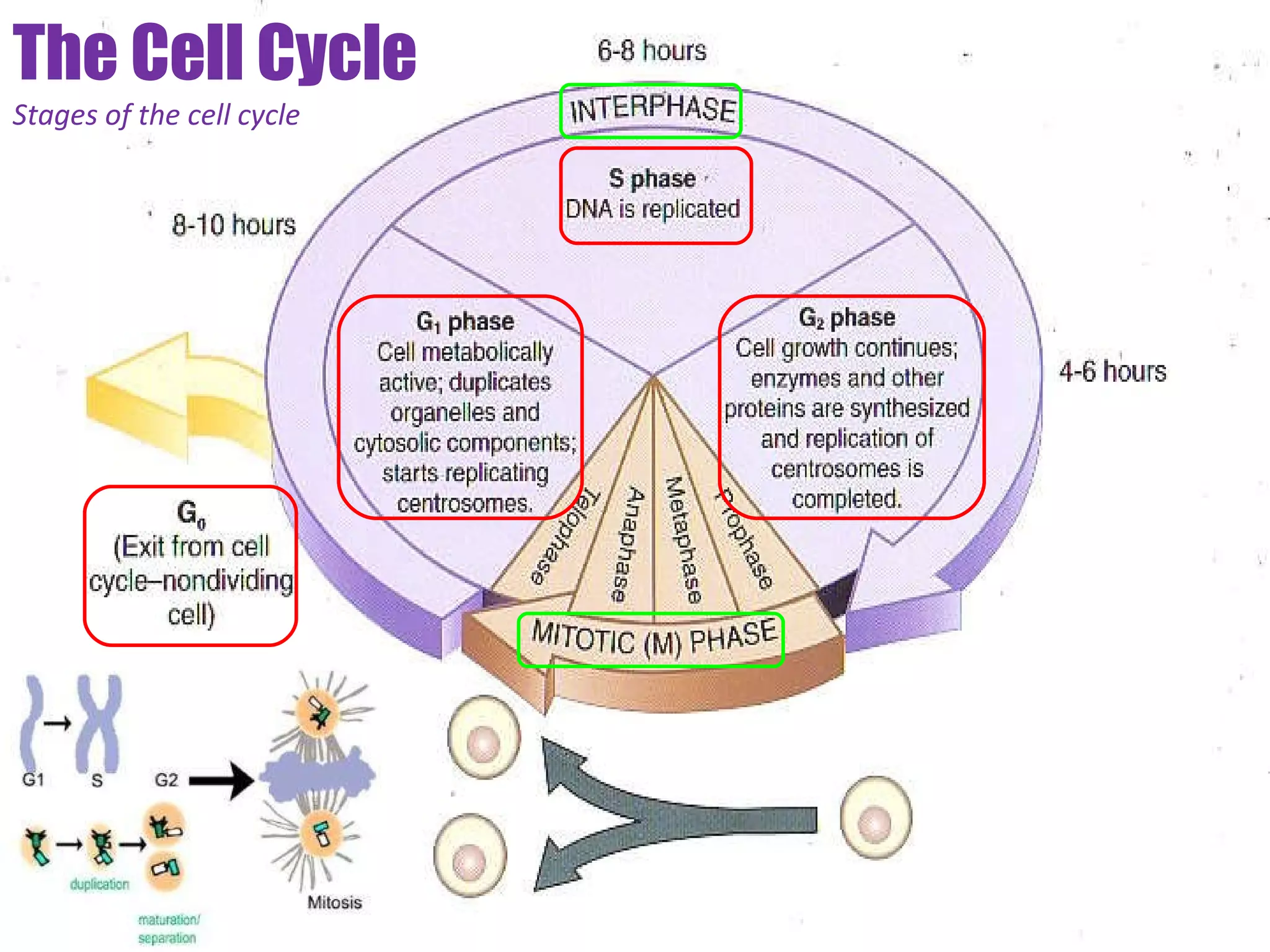
The Cell Cycle Stages of the cell cycle
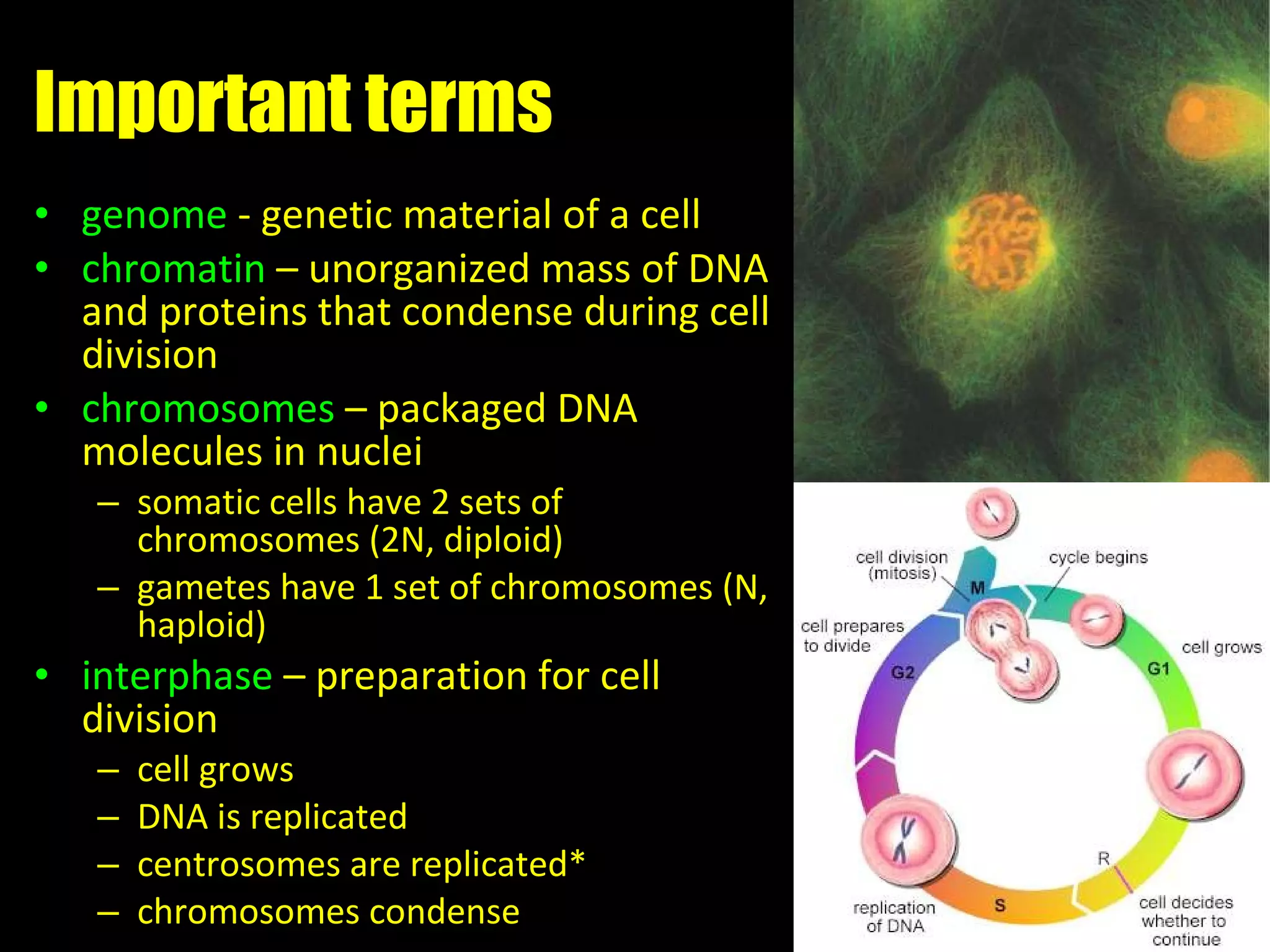
Important terms genome  - genetic material of a cell chromatin  – unorganized mass of DNA and proteins that condense during cell division chromosomes  – packaged DNA molecules in nuclei somatic cells have 2 sets of chromosomes (2N, diploid) gametes have 1 set of chromosomes (N, haploid) interphase  – preparation for cell division  cell grows DNA is replicated centrosomes are replicated* chromosomes condense
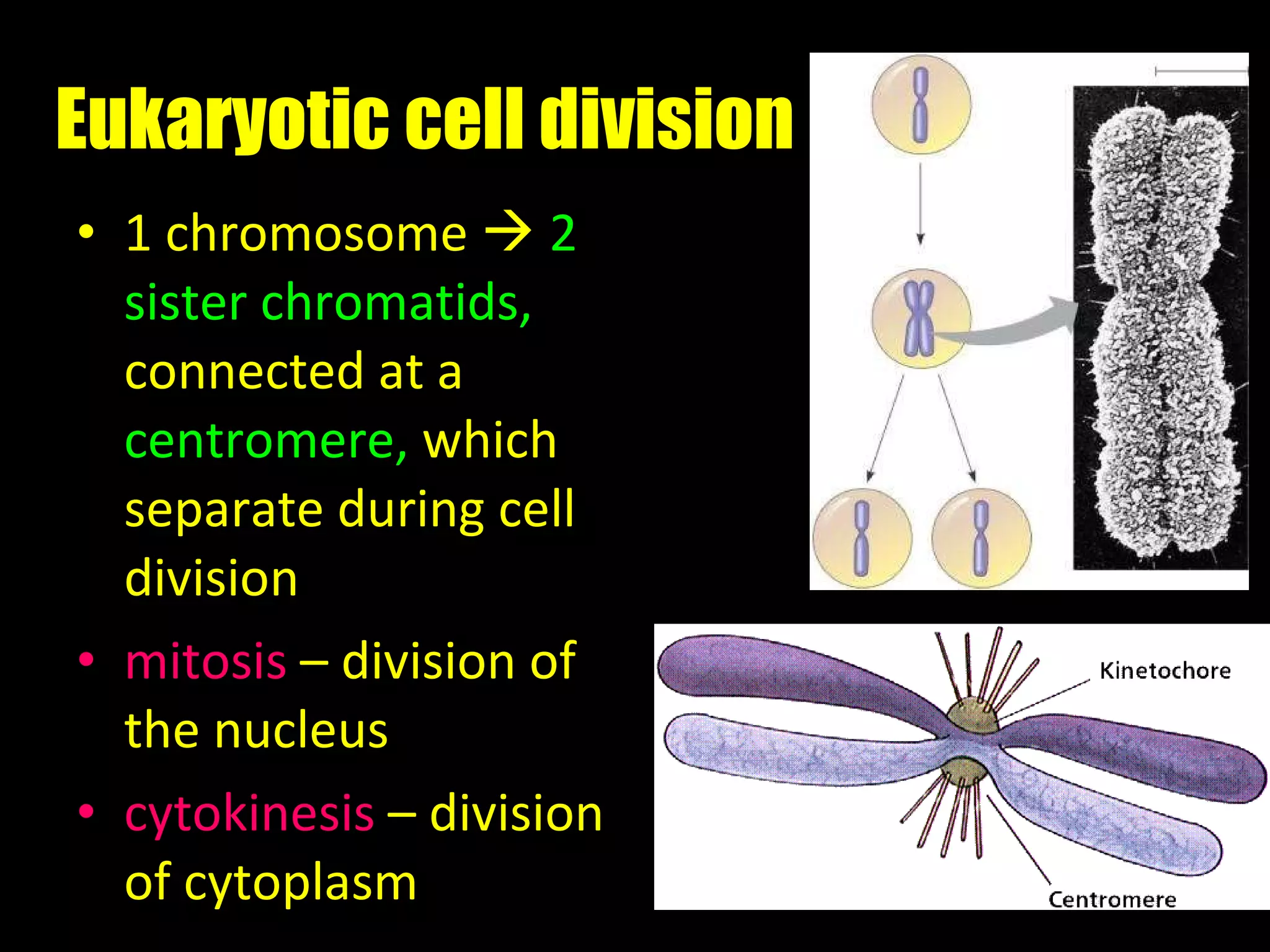
Eukaryotic cell division 1 chromosome     2 sister chromatids,  connected at a  centromere,  which separate during cell division mitosis  – division of the nucleus cytokinesis  – division of cytoplasm
 
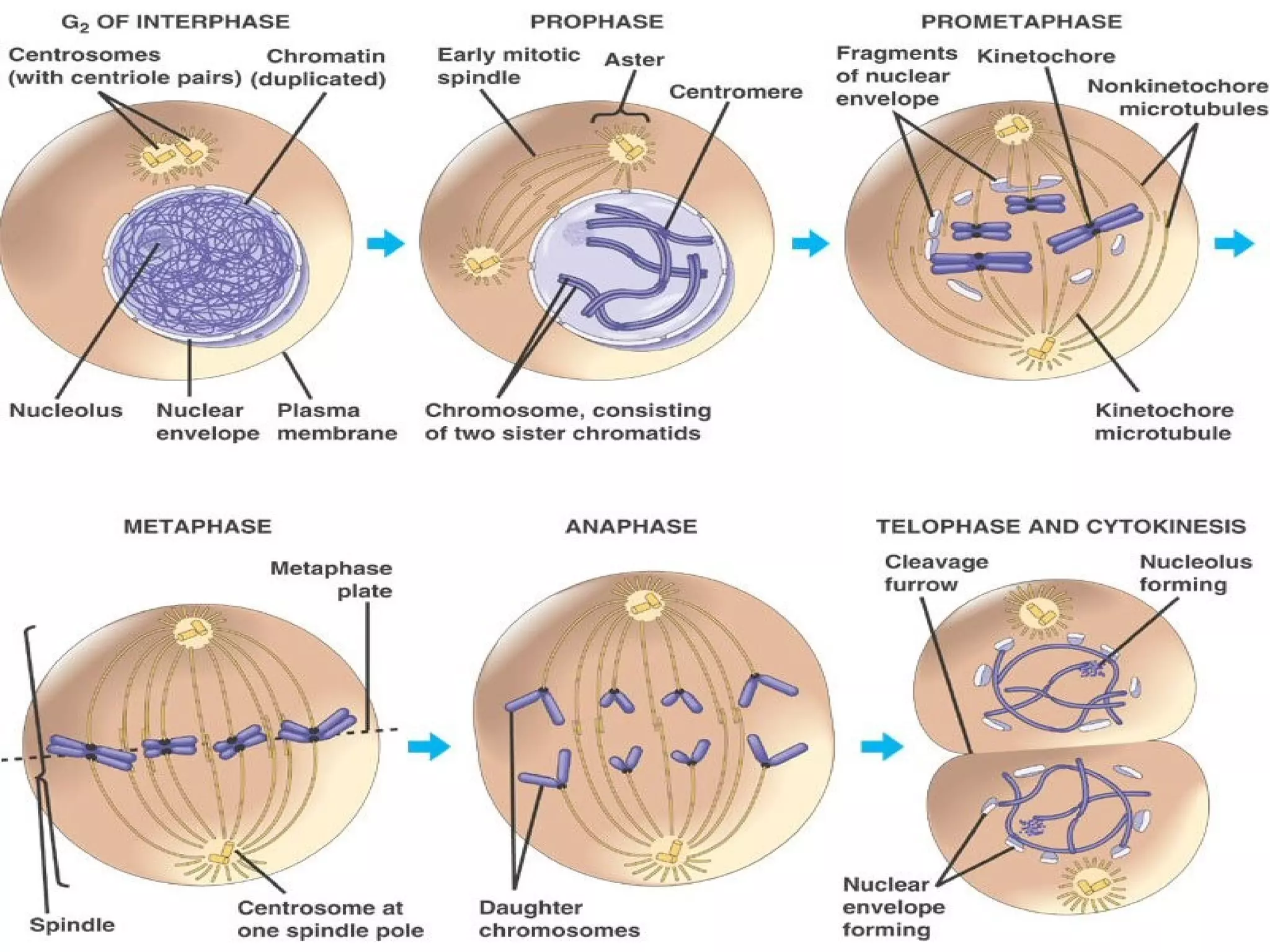
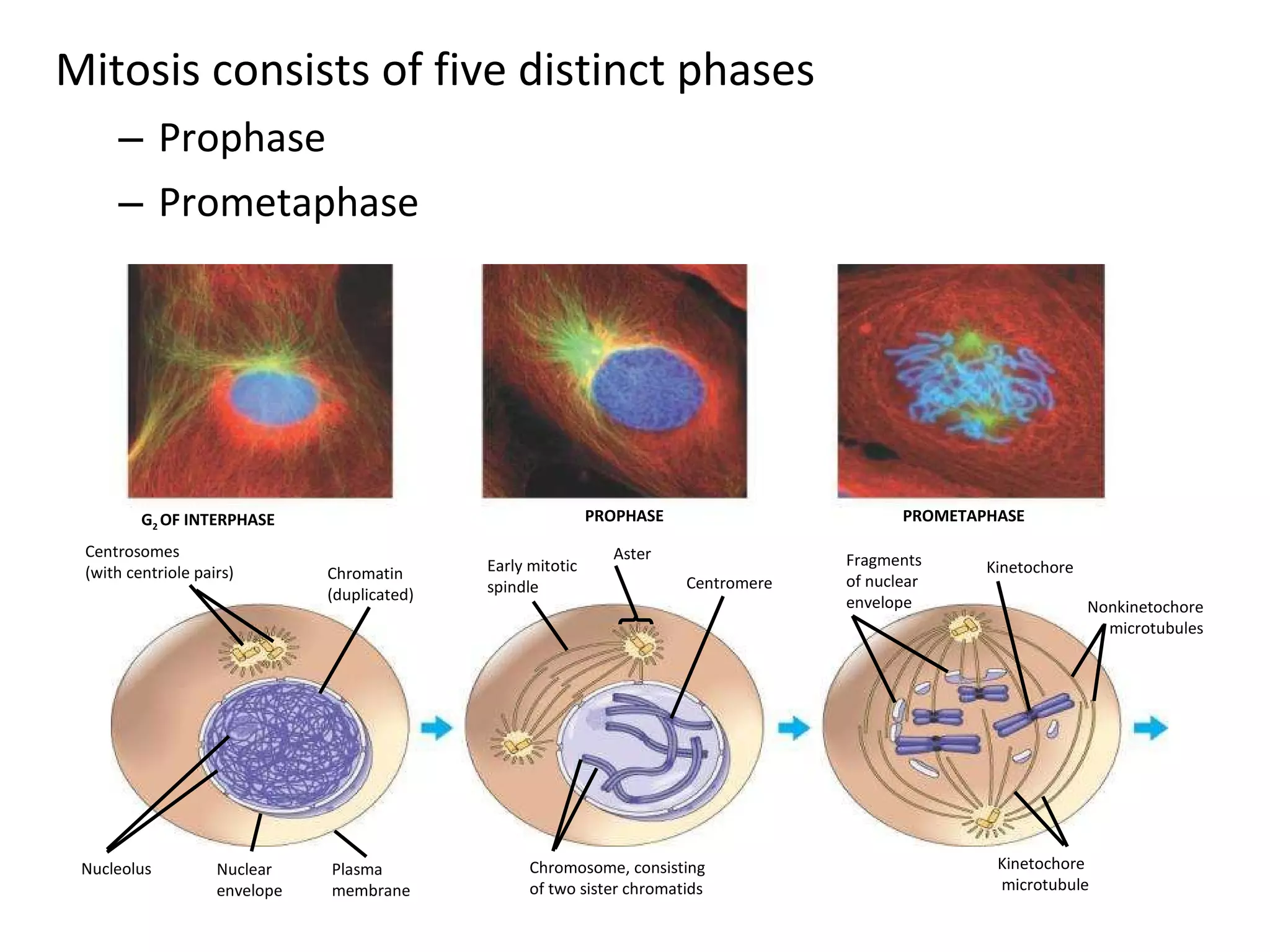
Mitosis consists of five distinct phases Prophase Prometaphase G 2  OF INTERPHASE PROPHASE PROMETAPHASE Centrosomes (with centriole pairs) Chromatin (duplicated) Early mitotic spindle Aster Centromere Fragments of nuclear envelope Kinetochore Nucleolus Nuclear envelope Plasma membrane Chromosome, consisting of two sister chromatids Kinetochore  microtubule  Nonkinetochore microtubules
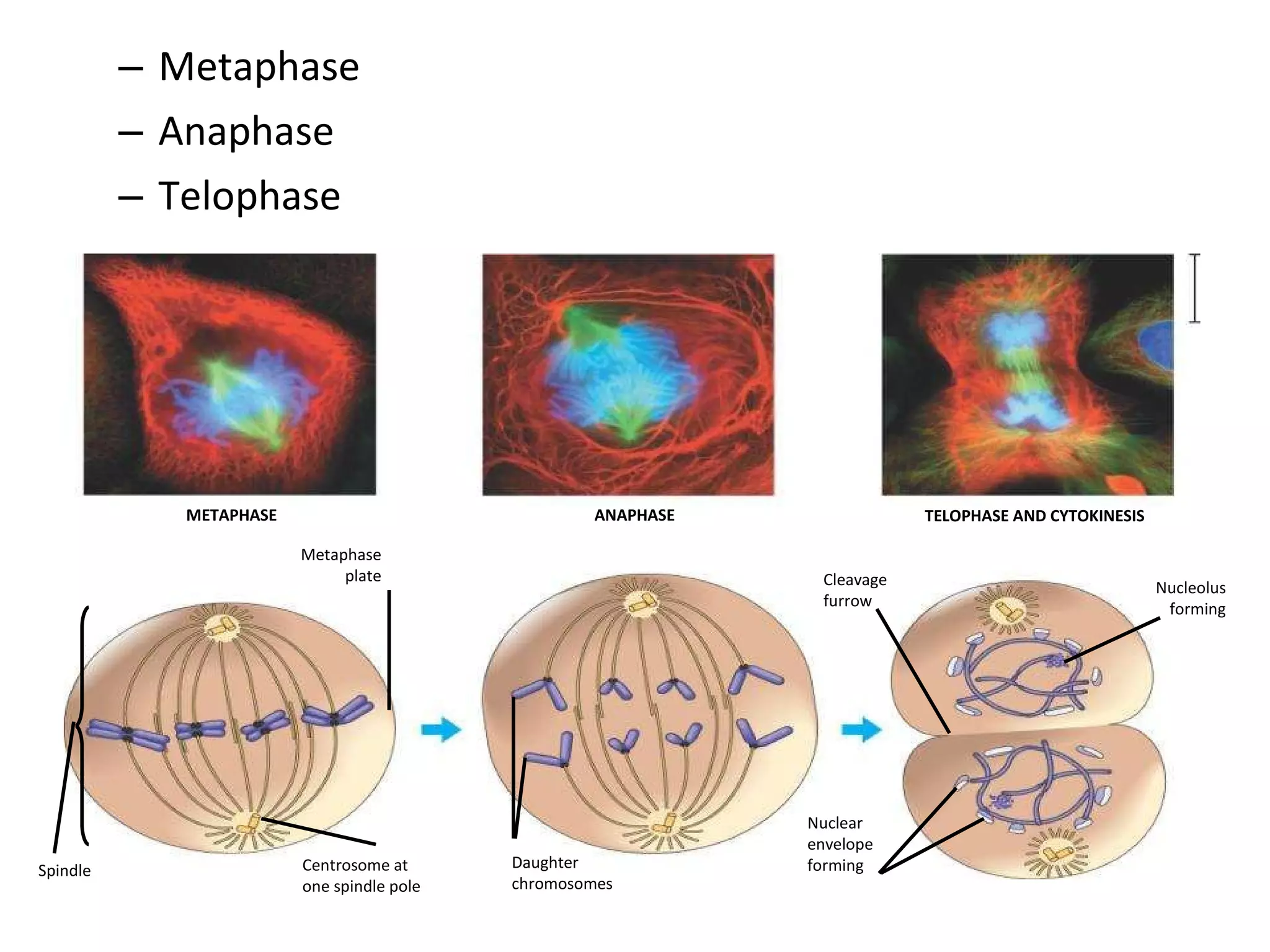
Metaphase Anaphase Telophase Centrosome at  one spindle pole Daughter  chromosomes METAPHASE ANAPHASE TELOPHASE AND CYTOKINESIS Spindle Metaphase plate Nucleolus forming Cleavage furrow Nuclear  envelope forming
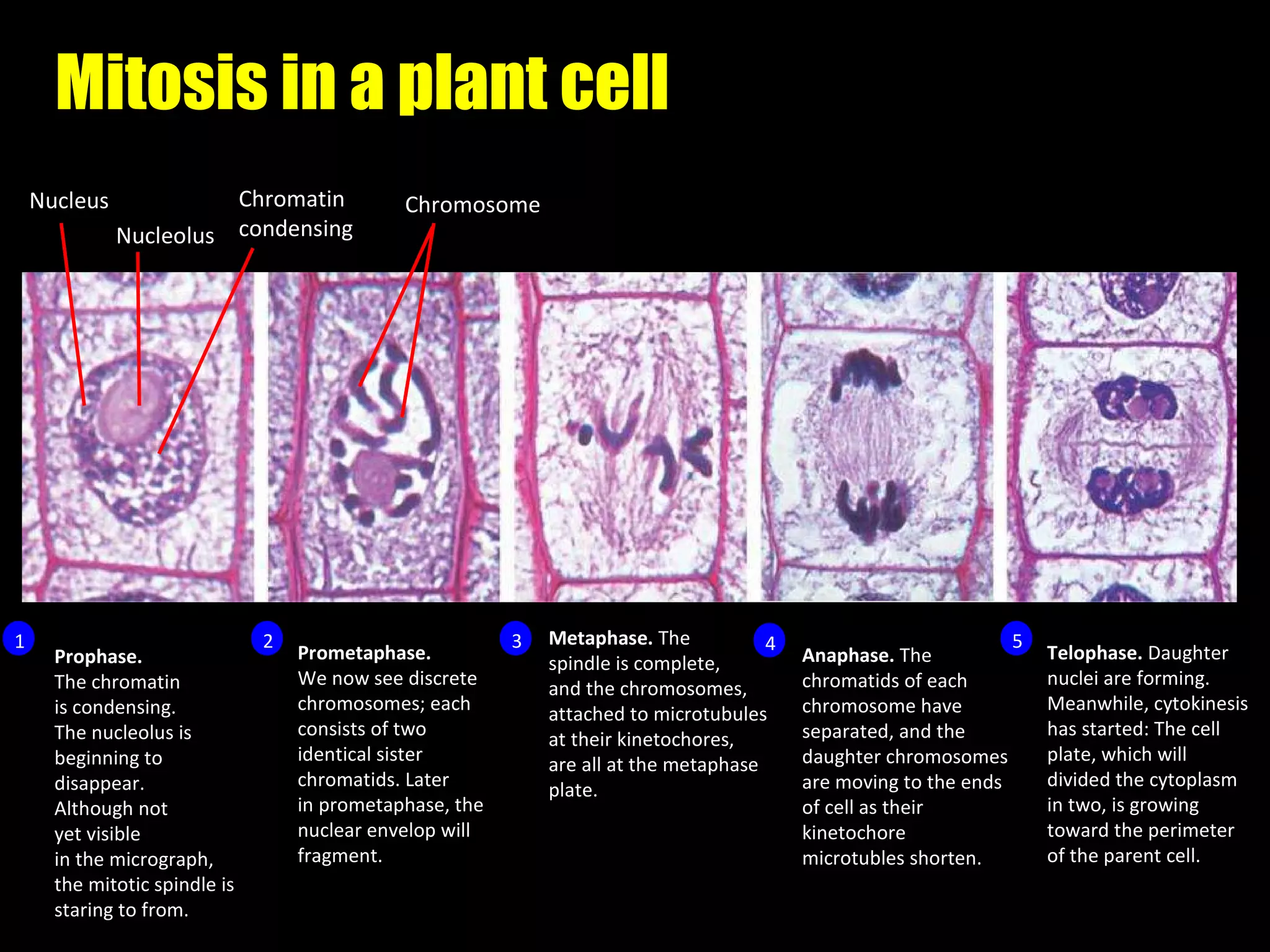
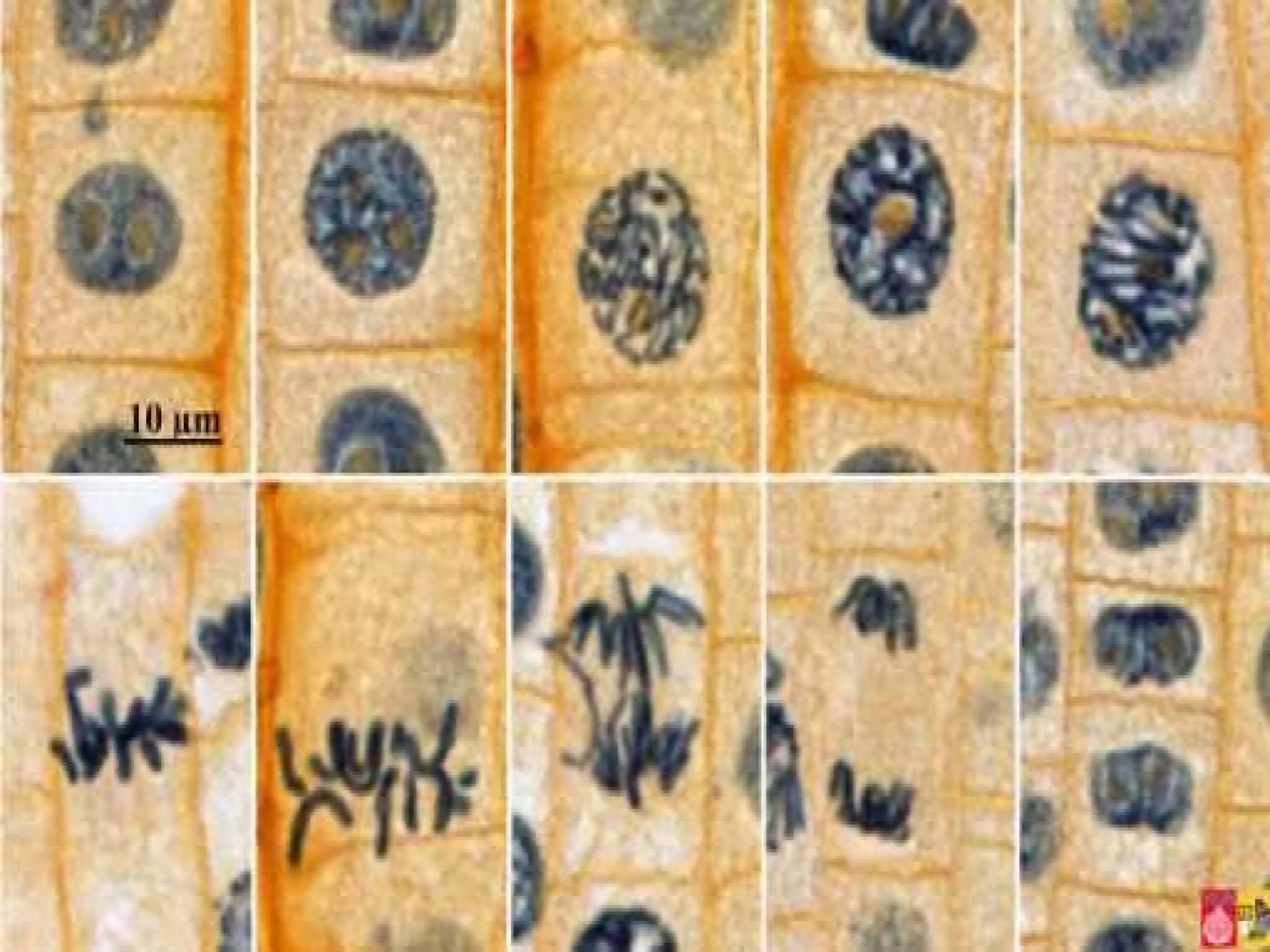
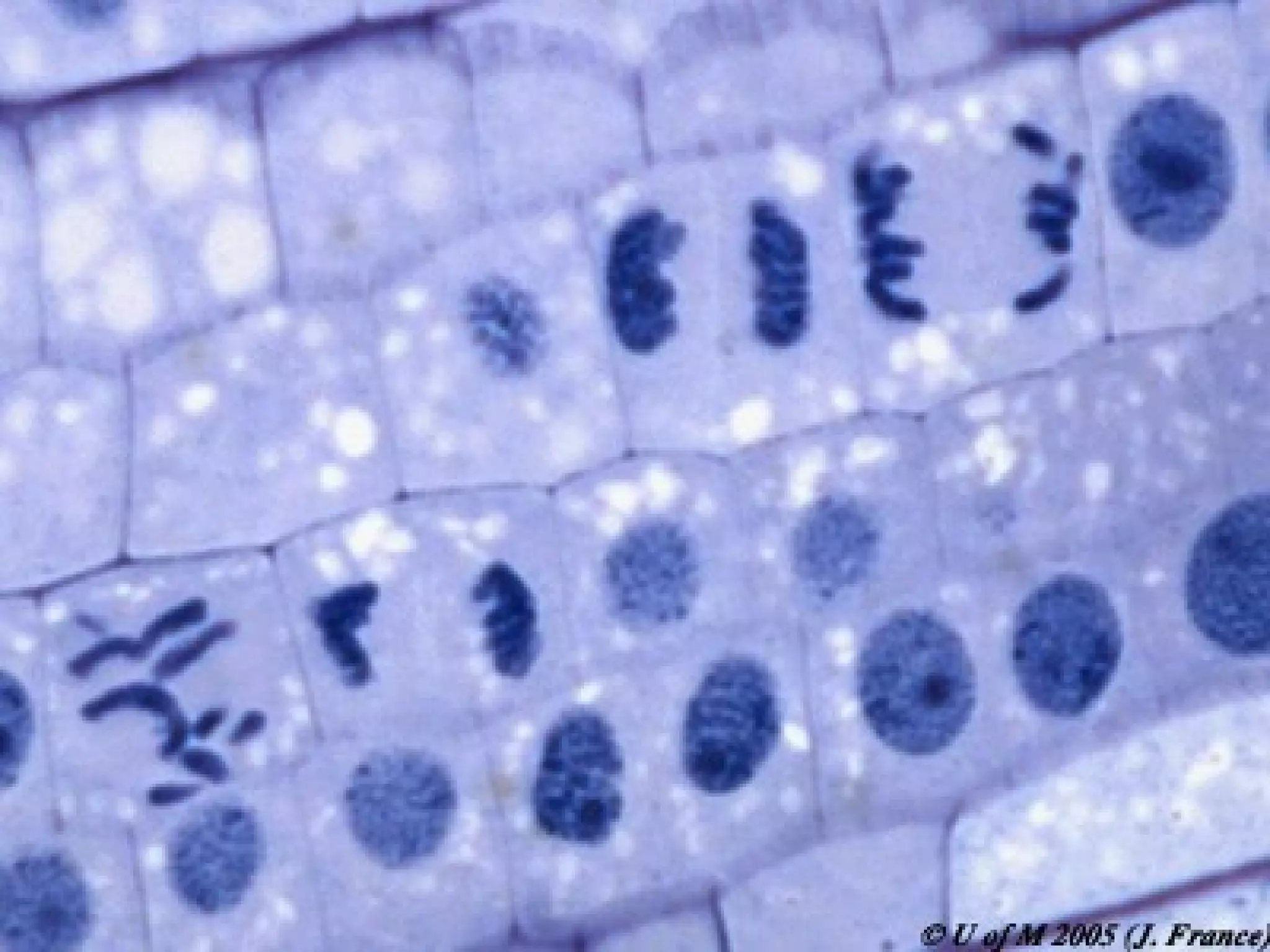
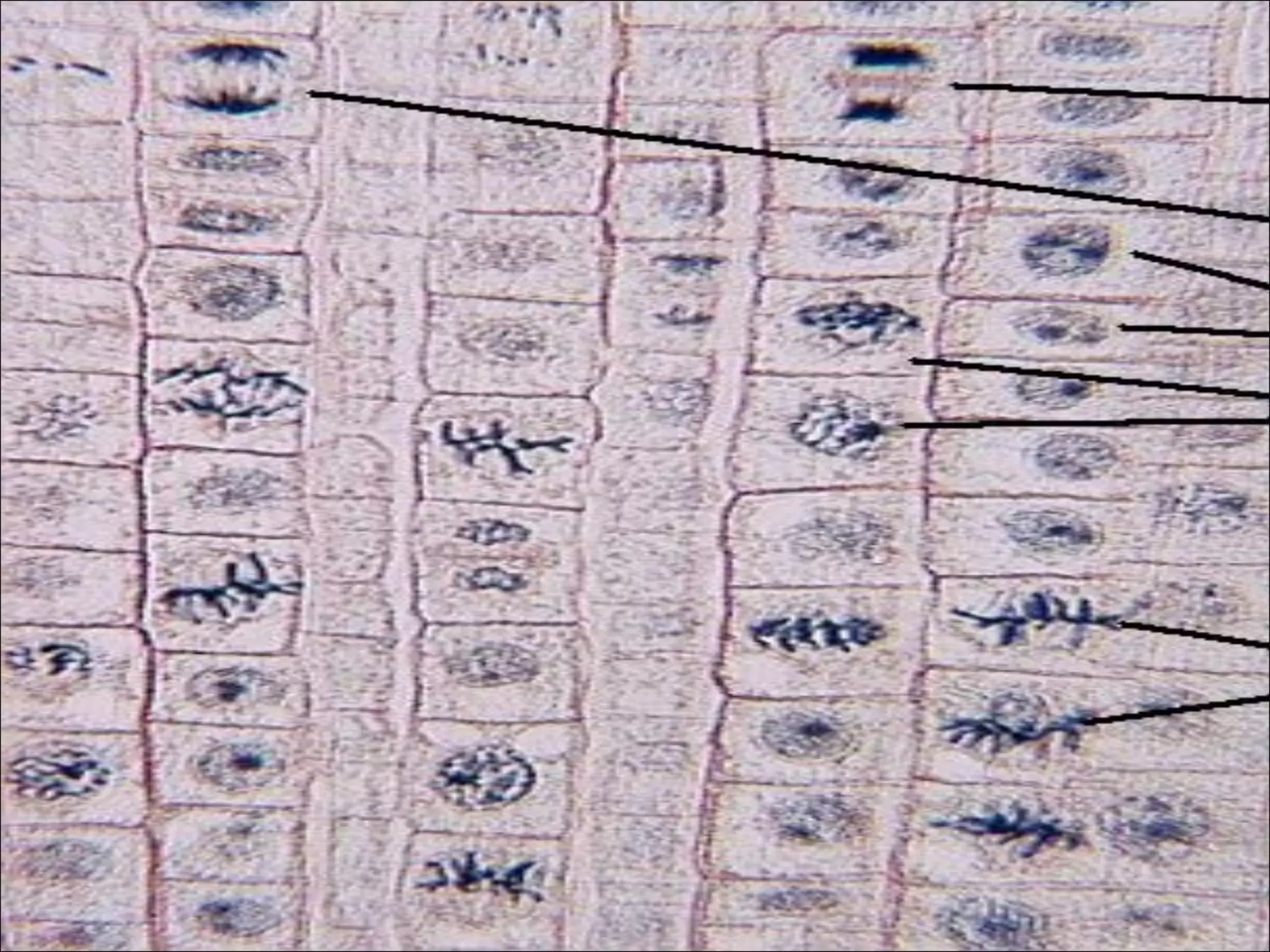
Mitosis in a plant cell 1 Prophase.  The chromatin is condensing.  The nucleolus is  beginning to  disappear. Although not  yet visible  in the micrograph,  the mitotic spindle is  staring to from. Prometaphase. We now see discrete chromosomes; each  consists of two  identical sister  chromatids. Later in prometaphase, the  nuclear envelop will  fragment. Metaphase.  The  spindle is complete, and the chromosomes, attached to microtubules at their kinetochores,  are all at the metaphase  plate. Anaphase.  The chromatids of each  chromosome have  separated, and the  daughter chromosomes are moving to the ends  of cell as their  kinetochore microtubles shorten. Telophase.  Daughter nuclei are forming.  Meanwhile, cytokinesis has started: The cell plate, which will  divided the cytoplasm  in two, is growing  toward the perimeter   of the parent cell. 2 3 4 5 Nucleus Nucleolus Chromosome Chromatin condensing


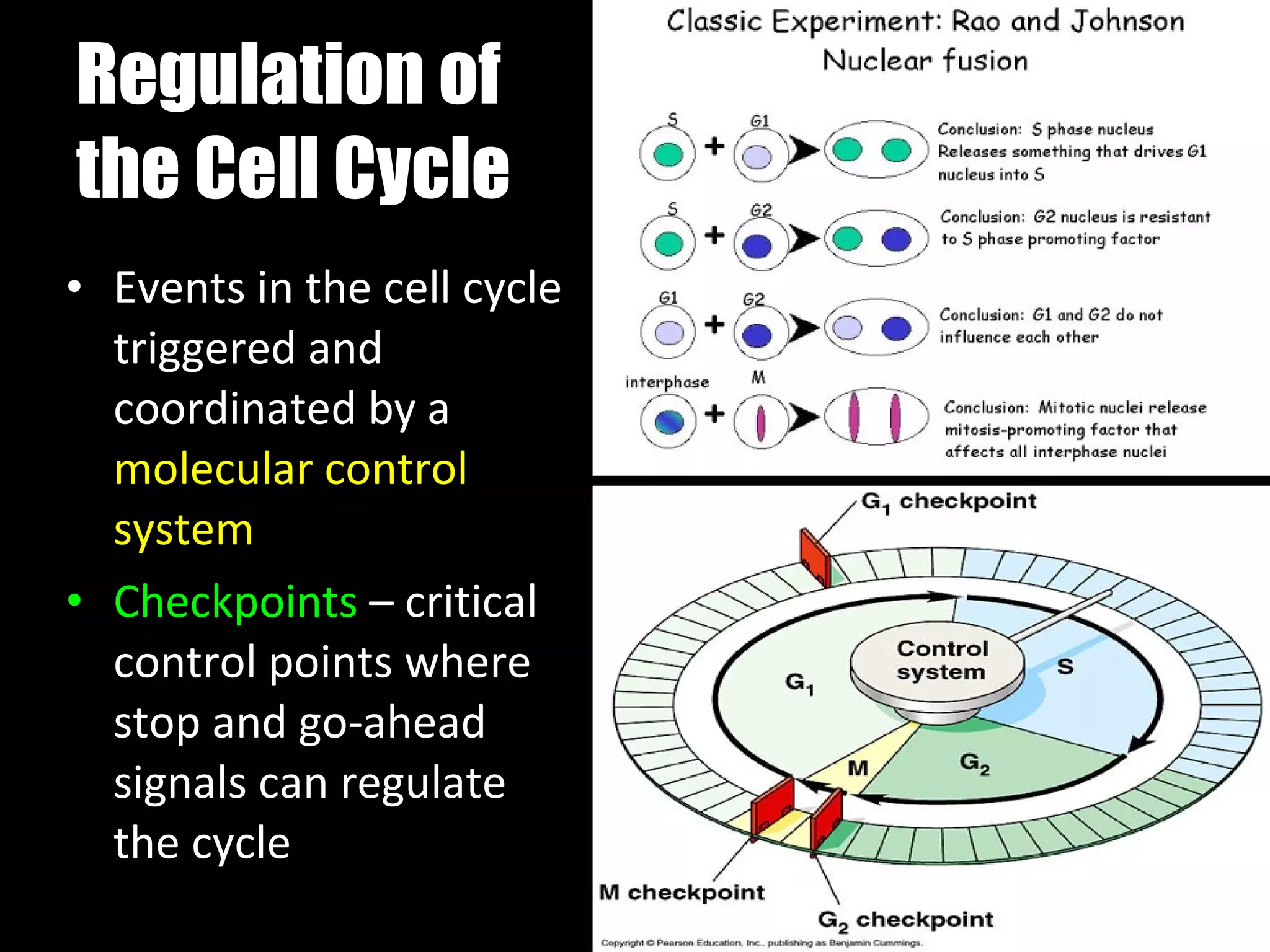
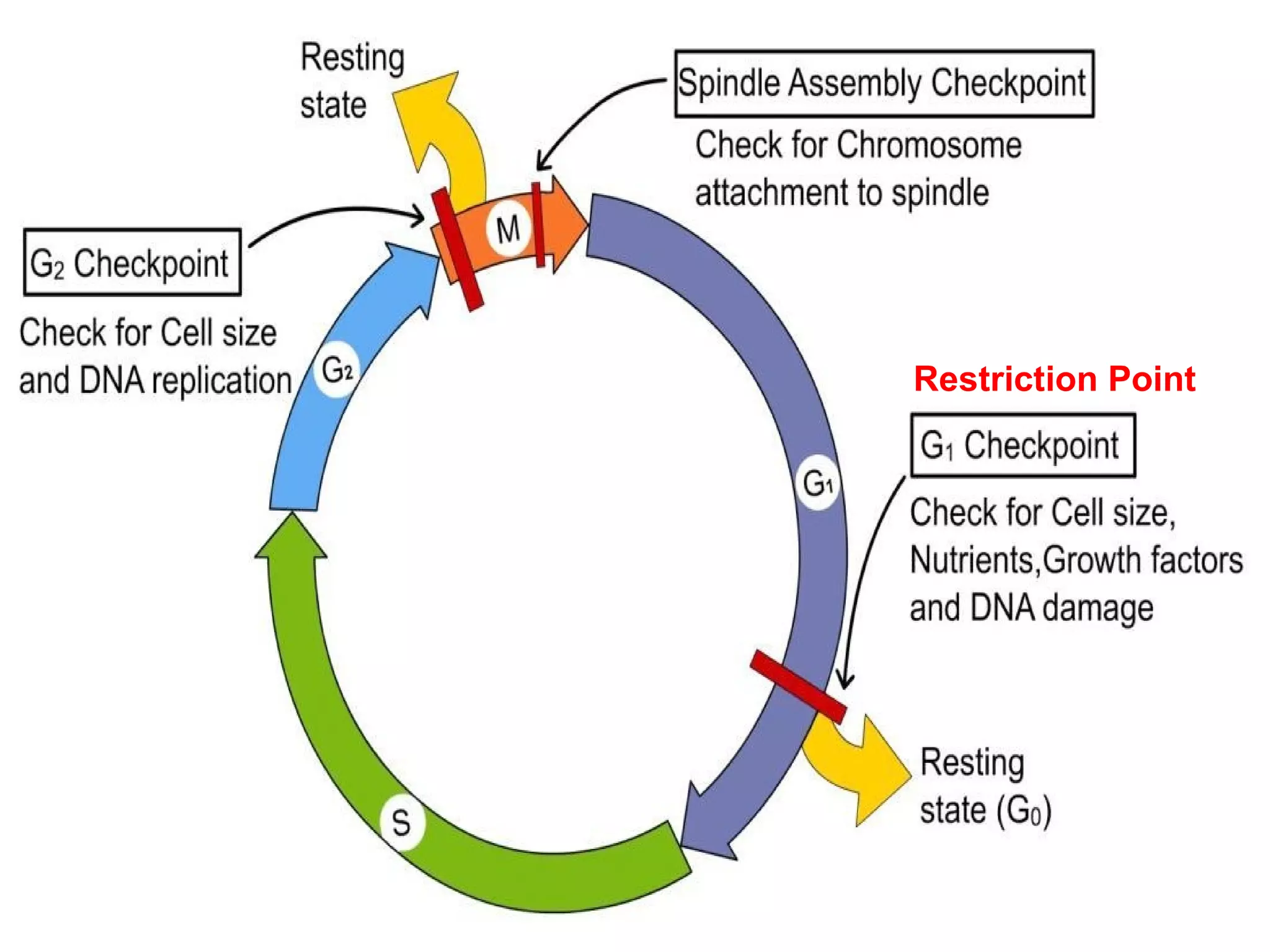
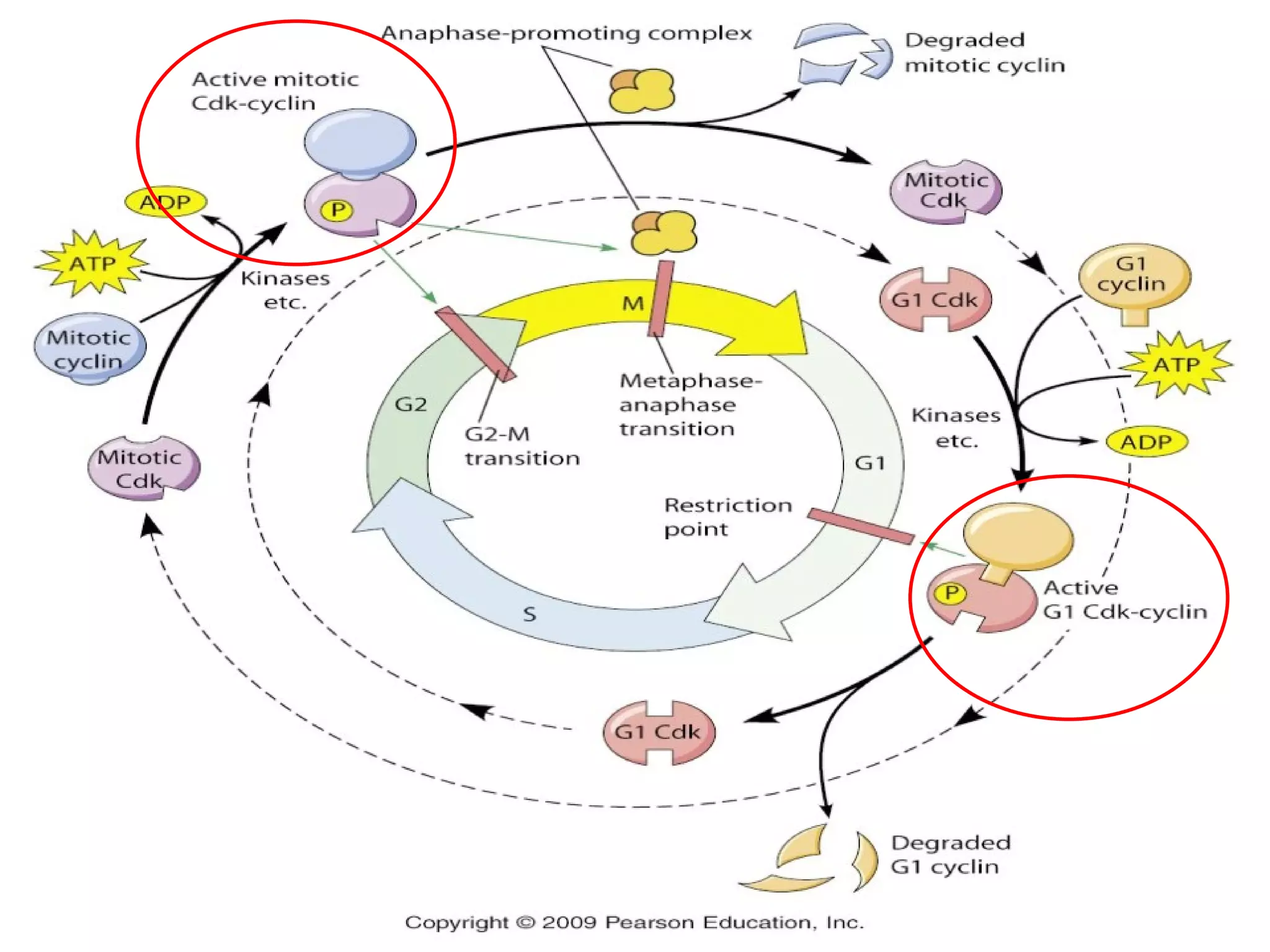
Regulation of the Cell Cycle Events in the cell cycle triggered and coordinated by a  molecular control system Checkpoints  – critical control points where stop and go-ahead signals can regulate the cycle
Restriction Point
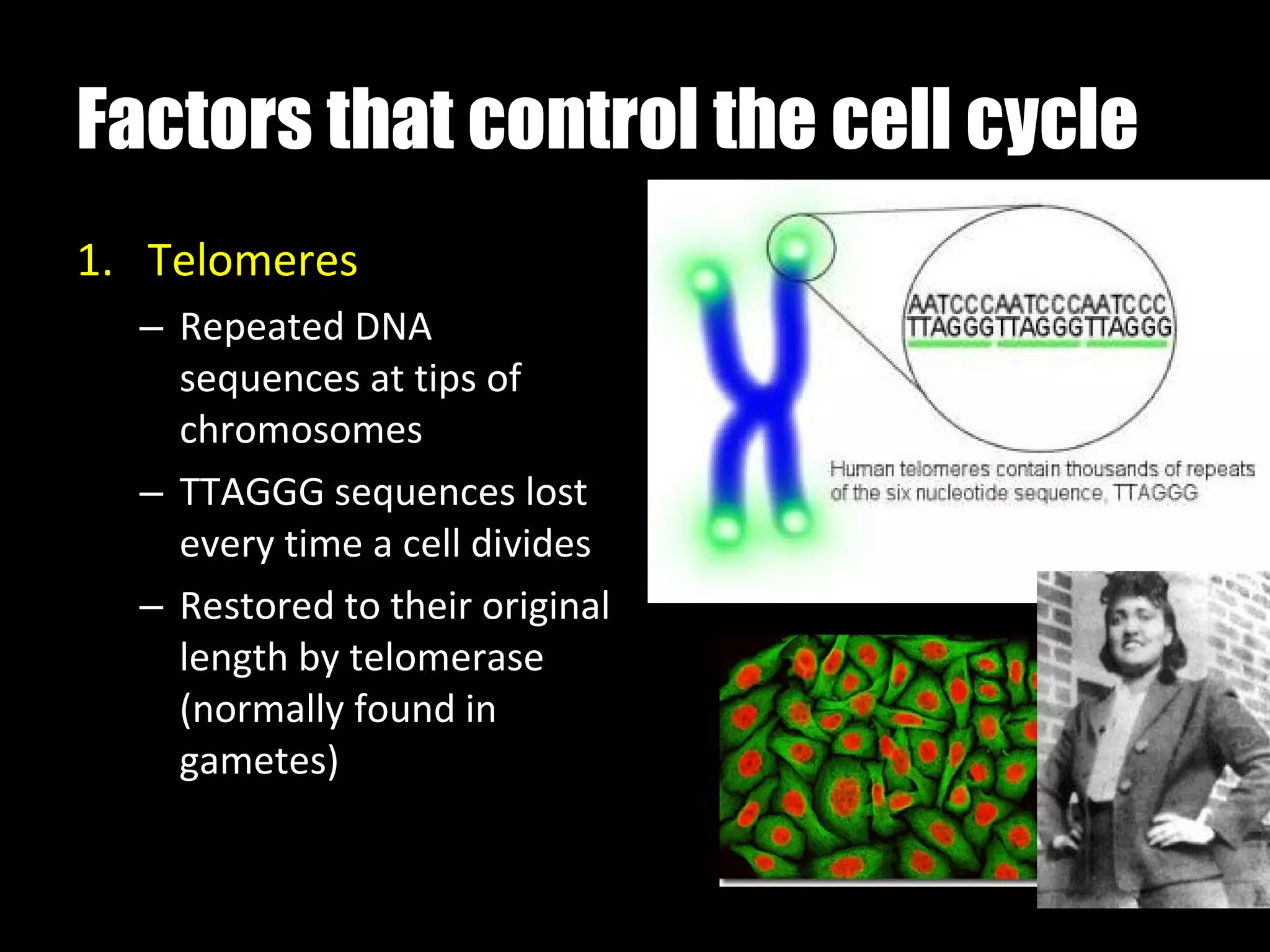
Factors that control the cell cycle Telomeres Repeated DNA sequences at tips of chromosomes TTAGGG sequences lost every time a cell divides Restored to their original length by telomerase (normally found in gametes)
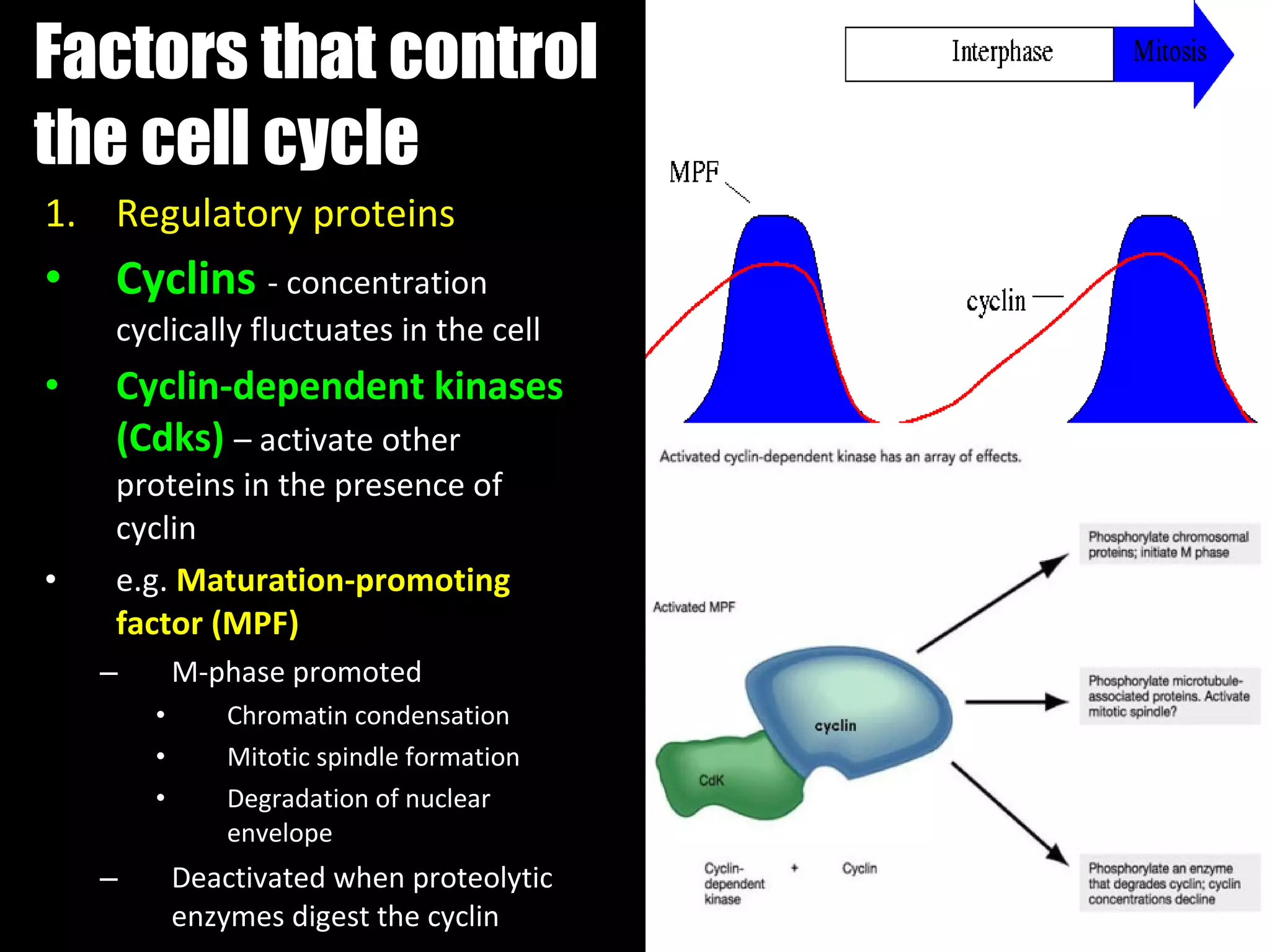
Factors that control the cell cycle Regulatory proteins Cyclins  - concentration cyclically fluctuates in the cell  Cyclin-dependent kinases (Cdks)  – activate other proteins in the presence of cyclin e.g.  Maturation-promoting factor (MPF) M-phase promoted Chromatin condensation Mitotic spindle formation Degradation of nuclear envelope Deactivated when proteolytic enzymes digest the cyclin
 
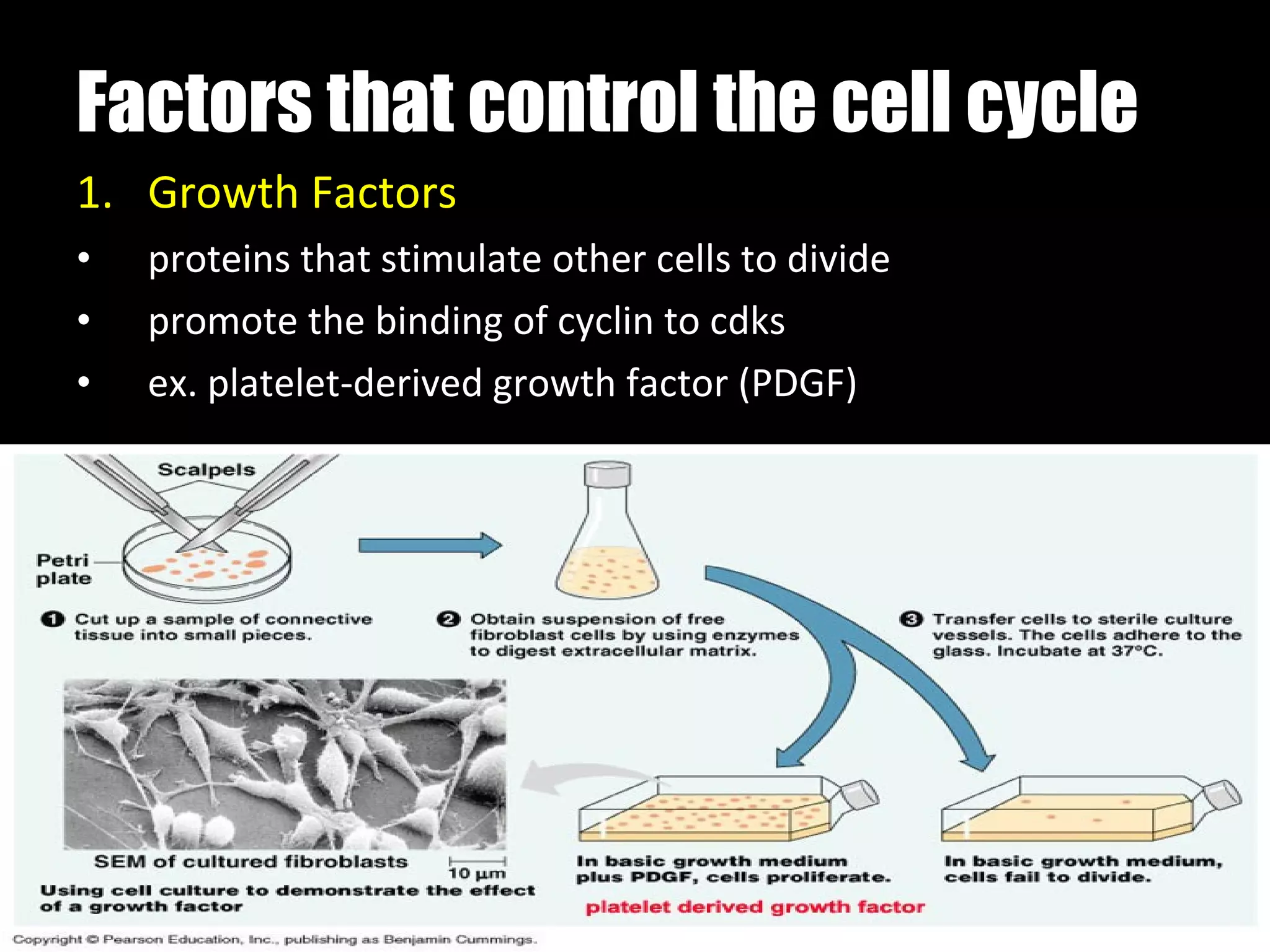
Factors that control the cell cycle Growth Factors proteins that stimulate other cells to divide  promote the binding of cyclin to cdks ex. platelet-derived growth factor (PDGF)
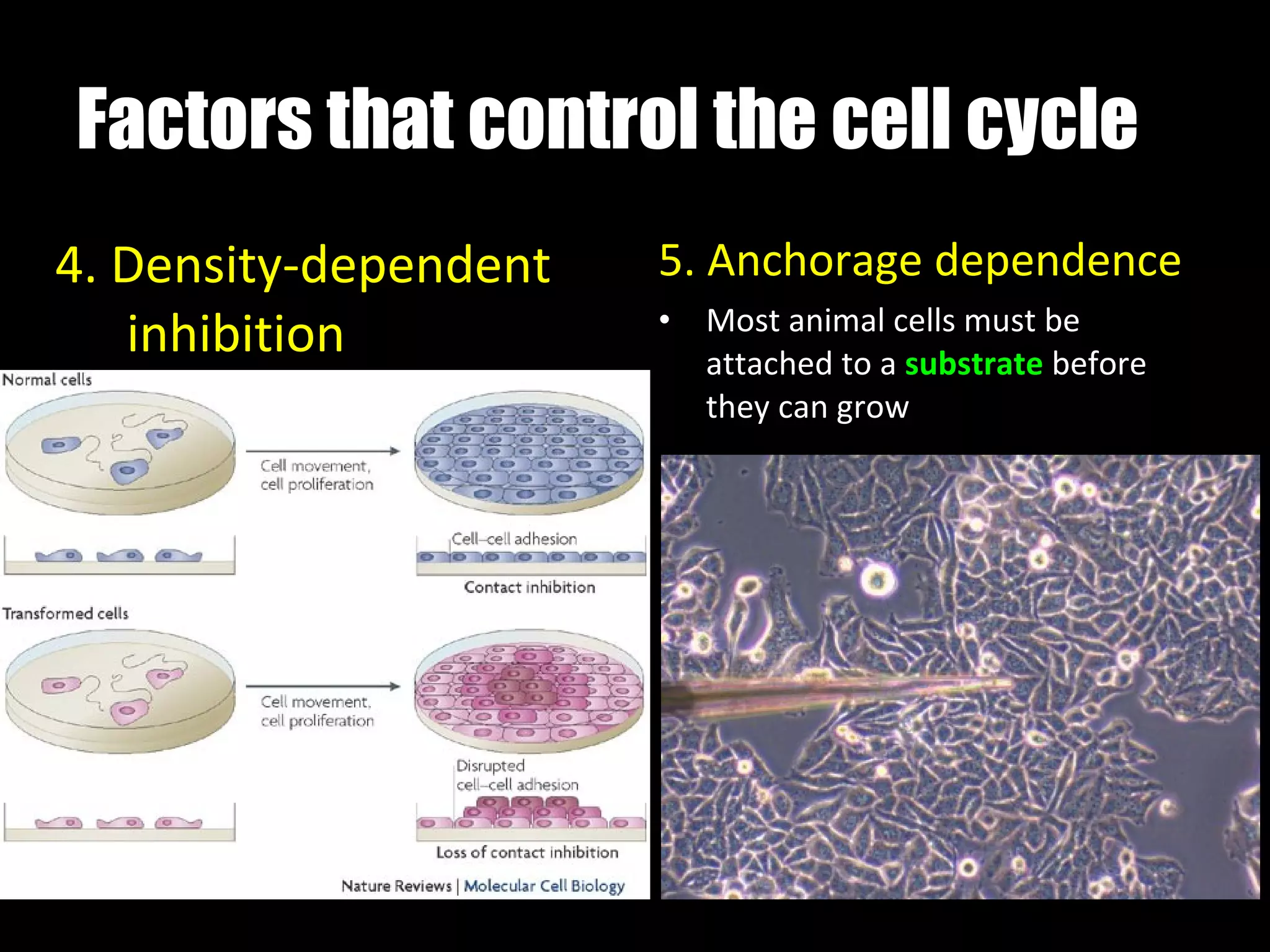
Factors that control the cell cycle 4. Density-dependent inhibition 5. Anchorage dependence Most animal cells must be attached to a  substrate  before they can grow
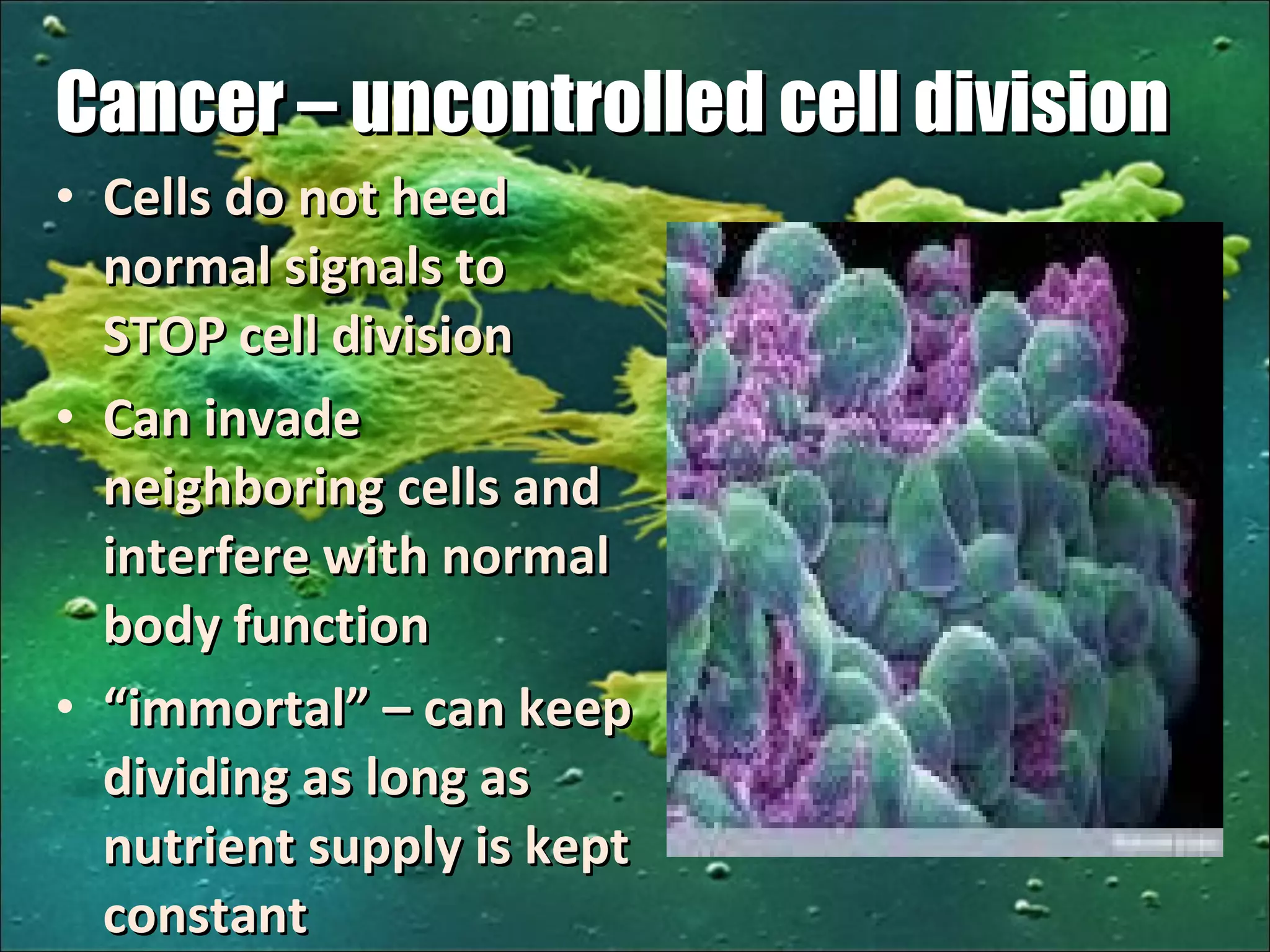
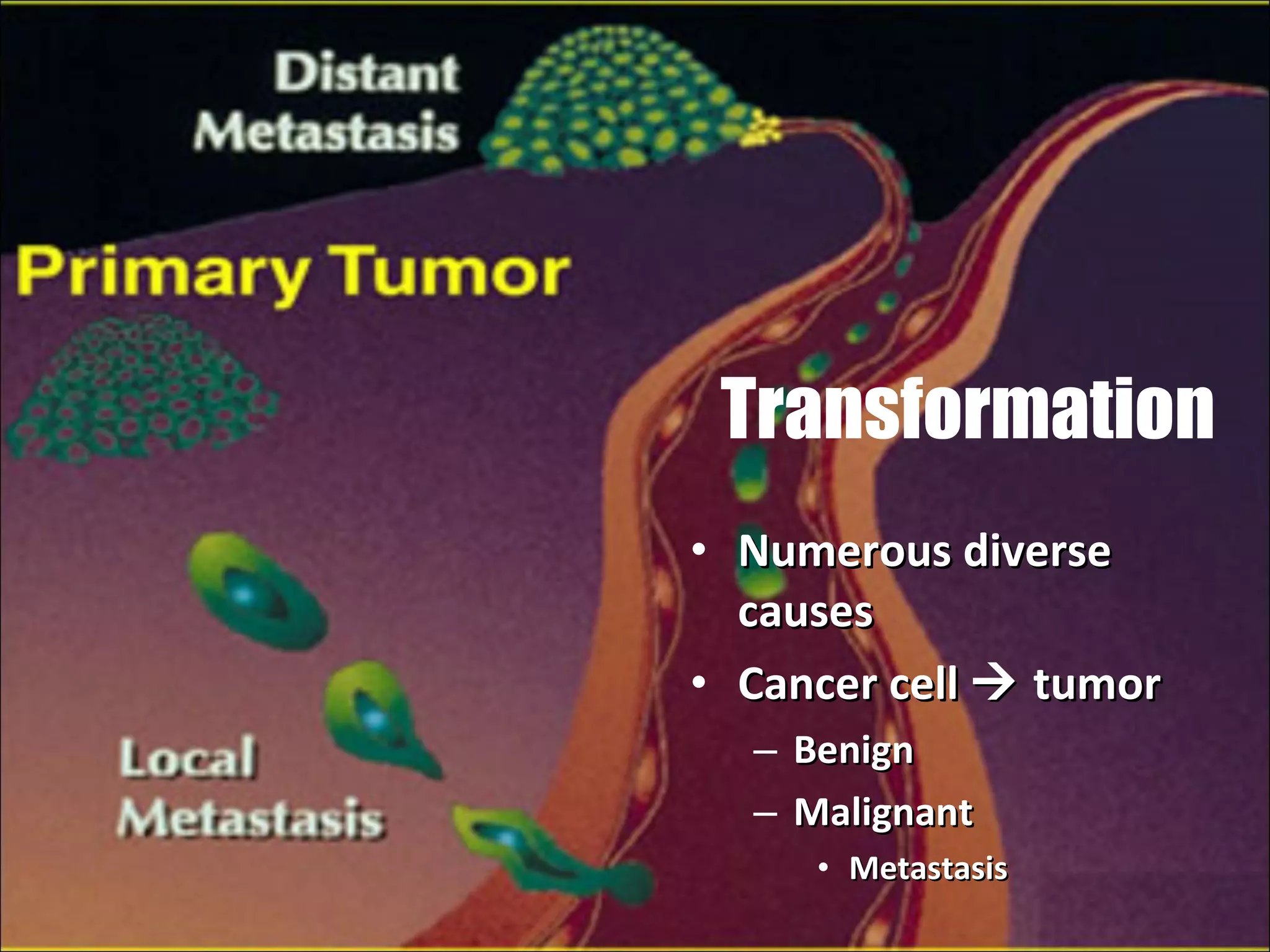
Cancer – uncontrolled cell division Cells do not heed normal signals to STOP cell division Can invade neighboring cells and interfere with normal body function “ immortal” – can keep dividing as long as nutrient supply is kept constant
Transformation Numerous diverse causes Cancer cell    tumor Benign Malignant Metastasis
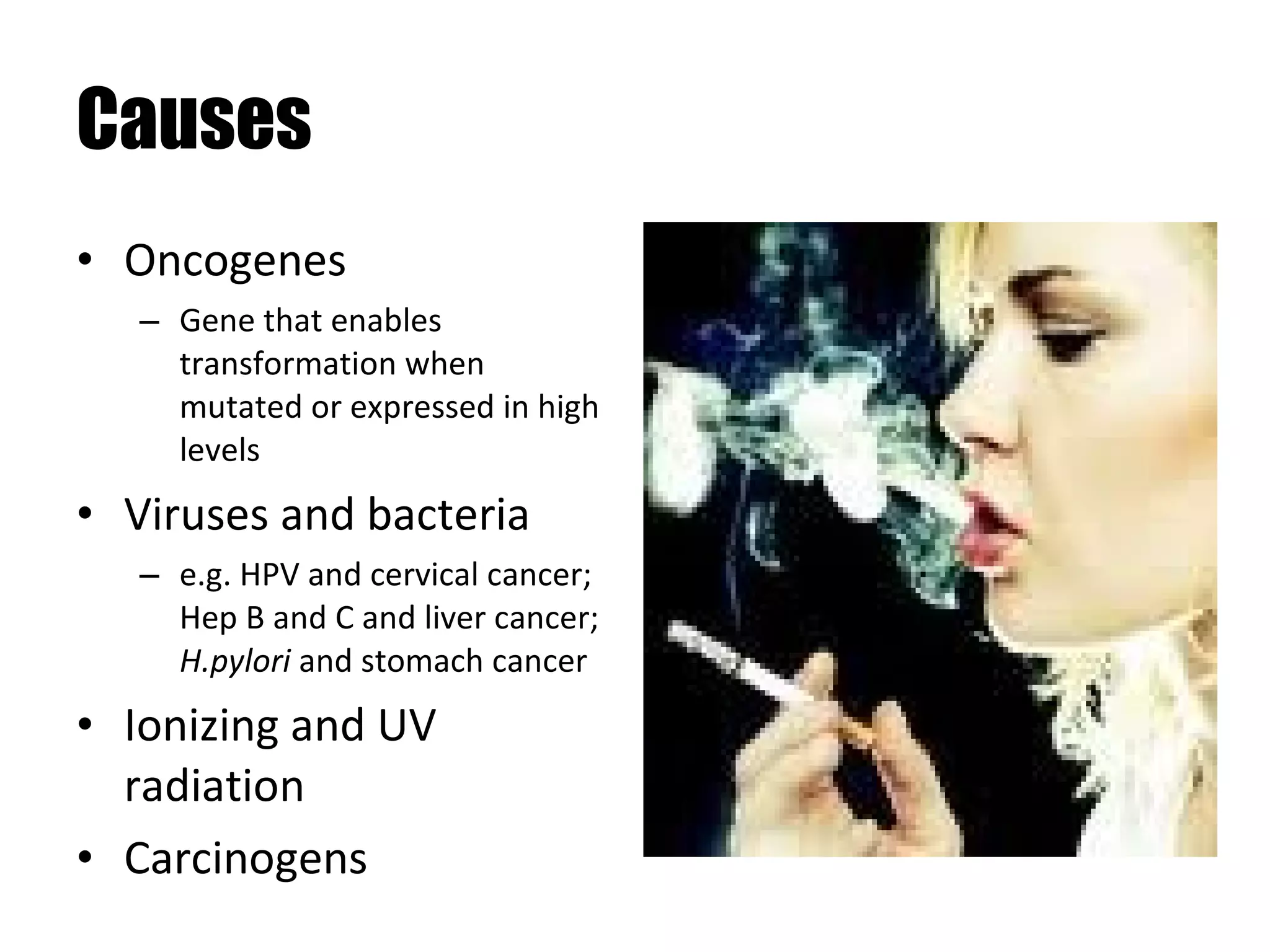
Causes Oncogenes Gene that enables transformation when mutated or expressed in high levels Viruses and bacteria e.g. HPV and cervical cancer; Hep B and C and liver cancer;  H.pylori  and stomach cancer Ionizing and UV radiation Carcinogens
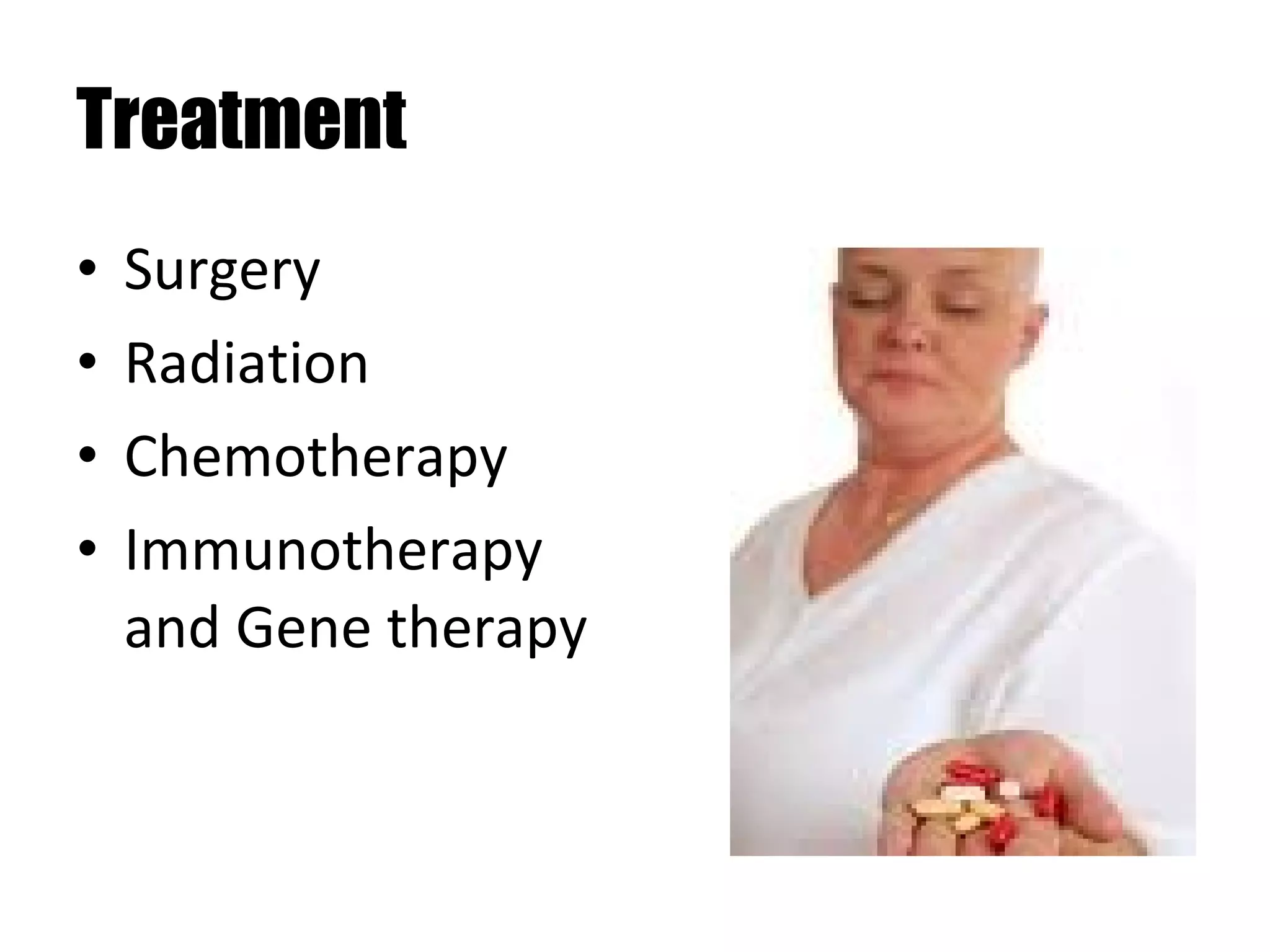
Treatment Surgery Radiation Chemotherapy Immunotherapy and Gene therapy
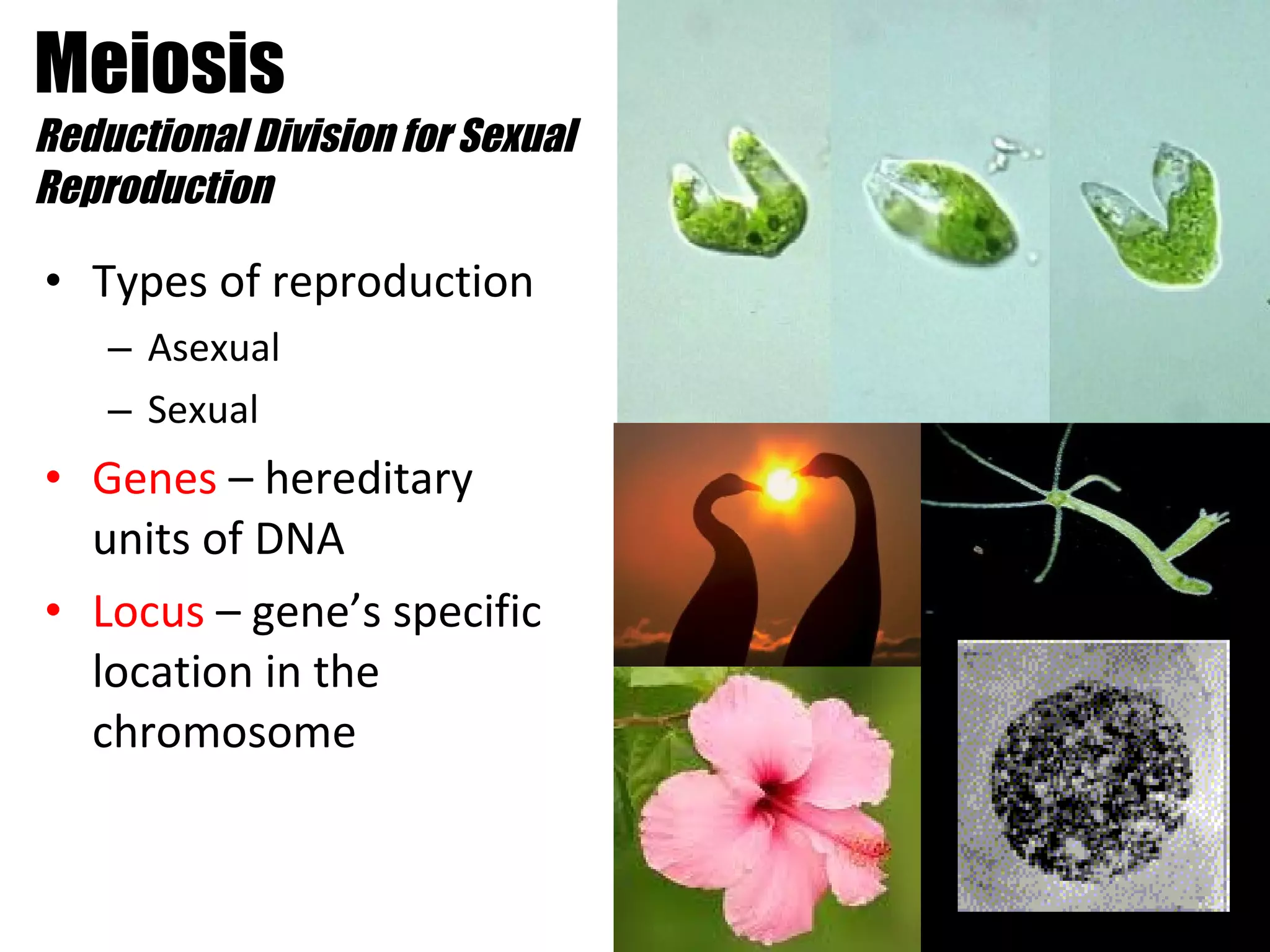
Meiosis Reductional Division for Sexual Reproduction Types of reproduction Asexual Sexual Genes  – hereditary units of DNA Locus  – gene’s specific location in the chromosome
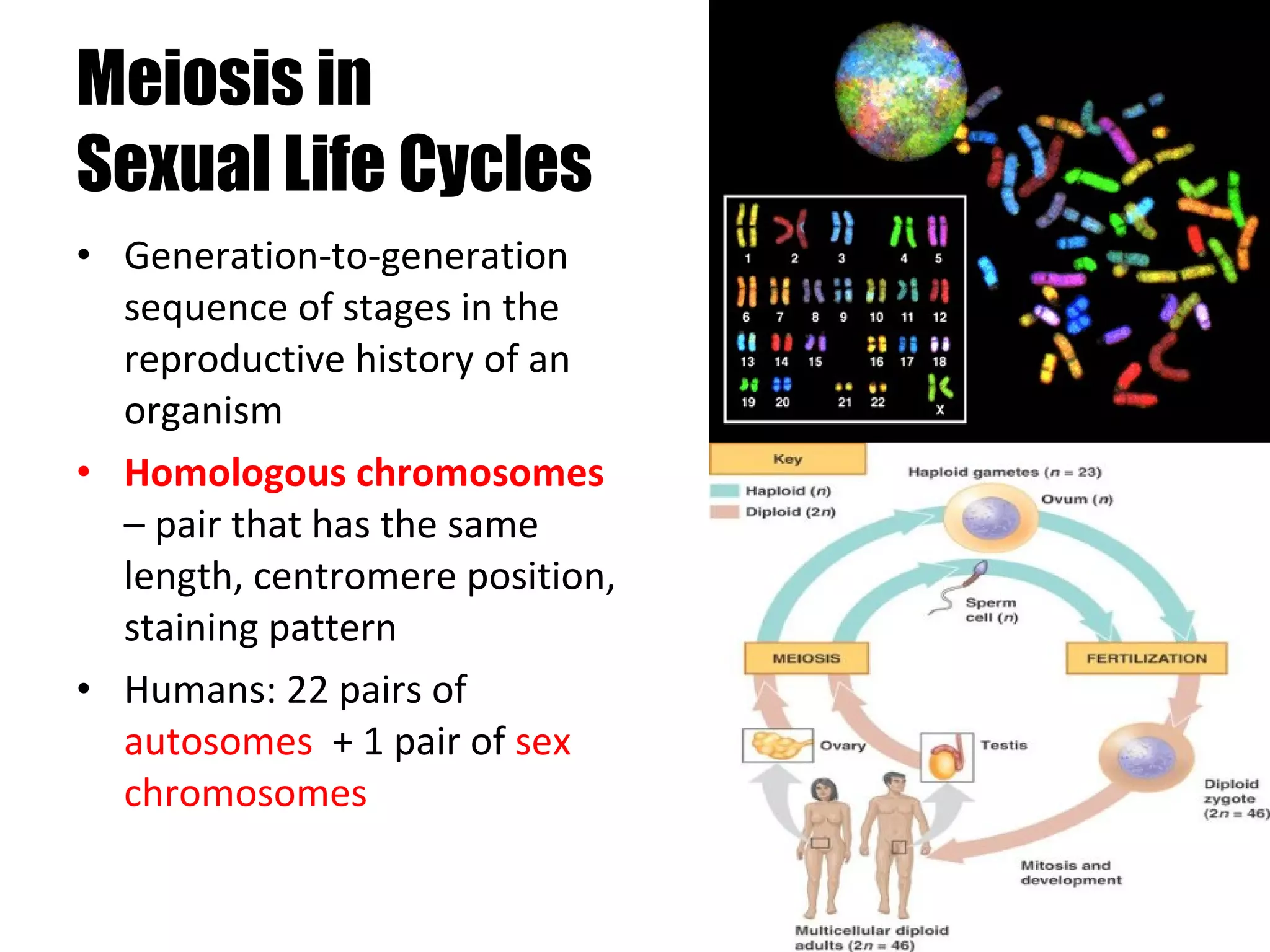
Meiosis in  Sexual Life Cycles Generation-to-generation sequence of stages in the reproductive history of an organism Homologous chromosomes  – pair that has the same length, centromere position, staining pattern Humans: 22 pairs of  autosomes   + 1 pair of  sex chromosomes
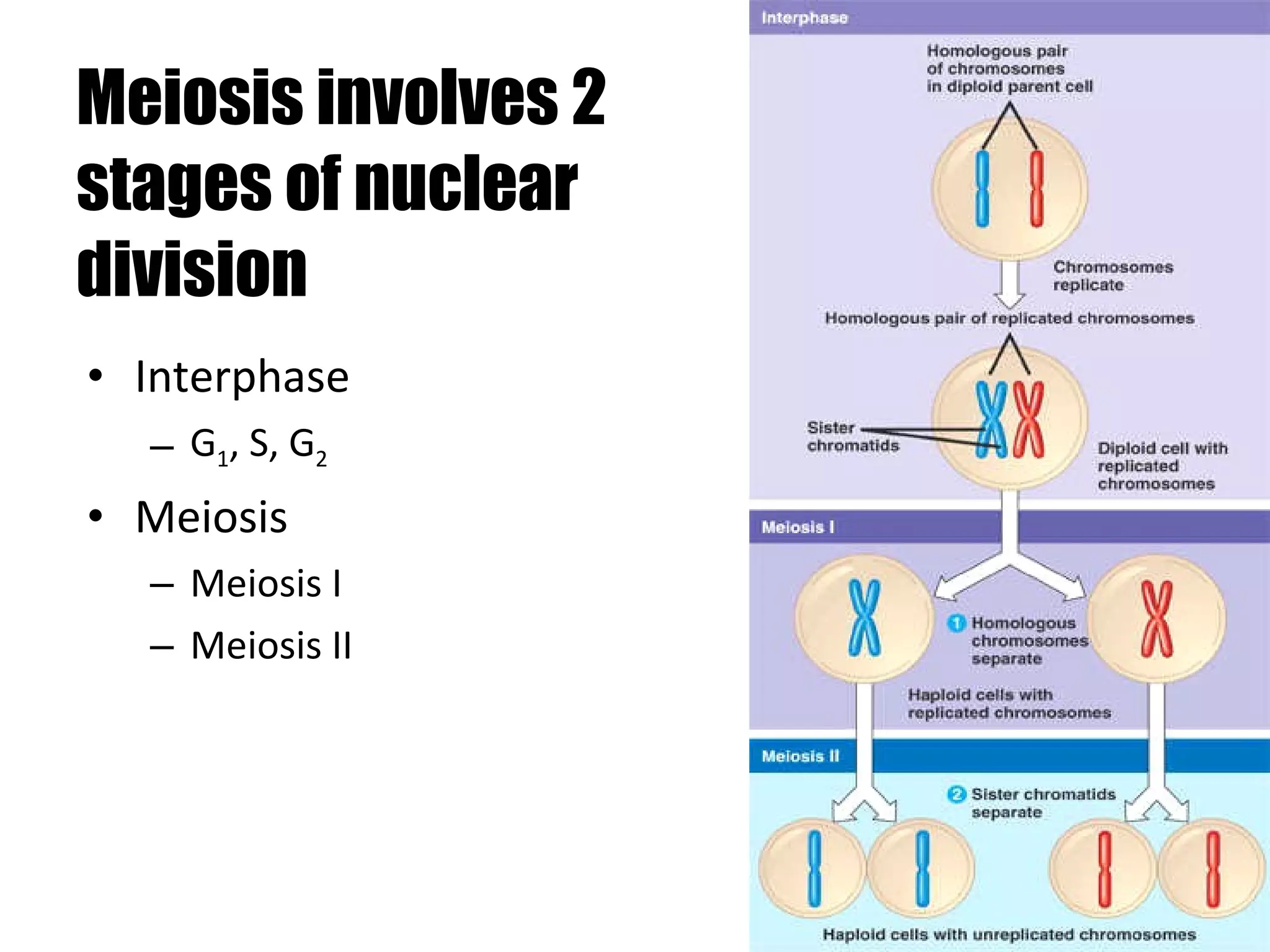
Meiosis involves 2 stages of nuclear division Interphase G 1 , S, G 2 Meiosis Meiosis I Meiosis II
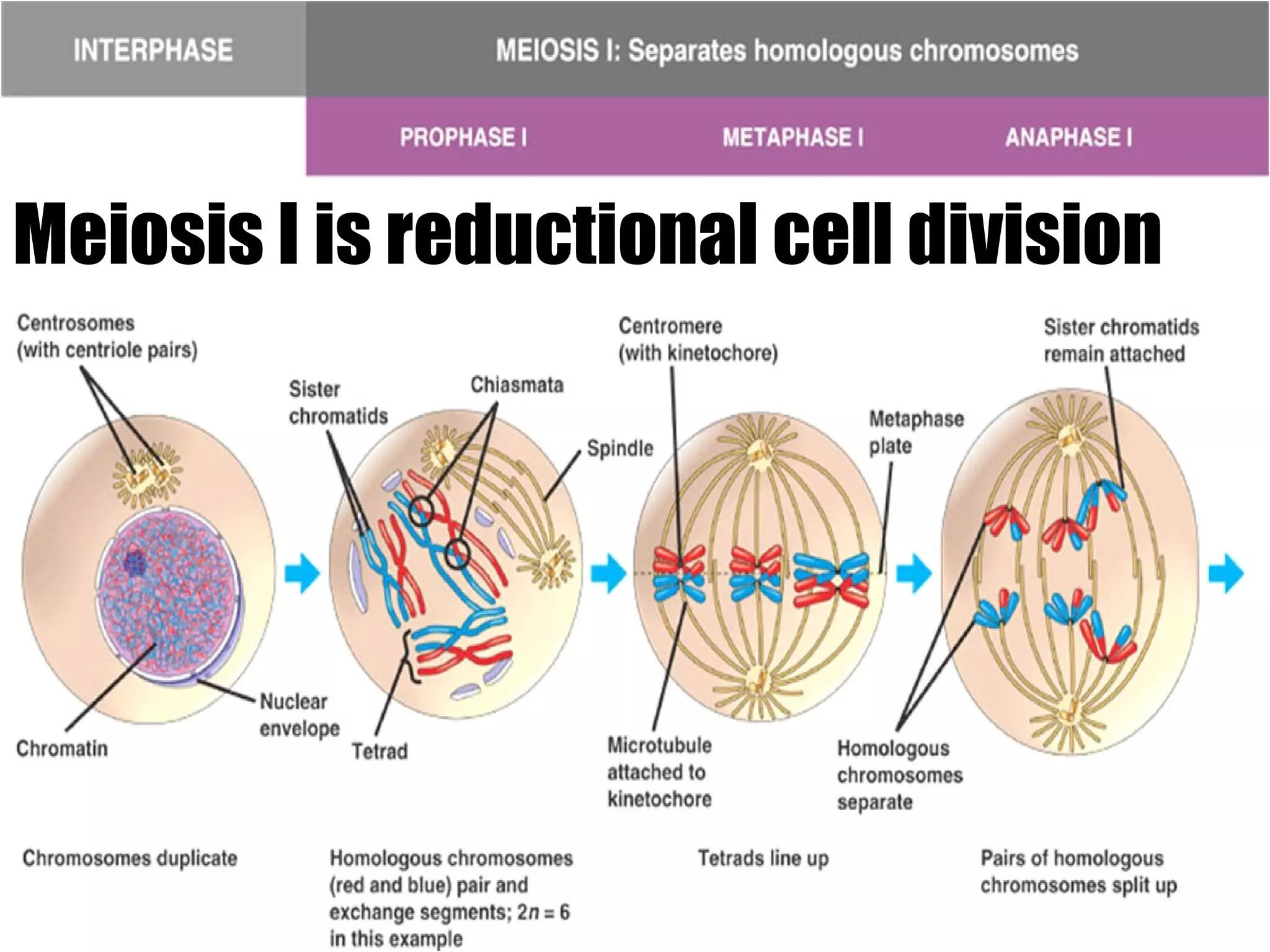
Meiosis I is reductional cell division
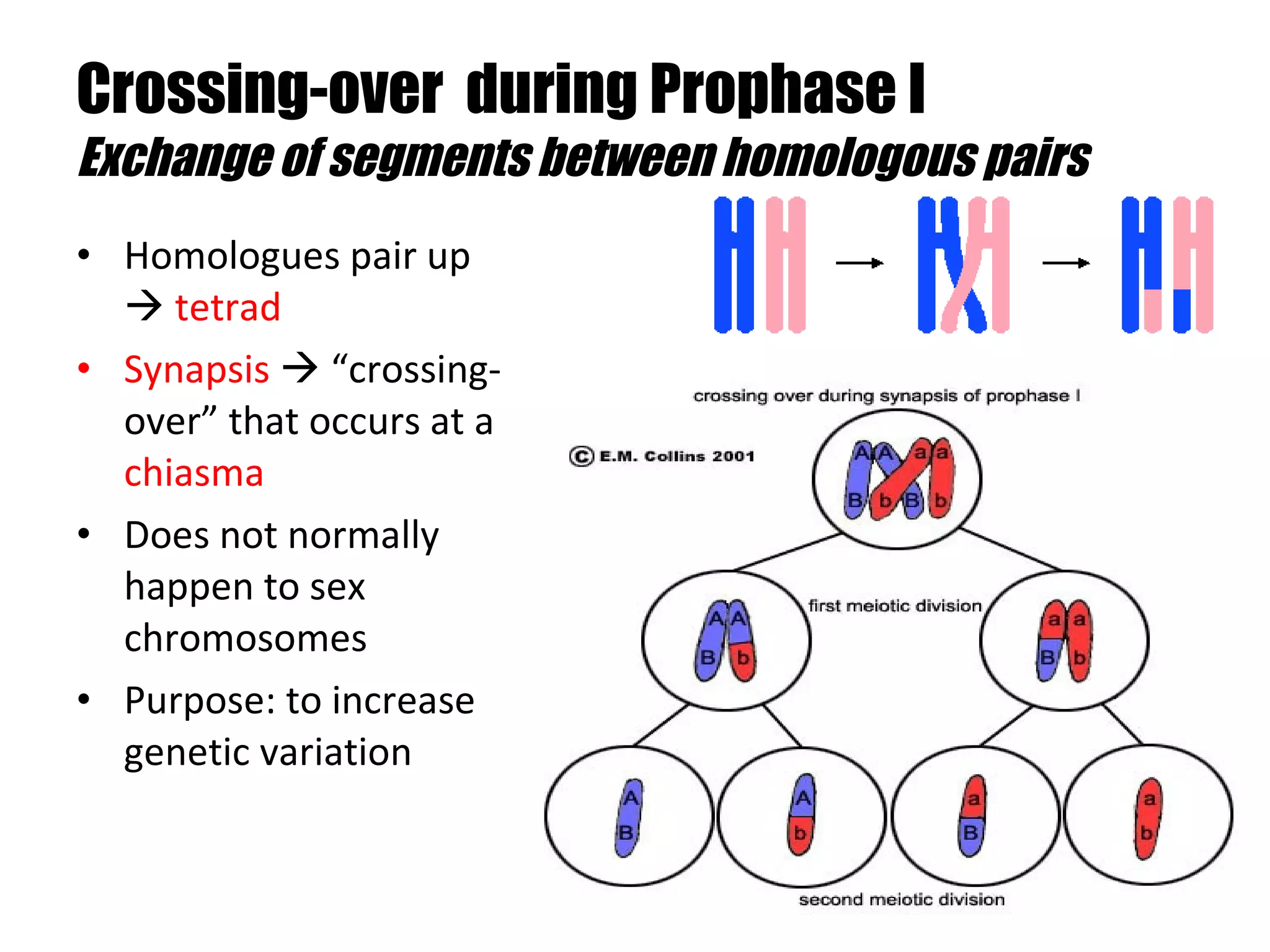
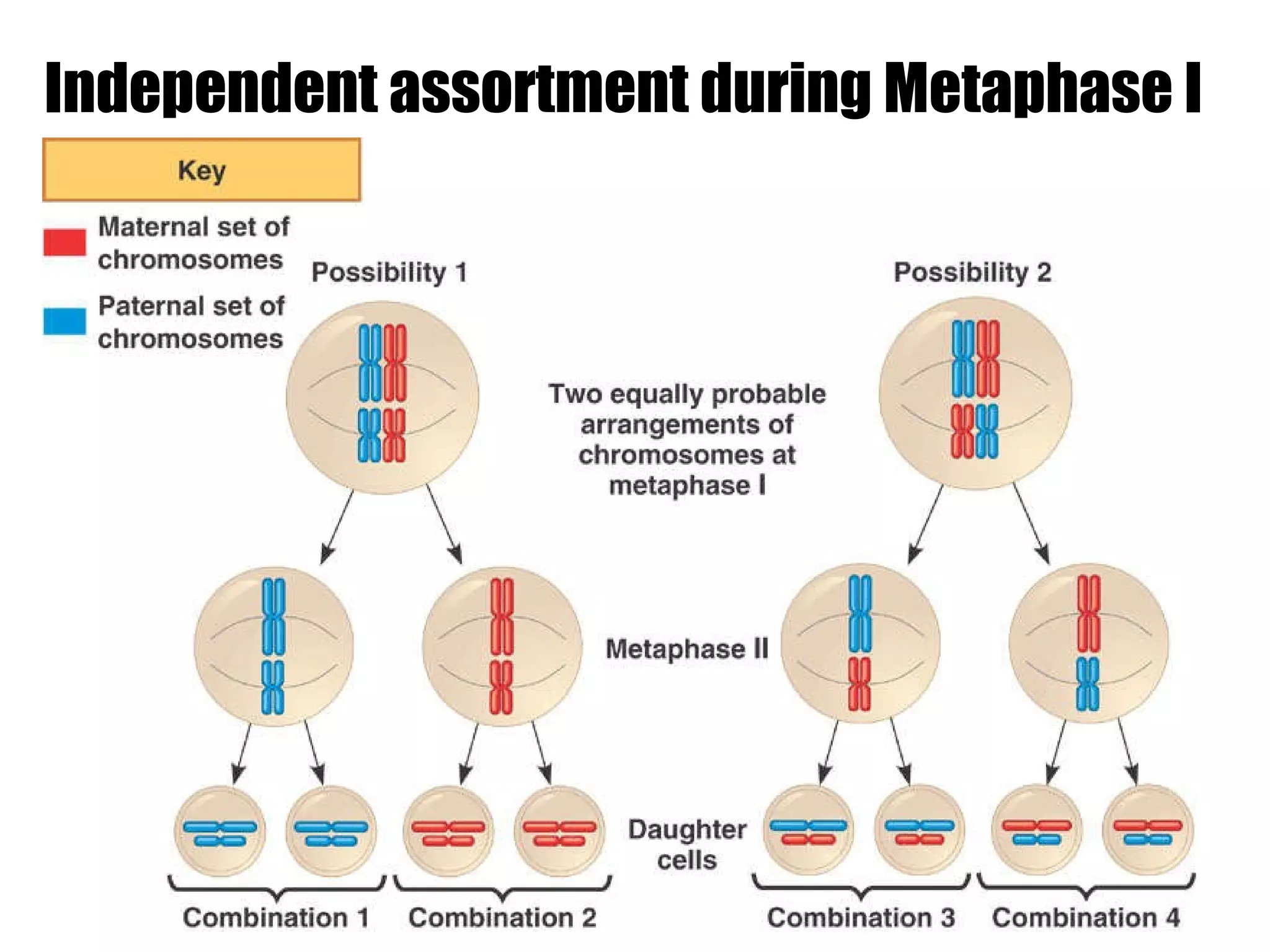
Crossing-over  during Prophase I Exchange of segments between homologous pairs  Homologues pair up     tetrad Synapsis     “crossing-over” that occurs at a  chiasma Does not normally happen to sex chromosomes Purpose: to increase genetic variation
Independent assortment during Metaphase I
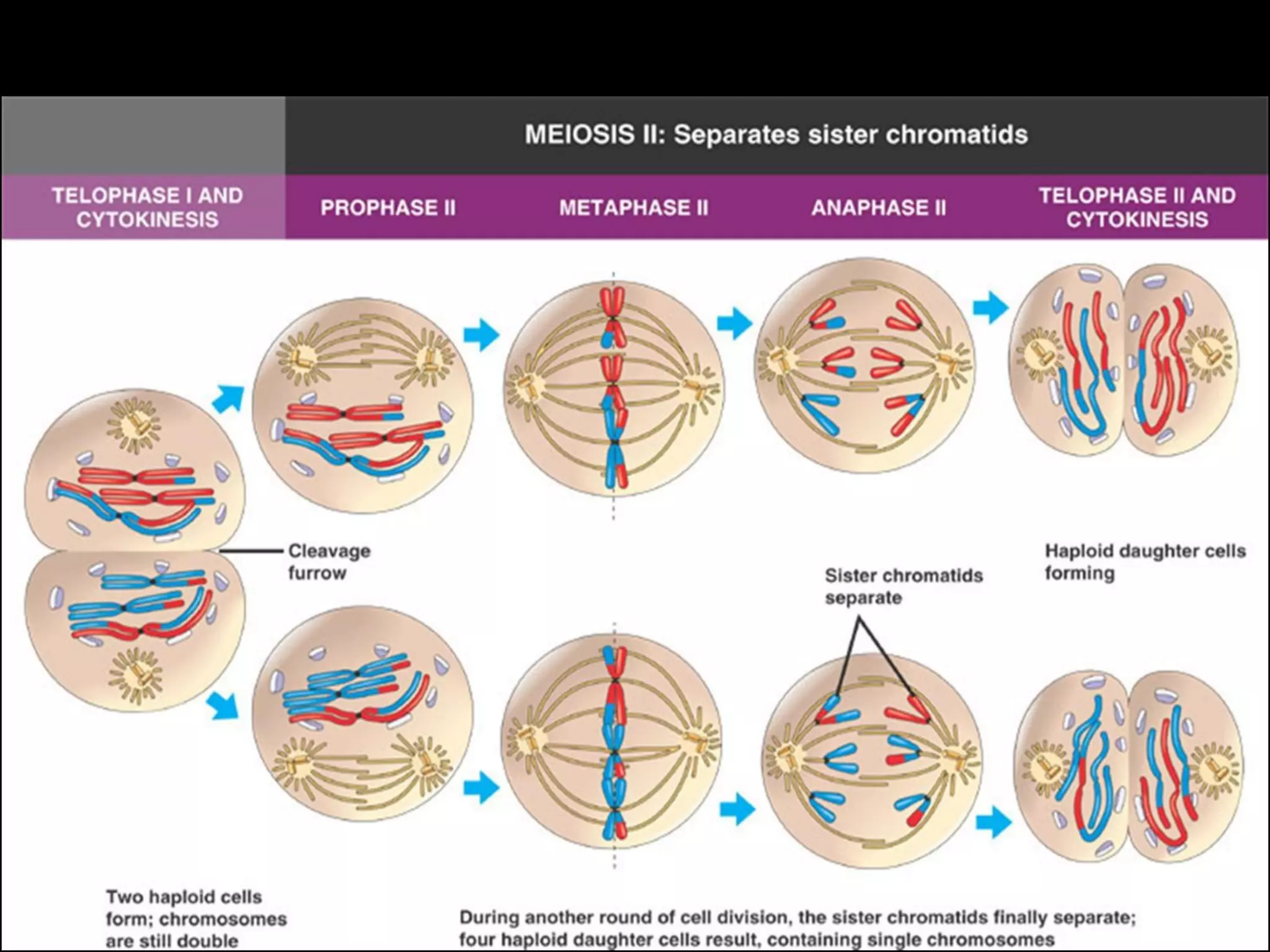
Meiosis II is equational cell division
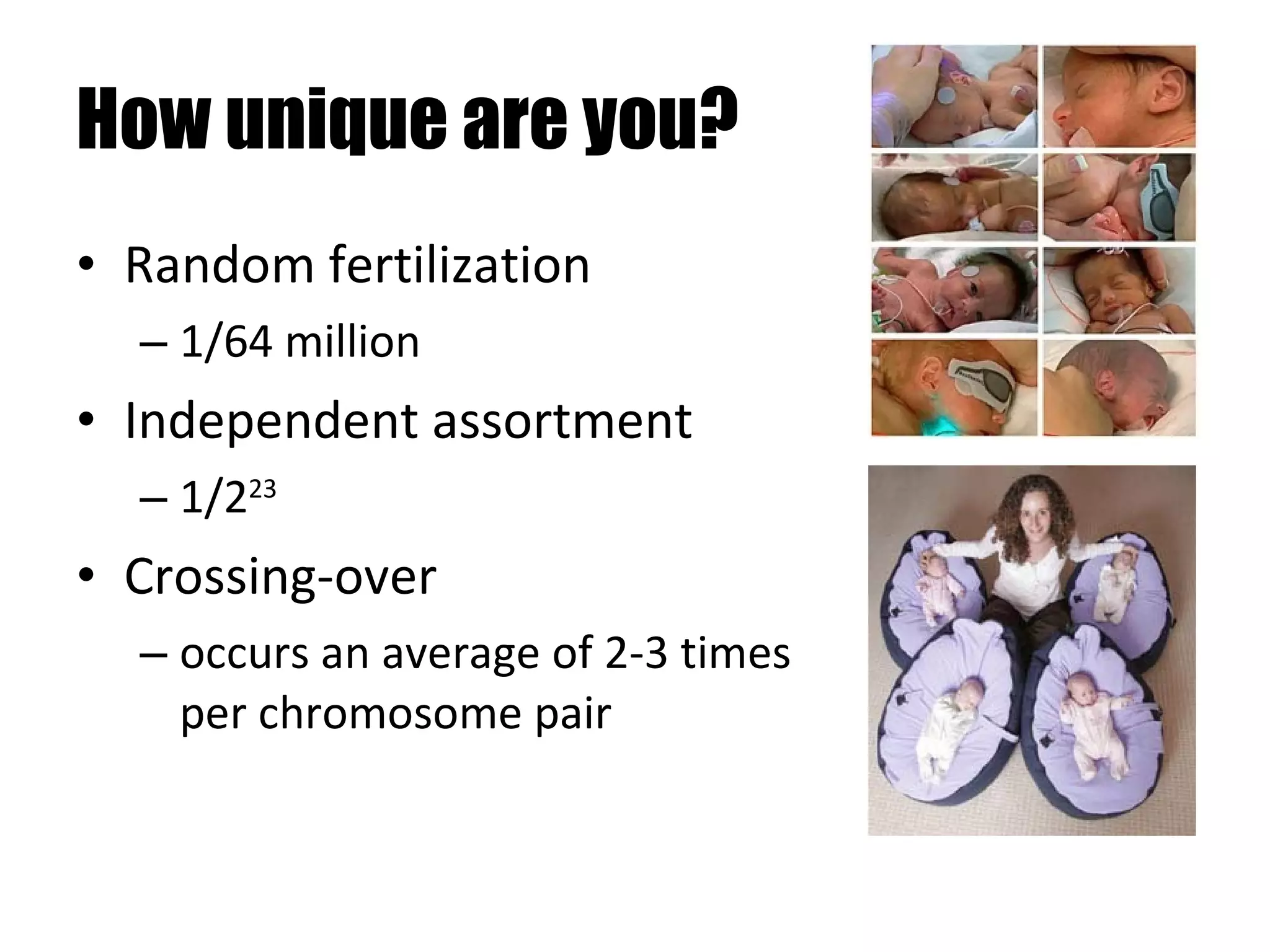
How unique are you? Random fertilization 1/64 million Independent assortment 1/2 23 Crossing-over occurs an average of 2-3 times per chromosome pair
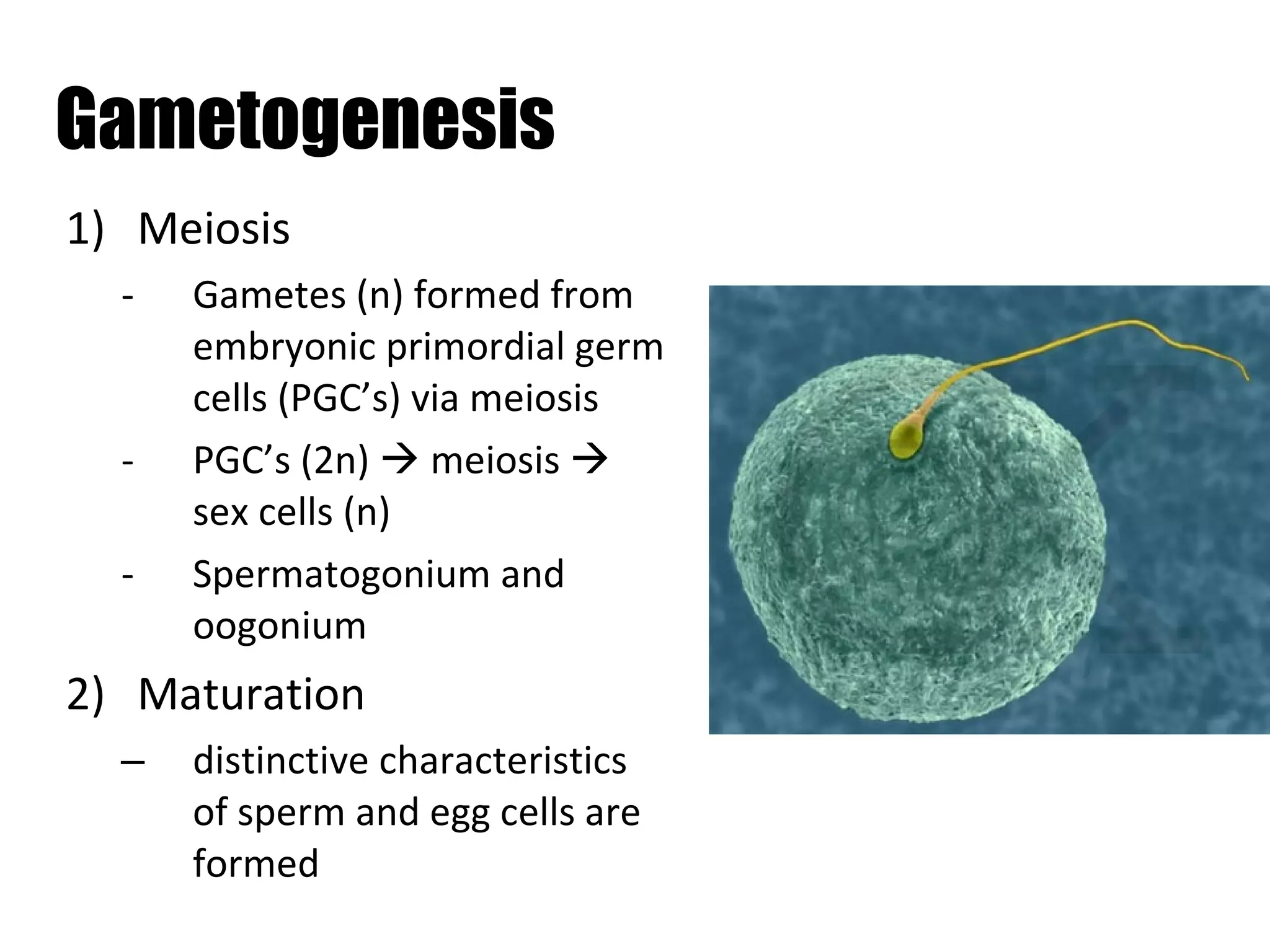
Gametogenesis Meiosis Gametes (n) formed from embryonic primordial germ cells (PGC’s) via meiosis PGC’s (2n)    meiosis    sex cells (n) Spermatogonium and oogonium Maturation distinctive characteristics of sperm and egg cells are  formed
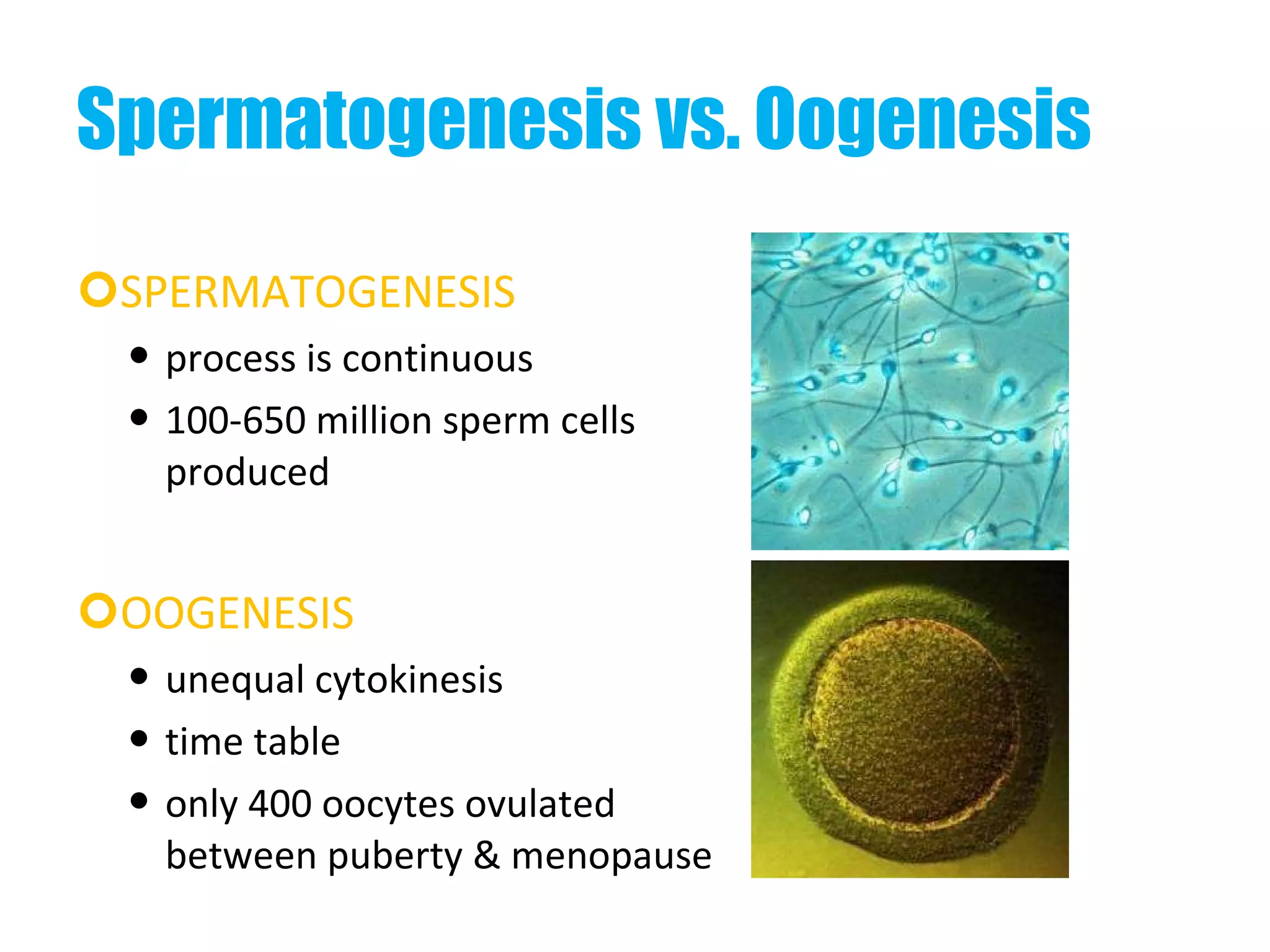
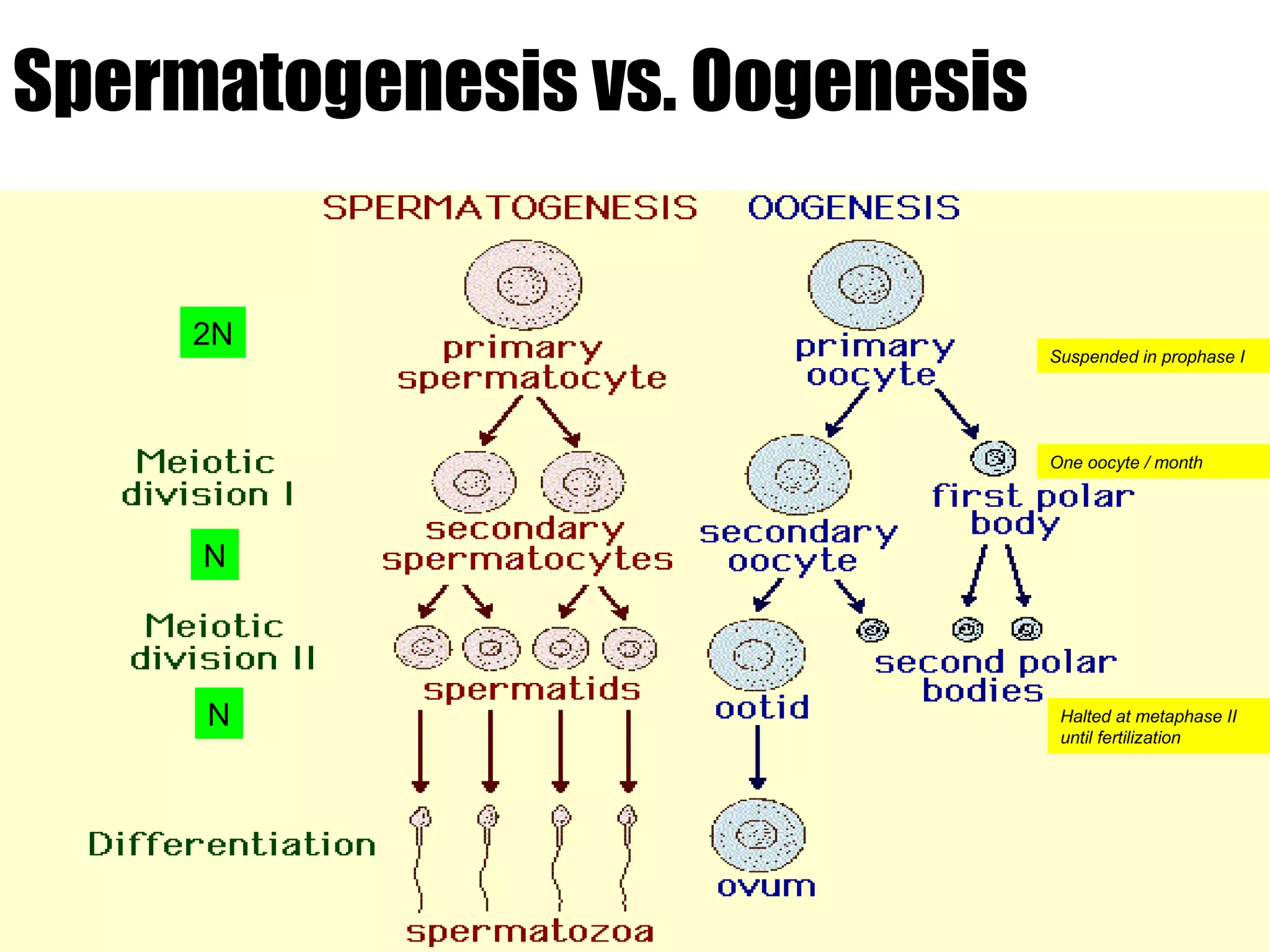
Spermatogenesis vs. Oogenesis SPERMATOGENESIS process is continuous 100-650 million sperm cells produced OOGENESIS unequal cytokinesis time table only 400 oocytes ovulated between puberty & menopause
Spermatogenesis vs. Oogenesis Suspended in prophase I One oocyte / month Halted at metaphase II until fertilization 2N N N
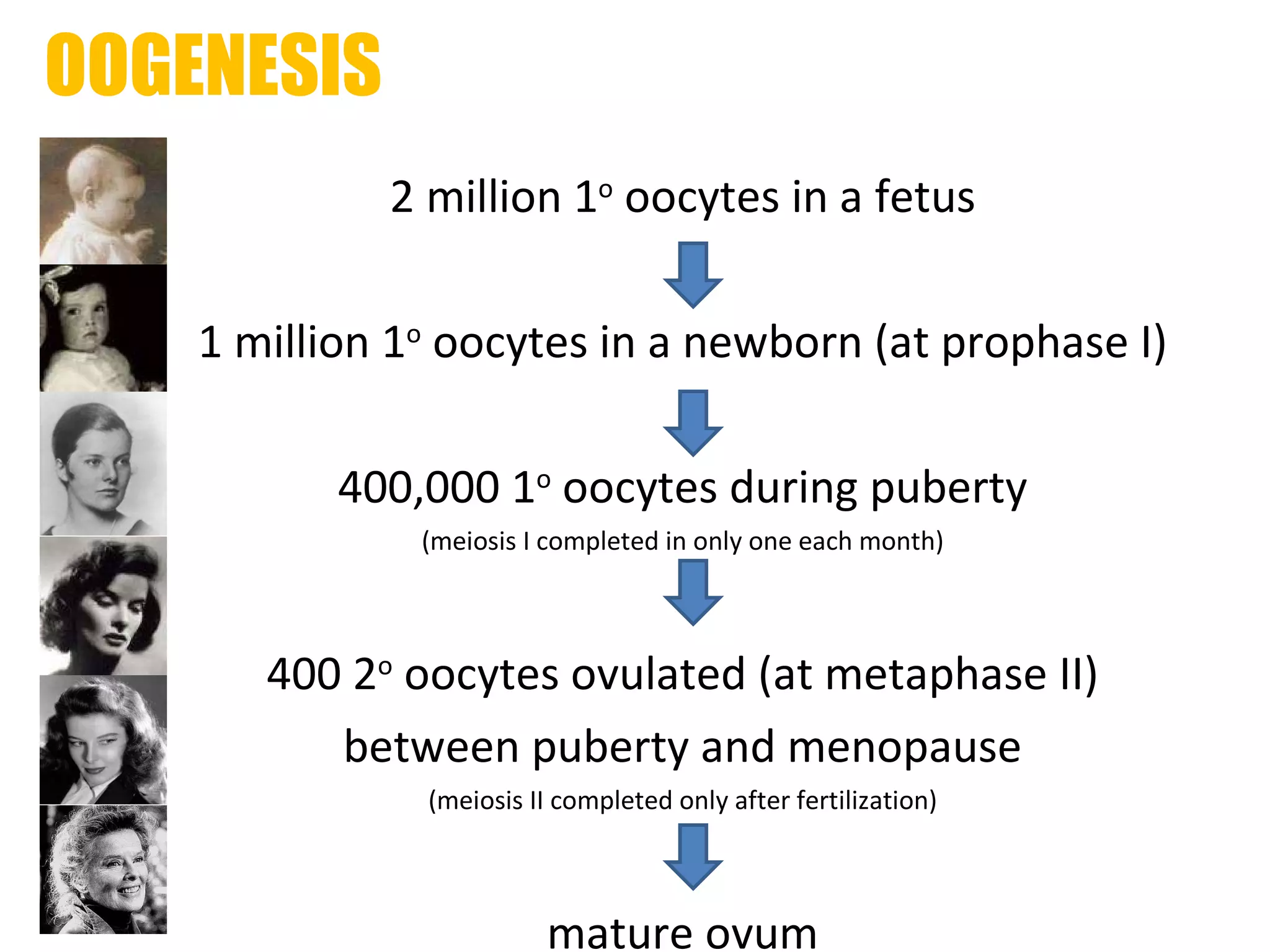
OOGENESIS 2 million 1 o  oocytes in a fetus 1 million 1 o  oocytes in a newborn (at prophase I) 400,000 1 o  oocytes during puberty (meiosis I completed in only one each month) 400 2 o  oocytes ovulated (at metaphase II) between puberty and menopause (meiosis II completed only after fertilization) mature ovum
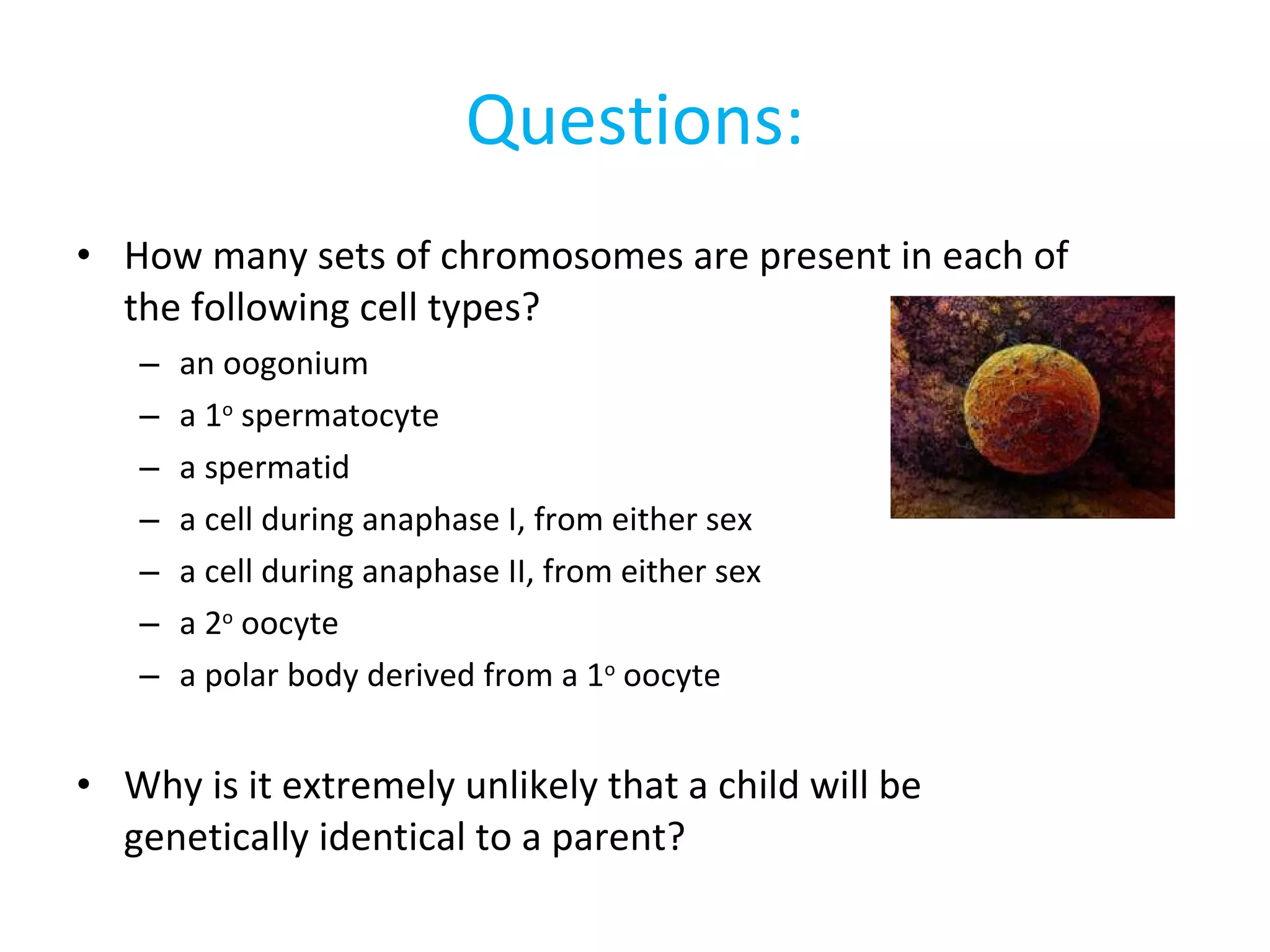
Questions: How many sets of chromosomes are present in each of the following cell types? an oogonium a 1 o  spermatocyte a spermatid a cell during anaphase I, from either sex a cell during anaphase II, from either sex a 2 o  oocyte a polar body derived from a 1 o  oocyte Why is it extremely unlikely that a child will be genetically identical to a parent?
Questions: How do the structures of the male and female gametes aid in their functions? A woman who is about 4 weeks pregnant suddenly begins to bleed and pass some tissue through her vagina.  After a physician examines the material, he explains to her that a sperm fertilized a polar body instead of an ovum, and an embryo could not develop.  What has happened?  Why do you think a polar body cannot support the development of an embryo, whereas an ovum, which is genetically identical to it, can?
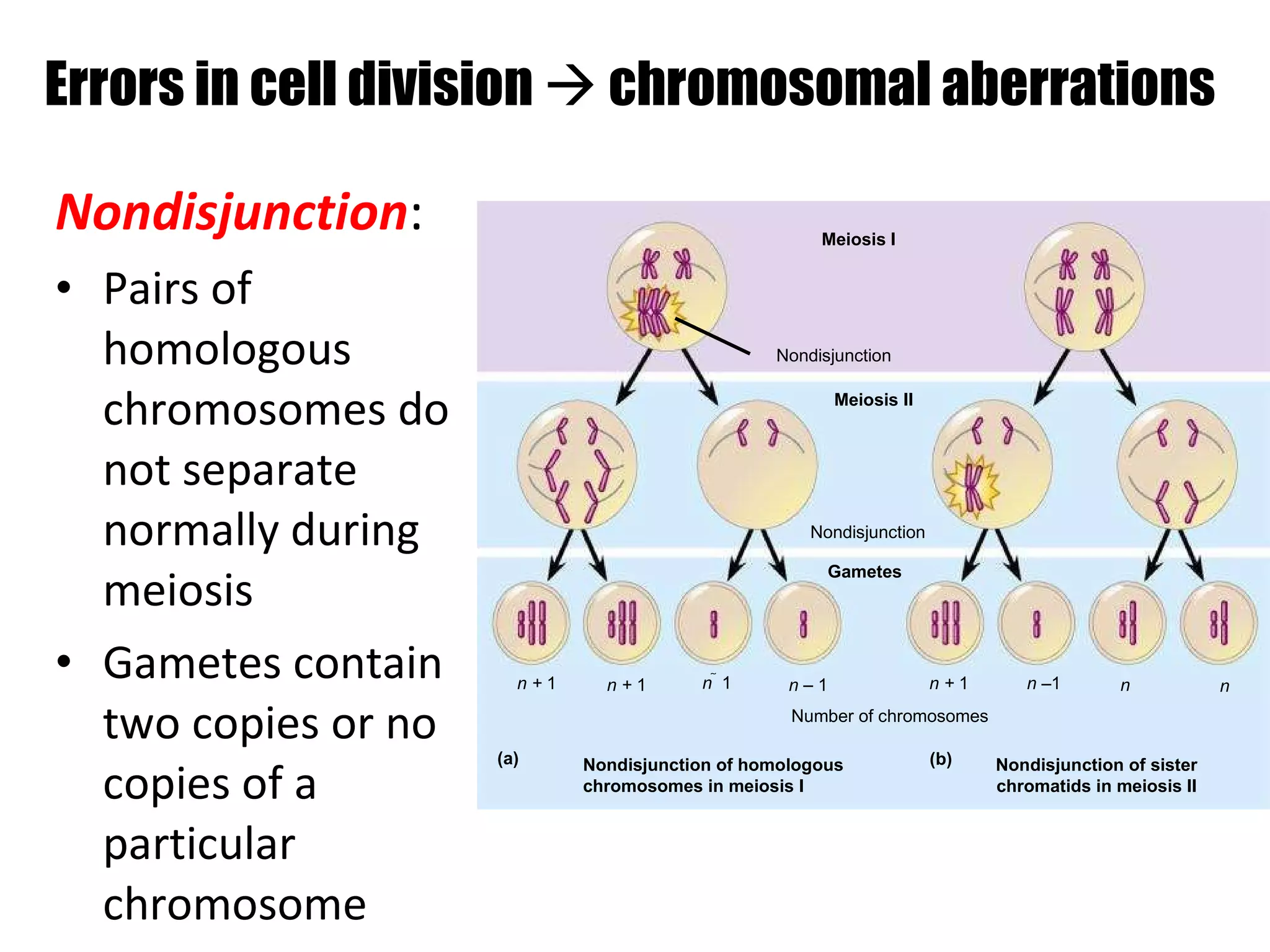
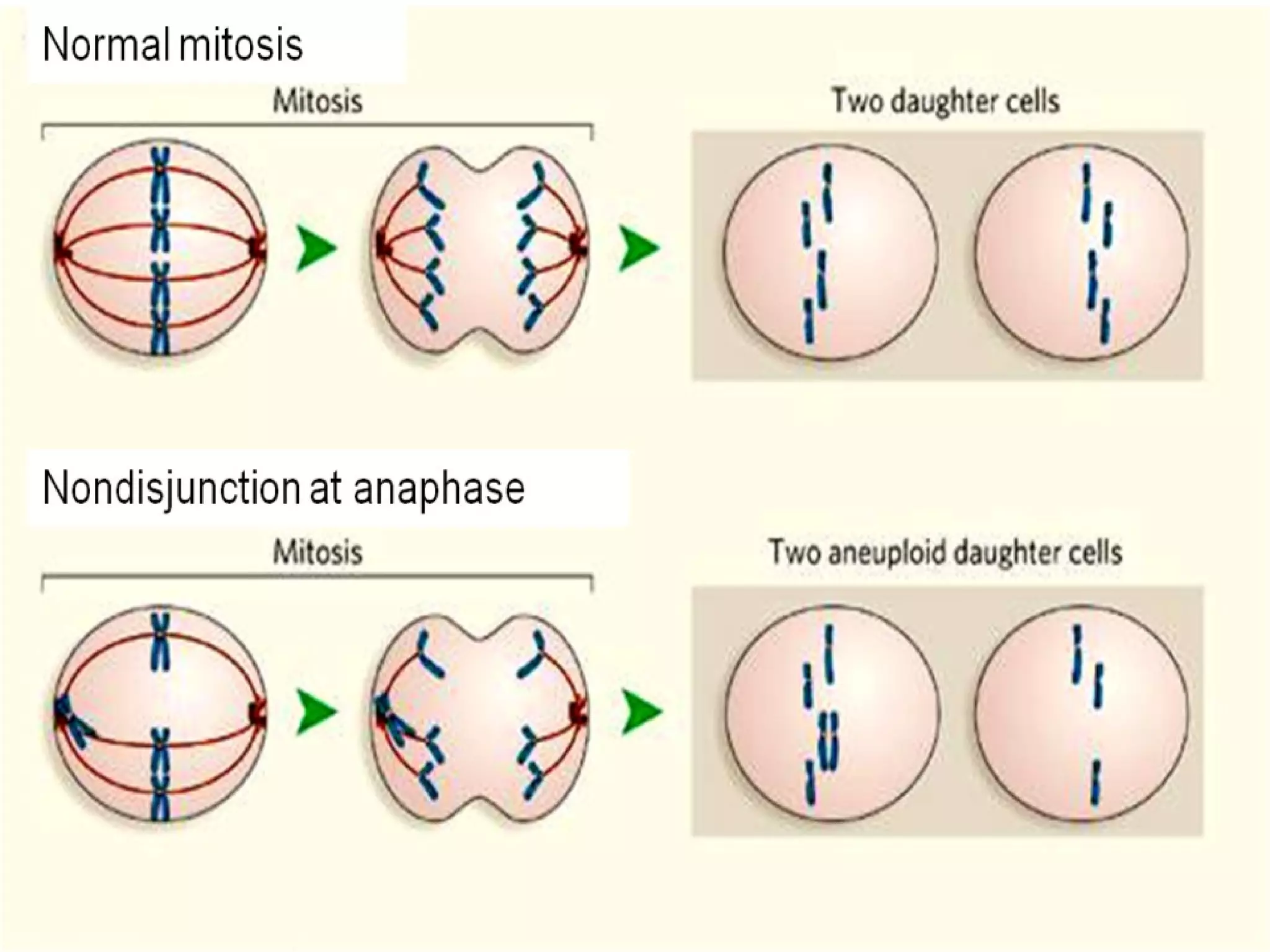
Errors in cell division    chromosomal aberrations Nondisjunction : Pairs of homologous chromosomes do not separate normally during meiosis Gametes contain two copies or no copies of a particular chromosome Meiosis I Nondisjunction Meiosis II Nondisjunction Gametes n +  1 n +  1 n   1 n –  1 n +  1 n – 1 n n Number of chromosomes Nondisjunction of homologous chromosomes in meiosis I Nondisjunction of sister chromatids in meiosis II (a) (b)
 
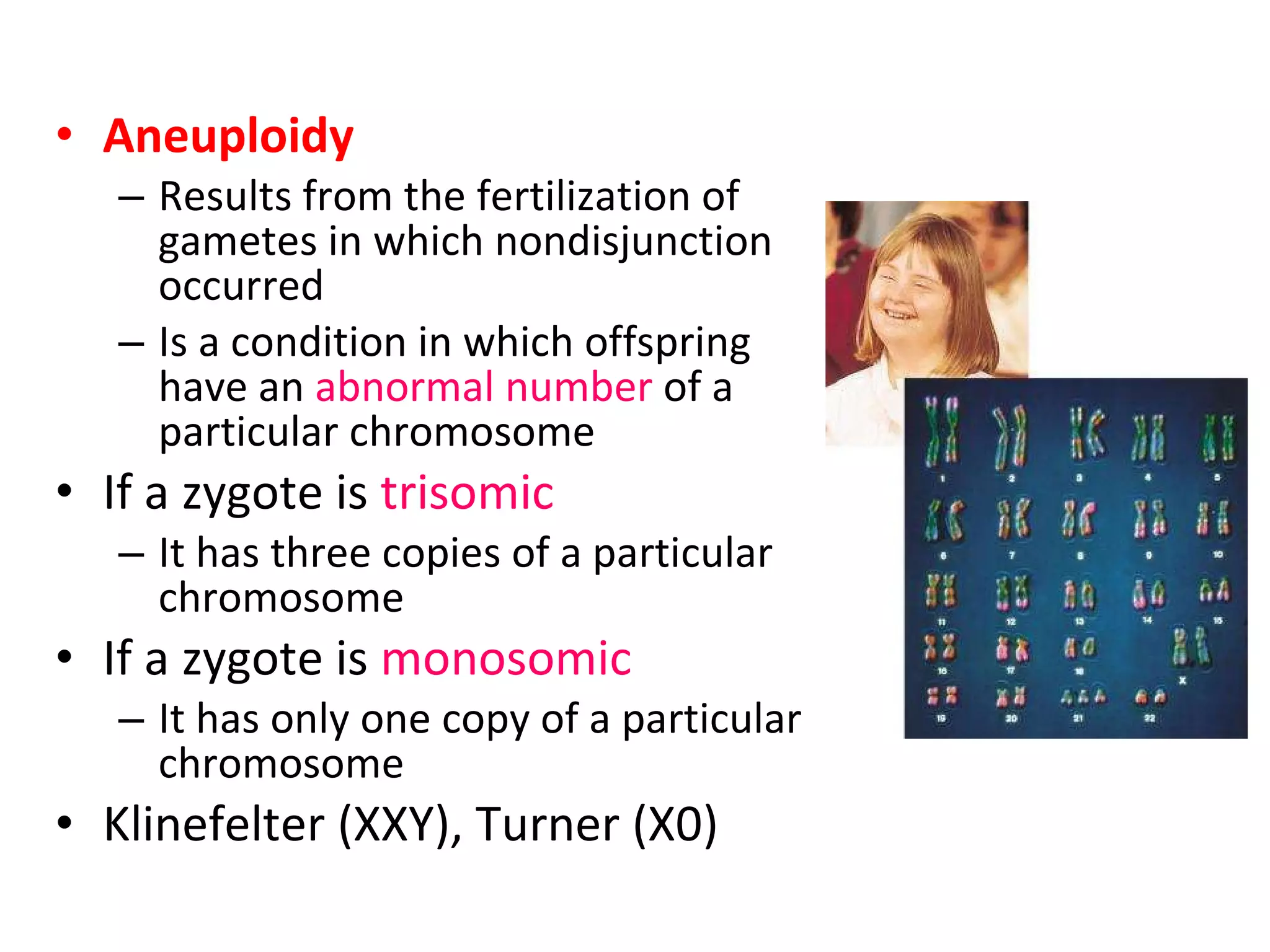
Aneuploidy Results from the fertilization of gametes in which nondisjunction occurred Is a condition in which offspring have an  abnormal number  of a particular chromosome If a zygote is  trisomic It has three copies of a particular chromosome If a zygote is  monosomic It has only one copy of a particular chromosome Klinefelter (XXY), Turner (X0)
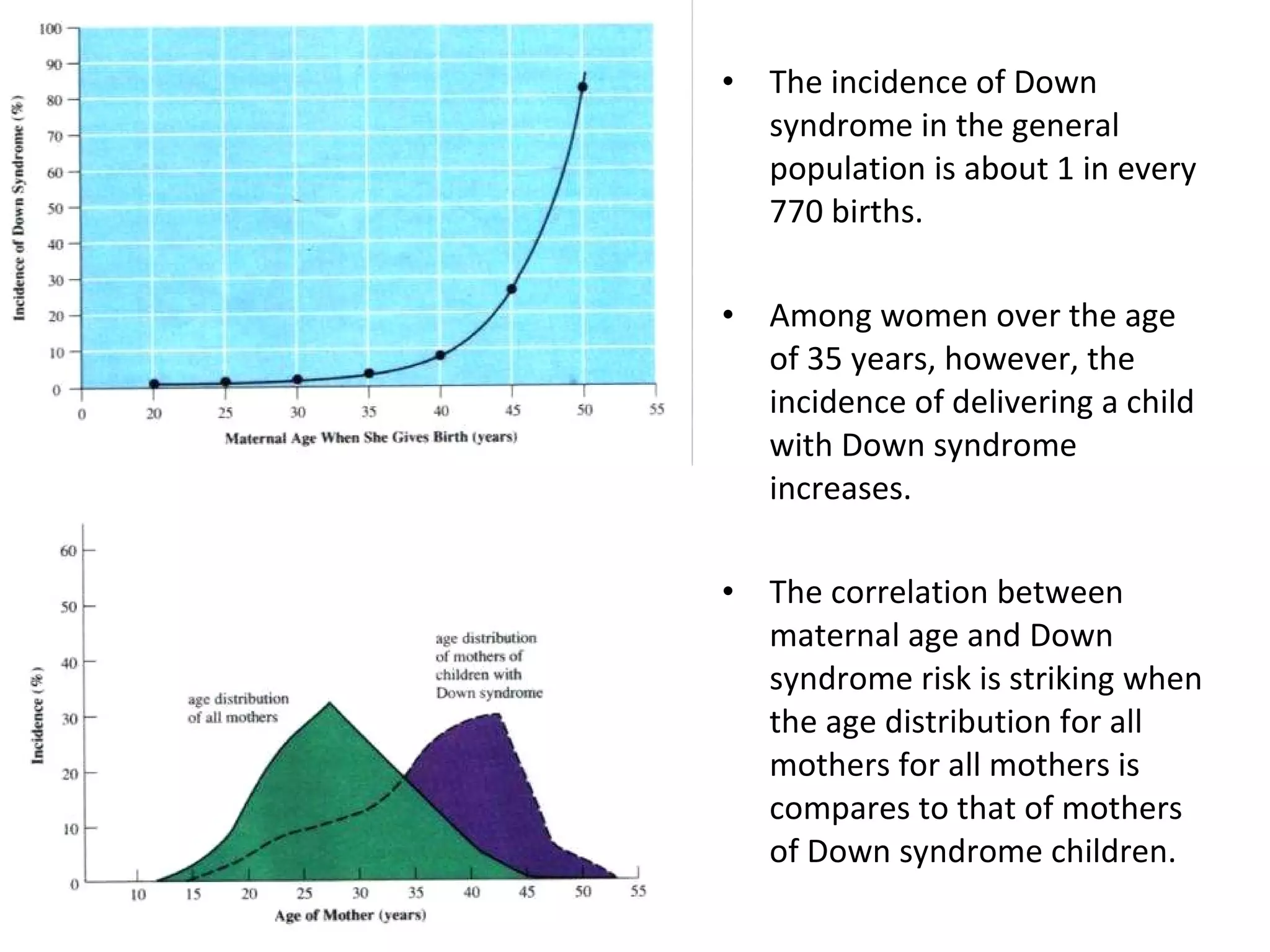
The incidence of Down syndrome in the general population is about 1 in every 770 births.  Among women over the age of 35 years, however, the incidence of delivering a child with Down syndrome increases.  The correlation between maternal age and Down syndrome risk is striking when the age distribution for all mothers for all mothers is compares to that of mothers of Down syndrome children.
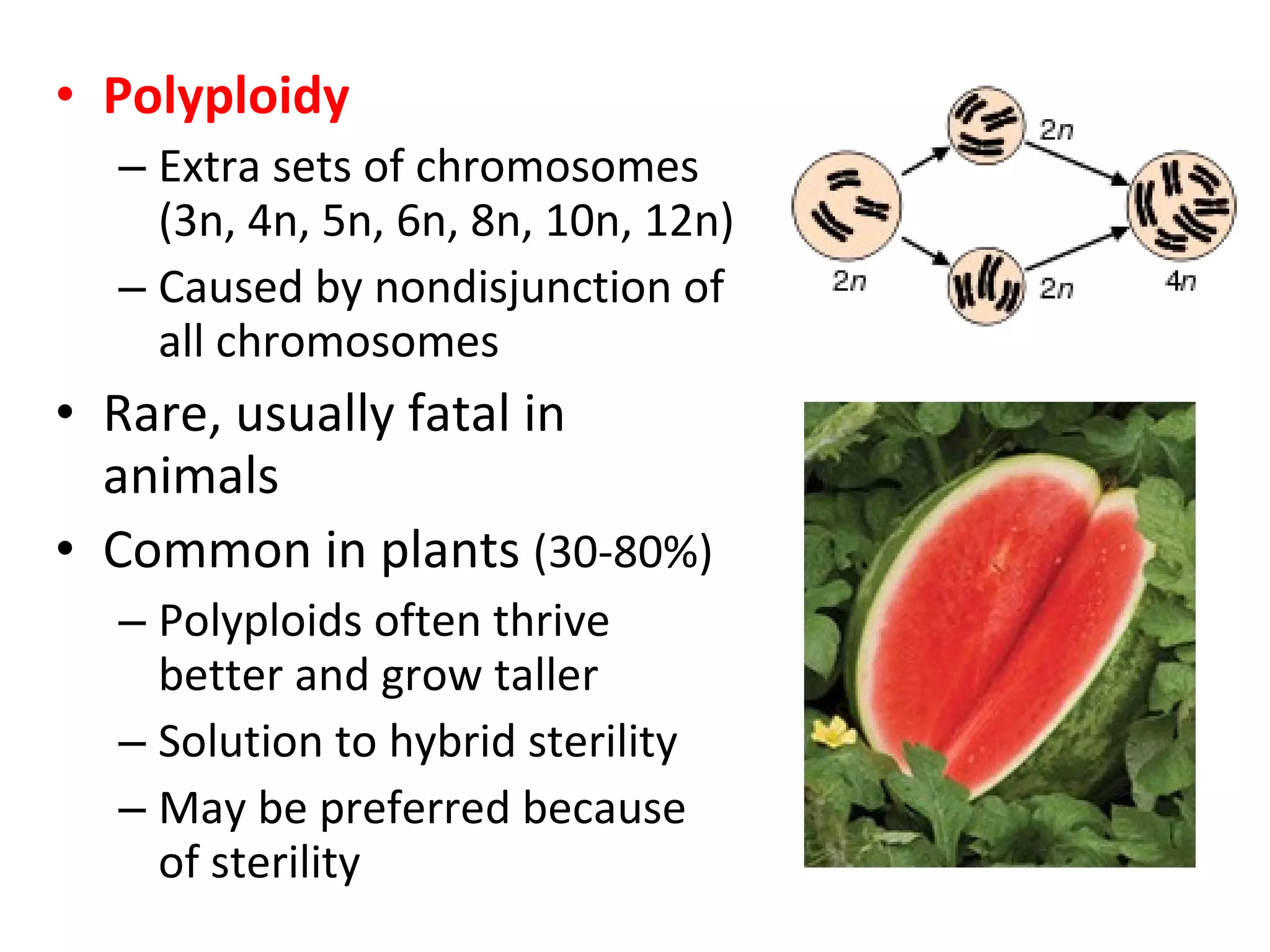
Polyploidy Extra sets of chromosomes (3n, 4n, 5n, 6n, 8n, 10n, 12n) Caused by nondisjunction of all chromosomes Rare, usually fatal in animals Common in plants  (30-80%) Polyploids often thrive better and grow taller Solution to hybrid sterility May be preferred because of sterility

Presentation 01 - The Cell Cycle

  • 1.
  • 2.
    Core Concepts Celldivision is necessary for reproduction, repair and growth. The cell cycle is a continuum of processes undergone by cells during their lifetime, which involves growth and functioning, and culminates in division. Mitosis produces two new identical cells. Interactions of physical and chemical signals control the events of the cell cycle. Cancer results from abnormal or lacking control signals of the cell cycle. Meiosis is a special kind of division that produces four (4) haploid, non-identical cells. Errors may occur during cell division, producing cells with abnormal chromosome number.
  • 3.
    Keywords anaphase centromerechromatin chromosome crossing-over cytokinesis diploid G1 G2 genome haploid homologue interphase kinetochore meiosis metaphase mitosis non-disjunction prophase sister chromatid spindle synthesis telophase tetrad
  • 4.
    The Cell CycleRoles of Cell Division Growth and development Reproduction Renewal and repair
  • 5.
    The Cell CycleTypes of cell division Mitosis May have evolved from binary fission in prokaryotes Method of asexual reproduction in unicellular eukaryotes Meiosis Responsible for production of gametes in multicellular eukaryotes
  • 6.
    The Cell CycleStages of the cell cycle
  • 7.
    Important terms genome - genetic material of a cell chromatin – unorganized mass of DNA and proteins that condense during cell division chromosomes – packaged DNA molecules in nuclei somatic cells have 2 sets of chromosomes (2N, diploid) gametes have 1 set of chromosomes (N, haploid) interphase – preparation for cell division cell grows DNA is replicated centrosomes are replicated* chromosomes condense
  • 8.
    Eukaryotic cell division1 chromosome  2 sister chromatids, connected at a centromere, which separate during cell division mitosis – division of the nucleus cytokinesis – division of cytoplasm
  • 9.
  • 10.
    Mitosis consists offive distinct phases Prophase Prometaphase G 2 OF INTERPHASE PROPHASE PROMETAPHASE Centrosomes (with centriole pairs) Chromatin (duplicated) Early mitotic spindle Aster Centromere Fragments of nuclear envelope Kinetochore Nucleolus Nuclear envelope Plasma membrane Chromosome, consisting of two sister chromatids Kinetochore microtubule Nonkinetochore microtubules
  • 11.
    Metaphase Anaphase TelophaseCentrosome at one spindle pole Daughter chromosomes METAPHASE ANAPHASE TELOPHASE AND CYTOKINESIS Spindle Metaphase plate Nucleolus forming Cleavage furrow Nuclear envelope forming
  • 12.
    Mitosis in aplant cell 1 Prophase. The chromatin is condensing. The nucleolus is beginning to disappear. Although not yet visible in the micrograph, the mitotic spindle is staring to from. Prometaphase. We now see discrete chromosomes; each consists of two identical sister chromatids. Later in prometaphase, the nuclear envelop will fragment. Metaphase. The spindle is complete, and the chromosomes, attached to microtubules at their kinetochores, are all at the metaphase plate. Anaphase. The chromatids of each chromosome have separated, and the daughter chromosomes are moving to the ends of cell as their kinetochore microtubles shorten. Telophase. Daughter nuclei are forming. Meanwhile, cytokinesis has started: The cell plate, which will divided the cytoplasm in two, is growing toward the perimeter of the parent cell. 2 3 4 5 Nucleus Nucleolus Chromosome Chromatin condensing
  • 13.
  • 14.
  • 15.
  • 16.
  • 17.
    Regulation of theCell Cycle Events in the cell cycle triggered and coordinated by a molecular control system Checkpoints – critical control points where stop and go-ahead signals can regulate the cycle
  • 18.
  • 19.
    Factors that controlthe cell cycle Telomeres Repeated DNA sequences at tips of chromosomes TTAGGG sequences lost every time a cell divides Restored to their original length by telomerase (normally found in gametes)
  • 20.
    Factors that controlthe cell cycle Regulatory proteins Cyclins - concentration cyclically fluctuates in the cell Cyclin-dependent kinases (Cdks) – activate other proteins in the presence of cyclin e.g. Maturation-promoting factor (MPF) M-phase promoted Chromatin condensation Mitotic spindle formation Degradation of nuclear envelope Deactivated when proteolytic enzymes digest the cyclin
  • 21.
  • 22.
    Factors that controlthe cell cycle Growth Factors proteins that stimulate other cells to divide promote the binding of cyclin to cdks ex. platelet-derived growth factor (PDGF)
  • 23.
    Factors that controlthe cell cycle 4. Density-dependent inhibition 5. Anchorage dependence Most animal cells must be attached to a substrate before they can grow
  • 24.
    Cancer – uncontrolledcell division Cells do not heed normal signals to STOP cell division Can invade neighboring cells and interfere with normal body function “ immortal” – can keep dividing as long as nutrient supply is kept constant
  • 25.
    Transformation Numerous diversecauses Cancer cell  tumor Benign Malignant Metastasis
  • 26.
    Causes Oncogenes Genethat enables transformation when mutated or expressed in high levels Viruses and bacteria e.g. HPV and cervical cancer; Hep B and C and liver cancer; H.pylori and stomach cancer Ionizing and UV radiation Carcinogens
  • 27.
    Treatment Surgery RadiationChemotherapy Immunotherapy and Gene therapy
  • 28.
    Meiosis Reductional Divisionfor Sexual Reproduction Types of reproduction Asexual Sexual Genes – hereditary units of DNA Locus – gene’s specific location in the chromosome
  • 29.
    Meiosis in Sexual Life Cycles Generation-to-generation sequence of stages in the reproductive history of an organism Homologous chromosomes – pair that has the same length, centromere position, staining pattern Humans: 22 pairs of autosomes + 1 pair of sex chromosomes
  • 30.
    Meiosis involves 2stages of nuclear division Interphase G 1 , S, G 2 Meiosis Meiosis I Meiosis II
  • 31.
    Meiosis I isreductional cell division
  • 32.
    Crossing-over duringProphase I Exchange of segments between homologous pairs Homologues pair up  tetrad Synapsis  “crossing-over” that occurs at a chiasma Does not normally happen to sex chromosomes Purpose: to increase genetic variation
  • 33.
  • 34.
    Meiosis II isequational cell division
  • 35.
    How unique areyou? Random fertilization 1/64 million Independent assortment 1/2 23 Crossing-over occurs an average of 2-3 times per chromosome pair
  • 36.
    Gametogenesis Meiosis Gametes(n) formed from embryonic primordial germ cells (PGC’s) via meiosis PGC’s (2n)  meiosis  sex cells (n) Spermatogonium and oogonium Maturation distinctive characteristics of sperm and egg cells are formed
  • 37.
    Spermatogenesis vs. OogenesisSPERMATOGENESIS process is continuous 100-650 million sperm cells produced OOGENESIS unequal cytokinesis time table only 400 oocytes ovulated between puberty & menopause
  • 38.
    Spermatogenesis vs. OogenesisSuspended in prophase I One oocyte / month Halted at metaphase II until fertilization 2N N N
  • 39.
    OOGENESIS 2 million1 o oocytes in a fetus 1 million 1 o oocytes in a newborn (at prophase I) 400,000 1 o oocytes during puberty (meiosis I completed in only one each month) 400 2 o oocytes ovulated (at metaphase II) between puberty and menopause (meiosis II completed only after fertilization) mature ovum
  • 40.
    Questions: How manysets of chromosomes are present in each of the following cell types? an oogonium a 1 o spermatocyte a spermatid a cell during anaphase I, from either sex a cell during anaphase II, from either sex a 2 o oocyte a polar body derived from a 1 o oocyte Why is it extremely unlikely that a child will be genetically identical to a parent?
  • 41.
    Questions: How dothe structures of the male and female gametes aid in their functions? A woman who is about 4 weeks pregnant suddenly begins to bleed and pass some tissue through her vagina. After a physician examines the material, he explains to her that a sperm fertilized a polar body instead of an ovum, and an embryo could not develop. What has happened? Why do you think a polar body cannot support the development of an embryo, whereas an ovum, which is genetically identical to it, can?
  • 42.
    Errors in celldivision  chromosomal aberrations Nondisjunction : Pairs of homologous chromosomes do not separate normally during meiosis Gametes contain two copies or no copies of a particular chromosome Meiosis I Nondisjunction Meiosis II Nondisjunction Gametes n + 1 n + 1 n  1 n – 1 n + 1 n – 1 n n Number of chromosomes Nondisjunction of homologous chromosomes in meiosis I Nondisjunction of sister chromatids in meiosis II (a) (b)
  • 43.
  • 44.
    Aneuploidy Results fromthe fertilization of gametes in which nondisjunction occurred Is a condition in which offspring have an abnormal number of a particular chromosome If a zygote is trisomic It has three copies of a particular chromosome If a zygote is monosomic It has only one copy of a particular chromosome Klinefelter (XXY), Turner (X0)
  • 45.
    The incidence ofDown syndrome in the general population is about 1 in every 770 births. Among women over the age of 35 years, however, the incidence of delivering a child with Down syndrome increases. The correlation between maternal age and Down syndrome risk is striking when the age distribution for all mothers for all mothers is compares to that of mothers of Down syndrome children.
  • 46.
    Polyploidy Extra setsof chromosomes (3n, 4n, 5n, 6n, 8n, 10n, 12n) Caused by nondisjunction of all chromosomes Rare, usually fatal in animals Common in plants (30-80%) Polyploids often thrive better and grow taller Solution to hybrid sterility May be preferred because of sterility