Hepatitis C: Is it Curable?Hepatitis C: Is it Curable?
Dr. Noor A Abonewair, MRCP(UK)Dr. Noor A Abonewair, MRCP(UK)
Consultant Physician&GastroenterologistConsultant Physician&Gastroenterologist
KFH, Taif, KSAKFH, Taif, KSA
May 2010May 2010
ObjectivesObjectives
• Discuss Hep C Infection & Current TreatmentDiscuss Hep C Infection & Current Treatment
• Describe Hep C Treatment in CorrectionsDescribe Hep C Treatment in Corrections
• Explain New Medications for Hep CExplain New Medications for Hep C
• Outline Challenges Presented by NewOutline Challenges Presented by New
MedicationsMedications
• Propose Strategies to Address thesePropose Strategies to Address these
ChallengesChallenges
Hepatitis CHepatitis C
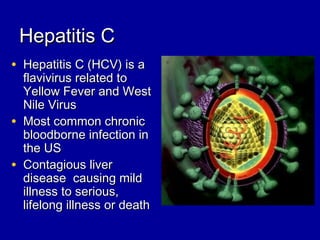
• Hepatitis C (HCV) is aHepatitis C (HCV) is a
flavivirus related toflavivirus related to
Yellow Fever and WestYellow Fever and West
Nile VirusNile Virus
• Most common chronicMost common chronic
bloodborne infection inbloodborne infection in
the USthe US
• Contagious liverContagious liver
disease causing milddisease causing mild
illness to serious,illness to serious,
lifelong illness or deathlifelong illness or death
Hep C TransmissionHep C Transmission
• Spread by blood to blood contact:Spread by blood to blood contact:
– IV drug useIV drug use
– Mother to child transmission (about 6%)Mother to child transmission (about 6%)
– Can be sexually transmitted but less commonCan be sexually transmitted but less common
– Since 1992, screening has limited spread throughSince 1992, screening has limited spread through
transfusions and transplantstransfusions and transplants
• For most, acute infection leads to chronicFor most, acute infection leads to chronic
infectioninfection
There is no vaccine for Hepatitis C.There is no vaccine for Hepatitis C.
Concomitant HIV infection is thought toConcomitant HIV infection is thought to
increase the risk of transmission.increase the risk of transmission.
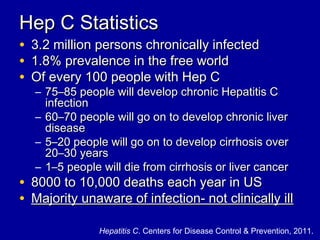
Hep C StatisticsHep C Statistics
• 3.2 million persons chronically infected3.2 million persons chronically infected
• 1.8% prevalence in the free world1.8% prevalence in the free world
• Of every 100 people with Hep COf every 100 people with Hep C
– 75–85 people will develop chronic Hepatitis C75–85 people will develop chronic Hepatitis C
infectioninfection
– 60–70 people will go on to develop chronic liver60–70 people will go on to develop chronic liver
diseasedisease
– 5–20 people will go on to develop cirrhosis over5–20 people will go on to develop cirrhosis over
20–30 years20–30 years
– 1–5 people will die from cirrhosis or liver cancer1–5 people will die from cirrhosis or liver cancer
• 8000 to 10,000 deaths each year in US8000 to 10,000 deaths each year in US
• Majority unaware of infection- not clinically illMajority unaware of infection- not clinically ill
Hepatitis C. Centers for Disease Control & Prevention, 2011.
Fibrosis & Disease Progression in Hepatitis C. Marcellin, et al.
Hepatology, 2002
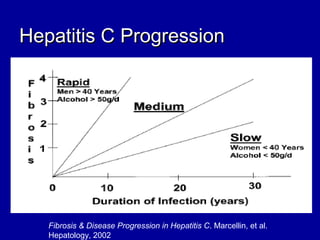
Hepatitis C ProgressionHepatitis C Progression
• Mechanisms associated with progression ofMechanisms associated with progression of
fibrosis are poorly understoodfibrosis are poorly understood
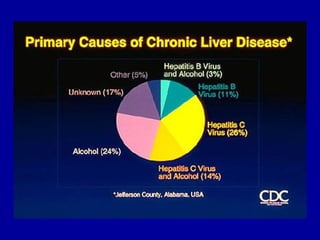
• Rate of progression variable but slow in generalRate of progression variable but slow in general
• Older age, male gender, excessive alcoholOlder age, male gender, excessive alcohol
consumption, overweight, and immune deficiencyconsumption, overweight, and immune deficiency
associated with more rapid progressionassociated with more rapid progression
• Alcohol consumption controlled in correctionalAlcohol consumption controlled in correctional
environmentenvironment
• Treatment of overweight & HIV is criticalTreatment of overweight & HIV is critical
Fibrosis & Disease Progression in Hepatitis CFibrosis & Disease Progression in Hepatitis C. Marcellin, et al. Hepatology, 2002. Marcellin, et al. Hepatology, 2002
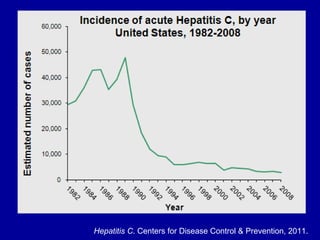
Hepatitis C TrendsHepatitis C Trends
• Most patients infected 20-40 years agoMost patients infected 20-40 years ago
before virus identification and screeningbefore virus identification and screening
• Incidence decreasing but number of patientsIncidence decreasing but number of patients
developing cirrhosis, cancer & end stage liverdeveloping cirrhosis, cancer & end stage liver
disease increasing (peak 2020 to 2030)disease increasing (peak 2020 to 2030)
• Total cost of care for untreated Hep C willTotal cost of care for untreated Hep C will
continue to increase over next 20 yearscontinue to increase over next 20 years
• Consensus on when and how Hep C will beConsensus on when and how Hep C will be
treated in Corrections is needed nowtreated in Corrections is needed now
People are often asymptomatic after exposure to thePeople are often asymptomatic after exposure to the
virus, but about 20% will develop acute hepatitis;virus, but about 20% will develop acute hepatitis;
some of them will experience malaise, weakness andsome of them will experience malaise, weakness and
anorexia.anorexia.
Up to 85% of those exposed do not clear the virus andUp to 85% of those exposed do not clear the virus and
go on to develop CHC. Progression of the diseasego on to develop CHC. Progression of the disease
occurs over 20–50 years.occurs over 20–50 years.
About 5–30% of people initially infected will developAbout 5–30% of people initially infected will develop
cirrhosis within 20 years and a small percentage ofcirrhosis within 20 years and a small percentage of
these are at high risk of developing hepatocellular ca.these are at high risk of developing hepatocellular ca.
One third may never progress to cirrhosis or will notOne third may never progress to cirrhosis or will not
progress for at least 50 years.progress for at least 50 years.
Some people with end-stage liver disease orSome people with end-stage liver disease or
hepatocellular ca may require liver transplantation.hepatocellular ca may require liver transplantation.
Six major genetic types of HCV have been identified.Six major genetic types of HCV have been identified.
Genotype 1 (G1)Genotype 1 (G1) is the most common in the UK, and isis the most common in the UK, and is
found in about 40–50% of cases and in 24% in KSA.found in about 40–50% of cases and in 24% in KSA.
Genotypes 2 and 3 (G2/3)Genotypes 2 and 3 (G2/3) contribute another 40–50%,contribute another 40–50%,
andand
Genotypes 4, 5 and 6Genotypes 4, 5 and 6 constitute the remainder of aboutconstitute the remainder of about
5%.5%.
Response to treatment varies between differentResponse to treatment varies between different
genotypes.genotypes.
G1 is relatively more common among people infectedG1 is relatively more common among people infected
through blood products, and G2/3 is relatively morethrough blood products, and G2/3 is relatively more
common among people who inject themselves withcommon among people who inject themselves with
illicit drugs.illicit drugs.
G 4 is the commonest type in KSA (62%)G 4 is the commonest type in KSA (62%)
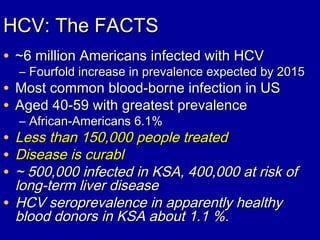
HCV: The FACTSHCV: The FACTS
• ~6 million Americans infected with HCV~6 million Americans infected with HCV
– Fourfold increase in prevalence expected by 2015Fourfold increase in prevalence expected by 2015
• Most common blood-borne infection in USMost common blood-borne infection in US
• Aged 40-59 with greatest prevalenceAged 40-59 with greatest prevalence
– African-Americans 6.1%African-Americans 6.1%
• Less than 150,000 people treatedLess than 150,000 people treated
• Disease is curablDisease is curabl
• ~ 500,000 infected in KSA, 400,000 at risk of~ 500,000 infected in KSA, 400,000 at risk of
long-term liver diseaselong-term liver disease
• HCV seroprevalence in apparently healthyHCV seroprevalence in apparently healthy
blood donors in KSA about 1.1 %.blood donors in KSA about 1.1 %.
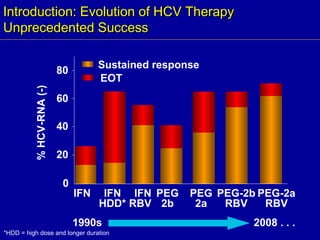
Introduction: Evolution of HCV TherapyIntroduction: Evolution of HCV Therapy
Unprecedented SuccessUnprecedented Success
40
60
20
80
IFN
0
IFN
HDD*
IFN
RBV
PEG
2b
PEG
2a
PEG-2b
RBV
PEG-2a
RBV
%HCV-RNA(-)
Sustained response
EOT
1990s 2008 . . .
*HDD = high dose and longer duration
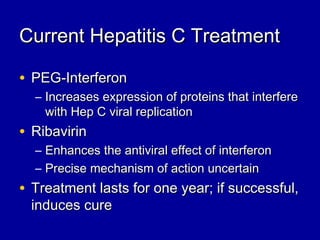
Current Hepatitis C TreatmentCurrent Hepatitis C Treatment
• PEG-InterferonPEG-Interferon
– Increases expression of proteins that interfereIncreases expression of proteins that interfere
with Hep C viral replicationwith Hep C viral replication
• RibavirinRibavirin
– Enhances the antiviral effect of interferonEnhances the antiviral effect of interferon
– Precise mechanism of action uncertainPrecise mechanism of action uncertain
• Treatment lasts for one year; if successful,Treatment lasts for one year; if successful,
induces cureinduces cure
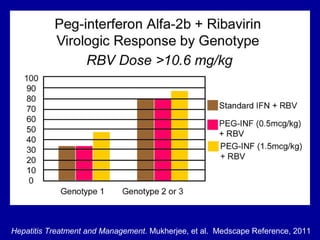
Hepatitis Treatment and Management. Mukherjee, et al. Medscape Reference, 2011
What does curable mean?What does curable mean?
• Sustained viral response (SVR)Sustained viral response (SVR)
• HCV-RNA negative in serumHCV-RNA negative in serum
• HCV-RNA negative in liverHCV-RNA negative in liver
What is a SVR?What is a SVR?
• HCV-RNA undetectable 24 weeks afterHCV-RNA undetectable 24 weeks after
stopping therapystopping therapy
• Type of therapy not importantType of therapy not important
– InterferonInterferon
– Interferon + ribavirinInterferon + ribavirin
– Newer therapiesNewer therapies
– In order to use the word “cure”, this response mustIn order to use the word “cure”, this response must
be durablebe durable
Criteria for achieving a SVRCriteria for achieving a SVR
• The ability to achieve a SVR is the result of 3The ability to achieve a SVR is the result of 3
independent stepsindependent steps
– The patient must achieve a virologic responseThe patient must achieve a virologic response
– The patient must maintain the responseThe patient must maintain the response
– The patient must not relapseThe patient must not relapse
• SVR = virologic response - (breakthrough +SVR = virologic response - (breakthrough +
relapse)relapse)
• To overcomeTo overcome non-responsenon-response and relapse, theand relapse, the
reasons for failure must be definedreasons for failure must be defined
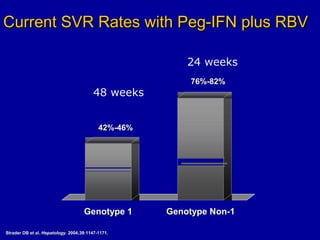
Current SVR Rates with Peg-IFN plus RBVCurrent SVR Rates with Peg-IFN plus RBV
Genotype Non-1Genotype Non-1Genotype 1Genotype 1
Strader DB et al.Strader DB et al. Hepatology.Hepatology. 2004;39:1147-1171.2004;39:1147-1171.
42%-46%42%-46%
76%-82%76%-82%
48 weeks
24 weeks
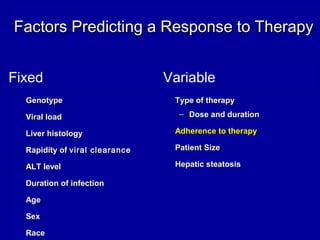
Factors Predicting a Response to TherapyFactors Predicting a Response to Therapy
Fixed Variable
GenotypeGenotype
Viral loadViral load
Liver histologyLiver histology
Rapidity ofRapidity of viral clearanceviral clearance
ALT levelALT level
Duration of infectionDuration of infection
AgeAge
SexSex
RaceRace
Type of therapyType of therapy
– Dose and durationDose and duration
Adherence to therapyAdherence to therapy
Patient SizePatient Size
Hepatic steatosisHepatic steatosis
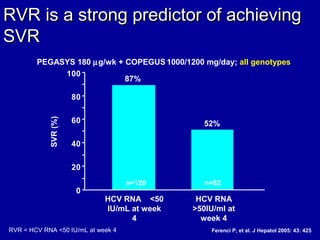
0
20
40
60
80
100
SVR(%)
87%
52%
n=120 n=82
RVR is a strong predictor of achievingRVR is a strong predictor of achieving
SVRSVR
Ferenci P, et al. J Hepatol 2005: 43: 425RVR = HCV RNA <50 IU/mL at week 4
PEGASYS 180 µg/wk + COPEGUS 1000/1200 mg/day; all genotypes
HCV RNA <50
IU/mL at week
4
HCV RNA
>50IU/ml at
week 4
10
30
50
70
90
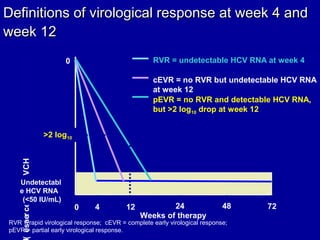
Definitions of virological response at week 4 andDefinitions of virological response at week 4 and
week 12week 12
HCVRNAdecrease(
EOTR SVR
724 48
Weeks of therapy
0 12
Undetectabl
e HCV RNA
(<50 IU/mL)
0 RVR = undetectable HCV RNA at week 4
cEVR = no RVR but undetectable HCV RNA
at week 12
>2 log10
pEVR = no RVR and detectable HCV RNA,
but >2 log10 drop at week 12
24
RVR = rapid virological response; cEVR = complete early virological response;
pEVR = partial early virological response.
Why aren’t we treating patients?Why aren’t we treating patients?
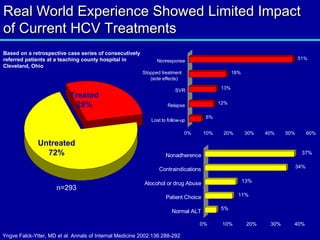
Real World Experience Showed Limited ImpactReal World Experience Showed Limited Impact
of Current HCV Treatmentsof Current HCV Treatments
6%
12%
13%
18%
51%
0% 10% 20% 30% 40% 50% 60%
Lost to follow-up
Relapse
SVR
Stopped treatment
(side effects)
Nonresponse
5%
11%
13%
34%
37%
0% 10% 20% 30% 40%
Normal ALT
Patient Choice
Alocohol or drug Abuse
Contraindications
Nonadherence
Treated
28%
Untreated
72%
Yngve Falck-Ytter, MD et al. Annals of Internal Medicine 2002:136:288-292
Based on a retrospective case series of consecutively
referred patients at a teaching county hospital in
Cleveland, Ohio
n=293
How can we improve cure rates?How can we improve cure rates?
• Make current therapy easier takeMake current therapy easier take
• Extend duration of therapyExtend duration of therapy
• Increase dosagesIncrease dosages
• New therapiesNew therapies
• Place more importance of viral kineticsPlace more importance of viral kinetics
• Realize that not one size fits allRealize that not one size fits all
“Tailored”
Treatment in Genotype I
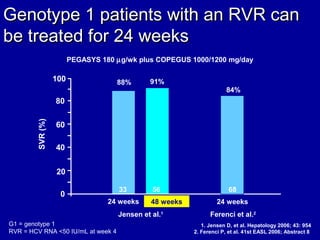
Genotype 1 patients with an RVR canGenotype 1 patients with an RVR can
be treated for 24 weeksbe treated for 24 weeks
0
20
40
60
SVR(%)
80
100
PEGASYS 180 µg/wk plus COPEGUS 1000/1200 mg/day
88% 91%
1. Jensen D, et al. Hepatology 2006; 43: 954
2. Ferenci P, et al. 41st EASL 2006; Abstract 8
G1 = genotype 1
RVR = HCV RNA <50 IU/mL at week 4
10
30
50
70
90 84%
24 weeks
Ferenci et al.2
n= 33 56 68
24 weeks 48 weeks
Jensen et al.1
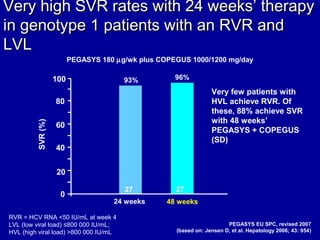
Very high SVR rates with 24 weeks’ therapyVery high SVR rates with 24 weeks’ therapy
in genotype 1 patients with an RVR andin genotype 1 patients with an RVR and
LVLLVL
0
20
40
60
SVR(%)
80
100
24 weeks 48 weeks
93% 96%
n= 27 27
PEGASYS EU SPC, revised 2007
(based on: Jensen D, et al. Hepatology 2006; 43: 954)
RVR = HCV RNA <50 IU/mL at week 4
LVL (low viral load) ≤800 000 IU/mL;
HVL (high viral load) >800 000 IU/mL
10
30
50
70
90 Very few patients with
HVL achieve RVR. Of
these, 88% achieve SVR
with 48 weeks’
PEGASYS + COPEGUS
(SD)
PEGASYS 180 µg/wk plus COPEGUS 1000/1200 mg/day
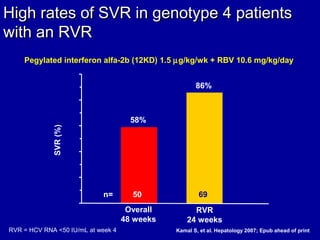
High rates of SVR in genotype 4 patientsHigh rates of SVR in genotype 4 patients
with an RVRwith an RVR
n= 50 69
86%
58%
Kamal S, et al. Hepatology 2007; Epub ahead of print
Pegylated interferon alfa-2b (12KD) 1.5 µg/kg/wk + RBV 10.6 mg/kg/day
Overall
48 weeks
SVR(%)
0
20
40
60
80
100
RVR
24 weeks
RVR = HCV RNA <50 IU/mL at week 4
10
30
50
70
90
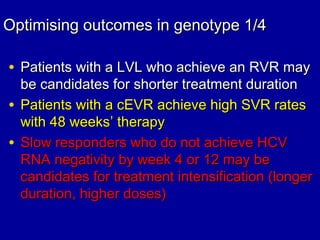
Optimising outcomes in genotype 1/4Optimising outcomes in genotype 1/4
• Patients with a LVL who achieve an RVR mayPatients with a LVL who achieve an RVR may
be candidates for shorter treatment durationbe candidates for shorter treatment duration
• Patients with a cEVR achieve high SVR ratesPatients with a cEVR achieve high SVR rates
with 48 weekswith 48 weeks’’ therapytherapy
• Slow responders who do not achieve HCVSlow responders who do not achieve HCV
RNA negativity by week 4 or 12 may beRNA negativity by week 4 or 12 may be
candidates for treatment intensification (longercandidates for treatment intensification (longer
duration, higher doses)duration, higher doses)
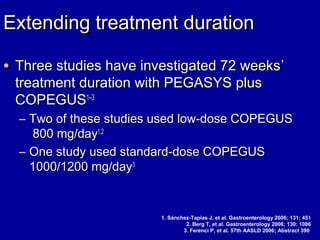
Extending treatment durationExtending treatment duration
• Three studies have investigated 72 weeksThree studies have investigated 72 weeks’’
treatment duration with PEGASYS plustreatment duration with PEGASYS plus
COPEGUSCOPEGUS11––33
– Two of these studies used low-dose COPEGUSTwo of these studies used low-dose COPEGUS
800 mg/day800 mg/day1,21,2
– One study used standard-dose COPEGUSOne study used standard-dose COPEGUS
1000/1200 mg/day1000/1200 mg/day33
1. Sánchez-Tapias J, et al. Gastroenterology 2006; 131: 451
2. Berg T, et al. Gastroenterology 2006; 130: 1086
3. Ferenci P, et al. 57th AASLD 2006; Abstract 390
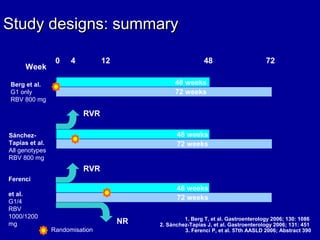
Ferenci
et al.
G1/4
RBV
1000/1200
mg
Study designs: summaryStudy designs: summary
48 weeks
72 weeks
48 weeks
72 weeks
48 weeks
72 weeks
RVR
RVR
NR
12
Week
Berg et al.
G1 only
RBV 800 mg
Sánchez-
Tapias et al.
All genotypes
RBV 800 mg
Randomisation
48 7240
1. Berg T, et al. Gastroenterology 2006; 130: 1086
2. Sánchez-Tapias J, et al. Gastroenterology 2006; 131: 451
3. Ferenci P, et al. 57th AASLD 2006; Abstract 390
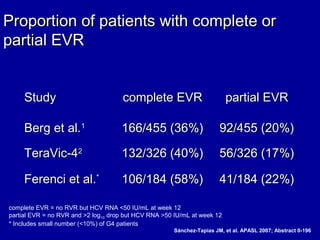
Proportion of patients with complete orProportion of patients with complete or
partial EVRpartial EVR
StudyStudy complete EVRcomplete EVR partial EVRpartial EVR
Berg et al.Berg et al.11
166/455 (36166/455 (36%)%) 92/455 (20%)92/455 (20%)
TeraVic-4TeraVic-422
132/326 (40132/326 (40%)%) 56/326 (1756/326 (17%)%)
Ferenci et al.Ferenci et al.**
106/184 (58%)106/184 (58%) 41/184 (2241/184 (22%)%)
complete EVR = no RVR but HCV RNA <50 IU/mL at week 12
partial EVR = no RVR and >2 log10 drop but HCV RNA >50 IU/mL at week 12
* Includes small number (<10%) of G4 patients
Sánchez-Tapias JM, et al. APASL 2007; Abstract 0-196
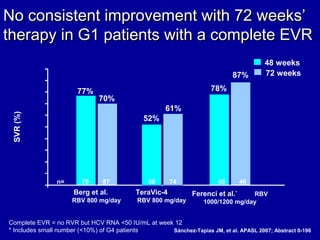
No consistent improvement with 72 weeks’No consistent improvement with 72 weeks’
therapy in G1 patients with a complete EVRtherapy in G1 patients with a complete EVR
Complete EVR = no RVR but HCV RNA <50 IU/mL at week 12
* Includes small number (<10%) of G4 patients
78%
87%
Ferenci et al.*
RBV
1000/1200 mg/day
77%
70%
Berg et al.
RBV 800 mg/day
SVR(%)
52%
61%
0
10
20
30
40
50
60
70
80
90
100
n= 79 87 58 74 60 46
TeraVic-4
RBV 800 mg/day
48 weeks
72 weeks
Sánchez-Tapias JM, et al. APASL 2007; Abstract 0-196
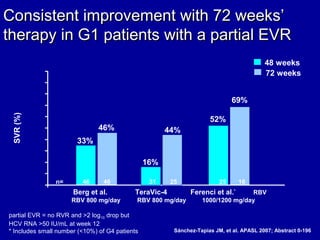
Consistent improvement with 72 weeks’Consistent improvement with 72 weeks’
therapy in G1 patients with a partial EVRtherapy in G1 patients with a partial EVR
partial EVR = no RVR and >2 log10 drop but
HCV RNA >50 IU/mL at week 12
* Includes small number (<10%) of G4 patients
SVR(%)
16%
44%
0
10
20
30
40
50
60
70
80
90
100
n= 46 46 31 25 25 16
TeraVic-4
RBV 800 mg/day
33%
46%
Berg et al.
RBV 800 mg/day
52%
69%
Ferenci et al.*
RBV
1000/1200 mg/day
48 weeks
72 weeks
Sánchez-Tapias JM, et al. APASL 2007; Abstract 0-196
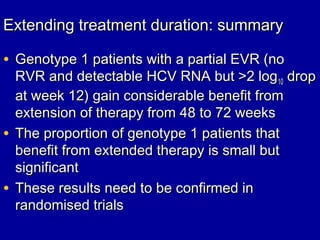
Extending treatment duration: summaryExtending treatment duration: summary
• Genotype 1 patients with a partial EVR (noGenotype 1 patients with a partial EVR (no
RVR and detectable HCV RNA but >2 logRVR and detectable HCV RNA but >2 log1010 dropdrop
at week 12) gain considerable benefit fromat week 12) gain considerable benefit from
extension of therapy from 48 to 72 weeksextension of therapy from 48 to 72 weeks
• The proportion of genotype 1 patients thatThe proportion of genotype 1 patients that
benefit from extended therapy is small butbenefit from extended therapy is small but
significantsignificant
• These results need to be confirmed inThese results need to be confirmed in
randomised trialsrandomised trials
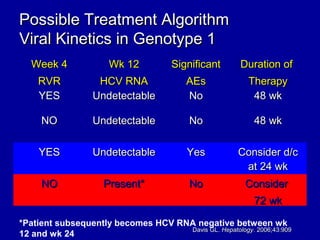
Possible Treatment AlgorithmPossible Treatment Algorithm
Viral Kinetics in Genotype 1Viral Kinetics in Genotype 1
Week 4Week 4
RVRRVR
Wk 12Wk 12
HCV RNAHCV RNA
SignificantSignificant
AEsAEs
Duration ofDuration of
TherapyTherapy
YESYES UndetectableUndetectable NoNo 48 wk48 wk
NONO UndetectableUndetectable NoNo 48 wk48 wk
YESYES UndetectableUndetectable YesYes Consider d/cConsider d/c
at 24 wkat 24 wk
NONO Present*Present* NoNo ConsiderConsider
72 wk72 wk
Davis GL.Davis GL. HepatologyHepatology. 2006;43:909. 2006;43:909
*Patient subsequently becomes HCV RNA negative between wk
12 and wk 24
““Tailored” Treatment inTailored” Treatment in
Genotypes 2 and 3Genotypes 2 and 3
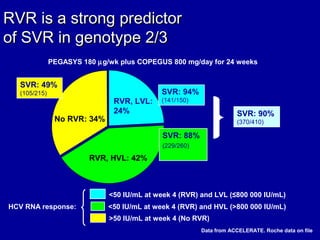
RVR is a strong predictorRVR is a strong predictor
of SVR in genotype 2/3of SVR in genotype 2/3
PEGASYS 180 µg/wk plus COPEGUS 800 mg/day for 24 weeks
SVR: 90%
(370/410)
RVR, HVL: 42%
No RVR: 34%
RVR, LVL:
24%
SVR: 49%
(105/215) SVR: 94%
(141/150)
SVR: 88%
(229/260)
Data from ACCELERATE. Roche data on file
<50 IU/mL at week 4 (RVR) and LVL (≤800 000 IU/mL)
<50 IU/mL at week 4 (RVR) and HVL (>800 000 IU/mL)
>50 IU/mL at week 4 (No RVR)
HCV RNA response:
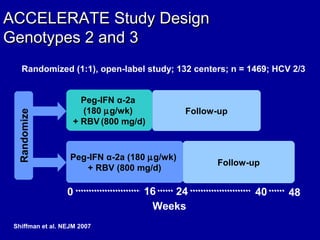
ACCELERATE Study DesignACCELERATE Study Design
Genotypes 2 and 3Genotypes 2 and 3
Randomize
Follow-up
Follow-up
Shiffman et al. NEJM 2007
Peg-IFN α-2a
(180 µg/wk)
+ RBV (800 mg/d)
Peg-IFN α-2a (180 µg/wk)
+ RBV (800 mg/d)
Randomized (1:1), open-label study; 132 centers; n = 1469; HCV 2/3
Weeks
0 16 24 40 48
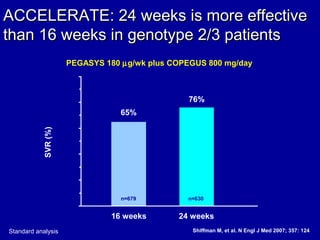
ACCELERATE: 24 weeks is more effectiveACCELERATE: 24 weeks is more effective
than 16 weeks in genotype 2/3 patientsthan 16 weeks in genotype 2/3 patients
Standard analysis
SVR(%)
n=679 n=630
65%
76%
0
20
40
60
80
100
10
30
50
70
90
16 weeks 24 weeks
PEGASYS 180 µg/wk plus COPEGUS 800 mg/day
Shiffman M, et al. N Engl J Med 2007; 357: 124
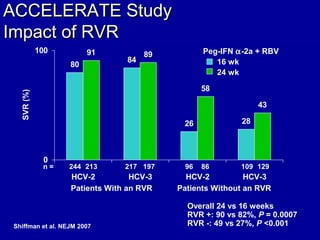
ACCELERATE StudyACCELERATE Study
Impact of RVRImpact of RVR
80
84
26 28
91 89
58
43
0
100
HCV-2 HCV-3 HCV-2 HCV-3
SVR(%)
Peg-IFN α-2a + RBV
16 wk
24 wk
n = 244 213 217 197 96 86 109 129
Patients With an RVR Patients Without an RVR
Overall 24 vs 16 weeks
RVR +: 90 vs 82%, P = 0.0007
RVR -: 49 vs 27%, P <0.001Shiffman et al. NEJM 2007
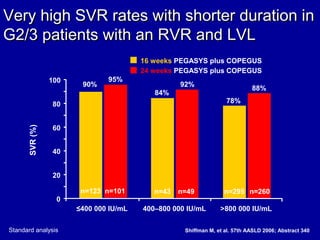
Very high SVR rates with shorter duration inVery high SVR rates with shorter duration in
G2/3 patients with an RVR and LVLG2/3 patients with an RVR and LVL
16 weeks PEGASYS plus COPEGUS
24 weeks PEGASYS plus COPEGUS
n=123 n=101 n=295 n=260n=49n=43
≤400 000 IU/mL 400–800 000 IU/mL >800 000 IU/mL
90%
84%
78%
95%
92%
88%
SVR(%)
0
20
40
60
80
100
Standard analysis Shiffman M, et al. 57th AASLD 2006; Abstract 340
Optimising outcomes in genotype 2/3:Optimising outcomes in genotype 2/3:
conclusionconclusion
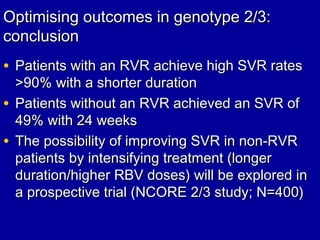
• Patients with an RVR achieve high SVR ratesPatients with an RVR achieve high SVR rates
>90%>90% with a shorter durationwith a shorter duration
• Patients without an RVR achieved an SVR ofPatients without an RVR achieved an SVR of
49% with 24 weeks49% with 24 weeks
• The possibility of improving SVR in non-RVRThe possibility of improving SVR in non-RVR
patients by intensifying treatment (longerpatients by intensifying treatment (longer
duration/higher RBV doses) will be explored induration/higher RBV doses) will be explored in
a prospective trial (NCORE 2/3 study; N=400)a prospective trial (NCORE 2/3 study; N=400)
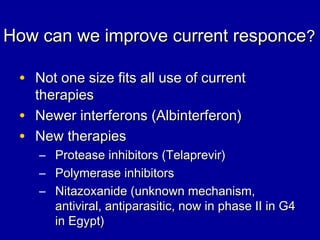
How can we improve current responceHow can we improve current responce??
• Not one size fits all use of currentNot one size fits all use of current
therapiestherapies
• Newer interferons (Albinterferon)Newer interferons (Albinterferon)
• New therapiesNew therapies
– Protease inhibitors (Telaprevir)Protease inhibitors (Telaprevir)
– Polymerase inhibitorsPolymerase inhibitors
– Nitazoxanide (unknown mechanism,Nitazoxanide (unknown mechanism,
antiviral, antiparasitic, now in phase II in G4antiviral, antiparasitic, now in phase II in G4
in Egypt)in Egypt)
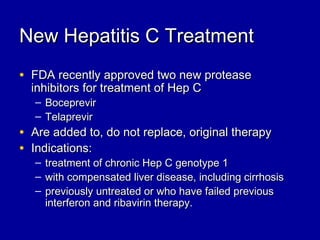
New Hepatitis C TreatmentNew Hepatitis C Treatment
• FDA recently approved two new proteaseFDA recently approved two new protease
inhibitors for treatment of Hep Cinhibitors for treatment of Hep C
– BoceprevirBoceprevir
– TelaprevirTelaprevir
• Are added to, do not replace, original therapyAre added to, do not replace, original therapy
• Indications:Indications:
– treatment of chronic Hep C genotype 1treatment of chronic Hep C genotype 1
– with compensated liver disease, including cirrhosiswith compensated liver disease, including cirrhosis
– previously untreated or who have failed previouspreviously untreated or who have failed previous
interferon and ribavirin therapy.interferon and ribavirin therapy.
New Hepatitis C TreatmentNew Hepatitis C Treatment
• In previously untreated patients, 79% of thoseIn previously untreated patients, 79% of those
receiving telaprevir experienced a sustainedreceiving telaprevir experienced a sustained
virologic response (SVR) compared with less thanvirologic response (SVR) compared with less than
50% with peginterferon alfa and ribavirin treatment50% with peginterferon alfa and ribavirin treatment
alone.alone.
• Cure rate for patients treated with telaprevirCure rate for patients treated with telaprevir
across all studies, and across all patient groups,across all studies, and across all patient groups,
was between 20-45% higher than current regimen.was between 20-45% higher than current regimen.
• Course of treatment decreased from 48 weeks toCourse of treatment decreased from 48 weeks to
24 weeks.24 weeks.
US Food and Drug Administration (FDA). FDA approves Incivek for hepatitis C. May
23, 2011.
Challenges of New TreatmentChallenges of New Treatment
• Cannot be given alone or resistance will developCannot be given alone or resistance will develop
• Same side effects plus additional side effectsSame side effects plus additional side effects
– AnemiaAnemia
– NeutropeniaNeutropenia
– ThrombocytopeniaThrombocytopenia
– Severe RashSevere Rash
• Logistical Challenges in the correctionalLogistical Challenges in the correctional
environment:environment:
– Must be given at same time every dayMust be given at same time every day
– Must be given with fatty food (e.g., ice cream)Must be given with fatty food (e.g., ice cream)
Cost of New TreatmentCost of New Treatment
• Both boceprevir and telaprevir are pricedBoth boceprevir and telaprevir are priced
for curefor cure
• $45,000 to $75,000 per patient$45,000 to $75,000 per patient
• Prevalence of Hep C higher in correctionalPrevalence of Hep C higher in correctional
patient populationpatient population
• In Delaware, 800/7000 patients with HepIn Delaware, 800/7000 patients with Hep
CC
• Treatment of entire population with newTreatment of entire population with new
regimen would cost up to $60,000,000.regimen would cost up to $60,000,000.
• Entire healthcare budget = $55,000,000.Entire healthcare budget = $55,000,000.
Strategies for Hep C TreatmentStrategies for Hep C Treatment
• The Federal Bureau of Prisons uses theThe Federal Bureau of Prisons uses the
following criteria for limiting Hep Cfollowing criteria for limiting Hep C
treatmenttreatment
– PEG-interferon contraindicatedPEG-interferon contraindicated
– Incarceration period insufficient for treatmentIncarceration period insufficient for treatment
– Inmate has unstable medical or mental healthInmate has unstable medical or mental health
conditioncondition
– Patient refuses treatmentPatient refuses treatment
Strategies for Hep C TreatmentStrategies for Hep C Treatment
• Monitoring early stages of Hep C rather thanMonitoring early stages of Hep C rather than
treatment acceptable and occurs in free worldtreatment acceptable and occurs in free world
• Treatment based on progression:Treatment based on progression:
– Liver function testsLiver function tests
– Liver biopsyLiver biopsy
– Other factors: age, co-infection with HIV, etc.Other factors: age, co-infection with HIV, etc.
• Monitor patients with earlier stages of fibrosisMonitor patients with earlier stages of fibrosis
& sentences under 5 years & coordinate with& sentences under 5 years & coordinate with
community providers for potential treatmentcommunity providers for potential treatment
Consensus on Use of NewConsensus on Use of New
MedicationsMedications
• If fibrosis progression indicates treatment,If fibrosis progression indicates treatment,
patients are tried on current therapy firstpatients are tried on current therapy first
• If therapy found to be futile at 12 weeks,If therapy found to be futile at 12 weeks,
patients are tried on new medical regimen,patients are tried on new medical regimen,
provided there are no contraindicationsprovided there are no contraindications
• As with current practice, patients shouldAs with current practice, patients should
be involved in the decision to treatbe involved in the decision to treat
whether using old or new regimenwhether using old or new regimen
CONCLLSIONCONCLLSION
Hepatitis C: Is it curable?Hepatitis C: Is it curable?
• Current published data supports theCurrent published data supports the
opinion that it is curableopinion that it is curable
• Small amounts of virus may remain in theSmall amounts of virus may remain in the
liver after SVRliver after SVR
– They also may be present in a normalThey also may be present in a normal
populationpopulation
• Current therapies are effective andCurrent therapies are effective and
improvingimproving
Hepatitis C: Is it curable?Hepatitis C: Is it curable?
• Disseminating this information to theDisseminating this information to the
community of patients and health carecommunity of patients and health care
providers at all levels may increaseproviders at all levels may increase
treatment ratestreatment rates
• Very important message to take home isVery important message to take home is
YES Hepatitis C is curableYES Hepatitis C is curable
Hepatitis c is  it curable ?

Hepatitis c is it curable ?

  • 1.
    Hepatitis C: Isit Curable?Hepatitis C: Is it Curable? Dr. Noor A Abonewair, MRCP(UK)Dr. Noor A Abonewair, MRCP(UK) Consultant Physician&GastroenterologistConsultant Physician&Gastroenterologist KFH, Taif, KSAKFH, Taif, KSA May 2010May 2010
  • 2.
    ObjectivesObjectives • Discuss HepC Infection & Current TreatmentDiscuss Hep C Infection & Current Treatment • Describe Hep C Treatment in CorrectionsDescribe Hep C Treatment in Corrections • Explain New Medications for Hep CExplain New Medications for Hep C • Outline Challenges Presented by NewOutline Challenges Presented by New MedicationsMedications • Propose Strategies to Address thesePropose Strategies to Address these ChallengesChallenges
  • 3.
    Hepatitis CHepatitis C •Hepatitis C (HCV) is aHepatitis C (HCV) is a flavivirus related toflavivirus related to Yellow Fever and WestYellow Fever and West Nile VirusNile Virus • Most common chronicMost common chronic bloodborne infection inbloodborne infection in the USthe US • Contagious liverContagious liver disease causing milddisease causing mild illness to serious,illness to serious, lifelong illness or deathlifelong illness or death
  • 4.
    Hep C TransmissionHepC Transmission • Spread by blood to blood contact:Spread by blood to blood contact: – IV drug useIV drug use – Mother to child transmission (about 6%)Mother to child transmission (about 6%) – Can be sexually transmitted but less commonCan be sexually transmitted but less common – Since 1992, screening has limited spread throughSince 1992, screening has limited spread through transfusions and transplantstransfusions and transplants • For most, acute infection leads to chronicFor most, acute infection leads to chronic infectioninfection There is no vaccine for Hepatitis C.There is no vaccine for Hepatitis C. Concomitant HIV infection is thought toConcomitant HIV infection is thought to increase the risk of transmission.increase the risk of transmission.
  • 5.
    Hep C StatisticsHepC Statistics • 3.2 million persons chronically infected3.2 million persons chronically infected • 1.8% prevalence in the free world1.8% prevalence in the free world • Of every 100 people with Hep COf every 100 people with Hep C – 75–85 people will develop chronic Hepatitis C75–85 people will develop chronic Hepatitis C infectioninfection – 60–70 people will go on to develop chronic liver60–70 people will go on to develop chronic liver diseasedisease – 5–20 people will go on to develop cirrhosis over5–20 people will go on to develop cirrhosis over 20–30 years20–30 years – 1–5 people will die from cirrhosis or liver cancer1–5 people will die from cirrhosis or liver cancer • 8000 to 10,000 deaths each year in US8000 to 10,000 deaths each year in US • Majority unaware of infection- not clinically illMajority unaware of infection- not clinically ill Hepatitis C. Centers for Disease Control & Prevention, 2011.
  • 7.
    Hepatitis C. Centersfor Disease Control & Prevention, 2011.
  • 8.
    Fibrosis & DiseaseProgression in Hepatitis C. Marcellin, et al. Hepatology, 2002 Hepatitis C ProgressionHepatitis C Progression
  • 9.
    Hepatitis C ProgressionHepatitisC Progression • Mechanisms associated with progression ofMechanisms associated with progression of fibrosis are poorly understoodfibrosis are poorly understood • Rate of progression variable but slow in generalRate of progression variable but slow in general • Older age, male gender, excessive alcoholOlder age, male gender, excessive alcohol consumption, overweight, and immune deficiencyconsumption, overweight, and immune deficiency associated with more rapid progressionassociated with more rapid progression • Alcohol consumption controlled in correctionalAlcohol consumption controlled in correctional environmentenvironment • Treatment of overweight & HIV is criticalTreatment of overweight & HIV is critical Fibrosis & Disease Progression in Hepatitis CFibrosis & Disease Progression in Hepatitis C. Marcellin, et al. Hepatology, 2002. Marcellin, et al. Hepatology, 2002
  • 10.
    Hepatitis C TrendsHepatitisC Trends • Most patients infected 20-40 years agoMost patients infected 20-40 years ago before virus identification and screeningbefore virus identification and screening • Incidence decreasing but number of patientsIncidence decreasing but number of patients developing cirrhosis, cancer & end stage liverdeveloping cirrhosis, cancer & end stage liver disease increasing (peak 2020 to 2030)disease increasing (peak 2020 to 2030) • Total cost of care for untreated Hep C willTotal cost of care for untreated Hep C will continue to increase over next 20 yearscontinue to increase over next 20 years • Consensus on when and how Hep C will beConsensus on when and how Hep C will be treated in Corrections is needed nowtreated in Corrections is needed now
  • 11.
    People are oftenasymptomatic after exposure to thePeople are often asymptomatic after exposure to the virus, but about 20% will develop acute hepatitis;virus, but about 20% will develop acute hepatitis; some of them will experience malaise, weakness andsome of them will experience malaise, weakness and anorexia.anorexia. Up to 85% of those exposed do not clear the virus andUp to 85% of those exposed do not clear the virus and go on to develop CHC. Progression of the diseasego on to develop CHC. Progression of the disease occurs over 20–50 years.occurs over 20–50 years. About 5–30% of people initially infected will developAbout 5–30% of people initially infected will develop cirrhosis within 20 years and a small percentage ofcirrhosis within 20 years and a small percentage of these are at high risk of developing hepatocellular ca.these are at high risk of developing hepatocellular ca. One third may never progress to cirrhosis or will notOne third may never progress to cirrhosis or will not progress for at least 50 years.progress for at least 50 years. Some people with end-stage liver disease orSome people with end-stage liver disease or hepatocellular ca may require liver transplantation.hepatocellular ca may require liver transplantation.
  • 12.
    Six major genetictypes of HCV have been identified.Six major genetic types of HCV have been identified. Genotype 1 (G1)Genotype 1 (G1) is the most common in the UK, and isis the most common in the UK, and is found in about 40–50% of cases and in 24% in KSA.found in about 40–50% of cases and in 24% in KSA. Genotypes 2 and 3 (G2/3)Genotypes 2 and 3 (G2/3) contribute another 40–50%,contribute another 40–50%, andand Genotypes 4, 5 and 6Genotypes 4, 5 and 6 constitute the remainder of aboutconstitute the remainder of about 5%.5%. Response to treatment varies between differentResponse to treatment varies between different genotypes.genotypes. G1 is relatively more common among people infectedG1 is relatively more common among people infected through blood products, and G2/3 is relatively morethrough blood products, and G2/3 is relatively more common among people who inject themselves withcommon among people who inject themselves with illicit drugs.illicit drugs. G 4 is the commonest type in KSA (62%)G 4 is the commonest type in KSA (62%)
  • 13.
    HCV: The FACTSHCV:The FACTS • ~6 million Americans infected with HCV~6 million Americans infected with HCV – Fourfold increase in prevalence expected by 2015Fourfold increase in prevalence expected by 2015 • Most common blood-borne infection in USMost common blood-borne infection in US • Aged 40-59 with greatest prevalenceAged 40-59 with greatest prevalence – African-Americans 6.1%African-Americans 6.1% • Less than 150,000 people treatedLess than 150,000 people treated • Disease is curablDisease is curabl • ~ 500,000 infected in KSA, 400,000 at risk of~ 500,000 infected in KSA, 400,000 at risk of long-term liver diseaselong-term liver disease • HCV seroprevalence in apparently healthyHCV seroprevalence in apparently healthy blood donors in KSA about 1.1 %.blood donors in KSA about 1.1 %.
  • 14.
    Introduction: Evolution ofHCV TherapyIntroduction: Evolution of HCV Therapy Unprecedented SuccessUnprecedented Success 40 60 20 80 IFN 0 IFN HDD* IFN RBV PEG 2b PEG 2a PEG-2b RBV PEG-2a RBV %HCV-RNA(-) Sustained response EOT 1990s 2008 . . . *HDD = high dose and longer duration
  • 15.
    Current Hepatitis CTreatmentCurrent Hepatitis C Treatment • PEG-InterferonPEG-Interferon – Increases expression of proteins that interfereIncreases expression of proteins that interfere with Hep C viral replicationwith Hep C viral replication • RibavirinRibavirin – Enhances the antiviral effect of interferonEnhances the antiviral effect of interferon – Precise mechanism of action uncertainPrecise mechanism of action uncertain • Treatment lasts for one year; if successful,Treatment lasts for one year; if successful, induces cureinduces cure
  • 16.
    Hepatitis Treatment andManagement. Mukherjee, et al. Medscape Reference, 2011
  • 17.
    What does curablemean?What does curable mean? • Sustained viral response (SVR)Sustained viral response (SVR) • HCV-RNA negative in serumHCV-RNA negative in serum • HCV-RNA negative in liverHCV-RNA negative in liver
  • 18.
    What is aSVR?What is a SVR? • HCV-RNA undetectable 24 weeks afterHCV-RNA undetectable 24 weeks after stopping therapystopping therapy • Type of therapy not importantType of therapy not important – InterferonInterferon – Interferon + ribavirinInterferon + ribavirin – Newer therapiesNewer therapies – In order to use the word “cure”, this response mustIn order to use the word “cure”, this response must be durablebe durable
  • 19.
    Criteria for achievinga SVRCriteria for achieving a SVR • The ability to achieve a SVR is the result of 3The ability to achieve a SVR is the result of 3 independent stepsindependent steps – The patient must achieve a virologic responseThe patient must achieve a virologic response – The patient must maintain the responseThe patient must maintain the response – The patient must not relapseThe patient must not relapse • SVR = virologic response - (breakthrough +SVR = virologic response - (breakthrough + relapse)relapse) • To overcomeTo overcome non-responsenon-response and relapse, theand relapse, the reasons for failure must be definedreasons for failure must be defined
  • 20.
    Current SVR Rateswith Peg-IFN plus RBVCurrent SVR Rates with Peg-IFN plus RBV Genotype Non-1Genotype Non-1Genotype 1Genotype 1 Strader DB et al.Strader DB et al. Hepatology.Hepatology. 2004;39:1147-1171.2004;39:1147-1171. 42%-46%42%-46% 76%-82%76%-82% 48 weeks 24 weeks
  • 21.
    Factors Predicting aResponse to TherapyFactors Predicting a Response to Therapy Fixed Variable GenotypeGenotype Viral loadViral load Liver histologyLiver histology Rapidity ofRapidity of viral clearanceviral clearance ALT levelALT level Duration of infectionDuration of infection AgeAge SexSex RaceRace Type of therapyType of therapy – Dose and durationDose and duration Adherence to therapyAdherence to therapy Patient SizePatient Size Hepatic steatosisHepatic steatosis
  • 22.
    0 20 40 60 80 100 SVR(%) 87% 52% n=120 n=82 RVR isa strong predictor of achievingRVR is a strong predictor of achieving SVRSVR Ferenci P, et al. J Hepatol 2005: 43: 425RVR = HCV RNA <50 IU/mL at week 4 PEGASYS 180 µg/wk + COPEGUS 1000/1200 mg/day; all genotypes HCV RNA <50 IU/mL at week 4 HCV RNA >50IU/ml at week 4 10 30 50 70 90
  • 23.
    Definitions of virologicalresponse at week 4 andDefinitions of virological response at week 4 and week 12week 12 HCVRNAdecrease( EOTR SVR 724 48 Weeks of therapy 0 12 Undetectabl e HCV RNA (<50 IU/mL) 0 RVR = undetectable HCV RNA at week 4 cEVR = no RVR but undetectable HCV RNA at week 12 >2 log10 pEVR = no RVR and detectable HCV RNA, but >2 log10 drop at week 12 24 RVR = rapid virological response; cEVR = complete early virological response; pEVR = partial early virological response.
  • 24.
    Why aren’t wetreating patients?Why aren’t we treating patients?
  • 25.
    Real World ExperienceShowed Limited ImpactReal World Experience Showed Limited Impact of Current HCV Treatmentsof Current HCV Treatments 6% 12% 13% 18% 51% 0% 10% 20% 30% 40% 50% 60% Lost to follow-up Relapse SVR Stopped treatment (side effects) Nonresponse 5% 11% 13% 34% 37% 0% 10% 20% 30% 40% Normal ALT Patient Choice Alocohol or drug Abuse Contraindications Nonadherence Treated 28% Untreated 72% Yngve Falck-Ytter, MD et al. Annals of Internal Medicine 2002:136:288-292 Based on a retrospective case series of consecutively referred patients at a teaching county hospital in Cleveland, Ohio n=293
  • 26.
    How can weimprove cure rates?How can we improve cure rates? • Make current therapy easier takeMake current therapy easier take • Extend duration of therapyExtend duration of therapy • Increase dosagesIncrease dosages • New therapiesNew therapies • Place more importance of viral kineticsPlace more importance of viral kinetics • Realize that not one size fits allRealize that not one size fits all
  • 27.
  • 28.
    Genotype 1 patientswith an RVR canGenotype 1 patients with an RVR can be treated for 24 weeksbe treated for 24 weeks 0 20 40 60 SVR(%) 80 100 PEGASYS 180 µg/wk plus COPEGUS 1000/1200 mg/day 88% 91% 1. Jensen D, et al. Hepatology 2006; 43: 954 2. Ferenci P, et al. 41st EASL 2006; Abstract 8 G1 = genotype 1 RVR = HCV RNA <50 IU/mL at week 4 10 30 50 70 90 84% 24 weeks Ferenci et al.2 n= 33 56 68 24 weeks 48 weeks Jensen et al.1
  • 29.
    Very high SVRrates with 24 weeks’ therapyVery high SVR rates with 24 weeks’ therapy in genotype 1 patients with an RVR andin genotype 1 patients with an RVR and LVLLVL 0 20 40 60 SVR(%) 80 100 24 weeks 48 weeks 93% 96% n= 27 27 PEGASYS EU SPC, revised 2007 (based on: Jensen D, et al. Hepatology 2006; 43: 954) RVR = HCV RNA <50 IU/mL at week 4 LVL (low viral load) ≤800 000 IU/mL; HVL (high viral load) >800 000 IU/mL 10 30 50 70 90 Very few patients with HVL achieve RVR. Of these, 88% achieve SVR with 48 weeks’ PEGASYS + COPEGUS (SD) PEGASYS 180 µg/wk plus COPEGUS 1000/1200 mg/day
  • 30.
    High rates ofSVR in genotype 4 patientsHigh rates of SVR in genotype 4 patients with an RVRwith an RVR n= 50 69 86% 58% Kamal S, et al. Hepatology 2007; Epub ahead of print Pegylated interferon alfa-2b (12KD) 1.5 µg/kg/wk + RBV 10.6 mg/kg/day Overall 48 weeks SVR(%) 0 20 40 60 80 100 RVR 24 weeks RVR = HCV RNA <50 IU/mL at week 4 10 30 50 70 90
  • 31.
    Optimising outcomes ingenotype 1/4Optimising outcomes in genotype 1/4 • Patients with a LVL who achieve an RVR mayPatients with a LVL who achieve an RVR may be candidates for shorter treatment durationbe candidates for shorter treatment duration • Patients with a cEVR achieve high SVR ratesPatients with a cEVR achieve high SVR rates with 48 weekswith 48 weeks’’ therapytherapy • Slow responders who do not achieve HCVSlow responders who do not achieve HCV RNA negativity by week 4 or 12 may beRNA negativity by week 4 or 12 may be candidates for treatment intensification (longercandidates for treatment intensification (longer duration, higher doses)duration, higher doses)
  • 32.
    Extending treatment durationExtendingtreatment duration • Three studies have investigated 72 weeksThree studies have investigated 72 weeks’’ treatment duration with PEGASYS plustreatment duration with PEGASYS plus COPEGUSCOPEGUS11––33 – Two of these studies used low-dose COPEGUSTwo of these studies used low-dose COPEGUS 800 mg/day800 mg/day1,21,2 – One study used standard-dose COPEGUSOne study used standard-dose COPEGUS 1000/1200 mg/day1000/1200 mg/day33 1. Sánchez-Tapias J, et al. Gastroenterology 2006; 131: 451 2. Berg T, et al. Gastroenterology 2006; 130: 1086 3. Ferenci P, et al. 57th AASLD 2006; Abstract 390
  • 33.
    Ferenci et al. G1/4 RBV 1000/1200 mg Study designs:summaryStudy designs: summary 48 weeks 72 weeks 48 weeks 72 weeks 48 weeks 72 weeks RVR RVR NR 12 Week Berg et al. G1 only RBV 800 mg Sánchez- Tapias et al. All genotypes RBV 800 mg Randomisation 48 7240 1. Berg T, et al. Gastroenterology 2006; 130: 1086 2. Sánchez-Tapias J, et al. Gastroenterology 2006; 131: 451 3. Ferenci P, et al. 57th AASLD 2006; Abstract 390
  • 34.
    Proportion of patientswith complete orProportion of patients with complete or partial EVRpartial EVR StudyStudy complete EVRcomplete EVR partial EVRpartial EVR Berg et al.Berg et al.11 166/455 (36166/455 (36%)%) 92/455 (20%)92/455 (20%) TeraVic-4TeraVic-422 132/326 (40132/326 (40%)%) 56/326 (1756/326 (17%)%) Ferenci et al.Ferenci et al.** 106/184 (58%)106/184 (58%) 41/184 (2241/184 (22%)%) complete EVR = no RVR but HCV RNA <50 IU/mL at week 12 partial EVR = no RVR and >2 log10 drop but HCV RNA >50 IU/mL at week 12 * Includes small number (<10%) of G4 patients Sánchez-Tapias JM, et al. APASL 2007; Abstract 0-196
  • 35.
    No consistent improvementwith 72 weeks’No consistent improvement with 72 weeks’ therapy in G1 patients with a complete EVRtherapy in G1 patients with a complete EVR Complete EVR = no RVR but HCV RNA <50 IU/mL at week 12 * Includes small number (<10%) of G4 patients 78% 87% Ferenci et al.* RBV 1000/1200 mg/day 77% 70% Berg et al. RBV 800 mg/day SVR(%) 52% 61% 0 10 20 30 40 50 60 70 80 90 100 n= 79 87 58 74 60 46 TeraVic-4 RBV 800 mg/day 48 weeks 72 weeks Sánchez-Tapias JM, et al. APASL 2007; Abstract 0-196
  • 36.
    Consistent improvement with72 weeks’Consistent improvement with 72 weeks’ therapy in G1 patients with a partial EVRtherapy in G1 patients with a partial EVR partial EVR = no RVR and >2 log10 drop but HCV RNA >50 IU/mL at week 12 * Includes small number (<10%) of G4 patients SVR(%) 16% 44% 0 10 20 30 40 50 60 70 80 90 100 n= 46 46 31 25 25 16 TeraVic-4 RBV 800 mg/day 33% 46% Berg et al. RBV 800 mg/day 52% 69% Ferenci et al.* RBV 1000/1200 mg/day 48 weeks 72 weeks Sánchez-Tapias JM, et al. APASL 2007; Abstract 0-196
  • 37.
    Extending treatment duration:summaryExtending treatment duration: summary • Genotype 1 patients with a partial EVR (noGenotype 1 patients with a partial EVR (no RVR and detectable HCV RNA but >2 logRVR and detectable HCV RNA but >2 log1010 dropdrop at week 12) gain considerable benefit fromat week 12) gain considerable benefit from extension of therapy from 48 to 72 weeksextension of therapy from 48 to 72 weeks • The proportion of genotype 1 patients thatThe proportion of genotype 1 patients that benefit from extended therapy is small butbenefit from extended therapy is small but significantsignificant • These results need to be confirmed inThese results need to be confirmed in randomised trialsrandomised trials
  • 38.
    Possible Treatment AlgorithmPossibleTreatment Algorithm Viral Kinetics in Genotype 1Viral Kinetics in Genotype 1 Week 4Week 4 RVRRVR Wk 12Wk 12 HCV RNAHCV RNA SignificantSignificant AEsAEs Duration ofDuration of TherapyTherapy YESYES UndetectableUndetectable NoNo 48 wk48 wk NONO UndetectableUndetectable NoNo 48 wk48 wk YESYES UndetectableUndetectable YesYes Consider d/cConsider d/c at 24 wkat 24 wk NONO Present*Present* NoNo ConsiderConsider 72 wk72 wk Davis GL.Davis GL. HepatologyHepatology. 2006;43:909. 2006;43:909 *Patient subsequently becomes HCV RNA negative between wk 12 and wk 24
  • 39.
    ““Tailored” Treatment inTailored”Treatment in Genotypes 2 and 3Genotypes 2 and 3
  • 40.
    RVR is astrong predictorRVR is a strong predictor of SVR in genotype 2/3of SVR in genotype 2/3 PEGASYS 180 µg/wk plus COPEGUS 800 mg/day for 24 weeks SVR: 90% (370/410) RVR, HVL: 42% No RVR: 34% RVR, LVL: 24% SVR: 49% (105/215) SVR: 94% (141/150) SVR: 88% (229/260) Data from ACCELERATE. Roche data on file <50 IU/mL at week 4 (RVR) and LVL (≤800 000 IU/mL) <50 IU/mL at week 4 (RVR) and HVL (>800 000 IU/mL) >50 IU/mL at week 4 (No RVR) HCV RNA response:
  • 41.
    ACCELERATE Study DesignACCELERATEStudy Design Genotypes 2 and 3Genotypes 2 and 3 Randomize Follow-up Follow-up Shiffman et al. NEJM 2007 Peg-IFN α-2a (180 µg/wk) + RBV (800 mg/d) Peg-IFN α-2a (180 µg/wk) + RBV (800 mg/d) Randomized (1:1), open-label study; 132 centers; n = 1469; HCV 2/3 Weeks 0 16 24 40 48
  • 42.
    ACCELERATE: 24 weeksis more effectiveACCELERATE: 24 weeks is more effective than 16 weeks in genotype 2/3 patientsthan 16 weeks in genotype 2/3 patients Standard analysis SVR(%) n=679 n=630 65% 76% 0 20 40 60 80 100 10 30 50 70 90 16 weeks 24 weeks PEGASYS 180 µg/wk plus COPEGUS 800 mg/day Shiffman M, et al. N Engl J Med 2007; 357: 124
  • 43.
    ACCELERATE StudyACCELERATE Study Impactof RVRImpact of RVR 80 84 26 28 91 89 58 43 0 100 HCV-2 HCV-3 HCV-2 HCV-3 SVR(%) Peg-IFN α-2a + RBV 16 wk 24 wk n = 244 213 217 197 96 86 109 129 Patients With an RVR Patients Without an RVR Overall 24 vs 16 weeks RVR +: 90 vs 82%, P = 0.0007 RVR -: 49 vs 27%, P <0.001Shiffman et al. NEJM 2007
  • 44.
    Very high SVRrates with shorter duration inVery high SVR rates with shorter duration in G2/3 patients with an RVR and LVLG2/3 patients with an RVR and LVL 16 weeks PEGASYS plus COPEGUS 24 weeks PEGASYS plus COPEGUS n=123 n=101 n=295 n=260n=49n=43 ≤400 000 IU/mL 400–800 000 IU/mL >800 000 IU/mL 90% 84% 78% 95% 92% 88% SVR(%) 0 20 40 60 80 100 Standard analysis Shiffman M, et al. 57th AASLD 2006; Abstract 340
  • 45.
    Optimising outcomes ingenotype 2/3:Optimising outcomes in genotype 2/3: conclusionconclusion • Patients with an RVR achieve high SVR ratesPatients with an RVR achieve high SVR rates >90%>90% with a shorter durationwith a shorter duration • Patients without an RVR achieved an SVR ofPatients without an RVR achieved an SVR of 49% with 24 weeks49% with 24 weeks • The possibility of improving SVR in non-RVRThe possibility of improving SVR in non-RVR patients by intensifying treatment (longerpatients by intensifying treatment (longer duration/higher RBV doses) will be explored induration/higher RBV doses) will be explored in a prospective trial (NCORE 2/3 study; N=400)a prospective trial (NCORE 2/3 study; N=400)
  • 46.
    How can weimprove current responceHow can we improve current responce?? • Not one size fits all use of currentNot one size fits all use of current therapiestherapies • Newer interferons (Albinterferon)Newer interferons (Albinterferon) • New therapiesNew therapies – Protease inhibitors (Telaprevir)Protease inhibitors (Telaprevir) – Polymerase inhibitorsPolymerase inhibitors – Nitazoxanide (unknown mechanism,Nitazoxanide (unknown mechanism, antiviral, antiparasitic, now in phase II in G4antiviral, antiparasitic, now in phase II in G4 in Egypt)in Egypt)
  • 47.
    New Hepatitis CTreatmentNew Hepatitis C Treatment • FDA recently approved two new proteaseFDA recently approved two new protease inhibitors for treatment of Hep Cinhibitors for treatment of Hep C – BoceprevirBoceprevir – TelaprevirTelaprevir • Are added to, do not replace, original therapyAre added to, do not replace, original therapy • Indications:Indications: – treatment of chronic Hep C genotype 1treatment of chronic Hep C genotype 1 – with compensated liver disease, including cirrhosiswith compensated liver disease, including cirrhosis – previously untreated or who have failed previouspreviously untreated or who have failed previous interferon and ribavirin therapy.interferon and ribavirin therapy.
  • 48.
    New Hepatitis CTreatmentNew Hepatitis C Treatment • In previously untreated patients, 79% of thoseIn previously untreated patients, 79% of those receiving telaprevir experienced a sustainedreceiving telaprevir experienced a sustained virologic response (SVR) compared with less thanvirologic response (SVR) compared with less than 50% with peginterferon alfa and ribavirin treatment50% with peginterferon alfa and ribavirin treatment alone.alone. • Cure rate for patients treated with telaprevirCure rate for patients treated with telaprevir across all studies, and across all patient groups,across all studies, and across all patient groups, was between 20-45% higher than current regimen.was between 20-45% higher than current regimen. • Course of treatment decreased from 48 weeks toCourse of treatment decreased from 48 weeks to 24 weeks.24 weeks. US Food and Drug Administration (FDA). FDA approves Incivek for hepatitis C. May 23, 2011.
  • 49.
    Challenges of NewTreatmentChallenges of New Treatment • Cannot be given alone or resistance will developCannot be given alone or resistance will develop • Same side effects plus additional side effectsSame side effects plus additional side effects – AnemiaAnemia – NeutropeniaNeutropenia – ThrombocytopeniaThrombocytopenia – Severe RashSevere Rash • Logistical Challenges in the correctionalLogistical Challenges in the correctional environment:environment: – Must be given at same time every dayMust be given at same time every day – Must be given with fatty food (e.g., ice cream)Must be given with fatty food (e.g., ice cream)
  • 50.
    Cost of NewTreatmentCost of New Treatment • Both boceprevir and telaprevir are pricedBoth boceprevir and telaprevir are priced for curefor cure • $45,000 to $75,000 per patient$45,000 to $75,000 per patient • Prevalence of Hep C higher in correctionalPrevalence of Hep C higher in correctional patient populationpatient population • In Delaware, 800/7000 patients with HepIn Delaware, 800/7000 patients with Hep CC • Treatment of entire population with newTreatment of entire population with new regimen would cost up to $60,000,000.regimen would cost up to $60,000,000. • Entire healthcare budget = $55,000,000.Entire healthcare budget = $55,000,000.
  • 51.
    Strategies for HepC TreatmentStrategies for Hep C Treatment • The Federal Bureau of Prisons uses theThe Federal Bureau of Prisons uses the following criteria for limiting Hep Cfollowing criteria for limiting Hep C treatmenttreatment – PEG-interferon contraindicatedPEG-interferon contraindicated – Incarceration period insufficient for treatmentIncarceration period insufficient for treatment – Inmate has unstable medical or mental healthInmate has unstable medical or mental health conditioncondition – Patient refuses treatmentPatient refuses treatment
  • 52.
    Strategies for HepC TreatmentStrategies for Hep C Treatment • Monitoring early stages of Hep C rather thanMonitoring early stages of Hep C rather than treatment acceptable and occurs in free worldtreatment acceptable and occurs in free world • Treatment based on progression:Treatment based on progression: – Liver function testsLiver function tests – Liver biopsyLiver biopsy – Other factors: age, co-infection with HIV, etc.Other factors: age, co-infection with HIV, etc. • Monitor patients with earlier stages of fibrosisMonitor patients with earlier stages of fibrosis & sentences under 5 years & coordinate with& sentences under 5 years & coordinate with community providers for potential treatmentcommunity providers for potential treatment
  • 53.
    Consensus on Useof NewConsensus on Use of New MedicationsMedications • If fibrosis progression indicates treatment,If fibrosis progression indicates treatment, patients are tried on current therapy firstpatients are tried on current therapy first • If therapy found to be futile at 12 weeks,If therapy found to be futile at 12 weeks, patients are tried on new medical regimen,patients are tried on new medical regimen, provided there are no contraindicationsprovided there are no contraindications • As with current practice, patients shouldAs with current practice, patients should be involved in the decision to treatbe involved in the decision to treat whether using old or new regimenwhether using old or new regimen
  • 54.
  • 55.
    Hepatitis C: Isit curable?Hepatitis C: Is it curable? • Current published data supports theCurrent published data supports the opinion that it is curableopinion that it is curable • Small amounts of virus may remain in theSmall amounts of virus may remain in the liver after SVRliver after SVR – They also may be present in a normalThey also may be present in a normal populationpopulation • Current therapies are effective andCurrent therapies are effective and improvingimproving
  • 56.
    Hepatitis C: Isit curable?Hepatitis C: Is it curable? • Disseminating this information to theDisseminating this information to the community of patients and health carecommunity of patients and health care providers at all levels may increaseproviders at all levels may increase treatment ratestreatment rates • Very important message to take home isVery important message to take home is YES Hepatitis C is curableYES Hepatitis C is curable

Editor's Notes

  • #21 SVR Rates with Peg-IFN/RBV According to Genotype: SVR (%) Both PegIFN -2a/RBV and PegIFN -2b/RBV combinations have been extensively studied in large, well controlled clinical trials. The two combinations produce very similar response rates, and the data in this slide depicts the average response and response ranges seen with the two products in registration trials. With both combinations, significant differences were observed when responses were analyzed according to genotype. With genotype 1, intent to treat analysis revealed a 42 to 46% response rate. Response rates for genotype non-1 were considerably higher than those seen for genotype 1. With intent to treat analysis, a 76 to 82% response rate was observed. Direct head to head comparisons of the two combination regimens have not been done. A large, 2,880 patient head to head comparison called IDEAL is currently underway. Adapted from Strader DB et al. Diagnosis, management, and treatment of hepatitis C. Hepatology 2004;39:1147-1171.