Molecular BiologyMolecular Biology
Principles and Basic ToolsPrinciples and Basic Tools
Molecular Biology - DefinitionMolecular Biology - Definition
 Molecular biologyMolecular biology is the study of biology at ais the study of biology at a
molecular level.molecular level.
 Molecular biologyMolecular biology; the study of; the study of genegene structure andstructure and
functions at thefunctions at the molecular levelmolecular level to understand theto understand the
molecular basis of hereditarymolecular basis of hereditary,, genetic variation,genetic variation,
and the expression patterns of genesand the expression patterns of genes..
 The field overlaps with other areas of biology andThe field overlaps with other areas of biology and
chemistry, particularly genetics and biochemistry.chemistry, particularly genetics and biochemistry.
Molecular Biology InterdisciplinaryMolecular Biology Interdisciplinary
ScienceScience
 Molecular biology chiefly concerns itselfMolecular biology chiefly concerns itself
with understanding the interactionswith understanding the interactions
between the various systems of a cell,between the various systems of a cell,
including the interactions between DNA,including the interactions between DNA,
RNA and protein biosynthesis as well asRNA and protein biosynthesis as well as
learning how these interactions arelearning how these interactions are
regulatedregulated
 Doctortvrao’s ‘e’ learning seriesDoctortvrao’s ‘e’ learning series
Beginning of Molecular BiologyBeginning of Molecular Biology
 TheThe Modern of molecular biologyModern of molecular biology begins inbegins in
the 1930s with the convergence of various,the 1930s with the convergence of various,
previously distinct biological disciplines:previously distinct biological disciplines:
biochemistry, genetics, microbiology, andbiochemistry, genetics, microbiology, and
virology.virology. With the hope of understanding life atWith the hope of understanding life at
its most fundamental level, numerous physicistsits most fundamental level, numerous physicists
and chemists also took an interest in what wouldand chemists also took an interest in what would
become molecular biology.become molecular biology.
 Doctortvrao’s ‘e’ learning seriesDoctortvrao’s ‘e’ learning series
Warren WeaverWarren Weaver
 While molecular biologyWhile molecular biology
was established in thewas established in the
1930s, the term was first1930s, the term was first
coined bycoined by WarrenWarren
WeaverWeaver in 1938. Warrenin 1938. Warren
was the director ofwas the director of
Natural Sciences for theNatural Sciences for the
RockefellerRockefeller
FoundationFoundation....
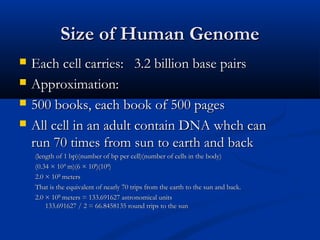
Size of Human GenomeSize of Human Genome
 Each cell carries: 3.2 billion base pairsEach cell carries: 3.2 billion base pairs
 Approximation:Approximation:
 500 books, each book of 500 pages500 books, each book of 500 pages
 All cell in an adult contain DNA whch canAll cell in an adult contain DNA whch can
run 70 times from sun to earth and backrun 70 times from sun to earth and back
(length of 1 bp)(number of bp per cell)(number of cells in the body)(length of 1 bp)(number of bp per cell)(number of cells in the body)
(0.34 × 10(0.34 × 10-9-9
 m)(6 × 10 m)(6 × 1099
)(10)(101313
))
2.0 × 102.0 × 101313
 meters meters
That is the equivalent of nearly 70 trips from the earth to the sun and back.That is the equivalent of nearly 70 trips from the earth to the sun and back.
2.0 × 102.0 × 101313
 meters = 133.691627 astronomical units meters = 133.691627 astronomical units
133.691627 / 2 = 66.8458135 round trips to the sun133.691627 / 2 = 66.8458135 round trips to the sun
Watson and CrickWatson and Crick
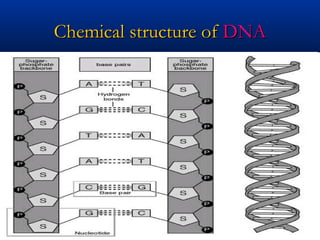
 The structure ofThe structure of DNADNA was described bywas described by
British ScientistsBritish Scientists Watson andWatson and CrickCrick as longas long
double helix shaped with its sugardouble helix shaped with its sugar
phosphate backbone on the outside and itsphosphate backbone on the outside and its
bases on inside; the two strand of helix runbases on inside; the two strand of helix run
in opposite direction and are anti-parallel toin opposite direction and are anti-parallel to
each other. Theeach other. The DNADNA double helix isdouble helix is
stabilized by hydrogen bonds between thestabilized by hydrogen bonds between the
basesbases
 Doctortvrao’s ‘e’ learning seriesDoctortvrao’s ‘e’ learning series
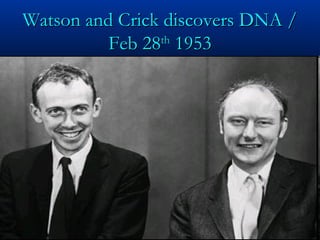
Watson and Crick discovers DNA /Watson and Crick discovers DNA /
Feb 28Feb 28thth
19531953
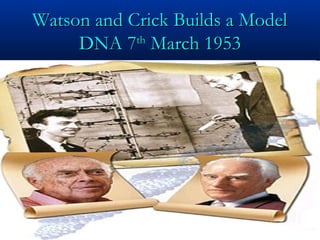
Watson and Crick Builds a ModelWatson and Crick Builds a Model
DNA 7DNA 7thth
March 1953March 1953
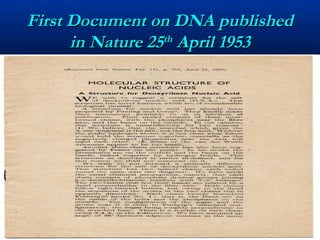
First Document on DNA publishedFirst Document on DNA published
in Nature 25in Nature 25thth
April 1953April 1953
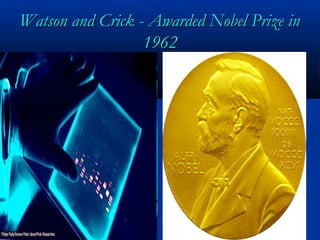
Watson and Crick - Awarded Nobel Prize inWatson and Crick - Awarded Nobel Prize in
19621962
DNA - StructureDNA - Structure
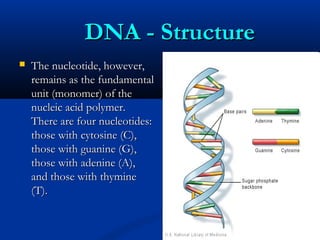
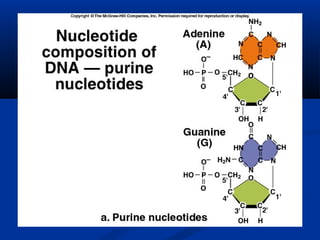
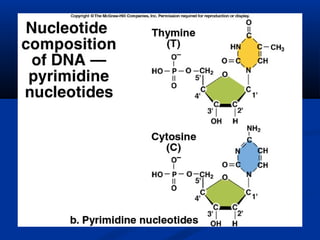
 The nucleotide, however,The nucleotide, however,
remains as the fundamentalremains as the fundamental
unit (monomer) of theunit (monomer) of the
nucleic acid polymer.nucleic acid polymer.
There are four nucleotides:There are four nucleotides:
those with cytosine (C),those with cytosine (C),
those with guanine (G),those with guanine (G),
those with adenine (A),those with adenine (A),
and those with thymineand those with thymine
(T).(T).
DNADNA
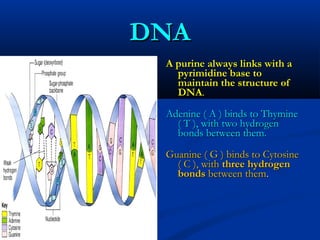
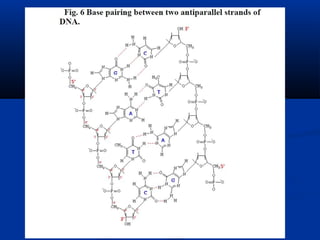
A purine always links with aA purine always links with a
pyrimidine base topyrimidine base to
maintain the structure ofmaintain the structure of
DNADNA..
Adenine ( A ) binds to ThymineAdenine ( A ) binds to Thymine
( T ), with two hydrogen( T ), with two hydrogen
bonds between them.bonds between them.
Guanine ( G ) binds to CytosineGuanine ( G ) binds to Cytosine
( C ), with( C ), with three hydrogenthree hydrogen
bondsbonds between thembetween them..
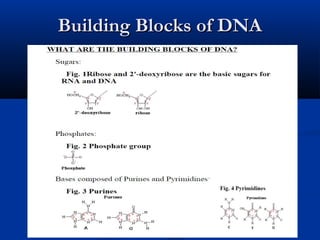
Building Blocks of DNABuilding Blocks of DNA
Chemical structure ofChemical structure of DNADNA
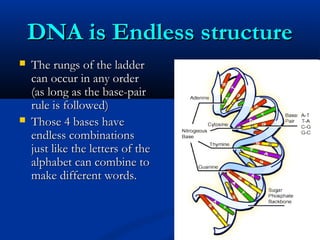
DNA is Endless structureDNA is Endless structure
 The rungs of the ladderThe rungs of the ladder
can occur in any ordercan occur in any order
(as long as the base-pair(as long as the base-pair
rule is followed)rule is followed)
 Those 4 bases haveThose 4 bases have
endless combinationsendless combinations
just like the letters of thejust like the letters of the
alphabet can combine toalphabet can combine to
make different words.make different words.

Lecture 1 basic molecular biology

  • 1.
    Molecular BiologyMolecular Biology Principlesand Basic ToolsPrinciples and Basic Tools
  • 2.
    Molecular Biology -DefinitionMolecular Biology - Definition  Molecular biologyMolecular biology is the study of biology at ais the study of biology at a molecular level.molecular level.  Molecular biologyMolecular biology; the study of; the study of genegene structure andstructure and functions at thefunctions at the molecular levelmolecular level to understand theto understand the molecular basis of hereditarymolecular basis of hereditary,, genetic variation,genetic variation, and the expression patterns of genesand the expression patterns of genes..  The field overlaps with other areas of biology andThe field overlaps with other areas of biology and chemistry, particularly genetics and biochemistry.chemistry, particularly genetics and biochemistry.
  • 3.
    Molecular Biology InterdisciplinaryMolecularBiology Interdisciplinary ScienceScience  Molecular biology chiefly concerns itselfMolecular biology chiefly concerns itself with understanding the interactionswith understanding the interactions between the various systems of a cell,between the various systems of a cell, including the interactions between DNA,including the interactions between DNA, RNA and protein biosynthesis as well asRNA and protein biosynthesis as well as learning how these interactions arelearning how these interactions are regulatedregulated  Doctortvrao’s ‘e’ learning seriesDoctortvrao’s ‘e’ learning series
  • 4.
    Beginning of MolecularBiologyBeginning of Molecular Biology  TheThe Modern of molecular biologyModern of molecular biology begins inbegins in the 1930s with the convergence of various,the 1930s with the convergence of various, previously distinct biological disciplines:previously distinct biological disciplines: biochemistry, genetics, microbiology, andbiochemistry, genetics, microbiology, and virology.virology. With the hope of understanding life atWith the hope of understanding life at its most fundamental level, numerous physicistsits most fundamental level, numerous physicists and chemists also took an interest in what wouldand chemists also took an interest in what would become molecular biology.become molecular biology.  Doctortvrao’s ‘e’ learning seriesDoctortvrao’s ‘e’ learning series
  • 5.
    Warren WeaverWarren Weaver While molecular biologyWhile molecular biology was established in thewas established in the 1930s, the term was first1930s, the term was first coined bycoined by WarrenWarren WeaverWeaver in 1938. Warrenin 1938. Warren was the director ofwas the director of Natural Sciences for theNatural Sciences for the RockefellerRockefeller FoundationFoundation....
  • 8.
    Size of HumanGenomeSize of Human Genome  Each cell carries: 3.2 billion base pairsEach cell carries: 3.2 billion base pairs  Approximation:Approximation:  500 books, each book of 500 pages500 books, each book of 500 pages  All cell in an adult contain DNA whch canAll cell in an adult contain DNA whch can run 70 times from sun to earth and backrun 70 times from sun to earth and back (length of 1 bp)(number of bp per cell)(number of cells in the body)(length of 1 bp)(number of bp per cell)(number of cells in the body) (0.34 × 10(0.34 × 10-9-9  m)(6 × 10 m)(6 × 1099 )(10)(101313 )) 2.0 × 102.0 × 101313  meters meters That is the equivalent of nearly 70 trips from the earth to the sun and back.That is the equivalent of nearly 70 trips from the earth to the sun and back. 2.0 × 102.0 × 101313  meters = 133.691627 astronomical units meters = 133.691627 astronomical units 133.691627 / 2 = 66.8458135 round trips to the sun133.691627 / 2 = 66.8458135 round trips to the sun
  • 9.
    Watson and CrickWatsonand Crick  The structure ofThe structure of DNADNA was described bywas described by British ScientistsBritish Scientists Watson andWatson and CrickCrick as longas long double helix shaped with its sugardouble helix shaped with its sugar phosphate backbone on the outside and itsphosphate backbone on the outside and its bases on inside; the two strand of helix runbases on inside; the two strand of helix run in opposite direction and are anti-parallel toin opposite direction and are anti-parallel to each other. Theeach other. The DNADNA double helix isdouble helix is stabilized by hydrogen bonds between thestabilized by hydrogen bonds between the basesbases  Doctortvrao’s ‘e’ learning seriesDoctortvrao’s ‘e’ learning series
  • 10.
    Watson and Crickdiscovers DNA /Watson and Crick discovers DNA / Feb 28Feb 28thth 19531953
  • 11.
    Watson and CrickBuilds a ModelWatson and Crick Builds a Model DNA 7DNA 7thth March 1953March 1953
  • 12.
    First Document onDNA publishedFirst Document on DNA published in Nature 25in Nature 25thth April 1953April 1953
  • 13.
    Watson and Crick- Awarded Nobel Prize inWatson and Crick - Awarded Nobel Prize in 19621962
  • 14.
    DNA - StructureDNA- Structure  The nucleotide, however,The nucleotide, however, remains as the fundamentalremains as the fundamental unit (monomer) of theunit (monomer) of the nucleic acid polymer.nucleic acid polymer. There are four nucleotides:There are four nucleotides: those with cytosine (C),those with cytosine (C), those with guanine (G),those with guanine (G), those with adenine (A),those with adenine (A), and those with thymineand those with thymine (T).(T).
  • 15.
    DNADNA A purine alwayslinks with aA purine always links with a pyrimidine base topyrimidine base to maintain the structure ofmaintain the structure of DNADNA.. Adenine ( A ) binds to ThymineAdenine ( A ) binds to Thymine ( T ), with two hydrogen( T ), with two hydrogen bonds between them.bonds between them. Guanine ( G ) binds to CytosineGuanine ( G ) binds to Cytosine ( C ), with( C ), with three hydrogenthree hydrogen bondsbonds between thembetween them..
  • 16.
    Building Blocks ofDNABuilding Blocks of DNA
  • 20.
    Chemical structure ofChemicalstructure of DNADNA
  • 21.
    DNA is EndlessstructureDNA is Endless structure  The rungs of the ladderThe rungs of the ladder can occur in any ordercan occur in any order (as long as the base-pair(as long as the base-pair rule is followed)rule is followed)  Those 4 bases haveThose 4 bases have endless combinationsendless combinations just like the letters of thejust like the letters of the alphabet can combine toalphabet can combine to make different words.make different words.