UNIT PLAN
DR. C. BEULAH JAYARANI
M.Sc., M.A, M.Ed, M.Phil (Edn), M.Phil (ZOO), NET, Ph.D (Edn)
ASST. PROFESSOR,
LOYOLA COLLEGE OF EDUCATION, CHENNAI - 34
INTRODUCTION
• “A unit may be defined as a means of organizing
materials for instructional purposes which
utilizes significant subject matter content,
involve pupils learning activities through active
participation intellectually and physically and
modifies the pupils behavior to the extent that
he is able to cope with new problems and
situations more competently”.
H.C. Morrison
03-08-2021 Dr. C. Beulah Jayarani 2
INTRODUCTION
• A unit is a large subdivision of subject matter with a common fabric of
knowledge.
• The unit is not just blocks of subject matter, but is composed of both method
and content.
• Thus, a unit organizes instruction and increases the probability that
instruction will be presented in a cohesive, meaningful and logic way.
• A properly planned unit integrates many type of activities, some of which
provide new information and others help pupils evaluate and retain this
information.
• Units of break up a course into meaningful segments that is larger than
lesson plans
03-08-2021 Dr. C. Beulah Jayarani 3
Contd.,
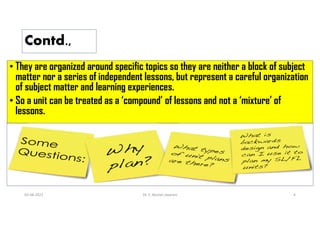
• They are organized around specific topics so they are neither a block of subject
matter nor a series of independent lessons, but represent a careful organization
of subject matter and learning experiences.
• So a unit can be treated as a ‘compound’ of lessons and not a ‘mixture’ of
lessons.
03-08-2021 Dr. C. Beulah Jayarani 4
DefINITIONs Of A UNIT
• ‘The important thing to provide a combination of subject matter and
processes which will have real meaning for the learner which will aid him
in continuously integrating his learning is through a unit’.
- Burton
• ‘A unit is as large a block of related subject matter as can be over viewed
by the learner’.
- Preston
• ‘A unit is an outline of carefully selected subject matter which has been
isolated because of its relationship to pupil’s need’s and interests’.
- Stanford
03-08-2021 Dr. C. Beulah Jayarani 5
ChARACTeRIsTICs Of A GOOD UNIT
• It should keep in view, the needs, the capabilities and the interest of the pupil
• It should take into account the previous experience and background of the pupil
• It should provide for new experiences which the students have not done before.
• The length of the unit should maintain interest of the pupil till the last
• The material of the unit should consist of familiar and related topics and not as
remote and strange one
• It should be related to social and physical environment of the pupil
03-08-2021 Dr. C. Beulah Jayarani 6
Contd.,
• It should help to anticipate and satisfy some of the future needs of the pupil
• It should be a part of the sequence that permits growth from year to year
• It should be a results of the co-operative planning of the teacher as far as
possible
• It should provide the basis for its evaluation
• It should be flexible enough to provide individual differences
• It should permit a variety of field trips, experiments, demonstrations, and
projects etc.
• It should be practicable in the given setting
03-08-2021 Dr. C. Beulah Jayarani 7
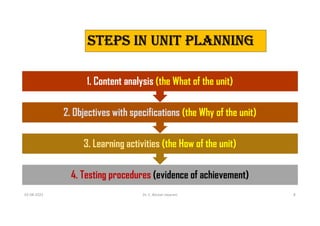
sTePs IN UNIT PLANNING
4. Testing procedures (evidence of achievement)
3. Learning activities (the How of the unit)
2. Objectives with specifications (the Why of the unit)
1. Content analysis (the What of the unit)
03-08-2021 Dr. C. Beulah Jayarani 8
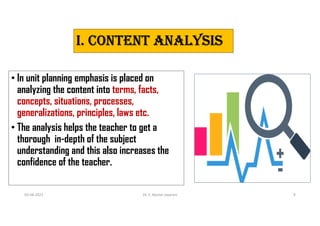
I. CONTeNT ANALysIs
• In unit planning emphasis is placed on
analyzing the content into terms, facts,
concepts, situations, processes,
generalizations, principles, laws etc.
• The analysis helps the teacher to get a
thorough in-depth of the subject
understanding and this also increases the
confidence of the teacher.
03-08-2021 Dr. C. Beulah Jayarani 9
II. ObjeCTIves AND sPeCIfICATIONs
• After analyzing the content,
teacher should identify the
general and specific objectives
of the content
03-08-2021 Dr. C. Beulah Jayarani 10
III. LeARNING ACTIvITIes
• Learning is not a pouring in process, but a gradual process that comes
about as a result of experience.
• Activities like field trips, experiments, demonstrations and projects can
be used in different settings.
• The experience can be backed up with reference books films and slides.
• Keeping in mind of the individual differences, the psychology of learning,
the content and objectives, suitable learning activities can be planned to
which the students will be exposed during the course of the unit.
03-08-2021 Dr. C. Beulah Jayarani 11
Iv. TesTING PROCeDURes
• The last step is the choice of suitable
evaluation tools and techniques
through which teacher can evaluate
the content coverage and teaching
method used.
03-08-2021 Dr. C. Beulah Jayarani 12
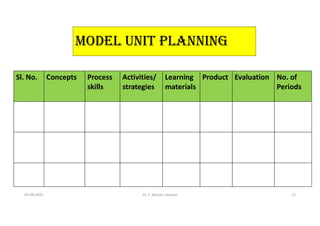
MODeL UNIT PLANNING
Sl. No. Concepts Process
skills
Activities/
strategies
Learning
materials
Product Evaluation No. of
Periods
03-08-2021 Dr. C. Beulah Jayarani 13
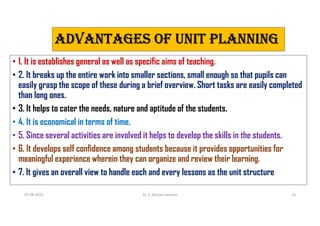
ADvANTAGes Of UNIT PLANNING
• 1. It is establishes general as well as specific aims of teaching.
• 2. It breaks up the entire work into smaller sections, small enough so that pupils can
easily grasp the scope of these during a brief overview. Short tasks are easily completed
than long ones.
• 3. It helps to cater the needs, nature and aptitude of the students.
• 4. It is economical in terms of time.
• 5. Since several activities are involved it helps to develop the skills in the students.
• 6. It develops self confidence among students because it provides opportunities for
meaningful experience wherein they can organize and review their learning.
• 7. It gives an overall view to handle each and every lessons as the unit structure
03-08-2021 Dr. C. Beulah Jayarani 14
CONCLUsION
• Effective unit planning requires the knowledge of the functional developments and the
logical maturity of the particular class students.
• It also requires information about the desires, interests and capacities of the students.
• The knowledge of psychology of learning, principals of teaching, previous knowledge of the
students, and effective mastery of the subject matter are essential for planning a unit.
• Unit plan demands sufficient experience of the teacher to plan classroom activities to
develop understanding, interest, aptitude and skill of students in addition to the scientific
knowledge in all its aspects- scientific terms, facts and principals ideas and concepts for
the whole academic year.
• In unit plan, there should be scope for creative activities by the students and should
provide opportunity for critical thinking for the educational year.
03-08-2021 Dr. C. Beulah Jayarani 15
RefeReNCe
TNTEU – Study Material
Ram Publications
Sri Krishna Publications
Kaviyamala Publications
Google Images
03-08-2021 Dr. C. Beulah Jayarani 16

Unit plan

  • 1.
    UNIT PLAN DR. C.BEULAH JAYARANI M.Sc., M.A, M.Ed, M.Phil (Edn), M.Phil (ZOO), NET, Ph.D (Edn) ASST. PROFESSOR, LOYOLA COLLEGE OF EDUCATION, CHENNAI - 34
  • 2.
    INTRODUCTION • “A unitmay be defined as a means of organizing materials for instructional purposes which utilizes significant subject matter content, involve pupils learning activities through active participation intellectually and physically and modifies the pupils behavior to the extent that he is able to cope with new problems and situations more competently”. H.C. Morrison 03-08-2021 Dr. C. Beulah Jayarani 2
  • 3.
    INTRODUCTION • A unitis a large subdivision of subject matter with a common fabric of knowledge. • The unit is not just blocks of subject matter, but is composed of both method and content. • Thus, a unit organizes instruction and increases the probability that instruction will be presented in a cohesive, meaningful and logic way. • A properly planned unit integrates many type of activities, some of which provide new information and others help pupils evaluate and retain this information. • Units of break up a course into meaningful segments that is larger than lesson plans 03-08-2021 Dr. C. Beulah Jayarani 3
  • 4.
    Contd., • They areorganized around specific topics so they are neither a block of subject matter nor a series of independent lessons, but represent a careful organization of subject matter and learning experiences. • So a unit can be treated as a ‘compound’ of lessons and not a ‘mixture’ of lessons. 03-08-2021 Dr. C. Beulah Jayarani 4
  • 5.
    DefINITIONs Of AUNIT • ‘The important thing to provide a combination of subject matter and processes which will have real meaning for the learner which will aid him in continuously integrating his learning is through a unit’. - Burton • ‘A unit is as large a block of related subject matter as can be over viewed by the learner’. - Preston • ‘A unit is an outline of carefully selected subject matter which has been isolated because of its relationship to pupil’s need’s and interests’. - Stanford 03-08-2021 Dr. C. Beulah Jayarani 5
  • 6.
    ChARACTeRIsTICs Of AGOOD UNIT • It should keep in view, the needs, the capabilities and the interest of the pupil • It should take into account the previous experience and background of the pupil • It should provide for new experiences which the students have not done before. • The length of the unit should maintain interest of the pupil till the last • The material of the unit should consist of familiar and related topics and not as remote and strange one • It should be related to social and physical environment of the pupil 03-08-2021 Dr. C. Beulah Jayarani 6
  • 7.
    Contd., • It shouldhelp to anticipate and satisfy some of the future needs of the pupil • It should be a part of the sequence that permits growth from year to year • It should be a results of the co-operative planning of the teacher as far as possible • It should provide the basis for its evaluation • It should be flexible enough to provide individual differences • It should permit a variety of field trips, experiments, demonstrations, and projects etc. • It should be practicable in the given setting 03-08-2021 Dr. C. Beulah Jayarani 7
  • 8.
    sTePs IN UNITPLANNING 4. Testing procedures (evidence of achievement) 3. Learning activities (the How of the unit) 2. Objectives with specifications (the Why of the unit) 1. Content analysis (the What of the unit) 03-08-2021 Dr. C. Beulah Jayarani 8
  • 9.
    I. CONTeNT ANALysIs •In unit planning emphasis is placed on analyzing the content into terms, facts, concepts, situations, processes, generalizations, principles, laws etc. • The analysis helps the teacher to get a thorough in-depth of the subject understanding and this also increases the confidence of the teacher. 03-08-2021 Dr. C. Beulah Jayarani 9
  • 10.
    II. ObjeCTIves ANDsPeCIfICATIONs • After analyzing the content, teacher should identify the general and specific objectives of the content 03-08-2021 Dr. C. Beulah Jayarani 10
  • 11.
    III. LeARNING ACTIvITIes •Learning is not a pouring in process, but a gradual process that comes about as a result of experience. • Activities like field trips, experiments, demonstrations and projects can be used in different settings. • The experience can be backed up with reference books films and slides. • Keeping in mind of the individual differences, the psychology of learning, the content and objectives, suitable learning activities can be planned to which the students will be exposed during the course of the unit. 03-08-2021 Dr. C. Beulah Jayarani 11
  • 12.
    Iv. TesTING PROCeDURes •The last step is the choice of suitable evaluation tools and techniques through which teacher can evaluate the content coverage and teaching method used. 03-08-2021 Dr. C. Beulah Jayarani 12
  • 13.
    MODeL UNIT PLANNING Sl.No. Concepts Process skills Activities/ strategies Learning materials Product Evaluation No. of Periods 03-08-2021 Dr. C. Beulah Jayarani 13
  • 14.
    ADvANTAGes Of UNITPLANNING • 1. It is establishes general as well as specific aims of teaching. • 2. It breaks up the entire work into smaller sections, small enough so that pupils can easily grasp the scope of these during a brief overview. Short tasks are easily completed than long ones. • 3. It helps to cater the needs, nature and aptitude of the students. • 4. It is economical in terms of time. • 5. Since several activities are involved it helps to develop the skills in the students. • 6. It develops self confidence among students because it provides opportunities for meaningful experience wherein they can organize and review their learning. • 7. It gives an overall view to handle each and every lessons as the unit structure 03-08-2021 Dr. C. Beulah Jayarani 14
  • 15.
    CONCLUsION • Effective unitplanning requires the knowledge of the functional developments and the logical maturity of the particular class students. • It also requires information about the desires, interests and capacities of the students. • The knowledge of psychology of learning, principals of teaching, previous knowledge of the students, and effective mastery of the subject matter are essential for planning a unit. • Unit plan demands sufficient experience of the teacher to plan classroom activities to develop understanding, interest, aptitude and skill of students in addition to the scientific knowledge in all its aspects- scientific terms, facts and principals ideas and concepts for the whole academic year. • In unit plan, there should be scope for creative activities by the students and should provide opportunity for critical thinking for the educational year. 03-08-2021 Dr. C. Beulah Jayarani 15
  • 16.
    RefeReNCe TNTEU – StudyMaterial Ram Publications Sri Krishna Publications Kaviyamala Publications Google Images 03-08-2021 Dr. C. Beulah Jayarani 16