COURSE PLAN AND UNIT PLAN
Vyas viraj .v
1st year M.sc. Nursing
Definition of course plan
• A course may be defined as complete series of
studies leading to graduation or a degree in case of
B.SC Nursing course requiring completion of several
short courses.
Purpose of course planning
 To ensure autonomy.
 It gives stability.
 It helps to solve the problem.
 It supports the curriculum process.
 It secures future progress.
 It brings about improvements.
 It promotes utilization of resources.
Level of course plan
 Pertains to organizing the both the content and
learning experiences within a unit or a subject.
 Deals with designing the pattern for the entire
program at the program level.
Principles
 State the objectives in behavioral terms.
 Establish sequence in order of succession, the
content materials has to be organized.
 The teacher should keep in mind
 What should the students learn from the course?
 What should be the sequence of topics/units?
 How much time is to be alloted?
 Provide cumulative learning by reinforcement.
Conti…
 Select an approach that is acceptable to all teachers.
 Provide variety in modes of learning.
Unity curriculum
 To reduce unmanageable bulk of specialized subjects
and bring some unity into atomized specialization.
 It also reduces the unit to manageable size and serves
as a Centre of organization.
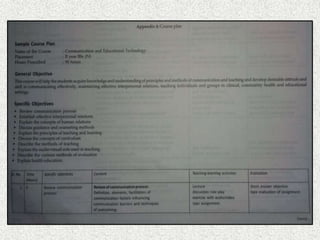
Structure of course plan
In planning course ,two kinds of planning are
involved:
 Identifying the kinds of elements and which specific
learning has to be organized.
 The selection of be specific organizing centers which
learners entire development be focused.
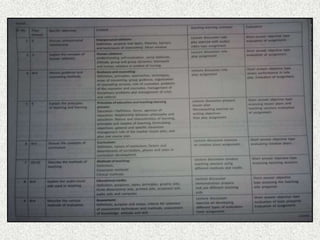
Elements of course plan
 Objectives –State the objectives or outcomes to be
achieved through the given course.
 Specifications for level of learner and placement
within the curriculum.
 Resources material needed for the course.
 Mention the placement of the course within the
curriculum.
Conti…..
 Organize the content.
 Describe the resource materials and method of
teaching.
 Prepare the plan of learning activities for students.
 Mention place, length of experience, experience
record/ cumulative record , observations, procedures,
plan for Rotation with field experiences, supervised
and guided practice.
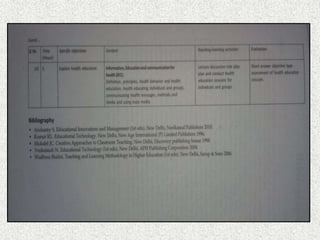
 Evaluation measures.
 Bibliography.
Process of organizing learning
experience
 The staff concerned for teaching the course and
administrator of the program will discuss and agree
on the general scheme of organization of the course
and its smooth implementation.
 Agreement.
 The basic units should be include.
 Flexible plans should be developed which can be
handled by each teacher.
 The plan should be used for particular activities in a
particular course.
Teachers role in course planning
 Teachers plan unit of work.
 He / She should select materials and learning
activities according to the level of students.
 He/ She should plan carefully.
 He / She should avoid gaps and non- projective
repetition in subject matter content.
 He/ She should provide enforcement of previous
learning.
Conti….
 He/ She has to set up working groups.
 He/ She should formulate the objectives prior to the
planning.
 He/ She should possess knowledge adequately.
 He/ She should have skills related to the area that
they are teaching.
Conti…
 The teachers plan should focuses on general
objectives of the course, the unit plan, and the class
plan.
 He/ She should be efficient in preparing course plan.
 He/ She should be accountable every steps of
planning.
 He/ She should plan equally to all the students.
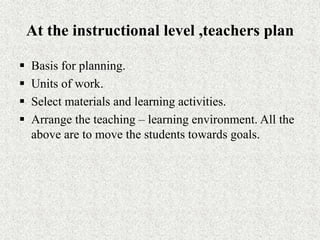
At the instructional level ,teachers plan
 Basis for planning.
 Units of work.
 Select materials and learning activities.
 Arrange the teaching – learning environment. All the
above are to move the students towards goals.
UNIT PLAN
Definition of unit plan
• Unit may be defined as a large subdivision of the
subject matter.
• Planning the unit is known as unit planning.
Characteristic of unit plan
1. Effectively in terms of whole rather than fraction
2. Developmental & therefore provide for vertical &
horizontal organization of learning experience
3. Effective when is an understanding and acceptance
of goal to be achieved & there is full and free
participation in planning for the attainment of those
goals.
4. Necessity for providing for individual
differences in rates of learning & interests
Conti….
5. Unit planning recognizes that true learning renders
the learners increasingly skill in self- directions.
6. Unit planning provides sound basis for evaluation.
Types of unit planning
1. Subject matter units
a) Topical unit
b) The generalization unit
c) The unit based on significant aspect of environment
or culture.
2. Experience unit
a) Unit based on center of interest
b) Unit based on student purpose
c) Unit based on student need
Unit planning in nursing course
 Since there is wide applicability of all type of unit
plans in nursing courses, the term “teaching-learning
unit” has been used to describe unit planning in
nursing course.
 The term ‘teaching-learning unit’ embodies the new
concept of unified learning experiences involving
comprehensive problems or projects which are
important to the student in nursing.
The essential activities of unit planning
1. Selection & statement of objectives
2. Selection of type of unit to be used
3. Selection of learning situations
4. Selection of knowledge component
5. Selection of the organizing centers-learning &
teaching activities
6. Selection of methods of evaluation
Course plan and unit plan

Course plan and unit plan

  • 1.
    COURSE PLAN ANDUNIT PLAN Vyas viraj .v 1st year M.sc. Nursing
  • 2.
    Definition of courseplan • A course may be defined as complete series of studies leading to graduation or a degree in case of B.SC Nursing course requiring completion of several short courses.
  • 3.
    Purpose of courseplanning  To ensure autonomy.  It gives stability.  It helps to solve the problem.  It supports the curriculum process.  It secures future progress.  It brings about improvements.  It promotes utilization of resources.
  • 4.
    Level of courseplan  Pertains to organizing the both the content and learning experiences within a unit or a subject.  Deals with designing the pattern for the entire program at the program level.
  • 5.
    Principles  State theobjectives in behavioral terms.  Establish sequence in order of succession, the content materials has to be organized.  The teacher should keep in mind  What should the students learn from the course?  What should be the sequence of topics/units?  How much time is to be alloted?  Provide cumulative learning by reinforcement.
  • 6.
    Conti…  Select anapproach that is acceptable to all teachers.  Provide variety in modes of learning. Unity curriculum  To reduce unmanageable bulk of specialized subjects and bring some unity into atomized specialization.  It also reduces the unit to manageable size and serves as a Centre of organization.
  • 7.
    Structure of courseplan In planning course ,two kinds of planning are involved:  Identifying the kinds of elements and which specific learning has to be organized.  The selection of be specific organizing centers which learners entire development be focused.
  • 8.
    Elements of courseplan  Objectives –State the objectives or outcomes to be achieved through the given course.  Specifications for level of learner and placement within the curriculum.  Resources material needed for the course.  Mention the placement of the course within the curriculum.
  • 9.
    Conti…..  Organize thecontent.  Describe the resource materials and method of teaching.  Prepare the plan of learning activities for students.  Mention place, length of experience, experience record/ cumulative record , observations, procedures, plan for Rotation with field experiences, supervised and guided practice.  Evaluation measures.  Bibliography.
  • 10.
    Process of organizinglearning experience  The staff concerned for teaching the course and administrator of the program will discuss and agree on the general scheme of organization of the course and its smooth implementation.  Agreement.  The basic units should be include.  Flexible plans should be developed which can be handled by each teacher.  The plan should be used for particular activities in a particular course.
  • 11.
    Teachers role incourse planning  Teachers plan unit of work.  He / She should select materials and learning activities according to the level of students.  He/ She should plan carefully.  He / She should avoid gaps and non- projective repetition in subject matter content.  He/ She should provide enforcement of previous learning.
  • 12.
    Conti….  He/ Shehas to set up working groups.  He/ She should formulate the objectives prior to the planning.  He/ She should possess knowledge adequately.  He/ She should have skills related to the area that they are teaching.
  • 13.
    Conti…  The teachersplan should focuses on general objectives of the course, the unit plan, and the class plan.  He/ She should be efficient in preparing course plan.  He/ She should be accountable every steps of planning.  He/ She should plan equally to all the students.
  • 14.
    At the instructionallevel ,teachers plan  Basis for planning.  Units of work.  Select materials and learning activities.  Arrange the teaching – learning environment. All the above are to move the students towards goals.
  • 18.
  • 19.
    Definition of unitplan • Unit may be defined as a large subdivision of the subject matter. • Planning the unit is known as unit planning.
  • 20.
    Characteristic of unitplan 1. Effectively in terms of whole rather than fraction 2. Developmental & therefore provide for vertical & horizontal organization of learning experience 3. Effective when is an understanding and acceptance of goal to be achieved & there is full and free participation in planning for the attainment of those goals. 4. Necessity for providing for individual differences in rates of learning & interests
  • 21.
    Conti…. 5. Unit planningrecognizes that true learning renders the learners increasingly skill in self- directions. 6. Unit planning provides sound basis for evaluation.
  • 22.
    Types of unitplanning 1. Subject matter units a) Topical unit b) The generalization unit c) The unit based on significant aspect of environment or culture. 2. Experience unit a) Unit based on center of interest b) Unit based on student purpose c) Unit based on student need
  • 23.
    Unit planning innursing course  Since there is wide applicability of all type of unit plans in nursing courses, the term “teaching-learning unit” has been used to describe unit planning in nursing course.  The term ‘teaching-learning unit’ embodies the new concept of unified learning experiences involving comprehensive problems or projects which are important to the student in nursing.
  • 24.
    The essential activitiesof unit planning 1. Selection & statement of objectives 2. Selection of type of unit to be used 3. Selection of learning situations 4. Selection of knowledge component 5. Selection of the organizing centers-learning & teaching activities 6. Selection of methods of evaluation