UNIVERSIDAD NACIONAL DE LOJA
PEDAGOGIA DE LOS IDIOMAS
NACIONALES Y EXTRANJEROS
CURRICULAR PLANNING
ABOUT UNIT PLAN LESSSON
• Name: Diana Abigail Torres Rodríguez
• Teacher: Mg.Sc María Patricia Rodríguez Ludeña
• Cycle: IV
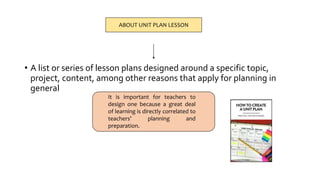
• A list or series of lesson plans designed around a specific topic,
project, content, among other reasons that apply for planning in
general
ABOUT UNIT PLAN LESSON
It is important for teachers to
design one because a great deal
of learning is directly correlated to
teachers’ planning and
preparation.
Class standards that are thematically
integrated are addressed.
• The process of planning forces you to
reflect on what you want to accomplish.
• Planning helps you control how class
time is used and, as a result of reflection.
• Lesson and unit plans can be used and
recycled, with revisions and adaptations
Bilash (2011)
What considerations do I need to make for
being able to design my Unit Plan?
• Unit plans are consistent with National curriculum guidelines.
• You must stick to a timeline to complete a unit.
• Take some time to review what resources are already available to
you
• Know about your students’ needs and interests
• Review what resources you can resort to, you should create a
diversity of assessment tools to evaluate learning
• Select what may fit their learning styles and use lessons and
activities that motivate their curiosity and interest of students
Standard Components
• Unit & Subject Area
• Communicative Competence
Component.
• Classroom/Level
• Unit Rationale
• Goals
• Objectives
• Content
• Learning adjectives
• List of resources
• List of materials
• Assessment
• Explanation of how the unit
plan addresses a particular
student profile.
ABOUT LESSON PLANS
A lesson plan is an extremely useful tool that serves as the following:
• A guide because it serves as a map or checklist that leads us in knowing what
to teach, in what order, and for how long.
• A resource for planning assessment measures such as quiz, midterms, and
final exams.
• A historical document : what we did in class and which we or a substitute
• Teacher can resort to as an account of what we did before and what needs to
be done
Why to design a lesson plan?
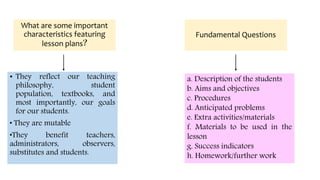
What are some important
characteristics featuring
lesson plans?
• They reflect our teaching
philosophy, student
population, textbooks, and
most importantly, our goals
for our students.
• They are mutable
•They benefit teachers,
administrators, observers,
substitutes and students.
Fundamental Questions
a. Description of the students
b. Aims and objectives
c. Procedures
d. Anticipated problems
e. Extra activities/materials
f. Materials to be used in the
lesson
g. Success indicators
h. Homework/further work
What are some standard components in a Lesson Plan?
• a. Description of the students
• b. Aims and objectives
• c. Procedures
• d. Anticipated problems
• e. Extra activities/materials
• f. Materials to be used in the lesson
• g. Success indicators h.
Homework/further work

Unit plan

  • 1.
    UNIVERSIDAD NACIONAL DELOJA PEDAGOGIA DE LOS IDIOMAS NACIONALES Y EXTRANJEROS CURRICULAR PLANNING ABOUT UNIT PLAN LESSSON • Name: Diana Abigail Torres Rodríguez • Teacher: Mg.Sc María Patricia Rodríguez Ludeña • Cycle: IV
  • 2.
    • A listor series of lesson plans designed around a specific topic, project, content, among other reasons that apply for planning in general ABOUT UNIT PLAN LESSON It is important for teachers to design one because a great deal of learning is directly correlated to teachers’ planning and preparation.
  • 3.
    Class standards thatare thematically integrated are addressed. • The process of planning forces you to reflect on what you want to accomplish. • Planning helps you control how class time is used and, as a result of reflection. • Lesson and unit plans can be used and recycled, with revisions and adaptations Bilash (2011)
  • 4.
    What considerations doI need to make for being able to design my Unit Plan? • Unit plans are consistent with National curriculum guidelines. • You must stick to a timeline to complete a unit. • Take some time to review what resources are already available to you • Know about your students’ needs and interests • Review what resources you can resort to, you should create a diversity of assessment tools to evaluate learning • Select what may fit their learning styles and use lessons and activities that motivate their curiosity and interest of students
  • 5.
    Standard Components • Unit& Subject Area • Communicative Competence Component. • Classroom/Level • Unit Rationale • Goals • Objectives • Content • Learning adjectives • List of resources • List of materials • Assessment • Explanation of how the unit plan addresses a particular student profile.
  • 6.
    ABOUT LESSON PLANS Alesson plan is an extremely useful tool that serves as the following: • A guide because it serves as a map or checklist that leads us in knowing what to teach, in what order, and for how long. • A resource for planning assessment measures such as quiz, midterms, and final exams. • A historical document : what we did in class and which we or a substitute • Teacher can resort to as an account of what we did before and what needs to be done Why to design a lesson plan?
  • 7.
    What are someimportant characteristics featuring lesson plans? • They reflect our teaching philosophy, student population, textbooks, and most importantly, our goals for our students. • They are mutable •They benefit teachers, administrators, observers, substitutes and students. Fundamental Questions a. Description of the students b. Aims and objectives c. Procedures d. Anticipated problems e. Extra activities/materials f. Materials to be used in the lesson g. Success indicators h. Homework/further work
  • 8.
    What are somestandard components in a Lesson Plan? • a. Description of the students • b. Aims and objectives • c. Procedures • d. Anticipated problems • e. Extra activities/materials • f. Materials to be used in the lesson • g. Success indicators h. Homework/further work