

Suresh Babu G
Grading in Education
Suresh Babu G
Assistant Professsor
CTE CPAS Paippad, Kottayam
Suresh Babu G
Grading
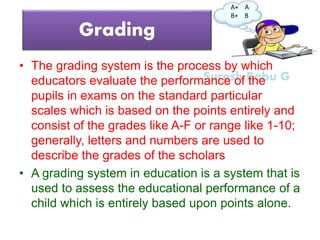
• The grading system is the process by which
educators evaluate the performance of the
pupils in exams on the standard particular
scales which is based on the points entirely and
consist of the grades like A-F or range like 1-10;
generally, letters and numbers are used to
describe the grades of the scholars
• A grading system in education is a system that is
used to assess the educational performance of a
child which is entirely based upon points alone.
A+ A
B+ B
Suresh Babu G
Features of Grading
 When students level of performance are classified
into a few classificatory units using letter grade , the
system of assessment is called grading system.
 In grading classification is made on 5 point, 7 point ,
9 point scale.
 It is a score
 It identifies students performance level with a wide
range
 It involves the use of set of specialized symbols
whose meaning ought to be objectively defined in
terms of specific criteria.
Suresh Babu G
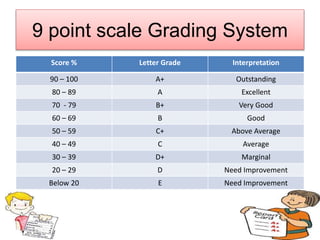
9 point scale Grading System
Score % Letter Grade Interpretation
90 – 100 A+ Outstanding
80 – 89 A Excellent
70 - 79 B+ Very Good
60 – 69 B Good
50 – 59 C+ Above Average
40 – 49 C Average
30 – 39 D+ Marginal
20 – 29 D Need Improvement
Below 20 E Need Improvement
Suresh Babu G
General Classification of
Grading
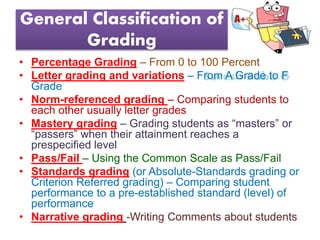
• Percentage Grading – From 0 to 100 Percent
• Letter grading and variations – From A Grade to F
Grade
• Norm-referenced grading – Comparing students to
each other usually letter grades
• Mastery grading – Grading students as “masters” or
“passers” when their attainment reaches a
prespecified level
• Pass/Fail – Using the Common Scale as Pass/Fail
• Standards grading (or Absolute-Standards grading or
Criterion Referred grading) – Comparing student
performance to a pre-established standard (level) of
performance
• Narrative grading -Writing Comments about students
Suresh Babu G
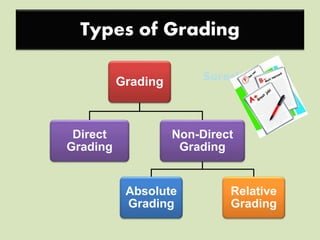
Types of Grading
Grading
Non-Direct
Grading
Absolute
Grading
Relative
Grading
Direct
Grading
Suresh Babu G
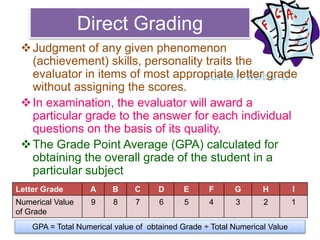
Direct Grading
Judgment of any given phenomenon
(achievement) skills, personality traits the
evaluator in items of most appropriate letter grade
without assigning the scores.
In examination, the evaluator will award a
particular grade to the answer for each individual
questions on the basis of its quality.
The Grade Point Average (GPA) calculated for
obtaining the overall grade of the student in a
particular subject
Letter Grade A B C D E F G H I
Numerical Value
of Grade
9 8 7 6 5 4 3 2 1
GPA = Total Numerical value of obtained Grade ÷ Total Numerical Value
Suresh Babu G
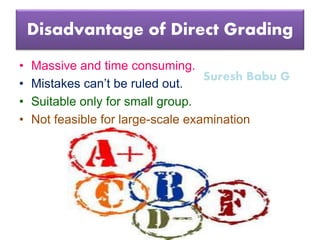
Disadvantage of Direct Grading
• Massive and time consuming.
• Mistakes can’t be ruled out.
• Suitable only for small group.
• Not feasible for large-scale examination
Suresh Babu G
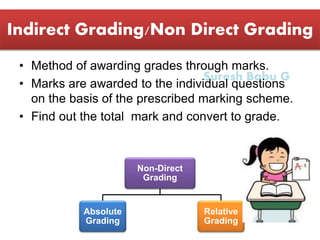
Indirect Grading/Non Direct Grading
• Method of awarding grades through marks.
• Marks are awarded to the individual questions
on the basis of the prescribed marking scheme.
• Find out the total mark and convert to grade.
Non-Direct
Grading
Absolute
Grading
Relative
Grading
Suresh Babu G
Absolute Grading
Based on a definite set of standard when
evaluating a student’s performance.
Based on teachers pre-specifying standard for
performance.
Based on criterion referenced, and keep tasks
mind without any variability.
Some fixed range of scores are determined in
advance for each grade.
The score obtained by a student in a subject
converted.
Example
A = 90-100
B = 80-89
C = 70-79
D = 60-69
F = 0-59
Suresh Babu G
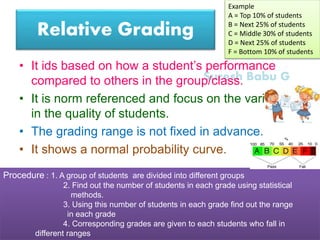
Relative Grading
• It ids based on how a student’s performance
compared to others in the group/class.
• It is norm referenced and focus on the variability
in the quality of students.
• The grading range is not fixed in advance.
• It shows a normal probability curve.
Procedure : 1. A group of students are divided into different groups
2. Find out the number of students in each grade using statistical
methods.
3. Using this number of students in each grade find out the range
in each grade
4. Corresponding grades are given to each students who fall in
different ranges
Example
A = Top 10% of students
B = Next 25% of students
C = Middle 30% of students
D = Next 25% of students
F = Bottom 10% of students
Suresh Babu G
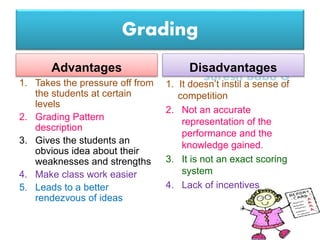
Grading
Advantages
1. Takes the pressure off from
the students at certain
levels
2. Grading Pattern
description
3. Gives the students an
obvious idea about their
weaknesses and strengths
4. Make class work easier
5. Leads to a better
rendezvous of ideas
Disadvantages
1. It doesn’t instil a sense of
competition
2. Not an accurate
representation of the
performance and the
knowledge gained.
3. It is not an exact scoring
system
4. Lack of incentives
Suresh Babu G

Grading in Education

  • 1.
    Suresh Babu G Gradingin Education Suresh Babu G Assistant Professsor CTE CPAS Paippad, Kottayam
  • 2.
    Suresh Babu G Grading •The grading system is the process by which educators evaluate the performance of the pupils in exams on the standard particular scales which is based on the points entirely and consist of the grades like A-F or range like 1-10; generally, letters and numbers are used to describe the grades of the scholars • A grading system in education is a system that is used to assess the educational performance of a child which is entirely based upon points alone. A+ A B+ B
  • 3.
    Suresh Babu G Featuresof Grading  When students level of performance are classified into a few classificatory units using letter grade , the system of assessment is called grading system.  In grading classification is made on 5 point, 7 point , 9 point scale.  It is a score  It identifies students performance level with a wide range  It involves the use of set of specialized symbols whose meaning ought to be objectively defined in terms of specific criteria.
  • 4.
    Suresh Babu G 9point scale Grading System Score % Letter Grade Interpretation 90 – 100 A+ Outstanding 80 – 89 A Excellent 70 - 79 B+ Very Good 60 – 69 B Good 50 – 59 C+ Above Average 40 – 49 C Average 30 – 39 D+ Marginal 20 – 29 D Need Improvement Below 20 E Need Improvement
  • 5.
    Suresh Babu G GeneralClassification of Grading • Percentage Grading – From 0 to 100 Percent • Letter grading and variations – From A Grade to F Grade • Norm-referenced grading – Comparing students to each other usually letter grades • Mastery grading – Grading students as “masters” or “passers” when their attainment reaches a prespecified level • Pass/Fail – Using the Common Scale as Pass/Fail • Standards grading (or Absolute-Standards grading or Criterion Referred grading) – Comparing student performance to a pre-established standard (level) of performance • Narrative grading -Writing Comments about students
  • 6.
    Suresh Babu G Typesof Grading Grading Non-Direct Grading Absolute Grading Relative Grading Direct Grading
  • 7.
    Suresh Babu G DirectGrading Judgment of any given phenomenon (achievement) skills, personality traits the evaluator in items of most appropriate letter grade without assigning the scores. In examination, the evaluator will award a particular grade to the answer for each individual questions on the basis of its quality. The Grade Point Average (GPA) calculated for obtaining the overall grade of the student in a particular subject Letter Grade A B C D E F G H I Numerical Value of Grade 9 8 7 6 5 4 3 2 1 GPA = Total Numerical value of obtained Grade ÷ Total Numerical Value
  • 8.
    Suresh Babu G Disadvantageof Direct Grading • Massive and time consuming. • Mistakes can’t be ruled out. • Suitable only for small group. • Not feasible for large-scale examination
  • 9.
    Suresh Babu G IndirectGrading/Non Direct Grading • Method of awarding grades through marks. • Marks are awarded to the individual questions on the basis of the prescribed marking scheme. • Find out the total mark and convert to grade. Non-Direct Grading Absolute Grading Relative Grading
  • 10.
    Suresh Babu G AbsoluteGrading Based on a definite set of standard when evaluating a student’s performance. Based on teachers pre-specifying standard for performance. Based on criterion referenced, and keep tasks mind without any variability. Some fixed range of scores are determined in advance for each grade. The score obtained by a student in a subject converted. Example A = 90-100 B = 80-89 C = 70-79 D = 60-69 F = 0-59
  • 11.
    Suresh Babu G RelativeGrading • It ids based on how a student’s performance compared to others in the group/class. • It is norm referenced and focus on the variability in the quality of students. • The grading range is not fixed in advance. • It shows a normal probability curve. Procedure : 1. A group of students are divided into different groups 2. Find out the number of students in each grade using statistical methods. 3. Using this number of students in each grade find out the range in each grade 4. Corresponding grades are given to each students who fall in different ranges Example A = Top 10% of students B = Next 25% of students C = Middle 30% of students D = Next 25% of students F = Bottom 10% of students
  • 12.
    Suresh Babu G Grading Advantages 1.Takes the pressure off from the students at certain levels 2. Grading Pattern description 3. Gives the students an obvious idea about their weaknesses and strengths 4. Make class work easier 5. Leads to a better rendezvous of ideas Disadvantages 1. It doesn’t instil a sense of competition 2. Not an accurate representation of the performance and the knowledge gained. 3. It is not an exact scoring system 4. Lack of incentives
  • 13.