The document provides an overview of achievement tests, which assess developed knowledge and skills to determine student readiness for instruction. It outlines the history, criteria for good tests, types, and major steps involved in constructing such tests, emphasizing the importance of planning, content weightage, and writing items. Additionally, it discusses functions of achievement tests and their role in evaluating student performance and promoting advancement.
INTRODUCTION
An Achievement testis an
assessment of developed knowledge
or skill.
Scores are often used to determine
the level of instruction for which a
student is prepared.
To measure a person's level of skill,
accomplishment, or knowledge in a
specific area.
To evaluate what you know and your
level of skill at the given moment
Tests measure students' mastery of
a particular instructional domain in
order to make decisions regarding
the advancement and/or
competency of the students.
The content can be derived
from three different
sources:
the textbook, the course
syllabus, and the class
objectives.
21-07-2021 Dr. C. Beulah Jayarani 2
3.
HISTORY …….
• InFrance in the early 20th century, the
psychologist Alfred Binet developed a
standardized test that would eventually
become the Stanford-Binet Intelligence
Test, a major component of the modern
IQ test.
• Achievement tests are developed to
measure skills and knowledge learned
in a given grade level, usually through
planned instruction, such as training or
classroom instruction.
21-07-2021 Dr. C. Beulah Jayarani 3
4.
CRITERIA OF THEGOOD TEST
To analyze the semester test items, there are some criteria of a
good test according to some expert. A good test should have
• (1) Validity
• (2) Reliability
• (3) Level of difficulty
• (4) Discrimination Power and
• (5) The Quality of Options
21-07-2021 Dr. C. Beulah Jayarani 4
5.
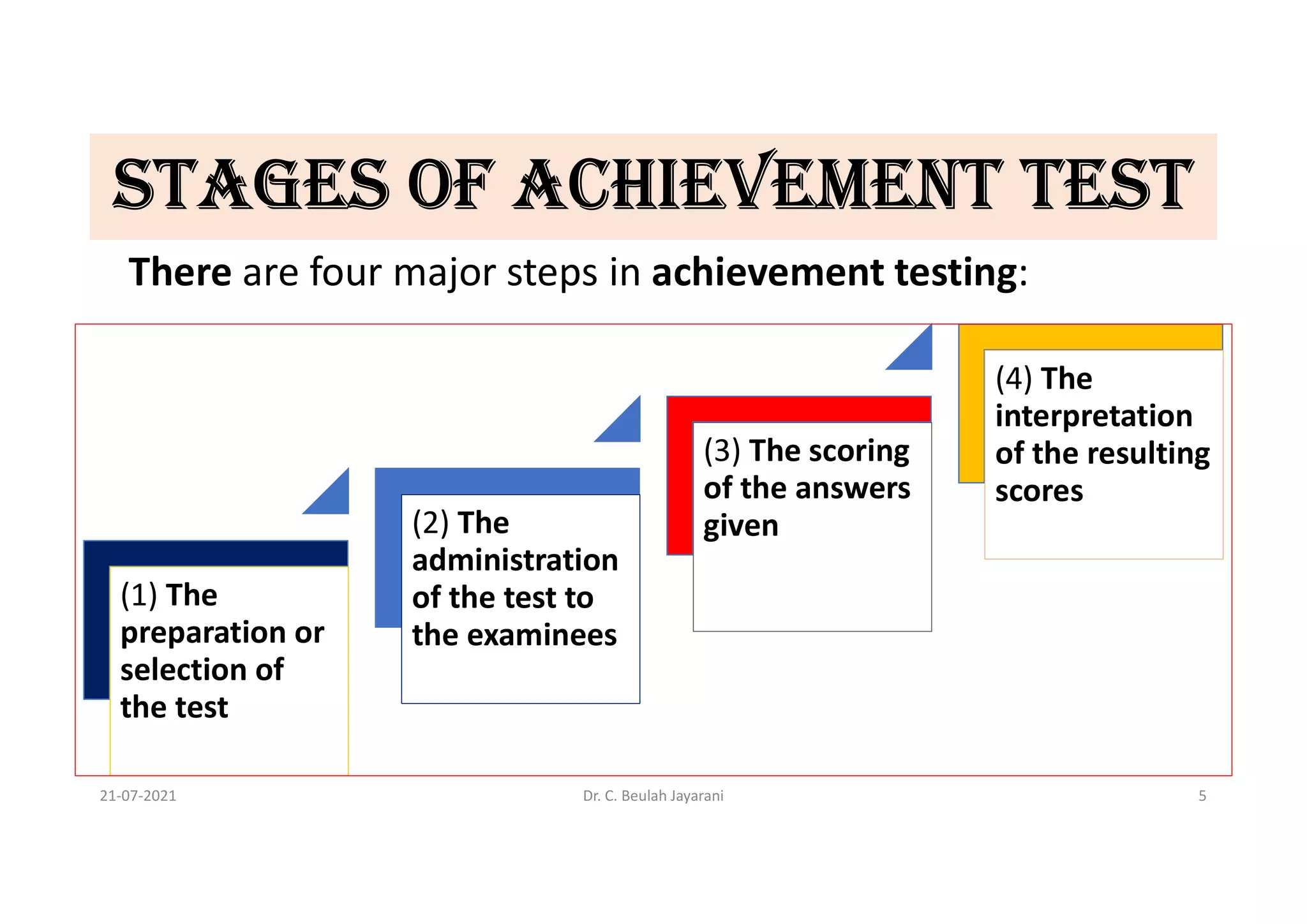
STAGES OF ACHIEVEMENTTEST
(1) The
preparation or
selection of
the test
(2) The
administration
of the test to
the examinees
(3) The scoring
of the answers
given
(4) The
interpretation
of the resulting
scores
There are four major steps in achievement testing:
21-07-2021 Dr. C. Beulah Jayarani 5
6.
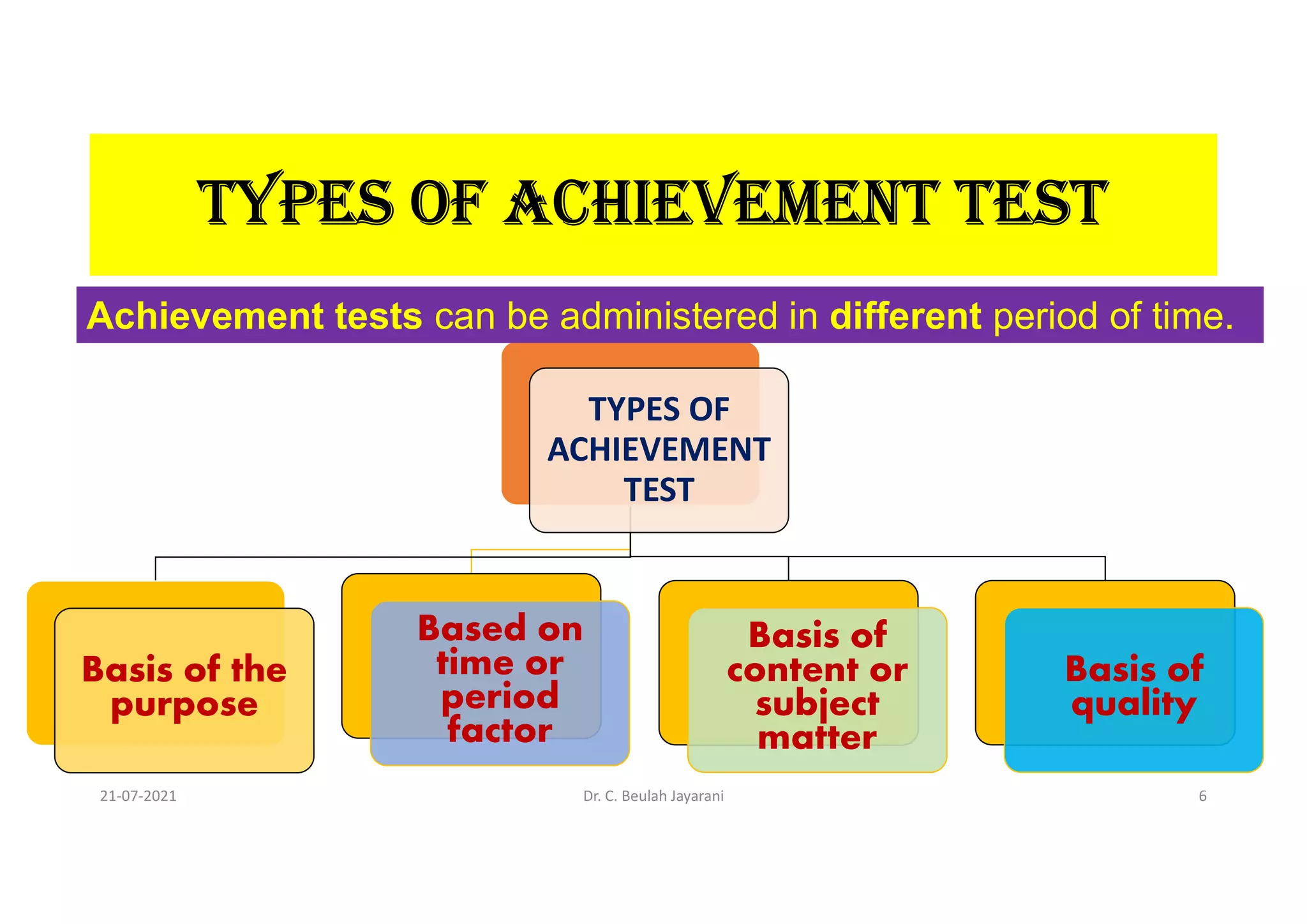
TYPES OF ACHIEVEMENTTEST
TYPES OF
ACHIEVEMENT
TEST
Basis of the
purpose
Based on
time or
period
factor
Basis of
content or
subject
matter
Basis of
quality
Achievement tests can be administered in different period of time.
21-07-2021 Dr. C. Beulah Jayarani 6
7.
TYPES OF ACHIEVEMENTTEST
BASIS OF THE PURPOSE
Diagnostic tests
Prognostic test
Accuracy test
Power test
Split test
21-07-2021 Dr. C. Beulah Jayarani 7
8.
TYPES OF ACHIEVEMENTTEST
BASED ON TIME
OR PERIOD
FACTOR
• Summative test
• Daily test
• Weekly test
• Slip test
• Monthly test
• Quarterly test
• Half yearly test
• Final examination
21-07-2021 Dr. C. Beulah Jayarani 8
9.
TYPES OF ACHIEVEMENTTEST
BASIS OF CONTENT OR SUBJECT MATTER
Language
test
Reading
test
Spelling
test
History
test
Geography
test
Mathematic test
Science
test
21-07-2021 Dr. C. Beulah Jayarani 9
MAjOR STEPS INVOLVEDIN THE
CONSTRUCTION OF ACHIEVEMENT TEST
1. Planning of test
2. Preparation of a design for the test
3. Preparation of the blue print
4. Writing of items
5. Preparation of the scoring key and marking scheme
6. Preparation of question-wise analysis
21-07-2021 Dr. C. Beulah Jayarani 12
13.
A. PLANNING OFTHE TEST
1. Planning of the test is the first important step in the
test construction.
2. The main goal of evaluation process is to collect valid,
reliable and useful data about the student.
3. Must determine the maximum time, maximum marks
& the nature of the test – (units & sub-units)
21-07-2021 Dr. C. Beulah Jayarani 13
14.
PREPARATION OF ADESIGN FOR THE TEST
a) Weightage to Objectives
b) Weightage to content
c) Weightage to form of questions
d) Weightage to difficult level
e) Scheme of Options
f) Scheme of Sections
21-07-2021 Dr. C. Beulah Jayarani 14
15.
A. WEIGHTAGE TOCURRICULAR ObjECTIVES
• This indicates the total marks and weightage to be given to different
levels of objectives.
Sl. No Objectives Marks Percentage
1. KNOWLEDGE 16 32%
2 UNDERSTANDING 14 28%
3 APPLICATION 18 36%
4. Skill 2 4%
TOTAL 50 100
21-07-2021 Dr. C. Beulah Jayarani 15
16.
b. WEIGHTAGE TOCONTENT
• This indicates the total marks and weightage to be given to different topics and
aspects
•
Sl.No TOPIC Marks Percentage
1. Unit 3 25 50
2 Unit 5 25 50
TOTAL 50 100
21-07-2021 Dr. C. Beulah Jayarani 16
17.
C. WEIGHTAGE TOFORM OF QUESTIONS
• This indicates the total marks and weightage to be given to different
types of questions
•
Sl.No TYPES OF QUESTIONS Marks Percentage
1. Objective 12 24
2 Very short answer 8 16
3. Essay 30 60
TOTAL 50 100
21-07-2021 Dr. C. Beulah Jayarani 17
18.
D. WEIGHTAGE TODIFFICULTY LEVEL
• This indicates the total marks and weightage to be given to different level
of questions.
•
Sl.No LEVEL OF QUESTIONS Marks Percentage
1. Easy level 20 40
2 Average level 20 40
3 Difficult level 10 20
TOTAL 50 100
21-07-2021 Dr. C. Beulah Jayarani 18
19.
E. SCHEME OFOPTIONS
1. Option or choices given to the students to select
certain questions.
2. External / Internal options
3. External means – the choice is given to the students for
selecting a given number of questions only from among the
total number of questions provided.
4. Internal Options means – the choice is given within a
question (either or)
21-07-2021 Dr. C. Beulah Jayarani 19
20.
F. SCHEME OFSECTIONS
The test will be in three sections
•Section A contains Objective type items
•Section B Short answer
•Section C Essay type items
21-07-2021 Dr. C. Beulah Jayarani 20
21.
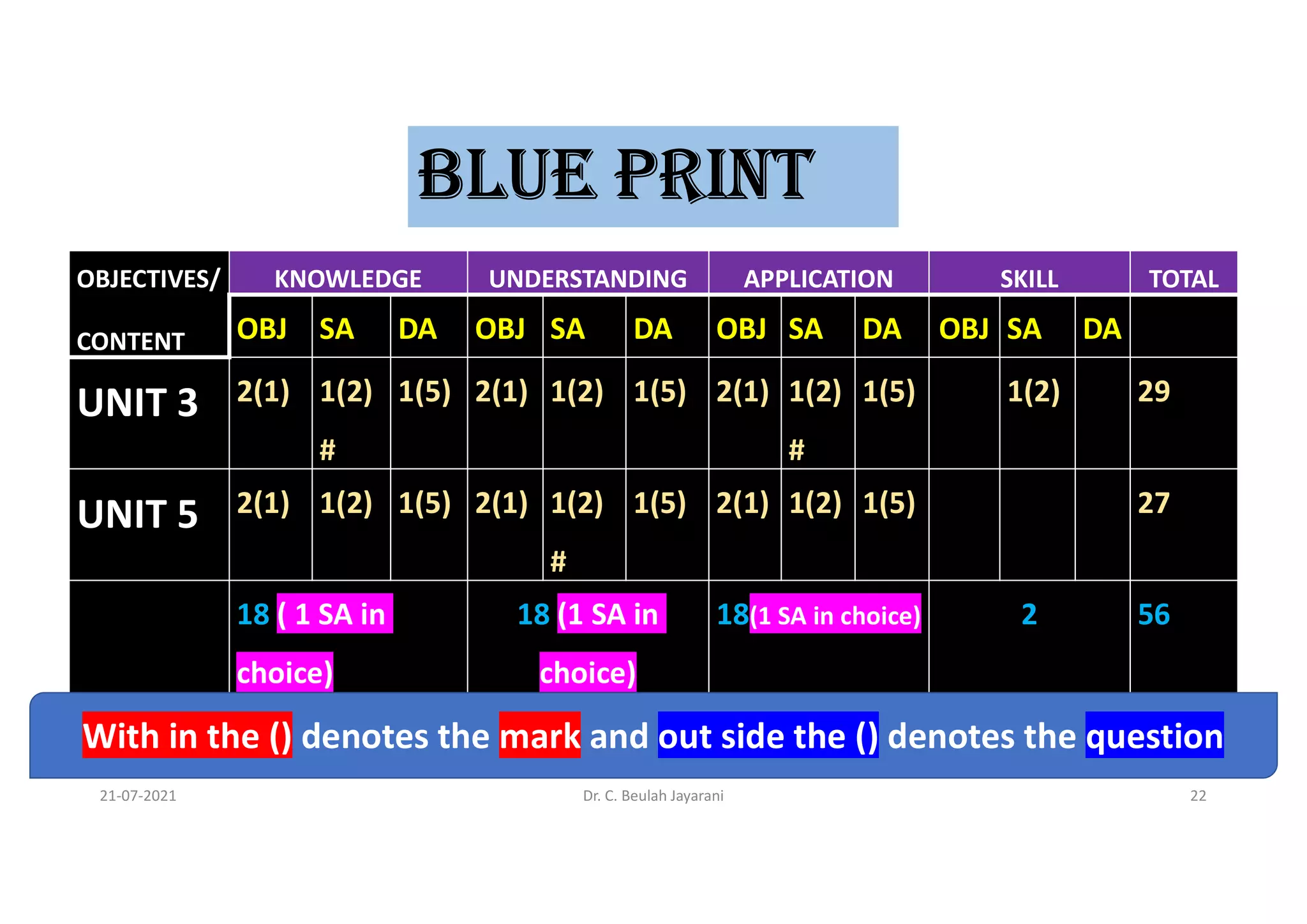
3. bLUE PRINT
•In a test blueprint is a document that
reflects the content of an assessment
that you will give your students.
• The test blueprint insures that every
instructional objective is addressed by the
test—and conversely that every question on
the test addresses an instructional
objective.
Blue print is a three dimensional
model which consisting Content,
Objectives and types of question
with the mark.
21-07-2021 Dr. C. Beulah Jayarani 21
22.
bLUE PRINT
OBJECTIVES/
CONTENT
KNOWLEDGE UNDERSTANDINGAPPLICATION SKILL TOTAL
OBJ SA DA OBJ SA DA OBJ SA DA OBJ SA DA
UNIT 3 2(1) 1(2)
#
1(5) 2(1) 1(2) 1(5) 2(1) 1(2)
#
1(5) 1(2) 29
UNIT 5 2(1) 1(2) 1(5) 2(1) 1(2)
#
1(5) 2(1) 1(2) 1(5) 27
18 ( 1 SA in
choice)
18 (1 SA in
choice)
18(1 SA in choice) 2 56
With in the () denotes the mark and out side the () denotes the question
21-07-2021 Dr. C. Beulah Jayarani 22
23.
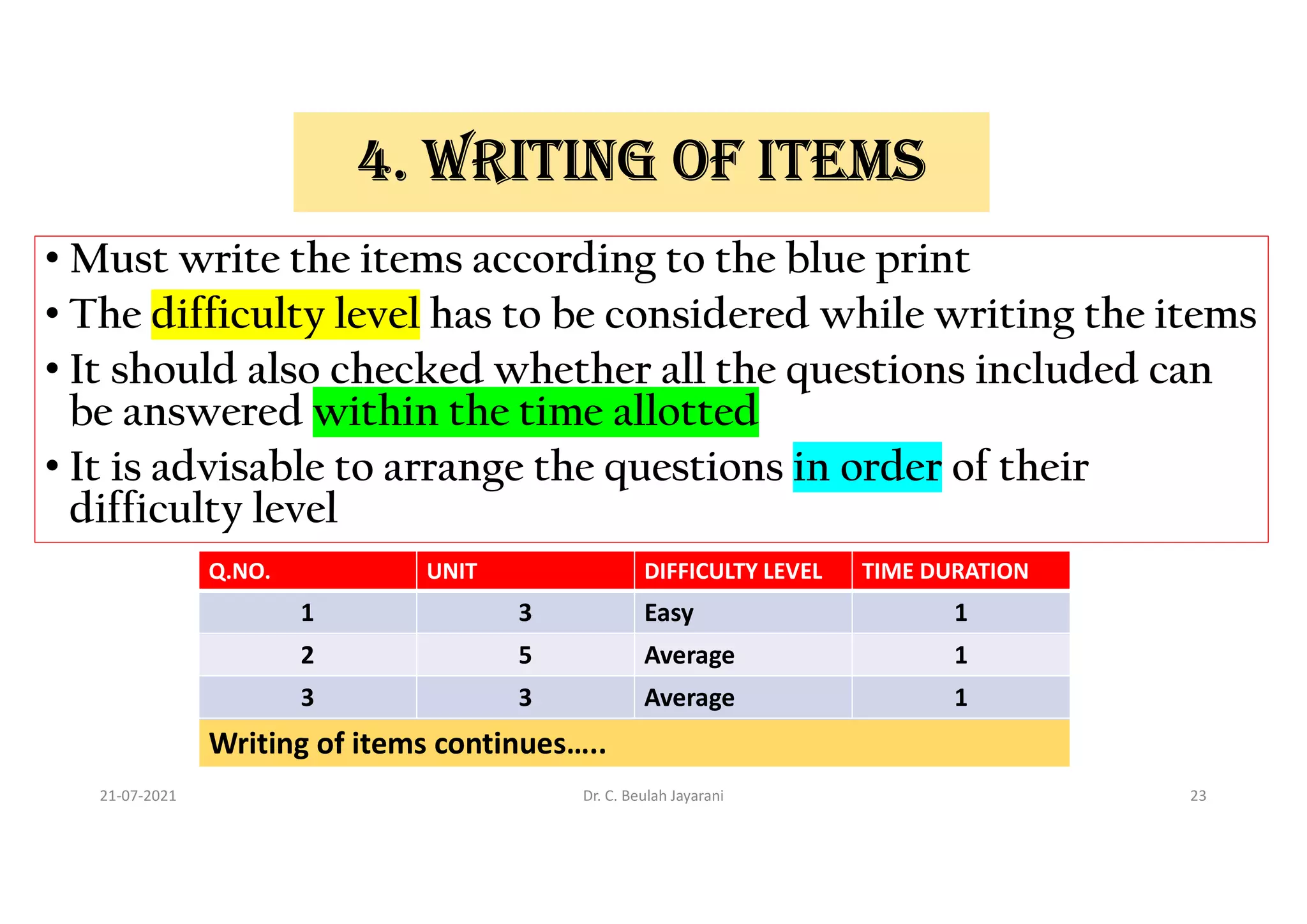
4. WRITING OFITEMS
• Must write the items according to the blue print
• The difficulty level has to be considered while writing the items
• It should also checked whether all the questions included can
be answered within the time allotted
• It is advisable to arrange the questions in order of their
difficulty level
Q.NO. UNIT DIFFICULTY LEVEL TIME DURATION
1 3 Easy 1
2 5 Average 1
3 3 Average 1
Writing of items continues…..
21-07-2021 Dr. C. Beulah Jayarani 23
24.
5. PREPARATION OFTHE SCORING kEY AND
MARkING SCHEME
• In the case of objective type items where the answers are
in the form of some letters or other symbol a scoring key
has to be prepared. Eg.,
QUESTION NO. & Unit No. ANSWER MARK
1 – Unit 3 C 1
2 – Unit 5 A 1
3 – Unit - 3 B 1
4 – Unit - 3 B 1
5 – Unit – 5 D 1
6 – Unit – 5 C 1
Scoring key Continues ……
21-07-2021 Dr. C. Beulah Jayarani 24
25.
6. PREPARATION OFQUESTION-WISE
ANALYSIS
Q.
NO
CONTENT OBJECTIVES FORMS OF
QUESTIONS
DIFFICULTY
LEVEL
MARKS ESTIMATED TIME
( In Mins)
1 Unit 3 Knowledge Objective Easy 1 1
2 Unit 5 Understanding Objective Easy 1 1
3 Unit 3 Application Objective Average 1 1
4 Unit 3 Understanding Objective Difficult 1 1
5 Unit 5 Application Objective Average 1 1
6 Unit 5 Skill Objective Average 1 1
Question wise analysis continues….
21-07-2021 Dr. C. Beulah Jayarani 25
26.
• Provides basisfor promotion to next grade
• To find out where each student stands in various academic areas.
• To measures present proficiency, mastery and understanding of general and
specific areas of knowledge.
• To measure what and how individual has learnt, viz. his present standard of
performance. The Scores indicate the academic status of the individual
learner in different subjects as a whole or individually.
• To motivate the student before a new assignment has taken
• To expose the pupils difficulties which the teacher can help them to solve.
FUNCTIONS OF ACHIEVEMENT TEST
21-07-2021 Dr. C. Beulah Jayarani 26
27.
REFERENCE
“Teaching of BiologicalScience”
TNTEU – Study Material
Ram Publications
Sri Krishna Publications
Kaviyamala Publications
Google Images
21-07-2021 Dr. C. Beulah Jayarani 27