COURSE PLAN, UNIT PLAN AND
LESSON PLAN
Mrs.B.Kavitha M.Sc (N),
Professor
Aswini College of Nursing, Thrissur
COURSE PLAN
 A course may be defined as a complete series of studies leading
to graduation or a degree.
 It mean any of the separate units of instruction in a subject
made of lectures & classes.
 When all the relevant subject matters are organized under one
course heading it refers to planning course of instruction.
1. “Course planning refers to planning courses of instructions. It
serves as a guide for the teacher as well as for the students in
creating conductive atmosphere for worthwhile learning and
purposeful activities".
2. "It is defined as a process of planning the entire content of the
program which has to be done before the commencement of
course".
 To ensure autonomy.
 It gives stability.
 It helps to solve the problem.
 It supports the curriculum process.
 It secures future progress.
 It brings about improvements.
 It promotes the utilization of resources.
 1. Pertaining to organizing both content and learning experiences
within a unit or a subject.
 2. Deals with designing the pattern for the entire program at the
program level.
 State the objectives in behavioral terms, which has to be achieved
 Establish sequence in order of Succession, the content materials
has to be organized.
 The teacher should keep in mind
o What should the students learn from the course?
o What should be the sequence of topic/units?
o How much time has to be allotted.
 Ensure logical and psychological continuity to organize to
continuity into fewer units, easy to understanding and repetition.
 Provide cumulative learning by reinforcement
 Plan for integration
 Select an approach that is acceptable to all teachers.
 The course should provide variety in mode of learning
 Unity curriculum :
o To reduce unmanageable bulk of specialized subjects and
bring some unity into atomized specialization.
o It also reduces the unit to manageable size and serves as a
Centre of organization.
In planning course, two kinds of planning are involved:
 1. Identifying the kinds of elements and which specific learning
has to be organized
 2. Selection of specific organizing centers on which learner's
entire development be focused.
 Objectives –State the objectives or outcomes to be achieved
through the given course.
 Specifications for level of learner and placement within the
curriculum.
 Resources material needed for the course.
 Mention the placement of the course within the curriculum. Eg:-
A course in Nursing foundation is placed in the Ist yr of nursing
curriculum.
 Organize the content in topic wise & unit wise.
 Objectives –State the objectives or outcomes to be achieved
through the given course.
 Specifications for level of learner and placement within the
curriculum.
 Resources material needed for the course.
 Mention the placement of the course within the curriculum. Eg:-
A course in Nursing foundation is placed in the Ist yr of nursing
curriculum.
 Organize the content in topic wise & unit wise.
 Describe the resource materials and method of teaching.
 Prepare the plan of learning activities for students.
 Mention place, length of experience, experience record/
cumulative record , observations, procedures, plan for Rotation
with field experiences, supervised and guided practice.
 Evaluation measures.( ongoing ,concurrent and terminal
evaluation)
 Bibliography(for both student and teachers)
TEACHERS ROLE IN COURSE PLANNING
 Teachers plan unit of work.
 He /She should select materials and learning activities
according to the level of students.
 He/ She should plan carefully.
 He / She should avoid gaps and non- projective repetition in
subject matter content.
 He/ She should provide enforcement of previous learning.
 He/ She has to set up working groups.
TEACHERS ROLE IN COURSE PLANNING
 He/ She should have skills related to their teaching area.
 The teacher’s plan should focus on the course’s general objectives,
the unit plan, and the class plan.
 He/ She should be efficient in preparing course plans.
 He/ She should be accountable for every step of planning.
 He/ She should plan equally for all the students.
 He/ She should formulate the objectives before the planning.
 He/ She should possess knowledge adequately.
UNIT PLAN
INTRODUCTION
The planning for the unit is known as ‘UNIT PLAN’ usually after
the year plan, the teacher plans the unit plan. So the year plan should
therefore be ready before one starts preparing the unit plan.
DEFINITION
• Unit may be defined as a large subdivision of the subject matter.
• Planning the unit is known as unit planning.
CRITERIA FOR A GOOD UNIT
• Principle of learning by whole.
• Principle of simple to complex
• Principle of concrete to abstract
• Principle of integration
• Principle of relatedness
• Principe of specification
• Principle of sequence
• A good unit includes the scope for variety of learning
experiences in relation to the subject matter learned.
• A good unit places all the relevant topics together.
• It helps us to plan for time specification to complete the unit,
scheme of evaluation, etc.
CHARACTERISTIC OF UNIT PLAN
• Learning takes place of whole rather than fractions.
• Learning is developmental and therefore provides for vertical and
horizontal organization of learning experiences.
• Learning is maximum when there is understanding and acceptance of
goals to be achieved.
• Learning needs to differ in accordance with individual differences and
learning interest.
• Unit planning recognizes that true learning renders the learners
increasingly skill in self- directions.
• Unit planning provides sound basis for the evaluation.
TYPES OF UNIT PLANNING
1) SUBJECT MATTER UNITS
a) Topical unit
b) The generalization unit
c) The unit based on significant aspect of environment or culture
2) EXPERIENCE UNIT
a) Unit based on center of interest
b) Unit based on student purpose
c) Unit based on student need
3) TEACHING- LEARNING UNIT
4) PROCESS UNIT
5) RESOURCE UNIT

ESSENTIAL ACTIVITIES IN PLANNING
A UNIT
• Selection & statement of objectives
• Selection of type of unit to be used
• Selection of the learning situation
• Selection of knowledge component (content)
• Selection of organization centers -teaching & learning activities
• Selection of methods of evaluation
• Selection of reference.
• Distribution of time
• Teacher's expertise
• Organization of the content of unit
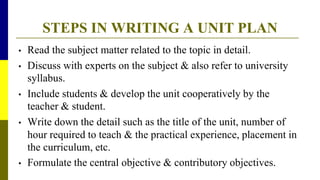
STEPS IN WRITING A UNIT PLAN
• Read the subject matter related to the topic in detail.
• Discuss with experts on the subject & also refer to university
syllabus.
• Include students & develop the unit cooperatively by the
teacher & student.
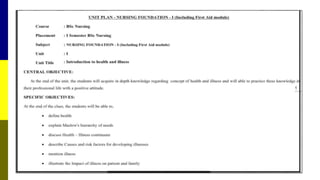
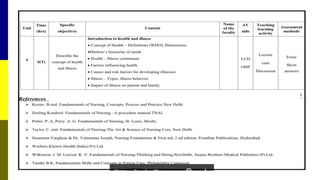
• Write down the detail such as the title of the unit, number of
hour required to teach & the practical experience, placement in
the curriculum, etc.
• Formulate the central objective & contributory objectives.
STEPS IN WRITING A UNIT PLAN
• Identify the content area & the methods of teaching.
• Plan the teaching learning activities to attain the objectives.
• Select the instructional aids to be used.
• Plan the experience- clinical, laboratory, visits etc.
• Decide on the approximate no. of hrs to be given to classroom &
clinical learning.
• Plan appropriate methods of evaluation & select the tools or
construct test for evaluation.
• Provide a list of books, journals, etc for reference.
LESSON
PLAN
DEFINITION
Lesson plan is the title given to a statement of achievements to be
realized & specific meaning by which these are to be attained as a
result of the activities engaged during the period. -NL Bossing
•It is the teacher’s mental and emotional visualization of the class
room experience as he plans it to occur.
•It is the blue print and a plan of action of what a teacher is going to
do.
PURPOSES
• It guides the teacher in presentation of subject matter & activities
involved.
• It provides definite objective for each day's work.
• It helps to achieve definite goals & objectives.
• It helps to maintain sequence of content presentation.
• It aids in time management& helps to avoid repetition.
• It gives the teacher greater confidence & greater freedom in
teaching.
• It facilitates self & peer assessment of teaching & future
improvement of lessons.
PURPOSES
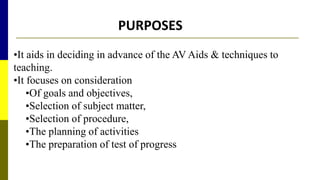
•It aids in deciding in advance of the AV Aids & techniques to
teaching.
•It focuses on consideration
•Of goals and objectives,
•Selection of subject matter,
•Selection of procedure,
•The planning of activities
•The preparation of test of progress
PURPOSES
• It keeps the teacher on the tracks
• Ensures steady progress and a definite outcome of teaching and
learning procedure
• It encourages organization of subject matter and activities.
• Prevents haphazard teaching.
• It serves as a check on unplanned curriculum-continuity and
inter connectedness.
• It provides basis for evaluation.
PRINCIPLES
• Used as a guide rather than as a rule of thumb
• Teacher must have mastery of and adequate training in the topic
• Needs to be fully conversant with new methods and techniques of
teaching
• Minimizes the chances of omitting some vital point of the informatio
n.
• Needs to organize the material in an organized rather than a logical
fashion
• Must ensure active student participation
• Should use different teaching learning methods
PREREQUISITES FOR GOOD LESSON PLANNING
• The teacher should have adequate mastery and Practice if it is for a
skill lesson.
• The teacher must be fully conversant with new methods and techniq
ues of teaching her/his subject.
• Teacher must have good knowledge of psychology, culture and com
munity and cite various examples accordingly.
• Ensure active learner participation during a class.
• Maintain interest and motivation of student.
• Avoid boredom.
• There should be variety and novelty in type of presentation.
ESSENTIAL ELEMENTS OF LESSON PLAN
Front page data such as Name, subject, topic, class, duration, venue,
A.V. Aids etc.
 Evaluation of previous knowledge.
 General learning objectives/ Central objectives.
 Specific learning objectives/ Behavioral objectives
 Selection & organization of subject matter- the content.
 Organizing centers includes learning activities & teaching activities.
 Types of illustrative material- AV Aids.
 Assignment
 Evaluation
 Follow- up action.
STEPS IN DEVELOPING A LESSON PLAN
•Preparation or introduction
•Knowledge which helps to lead them onto lesson.
1)Teacher prepares student to receive knowledge.
2)Testing previous knowledge.
3)It arouses interest and curiosity to learn new matter.
4)Introduction should be brief and to the point.
•Presentation
1)Aim of the lesson should be clearly stated before the presentation.
2)In teaching –learning process, both –actively participate.
3)The Teacher has to present the topic in enthusiastic manner
4)learner will be motivated and get interest to learn
Introduction
Presentation
Comparison
Generalizations
Application
Recapitulation
STEPS IN DEVELOPING A LESSON PLAN
•Comparison or association
1)Quote examples
2)Associate facts with to example
3)So that learner can understand very easily and arrive at
generalization on their own
•Generalizations
1)It involves reflective thinking.
2)Knowledge presented by the teacher should be thought
provoking.
3)Innovating and stimulating to assist the students to generalize
the situation.
Introduction
Presentation
Comparison
Generalizations
Application
Recapitulation
STEPS IN DEVELOPING A LESSON PLAN
•Application
1)The student make use of the knowledge acquired
2)Whatever they learnt in the theory has to apply in
clinical field to make learning more permanent and
worthwhile.
•Recapitulation
1)Ask suitable stimulating pivotal questions to student on
topic.
2)The answer will give feedback, regarding the efficacy
of the method of teaching clarification needed or not
Introduction
Presentation
Comparison
Generalizations
Application
Recapitulation
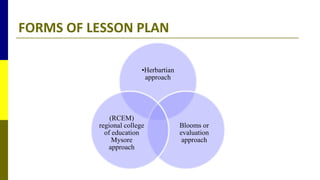
FORMS OF LESSON PLAN
•Herbartian
approach
Blooms or
evaluation
approach
(RCEM)
regional college
of education
Mysore
approach
Herbartian approach
•John Frederick Herbart (1776-1841)- a German Philosopher and
great educationist
•This approach is influenced by classical human organizational
theory
•The previous knowledge of the student is considered in preparing
lesson plan, but their abilities, attitudes and values are not taken into
consideration while designing a lesson plan.
Blooms approach
• Designed by B .S . Bloom (1961)
• He has made education as objective centered rather than client centered
• His approach of lesson planning is termed as evaluative approach
Features
• All educational activities are objective centered
• The teaching and testing should be objective centered
• The term evaluation concerns with all activities of teaching and testing
• It does not confine to the students achievement only
• It evaluates the teaching, learning objectives, methods and devices of
providing learning experiences.
• The student performances are evaluated in terms of learning objectives
and not the achievement of the content
RCEM Approach
• Developed by Indian educationists at Regional college of
Education , Mysore
• Design of lesson planning:-
 Input: Input refers to the objectives of the plan. They are known as
expected behavioral outcome. (EBO). They are classified into
following categories: 1. Knowledge. 2. Understanding. 3. Application.
4. Activity.
 Process: The process refers to the teaching strategies. They are: •
Communication strategy. • Instructional aids. • Learning situation. •
Technique of motivation
 Output: Refers to the real learning outcome. This includes general and
specific objectives.
HIGHLY STRUCTURED SESSON PLAN
LOOSELY STRUCTURED SESSON PLAN
Advantages / Disadvantage
Students:-
Merits
 A well presented class may increase the student motivation
 Greater scope for improving and modifying the learning experience
Demerits:-
 Student attention may want the presentation to suit the level of
understanding of all students
 Poor planning and lack of direction of teaching may result in wasting
student time
 Poor lesson plan can make the student a mere passive learner
Advantages / Disadvantage
Teacher
Advantages
 The teacher can plan the presentation in advance, helping in making the
teaching effective
 Helps in apparent time saving and avoids unnecessary repetition
 New knowledge can be presented which is not there in the text book
 Teacher can integrate the subject matter
 It enables the teacher to present a large amount of information in a short time
 It acts as a plan for self criticisms and self evaluation
Disadvantage:-
 The main emphasis is given to presentation
 It confines the teaching up to memory level only
REFERNCES
 Lakshmi Prasanna. Educational technology /Nursing education.
frontline publication. 2024.Pg no.69-81
 Sankaranarayanan B. teachers manual of effective teaching in
the digital age . worthreads Publications;2023 Pg no: 313-380

Course plan, Unit plan and Lesson plan.pptx

  • 1.
    COURSE PLAN, UNITPLAN AND LESSON PLAN Mrs.B.Kavitha M.Sc (N), Professor Aswini College of Nursing, Thrissur
  • 2.
  • 3.
     A coursemay be defined as a complete series of studies leading to graduation or a degree.  It mean any of the separate units of instruction in a subject made of lectures & classes.  When all the relevant subject matters are organized under one course heading it refers to planning course of instruction.
  • 4.
    1. “Course planningrefers to planning courses of instructions. It serves as a guide for the teacher as well as for the students in creating conductive atmosphere for worthwhile learning and purposeful activities". 2. "It is defined as a process of planning the entire content of the program which has to be done before the commencement of course".
  • 5.
     To ensureautonomy.  It gives stability.  It helps to solve the problem.  It supports the curriculum process.  It secures future progress.  It brings about improvements.  It promotes the utilization of resources.
  • 6.
     1. Pertainingto organizing both content and learning experiences within a unit or a subject.  2. Deals with designing the pattern for the entire program at the program level.
  • 7.
     State theobjectives in behavioral terms, which has to be achieved  Establish sequence in order of Succession, the content materials has to be organized.  The teacher should keep in mind o What should the students learn from the course? o What should be the sequence of topic/units? o How much time has to be allotted.  Ensure logical and psychological continuity to organize to continuity into fewer units, easy to understanding and repetition.
  • 8.
     Provide cumulativelearning by reinforcement  Plan for integration  Select an approach that is acceptable to all teachers.  The course should provide variety in mode of learning  Unity curriculum : o To reduce unmanageable bulk of specialized subjects and bring some unity into atomized specialization. o It also reduces the unit to manageable size and serves as a Centre of organization.
  • 9.
    In planning course,two kinds of planning are involved:  1. Identifying the kinds of elements and which specific learning has to be organized  2. Selection of specific organizing centers on which learner's entire development be focused.
  • 10.
     Objectives –Statethe objectives or outcomes to be achieved through the given course.  Specifications for level of learner and placement within the curriculum.  Resources material needed for the course.  Mention the placement of the course within the curriculum. Eg:- A course in Nursing foundation is placed in the Ist yr of nursing curriculum.  Organize the content in topic wise & unit wise.
  • 11.
     Objectives –Statethe objectives or outcomes to be achieved through the given course.  Specifications for level of learner and placement within the curriculum.  Resources material needed for the course.  Mention the placement of the course within the curriculum. Eg:- A course in Nursing foundation is placed in the Ist yr of nursing curriculum.  Organize the content in topic wise & unit wise.
  • 12.
     Describe theresource materials and method of teaching.  Prepare the plan of learning activities for students.  Mention place, length of experience, experience record/ cumulative record , observations, procedures, plan for Rotation with field experiences, supervised and guided practice.  Evaluation measures.( ongoing ,concurrent and terminal evaluation)  Bibliography(for both student and teachers)
  • 13.
    TEACHERS ROLE INCOURSE PLANNING  Teachers plan unit of work.  He /She should select materials and learning activities according to the level of students.  He/ She should plan carefully.  He / She should avoid gaps and non- projective repetition in subject matter content.  He/ She should provide enforcement of previous learning.  He/ She has to set up working groups.
  • 14.
    TEACHERS ROLE INCOURSE PLANNING  He/ She should have skills related to their teaching area.  The teacher’s plan should focus on the course’s general objectives, the unit plan, and the class plan.  He/ She should be efficient in preparing course plans.  He/ She should be accountable for every step of planning.  He/ She should plan equally for all the students.  He/ She should formulate the objectives before the planning.  He/ She should possess knowledge adequately.
  • 18.
  • 19.
    INTRODUCTION The planning forthe unit is known as ‘UNIT PLAN’ usually after the year plan, the teacher plans the unit plan. So the year plan should therefore be ready before one starts preparing the unit plan. DEFINITION • Unit may be defined as a large subdivision of the subject matter. • Planning the unit is known as unit planning.
  • 20.
    CRITERIA FOR AGOOD UNIT • Principle of learning by whole. • Principle of simple to complex • Principle of concrete to abstract • Principle of integration • Principle of relatedness • Principe of specification • Principle of sequence
  • 21.
    • A goodunit includes the scope for variety of learning experiences in relation to the subject matter learned. • A good unit places all the relevant topics together. • It helps us to plan for time specification to complete the unit, scheme of evaluation, etc.
  • 22.
    CHARACTERISTIC OF UNITPLAN • Learning takes place of whole rather than fractions. • Learning is developmental and therefore provides for vertical and horizontal organization of learning experiences. • Learning is maximum when there is understanding and acceptance of goals to be achieved. • Learning needs to differ in accordance with individual differences and learning interest. • Unit planning recognizes that true learning renders the learners increasingly skill in self- directions. • Unit planning provides sound basis for the evaluation.
  • 23.
    TYPES OF UNITPLANNING 1) SUBJECT MATTER UNITS a) Topical unit b) The generalization unit c) The unit based on significant aspect of environment or culture 2) EXPERIENCE UNIT a) Unit based on center of interest b) Unit based on student purpose c) Unit based on student need 3) TEACHING- LEARNING UNIT 4) PROCESS UNIT 5) RESOURCE UNIT 
  • 24.
    ESSENTIAL ACTIVITIES INPLANNING A UNIT • Selection & statement of objectives • Selection of type of unit to be used • Selection of the learning situation • Selection of knowledge component (content) • Selection of organization centers -teaching & learning activities • Selection of methods of evaluation • Selection of reference. • Distribution of time • Teacher's expertise • Organization of the content of unit
  • 25.
    STEPS IN WRITINGA UNIT PLAN • Read the subject matter related to the topic in detail. • Discuss with experts on the subject & also refer to university syllabus. • Include students & develop the unit cooperatively by the teacher & student. • Write down the detail such as the title of the unit, number of hour required to teach & the practical experience, placement in the curriculum, etc. • Formulate the central objective & contributory objectives.
  • 26.
    STEPS IN WRITINGA UNIT PLAN • Identify the content area & the methods of teaching. • Plan the teaching learning activities to attain the objectives. • Select the instructional aids to be used. • Plan the experience- clinical, laboratory, visits etc. • Decide on the approximate no. of hrs to be given to classroom & clinical learning. • Plan appropriate methods of evaluation & select the tools or construct test for evaluation. • Provide a list of books, journals, etc for reference.
  • 29.
  • 30.
    DEFINITION Lesson plan isthe title given to a statement of achievements to be realized & specific meaning by which these are to be attained as a result of the activities engaged during the period. -NL Bossing •It is the teacher’s mental and emotional visualization of the class room experience as he plans it to occur. •It is the blue print and a plan of action of what a teacher is going to do.
  • 31.
    PURPOSES • It guidesthe teacher in presentation of subject matter & activities involved. • It provides definite objective for each day's work. • It helps to achieve definite goals & objectives. • It helps to maintain sequence of content presentation. • It aids in time management& helps to avoid repetition. • It gives the teacher greater confidence & greater freedom in teaching. • It facilitates self & peer assessment of teaching & future improvement of lessons.
  • 32.
    PURPOSES •It aids indeciding in advance of the AV Aids & techniques to teaching. •It focuses on consideration •Of goals and objectives, •Selection of subject matter, •Selection of procedure, •The planning of activities •The preparation of test of progress
  • 33.
    PURPOSES • It keepsthe teacher on the tracks • Ensures steady progress and a definite outcome of teaching and learning procedure • It encourages organization of subject matter and activities. • Prevents haphazard teaching. • It serves as a check on unplanned curriculum-continuity and inter connectedness. • It provides basis for evaluation.
  • 34.
    PRINCIPLES • Used asa guide rather than as a rule of thumb • Teacher must have mastery of and adequate training in the topic • Needs to be fully conversant with new methods and techniques of teaching • Minimizes the chances of omitting some vital point of the informatio n. • Needs to organize the material in an organized rather than a logical fashion • Must ensure active student participation • Should use different teaching learning methods
  • 35.
    PREREQUISITES FOR GOODLESSON PLANNING • The teacher should have adequate mastery and Practice if it is for a skill lesson. • The teacher must be fully conversant with new methods and techniq ues of teaching her/his subject. • Teacher must have good knowledge of psychology, culture and com munity and cite various examples accordingly. • Ensure active learner participation during a class. • Maintain interest and motivation of student. • Avoid boredom. • There should be variety and novelty in type of presentation.
  • 36.
    ESSENTIAL ELEMENTS OFLESSON PLAN Front page data such as Name, subject, topic, class, duration, venue, A.V. Aids etc.  Evaluation of previous knowledge.  General learning objectives/ Central objectives.  Specific learning objectives/ Behavioral objectives  Selection & organization of subject matter- the content.  Organizing centers includes learning activities & teaching activities.  Types of illustrative material- AV Aids.  Assignment  Evaluation  Follow- up action.
  • 37.
    STEPS IN DEVELOPINGA LESSON PLAN •Preparation or introduction •Knowledge which helps to lead them onto lesson. 1)Teacher prepares student to receive knowledge. 2)Testing previous knowledge. 3)It arouses interest and curiosity to learn new matter. 4)Introduction should be brief and to the point. •Presentation 1)Aim of the lesson should be clearly stated before the presentation. 2)In teaching –learning process, both –actively participate. 3)The Teacher has to present the topic in enthusiastic manner 4)learner will be motivated and get interest to learn Introduction Presentation Comparison Generalizations Application Recapitulation
  • 38.
    STEPS IN DEVELOPINGA LESSON PLAN •Comparison or association 1)Quote examples 2)Associate facts with to example 3)So that learner can understand very easily and arrive at generalization on their own •Generalizations 1)It involves reflective thinking. 2)Knowledge presented by the teacher should be thought provoking. 3)Innovating and stimulating to assist the students to generalize the situation. Introduction Presentation Comparison Generalizations Application Recapitulation
  • 39.
    STEPS IN DEVELOPINGA LESSON PLAN •Application 1)The student make use of the knowledge acquired 2)Whatever they learnt in the theory has to apply in clinical field to make learning more permanent and worthwhile. •Recapitulation 1)Ask suitable stimulating pivotal questions to student on topic. 2)The answer will give feedback, regarding the efficacy of the method of teaching clarification needed or not Introduction Presentation Comparison Generalizations Application Recapitulation
  • 40.
    FORMS OF LESSONPLAN •Herbartian approach Blooms or evaluation approach (RCEM) regional college of education Mysore approach
  • 41.
    Herbartian approach •John FrederickHerbart (1776-1841)- a German Philosopher and great educationist •This approach is influenced by classical human organizational theory •The previous knowledge of the student is considered in preparing lesson plan, but their abilities, attitudes and values are not taken into consideration while designing a lesson plan.
  • 42.
    Blooms approach • Designedby B .S . Bloom (1961) • He has made education as objective centered rather than client centered • His approach of lesson planning is termed as evaluative approach Features • All educational activities are objective centered • The teaching and testing should be objective centered • The term evaluation concerns with all activities of teaching and testing • It does not confine to the students achievement only • It evaluates the teaching, learning objectives, methods and devices of providing learning experiences. • The student performances are evaluated in terms of learning objectives and not the achievement of the content
  • 43.
    RCEM Approach • Developedby Indian educationists at Regional college of Education , Mysore • Design of lesson planning:-  Input: Input refers to the objectives of the plan. They are known as expected behavioral outcome. (EBO). They are classified into following categories: 1. Knowledge. 2. Understanding. 3. Application. 4. Activity.  Process: The process refers to the teaching strategies. They are: • Communication strategy. • Instructional aids. • Learning situation. • Technique of motivation  Output: Refers to the real learning outcome. This includes general and specific objectives.
  • 44.
  • 45.
  • 46.
    Advantages / Disadvantage Students:- Merits A well presented class may increase the student motivation  Greater scope for improving and modifying the learning experience Demerits:-  Student attention may want the presentation to suit the level of understanding of all students  Poor planning and lack of direction of teaching may result in wasting student time  Poor lesson plan can make the student a mere passive learner
  • 47.
    Advantages / Disadvantage Teacher Advantages The teacher can plan the presentation in advance, helping in making the teaching effective  Helps in apparent time saving and avoids unnecessary repetition  New knowledge can be presented which is not there in the text book  Teacher can integrate the subject matter  It enables the teacher to present a large amount of information in a short time  It acts as a plan for self criticisms and self evaluation Disadvantage:-  The main emphasis is given to presentation  It confines the teaching up to memory level only
  • 48.
    REFERNCES  Lakshmi Prasanna.Educational technology /Nursing education. frontline publication. 2024.Pg no.69-81  Sankaranarayanan B. teachers manual of effective teaching in the digital age . worthreads Publications;2023 Pg no: 313-380