UNIT
PLAN
JUHIN.J
OBJECTIVES
At the end of this session, you’ll get clear understanding about;
● What is unit plan.
● List down the criteria for good unit.
● Enumerate the importance of unit planning
● List down the principles of unit planning
● Explain the types of unit planning
● Explain the process of unit planning
● Enlist the steps in writing a unit plan.
INTRODUCTION
Planning the unit is known as “Unit Plan”.
Usually after the year plan, the teacher plans the unit
plan. So the year plan should be ready before one starts
preparing the unit plan.
Large subdivision of the subject matter is
called unit. Unit planning provides you a sense of
direction and organization that helps you and your
students achieve significant academic gains within a
particular period of time.
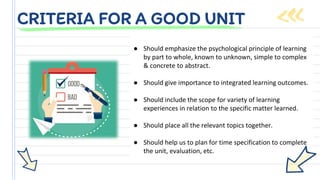
● Should emphasize the psychological principle of learning
by part to whole, known to unknown, simple to complex
& concrete to abstract.
● Should give importance to integrated learning outcomes.
● Should include the scope for variety of learning
experiences in relation to the specific matter learned.
● Should place all the relevant topics together.
● Should help us to plan for time specification to complete
the unit, evaluation, etc.
CRITERIA FOR A GOOD UNIT
● Helps to plan inter-related, meaningful learning activities and experiences in the form
of integrated whole experience.
● Provides guidelines and directions to plan and organize the experiences as planned
and usage of equipment's.
● Helps to involve students in teaching-learning process in a planned and organized way.
● Wastage of time, overlapping and gaps can be prevented.
● Helps students to apply the knowledge and experiences gained to solve related
problems in any situations.
● Provides freedom to students to work.
IMPORTANCE
● 87
PRINCIPLES OF UNIT PLANNING
● The needs, capabilities and interests of the students should be kept in view.
● The previous experience and background of the students should be taken into account.
● Familiar and related topics should be included in the unit.
● The interest of the student should be maintained till the end of the unit.
● It should be related to the social and physical environment of students.
● The unit should provide few new experiences which students have not gained before.
● It should help in anticipating and satisfying some of the future needs of the students.
● A variety of experiences like field trips, experiments, demonstrations, projects, etc. should
be planned for better learning.
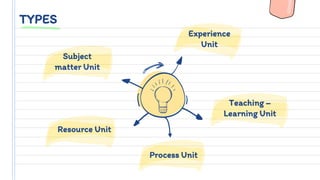
TYPES
Subject
matter Unit
Experience
Unit
Process Unit
Teaching –
Learning Unit
Resource Unit
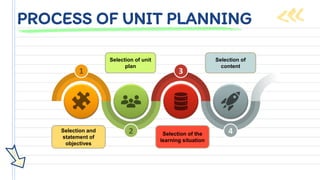
PROCESS OF UNIT PLANNING
Selection and
statement of
objectives
Selection of unit
plan
Selection of the
learning situation
Selection of
content
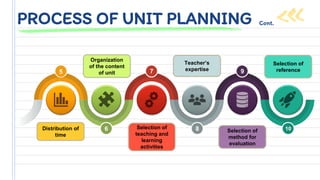
PROCESS OF UNIT PLANNING
5
6
7
8
9
10
Distribution of
time
Organization
of the content
of unit
Selection of
teaching and
learning
activities
Teacher’s
expertise
Selection of
method for
evaluation
Selection of
reference
Cont.
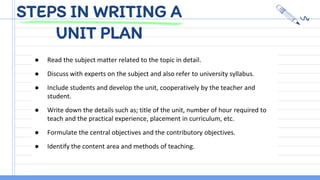
STEPS IN WRITING A
UNIT PLAN
● Read the subject matter related to the topic in detail.
● Discuss with experts on the subject and also refer to university syllabus.
● Include students and develop the unit, cooperatively by the teacher and
student.
● Write down the details such as; title of the unit, number of hour required to
teach and the practical experience, placement in curriculum, etc.
● Formulate the central objectives and the contributory objectives.
● Identify the content area and methods of teaching.
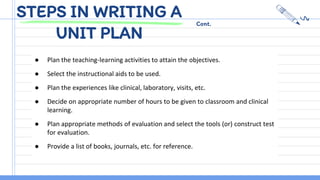
STEPS IN WRITING A
UNIT PLAN
● Plan the teaching-learning activities to attain the objectives.
● Select the instructional aids to be used.
● Plan the experiences like clinical, laboratory, visits, etc.
● Decide on appropriate number of hours to be given to classroom and clinical
learning.
● Plan appropriate methods of evaluation and select the tools (or) construct test
for evaluation.
● Provide a list of books, journals, etc. for reference.
Cont.
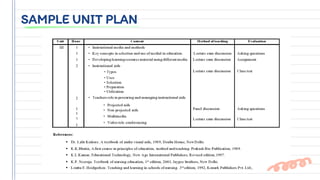
SAMPLE UNIT PLAN
SUMMARY
Book:
● R. Sudha (2013), Nursing Education principles and concepts,
P.71-73
Online Reference:
● http://www.egyankosh.ac.in
● http://blogs.ubc.ca
● http://educationaltechnology.net
REFERENCE
Unit Plan | Nursing Education | Juhin J

Unit Plan | Nursing Education | Juhin J

  • 1.
  • 3.
    OBJECTIVES At the endof this session, you’ll get clear understanding about; ● What is unit plan. ● List down the criteria for good unit. ● Enumerate the importance of unit planning ● List down the principles of unit planning ● Explain the types of unit planning ● Explain the process of unit planning ● Enlist the steps in writing a unit plan.
  • 4.
    INTRODUCTION Planning the unitis known as “Unit Plan”. Usually after the year plan, the teacher plans the unit plan. So the year plan should be ready before one starts preparing the unit plan. Large subdivision of the subject matter is called unit. Unit planning provides you a sense of direction and organization that helps you and your students achieve significant academic gains within a particular period of time.
  • 5.
    ● Should emphasizethe psychological principle of learning by part to whole, known to unknown, simple to complex & concrete to abstract. ● Should give importance to integrated learning outcomes. ● Should include the scope for variety of learning experiences in relation to the specific matter learned. ● Should place all the relevant topics together. ● Should help us to plan for time specification to complete the unit, evaluation, etc. CRITERIA FOR A GOOD UNIT
  • 6.
    ● Helps toplan inter-related, meaningful learning activities and experiences in the form of integrated whole experience. ● Provides guidelines and directions to plan and organize the experiences as planned and usage of equipment's. ● Helps to involve students in teaching-learning process in a planned and organized way. ● Wastage of time, overlapping and gaps can be prevented. ● Helps students to apply the knowledge and experiences gained to solve related problems in any situations. ● Provides freedom to students to work. IMPORTANCE
  • 7.
    ● 87 PRINCIPLES OFUNIT PLANNING ● The needs, capabilities and interests of the students should be kept in view. ● The previous experience and background of the students should be taken into account. ● Familiar and related topics should be included in the unit. ● The interest of the student should be maintained till the end of the unit. ● It should be related to the social and physical environment of students. ● The unit should provide few new experiences which students have not gained before. ● It should help in anticipating and satisfying some of the future needs of the students. ● A variety of experiences like field trips, experiments, demonstrations, projects, etc. should be planned for better learning.
  • 8.
  • 9.
    PROCESS OF UNITPLANNING Selection and statement of objectives Selection of unit plan Selection of the learning situation Selection of content
  • 10.
    PROCESS OF UNITPLANNING 5 6 7 8 9 10 Distribution of time Organization of the content of unit Selection of teaching and learning activities Teacher’s expertise Selection of method for evaluation Selection of reference Cont.
  • 11.
    STEPS IN WRITINGA UNIT PLAN ● Read the subject matter related to the topic in detail. ● Discuss with experts on the subject and also refer to university syllabus. ● Include students and develop the unit, cooperatively by the teacher and student. ● Write down the details such as; title of the unit, number of hour required to teach and the practical experience, placement in curriculum, etc. ● Formulate the central objectives and the contributory objectives. ● Identify the content area and methods of teaching.
  • 12.
    STEPS IN WRITINGA UNIT PLAN ● Plan the teaching-learning activities to attain the objectives. ● Select the instructional aids to be used. ● Plan the experiences like clinical, laboratory, visits, etc. ● Decide on appropriate number of hours to be given to classroom and clinical learning. ● Plan appropriate methods of evaluation and select the tools (or) construct test for evaluation. ● Provide a list of books, journals, etc. for reference. Cont.
  • 13.
  • 14.
  • 15.
    Book: ● R. Sudha(2013), Nursing Education principles and concepts, P.71-73 Online Reference: ● http://www.egyankosh.ac.in ● http://blogs.ubc.ca ● http://educationaltechnology.net REFERENCE