UNIT-III
Teaching General
Science
Dr. ChandanaPatnaik
Asst. Prof. CSSM,
Chamber, Mumbai
Submitted by:
Arooba Irfan
MP/2014-S-18
Amina Rashid
MP/ 2024-S-20
Submitted to:
Dr. Amir Hashmi
2.
Outline:
3.0 Objectives.
3.1 Introduction.
3.2Formulation of Instructional Objectives.
3.3 Unit Planning.
3.4 Lesson Planning.
3.5 Improvisation of teaching aids in general science.
3.6 Let us sum up.
3.
For teaching Science
1.Formulate instructional objectives
2. Plan teaching unit.
3. Plan lesson effectively with different approaches
4. Develop teaching aids
3.0 Objectives:
4.
Teaching-Learning Process
1. Toachieve identified objective➡️
state it clearly evaluate
➡️
effectively select test items aligns students towards
➡️ ➡️
relevant activities.
2. Meaningfully stated objective shows establish
➡️
communication writer's intention expected
➡️ behavioral
outcome➡️
accepted kind of performance as evidence
3.1 Introduction:
5.
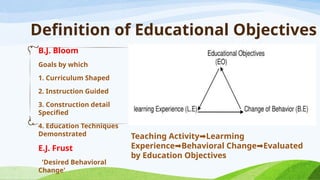
Definition of EducationalObjectives
B.J. Bloom
Goals by which
1. Curriculum Shaped
2. Instruction Guided
3. Construction detail
Specified
4. Education Techniques
Demonstrated
E.J. Frust
'Desired Behavioral
Change'
Teaching Activity➡️
Learming
Experience➡️
Behavioral Change➡️
Evaluated
by Education Objectives
6.
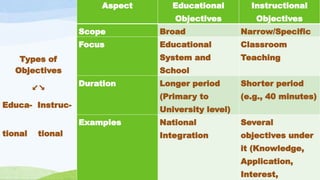
Types of
Objectives
↙️
↘️
Educa- Instruc-
tionaltional
Aspect Educational
Objectives
Instructional
Objectives
Scope Broad Narrow/Specific
Focus Educational
System and
School
Classroom
Teaching
Duration Longer period
(Primary to
University level)
Shorter period
(e.g., 40 minutes)
Examples National
Integration
Several
objectives under
it (Knowledge,
Application,
Interest,
7.
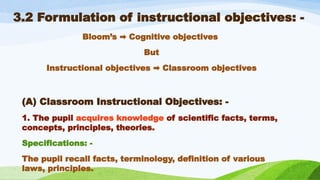
3.2 Formulation ofinstructional objectives: -
Bloom’s Cognitive objectives
➡️
But
Instructional objectives Classroom objectives
➡️
(A) Classroom Instructional Objectives: -
1. The pupil acquires knowledge of scientific facts, terms,
concepts, principles, theories.
Specifications: -
The pupil recall facts, terminology, definition of various
laws, principles.
8.
2. The pupildevelops an understanding of various scientific terms,
facts, definitions, concepts, laws, theories, procedures, etc.
Specifications: -
i) The pupil sees a relationship between different facts, concepts
i.e., mass and volume.
ii) The pupil cites examples of metals and metalloids.
3. The pupil applies his knowledge and understanding in new and
unfamiliar situation.
Specifications: -
i) The pupil analyses the given example into what in given and what
to be found out.
ii) The pupil solves the problems on velocity, momentum, etc.
9.
4. The pupildevelops the skills required for science learning.
Specifications: -
i) The pupil checks the feasibility on instruments before using them.
ii) The pupil rectifies the defects in the instruments
B) Personality Objectives
5. The pupil develops interest in science.
Specifications: -
i) The pupil reads, on his own, a number of books, magazines,
newspapers related to scientific information.
ii) The pupil visits places of scientific importance and interest e.g.
planetarium, laboratories, science centres etc.
10.
6. The pupildevelops positive scientific attitude.
Specifications: -
i) The pupil reconsiders his own judgments and beliefs in the light of new
knowledge
ii) The pupil arrives at a judgment after weighing all possible evidence
carefully.
7. The pupil appreciates the contribution of science in every walk of life
and knowledge.
Specifications: -
i) The pupil recognizes the contribution of scientists to the modern
world.
ii) The pupil expresses his appreciation of man’s effort to conquer nature
11.
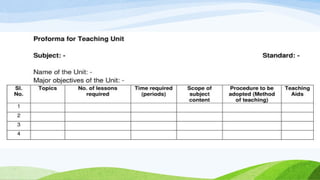
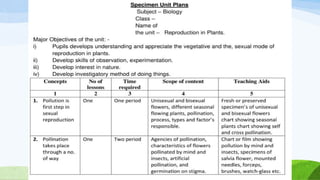
3.3 Unit Planning:-
“Alarge block of related subject matter viewed by the learner”.
➡️
Preston
‘Outline of related subject matter related to pupils.
➡️
Sanford
“Organized body of information and experience effect outcomes
➡️
for learner”.
Wisely
➡️
keeps in view the needs, capabilities and interest of pupils
organized body of information and experience
➡️
➡️aims at outcome from learners.
12.
Points to benoted while planning:
1. Related social/physical environment
2. Take in account previous experiences
3. Provide new experiences
4. Not lengthy interest is sustained.
5. Flexible students explore their unique capacities.
6. Result of cooperative planning teacher and pupil.
13.
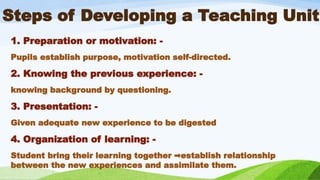
Steps of Developinga Teaching Unit
1. Preparation or motivation: -
Pupils establish purpose, motivation self-directed.
2. Knowing the previous experience: -
knowing background by questioning.
3. Presentation: -
Given adequate new experience to be digested
4. Organization of learning: -
Student bring their learning together establish relationship
➡️
between the new experiences and assimilate them.
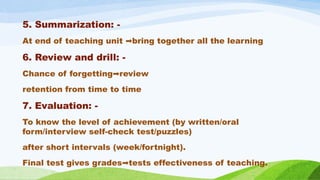
14.
5. Summarization: -
Atend of teaching unit bring together all the learning
➡️
6. Review and drill: -
Chance of forgetting review
➡️
retention from time to time
7. Evaluation: -
To know the level of achievement (by written/oral
form/interview self-check test/puzzles)
after short intervals (week/fortnight).
Final test gives grades tests effectiveness of teaching.
➡️