
CURRICULUM TRANSACTION AND MODE
Dr.M.Deivam
Assistant Professor
Department of Education
The Gandhigram Rural Institute (Deemed to be University)
Gandhigram, Dindigul District, Tamil Nadu – 624 302
Concept of Curriculum Transaction
• Curriculum Transaction is the effective and desired
implementation of the curriculum contents on the
basis of aims and objectives listed in the
curriculum.
• Curriculum Transaction incorporates effective
planning for providing learning experiences for its
learners, organization of planning, administration /
implementation of the organized planning and
evaluation of the implementations by the
implementer and the experts in the relevant field.
Cont.,
• Curriculum construction + Curriculum
transaction = Curriculum Development
• Curriculum transaction = Planning curriculum
in a subject area for different levels of study +
continuously monitoring their
implementation.
Requirements for Curriculum Transaction
• Planning in execution of framed objectives
• Clarity of thought to be presented
• Sound knowledge to transact to the target
• Review of the work in prior
• Team responsibility
• Clarity of communication
• Addressing different levels of children
Cont.,
• Knowing, observing and understanding children at
all times
• Time management
• Alertness in preparation and presentation
• Material organization relevant to the level of pupils
• Facilitate learning Environment
• Selection of appropriate teaching style and method
• Ready alternatives if needed
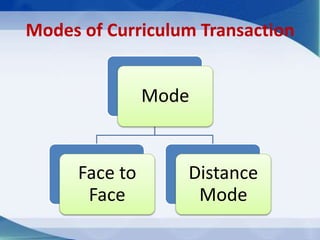
Modes of Curriculum Transaction
Mode
Face to
Face
Distance
Mode
Face-to-Face Mode
• The face-to-face mode refers to instructional
interactions in which learners and the teacher
transact a curriculum in a face-to-face situation.
• This mode includes inputs like seminars,
discussions, lectures, demonstrations and any
activity involving direct interaction between the
learners and the teacher.
• The face-to-face mode is the oldest and most
widely accepted mode.
Cont.,
• The era, when electronic media were not available
and even the print medium was unknown, the
most easily accessible channel for transmission of
knowledge and for communication was through
face-to-face interaction with the teacher.
• Over the years, the print medium has provided
support to oral communication with the teacher,
as the main focus in schools.
Distance Mode
• The distance mode, as the term indicates, pertains
to all kinds of interactions between the teacher
and learners in which they are not in direct contact
with one another and require a third channel or
medium for contact.
• These include the print, audio, video, or any other
mode. Open learning systems generally utilize such
modes
Cont.,
• Correspondence education acquired significance as
an alternative to 'teacher talk' in India, with
increased availability of printing facilities.
• As correspondence education widened with the
emergence of open learning system, the media of
transaction were diversified to include audio, visual
and audio-visual mechanisms.
• More recently, interactive television has come to
be used for communication of knowledge.
Cont.,
• The SWAYAM PRABHA is a group of 34 DTH
channels devoted to telecasting of high-quality
educational programmes on 24X7 basis using the
GSAT-15 satellite. Every day, there will be new
content for at least (4) hours which would be
repeated 5 more times in a day, allowing the
students to choose the time of their convenience.
Mode of online platform – COVID 19
• Facebook Live
• YouTube Live
• Google Meet
• Skype
• Zoom
• Join.me
• Appear.in
• Team Viewer
• UberConference
• GoTo Meeting
• Free Conferenc call
• Jitsi Meet
• TeamLink
• Cisco webex Meeting
Curriculum transaction and mode

Curriculum transaction and mode

  • 1.
    CURRICULUM TRANSACTION ANDMODE Dr.M.Deivam Assistant Professor Department of Education The Gandhigram Rural Institute (Deemed to be University) Gandhigram, Dindigul District, Tamil Nadu – 624 302
  • 2.
    Concept of CurriculumTransaction • Curriculum Transaction is the effective and desired implementation of the curriculum contents on the basis of aims and objectives listed in the curriculum. • Curriculum Transaction incorporates effective planning for providing learning experiences for its learners, organization of planning, administration / implementation of the organized planning and evaluation of the implementations by the implementer and the experts in the relevant field.
  • 3.
    Cont., • Curriculum construction+ Curriculum transaction = Curriculum Development • Curriculum transaction = Planning curriculum in a subject area for different levels of study + continuously monitoring their implementation.
  • 4.
    Requirements for CurriculumTransaction • Planning in execution of framed objectives • Clarity of thought to be presented • Sound knowledge to transact to the target • Review of the work in prior • Team responsibility • Clarity of communication • Addressing different levels of children
  • 5.
    Cont., • Knowing, observingand understanding children at all times • Time management • Alertness in preparation and presentation • Material organization relevant to the level of pupils • Facilitate learning Environment • Selection of appropriate teaching style and method • Ready alternatives if needed
  • 6.
    Modes of CurriculumTransaction Mode Face to Face Distance Mode
  • 7.
    Face-to-Face Mode • Theface-to-face mode refers to instructional interactions in which learners and the teacher transact a curriculum in a face-to-face situation. • This mode includes inputs like seminars, discussions, lectures, demonstrations and any activity involving direct interaction between the learners and the teacher. • The face-to-face mode is the oldest and most widely accepted mode.
  • 8.
    Cont., • The era,when electronic media were not available and even the print medium was unknown, the most easily accessible channel for transmission of knowledge and for communication was through face-to-face interaction with the teacher. • Over the years, the print medium has provided support to oral communication with the teacher, as the main focus in schools.
  • 9.
    Distance Mode • Thedistance mode, as the term indicates, pertains to all kinds of interactions between the teacher and learners in which they are not in direct contact with one another and require a third channel or medium for contact. • These include the print, audio, video, or any other mode. Open learning systems generally utilize such modes
  • 10.
    Cont., • Correspondence educationacquired significance as an alternative to 'teacher talk' in India, with increased availability of printing facilities. • As correspondence education widened with the emergence of open learning system, the media of transaction were diversified to include audio, visual and audio-visual mechanisms. • More recently, interactive television has come to be used for communication of knowledge.
  • 11.
    Cont., • The SWAYAMPRABHA is a group of 34 DTH channels devoted to telecasting of high-quality educational programmes on 24X7 basis using the GSAT-15 satellite. Every day, there will be new content for at least (4) hours which would be repeated 5 more times in a day, allowing the students to choose the time of their convenience.
  • 12.
    Mode of onlineplatform – COVID 19 • Facebook Live • YouTube Live • Google Meet • Skype • Zoom • Join.me • Appear.in • Team Viewer • UberConference • GoTo Meeting • Free Conferenc call • Jitsi Meet • TeamLink • Cisco webex Meeting