
Inverters
Prepared by,
Mr. A.Johny Renoald M.E., Ph.D,
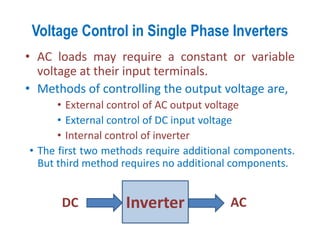
Voltage Control in Single Phase Inverters
• AC loads may require a constant or variable
voltage at their input terminals.
• Methods of controlling the output voltage are,
• External control of AC output voltage
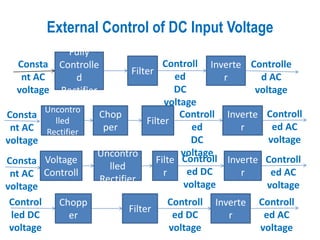
• External control of DC input voltage
• Internal control of inverter
• The first two methods require additional components.
But third method requires no additional components.
Inverter
DC AC
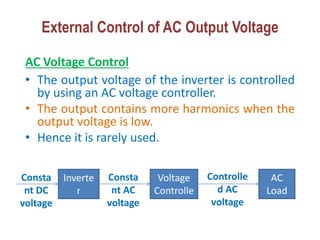
External Control of AC Output Voltage
AC Voltage Control
• The output voltage of the inverter is controlled
by using an AC voltage controller.
• The output contains more harmonics when the
output voltage is low.
• Hence it is rarely used.
Inverte
r
AC
Voltage
Controlle
r
AC
Load
Controlle
d AC
voltage
Consta
nt DC
voltage
Consta
nt AC
voltage
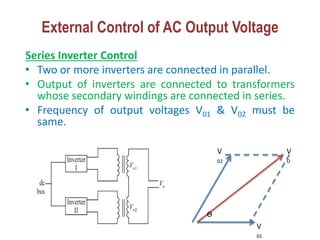
External Control of AC Output Voltage
Series Inverter Control
• Two or more inverters are connected in parallel.
• Output of inverters are connected to transformers
whose secondary windings are connected in series.
• Frequency of output voltages V01 & V02 must be
same.
ϴ
V
02
V
01
V
O
External Control of DC Input Voltage
Fully
Controlle
d
Rectifier
Filter
Inverte
r
Controlle
d AC
voltage
Controll
ed
DC
voltage
Consta
nt AC
voltage
Uncontro
lled
Rectifier
Filter
Inverte
r
Controll
ed AC
voltage
Chop
per
AC
Voltage
Controll
er
Filte
r
Inverte
r
Controll
ed DC
voltage
Uncontro
lled
Rectifier
Chopp
er
Filter
Inverte
r
Controll
ed AC
voltage
Controll
ed DC
voltage
Control
led DC
voltage
Controll
ed
DC
voltage
Consta
nt AC
voltage
Controll
ed AC
voltage
Consta
nt AC
voltage
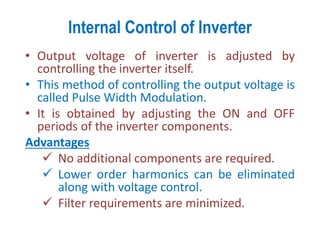
Internal Control of Inverter
• Output voltage of inverter is adjusted by
controlling the inverter itself.
• This method of controlling the output voltage is
called Pulse Width Modulation.
• It is obtained by adjusting the ON and OFF
periods of the inverter components.
Advantages
 No additional components are required.
 Lower order harmonics can be eliminated
along with voltage control.
 Filter requirements are minimized.
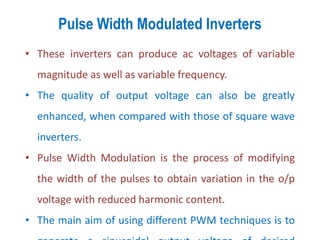
Pulse Width Modulated Inverters
• These inverters can produce ac voltages of variable
magnitude as well as variable frequency.
• The quality of output voltage can also be greatly
enhanced, when compared with those of square wave
inverters.
• Pulse Width Modulation is the process of modifying
the width of the pulses to obtain variation in the o/p
voltage with reduced harmonic content.
• The main aim of using different PWM techniques is to
Different types of PWM inverters
 Single pulse modulation
 Multiple pulse modulation
 Sinusoidal pulse modulation
 Modified sinusoidal pulse
modulation
 Space vector pulse width
modulation
Single Pulse Width Modulation
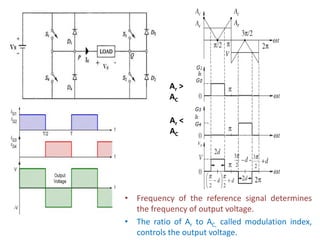
• In single pulse modulation, there is only one
pulse exists per half cycle.
• The width of this pulse is varied to control
the inverter output voltage.
• Frequency of the reference signal determines
the frequency of output voltage.
• The ratio of Ar to AC, called modulation index,
controls the output voltage.
Ar >
AC
Ar <
AC
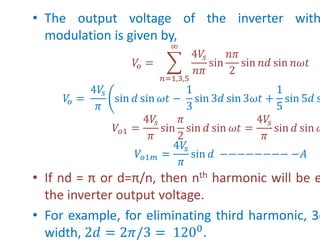
• The output voltage of the inverter with
modulation is given by,
𝑉
𝑜 =
𝑛=1,3,5
∞
4𝑉
𝑠
𝑛𝜋
sin
𝑛𝜋
2
sin 𝑛𝑑 sin 𝑛𝜔𝑡
𝑉
𝑜 =
4𝑉
𝑠
𝜋
sin 𝑑 sin 𝜔𝑡 −
1
3
sin 3𝑑 sin 3𝜔𝑡 +
1
5
sin 5𝑑 s
𝑉𝑜1 =
4𝑉
𝑠
𝜋
sin
𝜋
2
sin 𝑑 sin 𝜔𝑡 =
4𝑉
𝑠
𝜋
sin 𝑑 sin 𝜔
𝑉𝑜1𝑚 =
4𝑉
𝑠
𝜋
sin 𝑑 −−−−−−−− −𝐴
• If nd = π or d=π/n, then nth harmonic will be e
the inverter output voltage.
• For example, for eliminating third harmonic, 3d
width, 2𝑑 = 2𝜋/3 = 1200
.
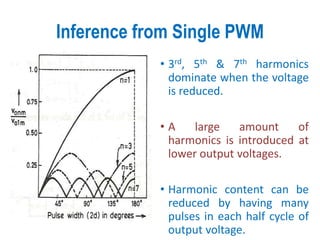
Inference from Single PWM
• 3rd, 5th & 7th harmonics
dominate when the voltage
is reduced.
• A large amount of
harmonics is introduced at
lower output voltages.
• Harmonic content can be
reduced by having many
pulses in each half cycle of
output voltage.
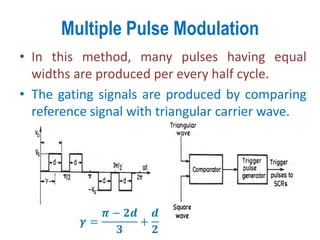
Multiple Pulse Modulation
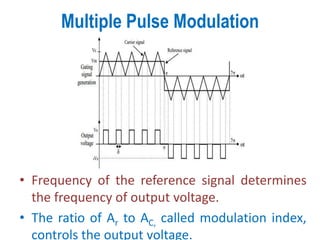
• In this method, many pulses having equal
widths are produced per every half cycle.
• The gating signals are produced by comparing
reference signal with triangular carrier wave.
𝜸 =
𝝅 − 𝟐𝒅
𝟑
+
𝒅
𝟐
Multiple Pulse Modulation
• Frequency of the reference signal determines
the frequency of output voltage.
• The ratio of Ar to AC, called modulation index,
controls the output voltage.
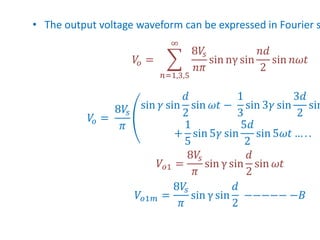
• The output voltage waveform can be expressed in Fourier s
𝑉
𝑜 =
𝑛=1,3,5
∞
8𝑉
𝑠
𝑛𝜋
sin nγ sin
𝑛𝑑
2
sin 𝑛𝜔𝑡
𝑉
𝑜 =
8𝑉
𝑠
𝜋
sin 𝛾 sin
𝑑
2
sin 𝜔𝑡 −
1
3
sin 3𝛾 sin
3𝑑
2
sin
+
1
5
sin 5𝛾 sin
5𝑑
2
sin 5𝜔𝑡 … . .
𝑉𝑜1 =
8𝑉
𝑠
𝜋
sin γ sin
𝑑
2
sin 𝜔𝑡
𝑉𝑜1𝑚 =
8𝑉
𝑠
𝜋
sin γ sin
𝑑
2
−−−−− −𝐵
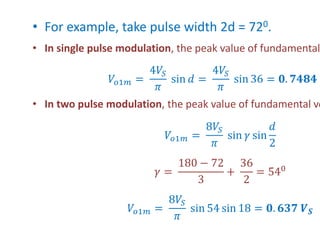
• For example, take pulse width 2d = 720.
• In single pulse modulation, the peak value of fundamental
𝑉𝑜1𝑚 =
4𝑉𝑆
𝜋
sin 𝑑 =
4𝑉𝑆
𝜋
sin 36 = 𝟎. 𝟕𝟒𝟖𝟒 𝑽
• In two pulse modulation, the peak value of fundamental vo
𝑉𝑜1𝑚 =
8𝑉𝑆
𝜋
sin 𝛾 sin
𝑑
2
𝛾 =
180 − 72
3
+
36
2
= 540
𝑉𝑜1𝑚 =
8𝑉𝑆
𝜋
sin 54 sin 18 = 𝟎. 𝟔𝟑𝟕 𝑽𝑺
Multiple Pulse Modulation
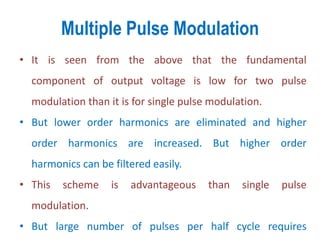
• It is seen from the above that the fundamental
component of output voltage is low for two pulse
modulation than it is for single pulse modulation.
• But lower order harmonics are eliminated and higher
order harmonics are increased. But higher order
harmonics can be filtered easily.
• This scheme is advantageous than single pulse
modulation.
• But large number of pulses per half cycle requires
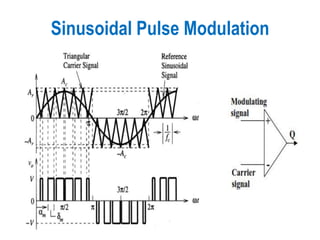
Sinusoidal Pulse Modulation
• In this method, several pulses per half cycle are
used as in the case of multiple pulse
modulation.
• But width of each pulse is modulated
proportional to the amplitude of sine wave.
• Gate pulses are generated by comparing
sinusoidal reference signal with triangular
carrier signal.
• Frequency of reference signal (fr) decides the
frequency of output voltage.
Sinusoidal Pulse Modulation
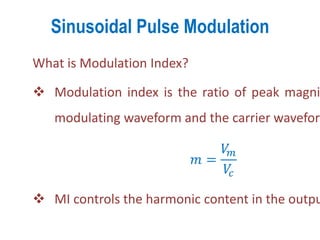
What is Modulation Index?
 Modulation index is the ratio of peak magni
modulating waveform and the carrier waveform
𝑚 =
𝑉
𝑚
𝑉
𝑐
 MI controls the harmonic content in the outpu
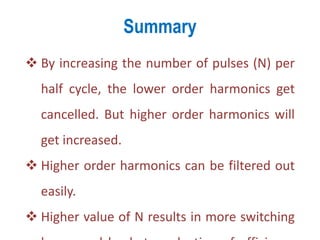
Summary
 By increasing the number of pulses (N) per
half cycle, the lower order harmonics get
cancelled. But higher order harmonics will
get increased.
 Higher order harmonics can be filtered out
easily.
 Higher value of N results in more switching
Sinusoidal Pulse Modulation
What is Over Modulation?
• When the peak magnitude of modulating
signal exceeds the peak magnitude of
carrier signal, the PWM inverter operates
under over-modulation.
• During over-modulation the output voltage
increases slightly.
Reduction of Harmonics in the Inverter
O/P
• Harmonics of 5% is allowable in an inverter output
voltage.
• But inverter output voltage contains more than 5% of
harmonics.
• Filters can be used to reduce the harmonic content.
• Small size filter is enough for reducing higher order
harmonics.
• But a bigger size filter is required for reducing lower
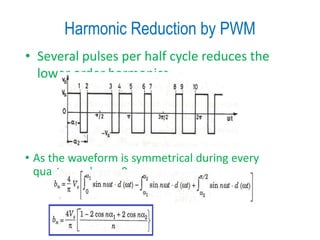
Harmonic Reduction by PWM
• Several pulses per half cycle reduces the
lower order harmonics.
• As the waveform is symmetrical during every
quarter cycle, an=0.
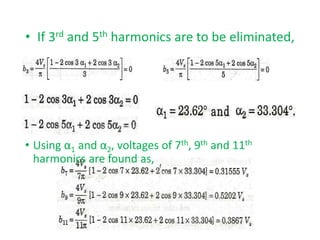
• If 3rd and 5th harmonics are to be eliminated,
• Using α1 and α2, voltages of 7th, 9th and 11th
harmonics are found as,
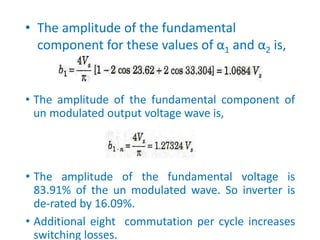
• The amplitude of the fundamental
component for these values of α1 and α2 is,
• The amplitude of the fundamental component of
un modulated output voltage wave is,
• The amplitude of the fundamental voltage is
83.91% of the un modulated wave. So inverter is
de-rated by 16.09%.
• Additional eight commutation per cycle increases
switching losses.
Harmonic Reduction by Transformer
Connections
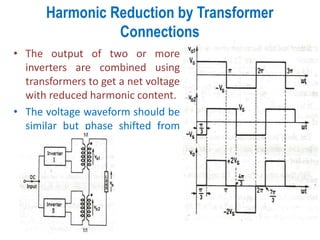
• The output of two or more
inverters are combined using
transformers to get a net voltage
with reduced harmonic content.
• The voltage waveform should be
similar but phase shifted from
each other.
Harmonic Reduction by Transformer
Connections
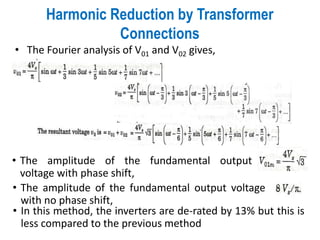
• The Fourier analysis of V01 and V02 gives,
• The amplitude of the fundamental output
voltage with phase shift,
• The amplitude of the fundamental output voltage
with no phase shift,
• In this method, the inverters are de-rated by 13% but this is
less compared to the previous method
Harmonic Reduction by Stepped Wave
Inverters
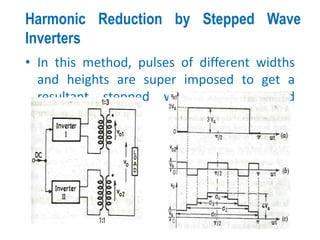
• In this method, pulses of different widths
and heights are super imposed to get a
resultant stepped wave with reduced
harmonic content.
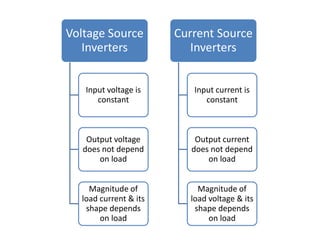
Voltage Source
Inverters
Input voltage is
constant
Output voltage
does not depend
on load
Magnitude of
load current & its
shape depends
on load
Current Source
Inverters
Input current is
constant
Output current
does not depend
on load
Magnitude of
load voltage & its
shape depends
on load
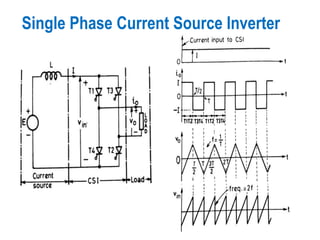
Single Phase Current Source Inverter

Unit- 4 inverters (part-2)

  • 1.
  • 2.
    Voltage Control inSingle Phase Inverters • AC loads may require a constant or variable voltage at their input terminals. • Methods of controlling the output voltage are, • External control of AC output voltage • External control of DC input voltage • Internal control of inverter • The first two methods require additional components. But third method requires no additional components. Inverter DC AC
  • 3.
    External Control ofAC Output Voltage AC Voltage Control • The output voltage of the inverter is controlled by using an AC voltage controller. • The output contains more harmonics when the output voltage is low. • Hence it is rarely used. Inverte r AC Voltage Controlle r AC Load Controlle d AC voltage Consta nt DC voltage Consta nt AC voltage
  • 4.
    External Control ofAC Output Voltage Series Inverter Control • Two or more inverters are connected in parallel. • Output of inverters are connected to transformers whose secondary windings are connected in series. • Frequency of output voltages V01 & V02 must be same. ϴ V 02 V 01 V O
  • 5.
    External Control ofDC Input Voltage Fully Controlle d Rectifier Filter Inverte r Controlle d AC voltage Controll ed DC voltage Consta nt AC voltage Uncontro lled Rectifier Filter Inverte r Controll ed AC voltage Chop per AC Voltage Controll er Filte r Inverte r Controll ed DC voltage Uncontro lled Rectifier Chopp er Filter Inverte r Controll ed AC voltage Controll ed DC voltage Control led DC voltage Controll ed DC voltage Consta nt AC voltage Controll ed AC voltage Consta nt AC voltage
  • 6.
    Internal Control ofInverter • Output voltage of inverter is adjusted by controlling the inverter itself. • This method of controlling the output voltage is called Pulse Width Modulation. • It is obtained by adjusting the ON and OFF periods of the inverter components. Advantages  No additional components are required.  Lower order harmonics can be eliminated along with voltage control.  Filter requirements are minimized.
  • 7.
    Pulse Width ModulatedInverters • These inverters can produce ac voltages of variable magnitude as well as variable frequency. • The quality of output voltage can also be greatly enhanced, when compared with those of square wave inverters. • Pulse Width Modulation is the process of modifying the width of the pulses to obtain variation in the o/p voltage with reduced harmonic content. • The main aim of using different PWM techniques is to
  • 8.
    Different types ofPWM inverters  Single pulse modulation  Multiple pulse modulation  Sinusoidal pulse modulation  Modified sinusoidal pulse modulation  Space vector pulse width modulation
  • 9.
    Single Pulse WidthModulation • In single pulse modulation, there is only one pulse exists per half cycle. • The width of this pulse is varied to control the inverter output voltage.
  • 10.
    • Frequency ofthe reference signal determines the frequency of output voltage. • The ratio of Ar to AC, called modulation index, controls the output voltage. Ar > AC Ar < AC
  • 11.
    • The outputvoltage of the inverter with modulation is given by, 𝑉 𝑜 = 𝑛=1,3,5 ∞ 4𝑉 𝑠 𝑛𝜋 sin 𝑛𝜋 2 sin 𝑛𝑑 sin 𝑛𝜔𝑡 𝑉 𝑜 = 4𝑉 𝑠 𝜋 sin 𝑑 sin 𝜔𝑡 − 1 3 sin 3𝑑 sin 3𝜔𝑡 + 1 5 sin 5𝑑 s 𝑉𝑜1 = 4𝑉 𝑠 𝜋 sin 𝜋 2 sin 𝑑 sin 𝜔𝑡 = 4𝑉 𝑠 𝜋 sin 𝑑 sin 𝜔 𝑉𝑜1𝑚 = 4𝑉 𝑠 𝜋 sin 𝑑 −−−−−−−− −𝐴 • If nd = π or d=π/n, then nth harmonic will be e the inverter output voltage. • For example, for eliminating third harmonic, 3d width, 2𝑑 = 2𝜋/3 = 1200 .
  • 12.
    Inference from SinglePWM • 3rd, 5th & 7th harmonics dominate when the voltage is reduced. • A large amount of harmonics is introduced at lower output voltages. • Harmonic content can be reduced by having many pulses in each half cycle of output voltage.
  • 13.
    Multiple Pulse Modulation •In this method, many pulses having equal widths are produced per every half cycle. • The gating signals are produced by comparing reference signal with triangular carrier wave. 𝜸 = 𝝅 − 𝟐𝒅 𝟑 + 𝒅 𝟐
  • 14.
    Multiple Pulse Modulation •Frequency of the reference signal determines the frequency of output voltage. • The ratio of Ar to AC, called modulation index, controls the output voltage.
  • 15.
    • The outputvoltage waveform can be expressed in Fourier s 𝑉 𝑜 = 𝑛=1,3,5 ∞ 8𝑉 𝑠 𝑛𝜋 sin nγ sin 𝑛𝑑 2 sin 𝑛𝜔𝑡 𝑉 𝑜 = 8𝑉 𝑠 𝜋 sin 𝛾 sin 𝑑 2 sin 𝜔𝑡 − 1 3 sin 3𝛾 sin 3𝑑 2 sin + 1 5 sin 5𝛾 sin 5𝑑 2 sin 5𝜔𝑡 … . . 𝑉𝑜1 = 8𝑉 𝑠 𝜋 sin γ sin 𝑑 2 sin 𝜔𝑡 𝑉𝑜1𝑚 = 8𝑉 𝑠 𝜋 sin γ sin 𝑑 2 −−−−− −𝐵
  • 16.
    • For example,take pulse width 2d = 720. • In single pulse modulation, the peak value of fundamental 𝑉𝑜1𝑚 = 4𝑉𝑆 𝜋 sin 𝑑 = 4𝑉𝑆 𝜋 sin 36 = 𝟎. 𝟕𝟒𝟖𝟒 𝑽 • In two pulse modulation, the peak value of fundamental vo 𝑉𝑜1𝑚 = 8𝑉𝑆 𝜋 sin 𝛾 sin 𝑑 2 𝛾 = 180 − 72 3 + 36 2 = 540 𝑉𝑜1𝑚 = 8𝑉𝑆 𝜋 sin 54 sin 18 = 𝟎. 𝟔𝟑𝟕 𝑽𝑺
  • 17.
    Multiple Pulse Modulation •It is seen from the above that the fundamental component of output voltage is low for two pulse modulation than it is for single pulse modulation. • But lower order harmonics are eliminated and higher order harmonics are increased. But higher order harmonics can be filtered easily. • This scheme is advantageous than single pulse modulation. • But large number of pulses per half cycle requires
  • 18.
    Sinusoidal Pulse Modulation •In this method, several pulses per half cycle are used as in the case of multiple pulse modulation. • But width of each pulse is modulated proportional to the amplitude of sine wave. • Gate pulses are generated by comparing sinusoidal reference signal with triangular carrier signal. • Frequency of reference signal (fr) decides the frequency of output voltage.
  • 19.
  • 20.
    Sinusoidal Pulse Modulation Whatis Modulation Index?  Modulation index is the ratio of peak magni modulating waveform and the carrier waveform 𝑚 = 𝑉 𝑚 𝑉 𝑐  MI controls the harmonic content in the outpu
  • 21.
    Summary  By increasingthe number of pulses (N) per half cycle, the lower order harmonics get cancelled. But higher order harmonics will get increased.  Higher order harmonics can be filtered out easily.  Higher value of N results in more switching
  • 22.
    Sinusoidal Pulse Modulation Whatis Over Modulation? • When the peak magnitude of modulating signal exceeds the peak magnitude of carrier signal, the PWM inverter operates under over-modulation. • During over-modulation the output voltage increases slightly.
  • 23.
    Reduction of Harmonicsin the Inverter O/P • Harmonics of 5% is allowable in an inverter output voltage. • But inverter output voltage contains more than 5% of harmonics. • Filters can be used to reduce the harmonic content. • Small size filter is enough for reducing higher order harmonics. • But a bigger size filter is required for reducing lower
  • 24.
    Harmonic Reduction byPWM • Several pulses per half cycle reduces the lower order harmonics. • As the waveform is symmetrical during every quarter cycle, an=0.
  • 25.
    • If 3rdand 5th harmonics are to be eliminated, • Using α1 and α2, voltages of 7th, 9th and 11th harmonics are found as,
  • 26.
    • The amplitudeof the fundamental component for these values of α1 and α2 is, • The amplitude of the fundamental component of un modulated output voltage wave is, • The amplitude of the fundamental voltage is 83.91% of the un modulated wave. So inverter is de-rated by 16.09%. • Additional eight commutation per cycle increases switching losses.
  • 27.
    Harmonic Reduction byTransformer Connections • The output of two or more inverters are combined using transformers to get a net voltage with reduced harmonic content. • The voltage waveform should be similar but phase shifted from each other.
  • 28.
    Harmonic Reduction byTransformer Connections • The Fourier analysis of V01 and V02 gives, • The amplitude of the fundamental output voltage with phase shift, • The amplitude of the fundamental output voltage with no phase shift, • In this method, the inverters are de-rated by 13% but this is less compared to the previous method
  • 29.
    Harmonic Reduction byStepped Wave Inverters • In this method, pulses of different widths and heights are super imposed to get a resultant stepped wave with reduced harmonic content.
  • 30.
    Voltage Source Inverters Input voltageis constant Output voltage does not depend on load Magnitude of load current & its shape depends on load Current Source Inverters Input current is constant Output current does not depend on load Magnitude of load voltage & its shape depends on load
  • 31.
    Single Phase CurrentSource Inverter