Chapter 8
Inverters
Converter DC to AC
8.1 Introduction
Inverters are circuits that convert dc to ac.
• The controlled full-wave bridge converters in Chap. 4 can function as inverters in
some instances, but an ac source must preexist in those cases.
• The focus of this chapter is on inverters that produce an ac output from a dc input.
• Inverters are used in applications such as
o Adjustable
o Speed ac motor drives
o Uninterruptible Power Supplies (UPS)
o Running AC appliances from an automobile batter
8.2 The Full-Bridge Converter
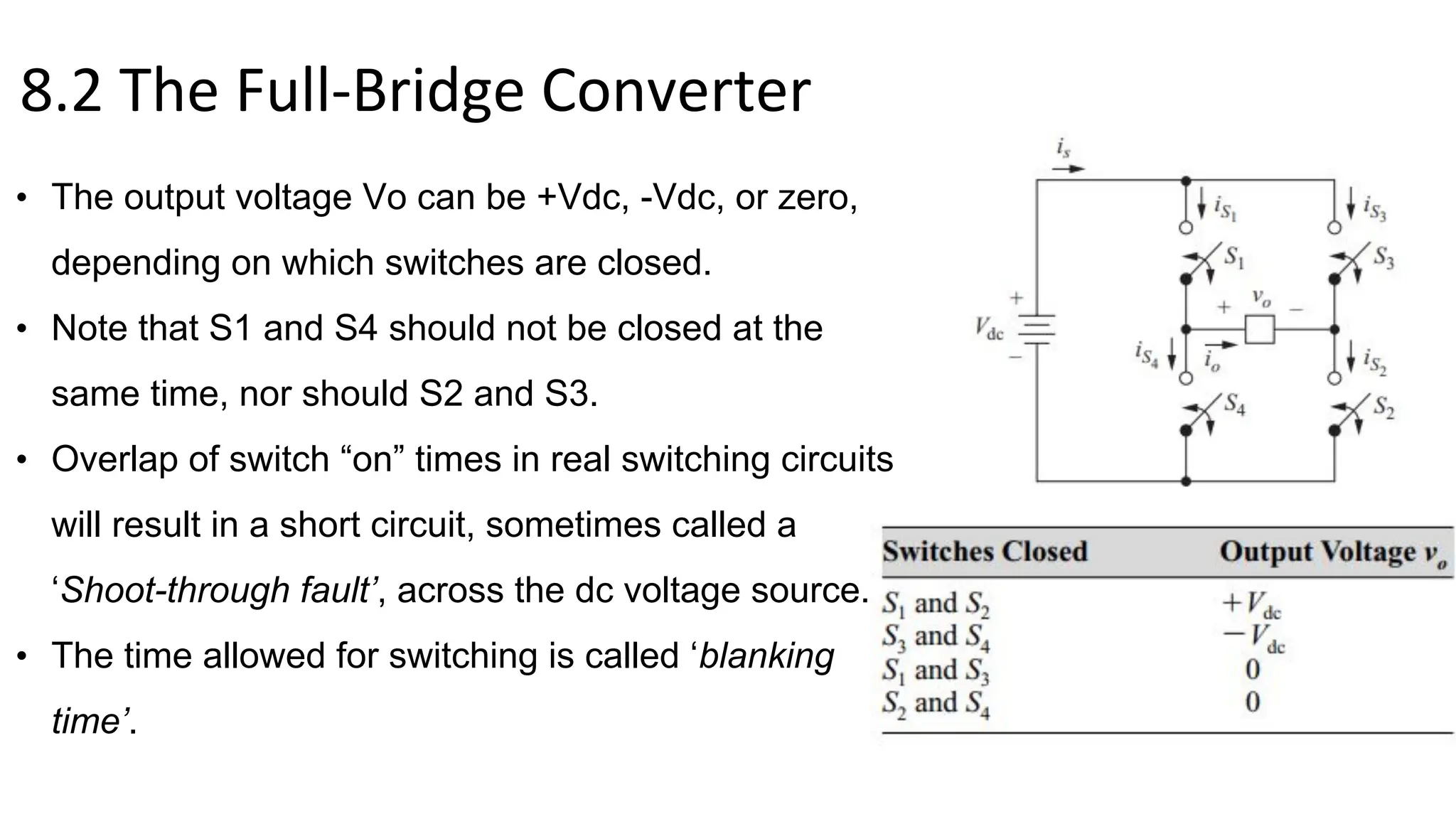
• The output voltage Vo can be +Vdc, -Vdc, or zero,
depending on which switches are closed.
• Note that S1 and S4 should not be closed at the
same time, nor should S2 and S3.
• Overlap of switch “on” times in real switching circuits
will result in a short circuit, sometimes called a
‘Shoot-through fault’, across the dc voltage source.
• The time allowed for switching is called ‘blanking
time’.
8.2 The Full-Bridge Converter
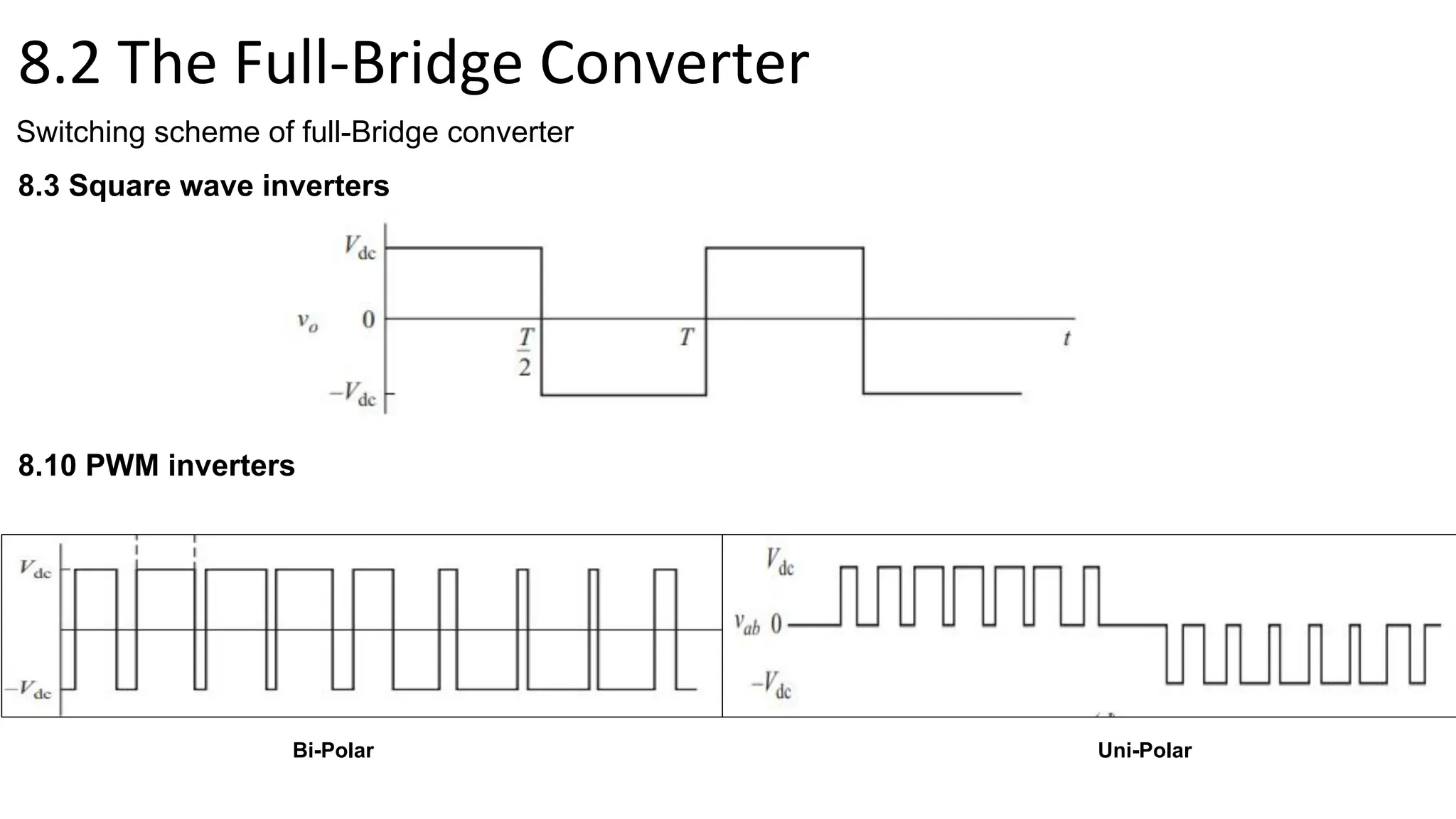
Switching scheme of full-Bridge converter
8.3 Square wave inverters
8.10 PWM inverters
Bi-Polar Uni-Polar
8.3 The Square-Wave Inverter
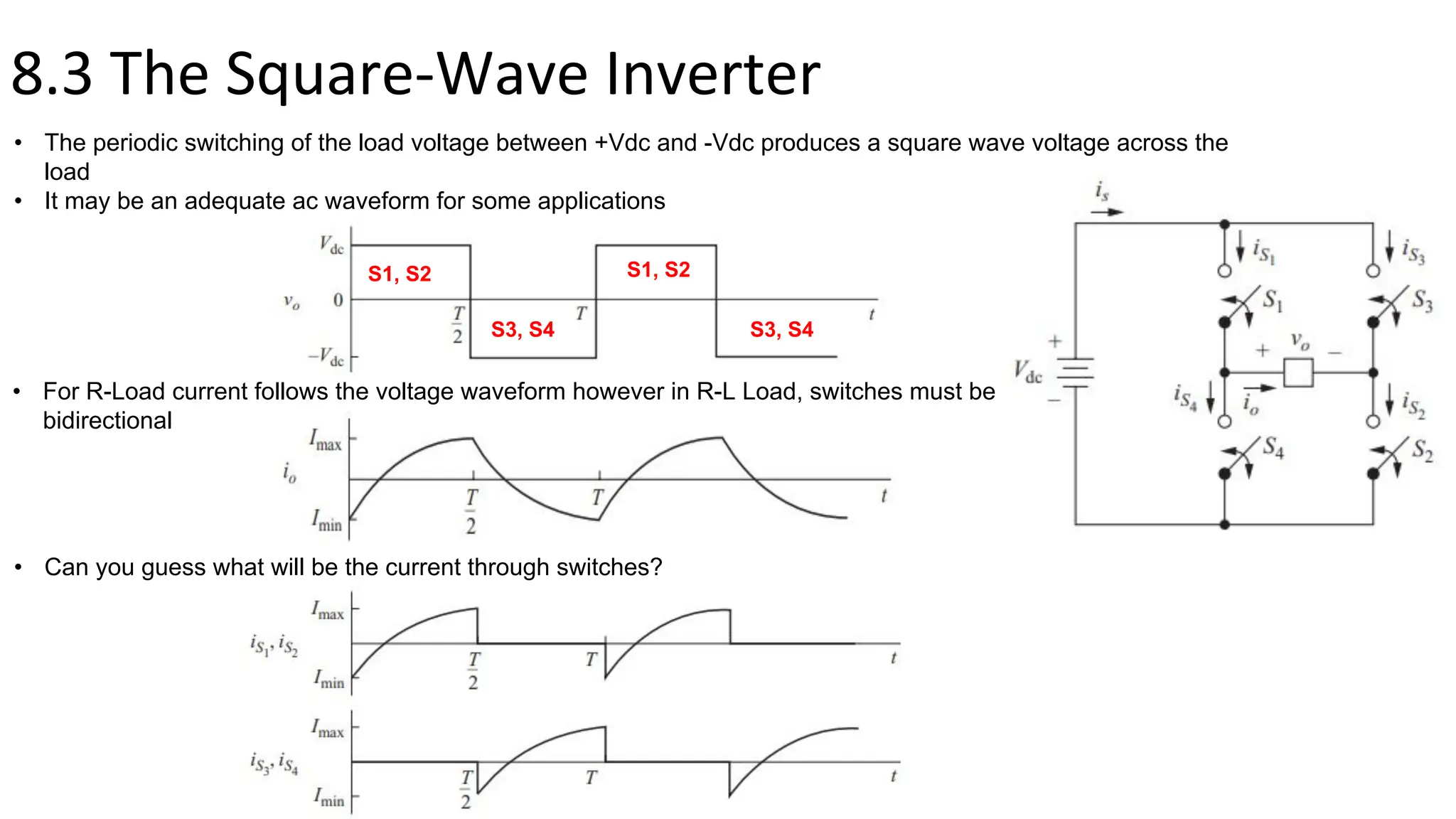
• The periodic switching of the load voltage between +Vdc and -Vdc produces a square wave voltage across the
load
• It may be an adequate ac waveform for some applications
• For R-Load current follows the voltage waveform however in R-L Load, switches must be
bidirectional
• Can you guess what will be the current through switches?
S1, S2
S3, S4
S1, S2
S3, S4
8.3 The Square-Wave Inverter
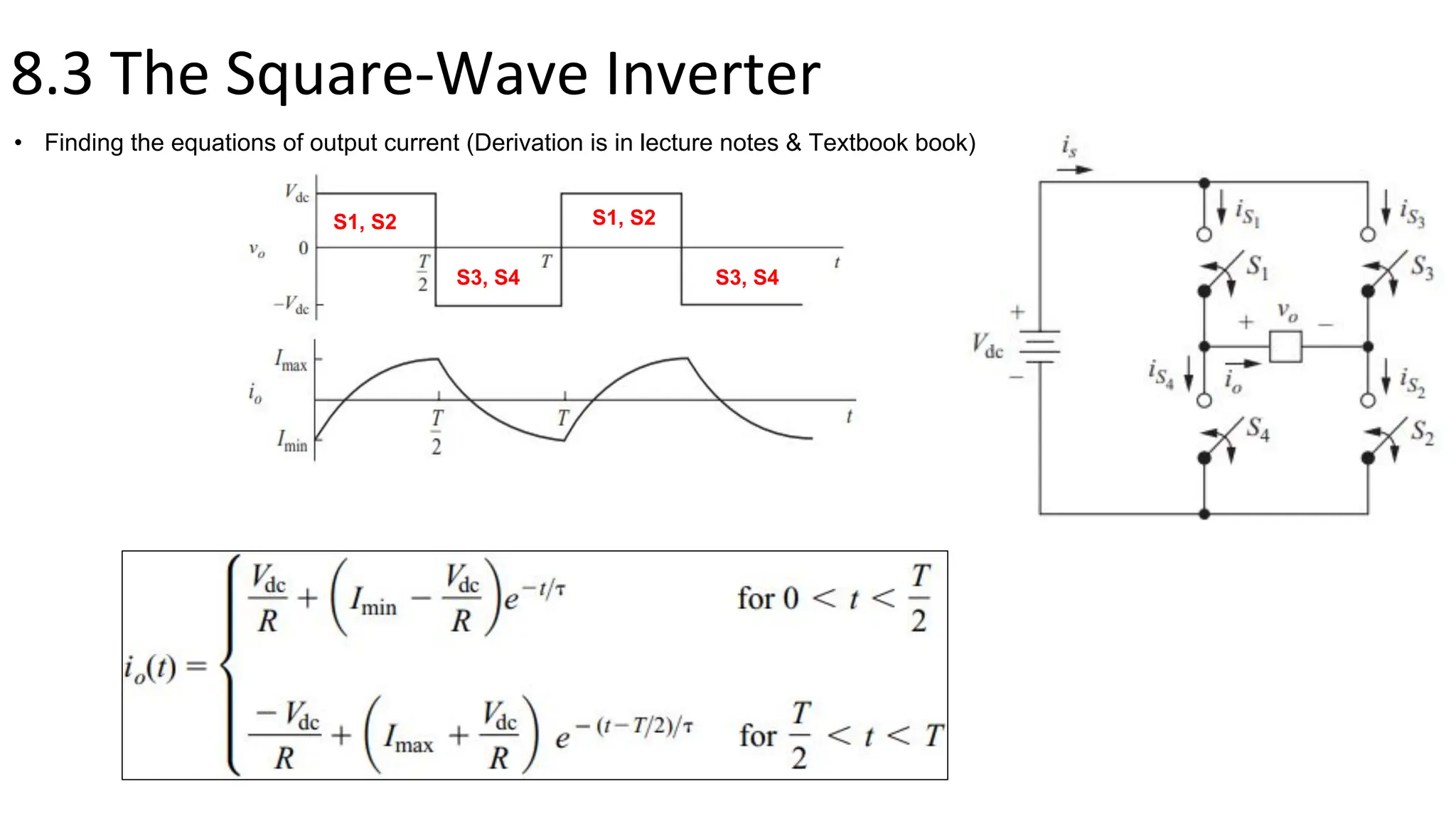
• Finding the equations of output current (Derivation is in lecture notes & Textbook book)
S1, S2
S3, S4
S1, S2
S3, S4
8.3 The Square-Wave Inverter
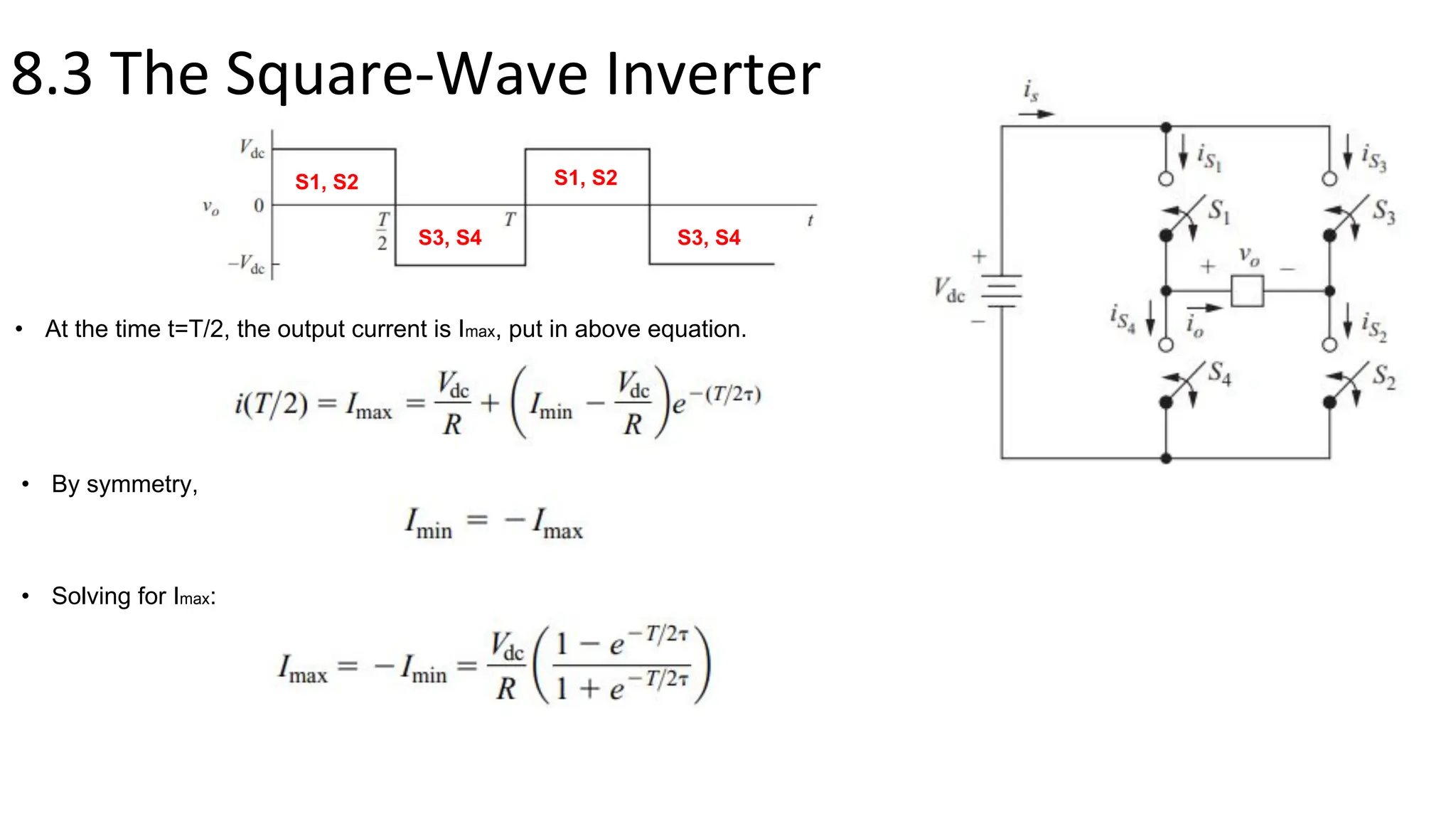
• At the time t=T/2, the output current is Imax, put in above equation.
S1, S2
S3, S4
S1, S2
S3, S4
• By symmetry,
• Solving for Imax:
8.3 The Square-Wave Inverter
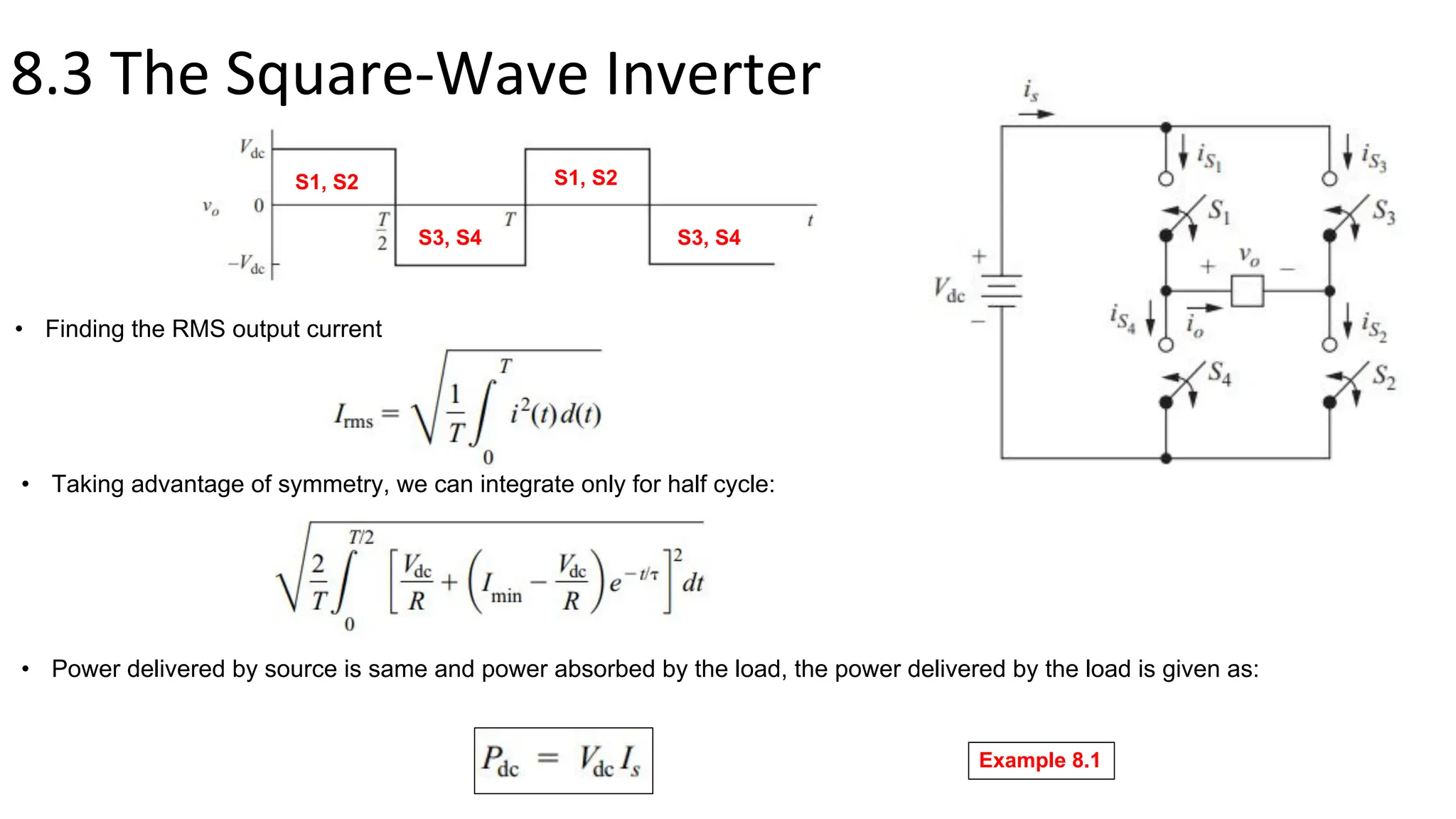
• Finding the RMS output current
S1, S2
S3, S4
S1, S2
S3, S4
• Taking advantage of symmetry, we can integrate only for half cycle:
• Power delivered by source is same and power absorbed by the load, the power delivered by the load is given as:
Example 8.1
8.3 The Square-Wave Inverter
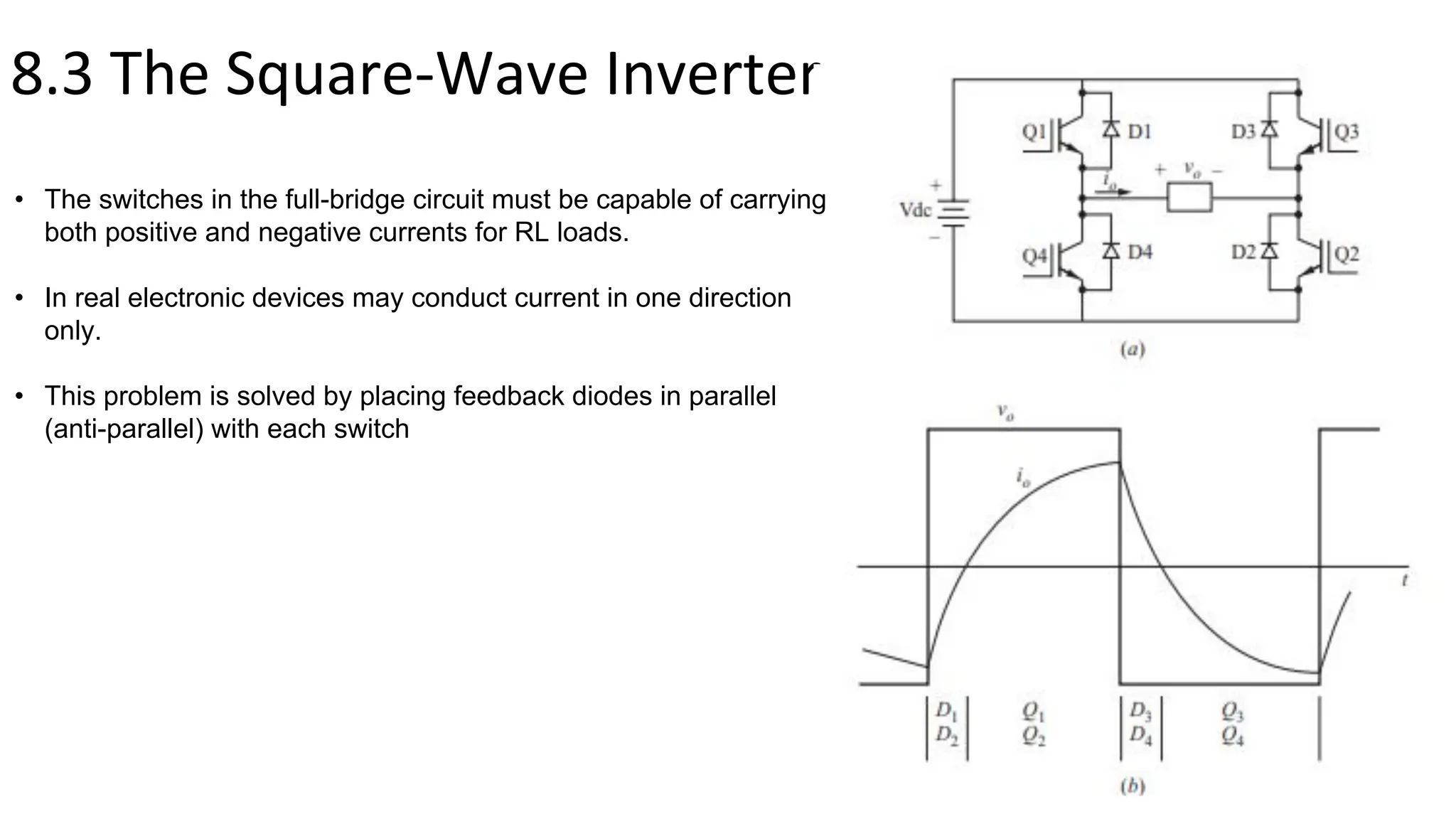
• The switches in the full-bridge circuit must be capable of carrying
both positive and negative currents for RL loads.
• In real electronic devices may conduct current in one direction
only.
• This problem is solved by placing feedback diodes in parallel
(anti-parallel) with each switch
8.4 Fourier Series Analysis
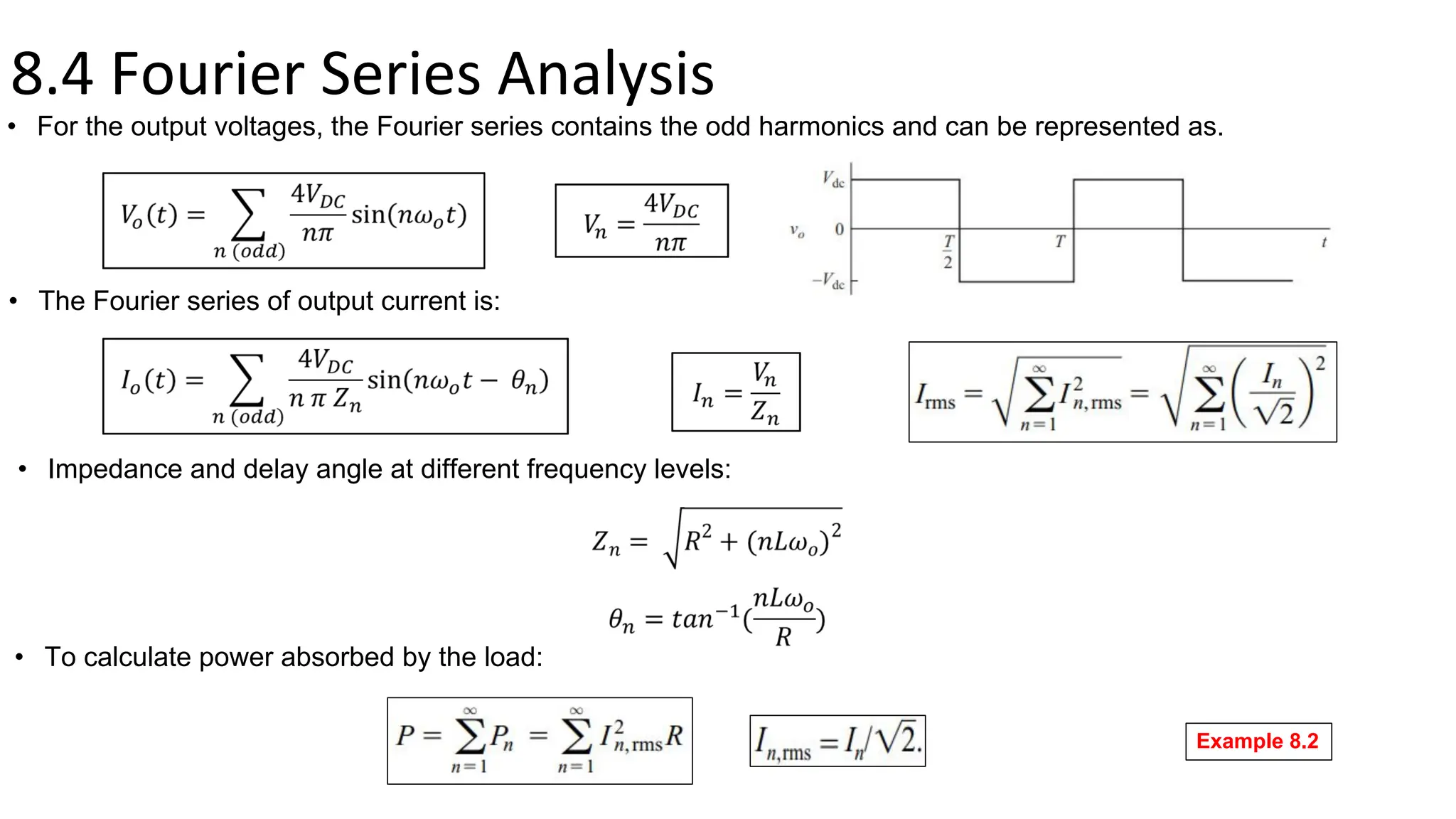
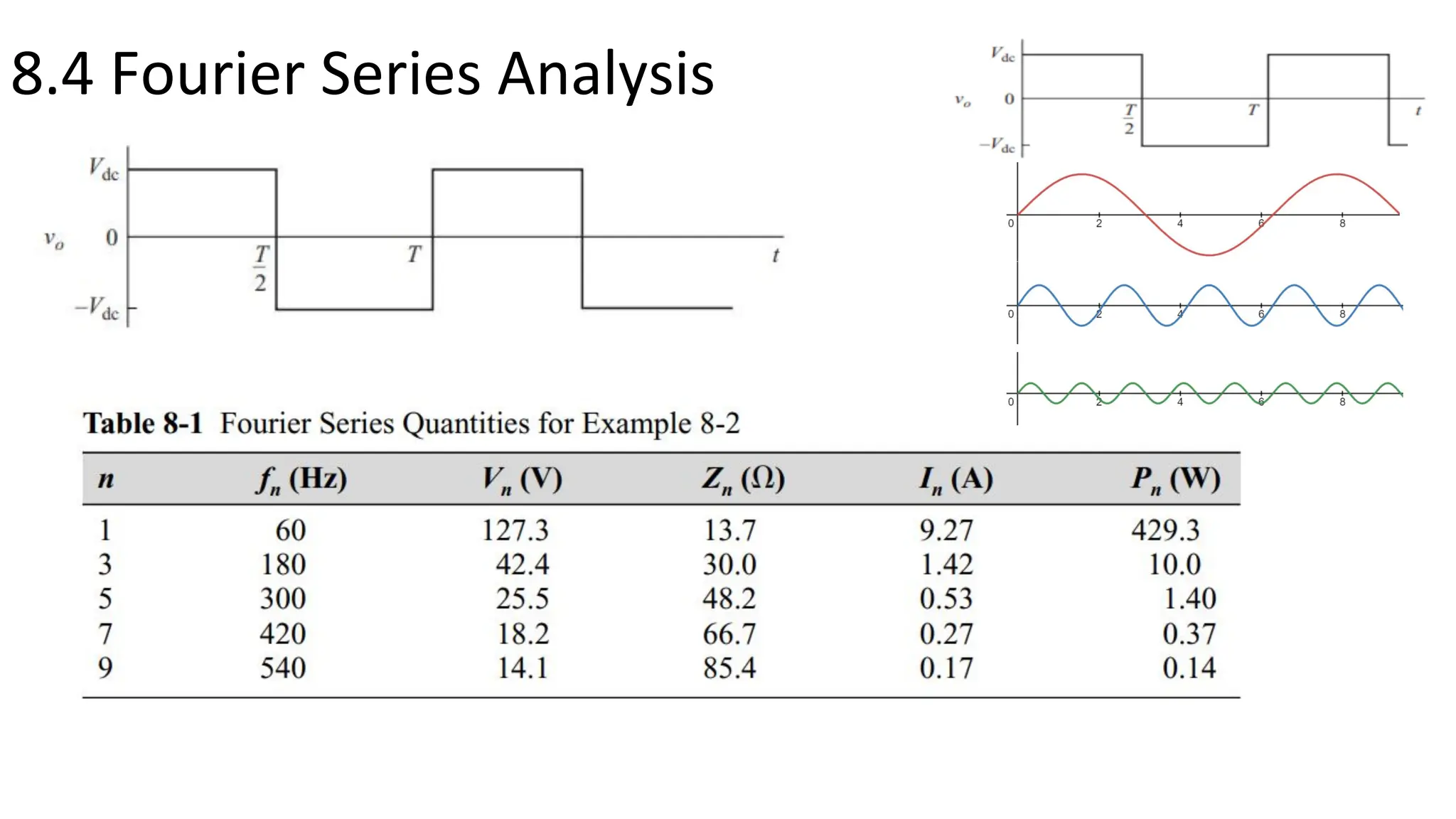
• For the output voltages, the Fourier series contains the odd harmonics and can be represented as.
• The Fourier series of output current is:
• Impedance and delay angle at different frequency levels:
• To calculate power absorbed by the load:
Example 8.2
8.4 Fourier Series Analysis
8.5 Total Harmonics Distortion
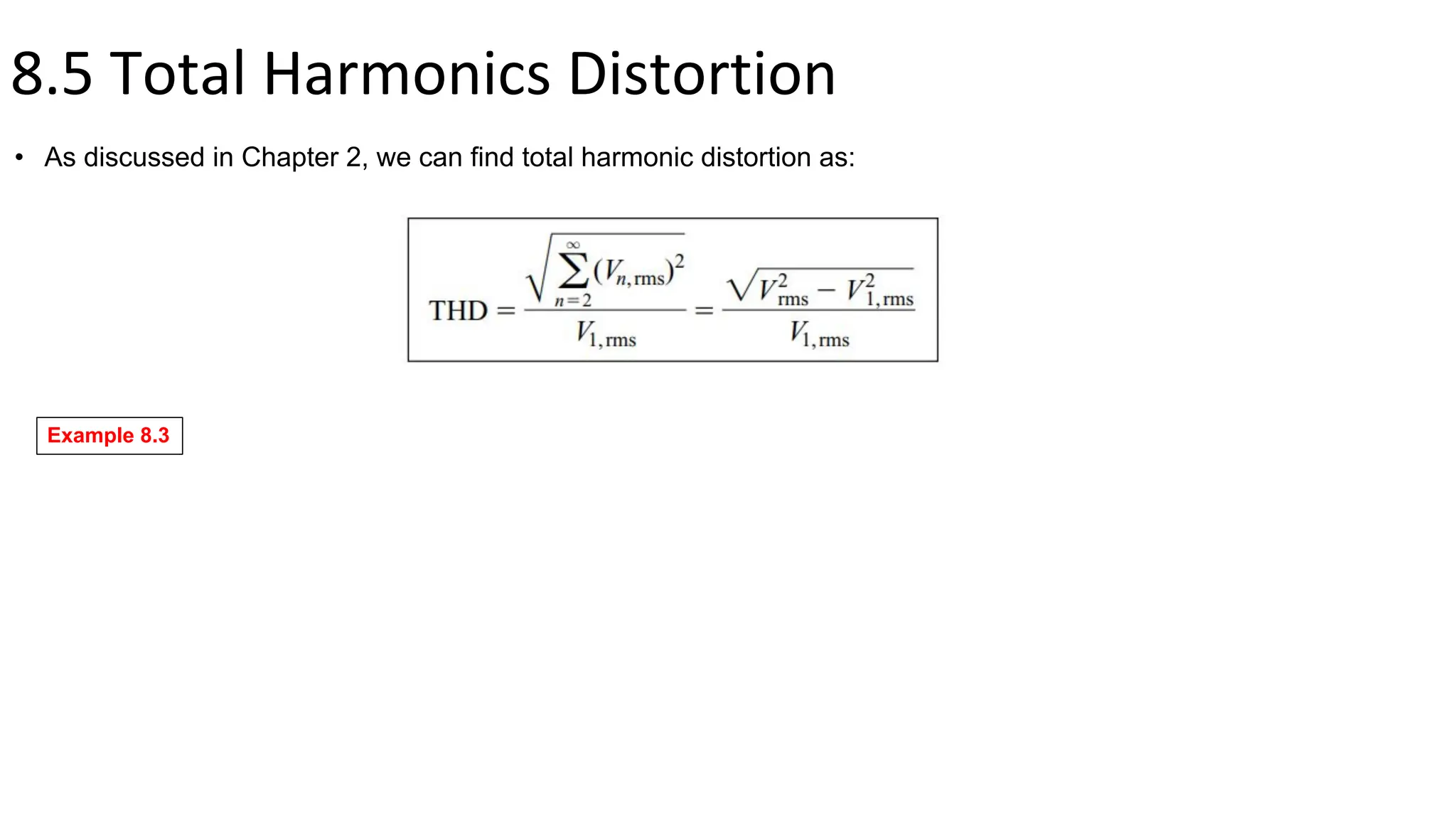
• As discussed in Chapter 2, we can find total harmonic distortion as:
Example 8.3
8.7 Amplitude and Harmonic
Control
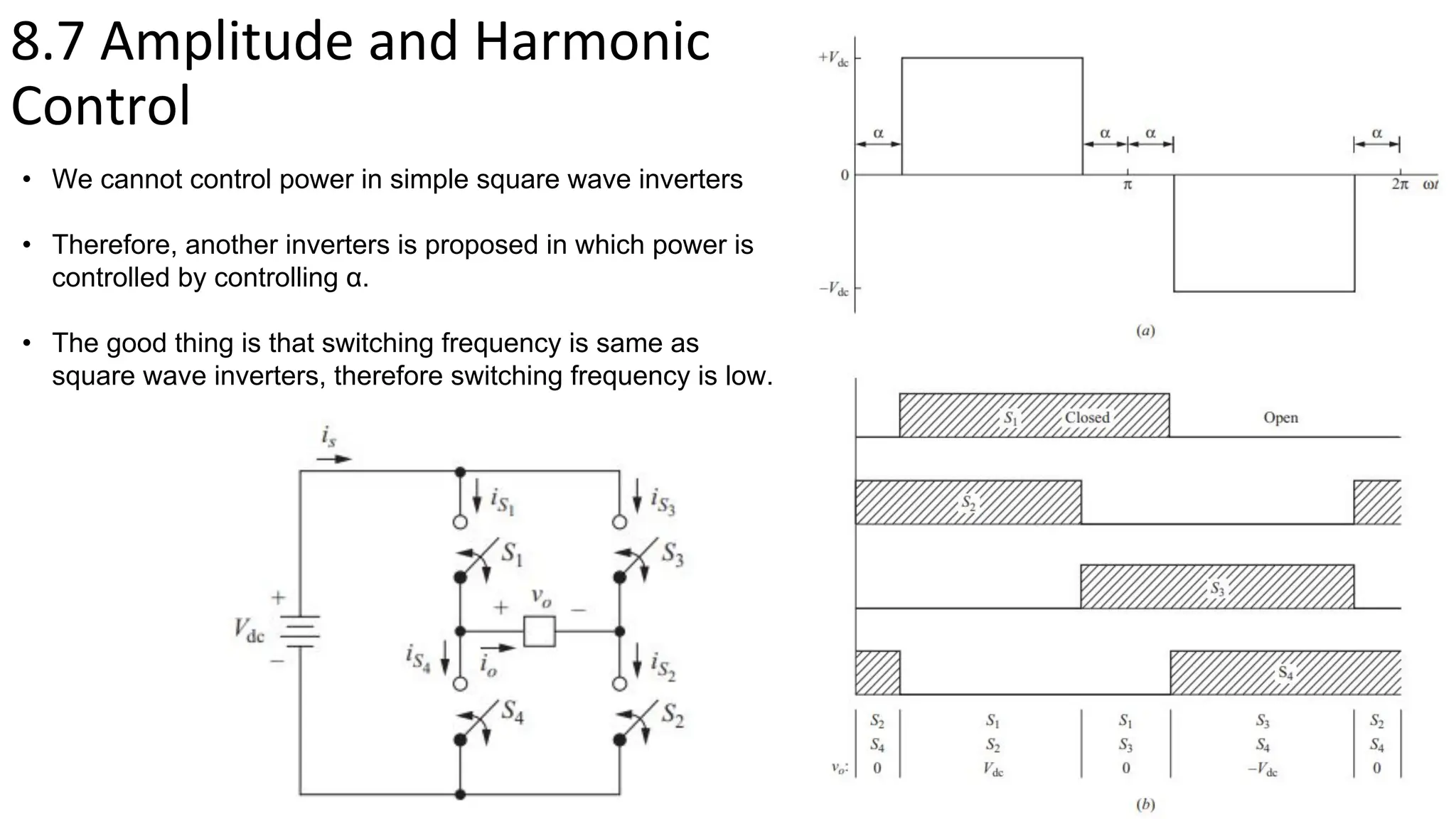
• We cannot control power in simple square wave inverters
• Therefore, another inverters is proposed in which power is
controlled by controlling α.
• The good thing is that switching frequency is same as
square wave inverters, therefore switching frequency is low.
8.7 Amplitude and Harmonic
Control
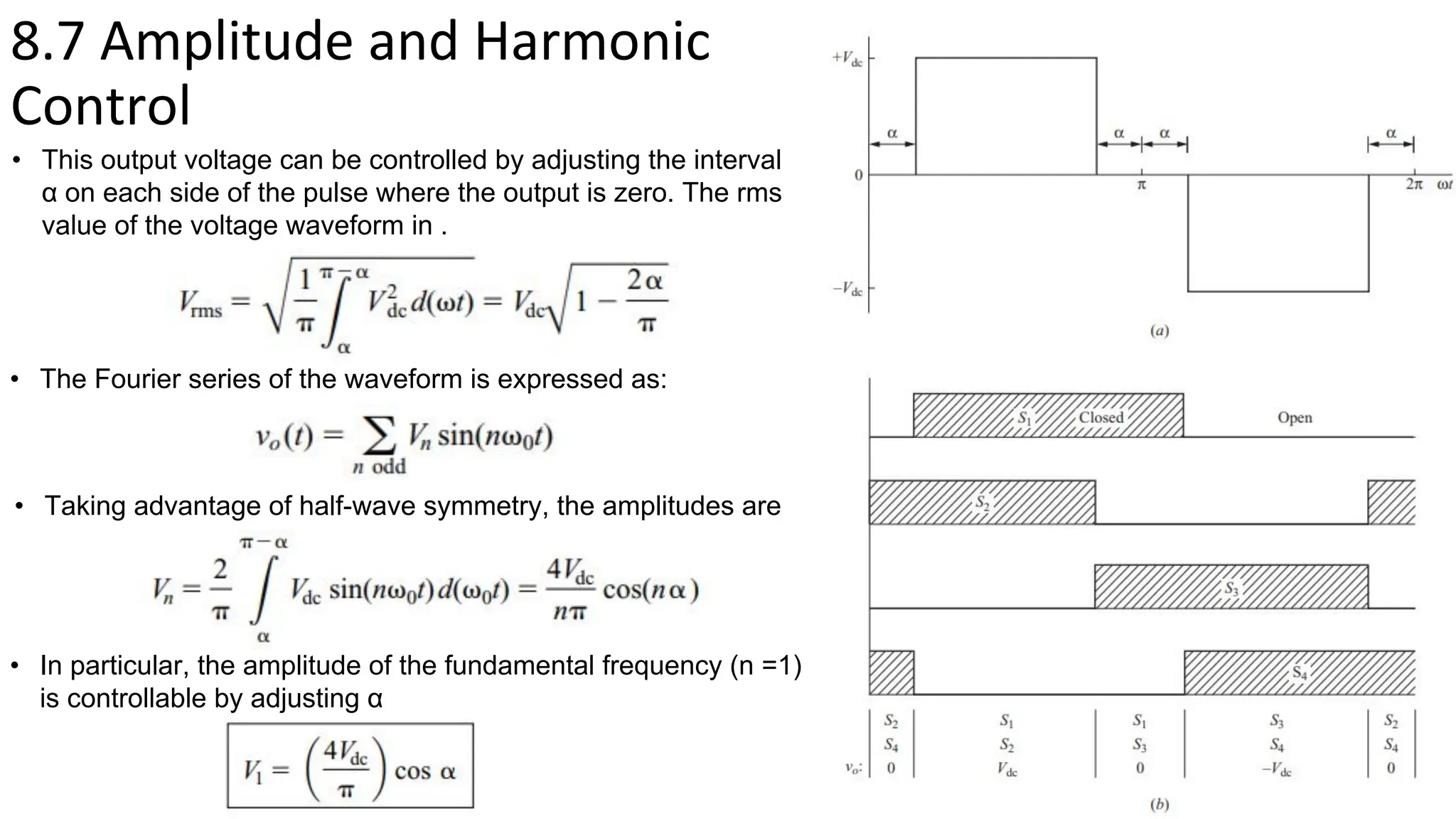
• This output voltage can be controlled by adjusting the interval
α on each side of the pulse where the output is zero. The rms
value of the voltage waveform in .
• The Fourier series of the waveform is expressed as:
• Taking advantage of half-wave symmetry, the amplitudes are
• In particular, the amplitude of the fundamental frequency (n =1)
is controllable by adjusting α
8.7 Amplitude and Harmonic
Control
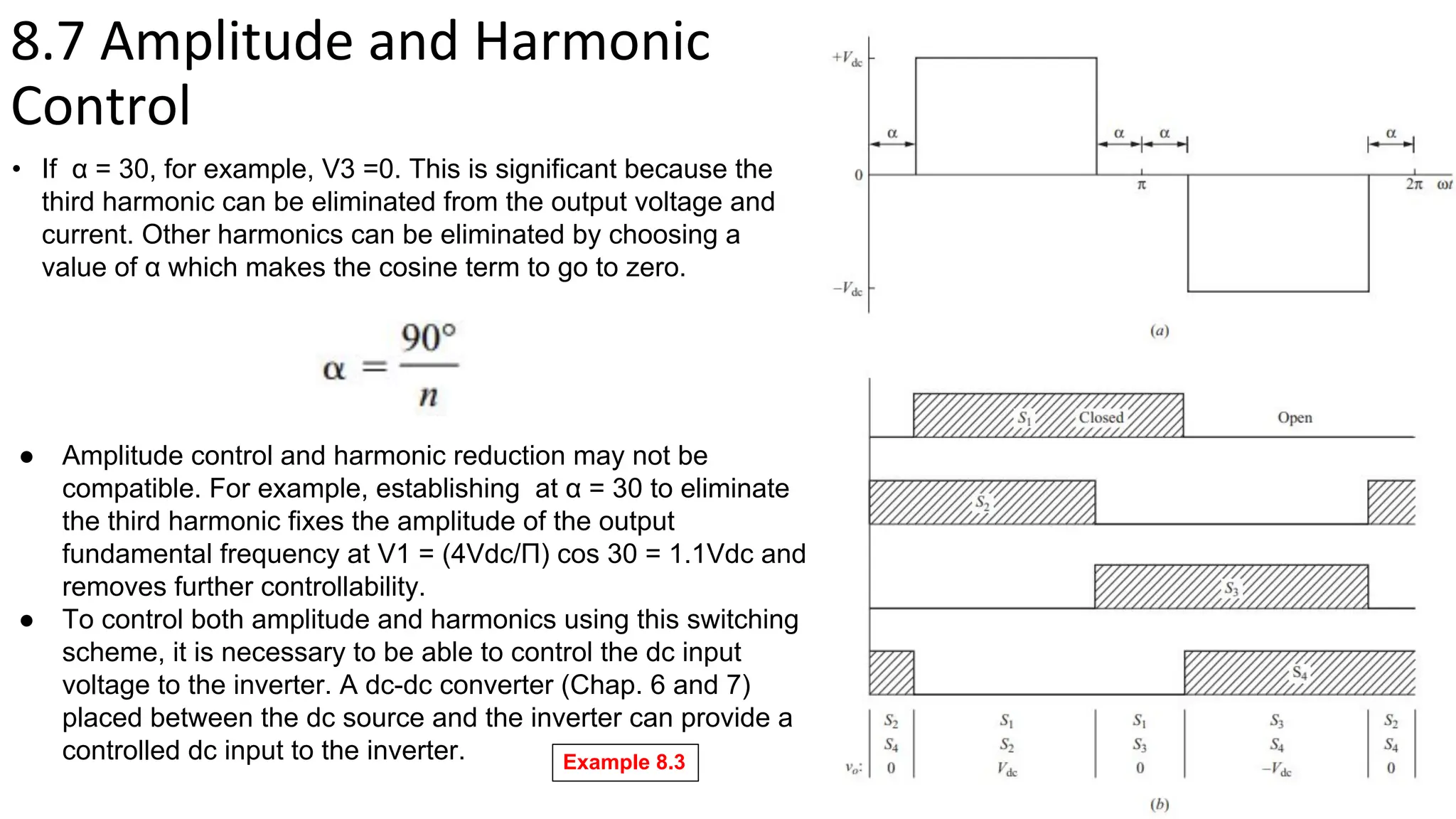
• If α = 30, for example, V3 =0. This is significant because the
third harmonic can be eliminated from the output voltage and
current. Other harmonics can be eliminated by choosing a
value of α which makes the cosine term to go to zero.
● Amplitude control and harmonic reduction may not be
compatible. For example, establishing at α = 30 to eliminate
the third harmonic fixes the amplitude of the output
fundamental frequency at V1 = (4Vdc/Π) cos 30 = 1.1Vdc and
removes further controllability.
● To control both amplitude and harmonics using this switching
scheme, it is necessary to be able to control the dc input
voltage to the inverter. A dc-dc converter (Chap. 6 and 7)
placed between the dc source and the inverter can provide a
controlled dc input to the inverter. Example 8.3
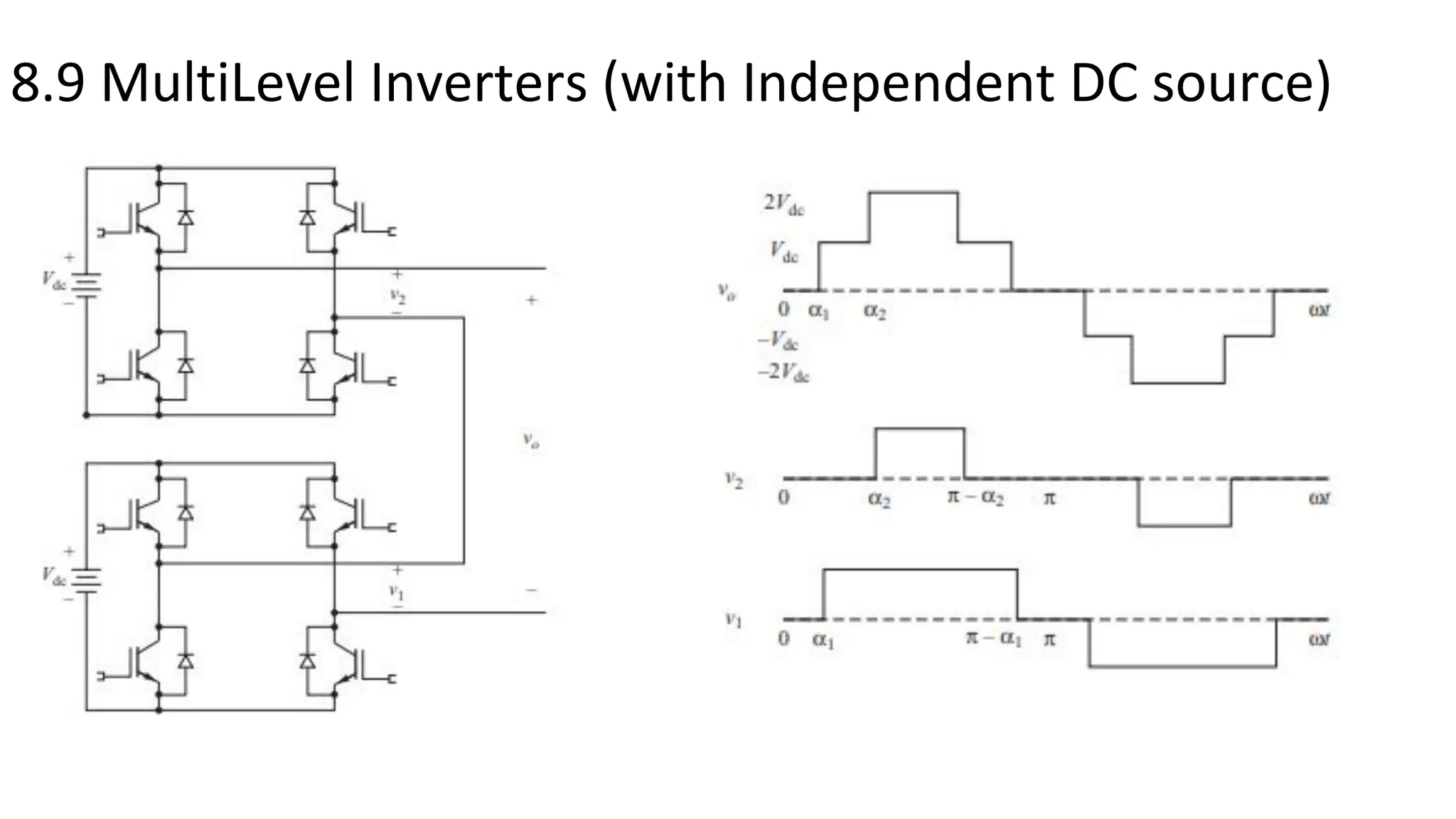
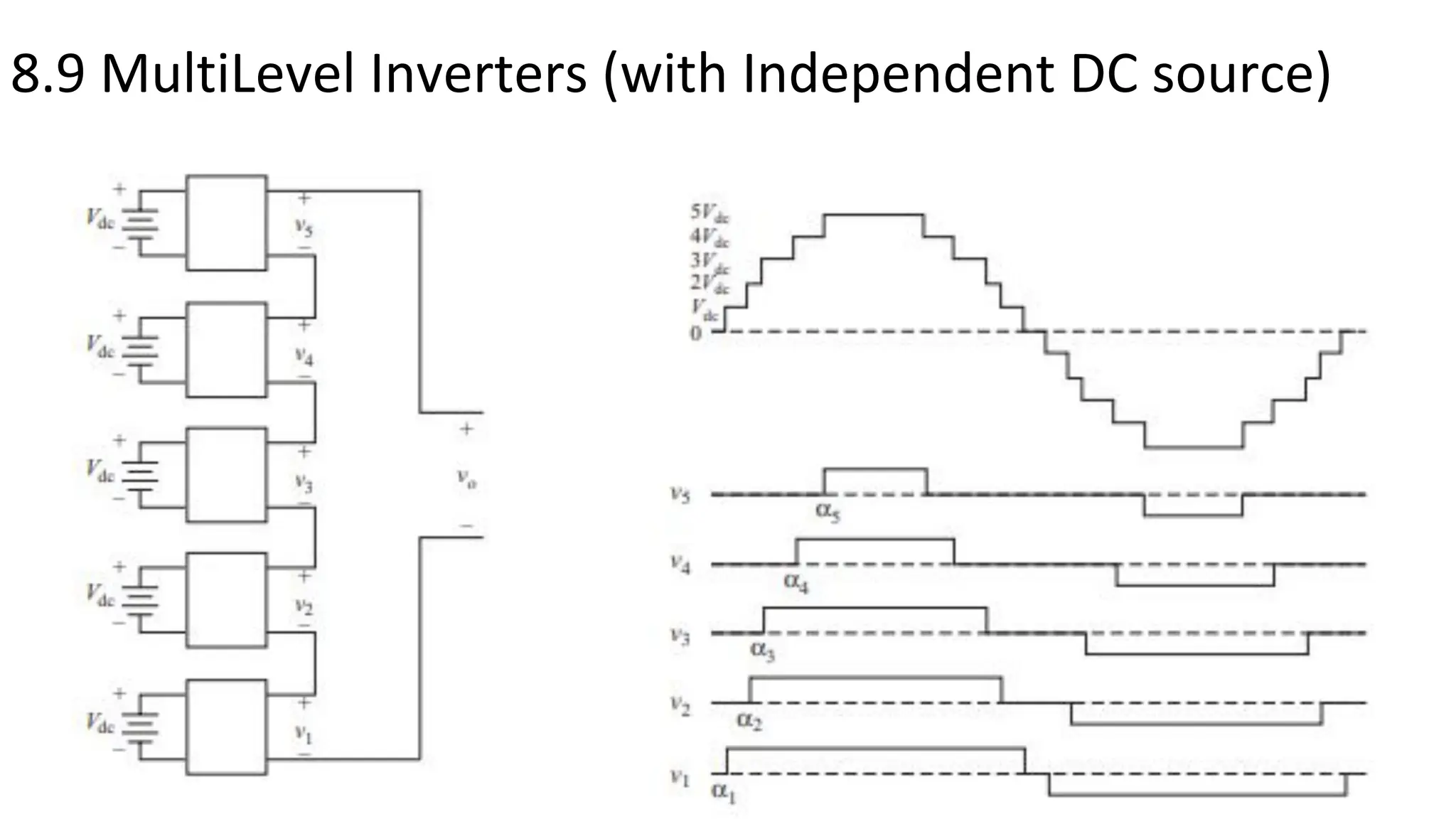
8.9 MultiLevel Inverters (with Independent DC source)
8.10 PULSE-WIDTH-MODULATED OUTPUT
Advantages:
• Pulse-width modulation (PWM) provides a way to decrease the total harmonic distortion of load current
• Generally meet THD requirements more easily than the square wave switching scheme
• The unfiltered PWM output will have a relatively high THD, but the harmonics will be at much higher
frequencies than for a square wave, making filtering easier
Dis-advantages:
• More complex control circuits for the switches and increased losses due to more frequent switching
• High switching losses.
8.10 PULSE-WIDTH-MODULATED OUTPUT
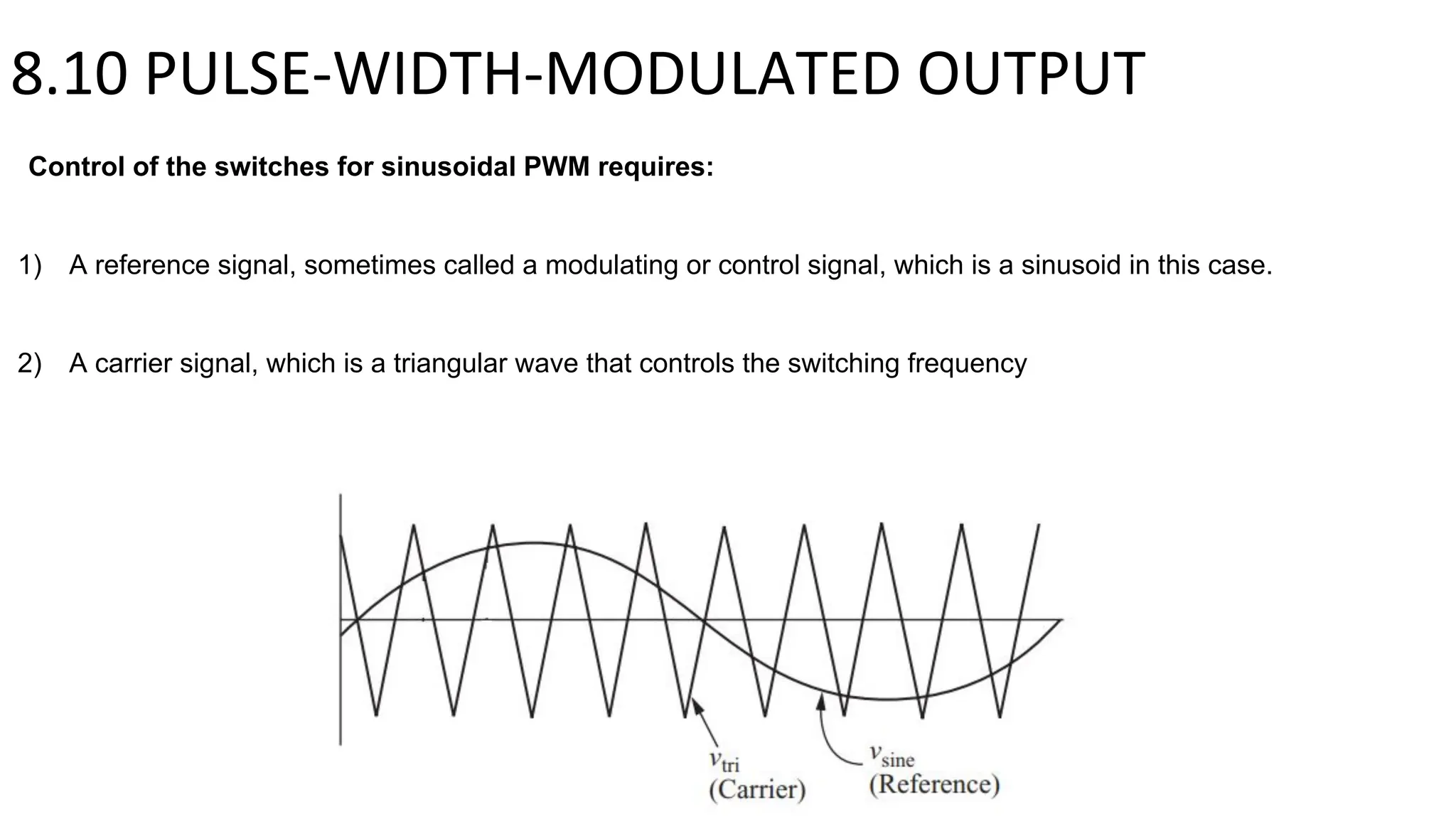
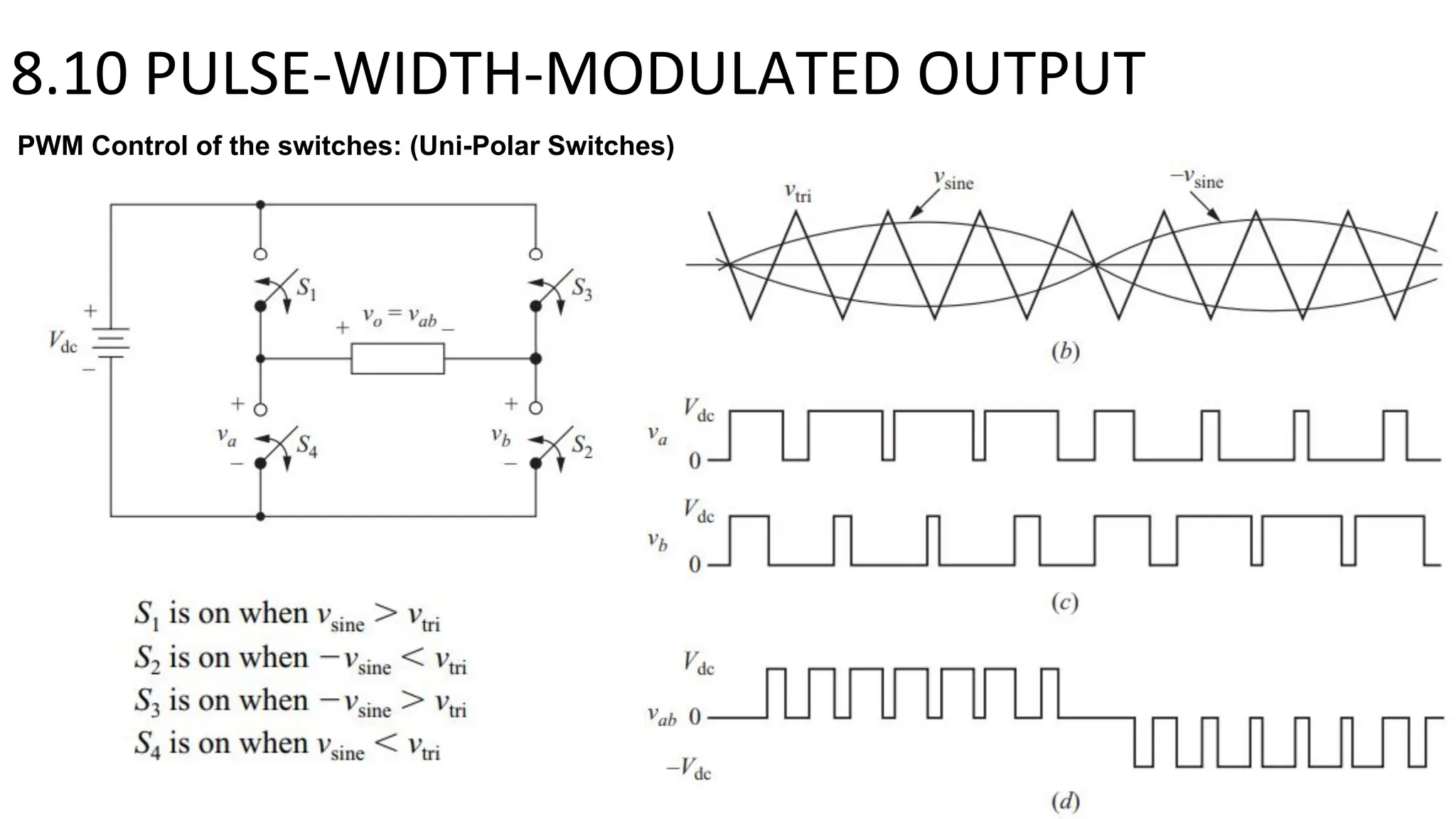
Control of the switches for sinusoidal PWM requires:
1) A reference signal, sometimes called a modulating or control signal, which is a sinusoid in this case.
2) A carrier signal, which is a triangular wave that controls the switching frequency
8.10 PULSE-WIDTH-MODULATED OUTPUT
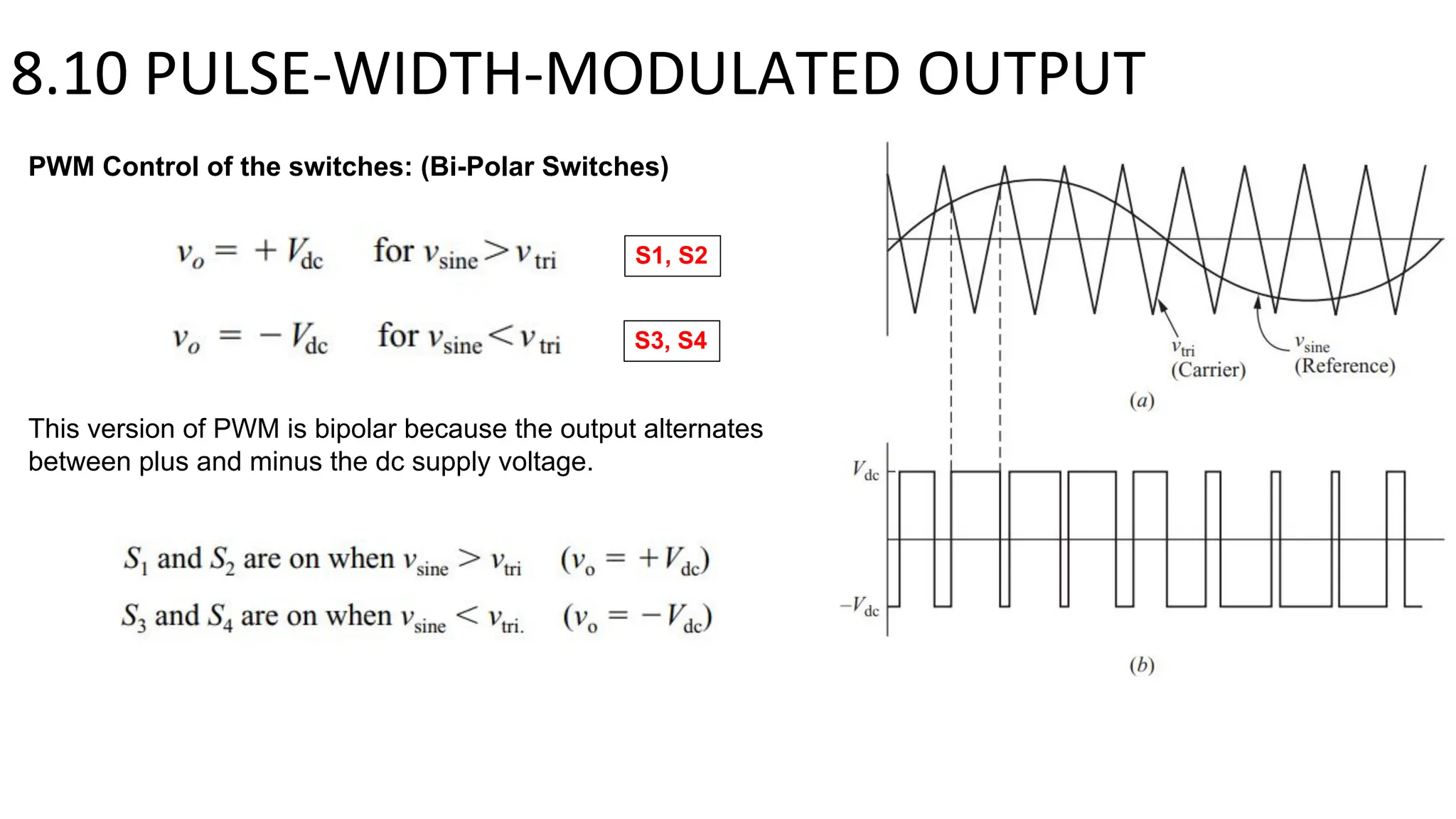
PWM Control of the switches: (Bi-Polar Switches)
This version of PWM is bipolar because the output alternates
between plus and minus the dc supply voltage.
S1, S2
S3, S4
8.10 PULSE-WIDTH-MODULATED OUTPUT
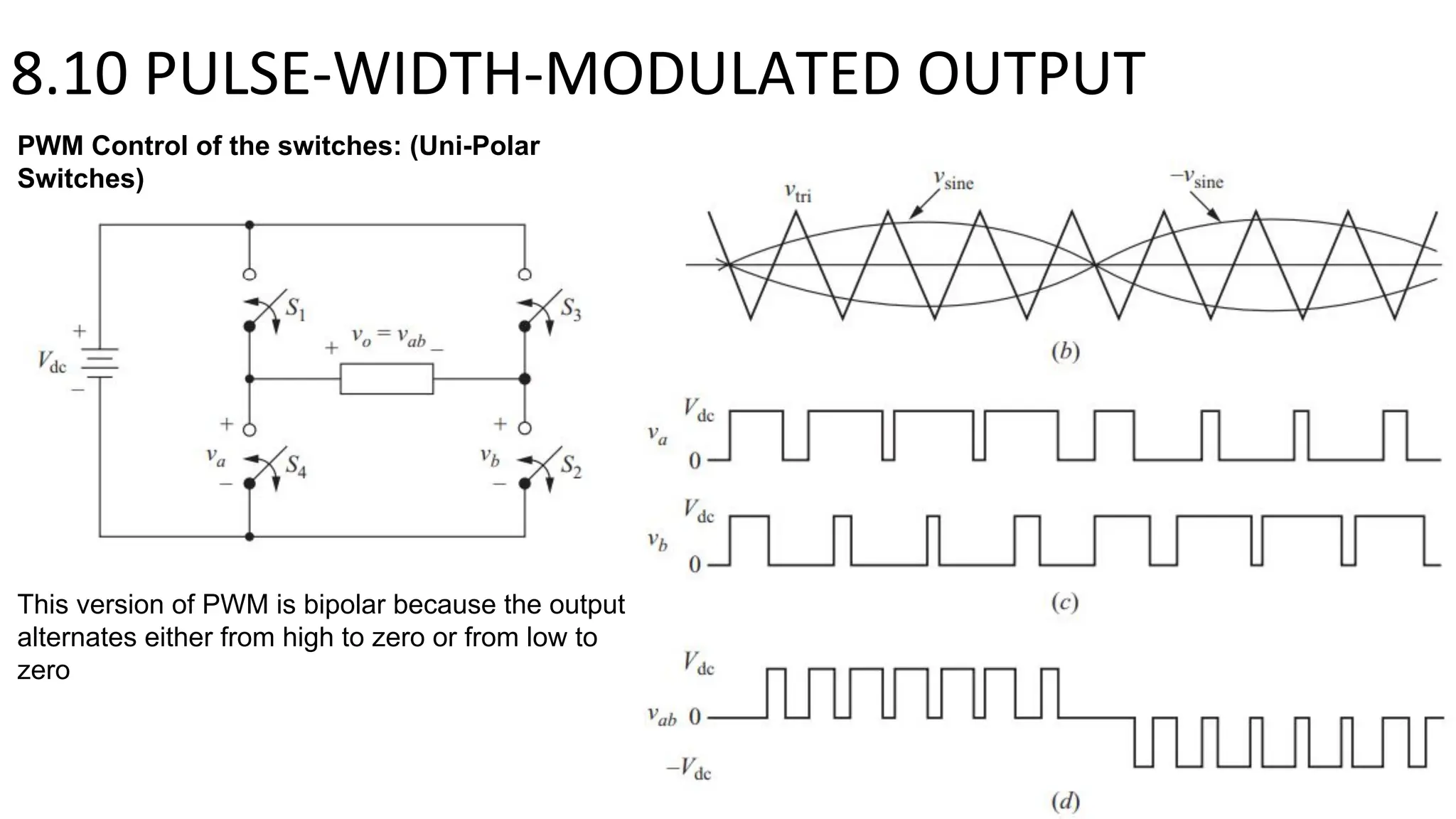
PWM Control of the switches: (Uni-Polar
Switches)
This version of PWM is bipolar because the output
alternates either from high to zero or from low to
zero
8.10 PULSE-WIDTH-MODULATED OUTPUT
PWM Control of the switches: (Uni-Polar Switches)
8.11 PWM DEFINITION AND CONSIDERATION
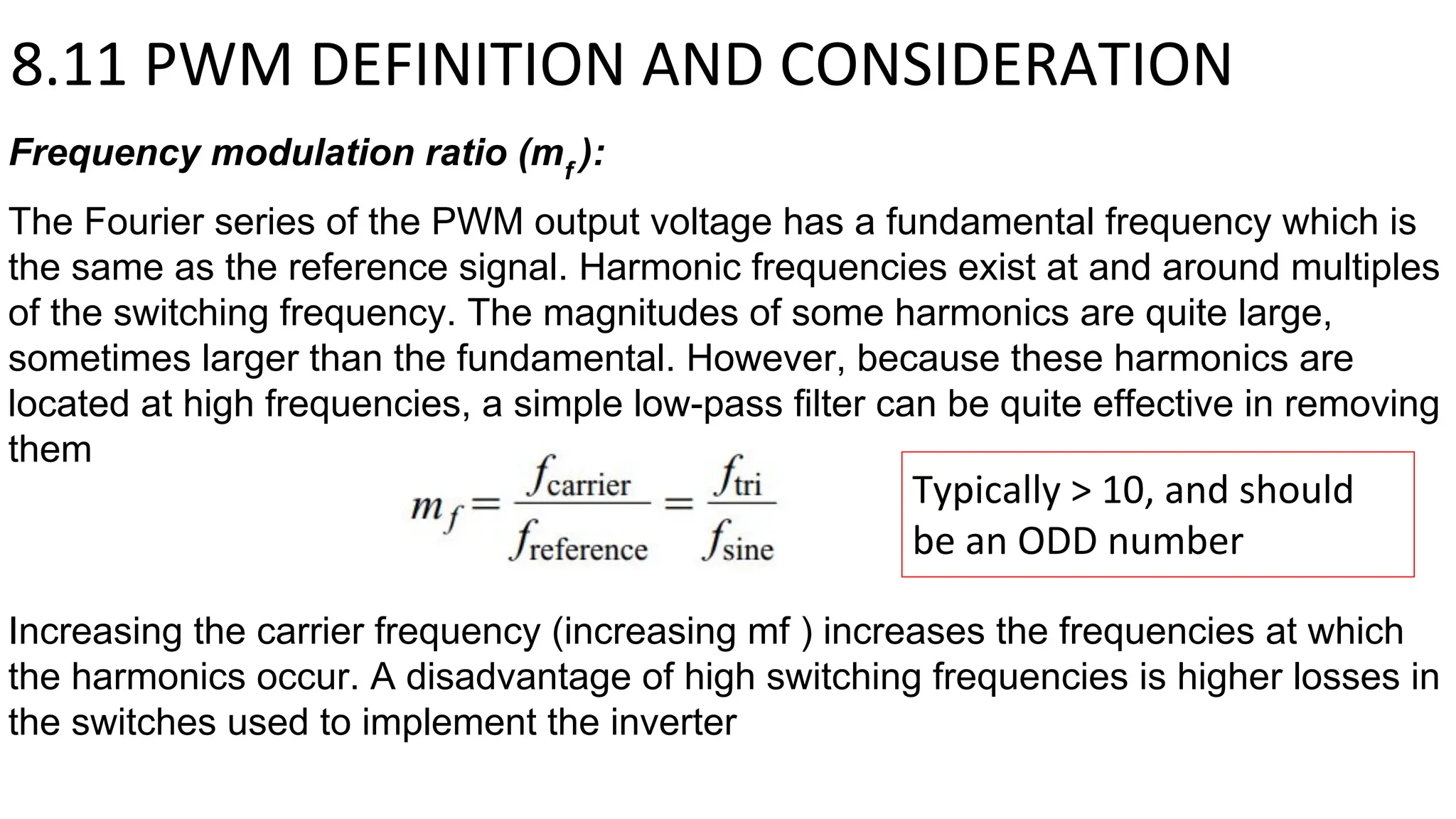
Frequency modulation ratio (mf
):
The Fourier series of the PWM output voltage has a fundamental frequency which is
the same as the reference signal. Harmonic frequencies exist at and around multiples
of the switching frequency. The magnitudes of some harmonics are quite large,
sometimes larger than the fundamental. However, because these harmonics are
located at high frequencies, a simple low-pass filter can be quite effective in removing
them
Increasing the carrier frequency (increasing mf ) increases the frequencies at which
the harmonics occur. A disadvantage of high switching frequencies is higher losses in
the switches used to implement the inverter
Typically > 10, and should
be an ODD number
8.11 PWM DEFINITION AND CONSIDERATION
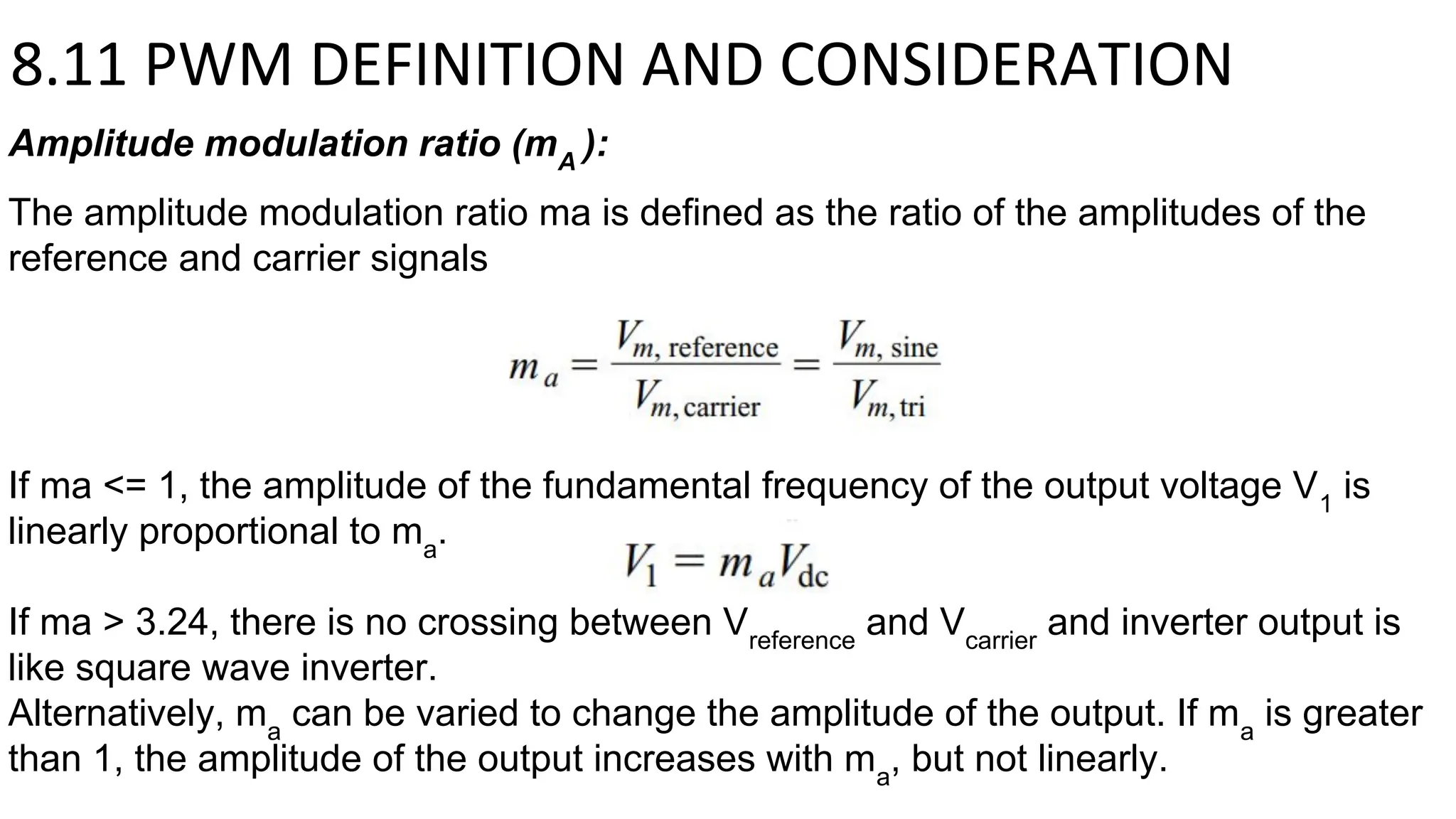
Amplitude modulation ratio (mA
):
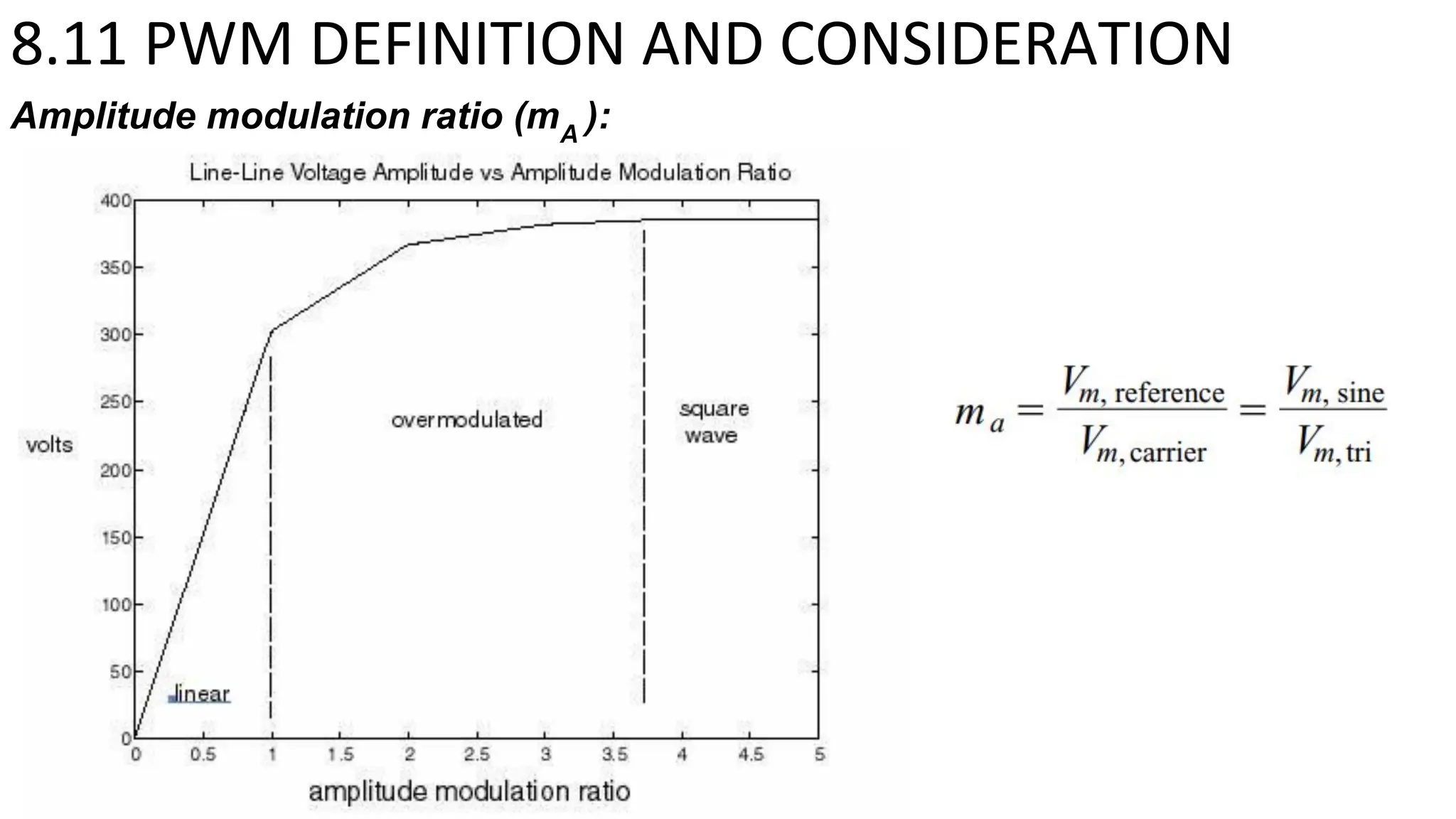
The amplitude modulation ratio ma is defined as the ratio of the amplitudes of the
reference and carrier signals
If ma <= 1, the amplitude of the fundamental frequency of the output voltage V1
is
linearly proportional to ma
.
If ma > 3.24, there is no crossing between Vreference
and Vcarrier
and inverter output is
like square wave inverter.
Alternatively, ma
can be varied to change the amplitude of the output. If ma
is greater
than 1, the amplitude of the output increases with ma
, but not linearly.
8.11 PWM DEFINITION AND CONSIDERATION
Amplitude modulation ratio (mA
):
Switches:
The switches in the full-bridge circuit must be capable of carrying current in either
direction for pulse-width modulation just as they did for square wave operation.
Reference Voltage:
The sinusoidal reference voltage must be generated within the control circuit of the
inverter or taken from an outside reference.
8.11 PWM DEFINITION AND CONSIDERATION
Bipolar Switching:
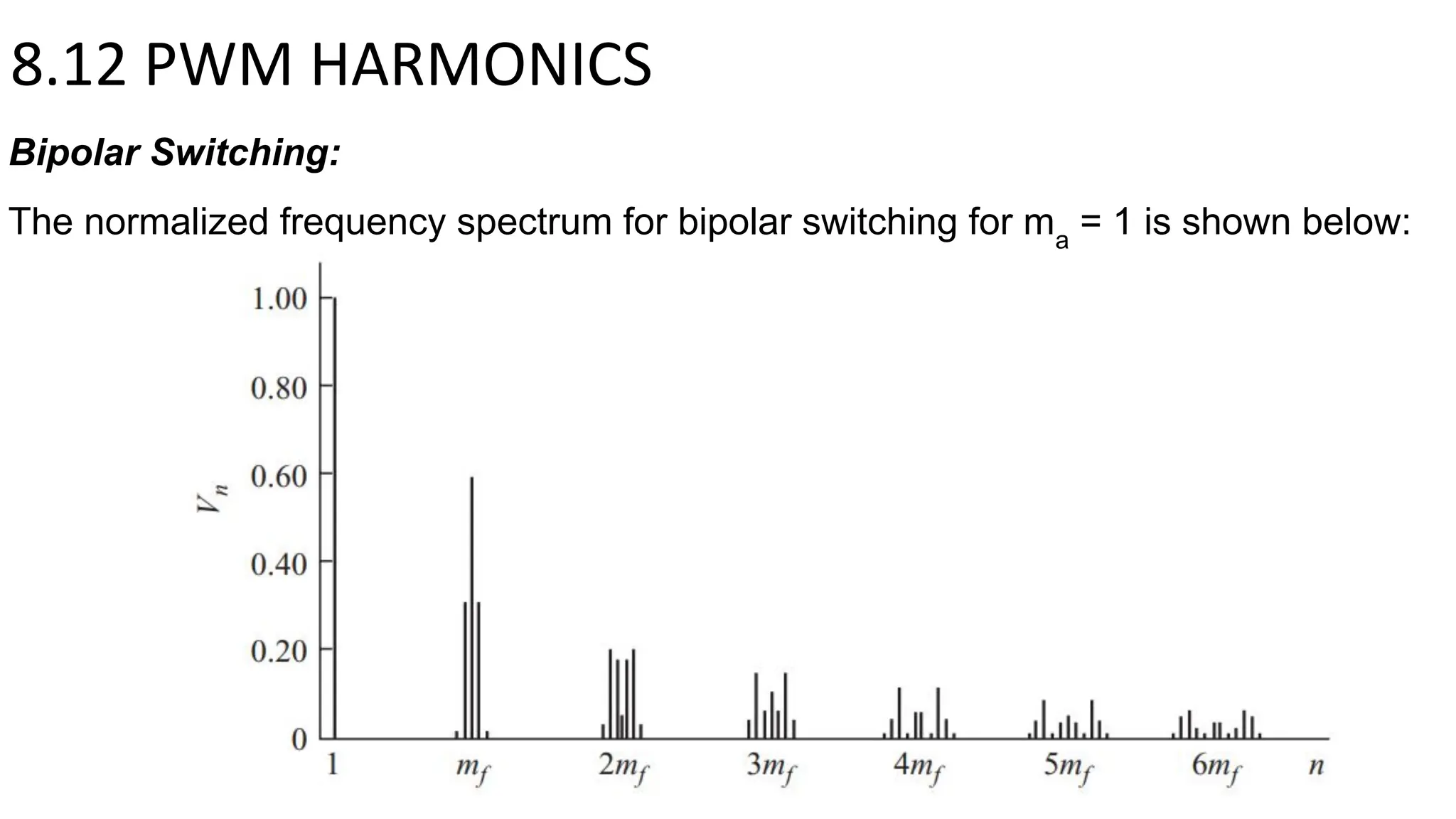
The normalized frequency spectrum for bipolar switching for ma
= 1 is shown below:
8.12 PWM HARMONICS
Bipolar Switching:
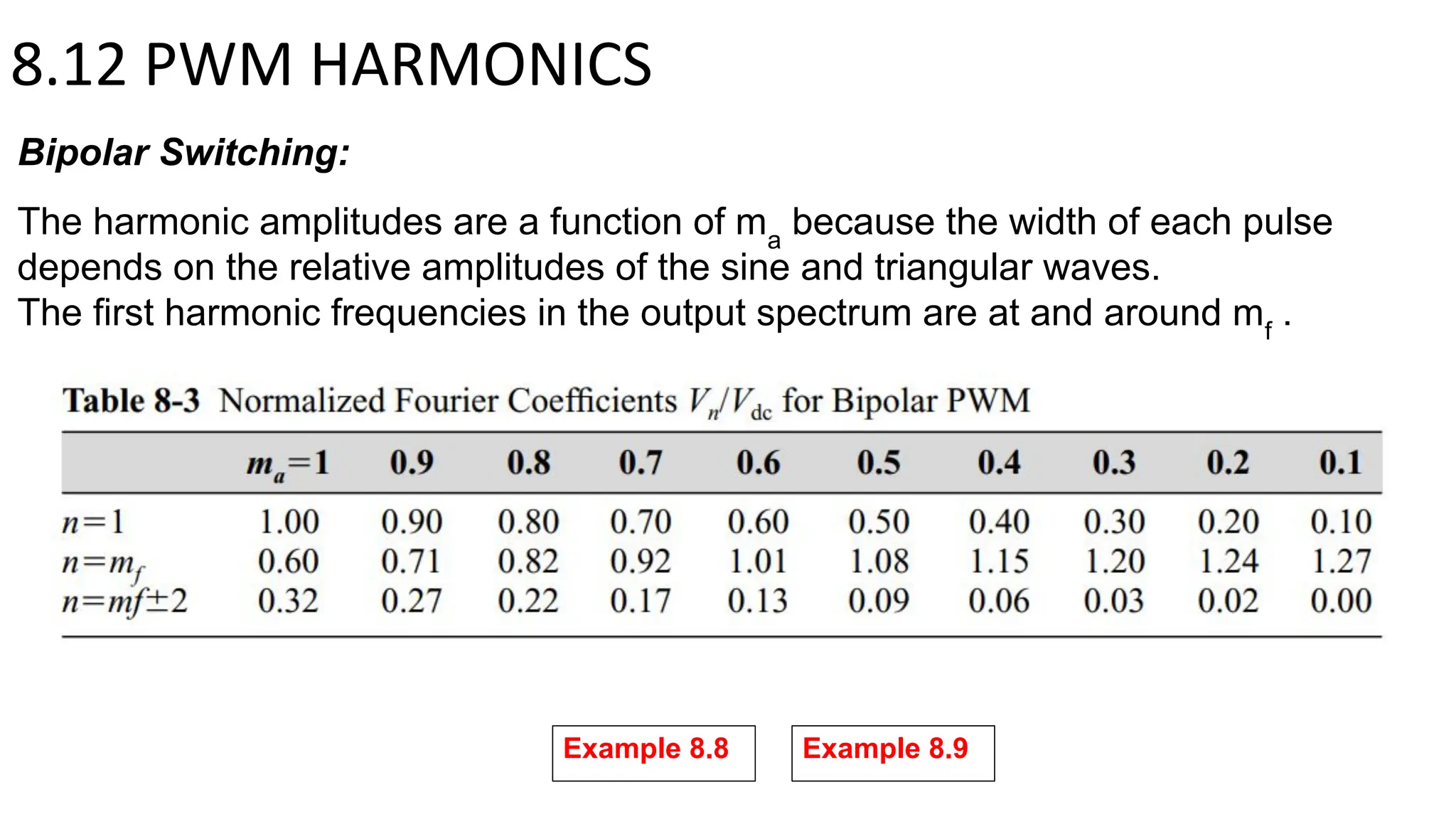
The harmonic amplitudes are a function of ma
because the width of each pulse
depends on the relative amplitudes of the sine and triangular waves.
The first harmonic frequencies in the output spectrum are at and around mf
.
8.12 PWM HARMONICS
Example 8.8 Example 8.9
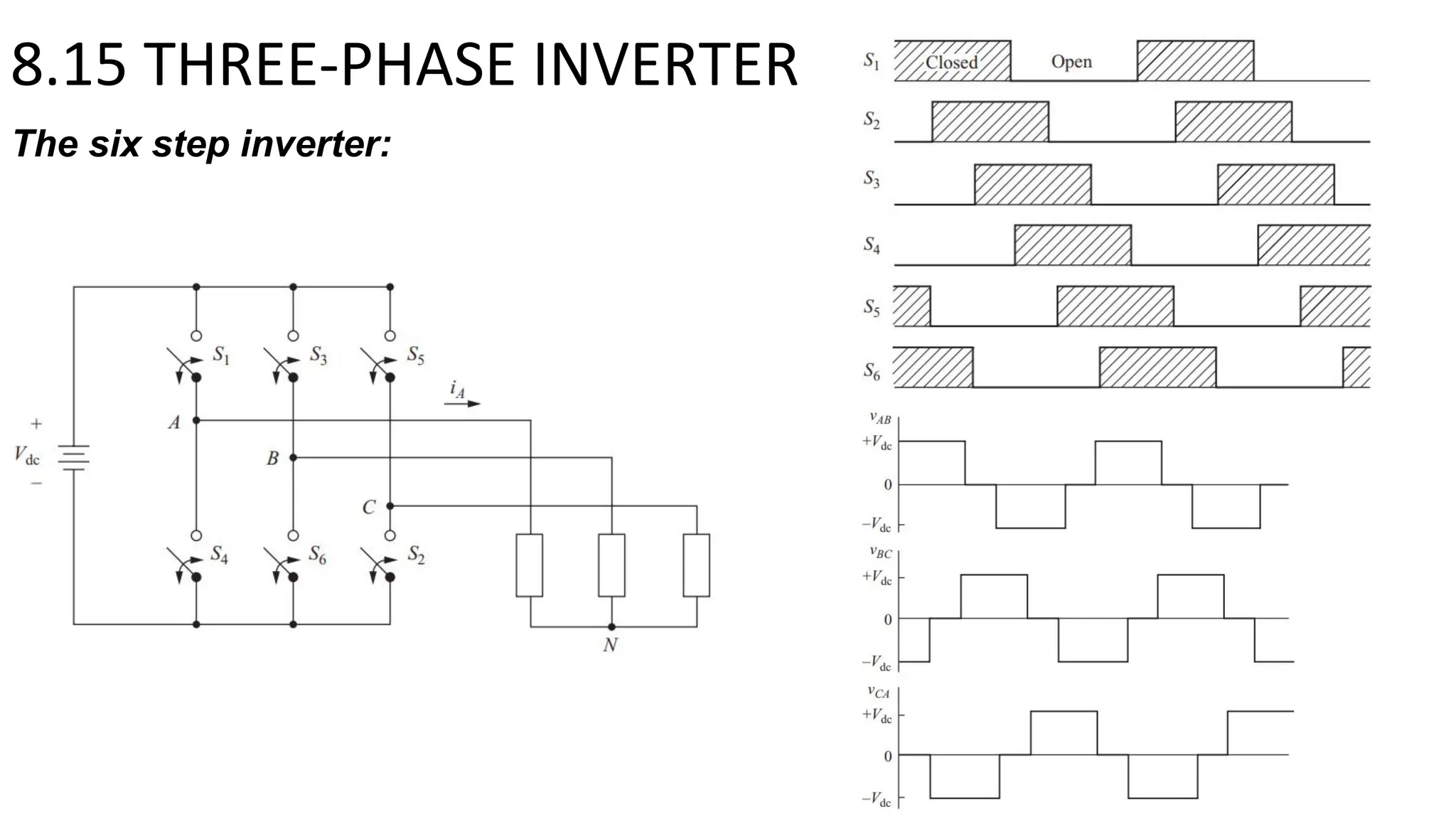
The six step inverter:
8.15 THREE-PHASE INVERTER
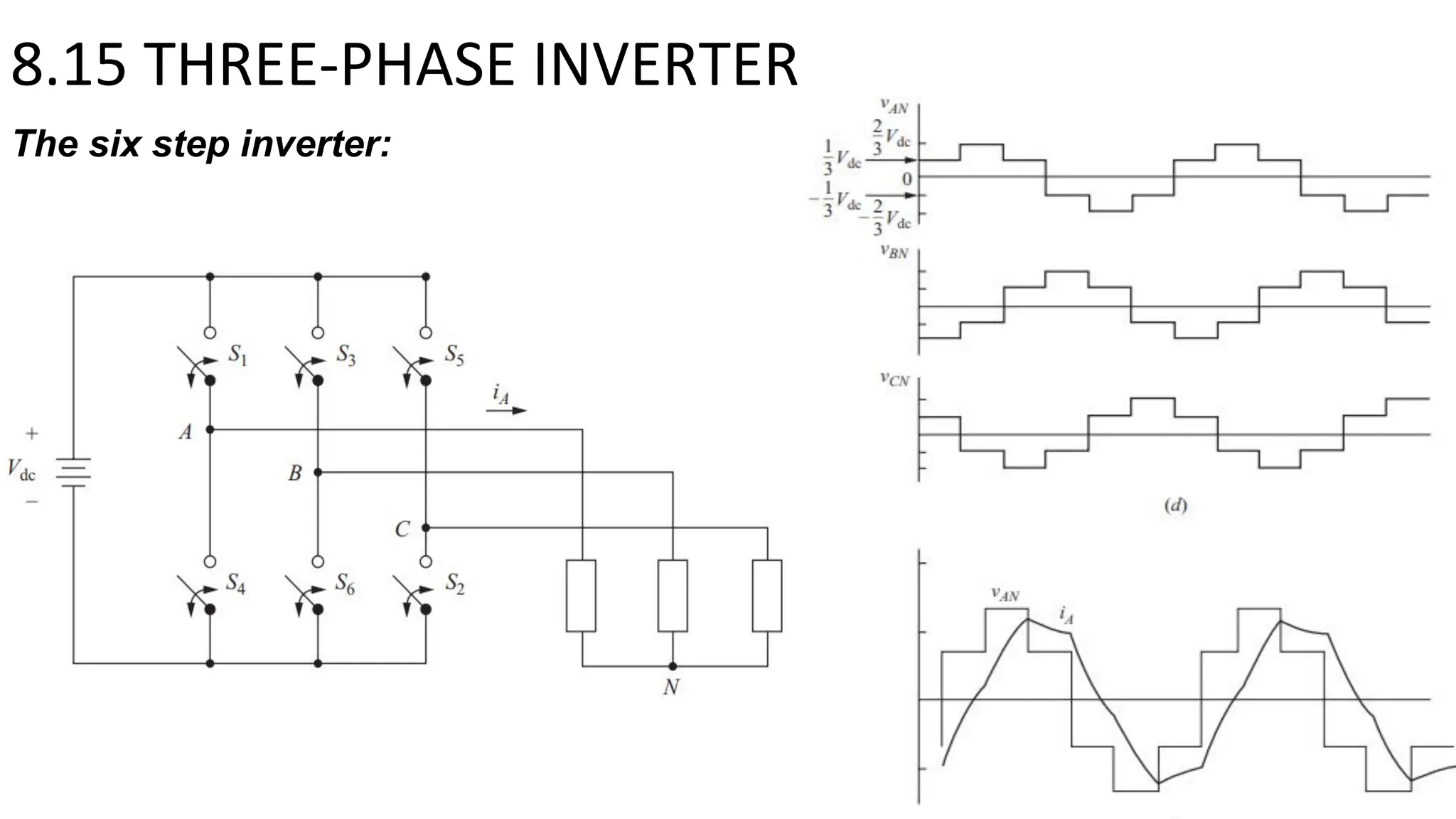
The six step inverter:
8.15 THREE-PHASE INVERTER
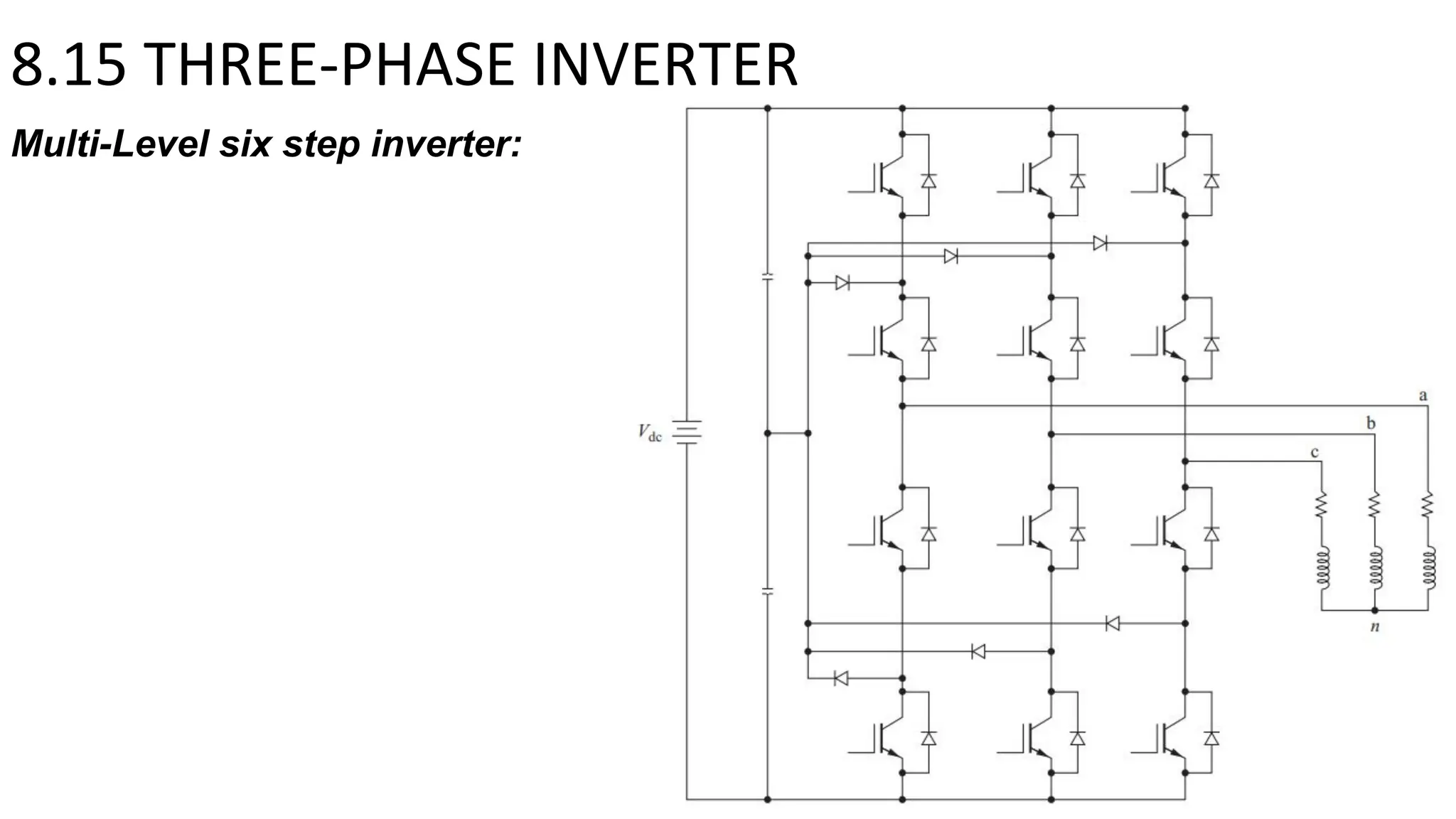
Multi-Level six step inverter:
8.15 THREE-PHASE INVERTER
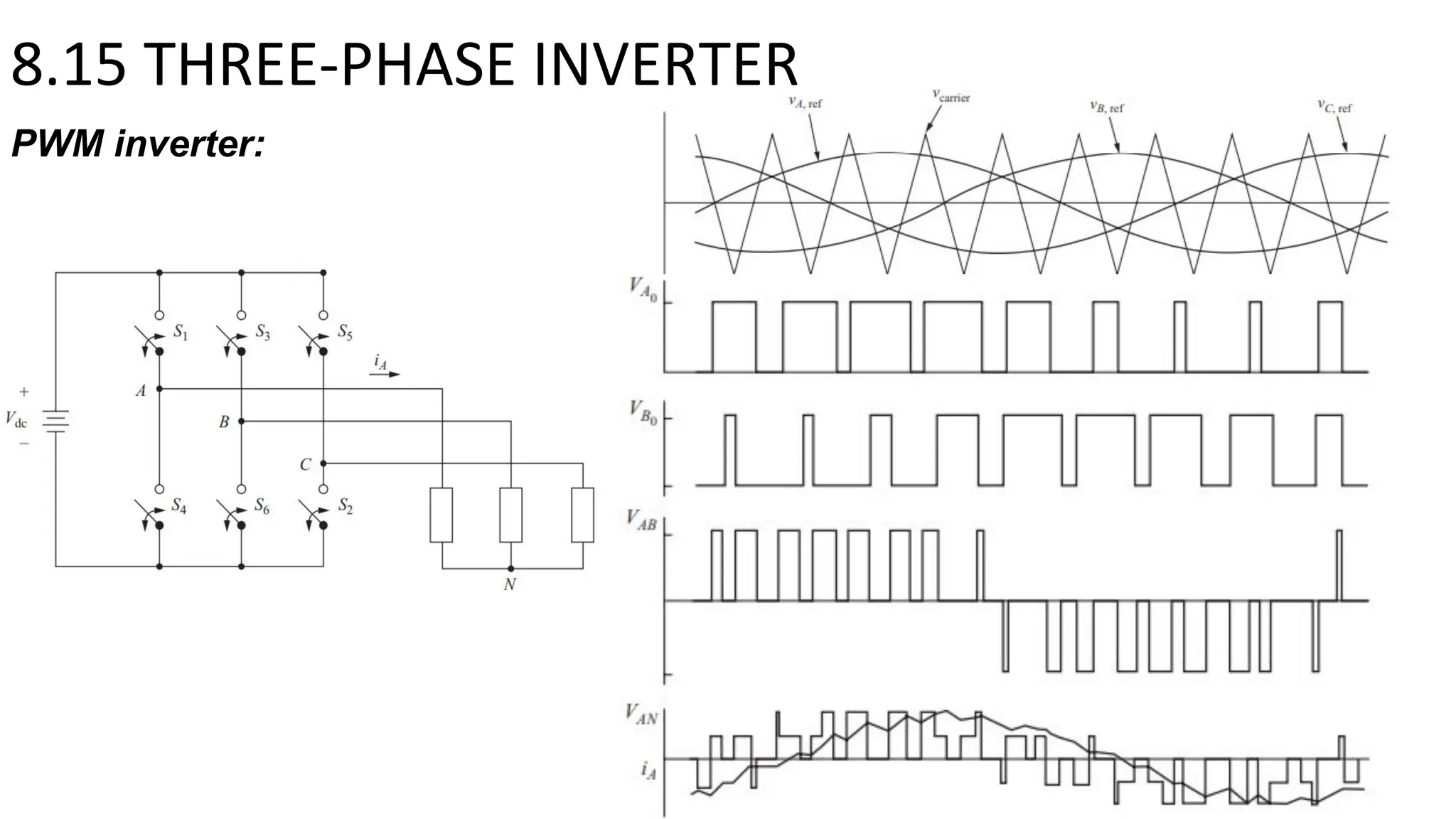
PWM inverter:
8.15 THREE-PHASE INVERTER

Lecture slides_Ch 8 power electronics daniel hart.pdf

  • 1.
  • 2.
    8.1 Introduction Inverters arecircuits that convert dc to ac. • The controlled full-wave bridge converters in Chap. 4 can function as inverters in some instances, but an ac source must preexist in those cases. • The focus of this chapter is on inverters that produce an ac output from a dc input. • Inverters are used in applications such as o Adjustable o Speed ac motor drives o Uninterruptible Power Supplies (UPS) o Running AC appliances from an automobile batter
  • 3.
    8.2 The Full-BridgeConverter • The output voltage Vo can be +Vdc, -Vdc, or zero, depending on which switches are closed. • Note that S1 and S4 should not be closed at the same time, nor should S2 and S3. • Overlap of switch “on” times in real switching circuits will result in a short circuit, sometimes called a ‘Shoot-through fault’, across the dc voltage source. • The time allowed for switching is called ‘blanking time’.
  • 4.
    8.2 The Full-BridgeConverter Switching scheme of full-Bridge converter 8.3 Square wave inverters 8.10 PWM inverters Bi-Polar Uni-Polar
  • 5.
    8.3 The Square-WaveInverter • The periodic switching of the load voltage between +Vdc and -Vdc produces a square wave voltage across the load • It may be an adequate ac waveform for some applications • For R-Load current follows the voltage waveform however in R-L Load, switches must be bidirectional • Can you guess what will be the current through switches? S1, S2 S3, S4 S1, S2 S3, S4
  • 6.
    8.3 The Square-WaveInverter • Finding the equations of output current (Derivation is in lecture notes & Textbook book) S1, S2 S3, S4 S1, S2 S3, S4
  • 7.
    8.3 The Square-WaveInverter • At the time t=T/2, the output current is Imax, put in above equation. S1, S2 S3, S4 S1, S2 S3, S4 • By symmetry, • Solving for Imax:
  • 8.
    8.3 The Square-WaveInverter • Finding the RMS output current S1, S2 S3, S4 S1, S2 S3, S4 • Taking advantage of symmetry, we can integrate only for half cycle: • Power delivered by source is same and power absorbed by the load, the power delivered by the load is given as: Example 8.1
  • 9.
    8.3 The Square-WaveInverter • The switches in the full-bridge circuit must be capable of carrying both positive and negative currents for RL loads. • In real electronic devices may conduct current in one direction only. • This problem is solved by placing feedback diodes in parallel (anti-parallel) with each switch
  • 10.
    8.4 Fourier SeriesAnalysis • For the output voltages, the Fourier series contains the odd harmonics and can be represented as. • The Fourier series of output current is: • Impedance and delay angle at different frequency levels: • To calculate power absorbed by the load: Example 8.2
  • 11.
  • 12.
    8.5 Total HarmonicsDistortion • As discussed in Chapter 2, we can find total harmonic distortion as: Example 8.3
  • 13.
    8.7 Amplitude andHarmonic Control • We cannot control power in simple square wave inverters • Therefore, another inverters is proposed in which power is controlled by controlling α. • The good thing is that switching frequency is same as square wave inverters, therefore switching frequency is low.
  • 14.
    8.7 Amplitude andHarmonic Control • This output voltage can be controlled by adjusting the interval α on each side of the pulse where the output is zero. The rms value of the voltage waveform in . • The Fourier series of the waveform is expressed as: • Taking advantage of half-wave symmetry, the amplitudes are • In particular, the amplitude of the fundamental frequency (n =1) is controllable by adjusting α
  • 15.
    8.7 Amplitude andHarmonic Control • If α = 30, for example, V3 =0. This is significant because the third harmonic can be eliminated from the output voltage and current. Other harmonics can be eliminated by choosing a value of α which makes the cosine term to go to zero. ● Amplitude control and harmonic reduction may not be compatible. For example, establishing at α = 30 to eliminate the third harmonic fixes the amplitude of the output fundamental frequency at V1 = (4Vdc/Π) cos 30 = 1.1Vdc and removes further controllability. ● To control both amplitude and harmonics using this switching scheme, it is necessary to be able to control the dc input voltage to the inverter. A dc-dc converter (Chap. 6 and 7) placed between the dc source and the inverter can provide a controlled dc input to the inverter. Example 8.3
  • 16.
    8.9 MultiLevel Inverters(with Independent DC source)
  • 17.
    8.9 MultiLevel Inverters(with Independent DC source)
  • 18.
    8.10 PULSE-WIDTH-MODULATED OUTPUT Advantages: •Pulse-width modulation (PWM) provides a way to decrease the total harmonic distortion of load current • Generally meet THD requirements more easily than the square wave switching scheme • The unfiltered PWM output will have a relatively high THD, but the harmonics will be at much higher frequencies than for a square wave, making filtering easier Dis-advantages: • More complex control circuits for the switches and increased losses due to more frequent switching • High switching losses.
  • 19.
    8.10 PULSE-WIDTH-MODULATED OUTPUT Controlof the switches for sinusoidal PWM requires: 1) A reference signal, sometimes called a modulating or control signal, which is a sinusoid in this case. 2) A carrier signal, which is a triangular wave that controls the switching frequency
  • 20.
    8.10 PULSE-WIDTH-MODULATED OUTPUT PWMControl of the switches: (Bi-Polar Switches) This version of PWM is bipolar because the output alternates between plus and minus the dc supply voltage. S1, S2 S3, S4
  • 21.
    8.10 PULSE-WIDTH-MODULATED OUTPUT PWMControl of the switches: (Uni-Polar Switches) This version of PWM is bipolar because the output alternates either from high to zero or from low to zero
  • 22.
    8.10 PULSE-WIDTH-MODULATED OUTPUT PWMControl of the switches: (Uni-Polar Switches)
  • 23.
    8.11 PWM DEFINITIONAND CONSIDERATION Frequency modulation ratio (mf ): The Fourier series of the PWM output voltage has a fundamental frequency which is the same as the reference signal. Harmonic frequencies exist at and around multiples of the switching frequency. The magnitudes of some harmonics are quite large, sometimes larger than the fundamental. However, because these harmonics are located at high frequencies, a simple low-pass filter can be quite effective in removing them Increasing the carrier frequency (increasing mf ) increases the frequencies at which the harmonics occur. A disadvantage of high switching frequencies is higher losses in the switches used to implement the inverter Typically > 10, and should be an ODD number
  • 24.
    8.11 PWM DEFINITIONAND CONSIDERATION Amplitude modulation ratio (mA ): The amplitude modulation ratio ma is defined as the ratio of the amplitudes of the reference and carrier signals If ma <= 1, the amplitude of the fundamental frequency of the output voltage V1 is linearly proportional to ma . If ma > 3.24, there is no crossing between Vreference and Vcarrier and inverter output is like square wave inverter. Alternatively, ma can be varied to change the amplitude of the output. If ma is greater than 1, the amplitude of the output increases with ma , but not linearly.
  • 25.
    8.11 PWM DEFINITIONAND CONSIDERATION Amplitude modulation ratio (mA ):
  • 26.
    Switches: The switches inthe full-bridge circuit must be capable of carrying current in either direction for pulse-width modulation just as they did for square wave operation. Reference Voltage: The sinusoidal reference voltage must be generated within the control circuit of the inverter or taken from an outside reference. 8.11 PWM DEFINITION AND CONSIDERATION
  • 27.
    Bipolar Switching: The normalizedfrequency spectrum for bipolar switching for ma = 1 is shown below: 8.12 PWM HARMONICS
  • 28.
    Bipolar Switching: The harmonicamplitudes are a function of ma because the width of each pulse depends on the relative amplitudes of the sine and triangular waves. The first harmonic frequencies in the output spectrum are at and around mf . 8.12 PWM HARMONICS Example 8.8 Example 8.9
  • 29.
    The six stepinverter: 8.15 THREE-PHASE INVERTER
  • 30.
    The six stepinverter: 8.15 THREE-PHASE INVERTER
  • 31.
    Multi-Level six stepinverter: 8.15 THREE-PHASE INVERTER
  • 32.