Contents:
 Construction
 Diagram
 Features of Synchronous Reluctance motor
 Operation
 Comparison of Synchronous Reluctance Motor Vs IM
 References
SYNCHRONOUS RELUCTANCE MOTOR
Kongunadu College of Engineering & Technology Synchronous Reluctance Motor
CONSTRUCTION
 The structure of reluctance motor is same as that of salient pole synchronous
machine
 The stator has three phase symmetrical winding, which creates sinusoidal
rotating magnetic field in the air gap, and the reluctance torque is developed
because the induced magnetic field in the rotor has a tendency to cause the rotor
to align with the stator field at a minimum reluctance position
 The rotor does not have any field winding
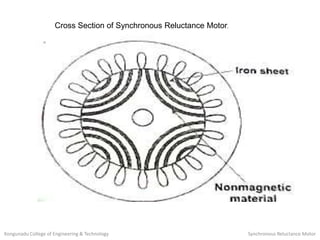
 The rotor of the modern reluctance machine is designed with iron laminations in
the axial direction separated by non-magnetic material.
Kongunadu College of Engineering & Technology Synchronous Reluctance Motor
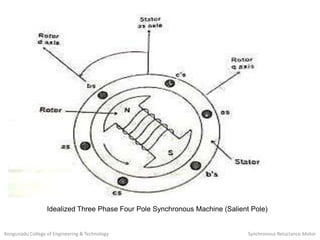
Idealized Three Phase Four Pole Synchronous Machine (Salient Pole)
Kongunadu College of Engineering & Technology Synchronous Reluctance Motor
Cross Section of Synchronous Reluctance Motor.
Kongunadu College of Engineering & Technology Synchronous Reluctance Motor
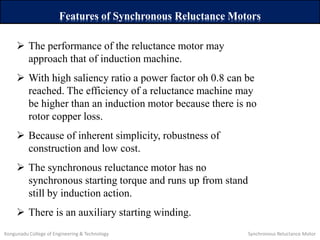
Features of Synchronous Reluctance Motors
 The performance of the reluctance motor may
approach that of induction machine.
 With high saliency ratio a power factor oh 0.8 can be
reached. The efficiency of a reluctance machine may
be higher than an induction motor because there is no
rotor copper loss.
 Because of inherent simplicity, robustness of
construction and low cost.
 The synchronous reluctance motor has no
synchronous starting torque and runs up from stand
still by induction action.
 There is an auxiliary starting winding.
Kongunadu College of Engineering & Technology Synchronous Reluctance Motor
OPERATION
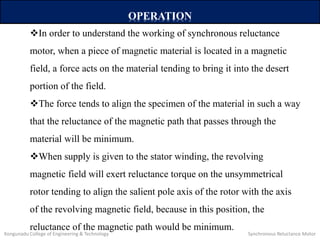
In order to understand the working of synchronous reluctance
motor, when a piece of magnetic material is located in a magnetic
field, a force acts on the material tending to bring it into the desert
portion of the field.
The force tends to align the specimen of the material in such a way
that the reluctance of the magnetic path that passes through the
material will be minimum.
When supply is given to the stator winding, the revolving
magnetic field will exert reluctance torque on the unsymmetrical
rotor tending to align the salient pole axis of the rotor with the axis
of the revolving magnetic field, because in this position, the
reluctance of the magnetic path would be minimum.
Kongunadu College of Engineering & Technology Synchronous Reluctance Motor
OPERATION
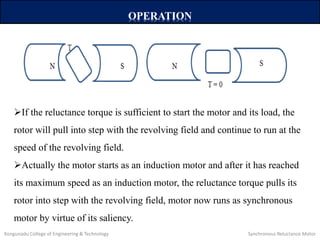
If the reluctance torque is sufficient to start the motor and its load, the
rotor will pull into step with the revolving field and continue to run at the
speed of the revolving field.
Actually the motor starts as an induction motor and after it has reached
its maximum speed as an induction motor, the reluctance torque pulls its
rotor into step with the revolving field, motor now runs as synchronous
motor by virtue of its saliency.
Kongunadu College of Engineering & Technology Synchronous Reluctance Motor
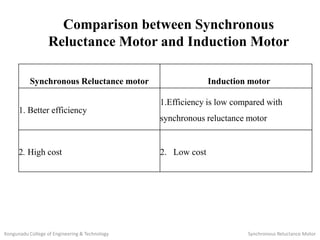
Synchronous Reluctance motor Induction motor
1. Better efficiency
1.Efficiency is low compared with
synchronous reluctance motor
2. High cost 2. Low cost
Comparison between Synchronous
Reluctance Motor and Induction Motor
Kongunadu College of Engineering & Technology Synchronous Reluctance Motor
REFERENCES
S.No Books / Web Sources
1. K.Venkataratnam, ‘Special Electrical Machines’, Universities Press (India) Private Limited, 2008
2. T.J.E. Miller, ‘Brushless Permanent Magnet and Reluctance Motor Drives’, Clarendon Press,Oxford, 1989.
3. T. Kenjo, ‘Stepping Motors and Their Microprocessor Controls’, Clarendon Press London, 1984.
4.
R.Krishnan, ‘Switched Reluctance Motor Drives – Modeling, Simulation, Analysis, Design andApplication’, CRC
Press, New York, 2001.
5. P.P. Aearnley, ‘Stepping Motors – A Guide to Motor Theory and Practice’, Peter Perengrinus ,London, 1982.
6. T. Kenjo and S. Nagamori, ‘Permanent Magnet and Brushless DC Motors’, Clarendon Press, London, 1988.
7. K.Dhayalini, “Special Electrical Machines,” Anuradha Publications, 2017.
8. Google and Wikipedia
Kongunadu College of Engineering & Technology Synchronous Reluctance Motor

Synchronous reluctance motor

  • 1.
    Contents:  Construction  Diagram Features of Synchronous Reluctance motor  Operation  Comparison of Synchronous Reluctance Motor Vs IM  References SYNCHRONOUS RELUCTANCE MOTOR Kongunadu College of Engineering & Technology Synchronous Reluctance Motor
  • 2.
    CONSTRUCTION  The structureof reluctance motor is same as that of salient pole synchronous machine  The stator has three phase symmetrical winding, which creates sinusoidal rotating magnetic field in the air gap, and the reluctance torque is developed because the induced magnetic field in the rotor has a tendency to cause the rotor to align with the stator field at a minimum reluctance position  The rotor does not have any field winding  The rotor of the modern reluctance machine is designed with iron laminations in the axial direction separated by non-magnetic material. Kongunadu College of Engineering & Technology Synchronous Reluctance Motor
  • 3.
    Idealized Three PhaseFour Pole Synchronous Machine (Salient Pole) Kongunadu College of Engineering & Technology Synchronous Reluctance Motor
  • 4.
    Cross Section ofSynchronous Reluctance Motor. Kongunadu College of Engineering & Technology Synchronous Reluctance Motor
  • 5.
    Features of SynchronousReluctance Motors  The performance of the reluctance motor may approach that of induction machine.  With high saliency ratio a power factor oh 0.8 can be reached. The efficiency of a reluctance machine may be higher than an induction motor because there is no rotor copper loss.  Because of inherent simplicity, robustness of construction and low cost.  The synchronous reluctance motor has no synchronous starting torque and runs up from stand still by induction action.  There is an auxiliary starting winding. Kongunadu College of Engineering & Technology Synchronous Reluctance Motor
  • 6.
    OPERATION In order tounderstand the working of synchronous reluctance motor, when a piece of magnetic material is located in a magnetic field, a force acts on the material tending to bring it into the desert portion of the field. The force tends to align the specimen of the material in such a way that the reluctance of the magnetic path that passes through the material will be minimum. When supply is given to the stator winding, the revolving magnetic field will exert reluctance torque on the unsymmetrical rotor tending to align the salient pole axis of the rotor with the axis of the revolving magnetic field, because in this position, the reluctance of the magnetic path would be minimum. Kongunadu College of Engineering & Technology Synchronous Reluctance Motor
  • 7.
    OPERATION If the reluctancetorque is sufficient to start the motor and its load, the rotor will pull into step with the revolving field and continue to run at the speed of the revolving field. Actually the motor starts as an induction motor and after it has reached its maximum speed as an induction motor, the reluctance torque pulls its rotor into step with the revolving field, motor now runs as synchronous motor by virtue of its saliency. Kongunadu College of Engineering & Technology Synchronous Reluctance Motor
  • 8.
    Synchronous Reluctance motorInduction motor 1. Better efficiency 1.Efficiency is low compared with synchronous reluctance motor 2. High cost 2. Low cost Comparison between Synchronous Reluctance Motor and Induction Motor Kongunadu College of Engineering & Technology Synchronous Reluctance Motor
  • 9.
    REFERENCES S.No Books /Web Sources 1. K.Venkataratnam, ‘Special Electrical Machines’, Universities Press (India) Private Limited, 2008 2. T.J.E. Miller, ‘Brushless Permanent Magnet and Reluctance Motor Drives’, Clarendon Press,Oxford, 1989. 3. T. Kenjo, ‘Stepping Motors and Their Microprocessor Controls’, Clarendon Press London, 1984. 4. R.Krishnan, ‘Switched Reluctance Motor Drives – Modeling, Simulation, Analysis, Design andApplication’, CRC Press, New York, 2001. 5. P.P. Aearnley, ‘Stepping Motors – A Guide to Motor Theory and Practice’, Peter Perengrinus ,London, 1982. 6. T. Kenjo and S. Nagamori, ‘Permanent Magnet and Brushless DC Motors’, Clarendon Press, London, 1988. 7. K.Dhayalini, “Special Electrical Machines,” Anuradha Publications, 2017. 8. Google and Wikipedia Kongunadu College of Engineering & Technology Synchronous Reluctance Motor