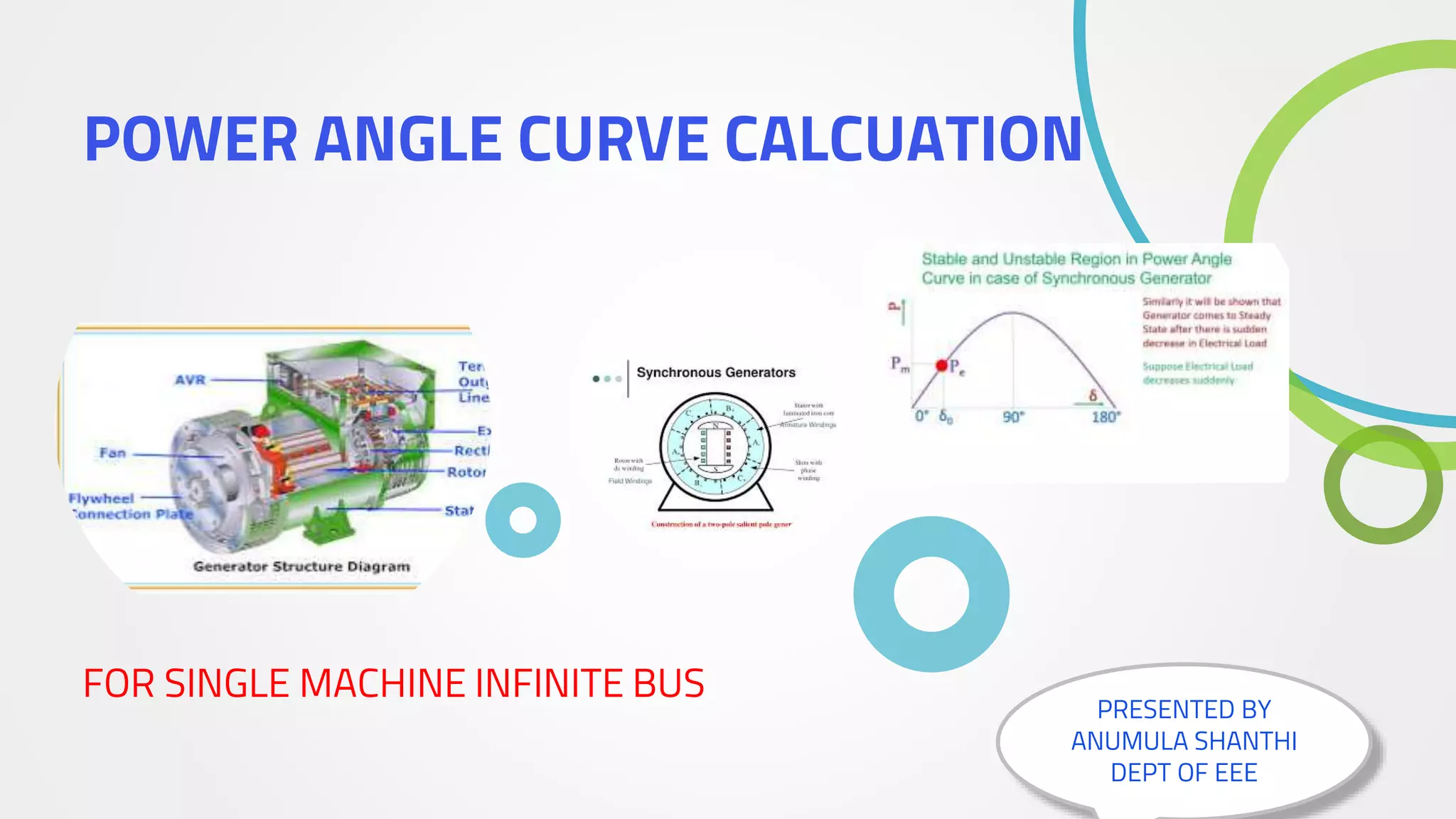
POWER ANGLE CURVE CALCUATION
FOR SINGLE MACHINE INFINITE BUS
PRESENTED BY
ANUMULA SHANTHI
DEPT OF EEE
Infinite Bus. Definition: The bus whose voltage and frequency remains
constant even after the variation in the load is known as the infinite bus. ...
The voltage and frequency always remain constant. The synchronous
impedance of the bus is low because of parallel operations of the machine.
POWER ANGLE CUREVE:
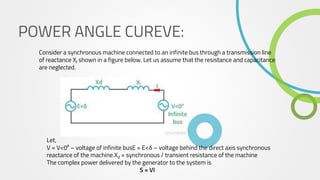
Consider a synchronous machine connected to an infinite bus through a transmission line
of reactance Xl shown in a figure below. Let us assume that the resistance and capacitance
are neglected.
Let,
V = V<0⁰ – voltage of infinite busE = E<δ – voltage behind the direct axis synchronous
reactance of the machine.Xd = synchronous / transient resistance of the machine
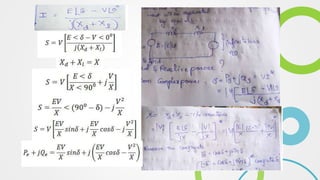
The complex power delivered by the generator to the system is
S = VI
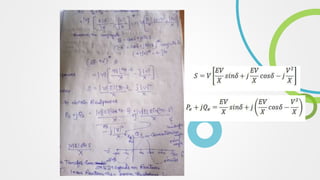
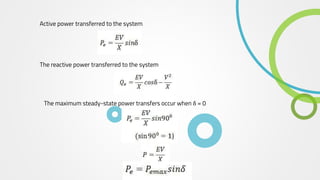
Active power transferred to the system
The reactive power transferred to the system
The maximum steady-state power transfers occur when δ = 0
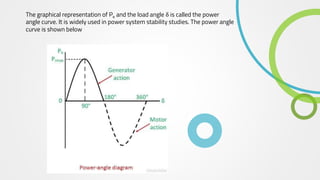
The graphical representation of Pe and the load angle δ is called the power
angle curve. It is widely used in power system stability studies. The power angle
curve is shown below
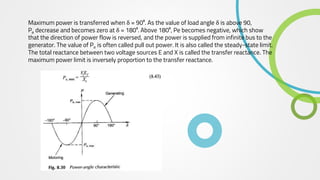
Maximum power is transferred when δ = 90⁰. As the value of load angle δ is above 90,
Pe decrease and becomes zero at δ = 180⁰. Above 180⁰, Pe becomes negative, which show
that the direction of power flow is reversed, and the power is supplied from infinite bus to the
generator. The value of Pe is often called pull out power. It is also called the steady-state limit.
The total reactance between two voltage sources E and X is called the transfer reactance. The
maximum power limit is inversely proportion to the transfer reactance.
Power transfer from single machine to the infinite bus depends
upon the reactance ............
I.e....if lesser reactance then the power transfer will be more..
If higher reactance then the power transfer will be less....
Thankyou…

Power angle curve calclation

  • 1.
    POWER ANGLE CURVECALCUATION FOR SINGLE MACHINE INFINITE BUS PRESENTED BY ANUMULA SHANTHI DEPT OF EEE
  • 2.
    Infinite Bus. Definition:The bus whose voltage and frequency remains constant even after the variation in the load is known as the infinite bus. ... The voltage and frequency always remain constant. The synchronous impedance of the bus is low because of parallel operations of the machine.
  • 3.
    POWER ANGLE CUREVE: Considera synchronous machine connected to an infinite bus through a transmission line of reactance Xl shown in a figure below. Let us assume that the resistance and capacitance are neglected. Let, V = V<0⁰ – voltage of infinite busE = E<δ – voltage behind the direct axis synchronous reactance of the machine.Xd = synchronous / transient resistance of the machine The complex power delivered by the generator to the system is S = VI
  • 6.
    Active power transferredto the system The reactive power transferred to the system The maximum steady-state power transfers occur when δ = 0
  • 7.
    The graphical representationof Pe and the load angle δ is called the power angle curve. It is widely used in power system stability studies. The power angle curve is shown below
  • 8.
    Maximum power istransferred when δ = 90⁰. As the value of load angle δ is above 90, Pe decrease and becomes zero at δ = 180⁰. Above 180⁰, Pe becomes negative, which show that the direction of power flow is reversed, and the power is supplied from infinite bus to the generator. The value of Pe is often called pull out power. It is also called the steady-state limit. The total reactance between two voltage sources E and X is called the transfer reactance. The maximum power limit is inversely proportion to the transfer reactance.
  • 9.
    Power transfer fromsingle machine to the infinite bus depends upon the reactance ............ I.e....if lesser reactance then the power transfer will be more.. If higher reactance then the power transfer will be less....
  • 10.