E MAIL
AGENDA
MINUTES
CIRCULAR LETTER
BIODATA, RESUME AND
CURRICULUM VITAE
WRITING THE RESUME
WRITING COVERING LETTER
OF
JOB APPLICATIONS
 An e-mail is a communication sent from one
computer to another, usually via a network. It is
the least formal method of written
communication within a company.
 SO WHEN SHOULD WE WRITE
 less formal - written in a conversational style
 Sent to your work colleagues or fellow
students/professors from the same school.
 Meaning
*Agenda is a document that outlines the
contents of a forthcoming meeting.
 It is usually sent along with the notice of the
meeting. Sometimes agenda is prepared after
the circulation of the notice in order to enable
the members to get included in the agenda any
item that they would like to be discussed at the
meeting.
 Example: - The next quarterly meeting of the
Board of Directors will take place on Monday,
21st October , 20…. At 5pm, in the conference
room
Simco India Limited, Chennai
 AGENDA
 1. Minutes of the last meeting.
 2. Matters arising from the minutes.
 3. Financial irregularities in Arichuur branch.
 4. Reorganization of work in Chennai
branch.
 5. Any other business
 6. Date of next meeting.
 Meaning
 Minutes are the official record of the
proceedings of a meeting.
 All organizations, whether commercial or
social, attach great importance to
maintaining a proper record of the business
transacted at their various meeting.
 Once minutes are approved and signed,
even a court of law accepts them as
evidence of the proceedings.
 The main uses of minutes are as follows:
1. Minutes contain a record of the business
transacted and decisions taken at a meeting.
2. They serve as a permanent record for future
reference.
3. Minutes serve as a reminder of the actions to
be taken to implement the decisions arrived at a
meeting.
4. Minutes can be produced as evidence of the
proceedings in a court of Law.
 1. Minutes of resolution
a. In this type of minutes only the resolutions passed
at the meeting are recorded
b. It always begin with the words ―Resolved that
followed by the exact resolution
 2. Minutes of narration
a. In this type of minutes, the resolutions passed at
the meeting are recorded.
b. In addition, a brief account of the business
discussed and transacted and the voting pattern are
also recorded
 1. The kind of meeting
 2. Date, time and place of the meeting
 3. The name of the person in the chairman.
 4. Name of directors, secretary and persons in attendance
 5. Reading and confirmation of the minutes of the last meeting
and their signing by the Chairman, together with any matters
arising from the minutes
 6. Financial statements and reports presented and approved in
the meeting. These may be put in the form of ‗Appendix‘
 7. Appointment made, if any.
 8. In the case of special resolution, the number of votes for and
against.
 9. Instructions given by the meeting to the secretary or other
officers.
 10. Chairman‘s signature and date of verification of minutes as
correct.
 The letter is known as circular letter because it
is circulated to a large number of customers.
Necessary number of copies may be
cyclostyled, printed or electro stated and one
copy addressed to one individual by post. The
copies can also be distributed at random.
 Features
1. Absence of senders reference
2. Absence of Inside address
3. Combined Salutation
4. Signature of the official
5. Special attention to the customers
There are three terms used and described as under:
 (1) Bio-data
Bio-data is a paragraph summary of who a person is and can be
written for any purpose whatsoever.
 (2) Resume
Resume is a statement containing specific information relating
to education, training and experience.
It is usually a single page and is used for applying for job.
 (3) Curriculum Vitae
Curriculum Vitae is like a resume but it may be much longer
spreading in to 3 to 4 pages.
The above definitions bring out the subtle differences among the
various terms used. However, in India they are being used
almost interchangeably. In this Unit, the term resume has been
used.
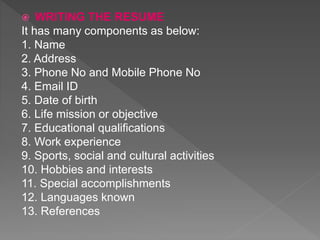
 WRITING THE RESUME
It has many components as below:
1. Name
2. Address
3. Phone No and Mobile Phone No
4. Email ID
5. Date of birth
6. Life mission or objective
7. Educational qualifications
8. Work experience
9. Sports, social and cultural activities
10. Hobbies and interests
11. Special accomplishments
12. Languages known
13. References
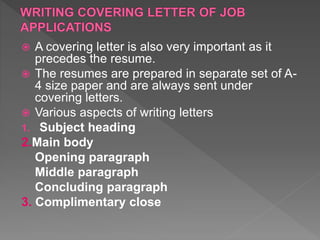
 A covering letter is also very important as it
precedes the resume.
 The resumes are prepared in separate set of A-
4 size paper and are always sent under
covering letters.
 Various aspects of writing letters
1. Subject heading
2.Main body
Opening paragraph
Middle paragraph
Concluding paragraph
3. Complimentary close

Resume Preparation

  • 2.
    E MAIL AGENDA MINUTES CIRCULAR LETTER BIODATA,RESUME AND CURRICULUM VITAE WRITING THE RESUME WRITING COVERING LETTER OF JOB APPLICATIONS
  • 3.
     An e-mailis a communication sent from one computer to another, usually via a network. It is the least formal method of written communication within a company.  SO WHEN SHOULD WE WRITE  less formal - written in a conversational style  Sent to your work colleagues or fellow students/professors from the same school.
  • 4.
     Meaning *Agenda isa document that outlines the contents of a forthcoming meeting.  It is usually sent along with the notice of the meeting. Sometimes agenda is prepared after the circulation of the notice in order to enable the members to get included in the agenda any item that they would like to be discussed at the meeting.  Example: - The next quarterly meeting of the Board of Directors will take place on Monday, 21st October , 20…. At 5pm, in the conference room Simco India Limited, Chennai
  • 5.
     AGENDA  1.Minutes of the last meeting.  2. Matters arising from the minutes.  3. Financial irregularities in Arichuur branch.  4. Reorganization of work in Chennai branch.  5. Any other business  6. Date of next meeting.
  • 6.
     Meaning  Minutesare the official record of the proceedings of a meeting.  All organizations, whether commercial or social, attach great importance to maintaining a proper record of the business transacted at their various meeting.  Once minutes are approved and signed, even a court of law accepts them as evidence of the proceedings.
  • 7.
     The mainuses of minutes are as follows: 1. Minutes contain a record of the business transacted and decisions taken at a meeting. 2. They serve as a permanent record for future reference. 3. Minutes serve as a reminder of the actions to be taken to implement the decisions arrived at a meeting. 4. Minutes can be produced as evidence of the proceedings in a court of Law.
  • 8.
     1. Minutesof resolution a. In this type of minutes only the resolutions passed at the meeting are recorded b. It always begin with the words ―Resolved that followed by the exact resolution  2. Minutes of narration a. In this type of minutes, the resolutions passed at the meeting are recorded. b. In addition, a brief account of the business discussed and transacted and the voting pattern are also recorded
  • 9.
     1. Thekind of meeting  2. Date, time and place of the meeting  3. The name of the person in the chairman.  4. Name of directors, secretary and persons in attendance  5. Reading and confirmation of the minutes of the last meeting and their signing by the Chairman, together with any matters arising from the minutes  6. Financial statements and reports presented and approved in the meeting. These may be put in the form of ‗Appendix‘  7. Appointment made, if any.  8. In the case of special resolution, the number of votes for and against.  9. Instructions given by the meeting to the secretary or other officers.  10. Chairman‘s signature and date of verification of minutes as correct.
  • 10.
     The letteris known as circular letter because it is circulated to a large number of customers. Necessary number of copies may be cyclostyled, printed or electro stated and one copy addressed to one individual by post. The copies can also be distributed at random.  Features 1. Absence of senders reference 2. Absence of Inside address 3. Combined Salutation 4. Signature of the official 5. Special attention to the customers
  • 12.
    There are threeterms used and described as under:  (1) Bio-data Bio-data is a paragraph summary of who a person is and can be written for any purpose whatsoever.  (2) Resume Resume is a statement containing specific information relating to education, training and experience. It is usually a single page and is used for applying for job.  (3) Curriculum Vitae Curriculum Vitae is like a resume but it may be much longer spreading in to 3 to 4 pages. The above definitions bring out the subtle differences among the various terms used. However, in India they are being used almost interchangeably. In this Unit, the term resume has been used.
  • 13.
     WRITING THERESUME It has many components as below: 1. Name 2. Address 3. Phone No and Mobile Phone No 4. Email ID 5. Date of birth 6. Life mission or objective 7. Educational qualifications 8. Work experience 9. Sports, social and cultural activities 10. Hobbies and interests 11. Special accomplishments 12. Languages known 13. References
  • 14.
     A coveringletter is also very important as it precedes the resume.  The resumes are prepared in separate set of A- 4 size paper and are always sent under covering letters.  Various aspects of writing letters 1. Subject heading 2.Main body Opening paragraph Middle paragraph Concluding paragraph 3. Complimentary close