STATIC KRAMER SYSTEM
Slip power recovery
 Instead of wasting the slip power in the rotor circuit resistance, a better approach is
to convert it to ac line power and return it back to the line. Two types of converter
provide this approach:
1) Static Kramer Drive - only allows
operation at sub-synchronous speed.
2) Static Scherbius Drive - allows
operation above and below
synchronous speed
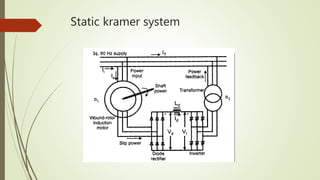
Static kramer system
At zero speed (s=1) the motor acts as a transformer and all the real power is
transferred back to the line (neglecting losses). The motor and inverter only
consume reactive power.
At synchronous speed (s=0) the power factor is the lowest and increases as slip
increases. The PF can be improved close to synchronous speed by using a
step-down transformer. The inverter line current is reduced by the
transformer turns ratio -> reduced PF.
SPEED CONTROL
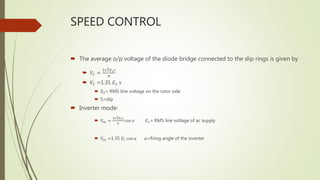
 The average o/p voltage of the diode bridge connected to the slip rings is given by
 𝑉𝐶 =
3 2𝐸2 𝑠
𝜋
 𝑉𝐶 =1.35 𝐸2 s
 𝐸2= RMS line voltage on the rotor side
 S=slip
 Inverter mode:
 𝑉𝑖𝑛 =
3 2𝐸 𝑙 𝑠
𝜋
cos 𝛼 𝐸2= RMS line voltage of ac supply
 𝑉𝑖𝑛 =1.35 𝐸𝑙 cos 𝛼 𝛼=firing angle of the inverter
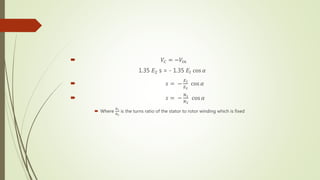
 𝑉𝐶 = −𝑉𝑖𝑛
1.35 𝐸2 s = - 1.35 𝐸𝑙 cos 𝛼
 𝑠 = −
𝐸 𝑙
𝐸2
cos 𝛼
 𝑠 = −
𝑁1
𝑁2
cos 𝛼
 Where
𝑁1
𝑁2
is the turns ratio of the stator to rotor winding which is fixed
SPEED CONTROL WITH LOAD
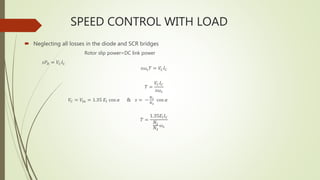
 Neglecting all losses in the diode and SCR bridges
Rotor slip power=DC link power
𝑠𝑃𝑅 = 𝑉𝐶 𝐼 𝐶
𝑠𝜔𝑠 𝑇 = 𝑉𝐶 𝐼 𝐶
𝑇 =
𝑉𝐶 𝐼 𝐶
𝑠𝜔𝑠
𝑉𝐶 = 𝑉𝑖𝑛 = 1.35 𝐸𝑙 cos 𝛼 & 𝑠 = −
𝑁1
𝑁2
cos 𝛼
𝑇 =
1.35𝐸𝑙 𝐼 𝐶
𝑁1
𝑁2
𝜔𝑠
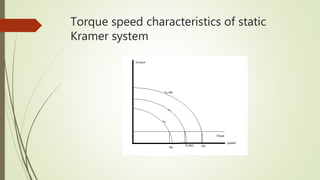
Torque speed characteristics of static
Kramer system
Static kramer system

Static kramer system

  • 1.
  • 2.
    Slip power recovery Instead of wasting the slip power in the rotor circuit resistance, a better approach is to convert it to ac line power and return it back to the line. Two types of converter provide this approach: 1) Static Kramer Drive - only allows operation at sub-synchronous speed. 2) Static Scherbius Drive - allows operation above and below synchronous speed
  • 3.
  • 4.
    At zero speed(s=1) the motor acts as a transformer and all the real power is transferred back to the line (neglecting losses). The motor and inverter only consume reactive power. At synchronous speed (s=0) the power factor is the lowest and increases as slip increases. The PF can be improved close to synchronous speed by using a step-down transformer. The inverter line current is reduced by the transformer turns ratio -> reduced PF.
  • 5.
    SPEED CONTROL  Theaverage o/p voltage of the diode bridge connected to the slip rings is given by  𝑉𝐶 = 3 2𝐸2 𝑠 𝜋  𝑉𝐶 =1.35 𝐸2 s  𝐸2= RMS line voltage on the rotor side  S=slip  Inverter mode:  𝑉𝑖𝑛 = 3 2𝐸 𝑙 𝑠 𝜋 cos 𝛼 𝐸2= RMS line voltage of ac supply  𝑉𝑖𝑛 =1.35 𝐸𝑙 cos 𝛼 𝛼=firing angle of the inverter
  • 6.
     𝑉𝐶 =−𝑉𝑖𝑛 1.35 𝐸2 s = - 1.35 𝐸𝑙 cos 𝛼  𝑠 = − 𝐸 𝑙 𝐸2 cos 𝛼  𝑠 = − 𝑁1 𝑁2 cos 𝛼  Where 𝑁1 𝑁2 is the turns ratio of the stator to rotor winding which is fixed
  • 7.
    SPEED CONTROL WITHLOAD  Neglecting all losses in the diode and SCR bridges Rotor slip power=DC link power 𝑠𝑃𝑅 = 𝑉𝐶 𝐼 𝐶 𝑠𝜔𝑠 𝑇 = 𝑉𝐶 𝐼 𝐶 𝑇 = 𝑉𝐶 𝐼 𝐶 𝑠𝜔𝑠 𝑉𝐶 = 𝑉𝑖𝑛 = 1.35 𝐸𝑙 cos 𝛼 & 𝑠 = − 𝑁1 𝑁2 cos 𝛼 𝑇 = 1.35𝐸𝑙 𝐼 𝐶 𝑁1 𝑁2 𝜔𝑠
  • 8.
    Torque speed characteristicsof static Kramer system