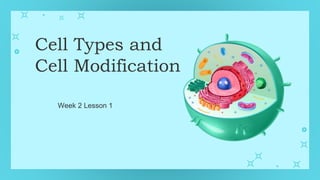

Cell Types and
Cell Modification
Week 2 Lesson 1
Objectives
At the end of the lesson, the learners shall be able to:
K: distinguish prokaryotic and eukaryotic cells
according to their distinguishing features
S: classify different cell types (of plant/animal tissues)
and specify the functions of each
A: relate the importance of some cell modification by
describing their adaptation to carry out specialized
function (e.g., microvilli, root hair)
Table of contents
Obj. 1 distinguish prokaryotic and
eukaryotic cells according to their
distinguishing features
Obj. 2 classify different cell types
(of plant/animal tissues) and
specify the functions of each
Obj. 3 relate the importance of
some cell modification by
describing their adaptation to carry
out specialized function
01 02 03
Prokaryotic Vs
Eukaryotic Cells Types of Cells Cell Modification
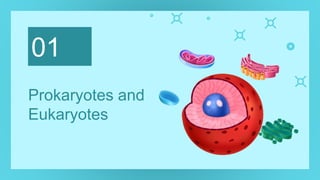
Prokaryotes and
Eukaryotes
01
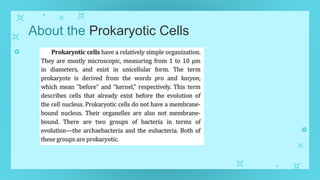
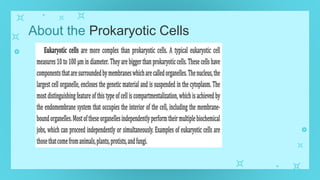
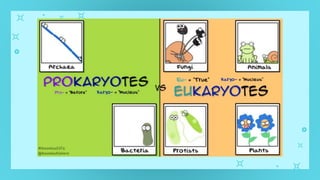
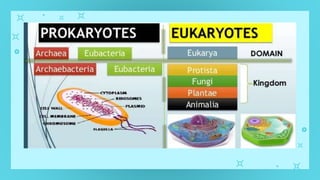
About the Prokaryotic Cells
Cells as Tissues.
Tissue is a group of cells having
similar structure and function.
In plants and animals' group of cells
called tissues carry out specific
functions.
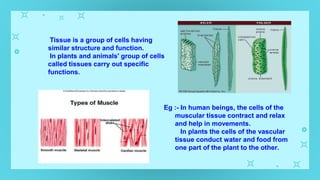
Eg :- In human beings, the cells of the
muscular tissue contract and relax
and help in movements.
In plants the cells of the vascular
tissue conduct water and food from
one part of the plant to the other.
Differences between Plant and Animal tissues
a) Plant tissues :-
i) Plants do not move from place to place. Most of the
cells and
tissues in plants provide mechanical support and
strength. Most of the tissues consists of dead cells
because they provide
mechanical support and strength to the plant.
ii) The growth of plants takes place only in some regions.
Plants
have tissues called meristematic tissues which divide
and help in
growth and permanent tissues which do not divide.
b) Animal tissues :-
i) Animals move from place to place and need more energy
than
plants. Most cells and tissues in animals are living cells.
ii) The growth of animals is more uniform, so animals do
not have
separate dividing and non dividing cells. Animals have
organs
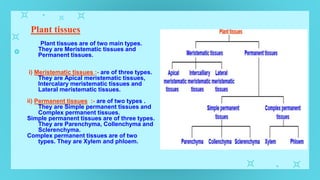
Plant tissues
Plant tissues are of two main types.
They are Meristematic tissues and
Permanent tissues.
i) Meristematic tissues :- are of three types.
They are Apical meristematic tissues,
Intercalary meristematic tissues and
Lateral meristematic tissues.
ii) Permanent tissues :- are of two types .
They are Simple permanent tissues and
Complex permanent tissues.
Simple permanent tissues are of three types.
They are Parenchyma, Collenchyma and
Sclerenchyma.
Complex permanent tissues are of two
types. They are Xylem and phloem.
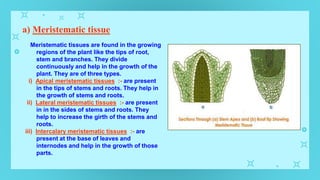
a) Meristematic tissue
Meristematic tissues are found in the growing
regions of the plant like the tips of root,
stem and branches. They divide
continuously and help in the growth of the
plant. They are of three types.
i) Apical meristematic tissues :- are present
in the tips of stems and roots. They help in
the growth of stems and roots.
ii) Lateral meristematic tissues :- are present
in in the sides of stems and roots. They
help to increase the girth of the stems and
roots.
iii) Intercalary meristematic tissues :- are
present at the base of leaves and
internodes and help in the growth of those
parts.
b) Permanent tissues
Permanent tissues are formed from meristematic tissues. They do
not divide
and have permanent shape and size. They differentiate into different
types of
permanent tissues. Permanent tissues are of two main types. They
are Simple
permanent tissues and Complex permanent tissues.
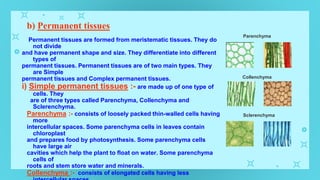
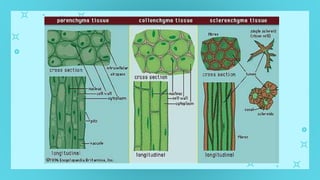
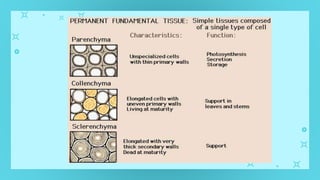
i) Simple permanent tissues :- are made up of one type of
cells. They
are of three types called Parenchyma, Collenchyma and
Sclerenchyma.
Parenchyma :- consists of loosely packed thin-walled cells having
more
intercellular spaces. Some parenchyma cells in leaves contain
chloroplast
and prepares food by photosynthesis. Some parenchyma cells
have large air
cavities which help the plant to float on water. Some parenchyma
cells of
roots and stem store water and minerals.
Collenchyma :- consists of elongated cells having less
Parenchyma
Collenchyma
Sclerenchyma
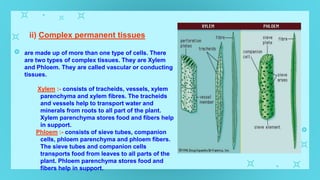
ii) Complex permanent tissues
are made up of more than one type of cells. There
are two types of complex tissues. They are Xylem
and Phloem. They are called vascular or conducting
tissues.
Xylem :- consists of tracheids, vessels, xylem
parenchyma and xylem fibres. The tracheids
and vessels help to transport water and
minerals from roots to all part of the plant.
Xylem parenchyma stores food and fibers help
in support.
Phloem :- consists of sieve tubes, companion
cells, phloem parenchyma and phloem fibers.
The sieve tubes and companion cells
transports food from leaves to all parts of the
plant. Phloem parenchyma stores food and
fibers help in support.
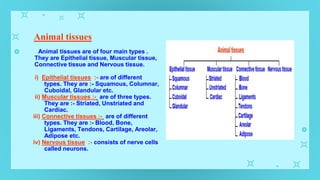
Animal tissues
Animal tissues are of four main types .
They are Epithelial tissue, Muscular tissue,
Connective tissue and Nervous tissue.
i) Epithelial tissues :- are of different
types. They are :- Squamous, Columnar,
Cuboidal, Glandular etc.
ii) Muscular tissues :- are of three types.
They are :- Striated, Unstriated and
Cardiac.
iii) Connective tissues :- are of different
types. They are :- Blood, Bone,
Ligaments, Tendons, Cartilage, Areolar,
Adipose etc.
iv) Nervous tissue :- consists of nerve cells
called neurons.
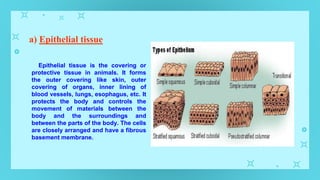
a) Epithelial tissue
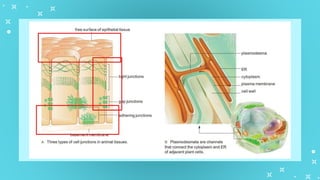
Epithelial tissue is the covering or
protective tissue in animals. It forms
the outer covering like skin, outer
covering of organs, inner lining of
blood vessels, lungs, esophagus, etc. It
protects the body and controls the
movement of materials between the
body and the surroundings and
between the parts of the body. The cells
are closely arranged and have a fibrous
basement membrane.
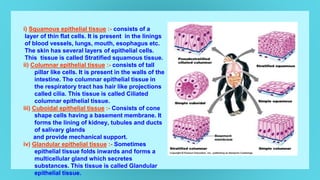
i) Squamous epithelial tissue :- consists of a
layer of thin flat cells. It is present in the linings
of blood vessels, lungs, mouth, esophagus etc.
The skin has several layers of epithelial cells.
This tissue is called Stratified squamous tissue.
ii) Columnar epithelial tissue :- consists of tall
pillar like cells. It is present in the walls of the
intestine. The columnar epithelial tissue in
the respiratory tract has hair like projections
called cilia. This tissue is called Ciliated
columnar epithelial tissue.
iii) Cuboidal epithelial tissue :- Consists of cone
shape cells having a basement membrane. It
forms the lining of kidney, tubules and ducts
of salivary glands
and provide mechanical support.
iv) Glandular epithelial tissue :- Sometimes
epithelial tissue folds inwards and forms a
multicellular gland which secretes
substances. This tissue is called Glandular
epithelial tissue.
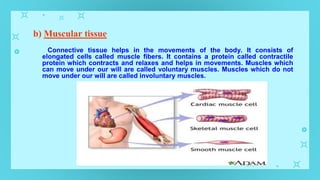
b) Muscular tissue
Connective tissue helps in the movements of the body. It consists of
elongated cells called muscle fibers. It contains a protein called contractile
protein which contracts and relaxes and helps in movements. Muscles which
can move under our will are called voluntary muscles. Muscles which do not
move under our will are called involuntary muscles.
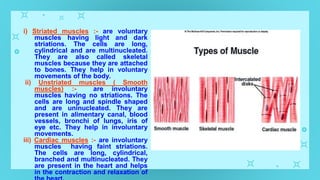
i) Striated muscles :- are voluntary
muscles having light and dark
striations. The cells are long,
cylindrical and are multinucleated.
They are also called skeletal
muscles because they are attached
to bones. They help in voluntary
movements of the body.
ii) Unstriated muscles ( Smooth
muscles) :- are involuntary
muscles having no striations. The
cells are long and spindle shaped
and are uninucleated. They are
present in alimentary canal, blood
vessels, bronchi of lungs, iris of
eye etc. They help in involuntary
movements.
iii) Cardiac muscles :- are involuntary
muscles having faint striations.
The cells are long, cylindrical,
branched and multinucleated. They
are present in the heart and helps
in the contraction and relaxation of
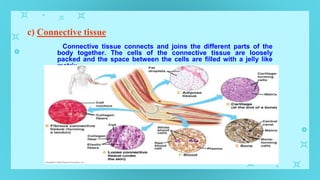
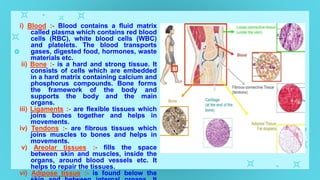
c) Connective tissue
Connective tissue connects and joins the different parts of the
body together. The cells of the connective tissue are loosely
packed and the space between the cells are filled with a jelly like
matrix.
i) Blood :- Blood contains a fluid matrix
called plasma which contains red blood
cells (RBC), white blood cells (WBC)
and platelets. The blood transports
gases, digested food, hormones, waste
materials etc.
ii) Bone :- is a hard and strong tissue. It
consists of cells which are embedded
in a hard matrix containing calcium and
phosphorus compounds. Bone forms
the framework of the body and
supports the body and the main
organs.
iii) Ligaments :- are flexible tissues which
joins bones together and helps in
movements.
iv) Tendons :- are fibrous tissues which
joins muscles to bones and helps in
movements.
v) Areolar tissues :- fills the space
between skin and muscles, inside the
organs, around blood vessels etc. It
helps to repair the tissues.
vi) Adipose tissue :- is found below the
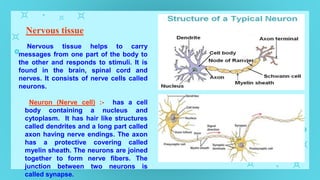
Nervous tissue
Nervous tissue helps to carry
messages from one part of the body to
the other and responds to stimuli. It is
found in the brain, spinal cord and
nerves. It consists of nerve cells called
neurons.
Neuron (Nerve cell) :- has a cell
body containing a nucleus and
cytoplasm. It has hair like structures
called dendrites and a long part called
axon having nerve endings. The axon
has a protective covering called
myelin sheath. The neurons are joined
together to form nerve fibers. The
junction between two neurons is
called synapse.
GenBio1W2L1 Cell Types and Cell Modification.pptx

GenBio1W2L1 Cell Types and Cell Modification.pptx

  • 1.
    Cell Types and CellModification Week 2 Lesson 1
  • 2.
    Objectives At the endof the lesson, the learners shall be able to: K: distinguish prokaryotic and eukaryotic cells according to their distinguishing features S: classify different cell types (of plant/animal tissues) and specify the functions of each A: relate the importance of some cell modification by describing their adaptation to carry out specialized function (e.g., microvilli, root hair)
  • 3.
    Table of contents Obj.1 distinguish prokaryotic and eukaryotic cells according to their distinguishing features Obj. 2 classify different cell types (of plant/animal tissues) and specify the functions of each Obj. 3 relate the importance of some cell modification by describing their adaptation to carry out specialized function 01 02 03 Prokaryotic Vs Eukaryotic Cells Types of Cells Cell Modification
  • 4.
  • 5.
  • 6.
  • 10.
  • 11.
    Tissue is agroup of cells having similar structure and function. In plants and animals' group of cells called tissues carry out specific functions. Eg :- In human beings, the cells of the muscular tissue contract and relax and help in movements. In plants the cells of the vascular tissue conduct water and food from one part of the plant to the other.
  • 12.
    Differences between Plantand Animal tissues a) Plant tissues :- i) Plants do not move from place to place. Most of the cells and tissues in plants provide mechanical support and strength. Most of the tissues consists of dead cells because they provide mechanical support and strength to the plant. ii) The growth of plants takes place only in some regions. Plants have tissues called meristematic tissues which divide and help in growth and permanent tissues which do not divide. b) Animal tissues :- i) Animals move from place to place and need more energy than plants. Most cells and tissues in animals are living cells. ii) The growth of animals is more uniform, so animals do not have separate dividing and non dividing cells. Animals have organs
  • 13.
    Plant tissues Plant tissuesare of two main types. They are Meristematic tissues and Permanent tissues. i) Meristematic tissues :- are of three types. They are Apical meristematic tissues, Intercalary meristematic tissues and Lateral meristematic tissues. ii) Permanent tissues :- are of two types . They are Simple permanent tissues and Complex permanent tissues. Simple permanent tissues are of three types. They are Parenchyma, Collenchyma and Sclerenchyma. Complex permanent tissues are of two types. They are Xylem and phloem.
  • 14.
    a) Meristematic tissue Meristematictissues are found in the growing regions of the plant like the tips of root, stem and branches. They divide continuously and help in the growth of the plant. They are of three types. i) Apical meristematic tissues :- are present in the tips of stems and roots. They help in the growth of stems and roots. ii) Lateral meristematic tissues :- are present in in the sides of stems and roots. They help to increase the girth of the stems and roots. iii) Intercalary meristematic tissues :- are present at the base of leaves and internodes and help in the growth of those parts.
  • 15.
    b) Permanent tissues Permanenttissues are formed from meristematic tissues. They do not divide and have permanent shape and size. They differentiate into different types of permanent tissues. Permanent tissues are of two main types. They are Simple permanent tissues and Complex permanent tissues. i) Simple permanent tissues :- are made up of one type of cells. They are of three types called Parenchyma, Collenchyma and Sclerenchyma. Parenchyma :- consists of loosely packed thin-walled cells having more intercellular spaces. Some parenchyma cells in leaves contain chloroplast and prepares food by photosynthesis. Some parenchyma cells have large air cavities which help the plant to float on water. Some parenchyma cells of roots and stem store water and minerals. Collenchyma :- consists of elongated cells having less Parenchyma Collenchyma Sclerenchyma
  • 18.
    ii) Complex permanenttissues are made up of more than one type of cells. There are two types of complex tissues. They are Xylem and Phloem. They are called vascular or conducting tissues. Xylem :- consists of tracheids, vessels, xylem parenchyma and xylem fibres. The tracheids and vessels help to transport water and minerals from roots to all part of the plant. Xylem parenchyma stores food and fibers help in support. Phloem :- consists of sieve tubes, companion cells, phloem parenchyma and phloem fibers. The sieve tubes and companion cells transports food from leaves to all parts of the plant. Phloem parenchyma stores food and fibers help in support.
  • 19.
    Animal tissues Animal tissuesare of four main types . They are Epithelial tissue, Muscular tissue, Connective tissue and Nervous tissue. i) Epithelial tissues :- are of different types. They are :- Squamous, Columnar, Cuboidal, Glandular etc. ii) Muscular tissues :- are of three types. They are :- Striated, Unstriated and Cardiac. iii) Connective tissues :- are of different types. They are :- Blood, Bone, Ligaments, Tendons, Cartilage, Areolar, Adipose etc. iv) Nervous tissue :- consists of nerve cells called neurons.
  • 20.
    a) Epithelial tissue Epithelialtissue is the covering or protective tissue in animals. It forms the outer covering like skin, outer covering of organs, inner lining of blood vessels, lungs, esophagus, etc. It protects the body and controls the movement of materials between the body and the surroundings and between the parts of the body. The cells are closely arranged and have a fibrous basement membrane.
  • 21.
    i) Squamous epithelialtissue :- consists of a layer of thin flat cells. It is present in the linings of blood vessels, lungs, mouth, esophagus etc. The skin has several layers of epithelial cells. This tissue is called Stratified squamous tissue. ii) Columnar epithelial tissue :- consists of tall pillar like cells. It is present in the walls of the intestine. The columnar epithelial tissue in the respiratory tract has hair like projections called cilia. This tissue is called Ciliated columnar epithelial tissue. iii) Cuboidal epithelial tissue :- Consists of cone shape cells having a basement membrane. It forms the lining of kidney, tubules and ducts of salivary glands and provide mechanical support. iv) Glandular epithelial tissue :- Sometimes epithelial tissue folds inwards and forms a multicellular gland which secretes substances. This tissue is called Glandular epithelial tissue.
  • 22.
    b) Muscular tissue Connectivetissue helps in the movements of the body. It consists of elongated cells called muscle fibers. It contains a protein called contractile protein which contracts and relaxes and helps in movements. Muscles which can move under our will are called voluntary muscles. Muscles which do not move under our will are called involuntary muscles.
  • 23.
    i) Striated muscles:- are voluntary muscles having light and dark striations. The cells are long, cylindrical and are multinucleated. They are also called skeletal muscles because they are attached to bones. They help in voluntary movements of the body. ii) Unstriated muscles ( Smooth muscles) :- are involuntary muscles having no striations. The cells are long and spindle shaped and are uninucleated. They are present in alimentary canal, blood vessels, bronchi of lungs, iris of eye etc. They help in involuntary movements. iii) Cardiac muscles :- are involuntary muscles having faint striations. The cells are long, cylindrical, branched and multinucleated. They are present in the heart and helps in the contraction and relaxation of
  • 24.
    c) Connective tissue Connectivetissue connects and joins the different parts of the body together. The cells of the connective tissue are loosely packed and the space between the cells are filled with a jelly like matrix.
  • 25.
    i) Blood :-Blood contains a fluid matrix called plasma which contains red blood cells (RBC), white blood cells (WBC) and platelets. The blood transports gases, digested food, hormones, waste materials etc. ii) Bone :- is a hard and strong tissue. It consists of cells which are embedded in a hard matrix containing calcium and phosphorus compounds. Bone forms the framework of the body and supports the body and the main organs. iii) Ligaments :- are flexible tissues which joins bones together and helps in movements. iv) Tendons :- are fibrous tissues which joins muscles to bones and helps in movements. v) Areolar tissues :- fills the space between skin and muscles, inside the organs, around blood vessels etc. It helps to repair the tissues. vi) Adipose tissue :- is found below the
  • 26.
    Nervous tissue Nervous tissuehelps to carry messages from one part of the body to the other and responds to stimuli. It is found in the brain, spinal cord and nerves. It consists of nerve cells called neurons. Neuron (Nerve cell) :- has a cell body containing a nucleus and cytoplasm. It has hair like structures called dendrites and a long part called axon having nerve endings. The axon has a protective covering called myelin sheath. The neurons are joined together to form nerve fibers. The junction between two neurons is called synapse.