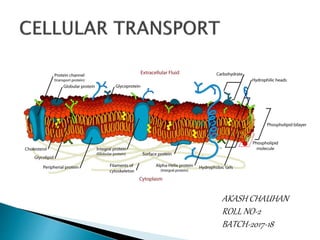
AKASH CHAUHAN
ROLL NO-2
BATCH-2017-18
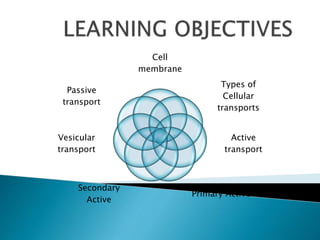
Cell
membrane
Types of
Cellular
transports
Active
transport
Primary Active
Secondary
Active
Vesicular
transport
Passive
transport
 OVERVIEW OF CELL MEMBRANE
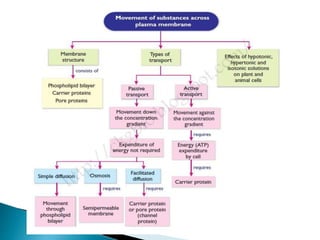
 TYPES OF CELLULAR TRANSPORTS
 PASSIVE TRANSPORT
 SIMPLE DIFFUSION
 FACILITATED DIFFUSION
 OSMOSIS
 ACTIVE TRANSPORT
 PRIMARY
 SECONDARY
 VESICULAR TRANSPORT
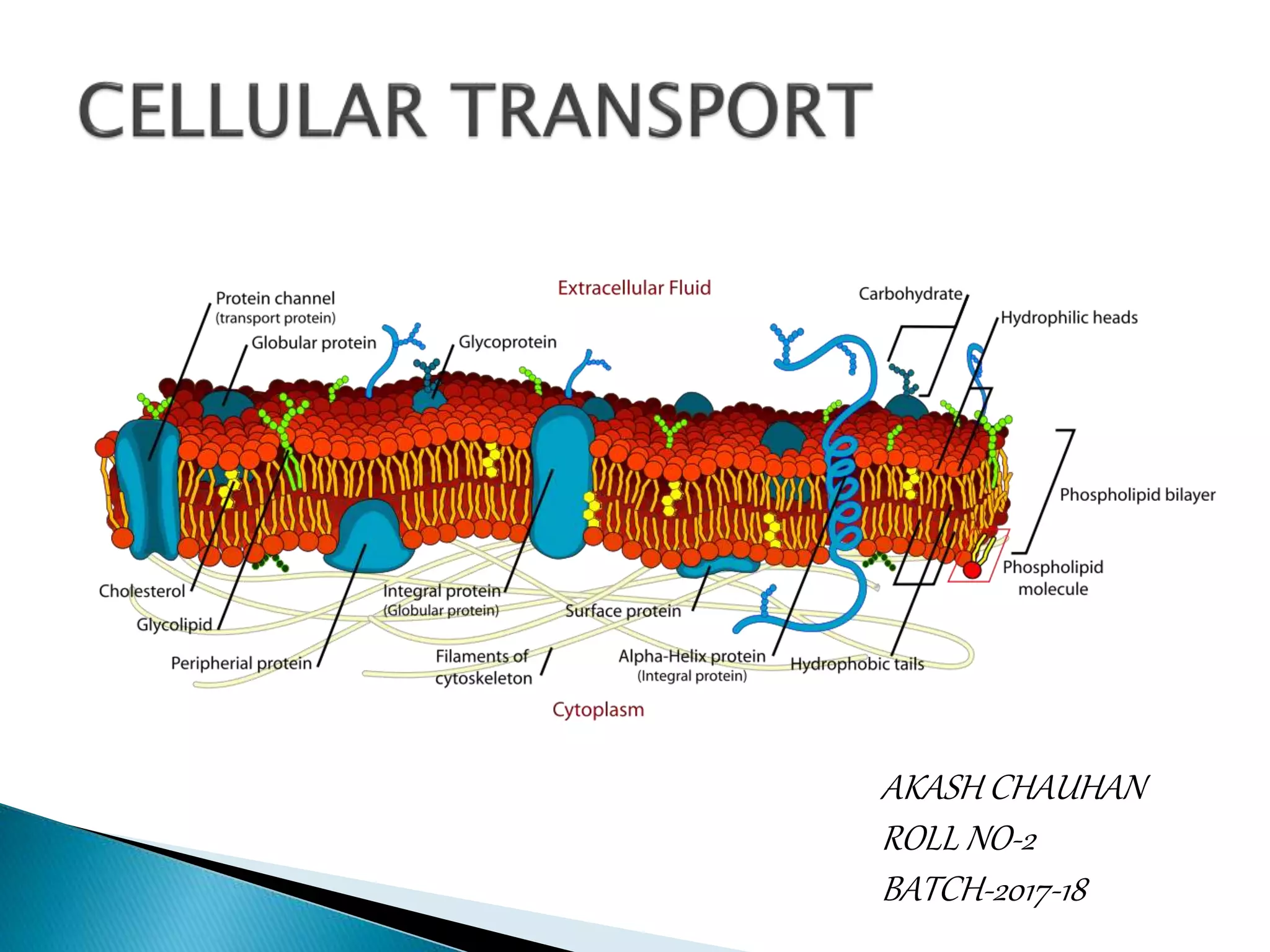
CELL MEMBRANE
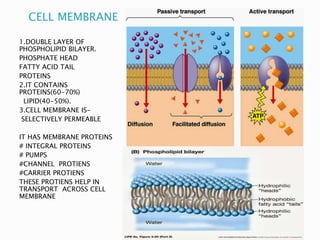
1.DOUBLE LAYER OF
PHOSPHOLIPID BILAYER.
PHOSPHATE HEAD
FATTY ACID TAIL
PROTEINS
2.IT CONTAINS
PROTEINS(60-70%)
LIPID(40-50%).
3.CELL MEMBRANE IS-
SELECTIVELY PERMEABLE
IT HAS MEMBRANE PROTEINS
# INTEGRAL PROTEINS
# PUMPS
#CHANNEL PROTIENS
#CARRIER PROTIENS
THESE PROTIENS HELP IN
TRANSPORT ACROSS CELL
MEMBRANE
 When a cell uses no energy to move particles
across a membrane passive transport occurs
 Particles go DOWN their concentration
gradient.
 all diffusion & osmosis are passive
transport.
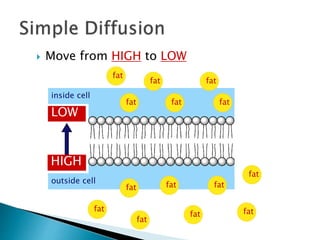
 Move from HIGH to LOW
inside cell
outside cell
fat
fat
fat
fat
fat
fat fat
fat
fat
fat
fat
fat
fat
fat
LOW
HIGH
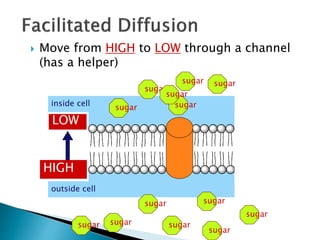
 Move from HIGH to LOW through a channel
(has a helper)
inside cell
outside cell
sugar
sugar
sugar
sugar
sugar
sugar
sugar
sugar
sugar
sugar
sugar
sugar
sugar
LOW
HIGH
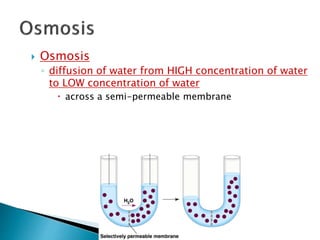
 Osmosis
◦ diffusion of water from HIGH concentration of water
to LOW concentration of water
 across a semi-permeable membrane
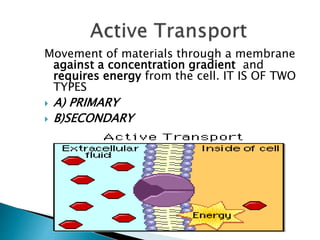
Movement of materials through a membrane
against a concentration gradient and
requires energy from the cell. IT IS OF TWO
TYPES
 A) PRIMARY
 B)SECONDARY
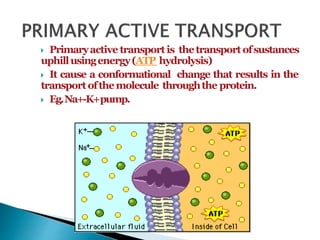
 Primaryactive transport is thetransport ofsustances
uphillusingenergy(ATP hydrolysis)
 It cause a conformational change that results in the
transport ofthemolecule throughthe protein.
 Eg.Na+-K+pump.
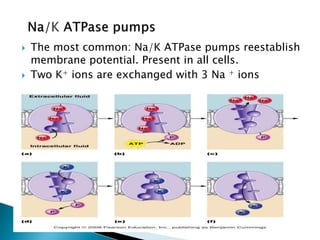
 The most common: Na/K ATPase pumps reestablish
membrane potential. Present in all cells.
 Two K+ ions are exchanged with 3 Na + ions
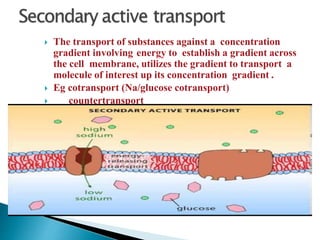
 The transport of substances against a concentration
gradient involving energy to establish a gradient across
the cell membrane, utilizes the gradient to transport a
molecule of interest up its concentration gradient .
 Eg cotransport (Na/glucose cotransport)
 countertransport
1. Exocytosis [ exo = outside]
movement of large materials OUT of the cell
~a vesicle may fuse with the membrane and
expel its contents
CYTOPLASM
FLUID OUTSIDE CELL
2. Endocytosis [ endo = inside]
movement of large materials to INSIDE of
the cell
~membrane may fold inward, trapping
materials from the outside
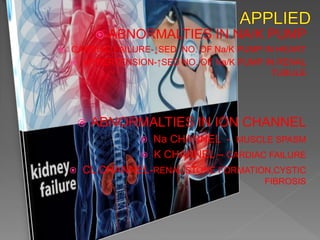
 ABNORMALTIES IN NA/K PUMP
 CARDIAC FAILURE-↓SED NO. OF Na/K PUMP IN HEART
 HYPERTENSION-↑SED NO. OF Na/K PUMP IN RENAL
TUBULE
 ABNORMALTIES IN ION CHANNEL
 Na CHANNEL - MUSCLE SPASM
 K CHANNEL – CARDIAC FAILURE
 CL CHANNEL-RENAL STONE FORMATION,CYSTIC
FIBROSIS
1. Guyton and Hall Textbook of Medical
Physiology E-Book (Guyton Physiology)
2. Essentials of Medical Physiology by
k.sembulingum
3. Google
4. Slideshare
5. Ganongs Review Of Medical Physiology 25th
Edition
Cell transport

Cell transport

  • 1.
  • 2.
  • 3.
     OVERVIEW OFCELL MEMBRANE  TYPES OF CELLULAR TRANSPORTS  PASSIVE TRANSPORT  SIMPLE DIFFUSION  FACILITATED DIFFUSION  OSMOSIS  ACTIVE TRANSPORT  PRIMARY  SECONDARY  VESICULAR TRANSPORT
  • 4.
    CELL MEMBRANE 1.DOUBLE LAYEROF PHOSPHOLIPID BILAYER. PHOSPHATE HEAD FATTY ACID TAIL PROTEINS 2.IT CONTAINS PROTEINS(60-70%) LIPID(40-50%). 3.CELL MEMBRANE IS- SELECTIVELY PERMEABLE IT HAS MEMBRANE PROTEINS # INTEGRAL PROTEINS # PUMPS #CHANNEL PROTIENS #CARRIER PROTIENS THESE PROTIENS HELP IN TRANSPORT ACROSS CELL MEMBRANE
  • 6.
     When acell uses no energy to move particles across a membrane passive transport occurs  Particles go DOWN their concentration gradient.  all diffusion & osmosis are passive transport.
  • 7.
     Move fromHIGH to LOW inside cell outside cell fat fat fat fat fat fat fat fat fat fat fat fat fat fat LOW HIGH
  • 8.
     Move fromHIGH to LOW through a channel (has a helper) inside cell outside cell sugar sugar sugar sugar sugar sugar sugar sugar sugar sugar sugar sugar sugar LOW HIGH
  • 9.
     Osmosis ◦ diffusionof water from HIGH concentration of water to LOW concentration of water  across a semi-permeable membrane
  • 10.
    Movement of materialsthrough a membrane against a concentration gradient and requires energy from the cell. IT IS OF TWO TYPES  A) PRIMARY  B)SECONDARY
  • 11.
     Primaryactive transportis thetransport ofsustances uphillusingenergy(ATP hydrolysis)  It cause a conformational change that results in the transport ofthemolecule throughthe protein.  Eg.Na+-K+pump.
  • 12.
     The mostcommon: Na/K ATPase pumps reestablish membrane potential. Present in all cells.  Two K+ ions are exchanged with 3 Na + ions
  • 13.
     The transportof substances against a concentration gradient involving energy to establish a gradient across the cell membrane, utilizes the gradient to transport a molecule of interest up its concentration gradient .  Eg cotransport (Na/glucose cotransport)  countertransport
  • 14.
    1. Exocytosis [exo = outside] movement of large materials OUT of the cell ~a vesicle may fuse with the membrane and expel its contents CYTOPLASM FLUID OUTSIDE CELL
  • 15.
    2. Endocytosis [endo = inside] movement of large materials to INSIDE of the cell ~membrane may fold inward, trapping materials from the outside
  • 16.
     ABNORMALTIES INNA/K PUMP  CARDIAC FAILURE-↓SED NO. OF Na/K PUMP IN HEART  HYPERTENSION-↑SED NO. OF Na/K PUMP IN RENAL TUBULE  ABNORMALTIES IN ION CHANNEL  Na CHANNEL - MUSCLE SPASM  K CHANNEL – CARDIAC FAILURE  CL CHANNEL-RENAL STONE FORMATION,CYSTIC FIBROSIS
  • 17.
    1. Guyton andHall Textbook of Medical Physiology E-Book (Guyton Physiology) 2. Essentials of Medical Physiology by k.sembulingum 3. Google 4. Slideshare 5. Ganongs Review Of Medical Physiology 25th Edition