These are called
CELLS
They were first
named by ROBERT
HOOKE
Cell Theory
Presented by Kesler Science
What are the
building blocks of
life?
Essential Question:
Objective
I can explain the
components of
cell theory.
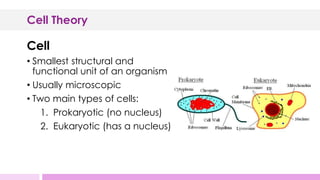
Cell
• Smallest structural and
functional unit of an organism
• Usually microscopic
• Two main types of cells:
1. Prokaryotic (no nucleus)
2. Eukaryotic (has a nucleus)
Cell Theory
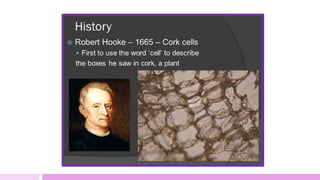
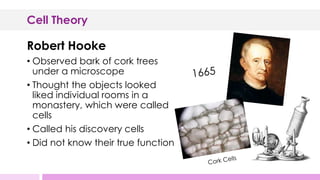
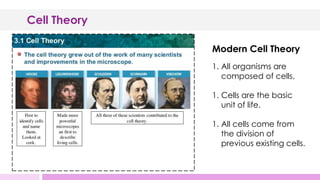
Robert Hooke
• Observed bark of cork trees
under a microscope
• Thought the objects looked
liked individual rooms in a
monastery, which were called
cells
• Called his discovery cells
• Did not know their true function
Cell Theory
Anton van Leeuwenhoek
• Developed the microscope
lens to see greater
magnification
• First person to observe bacteria
Cell Theory
1670
Matthias Schleiden
• Concluded all plant
tissues are composed of
cells
• Declared that the cell is
the basic building block
of all plant matter.
Cell Theory
Cell Theory
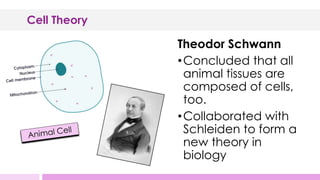
Theodor Schwann
•Concluded that all
animal tissues are
composed of cells,
too.
•Collaborated with
Schleiden to form a
new theory in
biology
Cell Theory
• Schleiden and Schwann’s
ideas became known as
the cell theory.
1. All organisms are
composed of cells.
2. Cells are the basic unit of
life.
• This theory was as important
to biology as the atomic
theory was to chemistry.
Cell Theory
There was one more piece of
the puzzle to cell theory. Where
did these cells come from?
Cell Theory
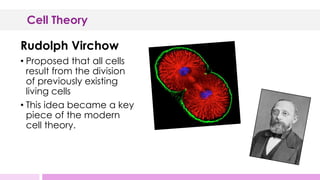
Rudolph Virchow
• Proposed that all cells
result from the division
of previously existing
living cells
• This idea became a key
piece of the modern
cell theory.
Cell Theory
Modern Cell Theory
1. All organisms are
composed of cells.
1. Cells are the basic
unit of life.
1. All cells come from
the division of
previous existing cells.
Cell Theory
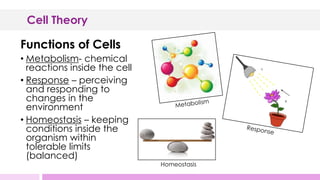
Functions of Cells
• Metabolism- chemical
reactions inside the cell
• Response – perceiving
and responding to
changes in the
environment
• Homeostasis – keeping
conditions inside the
organism within
tolerable limits
(balanced)
Homeostasis
Cell Theory
Functions of Cells
(continued)
• Growth – increase in size
• Reproduction –
producing offspring
(sexually or asexually)
• Nutrition – Obtaining
food to provide energy
for growth
• Defense – protection
against enemies
Growth
Quick Action – Cell Theory
Let’s see how good you memory is.
There were 7 cell functions listed on the last two slides.
Have your teacher give you another peek at them and
then write down as many as you can remember.

Cell_theory_and_Cell_Introduction.pptx

  • 2.
    These are called CELLS Theywere first named by ROBERT HOOKE
  • 4.
  • 5.
    What are the buildingblocks of life? Essential Question:
  • 6.
    Objective I can explainthe components of cell theory.
  • 7.
    Cell • Smallest structuraland functional unit of an organism • Usually microscopic • Two main types of cells: 1. Prokaryotic (no nucleus) 2. Eukaryotic (has a nucleus) Cell Theory
  • 8.
    Robert Hooke • Observedbark of cork trees under a microscope • Thought the objects looked liked individual rooms in a monastery, which were called cells • Called his discovery cells • Did not know their true function Cell Theory
  • 9.
    Anton van Leeuwenhoek •Developed the microscope lens to see greater magnification • First person to observe bacteria Cell Theory 1670
  • 10.
    Matthias Schleiden • Concludedall plant tissues are composed of cells • Declared that the cell is the basic building block of all plant matter. Cell Theory
  • 11.
    Cell Theory Theodor Schwann •Concludedthat all animal tissues are composed of cells, too. •Collaborated with Schleiden to form a new theory in biology
  • 12.
    Cell Theory • Schleidenand Schwann’s ideas became known as the cell theory. 1. All organisms are composed of cells. 2. Cells are the basic unit of life. • This theory was as important to biology as the atomic theory was to chemistry. Cell Theory There was one more piece of the puzzle to cell theory. Where did these cells come from?
  • 13.
    Cell Theory Rudolph Virchow •Proposed that all cells result from the division of previously existing living cells • This idea became a key piece of the modern cell theory.
  • 14.
    Cell Theory Modern CellTheory 1. All organisms are composed of cells. 1. Cells are the basic unit of life. 1. All cells come from the division of previous existing cells.
  • 15.
    Cell Theory Functions ofCells • Metabolism- chemical reactions inside the cell • Response – perceiving and responding to changes in the environment • Homeostasis – keeping conditions inside the organism within tolerable limits (balanced) Homeostasis
  • 16.
    Cell Theory Functions ofCells (continued) • Growth – increase in size • Reproduction – producing offspring (sexually or asexually) • Nutrition – Obtaining food to provide energy for growth • Defense – protection against enemies Growth
  • 17.
    Quick Action –Cell Theory Let’s see how good you memory is. There were 7 cell functions listed on the last two slides. Have your teacher give you another peek at them and then write down as many as you can remember.