Biogenesis vs.
Abiogenesis
Biology 11
“The secret to reaching my goals lies
solely in my tenacity”
-Louis Pasteur
Abiogenesis vs. Biogenesis
Introduction:
 Biology as a Science progressed by
observation.
 The hypotheses proposed by early
scientists were rarely tested by
experiments.
Abiogenesis continued…
Example:
 Pond dries up – no fish or frogs
 Rain comes – fish and frogs
Therefore: It rained fish and frogs
Abiogenesis continued…
Theory of Abiogenesis
(aka spontaneous generation)
 Nonliving things can be transformed
into living things.
 Proposed by Aristotle who observed
rotting meat and flies.
 Existed for nearly 2000 years
Van Helmont continued…
 ~300 years ago
Belgian doctor Jean van Helmont –
concluded that mice could be created from a
dirty shirt.
 He placed grains of wheat and a dirty shirt in
a container and in 21 days mice appeared.
 Conclusion: Sweat caused wheat to ferment
into mice. Abiogenesis!
Redi
 In 1668 Francesco Redi (Italian
physician) tested Aristotle’s hypothesis
(meat  flies)
Redi continued…
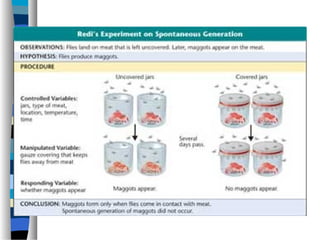
 4 sets of jars with meat (snake, eel, fish,
veal)
one set was open (experimental group)
one set was sealed (control group)
 Maggots appeared on open jars of meat
 Conclusion: Flies come from flies!
Biogenesis – life from life.
Redi continued…
 Bad news  lots of critics
 No air in jar, therefore life could not
survive.
 Redi repeated his experiment with a
fine mesh wire – supported Biogenesis
again!
 Critics still objected…
Needham
 John Needham (1713 – 1781) English
botanist
 Reexamined theory of Abiogenesis
 Observed meat broth left unsealed
soon changed colour (evidence of
microorganisms).
Needham continued…
Experiment:
 Boiled flasks of meat broth to kill
microorganisms
 Left the flasks (unsealed)
 Flasks soon become murky and full of
microbes
Needham continued…
Conclusion:
 Abiogenesis AHHHHHHHHH!!!
 Sent many Scientists down the wrong
path.
Lazzaro Spallanzani
(1729-1799)
 25 years later Spallanzani repeated
experiment more carefully
 Boiled flasks longer and sealed flasks
 Critics again objected to sealed flasks!
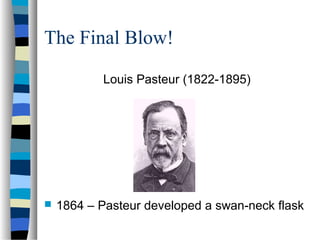
The Final Blow!
Louis Pasteur (1822-1895)
 1864 – Pasteur developed a swan-neck flask
Pasteur continued…
Experiment:
 Boiled broth, air could enter but
microbes were trapped in curved flask
 Broth remained clear  Biogenesis
finally proven!
The End!
Now here is your assignment:
List and explain three “flaws” in experimental design
that you have heard about during this presentation.

Biogenesis vs. abiogenesis

  • 1.
  • 2.
    “The secret toreaching my goals lies solely in my tenacity” -Louis Pasteur
  • 3.
    Abiogenesis vs. Biogenesis Introduction: Biology as a Science progressed by observation.  The hypotheses proposed by early scientists were rarely tested by experiments.
  • 4.
    Abiogenesis continued… Example:  Ponddries up – no fish or frogs  Rain comes – fish and frogs Therefore: It rained fish and frogs
  • 5.
    Abiogenesis continued… Theory ofAbiogenesis (aka spontaneous generation)  Nonliving things can be transformed into living things.  Proposed by Aristotle who observed rotting meat and flies.  Existed for nearly 2000 years
  • 6.
    Van Helmont continued… ~300 years ago Belgian doctor Jean van Helmont – concluded that mice could be created from a dirty shirt.  He placed grains of wheat and a dirty shirt in a container and in 21 days mice appeared.  Conclusion: Sweat caused wheat to ferment into mice. Abiogenesis!
  • 7.
    Redi  In 1668Francesco Redi (Italian physician) tested Aristotle’s hypothesis (meat  flies)
  • 9.
    Redi continued…  4sets of jars with meat (snake, eel, fish, veal) one set was open (experimental group) one set was sealed (control group)  Maggots appeared on open jars of meat  Conclusion: Flies come from flies! Biogenesis – life from life.
  • 10.
    Redi continued…  Badnews  lots of critics  No air in jar, therefore life could not survive.  Redi repeated his experiment with a fine mesh wire – supported Biogenesis again!  Critics still objected…
  • 11.
    Needham  John Needham(1713 – 1781) English botanist  Reexamined theory of Abiogenesis  Observed meat broth left unsealed soon changed colour (evidence of microorganisms).
  • 12.
    Needham continued… Experiment:  Boiledflasks of meat broth to kill microorganisms  Left the flasks (unsealed)  Flasks soon become murky and full of microbes
  • 13.
    Needham continued… Conclusion:  AbiogenesisAHHHHHHHHH!!!  Sent many Scientists down the wrong path.
  • 14.
    Lazzaro Spallanzani (1729-1799)  25years later Spallanzani repeated experiment more carefully  Boiled flasks longer and sealed flasks  Critics again objected to sealed flasks!
  • 15.
    The Final Blow! LouisPasteur (1822-1895)  1864 – Pasteur developed a swan-neck flask
  • 16.
    Pasteur continued… Experiment:  Boiledbroth, air could enter but microbes were trapped in curved flask  Broth remained clear  Biogenesis finally proven!
  • 18.
    The End! Now hereis your assignment: List and explain three “flaws” in experimental design that you have heard about during this presentation.