Prepared by: Sir Cee Jae Q. Darunday, LPT
CELLS AND
CELL THEORY
CELLS:
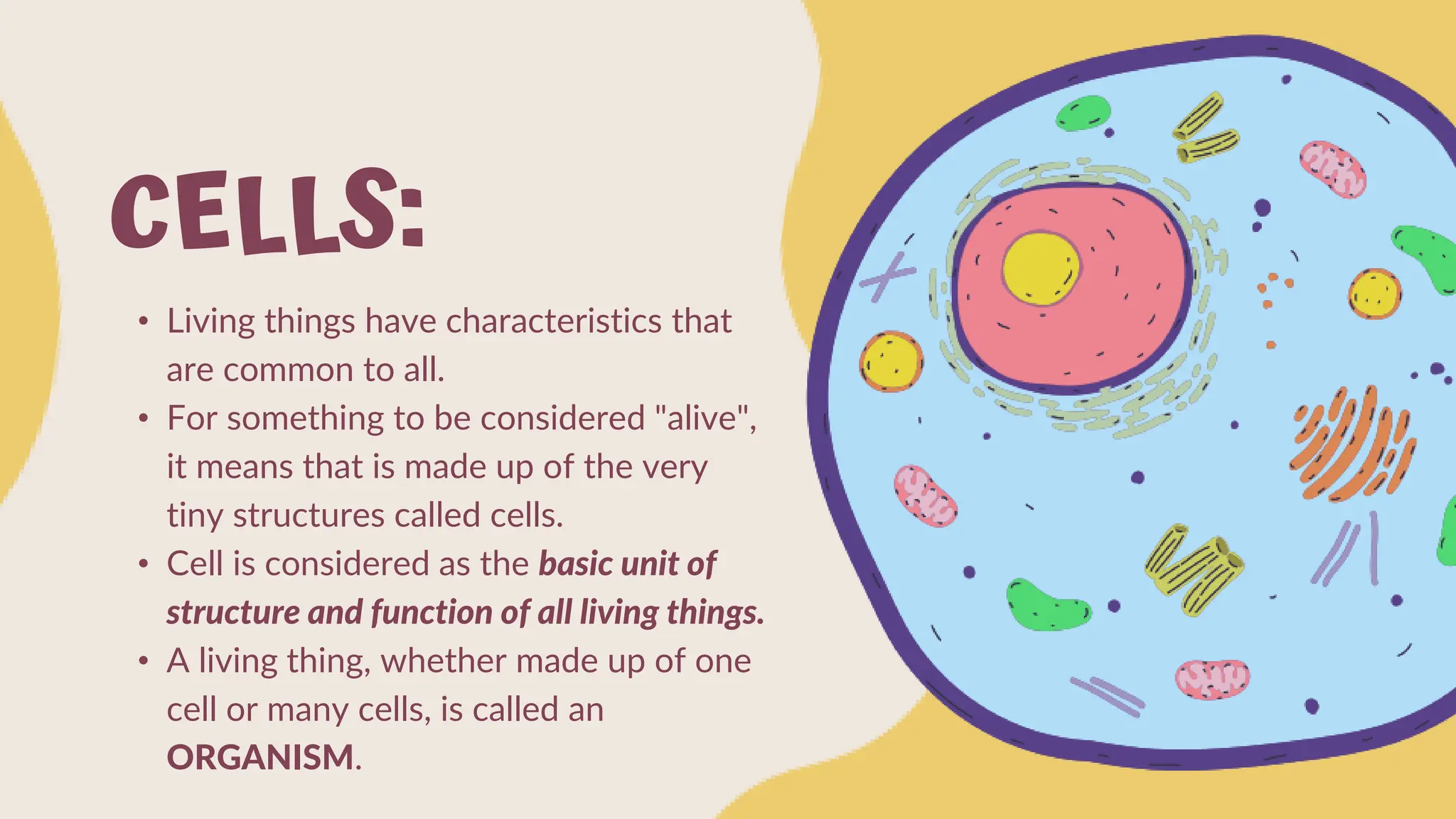
• Living things have characteristics that
are common to all.
• For something to be considered "alive",
it means that is made up of the very
tiny structures called cells.
• Cell is considered as the basic unit of
structure and function of all living things.
• A living thing, whether made up of one
cell or many cells, is called an
ORGANISM.
CELLS:
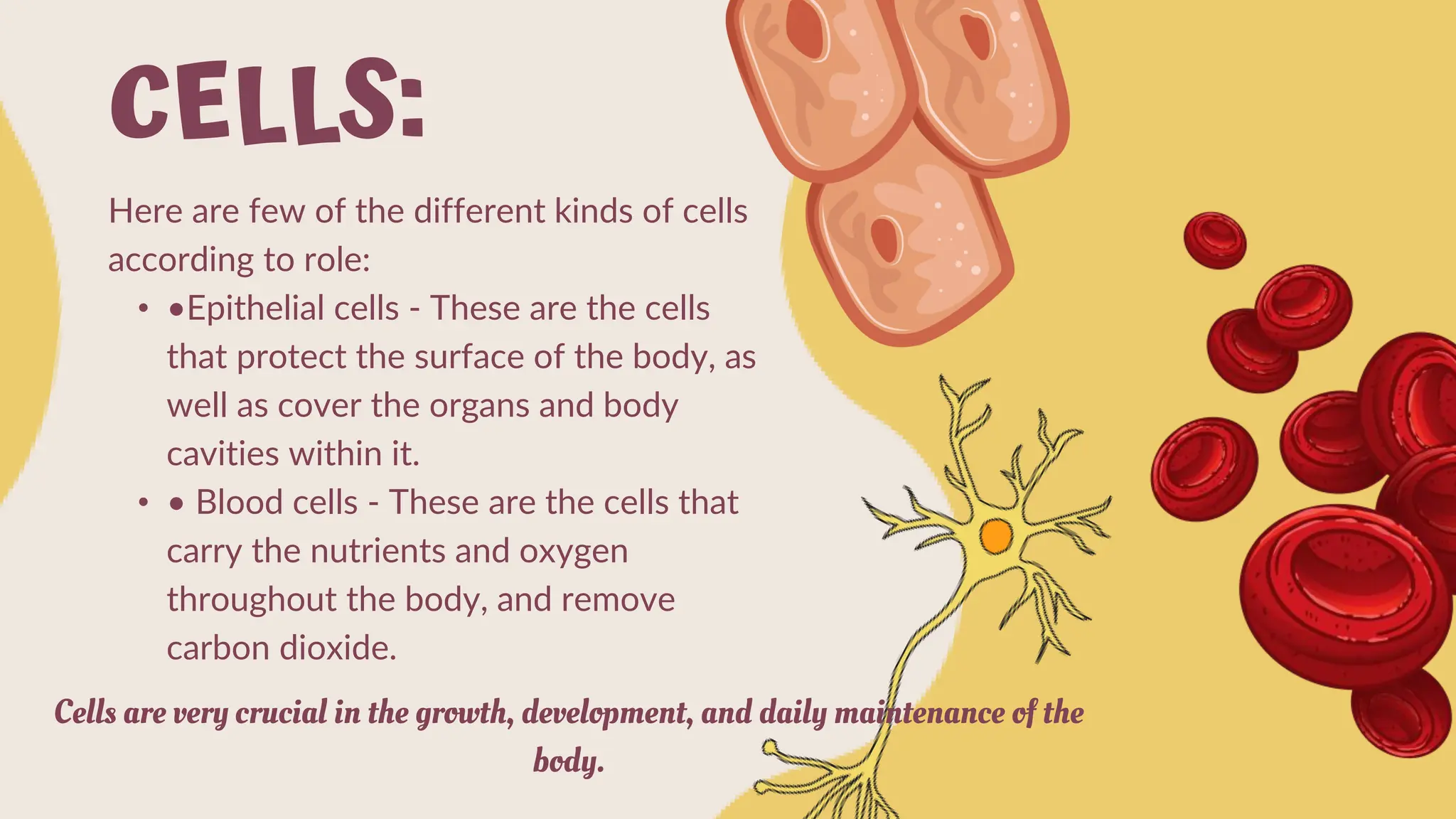
Here are few of the different kinds of cells
according to role:
• •Epithelial cells - These are the cells
that protect the surface of the body, as
well as cover the organs and body
cavities within it.
• • Blood cells - These are the cells that
carry the nutrients and oxygen
throughout the body, and remove
carbon dioxide.
Cells are very crucial in the growth, development, and daily maintenance of the
body.
CELL THEORY
• The cell theory is called the foundation
of modern biology.
• It served as the guiding paradigm to
succeeding scientists who established
hallmarks in biology.
CELL THEORY
Let us trace the discovery of the cell through the
scientists who contributed their own theories.
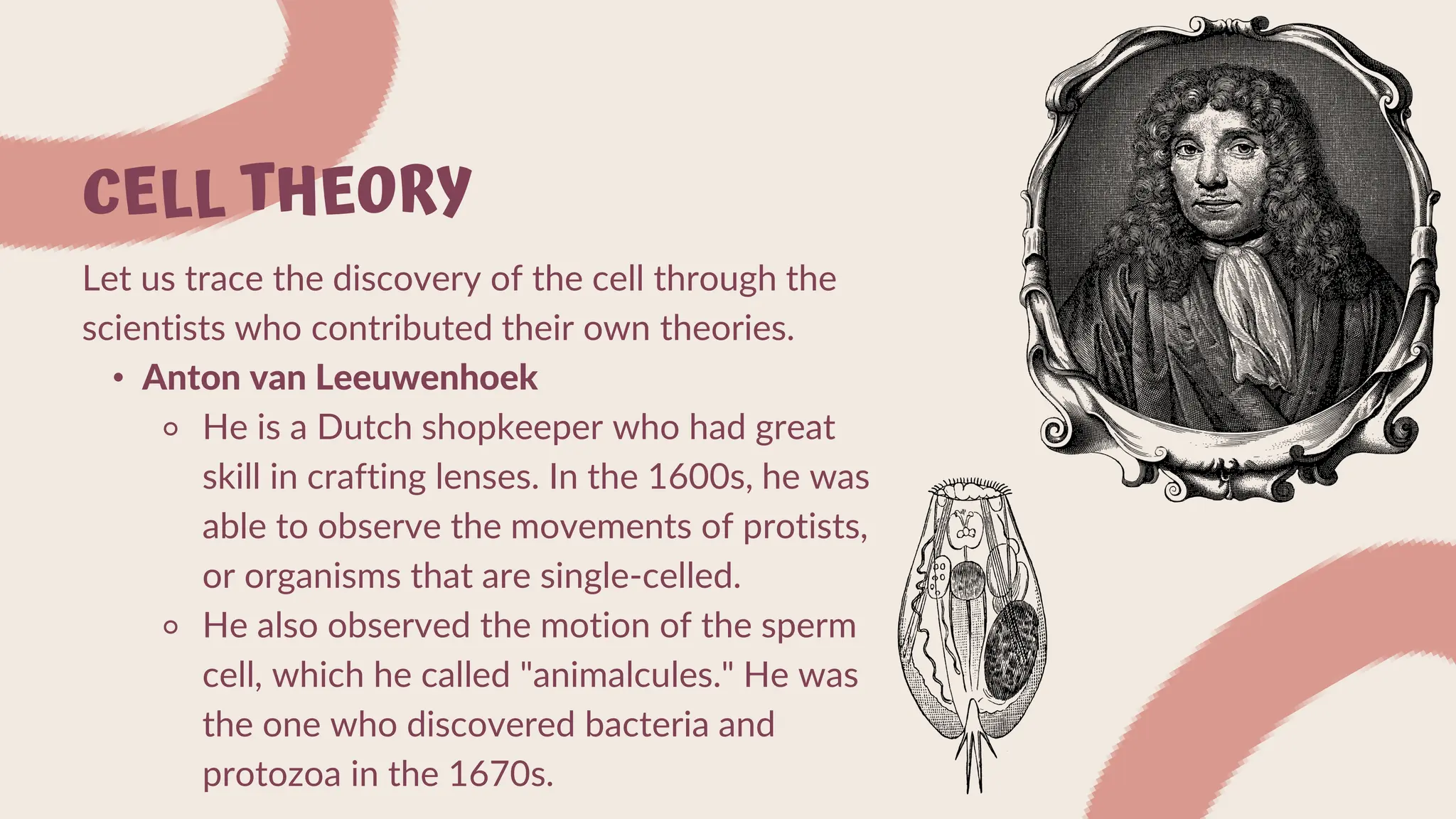
• Anton van Leeuwenhoek
⚬ He is a Dutch shopkeeper who had great
skill in crafting lenses. In the 1600s, he was
able to observe the movements of protists,
or organisms that are single-celled.
⚬ He also observed the motion of the sperm
cell, which he called "animalcules." He was
the one who discovered bacteria and
protozoa in the 1670s.
CELL THEORY
Let us trace the discovery of the cell through the
scientists who contributed their own theories.
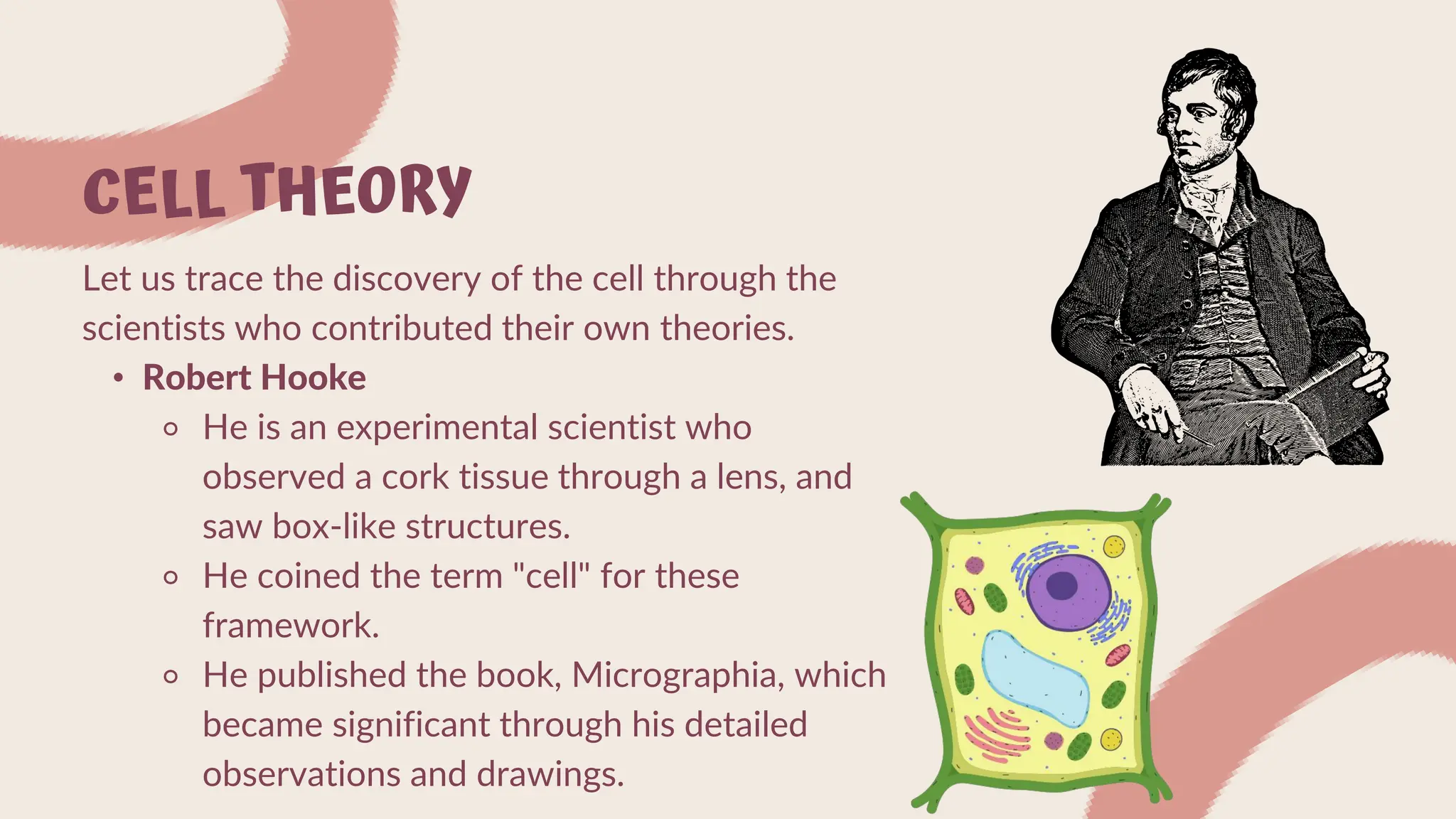
• Robert Hooke
⚬ He is an experimental scientist who
observed a cork tissue through a lens, and
saw box-like structures.
⚬ He coined the term "cell" for these
framework.
⚬ He published the book, Micrographia, which
became significant through his detailed
observations and drawings.
CELL THEORY
Let us trace the discovery of the cell through the scientists who
contributed their own theories.
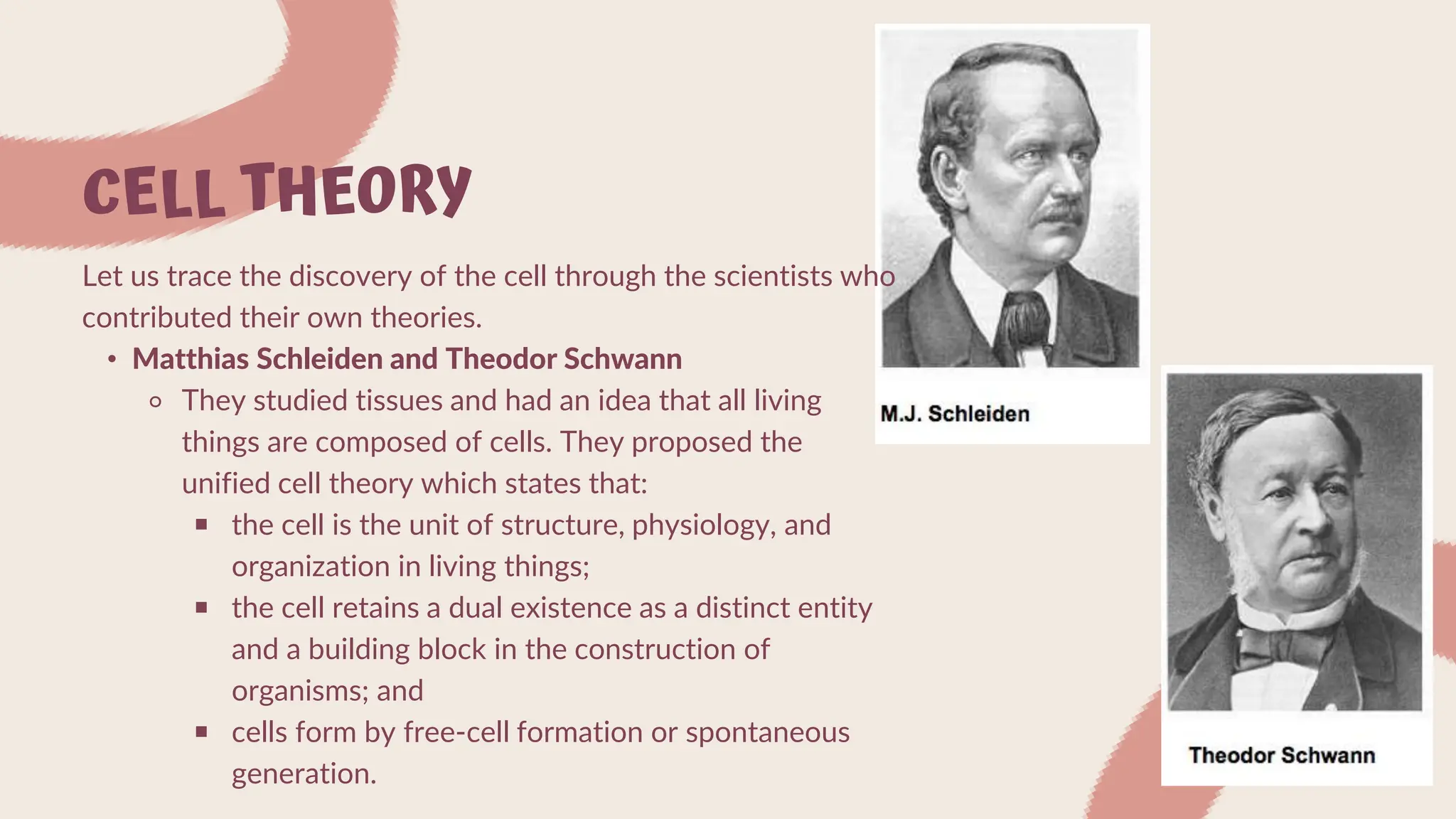
• Matthias Schleiden and Theodor Schwann
⚬ They studied tissues and had an idea that all living
things are composed of cells. They proposed the
unified cell theory which states that:
■ the cell is the unit of structure, physiology, and
organization in living things;
■ the cell retains a dual existence as a distinct entity
and a building block in the construction of
organisms; and
■ cells form by free-cell formation or spontaneous
generation.
Let us trace the discovery of the cell through the
scientists who contributed their own theories.
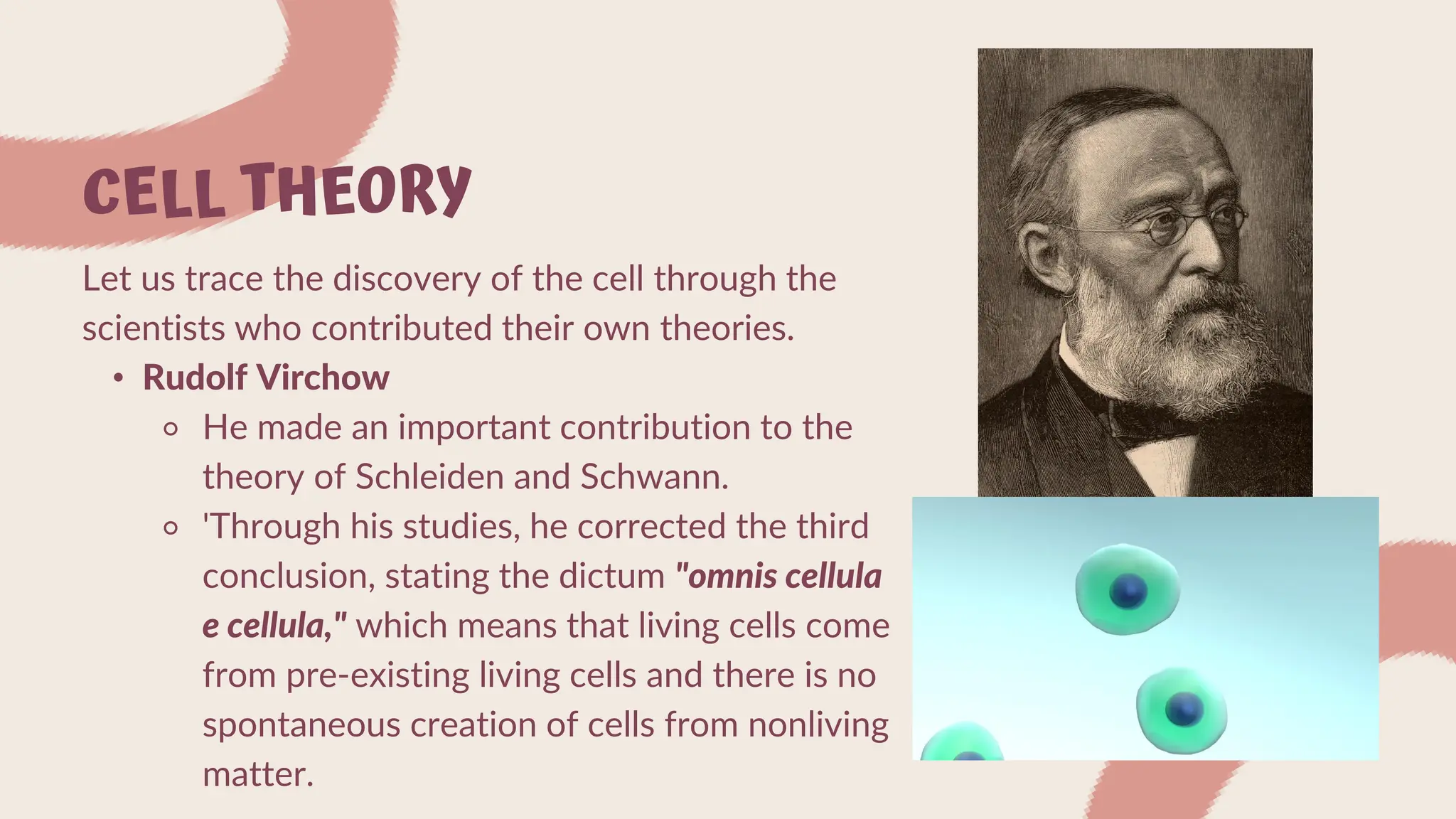
• Rudolf Virchow
⚬ He made an important contribution to the
theory of Schleiden and Schwann.
⚬ 'Through his studies, he corrected the third
conclusion, stating the dictum "omnis cellula
e cellula," which means that living cells come
from pre-existing living cells and there is no
spontaneous creation of cells from nonliving
matter.
CELL THEORY
'THROUGH THE CELL THEORIES PROPOSED BY THE EARLY SCIENTISTS-THAT ALL LIVING
CHINGS ARE COMPOSED OF CELLS AND THAT ALL CELLS ARISE FROM OTHER CELLS-
CAME THE BASIS FOR A WORKING DEFINITION OF LIVING THINGS.
CELL & CELL THEORY
• All known living things are made up of cells.
• The cell is the structural and functional unit of all
living things.
• All cells come from pre-existing cells by division.
• Cells contain hereditary information that is passed
from cell to cell during cell division.
• All cells are basically the same in chemical
composition.
• All energy flow of life occurs within cells.
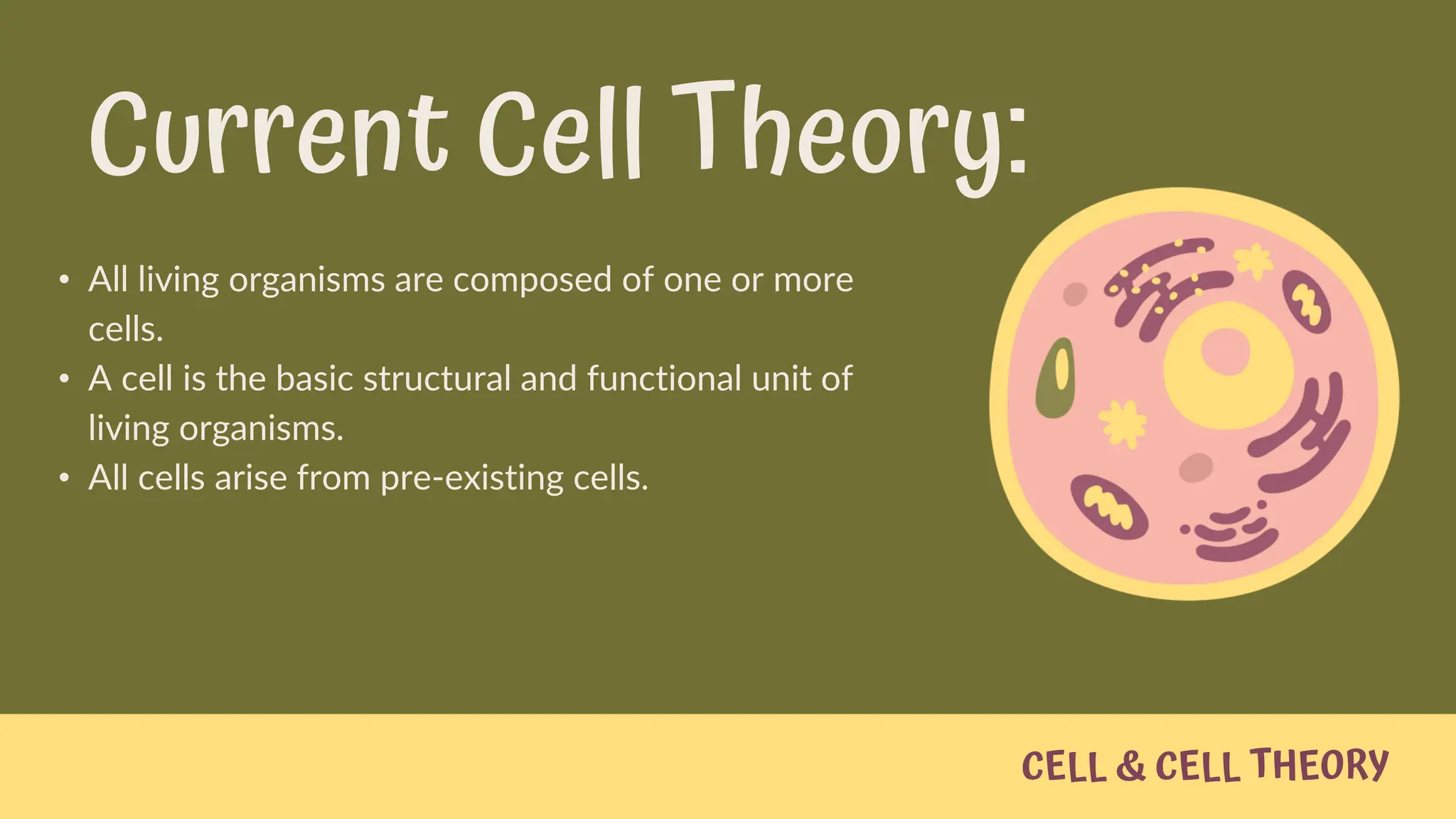
Current Cell Theory:
CELL & CELL THEORY
• All living organisms are composed of one or more
cells.
• A cell is the basic structural and functional unit of
living organisms.
• All cells arise from pre-existing cells.
Don't hesitate to ask any
questions!
THANK YOU FOR
LISTENING!

1 Cells and Cell theory.pdf

  • 1.
    Prepared by: SirCee Jae Q. Darunday, LPT CELLS AND CELL THEORY
  • 2.
    CELLS: • Living thingshave characteristics that are common to all. • For something to be considered "alive", it means that is made up of the very tiny structures called cells. • Cell is considered as the basic unit of structure and function of all living things. • A living thing, whether made up of one cell or many cells, is called an ORGANISM.
  • 3.
    CELLS: Here are fewof the different kinds of cells according to role: • •Epithelial cells - These are the cells that protect the surface of the body, as well as cover the organs and body cavities within it. • • Blood cells - These are the cells that carry the nutrients and oxygen throughout the body, and remove carbon dioxide. Cells are very crucial in the growth, development, and daily maintenance of the body.
  • 4.
    CELL THEORY • Thecell theory is called the foundation of modern biology. • It served as the guiding paradigm to succeeding scientists who established hallmarks in biology.
  • 5.
    CELL THEORY Let ustrace the discovery of the cell through the scientists who contributed their own theories. • Anton van Leeuwenhoek ⚬ He is a Dutch shopkeeper who had great skill in crafting lenses. In the 1600s, he was able to observe the movements of protists, or organisms that are single-celled. ⚬ He also observed the motion of the sperm cell, which he called "animalcules." He was the one who discovered bacteria and protozoa in the 1670s.
  • 6.
    CELL THEORY Let ustrace the discovery of the cell through the scientists who contributed their own theories. • Robert Hooke ⚬ He is an experimental scientist who observed a cork tissue through a lens, and saw box-like structures. ⚬ He coined the term "cell" for these framework. ⚬ He published the book, Micrographia, which became significant through his detailed observations and drawings.
  • 7.
    CELL THEORY Let ustrace the discovery of the cell through the scientists who contributed their own theories. • Matthias Schleiden and Theodor Schwann ⚬ They studied tissues and had an idea that all living things are composed of cells. They proposed the unified cell theory which states that: ■ the cell is the unit of structure, physiology, and organization in living things; ■ the cell retains a dual existence as a distinct entity and a building block in the construction of organisms; and ■ cells form by free-cell formation or spontaneous generation.
  • 8.
    Let us tracethe discovery of the cell through the scientists who contributed their own theories. • Rudolf Virchow ⚬ He made an important contribution to the theory of Schleiden and Schwann. ⚬ 'Through his studies, he corrected the third conclusion, stating the dictum "omnis cellula e cellula," which means that living cells come from pre-existing living cells and there is no spontaneous creation of cells from nonliving matter. CELL THEORY
  • 9.
    'THROUGH THE CELLTHEORIES PROPOSED BY THE EARLY SCIENTISTS-THAT ALL LIVING CHINGS ARE COMPOSED OF CELLS AND THAT ALL CELLS ARISE FROM OTHER CELLS- CAME THE BASIS FOR A WORKING DEFINITION OF LIVING THINGS. CELL & CELL THEORY • All known living things are made up of cells. • The cell is the structural and functional unit of all living things. • All cells come from pre-existing cells by division. • Cells contain hereditary information that is passed from cell to cell during cell division. • All cells are basically the same in chemical composition. • All energy flow of life occurs within cells.
  • 10.
    Current Cell Theory: CELL& CELL THEORY • All living organisms are composed of one or more cells. • A cell is the basic structural and functional unit of living organisms. • All cells arise from pre-existing cells.
  • 11.
    Don't hesitate toask any questions! THANK YOU FOR LISTENING!