Plant Organs System
Roots & Stem
Leaf
Flower & Fruits
The plant body consists of two basic parts:
the shoot system and the root system.
• Shoot System: includes organs such as
leaves, buds, stems, flowers, and fruits and usually it
develops above ground.
– The functions of the shoot system includes:
• Photosynthesis
• Reproduction
• Storage
• Transport
• Hormone production
• Root System: includes roots as well as
modified stem structures such as tubers and
rhizomes and usually it develops underground.
– The functions of the root system includes:
• Anchorage
• Absorption
• Storage
• Transport
• Production of certain hormones
• ROOTS & STEM
• LEAF
• FLOWER & FRUITS
Roots
• Root
– is the organ of a plant that typically lies below the
surface of the soil.
– a root can also be aerial (growing above the
ground) or aerating (growing up above the ground
or especially above water).
– PARTS OF A ROOT.
PARTS OF A ROOT
• Root tip Cambium
– Meristem Water Uptake
– root cap Mineral Uptake
• The Region of Elongation Gas Exchange
• The Region of Differentiation
– Epidermis
– Cortex
– Endodermis
– Stele
• Pericycle
• Xylem
• Phloem
PARTS OF A ROOT
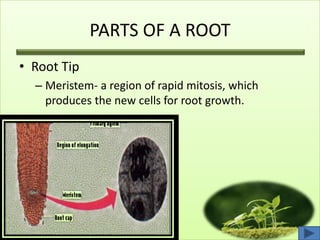
• Root Tip
– Meristem- a region of rapid mitosis, which
produces the new cells for root growth.
PARTS OF A ROOT
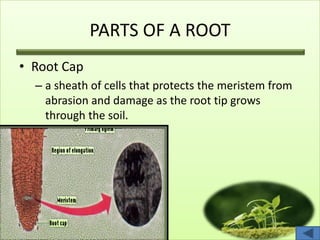
• Root Cap
– a sheath of cells that protects the meristem from
abrasion and damage as the root tip grows
through the soil.
PARTS OF A ROOT
• The Region of Elongation
– Here the cells produced by mitosis undergo a
period of elongation in the direction of the axis of
the root. It is at this time that they are sensitive to
gravity and respond with gravitropism.
PARTS OF A ROOT
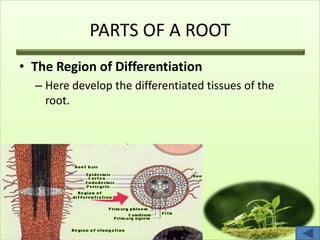
• The Region of Differentiation
– Here develop the differentiated tissues of the
root.
PARTS OF A ROOT
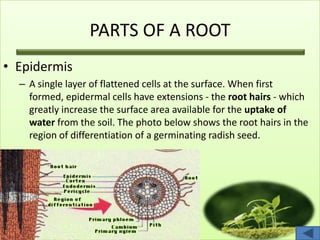
• Epidermis
– A single layer of flattened cells at the surface. When first
formed, epidermal cells have extensions - the root hairs - which
greatly increase the surface area available for the uptake of
water from the soil. The photo below shows the root hairs in the
region of differentiation of a germinating radish seed.
PARTS OF A ROOT
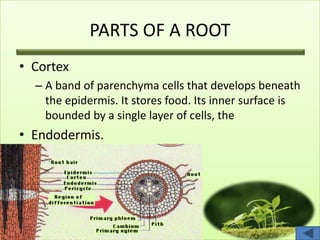
• Cortex
– A band of parenchyma cells that develops beneath
the epidermis. It stores food. Its inner surface is
bounded by a single layer of cells, the
• Endodermis.
PARTS OF A ROOT
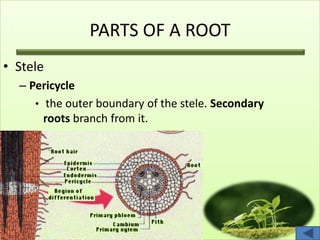
• Stele
– Pericycle
• the outer boundary of the stele. Secondary
roots branch from it.
PARTS OF A ROOT
• Xylem
– arranged in bundles in a spoke like fashion.
– caries water and disolved nutrients from the roots
throughout the plant.
PARTS OF A ROOT
• Phloem
– alternates with xylem.
– carries/ distributes the products of photosynthesis
(mainly from the leaves) to the rest of the plants.
PARTS OF A ROOT
• Cambium
– In older parts of the root, another meristem forms
between the xylem and phloem. Mitosis in the cambium
produces new "secondary xylem" to the inside
and secondary phloem to the outside.
PARTS OF A ROOT
• Water Uptake
– Water enters the root through the root hairs. These
extensions of epidermal cells have sickly walls and adhere
tightly to soil particles with their film of moisture.
PARTS OF A ROOT
• Mineral Uptake
– One might have expected that minerals would enter the
root dissolved in water. But, in fact, minerals enter
separately:Even when no water is being
absorbed, minerals enter freely.
– Minerals can enter against their concentration gradient;
that is, by active transport.
– Anything that interferes with the metabolism of root cells
interferes with mineral absorption.
PARTS OF A ROOT
• Gas Exchange
– The older parts of roots are sheathed in layers of dead cork
cells impregnated with a waxy, waterproof (and airproof)
substance called suberin. This sheath reduces water loss
but is as impervious to oxygen and carbon dioxide as it is
to water.
– However, the cork is perforated by nonsuberized pores
called lenticels. These permit the exchange of oxygen and
carbon dioxide between the air and the living cells
beneath.
Stem
• Stem
– A stem is one of two main structural axes of a vascular
plant.
– The stem is normally divided into nodes and
internodes, the nodes hold buds which grow into one or
more leaves, inflorescence (flowers), conifer
cones, roots, other stems etc.
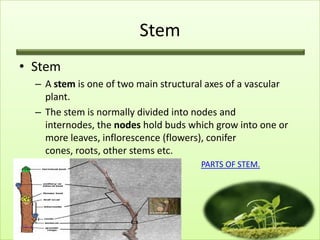
• PARTS OF STEM.
PARTS OF STEM
Leaf scar - is the mark left on a stem
after a leaf falls.
Terminal bud - is the main area of
growth in most plants.
Lenticel - it function as a
pore, providing a medium for the direct
exchange og gases between the internal
tissues and atmosphere.
Flower bud – have not yet bloomed
into a full-size flower.
Growth rings - also referred to as tree
rings or annual rings, can be seen in a
horizontal cross section cut through the
trunk of a tree.
Leaf
• Leaf
– A leaf is an organ of a vascular plant, as defined
in botanical terms, and in particular in plant morphology.
– Typically a leaf is a thin, flattened organ borne above
ground and specialized for photosynthesis, but many types
of leaves are adapted in ways almost unrecognisable in
those terms: some are not flat (for example
many succulent leaves and conifers), some are not above
ground (such as bulb scales), and some are without major
photosynthetic function (consider for
example cataphylls, spines, and cotyledons).
– PARTS OF THE LEAF.
Chloroplasts
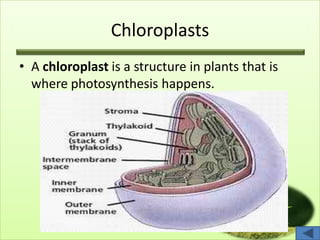
• A chloroplast is a structure in plants that is
where photosynthesis happens.
Flower
• Flower
– A flower is the part of the plant that makes the
seeds.
– A flower, sometimes known as a bloom or
blossom, is the reproductive structure found
in flowering plants.
– PARTS OF A FLOWER.
Parts of Flower
• Pollen
• Anther
• Filament
• Stamen
• Stigma
• Style
• Ovary
• Pistil
• Seeds
• Sepal
• Petals
• Stem
Parts of Flower
• Pollen
– sperm of the plant.
– is a fine to coarse powder containing the micro
gametophytes of seed plants, which produce the
male gametes (sperm cells).
Parts of Flower
• Anther
– contains the pollen.
Parts of Flower
• Filament
– are a series of chain like cells.
– stalk on which anther is attached, longer in wind pollinated
plants.
Parts of Flower
• Stamen
– male part of plant, parts where pollen anther and
filament are combined.
Parts of Flower
• Stigma
– sticky part to which pollen attaches.
Parts of Flower
• Style
– simply, a tube through which sperm travel to
seeds.
Parts of Flower
• Ovary
– contains the seeds, later to become the fruit of
the plant.
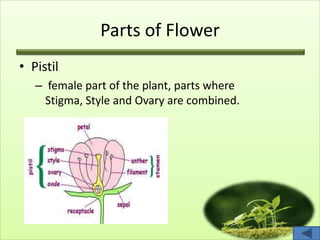
Parts of Flower
• Pistil
– female part of the plant, parts where
Stigma, Style and Ovary are combined.
Parts of Flower
• Seeds
– future plants, contained in the ovary.
Parts of Flower
• Sepal
– tiny leaf-like structures that protect the flower as
a bud.
Parts of Flower
• Petals
– brightly colored, used to attract pollinators.
Parts of Flower
• Stem
– supports the flower.
Fruits
• Fruits
– is a part of a flowering plant that derives from
specific tissues of the flower, one or
more ovaries, and in some cases accessory tissues.

Plant organs system

  • 1.
    Plant Organs System Roots& Stem Leaf Flower & Fruits
  • 2.
    The plant bodyconsists of two basic parts: the shoot system and the root system. • Shoot System: includes organs such as leaves, buds, stems, flowers, and fruits and usually it develops above ground. – The functions of the shoot system includes: • Photosynthesis • Reproduction • Storage • Transport • Hormone production
  • 3.
    • Root System:includes roots as well as modified stem structures such as tubers and rhizomes and usually it develops underground. – The functions of the root system includes: • Anchorage • Absorption • Storage • Transport • Production of certain hormones
  • 4.
    • ROOTS &STEM • LEAF • FLOWER & FRUITS
  • 5.
    Roots • Root – isthe organ of a plant that typically lies below the surface of the soil. – a root can also be aerial (growing above the ground) or aerating (growing up above the ground or especially above water). – PARTS OF A ROOT.
  • 6.
    PARTS OF AROOT • Root tip Cambium – Meristem Water Uptake – root cap Mineral Uptake • The Region of Elongation Gas Exchange • The Region of Differentiation – Epidermis – Cortex – Endodermis – Stele • Pericycle • Xylem • Phloem
  • 7.
    PARTS OF AROOT • Root Tip – Meristem- a region of rapid mitosis, which produces the new cells for root growth.
  • 8.
    PARTS OF AROOT • Root Cap – a sheath of cells that protects the meristem from abrasion and damage as the root tip grows through the soil.
  • 9.
    PARTS OF AROOT • The Region of Elongation – Here the cells produced by mitosis undergo a period of elongation in the direction of the axis of the root. It is at this time that they are sensitive to gravity and respond with gravitropism.
  • 10.
    PARTS OF AROOT • The Region of Differentiation – Here develop the differentiated tissues of the root.
  • 11.
    PARTS OF AROOT • Epidermis – A single layer of flattened cells at the surface. When first formed, epidermal cells have extensions - the root hairs - which greatly increase the surface area available for the uptake of water from the soil. The photo below shows the root hairs in the region of differentiation of a germinating radish seed.
  • 12.
    PARTS OF AROOT • Cortex – A band of parenchyma cells that develops beneath the epidermis. It stores food. Its inner surface is bounded by a single layer of cells, the • Endodermis.
  • 13.
    PARTS OF AROOT • Stele – Pericycle • the outer boundary of the stele. Secondary roots branch from it.
  • 14.
    PARTS OF AROOT • Xylem – arranged in bundles in a spoke like fashion. – caries water and disolved nutrients from the roots throughout the plant.
  • 15.
    PARTS OF AROOT • Phloem – alternates with xylem. – carries/ distributes the products of photosynthesis (mainly from the leaves) to the rest of the plants.
  • 16.
    PARTS OF AROOT • Cambium – In older parts of the root, another meristem forms between the xylem and phloem. Mitosis in the cambium produces new "secondary xylem" to the inside and secondary phloem to the outside.
  • 17.
    PARTS OF AROOT • Water Uptake – Water enters the root through the root hairs. These extensions of epidermal cells have sickly walls and adhere tightly to soil particles with their film of moisture.
  • 18.
    PARTS OF AROOT • Mineral Uptake – One might have expected that minerals would enter the root dissolved in water. But, in fact, minerals enter separately:Even when no water is being absorbed, minerals enter freely. – Minerals can enter against their concentration gradient; that is, by active transport. – Anything that interferes with the metabolism of root cells interferes with mineral absorption.
  • 19.
    PARTS OF AROOT • Gas Exchange – The older parts of roots are sheathed in layers of dead cork cells impregnated with a waxy, waterproof (and airproof) substance called suberin. This sheath reduces water loss but is as impervious to oxygen and carbon dioxide as it is to water. – However, the cork is perforated by nonsuberized pores called lenticels. These permit the exchange of oxygen and carbon dioxide between the air and the living cells beneath.
  • 20.
    Stem • Stem – Astem is one of two main structural axes of a vascular plant. – The stem is normally divided into nodes and internodes, the nodes hold buds which grow into one or more leaves, inflorescence (flowers), conifer cones, roots, other stems etc. • PARTS OF STEM.
  • 22.
    PARTS OF STEM Leafscar - is the mark left on a stem after a leaf falls. Terminal bud - is the main area of growth in most plants. Lenticel - it function as a pore, providing a medium for the direct exchange og gases between the internal tissues and atmosphere. Flower bud – have not yet bloomed into a full-size flower. Growth rings - also referred to as tree rings or annual rings, can be seen in a horizontal cross section cut through the trunk of a tree.
  • 23.
    Leaf • Leaf – Aleaf is an organ of a vascular plant, as defined in botanical terms, and in particular in plant morphology. – Typically a leaf is a thin, flattened organ borne above ground and specialized for photosynthesis, but many types of leaves are adapted in ways almost unrecognisable in those terms: some are not flat (for example many succulent leaves and conifers), some are not above ground (such as bulb scales), and some are without major photosynthetic function (consider for example cataphylls, spines, and cotyledons). – PARTS OF THE LEAF.
  • 26.
    Chloroplasts • A chloroplastis a structure in plants that is where photosynthesis happens.
  • 27.
    Flower • Flower – Aflower is the part of the plant that makes the seeds. – A flower, sometimes known as a bloom or blossom, is the reproductive structure found in flowering plants. – PARTS OF A FLOWER.
  • 28.
    Parts of Flower •Pollen • Anther • Filament • Stamen • Stigma • Style • Ovary • Pistil • Seeds • Sepal • Petals • Stem
  • 29.
    Parts of Flower •Pollen – sperm of the plant. – is a fine to coarse powder containing the micro gametophytes of seed plants, which produce the male gametes (sperm cells).
  • 30.
    Parts of Flower •Anther – contains the pollen.
  • 31.
    Parts of Flower •Filament – are a series of chain like cells. – stalk on which anther is attached, longer in wind pollinated plants.
  • 32.
    Parts of Flower •Stamen – male part of plant, parts where pollen anther and filament are combined.
  • 33.
    Parts of Flower •Stigma – sticky part to which pollen attaches.
  • 34.
    Parts of Flower •Style – simply, a tube through which sperm travel to seeds.
  • 35.
    Parts of Flower •Ovary – contains the seeds, later to become the fruit of the plant.
  • 36.
    Parts of Flower •Pistil – female part of the plant, parts where Stigma, Style and Ovary are combined.
  • 37.
    Parts of Flower •Seeds – future plants, contained in the ovary.
  • 38.
    Parts of Flower •Sepal – tiny leaf-like structures that protect the flower as a bud.
  • 39.
    Parts of Flower •Petals – brightly colored, used to attract pollinators.
  • 40.
    Parts of Flower •Stem – supports the flower.
  • 41.
    Fruits • Fruits – isa part of a flowering plant that derives from specific tissues of the flower, one or more ovaries, and in some cases accessory tissues.