Animal Cells
Ms. Bandy
Animal Cells
 Science Lesson


Student will be able to:
•identify the parts of a plant and animal cell
•state the function of the cell parts
•explain the differences between plant and animal cells
•Organize cells
What are cells?
What we know:   What we want to know:   What we learned:
Flashcards- Cell Unit

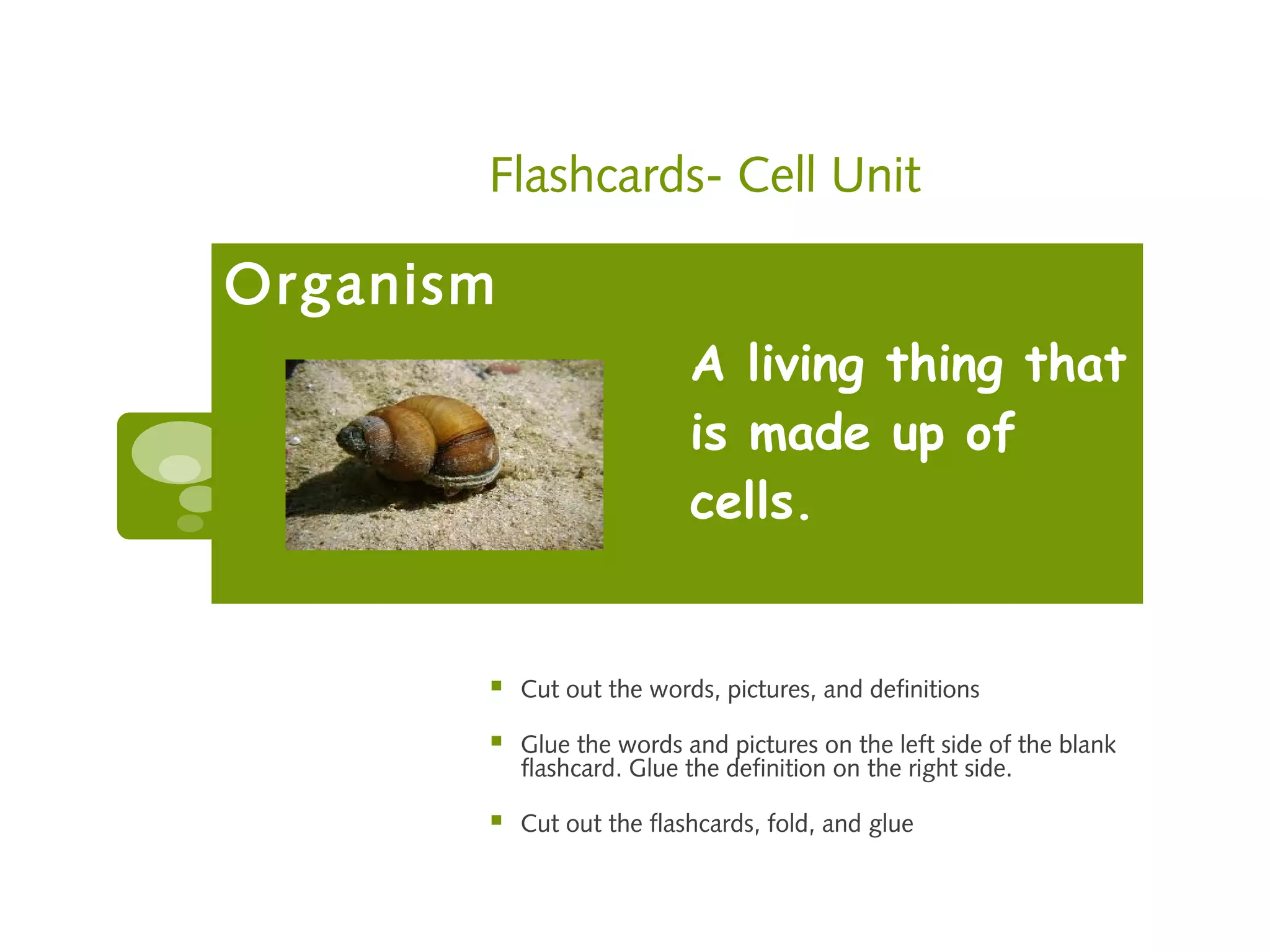
Organism
                           A living thing that
                           is made up of
                           cells.


       ď‚§   Cut out the words, pictures, and definitions

       ď‚§   Glue the words and pictures on the left side of the blank
           flashcard. Glue the definition on the right side.

       ď‚§   Cut out the flashcards, fold, and glue
Vocabulary Charades

ď‚§   Divide into groups

ď‚§   Each group will be assigned a vocabulary
    word.

ď‚§   Each group will have 2 to 3 minutes to come
    up with how to act out their word without
    speaking.

ď‚§   The class will play charades. Each group will
    take turns guessing the vocabulary word that
    is being acted out.
What are cells?
ď‚§   What are cells?

Cells are the smallest unit of living things that can carry out the
  basic processes of life.

ď‚§   Where do cells come from?

They come from other cells-Cells split or divided into two new
  cells- cells continually divide to make more cells for growth
  and repair.

Mitosis- Mitosis describes the process by which the nucleus of
 a cell divides to create two new nuclei, each containing an
 identical copy of DNA.

Meiosis- Meiosis, as described above, is the process by which
 certain sex cells are created.

http://www.pbs.org/wgbh/nova/miracle/media/divi.swf
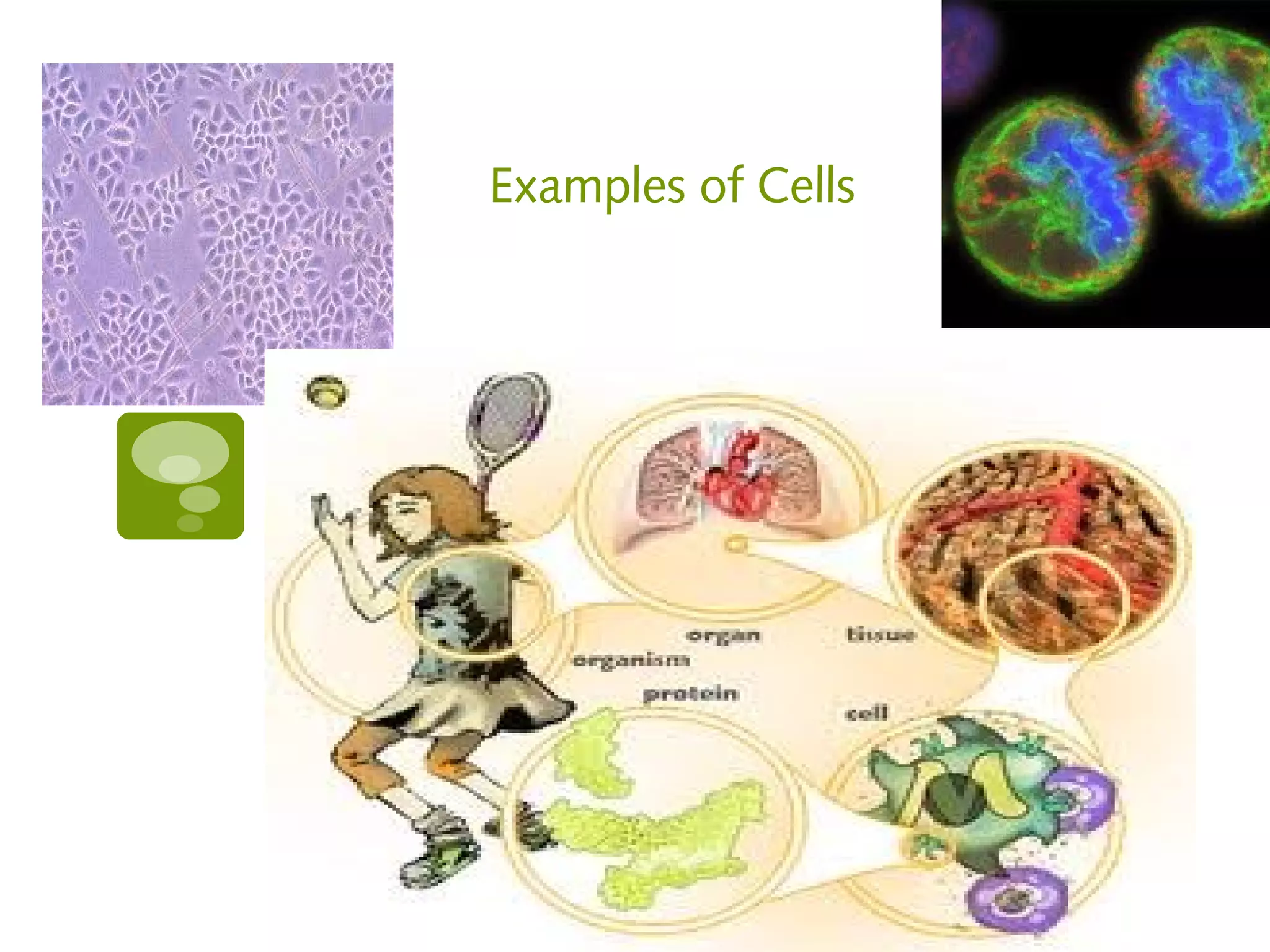
Examples of Cells

ď‚§
Organisms

ď‚§   What do cells make when they come
    together?

          Organisms

ď‚§   What are organisms?

    Organisms are living things. These
    organisms can range from microscopic to
    giant animals.

ď‚§   What do organisms have in common?

All living organisms are made up of cells.
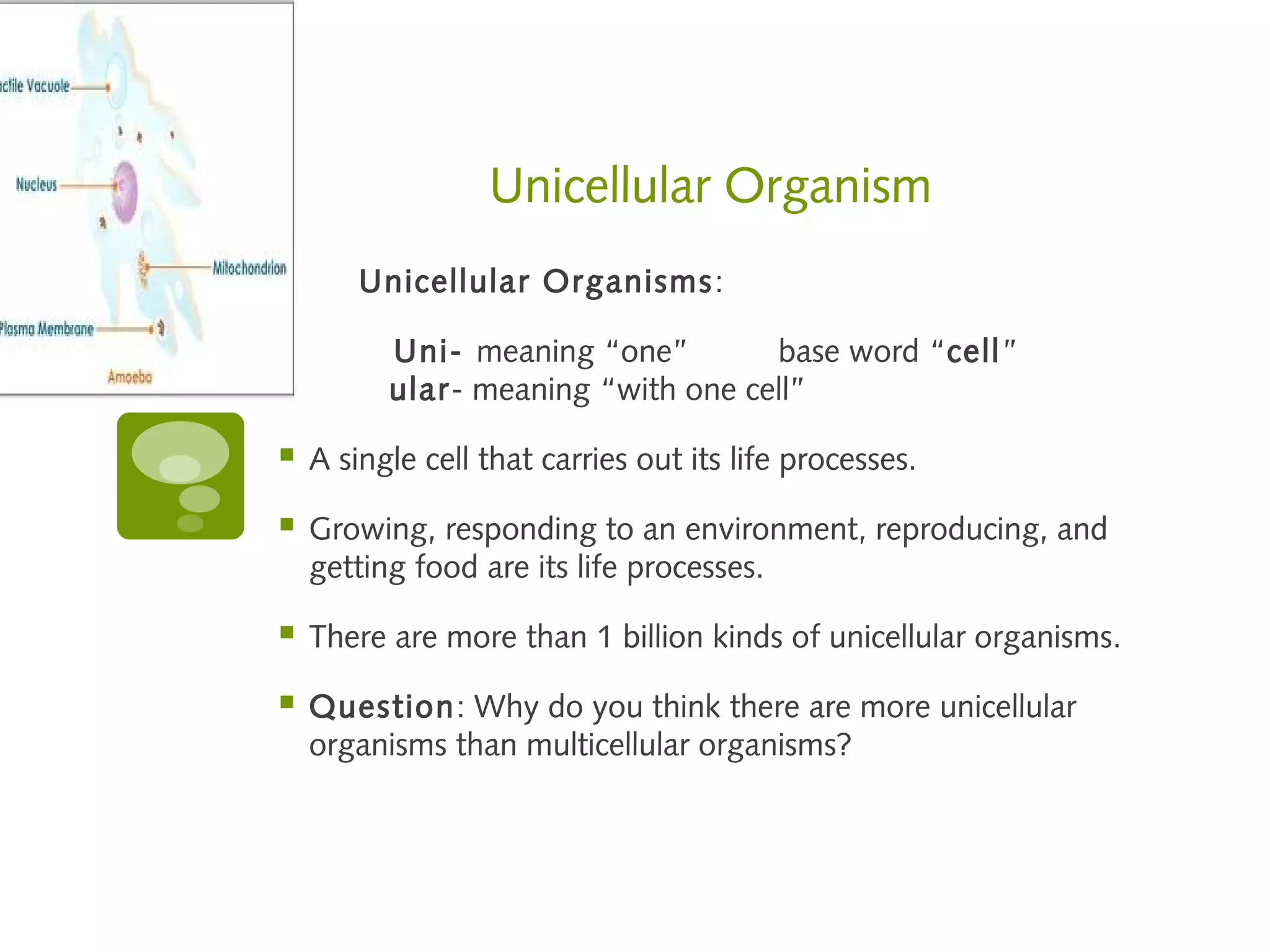
Unicellular Organism
        Unicellular Organisms :

          Uni- meaning “one”        base word “cell”
          ular- meaning “with one cell”

ď‚§   A single cell that carries out its life processes.

ď‚§   Growing, responding to an environment, reproducing, and
    getting food are its life processes.

ď‚§   There are more than 1 billion kinds of unicellular organisms.

ď‚§   Question: Why do you think there are more unicellular
    organisms than multicellular organisms?
Multicellular Organisms

                           Multicellular Organisms :

multus- means “many”; base word “cell”; ular- “with many cells”

ď‚§   Organisms are made of more than one cell.

ď‚§   Multicellular organisms include snakes, flowers, and you.

ď‚§   Every cell carries out its own life process. The cells work together to
    take care of different functions for the organism.

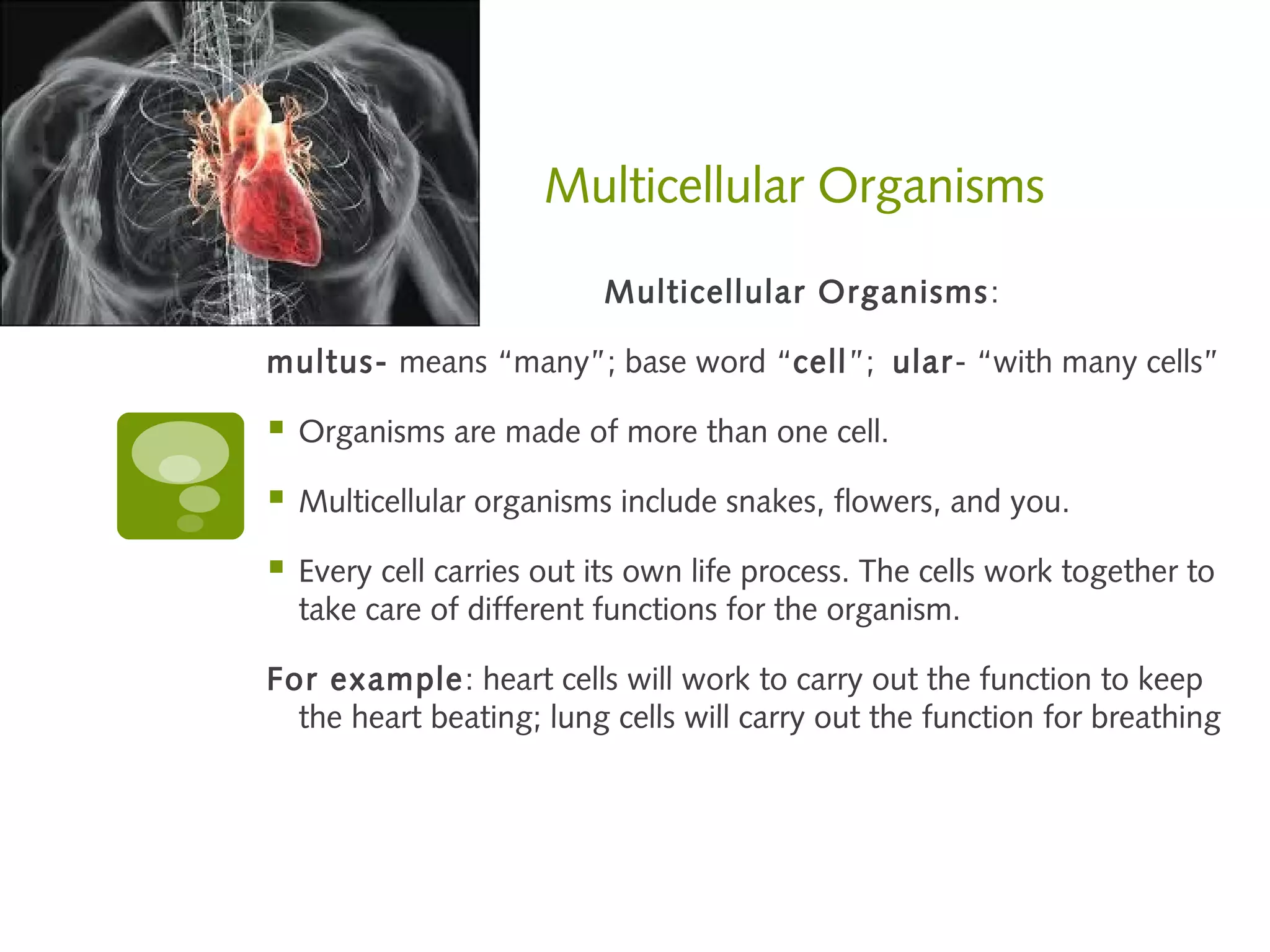
For example: heart cells will work to carry out the function to keep
  the heart beating; lung cells will carry out the function for breathing
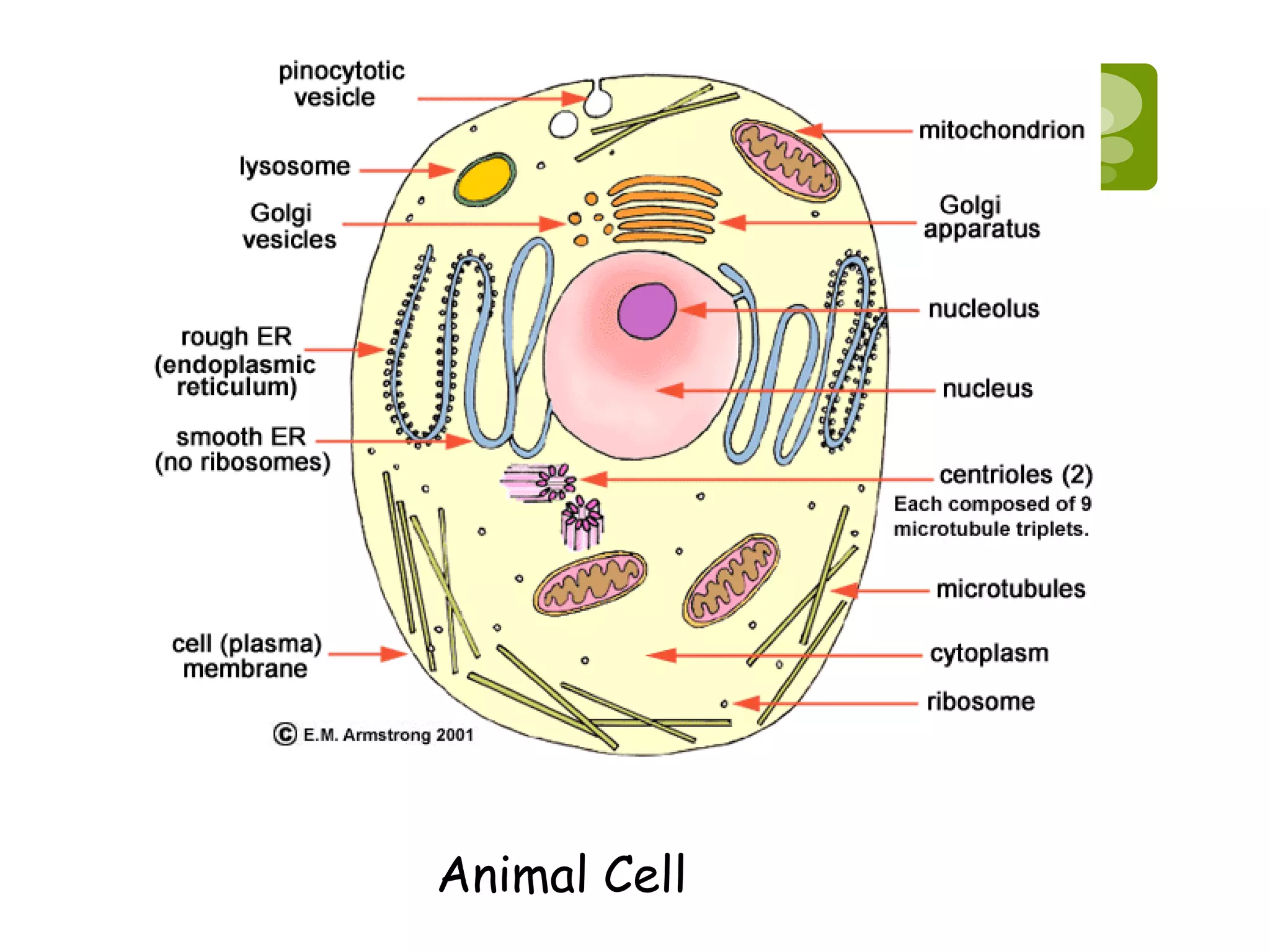
Animal Cell

ď‚§   All organisms are made up of cells.

ď‚§   Our bodies alone have more than 200 different kinds of cells.

          For example: skin cells, heart cells, blood cells, etc.

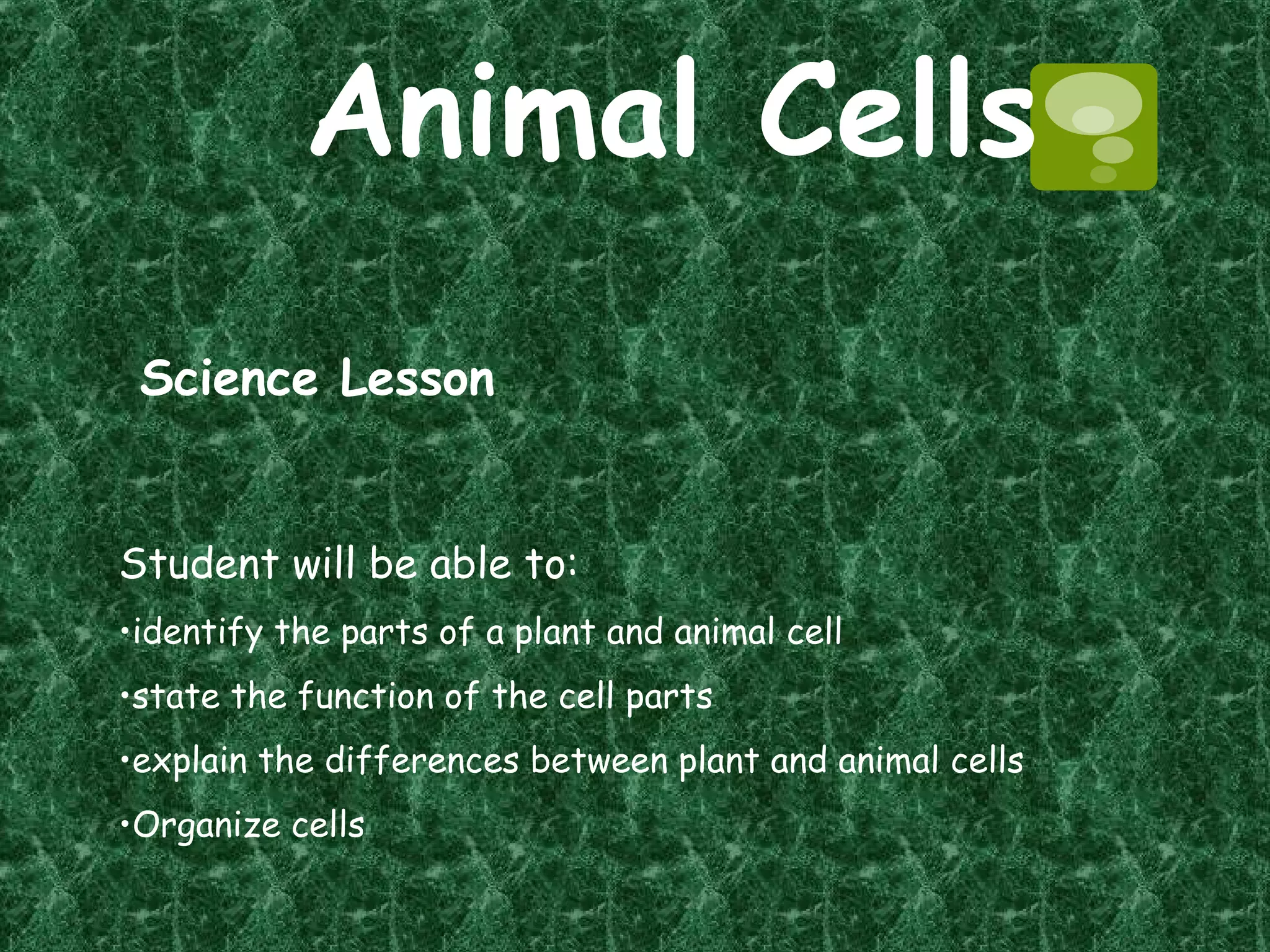
ď‚§   Animal Cells have basic structures that help the cell perform
    life process and keep the cell alive.

ď‚§   These basic structures are called organelles.

ď‚§ Main    Organelles of an Animal Cell:

Nucleus, cytoplasm, vacuole, mitochondria, cell membrane
Organelles and their jobs

    Cell Membrane

ď‚§   The layer around the outside of the cell.

ď‚§   It is the skin of the cell.

ď‚§   It controls which substances enter and leave the cell.

    Cytoplasm

ď‚§   A gel like liquid that occupies the region from the nucleus
    to the cell membrane.

   It supports all of the cell’s structures.

   Some of the cell’s life processes take place in the
    cytoplasm.
Organelles and their jobs

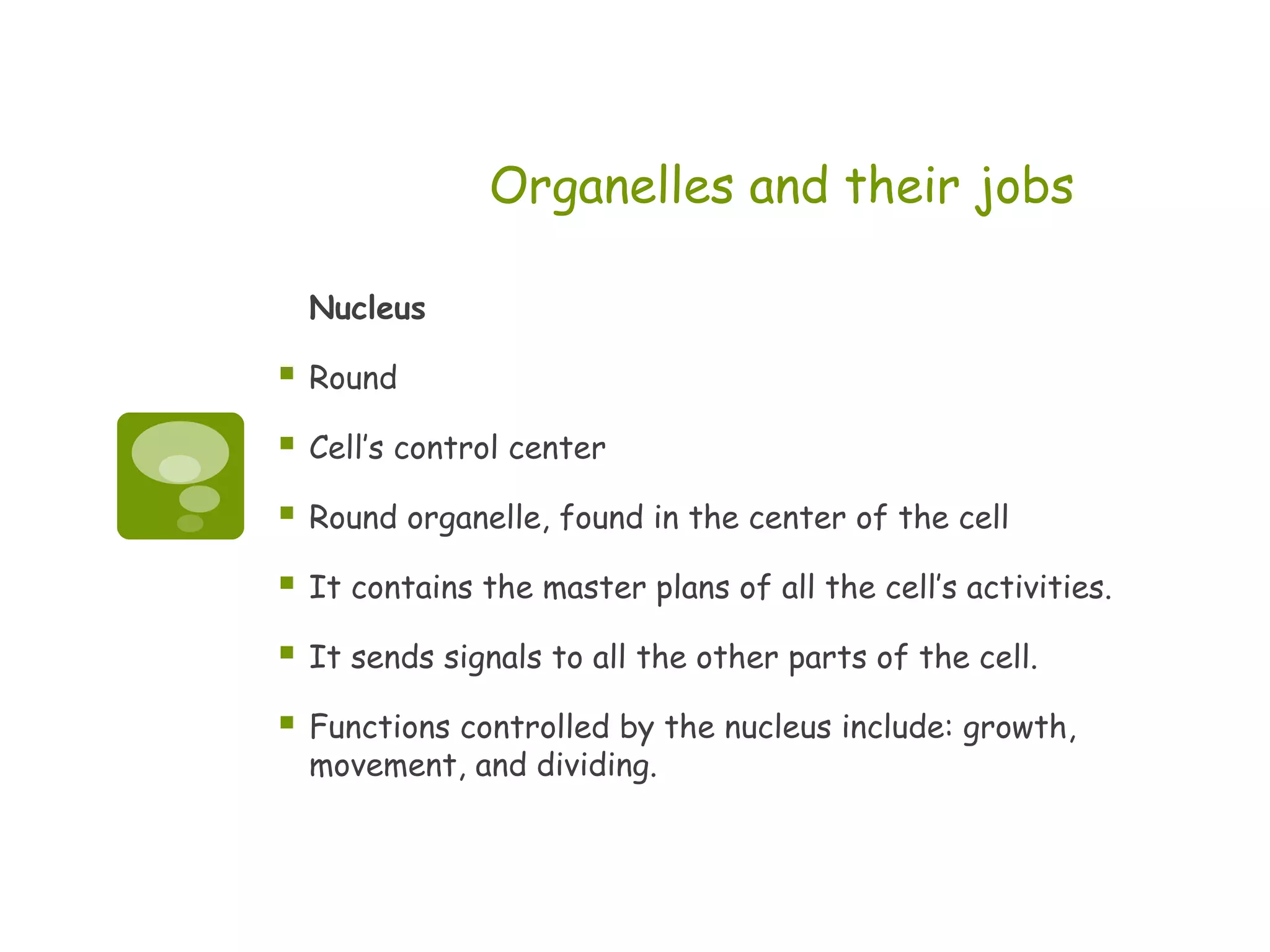
    Nucleus

ď‚§   Round

   Cell’s control center

ď‚§   Round organelle, found in the center of the cell

   It contains the master plans of all the cell’s activities.

ď‚§   It sends signals to all the other parts of the cell.

ď‚§   Functions controlled by the nucleus include: growth,
    movement, and dividing.
Organelles and their jobs

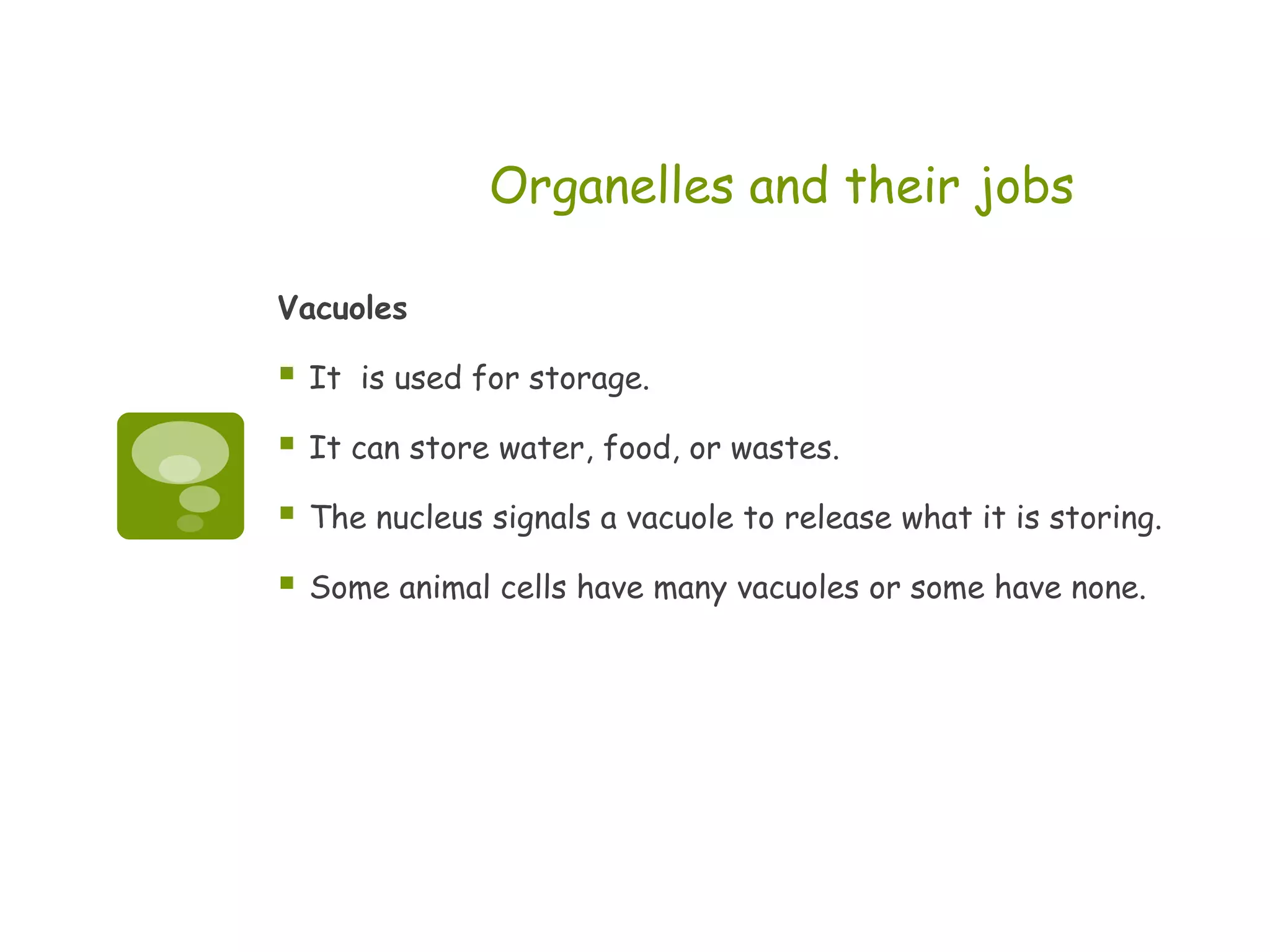
Vacuoles

ď‚§   It is used for storage.

ď‚§   It can store water, food, or wastes.

ď‚§   The nucleus signals a vacuole to release what it is storing.

ď‚§   Some animal cells have many vacuoles or some have none.
Organelles and their jobs

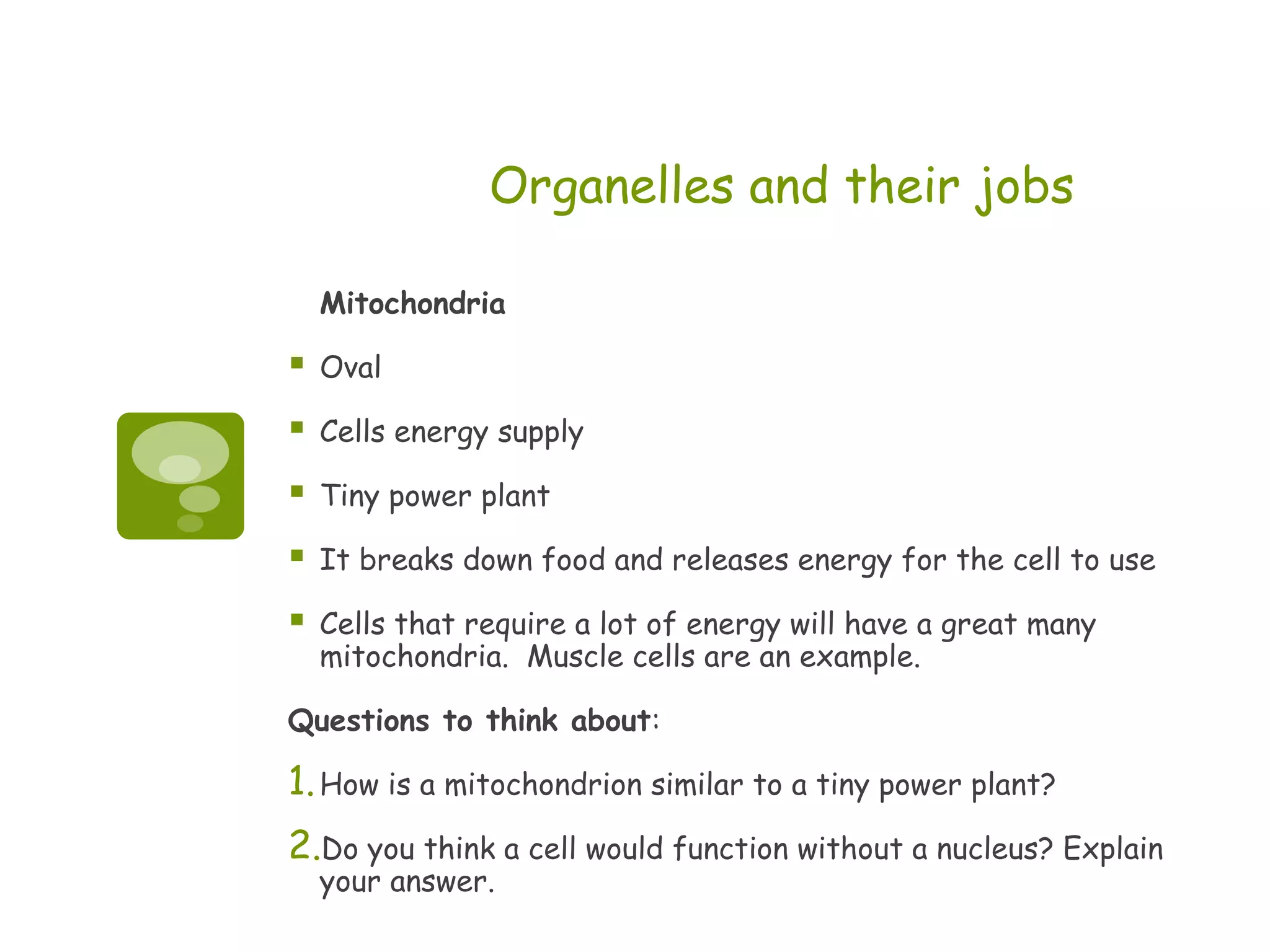
    Mitochondria

ď‚§   Oval

ď‚§   Cells energy supply

ď‚§   Tiny power plant

ď‚§   It breaks down food and releases energy for the cell to use

ď‚§   Cells that require a lot of energy will have a great many
    mitochondria. Muscle cells are an example.

Questions to think about:

1. How is a mitochondrion similar to a tiny power plant?
2.Do you think a cell would function without a nucleus? Explain
    your answer.
Human Cell Activity


Students will be
 assigned parts of the
 cell and take turns
 forming a cell.
Animal Cell
Make an Animal Cell Booklet

ď‚§   Choose 7 pieces of paper

ď‚§   Arrange them from least to greatest

ď‚§   The least will be title page. Decorate how
    you want it

ď‚§   The greatest will be page that the animal
    cell is drawn, labeled, and colored

ď‚§   The between pages are for organelles.
    Draw organelle and list facts about the
    organelle.

ď‚§   Title each page correctly. Look at example
    to check to see if titled correctly.
Let’s review: discuss these
questions with a partner.

1.   What is a cell?

2.   What is a an organism?

3.   Name the two types of organisms and their
     definitions.

4.   How do cells divide? What are the two
     processes?

5.   Name the five organelles.

6.   Name the functions of the five organelles.

7.   How is a tissue formed? Organ? Organ
     system?
Cell paragraph

1.   You are a cell. You need to be a certain type of cell.

2.   You are going to write a paragraph or paragraphs about what
     makes up a cell.

3.   You will begin with what is a cell?

4.   What do cells make up?

5.   How are cells produced?

6.   You are to describe the organelles and their functions.

7.   You are to include the following vocabulary words in your
     paragraph(s): cell, organism, unicellular, multicellular, tissue, organ,
     organ system

8.   Vocabulary words are to be used in the story and need to make
     sense.

Animal cell pp lesson

  • 1.
  • 2.
    Animal Cells ScienceLesson Student will be able to: •identify the parts of a plant and animal cell •state the function of the cell parts •explain the differences between plant and animal cells •Organize cells
  • 3.
    What are cells? Whatwe know: What we want to know: What we learned:
  • 5.
    Flashcards- Cell Unit Organism A living thing that is made up of cells. ď‚§ Cut out the words, pictures, and definitions ď‚§ Glue the words and pictures on the left side of the blank flashcard. Glue the definition on the right side. ď‚§ Cut out the flashcards, fold, and glue
  • 6.
    Vocabulary Charades ď‚§ Divide into groups ď‚§ Each group will be assigned a vocabulary word. ď‚§ Each group will have 2 to 3 minutes to come up with how to act out their word without speaking. ď‚§ The class will play charades. Each group will take turns guessing the vocabulary word that is being acted out.
  • 7.
    What are cells? ď‚§ What are cells? Cells are the smallest unit of living things that can carry out the basic processes of life. ď‚§ Where do cells come from? They come from other cells-Cells split or divided into two new cells- cells continually divide to make more cells for growth and repair. Mitosis- Mitosis describes the process by which the nucleus of a cell divides to create two new nuclei, each containing an identical copy of DNA. Meiosis- Meiosis, as described above, is the process by which certain sex cells are created. http://www.pbs.org/wgbh/nova/miracle/media/divi.swf
  • 8.
  • 9.
    Organisms ď‚§ What do cells make when they come together? Organisms ď‚§ What are organisms? Organisms are living things. These organisms can range from microscopic to giant animals. ď‚§ What do organisms have in common? All living organisms are made up of cells.
  • 10.
    Unicellular Organism Unicellular Organisms : Uni- meaning “one” base word “cell” ular- meaning “with one cell”  A single cell that carries out its life processes.  Growing, responding to an environment, reproducing, and getting food are its life processes.  There are more than 1 billion kinds of unicellular organisms.  Question: Why do you think there are more unicellular organisms than multicellular organisms?
  • 11.
    Multicellular Organisms Multicellular Organisms : multus- means “many”; base word “cell”; ular- “with many cells”  Organisms are made of more than one cell.  Multicellular organisms include snakes, flowers, and you.  Every cell carries out its own life process. The cells work together to take care of different functions for the organism. For example: heart cells will work to carry out the function to keep the heart beating; lung cells will carry out the function for breathing
  • 12.
    Animal Cell ď‚§ All organisms are made up of cells. ď‚§ Our bodies alone have more than 200 different kinds of cells. For example: skin cells, heart cells, blood cells, etc. ď‚§ Animal Cells have basic structures that help the cell perform life process and keep the cell alive. ď‚§ These basic structures are called organelles. ď‚§ Main Organelles of an Animal Cell: Nucleus, cytoplasm, vacuole, mitochondria, cell membrane
  • 13.
    Organelles and theirjobs Cell Membrane  The layer around the outside of the cell.  It is the skin of the cell.  It controls which substances enter and leave the cell. Cytoplasm  A gel like liquid that occupies the region from the nucleus to the cell membrane.  It supports all of the cell’s structures.  Some of the cell’s life processes take place in the cytoplasm.
  • 14.
    Organelles and theirjobs Nucleus  Round  Cell’s control center  Round organelle, found in the center of the cell  It contains the master plans of all the cell’s activities.  It sends signals to all the other parts of the cell.  Functions controlled by the nucleus include: growth, movement, and dividing.
  • 15.
    Organelles and theirjobs Vacuoles ď‚§ It is used for storage. ď‚§ It can store water, food, or wastes. ď‚§ The nucleus signals a vacuole to release what it is storing. ď‚§ Some animal cells have many vacuoles or some have none.
  • 16.
    Organelles and theirjobs Mitochondria ď‚§ Oval ď‚§ Cells energy supply ď‚§ Tiny power plant ď‚§ It breaks down food and releases energy for the cell to use ď‚§ Cells that require a lot of energy will have a great many mitochondria. Muscle cells are an example. Questions to think about: 1. How is a mitochondrion similar to a tiny power plant? 2.Do you think a cell would function without a nucleus? Explain your answer.
  • 17.
    Human Cell Activity Studentswill be assigned parts of the cell and take turns forming a cell.
  • 18.
  • 19.
    Make an AnimalCell Booklet ď‚§ Choose 7 pieces of paper ď‚§ Arrange them from least to greatest ď‚§ The least will be title page. Decorate how you want it ď‚§ The greatest will be page that the animal cell is drawn, labeled, and colored ď‚§ The between pages are for organelles. Draw organelle and list facts about the organelle. ď‚§ Title each page correctly. Look at example to check to see if titled correctly.
  • 20.
    Let’s review: discussthese questions with a partner. 1. What is a cell? 2. What is a an organism? 3. Name the two types of organisms and their definitions. 4. How do cells divide? What are the two processes? 5. Name the five organelles. 6. Name the functions of the five organelles. 7. How is a tissue formed? Organ? Organ system?
  • 21.
    Cell paragraph 1. You are a cell. You need to be a certain type of cell. 2. You are going to write a paragraph or paragraphs about what makes up a cell. 3. You will begin with what is a cell? 4. What do cells make up? 5. How are cells produced? 6. You are to describe the organelles and their functions. 7. You are to include the following vocabulary words in your paragraph(s): cell, organism, unicellular, multicellular, tissue, organ, organ system 8. Vocabulary words are to be used in the story and need to make sense.